Gen Z: Where are we now, and future pathways
Ravikiran Dwivedula, Poonam Singh, mehran Azaran
A B ST R AC T K E Y W O R D S
Journal of HUMAN RESOURCE MANAGEMENT
www.jhrm.eu • ISSN 2453-7683
1 INTRODUCTION
Generation Z or Gen Z is the demographic cohort after the Generation Y, also known as the millennial. While there are differences between the two cohorts, most of the researchers and demographers consider the years between mid-1990 to mid-2000’s as the starting birth years of Gen Z generational cohort. In organizational behavior literature, generational traits have been widely discussed (c.f. Christensen, Wilson & Edelman, 2018; Grow & Yang, 2018; Lanier, 2017). The generational differences between generation z, and other preceding generational cohorts - millennial, generation x, and baby boomers has also been presented (c.f. Lazányi & Bilan, 2017; Jiří, 2018). As the generation Z prepares to establish itself in the current labor market, existing management is likely to face some inter-generational issues. Given these inter-generational differences, there is a need to understand how workplace perceptions have changed for generation z. from the academic point of view, research on generation z at workplace is increasing, although sporadic. This is an opportune moment to consolidate the research themes investigated so far and suggest possible research directions for the future.
Scholarly research has focused on various themes relevant to this generational cohort. for example, engaging generation Z in the classrooms has garnered widespread attention (c.f. Cameron & Pagnattaro, 2017; Seemiller & Grace, 2017; moore, Jones & frazier, 2017). A related area of interest are teaching methods that are most effective to deliver instruction to generation Z students (c.f. Shatto, 2017; Igel & Urguhart, 2012). Yet another burgeoning area of research emanates from consumer behavior studies on generation Z. Understanding their consumer experiences (Priporas, Stylos & fotiadis, 2017; Puiu, 2016), perceptions towards traditional and digital advertising formats (Southgate, 2017), and brand loyalty (Rodriguez, 2015) have been researched more recently. Research that focuses on workplace issues relevant to managing generation Z employees has been concomitant. for example, Loveland (2017) investigates the perceptions of generation Z college students towards education and career development. Attitude of generation Z employees towards older employees which has implications for employee diversity is presented by Bertić and Telebuh (2018). In the same direction, Gajda (2017) presents the
e purpose of this paper is to consolidate the literature on generation z employees at workplace. e literature though sporadic, has garnered increasing interest from both academicians as well as management practitioners. Using co-word analysis, a qualitative research method, nineteen peer-reviewed articles published during the years 2000 and 2019 were analyzed. is analysis extracts five major themes: Generation Z characteristics, Workforce expectations, prevenient generation characteristics, Inter-generational dynamics, and Workplace transformation. Potential research directions that lie at the intersection of these research themes are presented as a conclusion for future research.
generation z, intergenerational dynamics, qualitative research methods, workplace
J E L C o d e : m 1 0
manuscript re ceive d 11 June 2019 Accepted after revisions 28 August 2019
CONTACT INfORmATION:
Ravikiran Dwivedula / Brandon University, Canada / [email protected] Poonam Singh / American College in Spain, Spain / [email protected] mehran Azaran / m.A. Consulting & Training, Canada / [email protected]
Journal of HUMAN RESOURCE MANAGEMENT
www.jhrm.eu • ISSN 2453-7683
perceptions of this young workforce towards the labor market. Given the inherent instability (or the dynamism) of the labor market, generation Z would evaluate the possibility of fulfilling their personal and professional goals when they enter the workforce (Gadja, 2017). Also important would be their assessment of how aligned are their values with the organizations, and existing workers belonging to a different generation (Lazányi & Bilan, 2017). Recent research attests that generation Z employees prefer virtual work even when collocated with their colleagues (Kubátová, 2016).
Thus, we see a milieu of research themes pertinent to generation Z. While the research stream identified numerous ideas, there are a number of competing perspectives on workplace issues that are most relevant to generation Z. There is little effort to organize the literature towards a structured theoretical corpus. The research on generation Z is still in nascent stages. If there are no efforts to consolidate the literature, there is a possibility of research growing sporadically without these perspectives interacting with each other. Our research
question-‘what are the research themes pertinent to generation Z employees at workplace?’, is motivated by this understudied research direction. In order to answer this research question, we set out with the following two objectives:
1. Identify underlying research themes on generation Z in the workplace
2. Analyze the interaction between these research themes to offer directions for future research
2 ORGANIZATION OF THE PAPER
The organization of the paper is as follows. first, we will present the literature on generation z employees. Second, in the methodology section, we will discuss ‘co-occurrence of key words’, a qualitative research technique that is used to identify underlying research themes from a theoretical corpus. Third, we will present the findings of our qualitative research analysis. In the fourth section, we offer a detail discussion of the findings- explaining the research themes, and providing directions for future research. This is followed by the conclusion.
3 LITERATURE REVIEW
Scholarly research on generation z has especially gained importance since the turn of the century. While the research is still nascent, various themes such as generational differences in the cohorts (c.f. Southgate, 2017; Zhitomirsky-Geffet & Blau, 2016), Generation Z values that determine their consumer behavior (c.f. Priporas, Sylos & fotiadis, 2017; Duffett, 2017), and the impact of social media on their behavior (Turner, 2015) have been studied. In addition to these broad themes, focus on the learning styles of Generation Z cohort and its implications on teaching pedagogy and education management has also received considerable importance in literature (c.f. Puiu, 2017; Pousson & myers, 2018; Hariadi, Dewiyani & Sudarmaningtyas, 2016).
The focus of our paper is to go beyond this extant research that mostly concentrates on values and general behavior of generation Z to discussing the issues relevant to workplace. Such a direction for research is important in the wake of generation z entering the workforce.
We address this research gap by presenting a synthesis and review of generation z at workplace. We considered three research databases for our literature review- EBSCO, ScienceDirect, and Sage Journals. Using the key words “generation z” and “workplace”; “generation z” and “organization”, we extracted 26 peer-reviewed articles from EBSCO, 57 articles from ScienceDirect, and 6 peer-reviewed articles from Sage publications. We examined each of these articles for their relevance to workplace, and also for any redundancy. Thus, we eliminated the articles which did not directly address workplace issues. for example, Schroth (2019) provides a description of general characteristics of generation Z. Grow, and Yang (2018) measures the expectations of generation Z students studying advertising. Chicca, and Shellenbarger (2018) describe the characteristics of young students studying nursing and classroom delivery techniques that are effective for this group. Gutfreund (2016) looks at the values of this generational cohort, and how it influences their buying behavior. Canaan, and Karkoulian, and El-Kassar (2016) juxtapose the conflict resolution styles of two generations of workers- generation x, and generation y. They propose future research which would include examining the conflict handling style of generation Z.
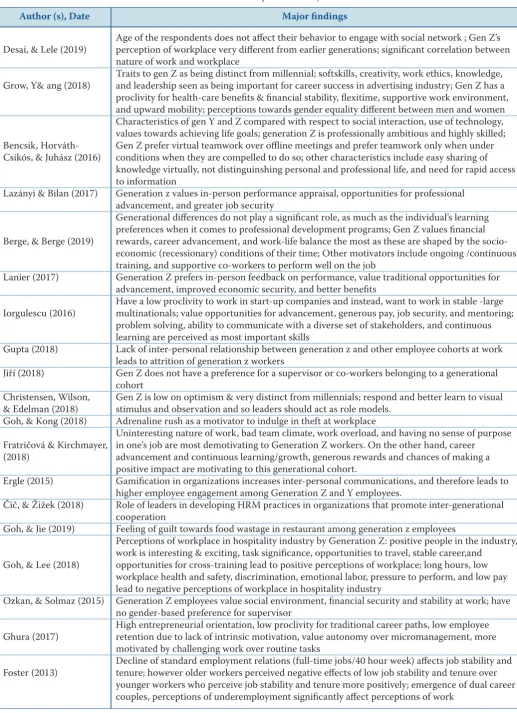
Table 1. Generation Z in workplace: summary of literature
Author (s), Date
Desai, & Lele (2019)
Grow, Y& ang (2018)
Bencsik, Horváth-Csikós, & Juhász (2016)
Lazányi & Bilan (2017)
Berge, & Berge (2019)
Lanier (2017)
Iorgulescu (2016)
Gupta (2018)
Jiří (2018)
Christensen, Wilson, & Edelman (2018) Goh, & Kong (2018)
fratričová & Kirchmayer, (2018)
Ergle (2015)
Čič, & Žižek (2018)
Goh, & Jie (2019)
Goh, & Lee (2018)
Ozkan, & Solmaz (2015)
Ghura (2017)
foster (2013)
Major findings
Age of the respondents does not affect their behavior to engage with social network ; Gen Z’s perception of workplace very different from earlier generations; significant correlation between nature of work and workplace
Traits to gen Z as being distinct from millennial; softskills, creativity, work ethics, knowledge, and leadership seen as being important for career success in advertising industry; Gen Z has a proclivity for health-care benefits & financial stability, flexitime, supportive work environment, and upward mobility; perceptions towards gender equality different between men and women Characteristics of gen Y and Z compared with respect to social interaction, use of technology, values towards achieving life goals; generation Z is professionally ambitious and highly skilled; Gen Z prefer virtual teamwork over offline meetings and prefer teamwork only when under conditions when they are compelled to do so; other characteristics include easy sharing of knowledge virtually, not distinguinshing personal and professional life, and need for rapid access to information
Generation z values in-person performance appraisal, opportunities for professional advancement, and greater job security
Generational differences do not play a significant role, as much as the individual’s learning preferences when it comes to professional development programs; Gen Z values financial rewards, career advancement, and work-life balance the most as these are shaped by the socio-economic (recessionary) conditions of their time; Other motivators include ongoing /continuous training, and supportive co-workers to perform well on the job
Generation Z prefers in-person feedback on performance, value traditional opportunities for advancement, improved economic security, and better benefits
Have a low proclivity to work in start-up companies and instead, want to work in stable -large multinationals; value opportunities for advancement, generous pay, job security, and mentoring; problem solving, ability to communicate with a diverse set of stakeholders, and continuous learning are perceived as most important skills
Lack of inter-personal relationship between generation z and other employee cohorts at work leads to attrition of generation z workers
Gen Z does not have a preference for a supervisor or co-workers belonging to a generational cohort
Gen Z is low on optimism & very distinct from millennials; respond and better learn to visual stimulus and observation and so leaders should act as role models.
Adrenaline rush as a motivator to indulge in theft at workplace
Uninteresting nature of work, bad team climate, work overload, and having no sense of purpose in one’s job are most demotivating to Generation Z workers. On the other hand, career
advancement and continuous learning/growth, generous rewards and chances of making a positive impact are motivating to this generational cohort.
Gamification in organizations increases inter-personal communications, and therefore leads to higher employee engagement among Generation Z and Y employees.
Role of leaders in developing HRm practices in organizations that promote inter-generational cooperation
feeling of guilt towards food wastage in restaurant among generation z employees
Perceptions of workplace in hospitality industry by Generation Z: positive people in the industry, work is interesting & exciting, task significance, opportunities to travel, stable career,and
opportunities for cross-training lead to positive perceptions of workplace; long hours, low workplace health and safety, discrimination, emotional labor, pressure to perform, and low pay lead to negative perceptions of workplace in hospitality industry
Generation Z employees value social environment, financial security and stability at work; have no gender-based preference for supervisor
High entrepreneurial orientation, low proclivity for traditional career paths, low employee retention due to lack of intrinsic motivation, value autonomy over micromanagement, more motivated by challenging work over routine tasks
4 METHODOLOGY
4.1 METHODOLOGICAL APPROACH
A prevalent trend to construct a research question is through ‘gap-spotting’ (Alvesson & Sandberg, 2013)-identifying or constructing gaps in the existing literature to generate research questions. However, scholars have argued against this approach that only incrementally adds to the theory and does not offer novel high impact research (Alvesson & Sandberg, 2013). Alvesson and Sandberg (2014) call for a view of knowledge production that increases the likelihood of generating novel ideas through synthesis and questioning of existing literature. following this recommendation, we not only describe the research themes (in response to research objective 1), but also examine the possible interactions between these themes to offer pathways for future research (in response to research objective 2).
4.2 METHOD
We reiterate here that the purpose of this paper is to identify workplace issues that are relevant to Generation Z employees. further to this purpose, the objectives of the research are to consolidate the research themes, and provide directions for further research. Thus, we choose a qualitative research technique- ‘co-occurrence of key words’ to consolidate the research themes.
for the purpose of analysis, we consider the 19 peer-reviewed articles published between the years 2000 and 2019 (summarized in table 1). Generation Z is a cohort that only came into existence during this period. furthermore, we only considered articles that directly addressed the research question- research themes relevant to Generation Z at workplace.
The absolute and relative frequencies of key terms occurring across the corpus was analyzed first. This was done by reviewing the key terms appearing in the abstracts of the research articles. Voyant tools, an open-source web-based text analytics tool was used.
In order to identify the underlying research themes, the frequency trend analysis of the key terms was followed by the construction of a social graph. VosViewer 1.6.10 (created by Lieden University Center for Science and Technology; also see van Eck, & Waltman, 2017 for a more detail explanation of the tool), an open source data analysis and visualization tool was used. The tool organizes the terms into various clusters which are color-coded. The words are counted for their presence in the documents using binary counting method, i.e., the number of times one word appears with another word. This counting of such co-occurring words is run iteratively until the words with proximity (words pairs appearing together) are grouped in a cluster. The 19 peer-reviewed articles (summarized in table 1) appearing in the research databases- EBSCO Host, ScienceDirect, and Sage Publishing were considered.
We considered presenting our findings in a visual form. Recent studies using qualitative research methods are extensively using such visual forms to map, and analyze disparate research themes. It is possible to represent the concepts and the relationships between them very clearly (Langley & Ravasi, 2019).
5 FINDINGS
There were four key terms that occurred most frequently, in the order, - generation, generations, work, and workplace. Interestingly, a further analysis of the frequency trends of these key terms revealed that ‘ ‘generations’, ‘work’, and ‘workplace’ occurred together more frequently (see table 2, and figure 1). The term ‘research’ was omitted from the analysis as it is understandable that it is a common term in peer-reviewed articles and may not necessarily add new meaning to the findings.
Table 1. Generation Z in workplace: summary of literature
Term
Generation Generations Work Workplace
Frequency
figure 1. Graphical representation of most frequently occurring terms
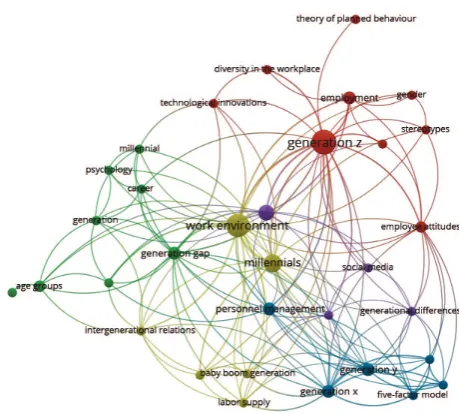
The co-occurrence of key word analysis revealed 33 key words that were organized in five clusters. These five clusters may be understood as the underlying research themes. The five clusters are : Generation Z characteristics, workforce expectations, Prevenient generation characteristics, inter-generational dynamics, and workplace transformation. The key words within each of these clusters extracted from co-occurrence analysis are summarized in table 3 below.
Table 3. Co-occurrence of key word analysis
The social graph of the co-occurrence of key word analysis representing the clusters and associated key words is shown in figure 2.
figure 2. Social graph of co-occurrence of key word analysis
Cluster
Cluster 1. Generation Z characteristics
Cluster 2. Workforce expectations
Cluster 3. Prevenient generation characteristics
Cluster 4. Inter-generational dynamics
Cluster 5. Workplace transformation
Key words
Diversity in workplace, employee attitudes, employment, gender, Generation Z, inter-personal relations, stereotypes, technological innovation, theory of planned behavior
Age group, career, generation, generation gap, industrial management, millennial, psychology, skill development
Conflict management, five-factor model, generation x, generation y, personality, personnel management
Baby-boomer generation, inter-generational relations, labor supply, work environment
6 DISCUSSION
The first research objective of this paper is to reveal the underlying research themes on workplace issues pertinent to Generation Z. The themes are organized into five clusters which are – ‘Generation z characteristics’, ‘workforce expectations’, ‘prevenient generation characteristics’, intergenerational dynamics’, and ‘workplace transformation’.
6.1 CLUSTER 1. GENERATION Z CHARACTERISTICS
Every individual brings unique set of values, and aspirations to the workplace. Some of these values are shaped collectively for the generational cohort by the prevailing socio-political-economic conditions. Generation Z can be considered the first digital native generation, raised with technology. us, they bring in technological fluency to workplace, and use it extensively to collaborate with other workers in the organization (Lanier, 2017). Although, research on characteristics of this generation is still nascent, Christensen (2018) suggests that Generation Z is less optimistic towards work as their values have been strongly influenced by the global economic recessions in the recent past. Grow and Yang (2018) further compared the characteristics of Generation Z men and women. ey found no notable difference in their career goals as both have similar career expectations such as development of creativity and communication skills, critical thinking, and time management. However, more men than women perceived that gender equity existed at workplace (Grow, & Yang, 2018).
6.2 CLUSTER 2. WORKFORCE EXPECTATIONS
Extant research acknowledges the difference in the values and therefore the work preferences between Generation Z and the preceding generations (fratričová, & Kirchmayer, 2018). In line with their proclivity for being independent as well as high entrepreneurial motivation, and outcome orientation (Christensen, 2018), Generation Z values autonomy at work (Weidmer, 2015) which also includes non-traditional employment arrangement such as teleworking (Weidmer, 2015; murray, 2013 as cited in Christensen, 2018). is inclination towards greater freedom at work is similar to what is observed among the millennial generation cohort (Weidmer, 2015). fratričová and Kirchmayer (2018) address one of the first studies on work motivation of Generation Z employees. In doing so, they extend the current dialog on the traits and values of Generation Z to its relevance at workplace. eir literature review identifies the following as Generation Z motivators - opportunities for learning & professional development, financial rewards, work culture, and flexibility (fratričová & Kirchmayer, 2018). A qualitative research study by these authors revealed work-person fit (eg. ‘enjoy work’, ‘having a sense of purpose’), relationships at work (with regards ‘team climate’, ‘conflict with coworkers’, ‘leadership’), work-related factors (such as ‘workload’, ‘equity of rewards’), achievement (performance appraisal, career growth, recognition) as some of the key motivators for Generation Z employees (fratričová & Kirchmayer, 2018). However, suggesting the lack of generation gap, Jiří (2016) concludes that Generation Z does not have any generational preferences for a supervisors, and were willing to cooperate with employees across generations at work. However, leaders supporting their career aspirations and well-being were certainly valued.
6.3 CLUSTER 3. PREVENIENT GENERATION CHARACTERISTICS
6.4 CLUSTER 4. INTERGENERATIONAL DYNAMICS
Extant research indicates a growing interest in understanding the working relationship between employees of different generations. Şenyuva (2018) suggests there are significant differences between value preferences of nurses belonging to baby boomers, generation y, and Generation Z. With respect workplace issues such as empowerment, and job satisfaction, a study by Couburn & Hall (2014) among registered nurses in USA suggests that nurses belonging to baby boomer generation perceived greater psychological empowerment at work over the younger generation. is also led to higher job satisfaction in this group. e characteristics of the different generational cohorts also affects the labor market. for example, fordor and Jaeckel (2017), and later, Lazányi and Bilan (2017) study the impact of existing workforce belonging to generation x and millennials on the new entrants to the labor market-Generation Z. Generation x, and millennials have the necessary qualifications and the social ties to establish themselves in the labor market. is then affects the opportunities for Generation Z. While millennial and generation x remain more invested in their careers, Generation Z values greater flexibility at work or work-life balance. us, Generation Z’s proclivity for greater freedom on the job coupled with generation X and millennials’ work ethics of staying committed to the organizations affects the availability of suitable labor/candidates in the job market.
6.5 CLUSTER 5. WORKPLACE TRANSFORMATION
Generation Z is the first global, most technologically literate, and socially empowered generation (Reeves & Oh, 2008 as cited in Desai & Lele, 2017). ey are highly dependent on technology and are constantly connected to social media because they value rapid access to information. is proclivity for rapid access to information is also explained by specific characteristics of this generation - collaboration, freedom, scrutiny, fun, integrity, speed, and innovation (Tabscott, 2009:6 as cited in Desai & Lele, 2017). ese traits are also well suited for modern organizations which are characterized by rapid changes to the industry and market structures, and evolution of technology (Grafton, 2011 as cited in Ghura, 2017). ese characteristics of Generation Z, and their profound influence on the work environment makes them distinct from the other preceding generations.
6.6 FUTURE RESEARCH
e second research objective is to understand the interaction between these five research themes and set the direction for future research.
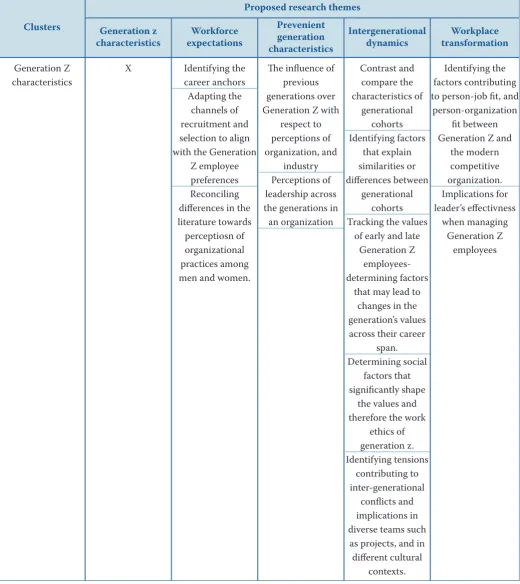
In the remainder of this section, we bring forward some areas for potential research that lie at the intersection of these domains. We will propose possible research directions between the themes Generation Z characteristics; and workforce expectations, prevenient generation characteristics, intergenerational dynamics, and workplace transformation.
GENERATION Z CHARACTERISTICS & WORKFORCE EXPECTATIONS
Generation Z entering the workforce poses new challenges for the organizations. Attracting, and retaining talent from this cohort will become important for organizations to build and leverage their competitive advantage. Identifying the key career anchors – preferences of Generation Z workforce should form the bases for the organization’s human resource policy and practice. Initial research on this topic (Bohdziewicz, 2016) suggests that Generation Z employees value lifestyle choices over security. furthermore, this cohort rejects the traditional vertical career path that is based on development of functional competencies. Another human resource practice that is significantly affected by the traits and expectations of Generation Z workers is recruitment and selection. Being the digital native generation, research indicates that organizations that use social media as a tool are successful at attracting Generation Z employees (Woźniak, 2016).
furthermore, perceptions of organizational practices such as job rotation, employee development, and work-life balance may be different among men, and women. for example, Ansari, Jabeen, moazzam, and Salman (2016) contend that such practices are perceived as being dated and being skewed towards the male employees in the organization. On the contrary, Hamid, Siadat, Reza, Arash, Ali, and Azizollah (2011) found no significant differences between men and women for their perceptions towards rewards, and motivation. ere is a need to reconcile such differences in the literature, especially in studies that concern Generation Z workforce.
GENERATION Z CHARACTERISTICS & PREVENIENT GENERATION CHARACTERISTICS
tourism industry more favorably with opportunities to travel, and challenging work. is then has significant implications for human resource planning in the organizations when forecasting the demand and supply of workforce belonging to Generation Z cohort. In a similar study, Bako (2018) investigated the preferences for leadership attributes across the generational cohorts. Attributes such as lacking in team spirit was rated more negatively by baby boomers than Generation Z. e leader’s ability to resolve conflicts was rated highly Generation Z while it received less importance from generation y employees. Generation z valued charismatic leaders more than any of the previous generations. us, these studies seem to suggest that the preferences of preceding generation has seemingly minimal influence on the preferences of Generation Z employees. is then has significant implications for human resource practices and leadership in the organizations when they have workforce from across the generational cohorts.
GENERATION Z CHARACTERISTICS & INTERGENERATIONAL DYNAMICS
Intergenerational dynamics at workplace received considerable attention in literature (c.f. Wallace, 1956; mcLoughlin, 2013; Howe & Strauss, 2007). Howard and Strauss (2007) suggest that even within a generation, individuals change during their lifetime. furthermore, each succeeding generation in their early life seems to replicate the traits of their preceding generation in their mid-life years. While their study considered baby boomers, generation x, and generation y, Generation Z was not considered given their absence from the workforce at the time of this research study. is then poses an interesting question as to whether the values of Generation Z is likely to evolve/change over time? Will there be a difference in the values between the current cohort of Generation Z in the workforce, and the late entrants? When the research seems to be divided on the similarities or differences between the generational cohorts, it would be of considerable academic and managerial importance to understand when during their lifetime and careers does Generation Z start exhibiting dissimilarities with their preceding generation? Radulescu, Ghinea, and Cantaragiu (2018) investigated the intergenerational dynamics across 4 generational cohorts - silent generation, baby boomers, generation x, and generation y. Baby boomers were reported as being most difficult to interact with. e highest level of differences (with respect to work and workplace) were reported between generation x, and y employees. Lack of tolerance, and reluctance to accept others’ perspective were reported to be the most significant reasons contributing to these differences. Social factors such as parenthood, relationship within family, and inclusion also contributed significantly towards these differences. Yet another factor contributing to inter-generational differences is culture. Yu (2003) suggests that siginficant differences exist between millennial and other generational cohorts who are working in Asian countries vis-a-vis western countries. In yet another study by Wyn (2012), significant differences exist between generation x employees belonging to Australia and Canada with respect to their perceptions of workplace practices and in general life. Extrapolating these findings to Generation Z poses an interesting question on what mechanisms would play a pivotal role in bridging the intergenerational gap between Generation Z and Generation Y, and millennial in the wake of changing societal conditions and for different cultural contexts.
GENERATION Z CHARACTERISTICS & WORKPLACE TRANSFORMATION
modern organizations are structured around virtual global teams operating beyond the national and geographical boundaries. Improvements in communication, coupled with modern technology has powered the emergence of such organizations. This trend also poses challenges especially for people management. Issues such as managing diverse team of employees, developing a global mindset among the employees, and cultural intelligence become the focus of managerial decisions (Radostina & Renata, 2018). Technology has also facilitated knowledge management practices at firm level that lead to innovation (Sung & Choi, 2018). Generation z with its tendency to access information and adopt emerging technologies are equipped with skills and values required for modern organizations. There has been extensive research on Generation Z employees in the hospiality industry. Literature is silent on other industries. for example, research on leadership traits in millennial leaders working in information technology industry indicates that traits are a significant predictor of leader’s performance (Bargavi, Samuel & Paul, 2017). Thus, identifying factors leading to person-job fit, and person-organization fit can shed further light on the aspirations of Generation Z, with implications for managing the human capital of the organization. Similarly, Anantatmula and Shrivastav (2012) note tensions between generation y and other employees of preceeding generations in project-based organizations. Challenges for a project manager to develop team management practices for such diverse project teams is discussed.
Table 4. Directions for future research
Clusters
Generation Z characteristics
Proposed research themes
X Generation z characteristics Identifying the career anchors Adapting the channels of recruitment and selection to align with the Generation
Z employee preferences Reconciling differences in the literature towards perceptiosn of organizational practices among men and women.
Workforce expectations
e influence of previous generations over Generation Z with
respect to perceptions of organization, and industry Perceptions of leadership across the generations in an organization Prevenient generation characteristics Contrast and compare the characteristics of generational cohorts Identifying factors that explain similarities or differences between generational cohorts Tracking the values
of early and late Generation Z
employees-determining factors
that may lead to changes in the generation’s values across their career
span. Determining social
factors that significantly shape
the values and therefore the work
ethics of generation z. Identifying tensions contributing to inter-generational conflicts and implications in diverse teams such
as projects, and in different cultural contexts. Intergenerational dynamics Identifying the factors contributing to person-job fit, and
person-organization fit between Generation Z and
7 ACADEMIC AND MANAGERIAL CONTRIBUTION
e findings of this qualitative study have implications for both academics and practitioners. from the academic standpoint, this study sets the initial tone for a structured investigation of workplace issues relevant to an emergent workforce. is study also points to commonalities across the research themes that are useful to frame the appropriate research questions. In doing this, this paper goes beyond the more commonly researched question- are there differences in what generational cohorts value in their work context (Lester, Standifer, Schultz & Windsor, 2012). e use of co-occurrence of key words as a technique is not common in the study of generational cohorts. meaningful co-co-occurrence clusters suggesting clear research themes have emerged. is reflects the growing body of research on Generation Z. Using a clustering technique such as co-occurrence of key words and following it through with the construction of a social graph reveals the interconnected flow of research ideas (Assefa & Rorissa, 2013).
ere are more generations in today’s workforce than ever before, and this poses challenges for human resource management professionals. Every generation has generalities and characteristics which are unique. Human resource management professionals through (human resource) practices help organizations to overcome these challenges of diversity and leverage the contributions that each generational cohort offers (Amaya & Gedro, 2014). is study brings forward expectations of Generation Z from their workplace. ese expectations can be translated to human resource practices such as identifying appropriate career anchors, maintaining person-job fit & person-organization fit, and meeting the learning needs of this workforce. Understanding the expectations of this group also has significant implications for the organization’s culture. e interaction between Generation Z and employees of different (generational) cohort, differences in their core values, and technology prominently influence the organization’s culture. Organizational leaders have a role to leverage the opportunities brought about by these changes. is study points towards certain hotspots- intergenerational conflicts, using the appropriate leadership style, building a positive image of leadership, and creating a competitive organization in the wake of employee diversity. All of these issues have been called to attention and further research in our analysis.
8 CONCLUSION
REFERENCES
Alvesson, m., & Sandberg, J. (2014). Habitat and habitus: Boxed-in versus box-breaking research.Organization Studies, 35(7), 967-987.
Alvesson, m., & Sandberg, J. (2013). Has management studies lost its way? Ideas for more imaginative and innovative research.Journal of Management Studies, 50(1), 128–152.
Amayah, A. T., & Gedro, J. (2014). Understanding Generational Diversity: Strategic Human Resource management and Development across the Generational “Divide.” New Horizons in Adult Education & Human Resource Development, 26(2), 36–48.
Assefa, S. G., & Rorissa, A. (2013). A bibliometric mapping of the structure of STEm education using co-word analysis. Journal of theAmerican Society for Information Science & Technology, 64(12), 2513–2536.
Anantatmula, V. S., & Shrivastav, B. (2012). Evolution of project teams for Generation Y workforce.International Journal of Managing Projects in Business, 5(1), 9–26.
Ansari, N., Jabeen, N., moazzam Baig, A., & Salman, Y. (2016). Diversity management: Towards a Theory of Gender Sensitive Practices.Bulletin of Education and Research, 38(2), 293–306.
Bargavi, N., Samuel, A. A., & Paul, P. J. D. (2017). Resilience of millennial leaders in the Indian IT industry.Journal of the Indian Academy of Applied Psychology, 43(2), 211–221.
Berge, Z. L., & Berge, m. B. (2019). The Economic ABCs of Educating and Training Generations X, Y, and Z.Performance Improvement, 58(5), 44–53.
Bertić, Ž., & Telebuh, m. (2018). Globalization, Ageing Process and Attitudes of Younger Generations to Ageing.
Collegium Antropologicum, 42(3), 73–83.
Bohdziewicz, P. (2016). Career Anchors of Representatives of Generation Z: Some Conclusions for managing the Younger Generation of Employees. Human Resource Management / Zarzadzanie Zasobami Ludzkimi, 113(6), 57–74.
Brailovskaia, J., & Bierhoff, H. W. (2018). The narcissistic millennial generation: a study of personality traits and online behavior on facebook.Journal of Adult Development, 1-13.
Coburn, A. S., & Hall, S. J. (2014). Generational differences in nurses’ characteristics, job satisfaction, quality of work life, and psychological empowerment.Journal of Hospital Administration, 3(5), 124.
Cameron, E. A., & Pagnattaro, m. A. (2017). Beyond millennials: Engaging Generation Z in Business Law Classes.Journal of Legal Studies Education, 34(2), 317–324.
Canaan messarra, L., Karkoulian, S., & El-Kassar, A.-N. (2016). Conflict resolution styles and personality.
International Journal of Productivity & Performance Management, 65(6), 792–810.
Chicca, J., & Shellenbarger, T. (2018). Connecting with Generation Z: Approaches in Nursing Education.Teaching & Learning in Nursing, 13(3), 180–184.
Desai, S. P., & Lele, V. (2017). Correlating Internet, Social Networks and Workplace - a Case of Generation Z Students.Journal of Commerce & Management Thought, 8(4), 802–815.
Duffett, R. G. (2017). Influence of social media marketing communications on young consumers’ attitudes.Young Consumers, 18(1), 19–39
Ergle, D. (2015). fostering Employee Engagement Through Gamification: AirBaltic forecaster Tool.Management
(18544223), 10(3), 219–234.
fodor, m., & Jaeckel, K. (2017). What does it take to have a successful career through the eyes of generation Z-based on the results of a primary qualitative research. International Journal on Lifelong Education and Leadership, 4(1), 1-7.
fratričová, J., & Kirchmayer, Z. (2018). Barriers to work motivation of generation Z.Journal of HRM, 21(2), 28–39. Gajda, J. (2017). Opportunities and Threats for the Representatives of the Generation Z on the Polish Labor market (In the Opinion of Students of Czestochowa University of Technology).Research Papers of the Wroclaw University of Economics / Prace Naukowe Uniwersytetu Ekonomicznego We Wroclawiu, (499), 66–78.
Grafton, m. (2011). Growing a business and becoming more entrepreneurial: the five traits of success.Strategic Direction, 27(6), 4-7.
Grow, J. m., & Yang, S. (2018). Generation-Z Enters the Advertising Workplace: Expectations Through a Gendered Lens.Journal of Advertising Education, 22(1), 7–22.
Hammill, G. (2005). mixing and managing four generations of employees.Fairleigh Dickinson University – FDU Magazine.
Hamid, R., Siadat, S. A., Reza, H., Arash, S., Ali, N. H., & Azizollah, A. (2011). The Analysis of Organizational Diagnosis on Based Six Box model in Universities.Higher Education Studies, 1(1), 84–92.
Hariadi, B., Dewiyani Sunarto, m. J., & Sudarmaningtyas, P. (2016). Development of Web-Based Learning Application for Generation Z. International Journal of Evaluation and Research in Education, 5(1), 60–68. Howe, N., & Strauss, W. (2007). The next 20 years: how customer and workforce attitudes will evolve. Harvard
business review, 85(7-8), 41-52.
Igel, C., & Urquhart, V. (2012). Generation Z, meet Cooperative Learning.Middle School Journal(J3), 43(4), 16–21. Jiří, B. (2016). The Employees of Baby Boomers Generation, Generation X, Generation Y and Generation Z in Selected Czech Corporations as Conceivers of Development and Competitiveness in their Corporation.Journal of Competitiveness, 8(4), 105–123.
Kubátová, J. (2016). Work)Related Attitudes of Czech Generation Z: International Comparison.Central European Business Review, 5(4), 61–70.
Langley, A., & Ravasi, D. (2019). Visual artifacts as tools for analysis and theorizing. In The Production of managerial Knowledge and Organizational Theory: New Approaches to Writing, Producing and Consuming Theory(pp. 173-199). Emerald Publishing Limited.
Lanier, K. (2017). 5 things HR professionals need to know about Generation Z. Strategic HR Review, 16(6), 288–290.
Lazányi, K., & Bilan, Y. (2017). Generetion Z on the Labour market - Do They Trust Others within Their Workplace?
Polish Journal of Management Studies, 16(1), 78–93.
Lester, S. W., Standifer, R. L., Schultz, N. J., & Windsor, J. m. (2012). Actual Versus Perceived Generational Differences at Work: An Empirical Examination.Journal of Leadership & Organizational Studies, 19(3), 341–354.
Loveland, E. (2017). Instant Generation.Journal of College Admission, (234), 34–38. mcLoughlin, W. G. (2013).Revivals, awakening and reform. University of Chicago Press.
merve Bako. (2018). Different leadership style choices, different generations.Prizren Social Science Journal, 2(2), 127-143.
moore, K., Jones, C., & frazier, R. S. (2017). Engineering Education for Generation Z. American Journal of Engineering Education, 8(2), 111–126.
murray, E. J. (2013). Generational differences: Uniting the four-way divide.Nursing management, 44(12), 36-41. Pousson, J. m., & myers, K. A. (2018). Ignatian Pedagogy as a frame for Universal Design in College:Meeting
Learning Needs of Generation Z. Education Sciences, 8.
Priporas, C.-V., Stylos, N., & fotiadis, A. K. (2017). Generation Z consumers’ expectations of interactions in smart retailing: A future agenda.Computers in Human Behavior, 77, 374–381.
Puiu, S. (2017). Generation Z — an Educational and managerial Perspective.Young Economists Journal / Revista Tinerilor Economisti, 14(29), 62–72.
Radostina K. Purvanova, Renata Kenda. (2018) Paradoxical Virtual Leadership: Reconsidering Virtuality Through a Paradox Lens.Group & Organization Management43:5, 752-786.
Radulescu madalina mirela, Ghinea Valentina mihaela, & Cantaragiu Ramona. (2018). Intergenerational gap dynamics. Proceedings of the International Conference on Business Excellence, 12(1), 829-842.
Rodriguez, A. (2015). Informed by millennial misses, Brands Retool for Gen Z.Advertising Age, 86(11), 0032. Schroth, H. (2019). Are You Ready for Gen Z in the Workplace?California Management Review, 61(3), 5–18. Seemiller, C., & Grace, m. (2017). Generation Z: Educating and Engaging the Next Generation of Students.About
Campus, 22(3), 21–26. Retrieved from http://search.ebscohost.com.berlioz.brandonu.ca/login.aspx?direct =true&db=eric&AN=EJ1166668&site=ehost-live
Selingo, J. (2018a, march 22).The third education revolution. The Atlantic.
Şenyuva, E. (2018). Intergenerational differences in the personal and professional values of nurses. Nursing Ethics, 25(7), 939–950.
Shatto, B. (2017). Teaching millennials and Generation Z: Bridging the Generational Divide.Creative Nursing,
23(1), 24.
Southgate, D. (2017). The emergence of Generation Z and its impact in advertising: Long-term implications for media planning and creative development.Journal of Advertising Research, 57(2), 227–235.
Sung, S., & Choi, J. (2018). Building knowledge stock and facilitating knowledge flow through human resource management practices toward firm innovation.Human Resource Management, 57(6), 1429-1442.
Tabscott, D. (2009).Growing up-How the next generation is changing your world, NY: mcGraw-Hill
Turner, A. (2015). Generation Z: Technology and social interest. The Journal of Individual Psychology, 71(2), 103–113.
van Eck, N. J., & Waltman, L. (2017). Citation-based clustering of publications using CitNetExplorer and VOSviewer.Scientometrics, 111(2), 1053-1070.
Wiedmer, T. (2015). Generations do differ: Best practices in leading traditionalists, boomers, and generations X, Y, and Z.Delta Kappa Gamma Bulletin, 82(1), 51.
Woźniak, J. (2016). Social media as an E-Recruitment Tool for Different Generations: methodological Considera-tions and Pilot Study.Human Resource Management / Zarzadzanie Zasobami Ludzkimi, 113(6), 103–124. Wyn, J. (2012). The making of a Generation: Policy and the Lives and Aspirations of Generation X.Journal of
Educational Administration and History, 44(3), 269–282.
Yu, H.-C., & miller, P. (2003). The generation gap and cultural influence — a Taiwan empirical investigation.Cross Cultural Management, 10(3), 23–41.