Process parameters optimization and molecular studies on bacteriocin-producing lactic
acid bacteria from ‘Kati’
Aarinade Adejumoke Omotayo, Oladipo Oladiti Olaniyi*, Bamidele Juliet Akinyele
Department of Microbiology, Federal University of Technology Akure, Nigeria.
ARTICLEINFO ABSTRACT
Article history: Received 17Oct. 2018 Received in revised form 21Feb. 2019
Accepted 02 Mar. 2019
Keywords: Crude bacteriocins; Lactic acid bacteria; Bacterial pathogens; ‘Kati’;
Antibacterial activity
This work described the isolation and identification of bacteriocin-producing lactic acid bacteria (LAB) from ‘Kati’(a sorghum based fermented food), and to evaluate the antibacterial effect of bacteriocin on selected pathogenic bacteria. The identities of the isolates were revealed to be as Lactobacillus plantarum, L. brevis, L. fermentum KAT1, L. fermentum KAT2 and Lactococcus lactis using 16S rRNA gene sequence analysis. Out of 28 LAB, five were found to inhibit selected pathogenic bacteria namely; Escherichia coli, Staphylococcus aureus, Salmonella typhimurium and Bacillus cereus. The unpurified bacteriocins produced by the isolated LAB were characterized with respect to the effect of temperature, pH and surfactant. The test isolates showed activities of 6400, 6400, 6400, 3200 and 1600AU/ml respectively. Crude bacteriocin from L. brevis and L. lactis were the most heat stable at 121ºC for 60 min. Bacteriocins from L. plantarum, L. lactis and L. fermentum KAT1 showed the highest antibacterial activity and stability at pH 2.0 to 6.0. Exposure to Tween 20 increased the bacteriocin activity of the LAB isolates except for L. fermentum KAT2 where loss of activity occurred. The findings from this study suggest that bacteriocinogenic LAB present in ‘kati’ have potentials to inhibit pathogenic/spoilage microorganisms in foods.
1. Introduction
The roles of lactic acid bacteria (LAB) are vital in the production of numerous fermented foods globally. Arrays of strains are frequently utilized as inocula in the fermentation of milk, cereals meat and vegetable (1). During the course of fermentation, LAB exerts desired organoleptic qualities on substrates being fermented and extends their shelf life by secreting antibacterial metabolites against food spoilage microorganisms (2). The antibacterial effect of LAB has been exploited by people for hundreds of years without any adverse effects on consumers. It has improved the nutritional profile, shelf life and safety of fermented foods. The preservation of fermented foods by LAB is connected to the secretion of certain antimicrobial
*Corresponding author. Tel.: +2348068054636
E-mail address: [email protected]
substances which includes bacteriocins, organic acids, hydrogen peroxide, reuterin and diacetyls. Among the various antimicrobial compounds secreted by LAB, bacteriocins take the lead in terms of antagonism against spoilage organisms commonly implicated in foods (3). Examples of lactic acid bacteria are: Lactobacillus spp, Leuconostoc spp, Lactococcus spp, Streptococcus spp, Enterococcus spp, Pediococcus spp, Weissella spp, e.t.c. An arrays of bacteriocins from LAB that have been identified and characterized include
Nisin, Diplococcin, Acidophilin, Bulgarican,
Helveticins, Lactacins, and Plantaricins. Out of these bacteriocins, Nisin produced by Lactococcus lactis sp. Lactis has been commercialized and extensively used (4).
LAB have a long historical application in food production due to its profound effects on organoleptic
scholar google
Content list available at
Journal of Food Safety and Hygiene
Journal homepage: http://jfsh.tums.ac.ir
and nutritional properties (5). They acidified raw materials via the production of organic acids, mainly lactic acid. In addition to the production of organic acids, acetic acid, aromatic substances, ethanol, bacteriocins, exopolysaccharides and relevance extracellular enzymes are produced by LAB. Traditionally, food fermentation process by LAB is based on spontaneous. However, in an industrial setting, food matrix is deliberately inoculated with LAB as starter cultures under controlled cultural parameters. The recent use of high profile novel starter cultures in food fermentation process is being explored for the purpose of improved functionalities and standardization of the end products (6). Also, certain strains of LAB have been noted to possess some desired health-promoting qualities; one of such qualities of these probiotics is the ability to either eliminate or inhibit the growth of some bacterial pathogens in the gastrointestinal tract. Few of the pathogens that have been successful combated by potential probiotics are Helicobacter pylori, Escherichia coli, and Salmonella (4).
In recent year, extensive research has targeted bacteriocin-producing strains of LAB with improved properties due to their food preserving potential connected with the antimicrobial nature of bacteriocins (7). Bacteriocin-producing LAB with a broad spectrum are of special interest in food industry because these bacteria are generally regarded as safe (GRAS). They occur naturally in fermented foods in a wide range of applications in food industry. Nowadays, there is a growing concern regarding the replacement of the use of chemical preservatives in food. LAB have been in use for a while for the fermentative preservation of several food products from dairy product to meat and vegetables. They can make antimicrobial substances (e.g. organic acids, hydrogen peroxide and bacteriocins) which can instigate the growth of the potential harmful and/or spoilage microorganisms. Since vegetables are sources of several vitamins, dietary fibers and minerals, it is desirable that vegetable based food products preserve their biological values during fermentation. Besides the traditional role of LAB in food preservation, they exert beneficial effects to the gut. Manufacturing food products with long shelf life and viable bacteria having confirmed health promoting result can contribute on a large scale to the human well-being in the near future.
Recent concerns about emerging microbial populations with antibiotic resistance and undesirable toxic properties of several bioactive peptides stimulated attention to the bacteriocins as promising natural antimicrobials in combating pathogens and
spoilage microorganisms. To accomplish this task, a precise understanding about the nature of these molecules is required (8). For now, the only commercially available and marketed bacteriocin is nisin and it is more active against Gram-positive spore-forming bacteria (3). Other bacteriocins of Lactobacillus spp. have been reported to be active against closely related species of mesophilic Lactobacillus and therefore regarded as potential natural food preservatives (9). Scanty information and limited use of LAB with antibacterial properties inform this present study. This study is therefore designed to screen bacteriocin-producing LAB isolated from ‘kati’: a sorghum based fermented food for bacteriocin production and evaluate their antibacterial effect on food spoilage bacteria.
2. Materials and methods
2.1. Sample collection
‘Kati’samples were purchased from four different locations namely Ikare, Akungba, Oka-Akoko and Okeagbe in Akoko area of Ondo state, Nigeria. The sorghum sample (control) was obtained from Oja-Oba Market in Akure, Ondo State, Nigeria making 15 samples in all. The samples were deposited in an aseptic polythene bags and then conveyed to
Microbiology Laboratory, FUTA for further
microbiological and chemical analysis.
2.2. Preparation and production of ‘kati’
Sorghum grains were sorted, soaked in distilled water for three days and then wet-milled. After milling, the milled dough was fermented for 12 h and were wrapped with cocoa (Theobroma cacao) leaves and then cooked for 20-30 min. The cooked dough was moulded vigorously in between the palms and then wrapped in fresh cocoa leaves and cooked again for
30-45 min. The cooked dough was cooled and kept in
a sterile polyethylene bag. The stored cooked dough is now ‘kati’.
2.3. Bacterial strains and culture
were purified by repetitive streaking.
2.4. Production of crude bacteriocin samples
Lactobacillus species were grown in 400 ml MRS agar broth for 72 h at 30ºC anaerobically intriplicate. For extraction of bacteriocin, a cell-free solution was centrifuged (4000 rpm for 40 min at 4ºC) and was
adjusted to pH 7.0 by 1M NaOH to eliminate organic
acids. The supernatant was thereafter filtered using 0.2 µm pore-size membrane filter.Inhibitory activity from hydrogen peroxide was removed by the inclusion of 2 mg/ml catalase (10).
2.5. Determination of bacteriocin activity
Agar well diffusion method was used as illustrated by Takahiro et al. (11). 5µl crude bacteriocin from the LAB strains from each dilution were placed in wells in plates implanted with the indicator/test strain; incubated aerobically at 37ºC for 24 h and the zone of inhibition diameters were recorded (12).
2.6. Determination of bacteriocin titre
The quantification of bacteriocin titre was performed by two fold serial dilutions of bacteriocin in saline solution and aliquots of 50 µl from each dilution were put in wells in plates incorporated with the indicator strains. The cultures were then incubated for 18-24 h at 37ºC under aerobic condition and the zone of
clearance (2mm and above) which indicate inhibition
of indicator organisms around the wells were observed and measured. The antibacterial activity of the bacteriocin was defined as the reciprocal of the highest dilution showing inhibition of the indicator lawn and was expressed in activity units per ml (AU ml-1) (13).
2.7. Molecular identification of bacterial isolates via 16S rRNA Gene Sequencing method
The identities of the pure bacterial cultures were authenticated by molecular tool. The DNA from pure bacterial cultures was isolated by FastDNA bacterial isolation Kit in accordance with the manufacturer’s instruction. The 16S rRNA gene in the isolated bacterial DNA was amplified by by Polymerase Chain Reaction (PCR) using two universal 16S rRNA primers (14).
The 50μl PCR mixtures contained 1μl DNA template,
25μl 2 × ExTaq PCR (Takara Bio INC, Shiga Japan), 1
μl of each primer ((Bioray biotechnology, Xiamen, China) and 22μl double-distilled water. The PCR
procedure adopted was as follows: primary denaturation for 5 min at 95ºC; 30 cylces of denaturation at 94ºC for 30 s; annealing at 58ºC for 30 s, and extension at 72ºC for 1 min; and an additional reaction for 10 min at 72ºC. The quality of PCR
products were inspected by agarose gel
electrophoresis after which they were submitted Bioray Biotechnology (Xiamen, China) for sequencing. The 16S rRNA gene sequence obtained was distinguished with other 16S rRNA gene sequences
already deposited in GenBank via BLASTNprogram
(http://blast.ncbi.nlm.nih.gov/Blast.cgi) and aligned with similar sequences using CLUSTX program (15).
2.8. Characterization of bacteriocin
In order to ascertain the optimum temperature and pH, and the effect of surfactant on crude bacteriocin activity, the samples were characterized by subjecting them to varied conditions. Their stability at different conditions was also evaluated.
2.8.1. Heat resistance
Crude bacteriocin was subjected to different incubation temperatures at 40, 60, 80, 100 and 121ºC. At 0, 30, 60 or 90 min of incubation, aliquots were withdrawn and bacteriocin activity was assayed (16).
2.8.2. pH sensitivity
Crude bacteriocin were regulated to pH 2, 4, 6, 8, 10, and 12 with HCl and NaOH, incubated for 4 h at room temperature and assayed accordingly (16).
2.8.3. Effect of surfactant on bacteriocin activity
The effect of surfactant on bacteriocin activity was investigated by integrating non-ionic surfactant (tween 20). The surfactant was includedinto crude bacteriocin at a concentration of 0.1 ml of surfactant ml-1 of bacteriocin solutions. This preparation was incubated at 30ºC for 60 min and assayed for bacteriocin activity against the food spoilage bacteria (17).
3. Results
3.1. Antibacterial activity of crude bacteriocin from isolated LAB against some pathogenic bacteria
The selected LABstrains from ‘kati’ produced
selected LAB showed varied inhibition against all the indicator organisms. The crude bacteriocin from L. lactis showed the highest inhibitory effect against Bacillus cereus, Staphylococcus aureus and Salmonella typhimurium, while the crude bacteriocin from L. plantarum had the highest antibacterial activity against Escherichia coli. E. coli was noted to have the highest susceptibility out of the four indicator organisms to the crude bacteriocin from L. plantarum, L. lactisand L. brevis.
Figure 1. Antibacterial activity of crude bacteriocin from isolated LAB against some pathogenic bacteria
3.2. Genomic characterization of the LAB isolates
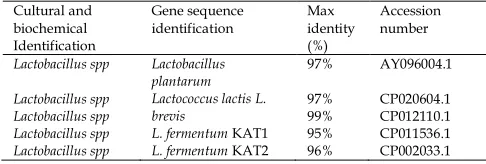
Molecular identities of the LAB via 16S rRNA Sequence analysis are presented in Table 1. The identities of these strains were revealed by comparing the gene sequences obtained with those available in GenBank. The LAB were identified as Lactobacillus plantarum, L. lactis, L. brevis, L. fermentum KAT1 and L. fermentum KAT2.
Table 1. Molecular identities of the LAB Cultural and
biochemical Identification
Gene sequence identification
Max identity (%)
Accession number
Lactobacillus spp 97% AY096004.1
Lactobacillus spp 97% CP020604.1
Lactobacillus spp 99% CP012110.1
Lactobacillus spp 95% CP011536.1
Lactobacillus spp
Lactobacillus plantarum Lactococcus lactis L. brevis
L. fermentum KAT1
L. fermentum KAT2 96% CP002033.1
3.3. Effect of temperature on antibacterial activity of bacteriocin from isolated LAB
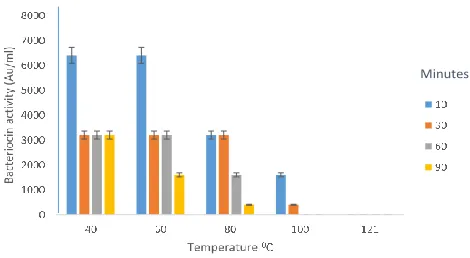
The effect of temperature on the bacteriocin activity was evaluated by incubating the crude bacteriocin (at 40, 60, 80, 100 and 121ºC) for various periods (Fig 2-6). The inhibitory activity of the bacteriocin from L.
plantarum incubated at different temperatures for different time interval is shown in Fig 2. At 40ºC for 10, 30 and 60 min of incubation, the inhibitory activity of the bacteriocin from L. plantarum against B. cereus was relatively stable and at 90 min the antibacterial spectrum reduced from approximately 6400 AU/ml to 3200 AU/ml. The bacteriocin activity of L. plantarum was heat stable at 60 and 80ºC from 10 to 30 min and at 60 to 90 min bacteriocin activity was reduced. At 100ºC, the bacteriocin activity was stable at 10 min, but reduced at 30 to 60 min, the activity was further reduced at 90 min. At 121ºC, L. plantarum showed activity of 3200, 1600, 400 AU/ml at 10, 30 and 60 min respectively. While at a temperature of 121ºC for 90 min, there was loss of activity.
Figure 2. Effect of temperature on bacteriocin activity from L. plantarum at different time interval
The bacteriocin activity of L. lactisis shown in Fig 3. At 40ºC, the bacteriocin activity was stable at different time interval of incubation, while at 60ºC, bacteriocin activity was stable from 10 to 60 min but reduced at 90 min. At 80 and 100ºC, the bacteriocin activity resulted in 6400 AU/ml for 10 min and was
reduced to 3200 and 1600 AU/ml from 30 to 90 min.
At 121ºC, the bacteriocin activity was 3200, 3200, 1600 and 400AU/ml at 10, 30, 60 and 90 min respectively. L. brevis showed a significant bacteriocin activity at different temperature range and time interval of incubation (Fig 4), it was the only test isolate that exhibited highest activity at 121ºC at all the time intervals which made it the most heat stable out of all the five isolated tests. The bacteriocin activity shown by L. brevis ranged from 6400 AU/ml to 3200 AU/ml at 40, 60, 80 and 100ºC for 10, 30, 60 and 90
min. While at 121ºC, it was stable at 10 min, but
reduced to 3200AU/ml at 30 min and reduced further
Minutes
to 1600AU/ml from 60 to 90 min.
Figure 3. Effect of temperature on bacteriocin activity from L. lactis at different time interval
Figure 4. Effect of temperature on bacteriocin activity from L. brevis at different time interval
L. fermentum KAT1 demonstrated considerable bacteriocin activity at temperature of 40, 60 and 80ºC but mostly at 40ºC at different time interval which is shown in figure 5. However, the bacteriocin activity
ranged from 6400 to 400AU/ml. At 100ºC, there was
bacteriocin activity from 10 to 30 min but no activity was shown from 60 to 90 min. Furthermore, there was complete loss of activity at 121ºC at all the time interval.
The bacteriocin of L. fermentum KAT2 is shown in figure 6. At 40ºC, the antibacterial activity was stable from 10 to 60 min, while at 90 min, it reduced 6400 to 3200 AU/ml. At 60 and 80ºC, the bacteriocin activity was stable from 10 to 30 min, but reduced from 60 to
Figure 5. Effect of temperature on bacteriocin activity from L. fermentum KAT1 at different time interval
90 min. At 100ºC, the activity was 6400, 3200, 3200 and 1600 AU/ml at 10, 30, 60, and 90 min, r espectively. There was considerable bacteriocin activity from 10 to 60 min, while at 90 min, there was loss of activity.
Figure 6. Effect of temperature on bacteriocin activity from L. fermentum KAT2 at different time interval
3.4. Effect of pH on antibacterial activity of bacteriocin from isolated LAB
Supernatant samples taken after centrifugation were adjusted to different pH and were shown to be effective against the test organism B. cereus. The impact of pH on bacteriocin activity is shown in Fig 7. Bacteriocins exhibited antibacterial efficacy and were stable in an acidic pH ranged from 2 to 6, while at pH 8 to 12, the antibacterial activity was minimal and the stability was reduced. At pH 4, the bacteriocin activity of all the LAB isolates was stable. The highest bacteriocin activity was demonstrated by L. lactis. The least bacteriocin activity was shown by L. brevis. The Minutes
Minutes
Minutes
bacteriocin activity shown ranged from 6400AU/ml to 400AU/ml.
Figure 7. Effect of pH on bacteriocin activity from the lactic acid bacteria
3.5. Effect of surfactants on antibacterial activity of bacteriocin from isolated LAB
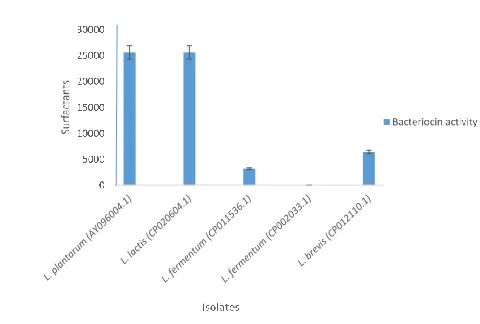
Exposure to surfactants (0.1% Tween 20) gave rise to an increase in the bacteriocin activity rather than decrease in activity. Fig 8 reveals the effect of Tween 20 on bacteriocin activity of the isolated lactic acid bacteria. Significant bacteriocin activity was exhibited by the L. plantarum and L. lactis, with an activity of 25600 AU/ml. A moderate activity was shown by L. brevis and L. fermentum KAT1 while L. fermentum KAT2 showed loss of activity.
Figure 8. Effect of surfactant on bacteriocin activity of the isolated lactic acid bacteria
4. Discussion
The generation of a bacteriocin with a vast spectrum of antibacterial efficacy against similar or
closely related bacterial strains can be an essential attribute for the selection of LAB as starter cultures and is of significance in the fermentation of cereals and legumes. The adoption of bacteriocins from LAB has been reported to enhance the nutritional and organoleptic quality of fermented foods and also reduce the processing cost. At present, certain strains of Lactococcus lactis and Pediococcus spp. are known to be producers of Nisin and Pediocin PA1 respectively. Nisin being the most extensively applied bacteriocin, it has been considered as GRAS (generally recognized as safe) in the United States for food (18). In the last few years, high premium has been placed on bacteriocins from LAB as a promising candidate in place of chemical preservatives. They are regarded as effective bio-preservatives agents and their application in food is presently the subject of thorough research.
The current investigation accentuates the isolation and identification of LAB strains from ‘kati’, production and characterization of bacteriocins produced by them. In this study, five wide spectrum bacteriocin-producing LAB strains were encountered and identified as L. brevis, L. plantarum, L. lactis, L. fermentum KAT1 and L. fermentum KAT2. Most of the LAB strains isolated and identified in this work had been previously isolated from some other fermented cereals with L. plantarum as the predominant organism. Ejikeme and Ijeoma (19) isolated L. plantarum, L. cellobiosus, L. pentosus, Leuconostoc mesenteroides and Pediococcus pentosaceus from ogi, a cereal-based fermented product, while Julius et al. (20) isolated L. plantarum and L.mesenteroides from maasai, a fermented maize dough. In another study by Fowoyo and Ogunbanwo (21), an array of LAB to include L. fermentum, L. plantarum, P.acidilactici, L. lactis and L. mesenteroides were identified from thevarious fermenting stages of white maize obtained from the South-western region of Nigeria formassa production, a traditional Nigerian snack made from fermented maize grains. The production of organic acids in the fermentation medium accounts for the presence of acid tolerant LAB to the detriment of the competing organisms (22).
The antibacterial spectrum of bacteriocin from LAB isolated from ‘kati’against selected bacterial pathogens was evaluated using in vitro technique. Out of the entire 28 LABs, only 5 strains showed antagonistic effect against the indicator organisms, after which molecular identification was carried out on Bacteriocin produced by the Lactobacillus spp. produced obvious and clear
zones of inhibition against the selected
pathogenic/spoilage bacteria. Bacteriocins from the
isolated LAB have a few striking qualities that validate this study. The most remarkable is that none of these bacteriocins is limited by the immensely narrow antibacterial spectrum reported for some bacteriocins of some LAB, for example Lactococcin A (23) and Lactacin B (24). The highest degree of inhibition was exhibited by L. lactis and L. plantarum. Earlier reports (25) have demonstrated that some bacteriocins produced by gram-positive bacteria have a better antibacterial activity.
The inhibitory activity of the bacteriocin from the LAB was fairly stable at different temperatures but decreased with increase in the incubation time. The antibacterial activity of bacteriocins was fairly stable in all the time intervals (minutes) at 40, 60, 80 and 100ºC, but was completely lost after incubating at
121ºC for L. fermentum KAT1. The bacteriocin from L.
brevis was most heat stable as there was no appreciable decline in activity after heating at 121ºC for 60 min whereas, there was notable decline of activity following heat treatment at 121ºC for all time intervals for both L. fermentum KAT1 and L. fermentum KAT2. Although heat stability of antibacterial activity of bacteriocin produced by Lactobacillus spp has been well documented (26). The stability in the antibacterial activity of bacteriocin produced by L. brevis subjected to heat treatment at 121ºC for 60 min is exceptional. L. plantarum as well as L. lactis showed significant heat stability. Heat stability is crucial for any bacteriocin to be used as a food preservative, because many mechanisms of food production require a heating process. Heat resistance is an important quality of several bacteriocins secreted by LAB and can differ effectively ranged from 60ºC or 100ºC for 30 min and above at 121ºC for 15-20 min (9). Different bacteriocins produced by LAB, especially the class I and class II, are potrayed as small hydrophobic proteins comprising small tertiary structure, which clarifies their heat stability. Other determinants contributing to heat stability of the bacteriocin of LAB are stable cross-linkages, a high glycine content and occurrence of strongly hydrophobic regions (9). Studies have shown and indicated that cold temperature is the most suitable for the preservation of bacteriocins for an effective application in the food industry. Therefore, the unique antibacterial attributes of L. brevis, L. plantarum, L. lactis, L. fermentum KAT1 and L. fermentum KAT2, can definitely have a great effect on their application as starter cultures for the production of fermented foods, with a perspective to bettering the cleanliness and safety of the foods produced.
Bacteriocins from the lactic acid bacteria exhibited antibacterial activity against test organisms and were stable in the pH ranged between 2 and 6, while its activity declined in alkaline regions (pH 8 to 12). The action of bacteriocin from the isolated LAB was demonstrated to be pH dependent. Bacteriocins produced by L. plantarum, L. lactis and L. fermentum KAT1 showed the greatest activity and stability at pH 2-6. Remarkable acid stability was earlier exhibited by plantaricin, bulgarican and lactobulgarican (24). The highest antibacterial activities of bulgarican and lactobulgarican from L. bulgaricus were reported to be stabled at pH 2.2 and 4.0 respectively against arrays of food spoilage and pathogenic bacteria. Bacteriocins vary tremendously with respect to their stability in different pH and temperature. Many of the bacteriocins produced by LAB are only stable at acid and neutral pH (9) and are inactivated even at a pH above 8.0 (e.g. nisin, lactostrepcins, pediocin AcH, leucocin A-UAL 187). The bacteriocin produced by L. lactis was stable at alkaline pH values which makes them an appealing subject in food supplies. A relevant detriment while using bacteriocins is in the likely decline of their longstanding efficiency attributed to pH changes, specifically in fermented foods. In this regard, bacteriocin activity of the isolated LAB were not altered by changing in pH; activity levels were still high at acidic and basic pH values.
Inhibitory activity was not lost following treatment with surfactant (Tween 20). Exposure of the bacteriocin in this study to surfactants (Tween 20) resulted in significant increase in bacteriocin activity. L. plantarum and L. lactis showed the highest activity after the addition of surfactants to the bacteriocin while L. fermentum KAT2 showed no activity with addition of the surfactants (Tween 20). It was reported by Malheiros et al. (27) that the supplementation of the bacteriocin production medium with Tween 20 resulted in highest bacteriocin yield by L. sakei. In a similar study by Castro et al. (28), the addition of Tween 20 to MRS broth enhanced L. curvatus ACU-1 bacteriocin activity. Tween 20 is a non-ionic surfactant agent capable of increasing bacteriocin production due to its effect on membrane fluidity and stimulation of the secretion of proteins (29). Inhibitory activity of bacteriocin might be due to the effect of surfactant in the permeability of the cell membrane of the test isolates (9).
16S rRNA sequence analysis showed that kati contains diversity of LAB. The crude bacteriocin from the LABstrainsexpressed antibacterial activity against all the indicator organisms. The antibacterial activities of thebacteriocinswere fairly stable over a wide range of temperature and pH. Hence, they could be exploited for various industrial purposes as bio-preservatives since various criteria useful for applications are met. It is therefore suggested that these bacteriocins could be employed as a productive control for spoilage and pathogenic microorganisms as they were able to show antimicrobial activity.
Acknowledgments
The technical supports from the Department of Microbiology, Federal University of Technology Akure, Nigeria is highly appreciated.
References
1. Wood BJ, Holzapfel WH. The Genera of lactic acid bacteria. Vol. 2, Blackie Academic and Professional, London. 2010.
2. Buddle BB, Hornbaeck T, Jacobson T, et al. Leuconostoc carnosum 4010 has the potential for use as a protective culture for vacuum-packed meats: Culture isolation, bacteriocin identification, and meat application experiments. Int J Food Microbiol 2003; 83: 171-84.
3. Deegan LH, Cotter PD, Hill C, et al. Bacteriocins: Biological tools for biopreservation and shelf-life extension. Int Dairy J 2013; 16: 1058-71.
4. Leroy F, De Vuyst L. Lactic acid bacteria as functional starter cultures for the food fermentation industry. Trends Food Sci &Technol 2010; 15: 67-78. 5. Chelule PK, Mokoena MP, Gqaleni N. Advantages of traditional lactic acid bacteria fermentation of food in Africa. Curr Res Technol Education Tropicsin Appl Microbiol &Microbial Biotechnol 2010;1160-67.
6. Pedreno M, Gandia F, Caballero N, et al. Characterization of the antioxidant activity of betalains from Beta Vulgaris L. roots Neo diet-cost. MusciaSpain. 2013;3: 916-8.
7. Savadago A, Quattara CT, Bassole IH, et al. Bacteriocins and lactic acid bacteria - A mini-review. Afri J Biotechnol 2012; 5: 678-83.
8. Asahara T, Nomoto K, Watanuki M, et al.
Antimicrobial activity of intraurethrally
administered probiotic Lactobacillus casei in a marine model of Escherichia coli urinary tract infection. Antimicrob Agents & Chemo 2011; 45: 1751-60.
9. De Vuyst L, Vandamme EJ. Antimicrobial potential of lactic acid bacteria. In: Bacteriocins of lactic acid bacteria. Springer US 2010; 91-142.
10. Daba H, Pandian S, Gosselin JF, et al. Detection and activity of bacteriocin produced by Leuconostoc mesenteroides. Appl Environ Microbiol 2000; 57: 3450-55.
11. Takahiro KA, Sheldon BW, Klapes NA, et al. Nisin treatment for inactivation of Salmonella species and other Gram negative bacteria. Appl Environ Microbiol 1991; 57: 3613-15.
12. Rammelsberg M and Radler F. Antibacterial polypeptides of Lactobacillus species. J Appl Microbiol 2002; 69:177-84.
13. Graciela H, Lacroix C, Huang J, et al. Simple method of purification and sequencing of a bacteriocin produced by Pediococcus acidilactici. UL J Appl Biotechnol 2003;77: 682-88.
14. Datsenko KA, Wanner BL. One-step inactivation of chromosomal genes in Escherichia coli K-12 using PCR products. Proc Nat Acad of Sci 2000; 97: 6640-45.
15. Lane DJ. 16S/23S rRNA sequencing. In E. Stackebrandt and M. Goodfellow (Ed.), Nucleic acid techniques in bacterial systematic. John Wiley and Sons, Chichester, England 1991; 115-7.
16. Brink BT, Minekus M, Van der Vossen JM. Antimicrobial activity of lactobacilli: preliminary characterization and optimization of production of acidocin B, a novel bacteriocin produced by Lactobacillus acidophilus M46. J Appl Bacteriol 2004; 77: 140-8.
17. Kelly R, Register E, Hsu MJ, et al. Isolation of a gene involved in 1, 3-beta-glucan synthesis in Aspergillus nidulans and purification of the corresponding protein. J Bacteriol 1996; 178: 81-91.
18. Mendoza M, Norden C, Durrer K, et al. A mechanism for chromosome segregation sensing by the NoCut checkpoint. Nat Cell Biol 2009; 11: 477-83.
19. Ejikeme N, Ijeoma OI. Isolation and
characterization of LAB associated with the fermentation of a cereal-based product for the development of starter culture. Food 2010; 4: 45-8.
20. Julius MM, Ulrich S, Philip MK, et al. Isolation, identification and characterization of the dominant
microorganisms of kule naoto: The maasai
Process parameters optimization and molecular/J Food Safe & Hyg 5(1): 10-18 17
Conflict of interest
traditional fermented milk in Kenya. Int J Food Microbiol 2004; 94: 269-78.
21. .Fowoyo PT, Ogunbanwo ST. Phenotypic diversity of lactic acid bacteria isolated from Massa, a fermented maize dough. Afri J Microbiol Res 2010; 4(24): 2682-91.
22. Holo H, Nilssen O, Nes IF. Lactococcin A, a new bacteriocin from Lactococcus lactis subsp. cremoris: isolation and characterization of the protein and its gene. J Bacteriol 2010; 173: 3879-87.
23. Barefoot SF, Klaenhammer TK. Detection and
activity of lactacin B a bacteriocin produced by Lactobacillus acidophilus. Appl Environ Microbiol 2003; 45: 1808-15.
24. Sanni AI, Onilude AA, Ogunbanwo ST, et al. Antagonistic activity of bacteriocin produced by Lactobacillus species from ogi, an indigenous fermented food. J Basic Microbiol 2010; 39: 189–95. 25. Nettles CG, Barefoot SF. Biochemical and genetic characteristics of bacteriocins of food-associated lactic acid bacteria. J Food Protect 2013; 56: 338-56. 26. Daeschel MA. Applications and interactions of
bacteriocins from lactic acid bacteria in foods and beverages. In: Hoover DG and Steenson LR (Eds.), Bacteriocins of Lactic acid Bacteria. London: Academic Press, 2010; 63-91.
27. Malheiros PS, Sant’Anna V, Svetoslav D, et al. Optimization of growth and bacteriocin production by Lactobacillus sakei subsp. sakei 2a. Braz J Microbiol 2015; 46: 825-34.
28. Castro MP, Palavecino NZ, Herman CO, et al. Lactic acid bacteria isolated from artisanal dry
sausages: Characterization of antibacterial
compounds and study of the factors affecting bacteriocin production. Meat Sci 2011; 87:321-9.