© 2015, IRJET ISO 9001:2008 Certified Journal Page 606
A proposed model of the Influence of Personality Trait Dimensions and
Trust on Knowledge Sharing
Malihe hLotfi*, Syaharizatul Noorizwan Bt. Muktar, Andrew C. Ologbo and Najmeh Reihani
Universiti Teknologi Malaysia (UTM),
Faculty of Management (T09), 81310 Skudai, Johor, Malaysia
---***---Abstract: To enhance the understanding of the important role of individual factors in influencing knowledge sharing in the organizations, this study aims at proposing the personality factors that could influence individual’s knowledge sharing behavior. Based on the theoretical support derived from the big five personality theory and the social exchange theory, we proposed that the five personality
traits dimension
namely agreeableness, openness, neuroticism, extraversion and conscientiousness as well as
trust would influence individuals’
knowledge sharing behavior. To empirically validate our proposed research model, we suggest that the structural equation modeling using the Amos software could be utilized by future studies that may intend to investigate this proposed research model. Future researchers could improve this proposed model in different cultural context and may also add other individual factors to suite their study objectives.
I. INTRODUCTION
In recent years, the concept of knowledge in organizations has become increasingly popular in the literature (Alvesson and Karreman, 2001), with knowledge being acknowledged as a crucial resource for
organi-zational performance and competitive
advantage (Wang and Noe, 2010), critical to the long-term sustainability and organizational success (Nonaka and Takeuchi, 1995). Knowledge as a valuable resource is embodied in individual employees and embedded in organization thus could enable organizations to innovate and compete (Bollinger and Smith, 2001). Individual employees possess a unique
set of knowledge gotten from prior experiences and sources accumulated over the years. This uniqueness of knowledge makes it difficult to imitate and substitute making it to be the most valuable organizational resource (Grant, 1996; Zack, 1999(.
In the literature, many studies have examined the influence of individual factors (such as trust, self- efficacy, altruism and so on) on knowledge sharing but studies examining the impact of personality characteristics on knowledge sharing have not extensively clarify how these personality characteristics could influence individuals’ willingness to share knowledge and their actual knowledge sharing behaviour. Therefore, this study proposes that personality factors could influence people’s willingness to share knowledge and their actual knowledge sharing behavior. This study attempt to enhance the understanding of individual factors toward knowledge sharing in the organizations based on the theoretical support derived from the big five personality theory. The study is organized into five sections; the first describes the conceptual issues of knowledge, knowledge management and knowledge sharing, the second section is focused on literature review on related previous study while the rest section is devoted to the research model, proposed methodology and conclusion.
II. DEFINITION OF CONCEPTS
A. Knowledge
© 2015, IRJET ISO 9001:2008 Certified Journal Page 607 science field, Nonaka and Takeuchi (1995)
introduced theories to conceptual knowledge. Furthermore, Davenport and Prusak (1998) described knowledge as value framed experience, expert insights and contextual information which gives a road map for assessing new information and experience. Tiwana (2000) views knowledge as actionable information available in the exact format, at the exact time, and at the exact place for decision making. In addition, Awad and Ghaziri (2004) offers a definition of knowledge, which is the understanding acquired through experiences or studies; it is "know-how" or a familiarity with how to do something that enables a person to perform a specialized task. It may also be an accumulation of facts, procedural rules or experiences.
Based on the synthesis of these definitions provided by different scholars, we conclude that knowledge could be seen as awareness or understanding of someone or something, such as facts, information, descriptions, or skills, which is gained through experience or education by perceiving, discovering, or learning to act in a way that achieves the objectives and goals of the individual and organization. By gaining knowledge, an individual can have a higher degree of convinced understanding of a subject, which is the ability to make use a piece of information for a particular purpose at the appropriate time. Consequently, knowledge has been accepted as an important resource in an organization which is very unique and comes in different forms.
B. Knowledge Management
The field of knowledge management though could be traced to the work of Polanyi, (1958) but it is not until 1990s that much recent interest in organizational knowledge has promoted the field of managing the knowledge to the organization's benefit. Knowledge management which could be simply referred to as the process of identifying and leveraging the collective knowledge in an organization to help the organization compete (Von Krogh 1998)
has now received much attention in the management literature. In general, knowledge management focuses on managing and facilitating knowledge-related activities, such as creation, capture, transformation and the use of knowledge (Lin, 2007).
The definition of knowledge management is still very much complex. Complex in the sense, that they are numerous conflicting definitions of the concept. This could probably due to the fact that the field is multidisciplinary in nature with the combination of approaches from science field, technology field, management, the business world etcetera. For the purpose of this study, we would utilize Becerra-Fernandez et al
(2004) definition of knowledge management which is the process of discovering, capturing, sharing, and applying knowledge to enhance, in a cost-effective fashion, the impact of knowledge on the unit's goal achieving. To
compliment Becerra-Fernandez et al (2004)
definition of knowledge management, we
introducedIpe’s (2003) description of
knowledge management from the business work perspectives which describes knowledge management as a deliberate, systematic business optimization strategy that selects, distils, stores, organizes, packages, and communicates information essential to the business of a company in a manner that
improves employee performance and
corporate competitiveness.
C Knowledge Sharing
Gupta and Govindarajan (2000)
described knowledge sharing as the major process of knowledge management which
involves the identification, outflow,
© 2015, IRJET ISO 9001:2008 Certified Journal Page 608
meetings, seminars and presentations
(Birchman, 2003). Lee and Al-Hawamdeh (2002) described knowledge sharing as a deliberate act that makes knowledge reusable by other people through transfer in the organization.
Van den Hooffet al (2003) views knowledge sharing as a process where individuals exchange knowledge (tacit or explicit) and together create a new knowledge. Similarly,
Rivera-Vazquez et al. (2009) describes
knowledge sharing as a practice where individuals commonly exchange both tacit and explicit knowledge to jointly create a new knowledge. Knowledge sharing studies is well grounded in theories. In other words, many theories have been used to support knowledge sharing research. For example, based on organizational theory, knowledge is a vital resource of competitive advantage and when effectively put together, it can create or add value to an organization. Based on
communication theory, knowledge is
transferred through communications from the source to the receiver (Cummings and Teng, 2003).
In sum, reviewing the literature on knowledge sharing descriptions exposes that there are many ways to understand precisely what knowledge sharing is all about. Therefore, knowledge sharing needs a process of common perspective taking where distinctive individual knowledge is exchanged, evaluated and integrated with that of others within the organization. Knowledge sharing provides the link between the individual and the organization by transferring knowledge that resides in individuals to the organization level where it is converted into economic and competitive value for the organization (Battersby, 2003).
III. LITERATURE REVIEW
This section is devoted to synthesis some existing literature that are related to this study. A few previous studies on knowledge sharing is examined, followed by a discussion on the big five personality theory which serves as the underpinning theory for this study. Based on
the findings of the literature review, a proposed research model is suggested by this study in order to provide further research direction for future studies.
A. Previous Studies on Knowledge Sharing
Only studies that examined knowledge sharing using the personality theory is reviewed for the purpose of this study. Gupta (2008) studied the role of personality in knowledge sharing and knowledge acquisition behaviour and found that people with high agreeableness and conscientiousness were more involved in knowledge sharing activities than people with low agreeableness and conscientiousness. Individuals high on conscientiousness were more involved in knowledge acquisition
activities than individuals low on
conscientiousness. Hsieh et al., (2011) explored the relationship among five factors of personality traits and innovation with the mediating role of knowledge management. Their study revealed that the big five affect individual and organizational innovation performance and it has also an impact on the
application of knowledge management.
© 2015, IRJET ISO 9001:2008 Certified Journal Page 609 and knowledge sharing by relating three
personality traits (agreeableness, conscientious ness and openness) to knowledge sharing. They found significant relationship between the personality traits and knowledge sharing. Also, their findings offered empirical evidence of the impact of enduring individual characteristics on knowledge sharing.
Based on the review of the existing literature on personality and knowledge sharing research area, it was found that the role that personal dispositions play in individual’s knowledge sharing behaviour is worth examining in depth. However, previous studies is still lacking in context. Most of the studies did not examine all the five dimensions of the big five personality theory. Also, most of the study is conducted among students. Therefore, this current study would differ in context as it set to examine all the five dimensions of the big five personality traits would provide in depth information on how personality factors could influence individuals’ willingness to share knowledge and their actual knowledge sharing behaviour.
B. Theoretical Background: The Big Five Personality Theory
The elements of the big five theory of personality traits was first initiated the original work of McDougall (1932). Personality traits are established set of uniqueness and tendencies that determines individuals’ similarities and differences in thoughts, feelings, and actions (Maddi, 1989). The “Big-Five” theory consist of five dimensions which are developed by the works of two authors Cattell and Kline, (1977) and Eyskenck (1985). These five traits are extroversion, neuroticism,
agreeableness, conscientiousness and
openness to experience.
Agreeableness personality dimension is denotes that individuals high in agreeableness are helpful, good natured, forgiving, generous, cheerful, courteous and cooperative (Barrick and Mount 1991). Agreeable people are warm, likable, emotionally supportive, and nurturing. In the context of workplace, agreeable
employees show higher levels of interpersonal competence and collaborate effectively when employees need to work jointly (Mount, et al. 1998). Openness dimension encompasses a wide range of characteristics such as being curious, open-minded and artistic (Thomas, Moore and Scott 1996). According to Bozionelos (2004), openness consists of multiplicity propensity to develop novel ideas, goals and flexibility of thoughts. People with high level of openness tend to be liberal, independent of judgment, possess easygoing attitude and like to undergo both negative and positive experiences which makes them generally more open to others in new learning new things at the workplace. Neuroticism dimension encompasses emotional displays, anxiousness, depression, low self-esteem, tension, guilt, shyness, moodiness and irrationality (Benet-Martinez and John 1998; Lepine and Dyne, 2001). Neurotics are individuals characterized by high levels of rigidity, anxiety, and emotional instability with different negative moods such as anxiety, sadness and nervous tension (Benet-Martinez and John 1998). Individuals with these traits are normally having high emotional sensitive and they are easily influenced by other people. Extraversion dimension refers to a persons’ tendency to engage in social activities. It encompasses a person’s characteristics of been active, cheery, confident, optimistic, outgoing, and passionate (Barricket al. 2002).People who are high in extraversion are generally sociable,
assertive, active, bold, energetic,
adventuresome, and expressive.
Conscientiousness dimension encompasses
characteristics such as dependability,
achievement-oriented and perseverance
(Thomset al., 1996). Barrick and Mount (1991)
described the characteristics of individuals
with high conscientiousness, such as
dependable, dutiful, organized, responsible, achievement oriented and hardworking while Bozionelos (2004) further explained that
conscientiousness is related with
© 2015, IRJET ISO 9001:2008 Certified Journal Page 610
hardworking, reliable, responsible and
organized (Barrick and Mount 1991).
C. Personality trait dimensions and Knowledge Sharing
The section would examine the relationship between the personality trait dimensions which are independent variables namely agreeableness, openness, neuroticism, extraversion and conscientiousness with willingness to share knowledge and the actual knowledge sharing behaviour.
Agreeableness and Knowledge Sharing
Agreeableness personality dimension is denotes that individuals high in agreeableness are helpful, good natured, forgiving, generous, cheerful, courteous and cooperative (Barrick and Mount 1991). Knowledge sharing is described as a practice where individuals commonly exchange both tacit and explicit knowledge to jointly create a new knowledge
Rivera-Vazquez et al. (2009). This study
suggests that since people high in
agreeableness are very helpful, good natured and cooperative with others thus they could most probably participate in knowledge sharing. Their friendly nature could enable them to easily maintain close relationship with others. Previous studies have suggested that people with high agreeableness never feel hesitate to share their information, experience and best practices. Matzleret al (2008) found that agreeableness has influence on knowledge sharing. Therefore, this study suggests that people high in agreeableness are more likely to share knowledge.
Proposition 1: Agreeableness would have a positive influence on individuals’ knowledge sharing behaviour.
Openness and Knowledge Sharing
According to Bozionelos (2004), openness encompasses a variety of interests, tendency to develop novel ideas, flexibility of thoughts, receptivity of new ideas, and inventiveness. Since openness is associated with active imagination, at tentativeness to inner feelings,
intellectual curiosity, originality, preference for variety (Costa and McCrae, 1992) thus individual with openness characteristics would most like participate in knowledge sharing. Previous studies have supported this relationship. Studies conducted by Matzleret al
(2008) claimed that individuals high with openness to experience are more engaged in
contributing and seeking knowledge.
Furthermore, Hsu et al (2007) also suggested that openness would positively influence knowledge sharing. Therefore, this study argues that individuals with high level of openness are more likely to share knowledge.
Proposition 2: Openness would have a positive influence on individuals’ knowledge sharing behaviour.
Neuroticism and Knowledge Sharing
Neuroticism encompasses different negative moods such as anxiety, sadness and nervous tension (Benet-Martinez and John 1998). It is likely that individuals with high in neuroticism would not interact and share knowledge with others. According to Gupta (2008) individual high in neuroticism tend to be anxious, depressed, angry, embarrassed, worried and insecure. Therefore, this study suggest that since of neuroticism will influence individual’s interaction with other people; it could possibly influence their participation in knowledge sharing activities. Previous studies did not find a significant relationship between neuroticism and knowledge sharing. Studies conducted by Wang and Yang (2007) showed no significant relationship neuroticism and intention to share knowledge. Therefore, this study would
examine the influence of individual’s
neuroticism and knowledge sharing.
Proposition 3: Neuroticism would have a negative influence on individuals’ knowledge sharing behaviour.
Extraversion and Knowledge Sharing
© 2015, IRJET ISO 9001:2008 Certified Journal Page 611 participate more in knowledge sharing.
Previous studies have suggested that extraversion has a positive influence on knowledge sharing. Studies conducted by De Vrieset al., (2006) found extraversion to positively influence knowledge sharing. A
recent study conducted by Wang et al., (2011)
found that extrovert individuals would share their knowledge whether there is reward or no reward. A possible explanation for this finding may be that there is a relationship between extraversion and need to gain status as suggested by Barrick, et al(2005). Therefore, this study argues that extrovert individuals tend to share knowledge because of their sociable and expressive nature.
Proposition 4: Extraversion would have a positive influence on individuals’ knowledge sharing behaviour
Conscientiousness and Knowledge Sharing
Mount (1991) described the characteristics of individuals with high conscientiousness, such as dependable, dutiful, organized, responsible, achievement oriented and hardworking. It could be argued that individuals with high conscientiousness would be more willing to participate in knowledge sharing. Previous studies have found conscientiousness to be related to knowledge sharing. Existing studies conducted by Matzleret al., (2008) as well as Wang and Yang, (2007) found a significant relationship to knowledge sharing. However, studies conducted by Cabrera et al. (2006) and
Teh, et al (2007) did not a significant
relationship between conscientiousness and knowledge sharing. Based on these, this study
argues that individuals high with
conscientiousness would more likely to share knowledge.
Proposition 5: Conscientiousness would have a positive influence on individuals’ knowledge sharing behaviour.
Trust and Knowledge Sharing
According to Jones and George (1998), trust can be perceived as an expression of confidence between few parties during whatever exchange, in which it will not bring bad or risk through the action of other parties, or confidence that will not be exploited by any party. Trust could be seen as people’s tendency to take risk with the intention of the other partner would not cause any harm. Knowledge sharing is described as a practice where individuals commonly exchange both tacit and explicit knowledge to jointly create a new knowledge Rivera-Vazquez et al (2009). This study suggests that individual would share their knowledge when they perceive the receiver to be honest, trustworthy, and reliable. There are lots of studies e.g. Dyer and Singh (1998) that suggested that trust building is an effective way to enhance knowledge sharing in the organization. Previous studies have
suggested that trust would influence
knowledge sharing. For example, study conducted by Kalantzisand Cope (2003), found that trust has a significant influence on knowledge sharing. Therefore, this study argues that individuals with high trust would likely participate more in knowledge sharing activities.
Proposition 6: Trust would have a positive influence on individuals’ knowledge sharing behaviour.
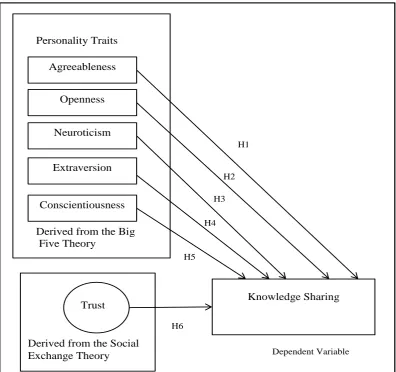
V. PROPOSED RESEARCH MODEL
Based on big five personality theory and the previous studies discussed, we proposed that the five personality trait dimensions namely agreeableness, openness, neuroticism, extraversion and conscientiousness would
© 2015, IRJET ISO 9001:2008 Certified Journal Page 612 Agreeableness
Conscientiousness Neuroticism
Extraversion Openness
Knowledge Sharing Trust
Personality Traits
Derived from the Big Five Theory
Derived from the Social Exchange Theory
H1
H2
H3
H4
H5
H6
[image:7.595.71.468.141.513.2]Dependent Variable
Figure 1: Proposed Research Model.
IV. PROPOSED METHODOLOGY
To empirically validate the six propositions stated in this study, we suggest that the quantitative method of data analysis could be employed. Therefore, a survey method through the use of a set of questionnaire is proposed to be utilized to collect data on the highlighted independent and dependent variables. The questionnaire should consist of two parts namely: part A and part B. Part A should capture the respondent’s
© 2015, IRJET ISO 9001:2008 Certified Journal Page 613 empirically test this model. However, scholars
may decide to employ the multiple regression analysis (MRA) using the statistical package for social science (SPSS) to ascertain which among the personality trait dimensions would have more influence on individuals willingness to share knowledge and actual knowledge sharing behavior.
VI. CONCLUSION
The importance of knowledge
management and knowledge sharing is receiving much attention in the literature. In the context of knowledge sharing, researchers have examined the influence of individual factors, organizational factors and technology factors on knowledge sharing. In the aspect of individual factors of knowledge sharing, factors such as altruism, self-efficacy, and reciprocity etcetera have received much intention in the literature. However, based on the literature review, we observed that much work is still needed to examine further the role played by personality characteristics in knowledge sharing. Therefore, we utilized the big five personality theory as the underlying theory to suggest that the five personality trait dimensions could influence individuals’ willingness to share knowledge and their actual knowledge sharing behavior. A research model is then proposed with a set of propositions derived from the big five personality theory and social exchange theory. We also proposed that these propositions could empirically validate using statistical techniques. This paper would guide future researchers and enhance the understanding the influence of individual factors on knowledge sharing in the organizations, particularly the influence of personality trait dimensions and trust on individuals’ knowledge sharing behavior.
REFERENCES
1. Alvesson, M., and Kärreman, D. (2001), Odd couple: making sense of the curious
concept of knowledge
management. Journal of management studies, 38(7), 995-1018.
2. Awad, E.M. and Ghaziri, H.M. (2004), Knowledge management, Upper Saddle River, NJ, Pearson Education, Inc.
3. Barrick, M.R., and Mount, M.K.
(1991),The Big Five personality
dimensions and job performance: A meta-analysis. Personnel Psychology, 44, 1-26.
4. Barrick, M.R., Mount, M.K., and
Piotrowski, M. (2002). Personality and job performance: Test of the mediating effects of motivation among sales representatives. Journal of Applied Psychology, 87, 43-51.
5. Barrick, M. R., Parks, L., and Mount, M. K. (2005), Self‐Monitoring As A Moderator
Of The Relationships Between
Personality Traits And Performance, Personnel Psychology, 58(3), 745-767. 6. Bartol, K. M., & Srivastava, A. (2002),
Encouraging knowledge sharing: the
role of organizational reward
systems. Journal of Leadership & Organizational Studies, 9(1), 64-76. 7. Becerra-Fernandez, I., Gonzalez, A., and
Sabherwal .R. (2004), Knowledge Management: Challenges, Solutions and Technologies, New Jersey: Pearson Education Inc.
8. Benet-Martinez, V. and John, O.P.
(1998), Los Cinco Grandes across cultures and ethnic groups: Multitrait multimethod analyses of the big five in
Spanish and English. Journalof
Personality and Social Psychology, 75 (30), 729-750.
9. Birchman, H. (2003), The impact of
question structure when sharing
knowledge, Electronic journal of
© 2015, IRJET ISO 9001:2008 Certified Journal Page 614 10. Bollinger, A. S., and Smith, R. D. (2001),
Managing organizational knowledge as a strategic asset, Journal of knowledge management, 5(1), 8-18.
11. Bozionelos, N. (2004), The big five of personality and work involvement. Journal of Managerial Psychology, 19(1), 69-81.
12. Bratianu, C., & Orzea, I. (2010), Organizational Knowledge Creation, Management & Marketing, 5(3).
13. Cattell, R. B., & Kline, P. E. (1977). The scientific analysis of personality and motivation. Academic Press.
14. Costa, P.T., Jr., and McCrae, R.R. (1992), Four ways five factors are basic. Personality and Individual Differences, 13, 653-665.
15. Cummings, J. L., and Teng, B. S. (2003), Transferring R&D knowledge: the key factors affecting knowledge transfer success, Journal of Engineering and technology management, 20 (1), 39-68. 16. Davenport, T.H. and Prusak, L. (1998),
Working knowledge: How organisation manage what they know, Havard
Business School Press, Boston,
Massachusetts.
17. De Vries, R. E., van den Hooff, B., & de Ridder, J. A. (2006, April), Explaining knowledge sharing the role of team communication styles, job satisfaction,
and performance beliefs.
Communication Research, 33(2), 115-135.
18. Eysenck, H.J. and Eysenckm, W. (1985), Personality and Individual Differences, New York Plenum.
19. Gupta, B. (2008), Role of Personality in Knowledge Sharing and Knowledge Acquisition Behaviour,Journal of the
Indian Academy of Applied
Psychology,34, (1), 143-149.
20. Gupta, A. K., and Govindarajan, V. (2000), Knowledge management’s social
dimension: lesson from Nucor steel, Sloan management Review, 42 (1), 71-81.
21. Grant, R. M. (1996). Toward a
knowledge-based theory of the
firm, Strategic management, Journal, 17, 109-122
22. Hsu, M.H, Ju, T. L., Yen, C.H and Chang,
C.M (2007), “Knowledge sharing
behaviour in virtual communities: The relationship between trust, self-efficacy,
and outcome expectations,”
International Journal of
Human-Computer Studies, 65, (2), 153-169. 23. Ipe, M. (2003), Knowledge sharing in
organizations: A conceptual framework, Human Resource Development Review, 2, 337.
24. Lee, C. K., and Al-Hawamdeh, S. (2002), Factors impacting knowledge sharing, Journal of Information and Knowledge Management, 1(1), 49-56.
25. LePine, J.A. and Dyne, L.V. (2001), Voice
and cooperative behaviour as
contrasting forms of contextual
performance: Evidence of differential relationships with big five personality characteristics and cognitive ability. Journal of Applied Psychology, 86 (2), 326-336.
26. Lin, H.F (2007), Knowledge sharing and
firm innovation capability: an empirical
study, International Journal of
Manpower, 28 (3/4), 315-332.
27. Lin, H.H and Wang, Y.S (2012),
Investigating the Effect of University
Students’ Personality Traits on
Knowledge Withholding Intention: A Multi-theory Perspective, International Journal of Information and Education Technology, 2(4), 354-557.
28. Maddi, S. R. (1989). Personality
© 2015, IRJET ISO 9001:2008 Certified Journal Page 615 29. Matzler, K., Renzl, B., Muller, J., Herting,
S. and Mooradian, T.A. (2008), Personality traits and knowledge
sharing, Journal of Economic
Psychology, 29 (3), 301-313.
30. McDougall, W. (1932), Of the words character and personality. Journal of Personality, 1(1), 3-16.
31. Nonaka, I., Takeuchi, H., and Takeuchi, H. (1995), The knowledge-creating company: how Japanese companies create the dynamics of innovation. 1995.New York, NY.
32. Polanyi, M. (1958), Personal Knowledge: Towards a Post-Critical Philosophy, Routledge & Kegan Paul, Chicago, IL 33. Rivera-Vazquez, J. C., Ortiz-Fournier, L.
V., and Flores, F. R. (2009),Overcoming culture barriers for innovation and
knowledge sharing, Journal of
knowledge management. 13(5), 257-270.
34. Teh, P. L., Yong, C. C., and Chong, C. W. (2011), Do the Big Five Personality Factors affect knowledge sharing behaviour? A study of Malaysian
universities, MalaysianJournal of
Library & Information Science, 16(1), 47–62.
35. Thoms, P., Moore, K.S. and Scott, K.S. (1996). The relationship between efficacy for participating in self-managed work groups and the big five personality dimensions. Journal of Organizational Behavior, 17 (4): 349-362.
36. Tiwana, A. (2000). The knowledge
management toolkit: practical
techniques for building a knowledge management system, Prentice Hall PTR. 37. Van den Hooff, B., Elving, W., Meeuwsen,
J. M., & Dumoulin, C. (2003), Knowledge sharing in knowledge communities, In Communities and technologies, 119-141, Springer Netherlands.
38. Von Krogh, G. (1998). Care in
Knowledge Creation. California
management review, 40(3).
39. Wang, S and Noe, R.A (2010),
Knowledge sharing: A review and directions for future research, Human Resource Management Review, 20, 115– 131.
40. Wang, C. C., and Yang, Y. J. (2007), Personality and intention to share knowledge: An empirical study of scientists in an R&D laboratory. Social
Behaviour and Personality:
anInternational Journal, 35(10), 1427– 1436.
41. Zack, M. H. (1999), Developing a
knowledge strategy, California