A Survey of Laboratory Programs for First
Year Medical Students
JAMES L. POLAND, KENNETH E.
GUYER, JR.
ANDHUGO
R.
SEIBEL
Departments of Physiology, Biochemistry and Anatomy,
Medica.
l College of Virginia,
Richmond, 23219
Introduction and Methods
Basic science courses offered to freshmen medical students have been traditionally taught by didactic presentations and laboratory work. Various factors have prompted many departments to either mark-edly reduce the time allotted for the traditional, but more vulnerable, laboratory phase of these courses or drastically alter the content of the laboratory pro-grams. Information concerning the desirability for such changes is incomplete and no evaluation has been developed to determine the effectiveness of change. Before beginning any further alterations in the laboratory programs at the Medical College of Virginia, it seemed desirable to determine anew what we wish to teach in the laboratory. This prob-lem was approached in part by surveying the atti-tudes of other anatomy, biochemistry, and physi-ology departments.
Questionnaires were sent to the chairmen of anatomy, biochemistry, and physiology departments in 116 medical schools. These schools included 102 US medical schools, 12 Canadian medical schools, and 2 American type medical schools in foreign countries. The US schools included some new medi-cal schools which have opened only recently or which are scheduled to begin classes in Medicine within the next few years. Seventy-one anatomy de-partments, 70 biochemistry departments, and 72 physiology departments responded by returning com-pleted or at least partially comcom-pleted questionnaires. (Incomplete answering of questionnaires by some
de-"'Analysis of data supported in part by NIH Grant FR 0016. We gratefully acknowledge assistance given by R. Flora and V. Hutto, Department of Biometry, Medical College of Virginia.
MCV QUARTERLY 7(1): 17-29, 1971
partments resulted in slight variations from question to question in the total number of departments re-sponding.) The data were obtained with the promise of anonymity and, although some direct quotations will be included, anonymity will be preserved through-out this report.
The first section of the questionnaire attempted to determine the characteristics and teaching respon-sibilities of the departments responding. The second section of the questionnaire was designed to indicate the significance which the departments place on the laboratory and to establish how they conduct their laboratory programs.
One part of the questionnaire listed seven possi-ble objectives of a laboratory program:
1. Interpretation of clinical laboratory findings 2. Acquirement of manipulative skills
3. Supplementation and reinforcement of didac-tic material
4. Development of student-faculty relations
5. Appreciation of experimental development and
methodology
6. Experience and responsibility of working with live animals or tissues
7. Other (to be specifically stated)
The department chairmen were then asked to rate these objectives using a system of 1 through 4 with 1 representing a very important objective and 4 re-presenting an objective of much lesser importance. In evaluating the returns we considered a rating of 1, 2, or a checkmark to indicate an important ob-jective and other ratings to denote relatively unim-portant objectives.
The data concerning the three disciplines of anatomy, biochemistry, and physiology were ana-lyzed separately using an IBM 1130 computer. The
LABORATORY PROGRAMS
results associated with each discipline are also re-ported separately for the convenience of those with discipline-oriented interest.
Some Characteristics and Teaching Responsibilities of the Departments
According to the departments that responded to the questionnaire, the average anatomy department consists of 10.6 full time faculty members and 2.9 part time members. Of the total 66 replies analyzed, 63 teach graduate students in addition to medical students; 25 have responsibilities in dental, 24 in nursing, 21 in physical therapy, 10 in dental hygiene,
and 6 in pharmacy curricula. There are 26 depart-ments that have commitdepart-ments in disciplines other than those listed in the questionnaire. These include occupational therapy, medical technology, veteri-nary medicine, postdoctoral education, residents, and undergraduate courses in the arts and sciences. Forty-nine of the 66 anatomy departments analyzed are at institutions operating under the traditional program based on the departmental courses. Four-teen departments are part of an integrated program involving at least one other department. Three de-partments felt their program did not fit any of the listed categories. Of 64 replies, 33 departments still identify their courses of neuroanatomy while 31 list their course as an integrated neural science course.
The departments of biochemistry responding to the questionnaires report a mean of 9.7 full time and 5.8 part time faculty. All of these departments teach medical students; most teach graduate students; almost a third teach dental students; and some teach various other students in paramedical, agricultural, or liberal arts areas. Fifty-nine of 67 departments are at medical schools which utilize separate departmental courses; the remaining eight departments teach medical students in an integrated program involving other de-partments.
The physiology departments responding to our questionnaire make up a population which has an
average of ten full time faculty members and three part time members. Of the total 72 physiology de-partments responding, 70 teach graduate students in addition to medical students; of these, 28 have no other teaching responsibilities. The remaining de-partments have teaching obligations to a variety of combinations of dental, pharmacy, nursing, physical therapy, and dental hygiene students. Other students who are taught by some of the departments include occupational therapy students, residents, biomedical engineers, and undergraduate students in the arts and sciences. Fifty-eight of the 72 responding physi-ology departments are at institutions operating un-der the traditional program based on departmental courses. Fourteen departments are part of an
inte-18
grated program involving at least one other depart-ment.
Significance of and Methods for Conducting a Laboratory Program
Anatomy Laboratories
Of the departments supplying complete informa-tion in gross anatomy, 27 spend between 25 and 50 hours in lecture, and 25 spend 50 to 100 hours. The mean is 50 hours of lecture; two departments spend less than 25 hours in the lecture portion of the course and four are in the 100~150 hour range.
In microscopic anatomy the mean time devoted to lectures is 41 hours with 38 departments ranging between 25 and 50 hours and 16 departments teach-ing between 50 and 100 hours. One department has
a lecture time of less than 25 hours. In neuroanat-omy the mean time allotted for lectures is 37 hours with two departments in the 0-25 hour range and seven departments in the 50-100 hour category. The majority of 48 groups spend between 25 and 50 hours in lectures.
Fifty percent, 69 % , and 72 % of the anatomy de-partments feel that the time which they have allot-ted for the laboratory phase in gross anatomy, mi-croscopic anatomy, and neuroanatomy (respectively)
is adequate to meet the objectives of the laboratory. Thirty percent feel that the time allotted for gross anatomy is less than adequate, 20% believe the same of microscopic anatomy, and 23% could use more time in the teaching of the neuroanatomy lab-oratory. More than adequate time was reported by
11 % in gross anatomy, 9% in microscopic anatomy,
and 5% in neuroanatomy. The mean time spent in the laboratory is 180 hours in gross anatomy, 80 in microscopic anatomy, and 59 in neuroanatomy. The departments vary greatly as to the number of hours which are devoted to laboratory teaching. Some persons apparently feel very strongly, especi-ally in gross anatomy, that laboratory programs are tremendously meaningful and important while oth-ers express doubt regarding their value. Ten depart-ments spend between O and 125 hours in the gross
anatomy laboratory, 29 teach between 125 and 225 hours, 7 are in the 225 to 300 hour range, and 1 de-partment spends more than 350 hours in the gross
anatomy laboratory. In microscopic anatomy 6 de-partments are in the 0-5 range, 16 in the 50-75 group, 17 in the 75-100 range, 12 in the 100~125 hour range, and 3 devote between 125 and 150 hours
to the laboratory portion. In neuroanatomy, 19 de-partments teach O to 50 hours, 23 teach 50 to 75 hours, 11 teach 75 to 100 hours, while 3 departments
spend 100 to 125 hours in the laboratory.
1. L.
POLAND,
K.
E. GUYER,
JR.
ANDH.
R.
SEIBEL
anatomy and 27 in neuroanatomy. When the stu-dent/faculty and graduate assistant ratio is consid-ered, the value shifts to 19 for all three courses.
Laboratory attendance is required in 75% of the departments, and accordingly (Fig 1) in gross anat-omy an average of 42% of the student's final grade is derived from his laboratory performance; the fig-ures are 39% and 35% for microscopic and neuro-anatomy courses respectively.
In gross anatomy 22 ( 42 % ) departments count practicals as 50 to 90% of the final grade while 13 (24%) use practicals as the sole measure of a stu-dent's accomplishments. In microscopic anatomy and neuroanatomy the figures for the 50-90% range are 32 (52%) and 24 (35%) respectively. Practicals are employed as the only evaluation of students in 12 (22%) microscopic and 14 (26%) neuroanatomy courses. Oral examinations are used by very few de-partments in all three disciplines for the evaluation of the students' performance. Written examinations, either as a separate examination or in conjunction with a lecture examination, seem to be quite popular since they are used by approximately 61 % of the departments in all three subject areas. Written or oral laboratory reports are used in one department to aid the evaluation of the students' performance. Another method mentioned for evaluation of stu-dents' laboratory progress is a subjective evaluation
of the students by the faculty either in the l abora-tory or in conferences and discussions about the lab-oratory work.
Flexibility in the curriculum for long or short laboratory periods as needed was reported in 43 (75%) of the departments while in 15 (25%) this possibility did not exist. The most popular length for any gross laboratory period is 3 to 5 hours although shorter and longer labs are often used. Laboratories in microscopic anatomy and neuroanatomy utilized
periods of less than 3 hours to the greatest extent. The three most esteemed objectives of laboratory exercises in all three courses in their order were (Figs 2a, b, c): supplementation and reinforcement of didactic material, interpretation of clinical labor-aro,y findings, and appreciation of experimental de-velopment and methodology. The latter is essenti-ally an appreciation of the "scientific method." Of less importance were the objective of acquirement of manipulative skills and development of student-faculty relations.
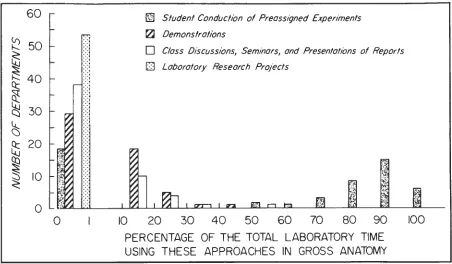
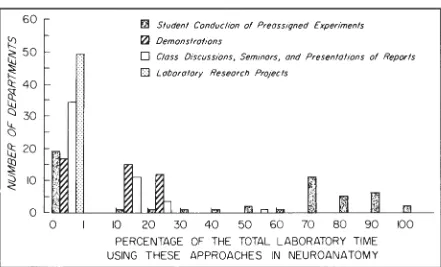
As can be seen in Figs 3a, b, and c, demonstrations and class discussions were used by about one-third of the departments and reflected 10% to 20% of total class time. Research projects were not em-ployed and student conduction of pre-assigned ex-periments was also extremely rare in the three anatomy specialties. The mean percentages of
lab-Gross Anotomy-Mean 42 %
Microscopic Anatomy- Mean 39%
Neuroanatomy- Mean 35 % 25
~ 20
~
~
Cl:: 15~
~ c:i Li... 10 C)
c:::i
~
5
0
0 10 20 30 40 50 60 70 80 100
PERCENTAGE
60
0
Sll Interpretation of C!,n,col Laboratory Find,nqs
Im Acquinng Manipulative Slolls
e"L! Supplementation and Reinforcement of D,docl!c Material
~ Development of Student-Focully Relations
D Apprecio/Jon of Experimental Development and Methodology
IMPORTANT UNIMPORTANT
RELATIVE IMPORTANCE
Fig 2(a)-Distribution of opinions concerning the impor-tance of certain objectives of a gross anatomy laboratory program.
60
0
D Interpretation of Cl,nicol Laboratory F,nd,ngs El Acqwr,ng Mompulotive Stalls
0 Supplementat,on ond .
Reinforcement of D,doct,c Moteriol
~ Development of Student -Foculfy Reio/Jons
[] AppreC1ot1on of Experimental Development and Methodology
IMPORTANT UNIMPORTANT
RELATIVE IMPORTANCE
Fig 2(b)-Distribution of opinions concerning the im-portance of certain objectives of a microscopic anatomy laboratory program.
oratory work carried out by the students were 90%
in gross anatomy, 80% in microscopic anatomy, and 82% in neuroanatomy; demonstrations in these three areas, respectively, comprised 8%, 10%, and 14% of the time.
The prevalent opinion of anatomists throughout the country seems to be that anatomy is a visual and manual science. Dissection and microscopic examination of material and painstaking repetition are still the most valuable assets to the student.
There is relative agreement that while planning effort and budget for the laboratory program have either remained unchanged or increased over the past five years, the actual laboratory time has either remained unchanged or decreased during the same period. Fifty-six percent of the departments have experienced a decrease in their time allotted for gross and microscopic anatomy; for neuroanatomy the corresponding figure is 42%. An increase for the anatomy disciplines was reported by 17% of the departments; the remainder report no drastic change in the time used for laboratory teaching.
Seventy-two percent used original microscopic slides in microscopic anatomy 90-100% of the time
60
0
12:l Interpretation of Clin,col Laboratory Findings
Eil Acquinnq Monipulo/Jve Sk!lls
l2l Supplemento/Jon and Reinforcement of D,doc/Jc Material
[!] Development of Student -Focully Reio/Jons
D AppreCJol!on of Experimental Development r;md Methodology
IMPORTANT UNIMPORTANT
RELATIVE IMPORTANCE.
J.
L. POLAND,
K.
E. GUYER,
JR.
ANDH.
R. SEIBEL
while 59% do the same in neuroanatomy. Koda-chrome projection slides are used between 0% and
20% of the laboratory time by_ 73% of the
micro-scopic anatomists and by 64% of the neuroanato-mists. Seventy-eight percent of the departments feel that the published laboratory manuals in the three
anatomy disciplines do not meet the requirements
and needs of the students and faculty. Of the responding departments 59% feel that some use of
special visual aids (including films, tapes, and closed circuit television) improves student learning. Thirty-four percent of the departments feel that these visual aids shorten the time required for labora-tory teaching while 56% feel the required time is unchanged but may be more effective. Ten percent think visual aids increase the time required for laboratory programs.
Most departments (90%) indicated that they use live black and white television (no one that replied indicated color capability), tapes and films, projec-tions, predissected materials, and charts and models to a certain extent. In general, however, no more than 10% of laboratory programs are occupied by audio-visual aids. The basic teaching goals of 75% of the anatomy departments have, despite the cur-rent stress on change, remained the same; they are still interested in giving the student a well rounded
and fairly complete course in the basic anatomy
disciplines which will be a foundation for his future clinical training.
Several comments include the sentiments that "it
is just plain stupid to cut hours in all courses to the same degree. Such a maneuver emasculates a course in Anatomy but does relatively little harm to
Bio-. chemistry and Physiology." Many people feel that
"the trend to reorganize anatomy with a view to preparing specialists only is shortsighted and dan-gerous; there is a need for a family-type practitioner, which precludes the dangerous shortening of basic science material." The sentiment also voiced quite frequently points out a basic contradiction in our
system of revising and changing curricula. At a time when more elective courses are being introduced, many decry the short span of four years available for medical education.
The feeling that "Anatomy is a laboratory subject;
. .. (especially) so with Gross Anatomy, least with Neuroanatomy and with Histology in an intermed-iary position" is held by virtually everyone. "It is a visual science and as such reading textbooks gets one only partially and incompletely on the way to its understanding."
Several comments include the sentiments that
"nothing replaces a high ratio of instructors to students," that "audiovisual aids are essential for small staffs with large numbers of students" and that
60
~
~ Student Conduction of Preassigned Experiments
rzl
Demonstrations50
~
~
40
ct
~
~
30
~
~
20
~
10
~
0
0
10
O
Class Discussions, Seminars, and Presentations of ReportsD
Laboratory Research Projects20
30
40
50
60
70
80
90
PERCENTAGE OF THE TOTAL LABORATORY TIME
USING THESE APPROACHES IN GROSS ANATOMY
Fig. 3(a)-Distribution of approaches used in conducting the laboratory program.
60
0
LABORATORY PROGRAMS
6!l
Student Conduction of Preass1qned Experiments~ Demonstrations
D
Class Discussions, Seminars, and Presentations of ReportsO
Laboratory Research Projects,,.
10
20
30
40
50
60
70
80
90
PERCENTAGE OF THE TOTAL LABORATORY TIME
USING THESE APPROACHES IN MICROSCOPIC ANATOMY
100
Fig 3 (b ) -Distribution of approaches used in conducting the laboratory program.
60
0
0
rn
Student Conduction of Preassiqned ExperimentsIZI
DemonstrationsO
Class Discussions, Seminars, and Presentations of ReportsO
Laboratory Research Projects10
20
30
40
50
60
70
80
90
PERCENTAGE OF THE TOTAL LABORATORY TIME
USING THESE APPROACHES IN NEUROANATOMY
100
J. L. POLAND,
K.
E. GUYER, JR.
ANDH. R. SEIBEL
"supervised dissection, predissected cadavers, chalk drawings and explanatory lectures are absolutely mandatory if the student is to gain any lasting value from the laboratory courses."
The feeling seems to be universal that a change in time and emphasis was needed; people feel that "tests are more reasonable in length and emphasis" and that the "attitude of the faculty is fairer" now. The opinion that an "M.D. needs a good general background" and that "repetition contrary to the thoughts of many is essential" is widely held.
The idea that "we should fight for maintaining our Gross Anatomy courses and should integrate Micro and Neuro" is widely held, but some people voice that the "integration scatters histology too much since the lectures and laboratories occur sporadically through the whole year." One could agree probably with the statements "deemphasize lectures, the lab is more important"; however, "it needs clinical orientation to a degree." "Laboratories should be made a learning experience instead of a teaching experience" expresses the sentiments of most anatomy departments.
Biochemistry Laboratories
Of 65 biochemistry departments reporting, 46 spend between 50 and 100 hours in lectures while
5 spend less than 25 hours. In the laboratory teach-ing program (includteach-ing demonstration) there is a mean of 94 hours. The individual values range from O to 348 hours. Of 65 departments reporting, 44 feel that the time allotted for the laboratory is adequate. Forty-three of these departments reported the number of hours spent in the laboratory pro-gram, and it will be noted that these range from O to 304 hours. It is interesting that although the mean time spent in the laboratory is only 94 hours, two departments having more than 175 hours of lab-oratory time felt that this was less than adequate. Of the 14 departments reporting more than adequate time, the range is from 40 to 348 hours.
The student/faculty ratio has a mean value of 23, but the ratio is decreased to 13 when graduate assistants are included with faculty. Although labora-tory attendance is required in 84% of the depart-ments responding, the mean value given to the laboratory grade in the calculation or determination of a student's final grade is only 18 % (Fig. 4). In 17 % of the departments the laboratory work con-tributes nothing to the student's final grade, and in 58% of the departments the laboratory work con-tributes less than 20% to the student's final grade.
Eight of 63 biochemistry departments use a prac-tical examination in helping to determine the student's grade in the laboratory; three of these give it credit for 50% or more of the student's lab-oratory grade. Oral examinations are used by only
four departments. Written examinations are used in helping to determine the student's laboratory grade in 29 departments, and in 21 departments, written examinations comprise 50% or more of the student's laboratory grade.
Written laboratory reports assume somewhat greater importance in the evaluation of the student's laboratory grade. Only 16 of 63 departments give no weight to written laboratory reports; in 40 de-partments they comprise 20% or more of the student's laboratory grade. Indeed, in seven depart-ments, the total laboratory grade is derived from this aspect of the student's performance. Oral lab-oratory reports assume somewhat less importance, but in 4 departments out of 63, they comprise 50% or more of the student's laboratory grade. This method of grading is not used at all in 53 depart-ments. Other methods of determining the student's
laboratory grade are used to some extent in 22 departments. In 11 of these, other methods deter-mine 50% or more of the student's laboratory grade. (The majority of these involved an unspecified sub-jective evaluation of the student's laboratory per-formance. Some departments also mentioned grading of analytical results on laboratory unknown samples, seminars, and laboratory technique.)
Sufficient flexibility of curriculum to allow longer or shorter laboratory periods is reported in 40 of 64 departments. The laboratory of 3 to 5 hours length is still the most popular, but it may also be noted that seven schools use laboratories longer than 5 hours exclusively.
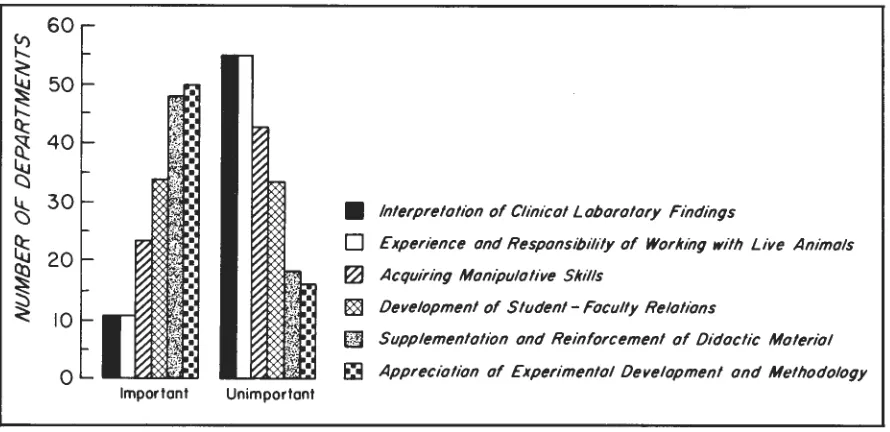
It is noted in Fig 5 that supplementation and reinforcement of didactic material and appreciation of experimental development and methodology are the most uniformly important objectives. These were considered important by 48 and 50 departments respectively of 66 answering this question. It is
per-Mean =/8%
O I 10 30 50 70 90
PERCENTAGE
LABORATORY PROGRAMS
haps surpnsmg that interpretation of clinical lab-oratory findings is considered quite unimportant. Experience and responsibility of working with live animals or tissues is similarly rated unimportant. The objective of development of student-faculty relations is considered to be an important objective in slightly more than half the departments.
Of 66 departments responding to this question,
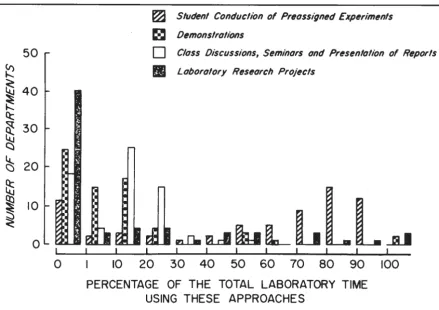
55 use student conduction of pre-assigned
experi-ments for a portion of their laboratory program
(Fig 6). Although 46 departments spend 50% or
more of their laboratory time in student conduction of pre-assigned experiments, no school uses 100% of its laboratory time for this purpose. Forty-eight use demonstrations in their laboratory program, but
only six use this in more than 50% of their
labora-tory program. Two schools are noted to use dem-onstrations exclusively. Forty-one departments use class discussions, seminar, and presentation of reports
for at least a portion of the laboratory program, but
in only four departments does it amount to more than 30% of the laboratory time. Twenty-six de-partments use laboratory research projects in their laboratory program. Of these 26, 15 allot this approach 30% or more, and 8 departments use this approach for greater than 70% of the laboratory time. Since supplementation and reinforcement of di-dactic material is often considered an important objec-tive of the laboratory program, the departments were asked which approaches they considered to be most effective in achieving this objective. Twelve of 41 departments selected student conduction of
pre-60
~
~
~
50
Q::
~
40
~
assigned experiments, and 13 of 41 departments
selected class discussion, seminars, and presentation of reports to be most effective. Laboratory research projects, and demonstrations were considered much less effective in reaching this particular objective.
Although the time devoted to the laboratory
program was not reported to have increased in any
of the responding schools, planning effort has in-creased in 35 and remained unchanged in 10 of 59
departments responding. In the past five years the
budget has increased in 30 and remained unchanged in 19 of 57 departments reporting.
The use of visual aids is considered by 28 of 33 departments to improve student learning. At the same time 14 of 27 departments consider that the
time required for laboratory teaching would be
un-changed and 3 departments indicate that the time required for laboratory teaching would increase
with use of visual aids. Only 4 of 58 departments make
any use of live, closed-circuit television in laboratory
teaching, and none utilize color.
Having presented tabulations of ordered responses, we would be remiss if we did not also report anon-ymously some remarks made in a section of the questionnaire requesting comments. One respondent stated tersely, "Biochemistry does not exist apart
from the laboratory. Medical students may not
like biochemistry laboratory. They need it to become acquainted with biochemistry."
On the other hand, one responded, "I am
begin-ning to question seriously in my own mind the role
of a laboratory in biochemistry to freshmen medical
~
30
• lnlerprelolion of Clinical Loborolory Findings~
20
~
~
10
0
Important Unimportant
O
Experience and Responsib,~ily of Working with Live Animalsr::a
Acquiring Manipulative Slrtlls~ Development of Student - Faculty Relations
~ Supplementation and Reinforcement of Oidoctic Material
E:3
Appreciation of Experimental Development and MethodologyFig 5-Distribution of opinions concerning the importance of certain objectives of a biochemistry laboratory program.
J.
L.
POLAND,
K.
E. GUYER, JR.
ANDH. R. SEIBEL
~ Student Conduction of Preassigned Experiments ~ Demonstrations
50
~
O
Class Discussions, Seminars and Presentation of ReportsIll
laboratory Research Projects~
40
~
Q::
~
30
~
~
20
~
~
10
~
0
0
10
20
30 40
50 60
70
80
90
100
PERCENTAGE OF THE TOTAL LABORATORY TIME
USING THESE APPROACHES
Fig. 6-Distribution of approaches used in conducting the biochemistry laboratory program.
students in general. For the relatively large invest-ment in time involved I am not convinced that the
student derives very much about biochemistry for his
investment." Another says that "Our own staff is split
. . . on [the] value of continuing any lab training
in biochemistry." The view is also reported that
". . . the first year medical students dislike the lab
as does the faculty."
Still another reports that, "It is becoming
in-creasingly apparent to us that the laboratory pro-gram is the most difficult part of the course to make
meaningful to students." And, questioning the need
again, "Of the 10% [of the students] essentially opposed to laboratory experimentation, some have excellent backgrounds and do very well as mea-sured by examination."
One responded at some length, "It is our feeling
that the laboratory for first year medical students
should be constructed to emphasize problem-solving
and introduction to the experimental method. We do
not attempt to make research biochemists of these
students but to introduce the concept that the prac-tice of medicine involves asking scientific questions
and interpreting data. Although the 'cook-book'
ap-proach is traditional, it does little to motivate, does
not challenge, provides very little instructional
bene-fit and renders the educational effort group-centered
instead of individualized. The small group project
approach makes it possible to give extra instructional effort for those who need it and to expand the scope
of the project for those who are capable."
There appears to be a move in the direction of
more flexibility in the laboratory program. At some
schools there are a number of options for the student
in regard to biochemistry laboratory. Thus various
students in a given freshman class may be assigned
to ( or at some schools may elect) pre-assigned
laboratory experiments, research projects, library work (with or without reports), or nothing. At some
schools biochemistry laboratories are not available.
In the Comments section of the questionnaire, 24
departments gave responses indicating that now ( or
in the next two years) there is no requirement for
students to participate in a traditional laboratory
program of pre-assigned experiments. When we
con-sider that not all respondents addressed themselves
to this particular problem in their comments, it seems
LABORATORY PROGRAMS
only 11 departments reported no student conduction
of pre-assigned experiments (Fig 6) does not really
conflict with this if we consider that: ( 1) the
answers from which Fig 6 was derived were based totally on past experience as opposed to both past
experience and some short term plans reported in
Comments; (2) in some schools certain students are
assigned to or may elect the traditional laboratory program while other students are in other programs;
and ( 3) in some schools an introductory series of laboratory exercises prior to different experiences
( including research projects and library problems or
discussion groups) has been calculated as pre-assigned
experiments and appeared to increase the magnitude
of this category in Fig 6.
Physiology Laboratories
Of the 68 departments reporting, 21 spend be-tween 50 and 75 hours in lectures and 25 spend 75
to 100 hours. Ten departments spend over 125 hours
in lectures while seven spend less than 50 hours.
There is a mean of 113 hours devoted to laboratory
teaching (including demonstrations) in these courses
with a wide distribution ranging from 16 to 360 hours.
Fifty of 66 physiology departments feel that the
time which they have allotted for the laboratory
phase is adequate to meet the objectives of the
lab-oratory. These 50 departments vary greatly as to
the number of hours which they spend in the
lab-oratory. Fifteen departments report that less than
75 hours is adequate while 13 have over 150
lab-oratory hours and feel that this is the appropriate
amount. Of the five departments which feel their
laboratory time is less than adequate only one had
over 100 hours of laboratory teaching. Of the ten
which feel the time they have allotted for the
lab-oratory phase is more than adequate, seven had
O
IO 20 30 40 50 60
PERCENTAGE
Fig 7-Distribution of percentage of the student's final
grade derived from his physiology laboratory
perform-ance (Mean·= 16% ).
26
over 100 hours of laboratory teaching (two of these
had over 200 hours) while three departments spend
between 75 and 100 hours for laboratory teaching. The wide distribution in allotted laboratory
teach-ing time and in opinions regarding adequacy is the
reflection of greatly diverse ideas concerning the
significance of the laboratory phase in the first year
medical student's program. Some persons feel that
laboratory programs are tremendously important
while others feel that they do not merit much time.
The distribution of the number of students per
faculty member in a typical laboratory has a mean
value of 16 but shifts to 9 when graduate assistants
are included with the faculty.
Laboratory attendance is required in 71 % of the
departments. However, in 14 of 55 responding
departments the students' laboratory work per se
contributes nothing toward their final grades (Fig 7); in 30 other departments, evaluation of the
student's laboratory performance contributes less
than 30% of his total grade. On the average the
student's laboratory performance contributes 16 %
of the student's final grade.
Only four physiology departments report using
practical examinations to any extent in evaluating the student's laboratory performance. Oral
examin-ations are also used by only a small number ( 8 out
of 63 departments) for evaluation of the student's
performance. Thirty-one departments use written
laboratory examinations to some extent either as a separate examination or in conjunction with a lecture examination. Written examinations seem to be the
most popular method for evaluating the student's
performance.
Nine departments use oral laboratory reports to
help evaluate the student's performance while 23 departments use written laboratory reports for this
purpose. In four cases these reports make up the
en-tire laboratory grade and in 15 other departments
they contribute to 50% or more of the final
lab-oratory grade. Another method mentioned for eval-uation of the student's laboratory performance is a
subjective evaluation of the students by the faculty
either in the laboratory or in conferences and
discus-sions about the laboratory work. Mentioned also as
influencing the laboratory grades in some departments
are projects, electives, attendance and term papers.
Flexibility for having long or short laboratory
periods as needed is reported in 55 of 69
depart-ments. The most popular length for a lab period is
3 to 5 hours although shorter and longer labs are
being used considerably. Twelve departments use lab
periods over 5 hours long exclusively.
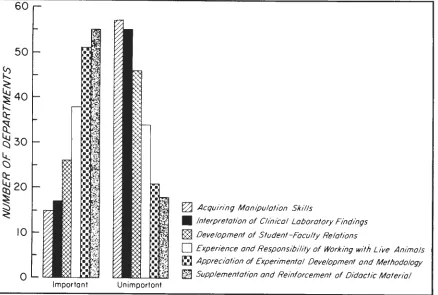
The two most esteemed objectives for a
labora-tory program were supplementation and reinforce-ment of didactic material and an appreciation of
J.
L.
POLAND,
K.
E. GUYER,
JR.
ANDH.
R.
SEIBEL
The latter is essentially an appreciation of the " sci-entific method." Of less importance were the ob-jectives of acquiring manipulative skills, interpretation of clinical laboratory development and development of student-faculty relations. As for the objective of obtaining experience and responsibility of working with live animals, 38 of 72 cases rated this objective as being important while 34 rated it as having much less importance.
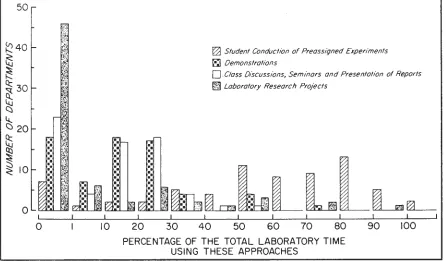
Of the 69 departments responding, 62 used student conduction of pre-assigned experiments to some extent in their laboratory program (Fig 9). Forty-eight used this approach in greater than 50% of their laboratory programs. Fifty-one departments conducted demonstra-tions as part of their lab programs; however, they were used for only a small percentage of the total lab time. Forty-two of these departments used demonstrations for less than 30% of the total time. Forty-five have class discussion, seminars and presentation of reports also as part of their lab programs. As in the case of demonstrations the class discussions occupy a relatively small percentage of the total laboratory time; 39 of these departments had class discussion in less than 30% of their lab programs. Twenty-three depart-ments use laboratory research projects to some extent
in their lab programs. Of the 23, 14 use it for less than 30% of the time while 3 use it for more than 70% of the total lab time.
There are diverse opinions on which approach is most effective for supplementation and reinforce-ment of didactic material. Twenty thought demon-strations made the best approach while ten thought laboratory research projects made the best approach. Intermediary importance for accomplishing this goal was given to class discussions and student conduction of pre-assigned experiments. There is relative agree-ment that while planning effort and budget for the laboratory program has remained unchanged or in-creased over the past five years the actual labora-tory time has either remained unchanged or de-creased during this same period.
Forty-eight of 54 responding departments feel that some use of special visual aids (including films, tapes, and closed circuit television) improves student learn-ing. Twenty-seven of 53 think these visual aids shortened the time required for laboratory teaching while 23 departments feel the required teaching
time is unchanged but may be more effective. Three think visual aids increase the time required for laboratory teaching.
~ Acquiring Manipulation Skills
Important Unimportant
• !nlerprelolion of Clinical Laboratory Findings
E8;l
Development of Student-Faculty RelationsO
Experience and Responsibility of Working wlth Live Anlmols~ Appreciation of Experimental Development and Methodology
~ Supplementation and Reinforcement of Dldoctic Moler/a/
50
0
0
10
20
30
40
~ Student Conduction of Preossiqned Experiments ~ Demonstrations
0 .Class Discussions, Seminars and Presentation of Reports
~ Laboratory Research Projects
50
60
70
80
90
100
PERCENTAGE OF THE TOTAL LABORATORY TIME USING THESE APPROACHES
Fig. 9-Distribution of approaches used in conducting the physiology laboratory program.
Thirty-one physiology departments indicated the use of closed circuit television ( two of these use
color TV to some extent). Twenty-seven of these 31 use TV in less than 30% of their laboratory programs.
Many comments accompanying the returned questionnaires cannot be summarized in a graph or table but are as enlightening as the tabulated data. There is a broad spectrum of opinion concerning the
significance and proper conduct of a laboratory program. Several comments include the sentiments that "laboratory teaching is of great importance in
teaching medical physiology, although, in the
ab-sence of alert and enthusiastic faculty, the
exper-ience becomes stultifying and meaningless for the
student. Laboratory teaching is extremely hard work
and requires the full-time vigorous attention from each faculty person involved." In contrast there are
those who feel that "the effort to teach physiology to medical students is a hopeless task and should be
abandoned. Let the clinicians teach them as the clinicians did from the days of Galen until recently. In the meantime, let us not struggle too hard." The latter opinion may be received as humor but still might be used to represent an expression of concern
shared by many about the merits of any laboratory program.
Some departments have substituted for the
tradi-28
tional laboratory a program of demonstrations with the objective of supplementation and reinforcement of didactic material. These departments undoubtedly feel that "the laboratory in the formal course is not the place to learn 'research' or 'scientific method' or special manipulative skills" but rather a place "to focus attention on outstanding physiological concepts which can be made more exciting by some
laboratory exposure." In contrast, other departments have initiated a research project system to supplant the traditional laboratory. Here the objective is to expose the medical student to the scientific method.
The approach still being used by the majority of departments for most of the laboratory program of each is student conduction of pre-assigned experi-ments. This approach has the potential of contribut-ing toward fulfillcontribut-ing two objectives. The proper selection of assigned experiments can supplement and reinforce the didactic presentation and do so in a
way to encourage the student to use the scientific method involving observing, collecting data, and drawing conclusions from the results. This approach
allows the instructor to know that within a certain period of time the student will have been guided into making certain observations which could be expected to lead to predictable conclusions. If this approach is to be successful, however, "the
J. L. POLAND, K. E. GUYER, JR.
ANDH. R. SEIBEL
as well as by hand. The student will take the latter
course if left to his own devices, hence the
import-ance of active pursuit of the important principle by the instructor."
Opinions were also given concerning factors en-hancing the students' enthusiasm and curiosity in
the laboratory. These include assurance of "some
perceivable clinical or career relevance in material presented" and insistence that "trivia must not be emphasized simply because they are readily recorded."
Summary
The laboratory in the anatomy disciplines is re-garded as the cornerstone and foundation of the dissemination and mastering of the basic knowledge of anatomy. Laboratory time has been reduced in almost all instances and especially in gross anatomy. Histology courses still are satisfactory and the in-tegration of neuroanatomy has been welcomed. These changes have occurred either by design or necessity. A moderate reduction in time in most cases has not produced inadequacies in the laboratory according
to a subjective evaluation by the departments
in-volved, but most would prefer a yardstick to
mea-sure the effectiveness of the changes. The majority of anatomy departments have, at least to the present time, retained the basic traditional laboratory pro-gram centered around student conduction of
regi-mented work, sprinkled with demonstrations and
audio-visual aids. This approach seems to suit the
needs of the faculty and students and has as its
primary objective supplementation and reinforce-ment of didactic material. These goals have remained
the same from year to year although the precise
nature and conduction of the laboratory program has often been changed.
Although many still feel that the biochemistry laboratory is an integral part of the biochemistry experience for medical students, the trend seems to favor reduction in the amount of time devoted to it. This reduction has not always occurred as a
re-sult of the biochemistry departments thinking it desirable in teaching, but more than two-thirds of our respondents consider their present time to be
adequate and another 23 % consider their time to
be more than adequate. In addition to a decrease
in laboratory time there appears to be a reduction in the percentage of laboratory time devoted to student conduction of pre-assigned experiments. As
one individual says, "It is my opinion that
conven-tional laboratory exercises are not effective in rein-forcing lecture presentations or in teaching
bio-chemistry methods or techniques." In deciding on
the proper approach, however, a number of
respondents sought to remind us that "the quality of the students is very critical."
. The majority of physiology departments have
retained in their medical physiology courses the traditional laboratory program centered around student conduction of pre-assigned experiments and sprinkled with demonstrations, conferences, and seminars. However, several physiology departments have reduced the time allotted to this laboratory work and their evaluation is that no inadequacies have developed. Some departments have substituted research projects for the traditional laboratory
pro-gram indicating the importance they place on
teach-ing the scientific method. Other departments have adopted a laboratory program centered around demonstrations designed to illustrate physiological concepts which either supplement or reinforce the
didactic presentations.
The professional educators tell us that we must define the objective and be able to measure the degree to which the objective is reached in effective
teaching experiences. It is clear that: ( 1) there is
less agreement on the objective of the laboratory experience than might be desired, and (2) the degree to which the objective is reached is not easily
mea-sured. We feel the latter statement to be justified on
the basis of our own experience in laboratory
grad-ing as well as the lack of emphasis of the laboratory grade in the student's final grade as compared to the relative time spent in the laboratory and lecture.
Hopefully the information and thoughts
pre-sented here will stimulate and aid many depart-ments in evaluating their own laboratory programs. However, one contributor has cautioned, and rightly so, that teaching is a " . . . creative art. Hence, nei -ther ga-thering statistics nor trying to mimic anyone else's program would be an appropriate technique
for improving a teaching program. Any laboratory
exercise to be successful must reflect the interests and
convictions of the local staff as a worthwhile learn-ing experience."
![Fig ]-Distribution of percentage of the student's final grades derived from his laboratory performance](https://thumb-us.123doks.com/thumbv2/123dok_us/8793882.1768186/3.544.41.483.361.648/distribution-percentage-student-final-grades-derived-laboratory-performance.webp)