www.geosci-model-dev.net/9/3461/2016/ doi:10.5194/gmd-9-3461-2016
© Author(s) 2016. CC Attribution 3.0 License.
The Scenario Model Intercomparison Project (ScenarioMIP)
for CMIP6
Brian C. O’Neill1, Claudia Tebaldi1, Detlef P. van Vuuren2,3, Veronika Eyring4, Pierre Friedlingstein5, George Hurtt6, Reto Knutti7, Elmar Kriegler8, Jean-Francois Lamarque1, Jason Lowe9, Gerald A. Meehl1, Richard Moss10,
Keywan Riahi11,12, and Benjamin M. Sanderson1
1National Center for Atmospheric Research (NCAR), Boulder, CO 80305, USA 2Netherlands Environmental Assessment Agency (PBL), The Hague, the Netherlands
3Copernicus Institute for Sustainable Development, Utrecht University, Utrecht, the Netherlands
4Deutsches Zentrum für Luft- und Raumfahrt (DLR), Institut für Physik der Atmosphäre, Oberpfaffenhofen, Germany 5University of Exeter, Exeter, UK
6University of Maryland, College Park, MD, USA
7Institute for Atmospheric and Climate Science, ETH Zurich, 8092 Zurich, Switzerland 8Potsdam Institute for Climate Impact Research (PIK), Potsdam, Germany
9Met Office Hadley Centre, Exeter, UK
10Pacific Northwest National Laboratory’s Joint Global Change Research Institute at the University of Maryland, College Park, MD, USA
11International Institute for Applied Systems Analysis (IIASA), Laxenburg, Austria 12Graz University of Technology, Graz, Austria
Correspondence to:Brian C. O’Neill ([email protected])
Received: 8 April 2016 – Published in Geosci. Model Dev. Discuss.: 22 April 2016 Revised: 16 August 2016 – Accepted: 31 August 2016 – Published: 28 September 2016
Abstract.Projections of future climate change play a funda-mental role in improving understanding of the climate sys-tem as well as characterizing societal risks and response op-tions. The Scenario Model Intercomparison Project (Scenar-ioMIP) is the primary activity within Phase 6 of the Coupled Model Intercomparison Project (CMIP6) that will provide multi-model climate projections based on alternative scenar-ios of future emissions and land use changes produced with integrated assessment models. In this paper, we describe Sce-narioMIP’s objectives, experimental design, and its relation to other activities within CMIP6. The ScenarioMIP design is one component of a larger scenario process that aims to facilitate a wide range of integrated studies across the cli-mate science, integrated assessment modeling, and impacts, adaptation, and vulnerability communities, and will form an important part of the evidence base in the forthcoming Inter-governmental Panel on Climate Change (IPCC) assessments. At the same time, it will provide the basis for investigating a number of targeted science and policy questions that are
projections made available and analyses performed over the 2018–2020 period.
1 Introduction
Scenarios describing possible future developments of anthro-pogenic drivers of climate change (i.e., greenhouse gases, chemically reactive gases, aerosols, and land use) consis-tent with socioeconomic developments play an important role in climate research. They allow an assessment of pos-sible changes in the climate system, impacts on society and ecosystems, and the effectiveness of response options such as adaptation and mitigation under a wide range of future outcomes.
Scenarios produced in the Intergovernmental Panel on Cli-mate Change (IPCC) Special Report on Emissions Scenarios (SRES; Nakicénovi´c et al., 2000) formed the basis for cli-mate model projections in Phase 3 of the Coupled Model Intercomparison Project (CMIP3; Meehl et al., 2007) and their assessment in the IPCC AR4 Working Group I (IPCC, 2007a), and were used to model impacts on society and ecosystems (IPCC, 2007, 2014a, b) and mitigation strategies (IPCC, 2001b, 2007c, 2014c). In 2007, an expert meeting at Noordwijkerhout agreed on a process for the development of new community scenarios (Moss et al., 2008, 2010). That process began with the identification of the Representative Concentration Pathways (RCPs; van Vuuren et al., 2011a), a set of four pathways of land use and emissions of air pol-lutants and greenhouse gases that spanned a wide range of future outcomes through 2100. The RCPs were the basis for climate model projections in CMIP5 (Taylor et al., 2012) and their assessment in the IPCC AR5 (IPCC, 2013).
The Scenario Model Intercomparison Project (Scenari-oMIP) is now the primary activity within CMIP6 that will provide multi-model climate projections based on alterna-tive scenarios that are directly relevant to societal concerns regarding climate change mitigation, adaptation, or impacts. These climate projections will be driven by a new set of emis-sions and land use scenarios (Riahi et al., 2016) produced with integrated assessment models (IAMs) based on new fu-ture pathways of societal development, the Shared Socioe-conomic Pathways (SSPs), and related to the RCPs. CMIP6 climate projections will differ from those in CMIP5 not only because they are produced with updated versions of climate models, but also because they are driven with SSP-based sce-narios produced with updated versions of IAMs and based on updated data on recent emissions trends. Unlike in CMIP3 and CMIP5, where climate model projections were part of the core experiments, in CMIP6 they are part of a dedicated CMIP6-Endorsed MIP (Eyring et al., 2016).
In Sect. 2, we describe the process by which Scenari-oMIP’s experimental design was formulated and its objec-tives. This includes its role in providing an integrating re-search framework across communities and in addressing
spe-cific research and policy questions. We provide background on the broader scenario process in which ScenarioMIP sim-ulations will play a role and identify the specific scientific questions it aims to address. Section 3 then describes the ex-perimental design, summarizing the types of model exper-iments to be run by the CMIP6 climate model groups sepa-rated into two tiers differentiated by priority, as well as the re-lation of the design to other components of CMIP6. Section 4 describes the planned inputs to climate models to be provided by integrated assessment models developing the emissions and land use scenarios, as well as the climate model outputs to be analyzed and made available to the community. Sec-tion 5 provides a concluding discussion.
2 ScenarioMIP process, objectives, and background 2.1 ScenarioMIP process
Because of the importance of the ScenarioMIP simulations across multiple research fields and to policy makers, the experimental design was developed collaboratively by re-searchers within the climate science, IAM, and impacts, adaptation, and vulnerability (IAV) communities. The idea for an activity within CMIP6 focused on scenarios was elab-orated in discussions in 2013 among the IAM, IAV and climate modeling communities.1 A ScenarioMIP Scientific Steering Committee (SSC) charged with proposing an exper-imental design was then formed following the 17th session of the World Climate Research Programme (WCRP) Work-ing Group on Coupled ModelWork-ing (WGCM) in October 2013 in Victoria, Canada.
The ScenarioMIP SSC together with other communities (see below) systematically investigated a number of issues that could substantially influence the experimental design, especially those that would affect the required number of model runs. First, the possibility was considered to iden-tify a smaller subset of scenarios to be run by statistically sampling from among the large number of possible com-binations of different SSPs, forcing targets, IAMs, and cli-mate models. It was decided that this approach could cur-rently not be carried out with a reasonable number of cli-mate model simulations without sacrificing the representa-tion of uncertainty for a given scenario. Second, the po-tential for pattern scaling or other statistical emulators of climate model output to meet some of the demand for scenario-based climate information was considered. A work-shop held for this purpose concluded that pattern scaling has currently not yet been demonstrated to be able to reli-1Key discussions occurred at the annual meeting of the
ably replace the need for climate model projections to gen-erate information for impact studies (although it might play a role for some applications, e.g. Tebaldi and Arblaster, 2014; see workshop report at https://www2.image.ucar.edu/ sites/default/files/event/PS2014WorkshopReport_0.pdf). Fi-nally, the difference between scenarios (in terms of global average forcing or temperature change) that is required to produce significantly different climate outcomes was inves-tigated. Initial studies indicate that scenario differences of at least 0.3◦C in global average surface temperature are likely necessary to generate statistically significant differences in local temperature over a substantial fraction of the surface, and substantially larger differences are required to produce similarly significant and extensive differences in precipita-tion outcomes (Tebaldi et al., 2015). Further work on this topic is desirable, especially to explore the sensitivity of ad-ditional impact-relevant variables, time and spatial scales of interest, and local forcings.
Informed by these conclusions, a process was organized by the SSC to develop a final protocol. This process in-cluded close interaction with the climate research, IAMs and IAV communities through presentations and discussions at a number of meetings in 2014 and 2015,2as well as coor-dination with other MIPs developing proposals for CMIP6. It also involved discussions with representatives of the Inte-grated Assessment Modeling Consortium’s (IAMC’s) Work-ing Group on Scenarios, which is coordinatWork-ing the produc-tion of SSP-based energy–land use–emissions scenarios (Ri-ahi et al., 2016) for CMIP6, and discussions with key in-dividuals in other relevant research communities, including through the International Committee On New Integrated Cli-mate change assessment Scenarios (ICONICS). Feedback on various drafts was also received from the CMIP review pro-cess and from relevant groups including ICONICS, the IPCC Task Group on Data and Scenario Support for Impacts and Climate Analysis (TGICA), the CMIP panel, and the WCRP Working Group on Regional Climate.
2.2 ScenarioMIP objectives
ScenarioMIP has three primary objectives:
a. Facilitate integrated research leading to a better under-standing not only of the physical climate system con-sequences of these scenarios, but also of the climate impact on societies. The results of the ScenarioMIP experiments will provide new climate information for 2Session at the July 2014 Snowmass meeting on integrated
as-sessment and impacts; joint meeting on proposed CMIP6 MIPs on scenarios, land use, and aerosols and chemistry, Aspen Global Change Institute, August 2014 (O’Neill et al., 2014a); WCRP-IPCC WG1 meeting in Bern, Switzerland, September 2014; WGCM18 meeting in October 2014; annual meeting of the Integrated Assess-ment Modeling Consortium, November 2014; IPCC expert meeting on scenarios, IIASA, Laxenburg, Austria, May 2015.
future scenarios that will facilitate integrated research across multiple communities including the (1) climate science, (2) integrated assessment modeling, and (3) im-pacts, adaptation, and vulnerability communities. This research will be key in informing mitigation and adap-tation policy considerations, including processes that are part of the UN Framework Convention on Climate Change (UNFCCC) such as the 2015 Paris Climate Agreement.
b. Provide a basis for addressing targeted science ques-tions in ScenarioMIP and other CMIP6 projects, regard-ing the climate effects of particular aspects of forcregard-ing relevant to scenario-based research. This includes the effects of a substantial overshoot in radiative forcing and the effect of different assumptions on land use and near-term climate forcers (NTCFs; namely tropospheric aerosols, tropospheric O3precursors, and CH4)on cli-mate change and its impacts. Therefore, a set of vari-ants of the scenarios proposed here are being proposed in other CMIP6-Endorsed MIPs (see Sect. 2.3.3) to ad-dress targeted questions.
c. Provide a basis for research efforts that target improved methods to quantify projection uncertainties based on multi-model ensembles, taking into account model per-formance, model dependence and observational un-certainty. This extends the knowledge basis derived from the Diagnostic, Evaluation and Characterization of Klima (DECK) experiments and the CMIP6 histor-ical simulations (Eyring et al., 2016) and allows for the quantification of uncertainties on different timescales. ScenarioMIP will provide some of the results needed in the next IPCC assessment to characterize the uncer-tainty in future climate and impacts.
The first objective is considered to be the highest priority for several reasons. First, “scenarios for integration” serve a large scientific audience, underpinning hundreds of scenario-based studies addressing a wide variety of scientific ques-tions regarding physical climate changes, mitigation, im-pacts, and adaptation. Having common climate and socioeco-nomic scenarios serves as a critical means to enhance direct comparability of a wide variety of studies, allowing synthetic conclusions to be drawn that would not be possible from a variety of uncoordinated studies (van Vuuren et al., 2012; Kriegler et al., 2012). The climate simulations produced by ScenarioMIP will constitute a key element of a larger, coor-dinated process within the climate change research commu-nity to produce both socioeconomic and climate scenarios that can underpin integrated research for many years to come (Sect. 2.3).
Third, the recent Paris Agreement adopted by parties to the UNFCCC (2015) has focused renewed attention on the goal of limiting warming to below 2◦C global mean
temper-ature change relative to pre-industrial and encouraged coun-tries to pursue efforts to limit warming to an even lower goal of 1.5◦C. Integrated scenarios can help inform dialogues and associated comparative climate changes to help address these political goals.
Finally, a common set of scenarios for integration reduces the need for individual research projects to develop their own scenario information to support scenario-based studies. The availability of common scenarios reduces possible redun-dancy in efforts and makes scenario-based research feasible for many groups that otherwise would not be able to carry it out.
2.3 The scenario framework
Moss et al. (2010) introduced a parallel approach for devel-oping new community scenarios, followed by an integration phase. One of the parallel tracks was the production of cli-mate model projections based on the four RCPs as part of CMIP5 (Taylor et al., 2012). The other track developed alter-native future societal development pathways (the SSPs) and emissions and land use scenarios based on them, generated with IAMs. The integration phase brings together the climate simulations and SSP-based societal futures to carry out inte-grated analysis.
The SSPs were developed over the last several years as a community effort and describe global developments lead-ing to different challenges for mitigation and adaptation to climate change. A conceptual framework for the SSPs and how they could be used with RCP-based climate simulations to carry out integrated research was developed first (van Vu-uren et al., 2012, 2014; O’Neill et al., 2014b; Kriegler et al., 2012, 2014a). The specific content of the SSPs was devel-oped next (Riahi et al, 2016). These comprise five alternative narratives that describe the main characteristics of the path-ways in qualitative terms (O’Neill et al., 2015) as well as quantitative descriptions for key elements including popula-tion (KC and Lutz, 2014), economic growth (Dellink et al., 2015), and urbanization (Jiang and O’Neill, 2015).
In short, the SSPs describe alternative evolutions of future society in the absence of climate change or climate policy. SSPs 1 and 5 envision relatively optimistic trends for human development, with substantial investments in education and health, rapid economic growth, and well-functioning institu-tions. However, SSP5 assumes an energy intensive, fossil-based economy, while in SSP1 there is an increasing shift toward sustainable practices. SSPs 3 and 4 envision more pessimistic development trends, with little investment in ed-ucation or health, fast growing population, and increasing inequalities. In SSP3 countries prioritize regional security, whereas in SSP4 large inequalities within and across coun-tries dominate, in both cases leading to societies that are
highly vulnerable to climate change. SSP2 envisions a cen-tral pathway in which trends continue their historical patterns without substantial deviations.
IAM scenarios were then developed based on the SSPs by elaborating on their implications for energy systems (Bauer et al., 2016) and land use changes (Popp et al., 2016) and quantifying resulting greenhouse gas emissions and atmo-spheric concentrations (Riahi et al., 2016). These SSP-based IAM scenarios consist of a set of baseline scenarios, which provide a description of future developments in the absence of climate change impacts or new climate policies beyond those in place today, as well as mitigation scenarios which explore the implications of climate change mitigation poli-cies applied to the baseline scenarios. Multiple IAMs were used for the quantification of the SSP scenarios, and a sin-gle “marker” scenario was selected as representative in each case. Scenarios in the ScenarioMIP design are selected from these marker scenarios.
Integrated analyses drawing on the qualitative and quanti-tative elements of the SSPs and climate change information from the CMIP5 simulations of the RCPs have already be-gun to appear (e.g., Alfieri et al., 2015; Arnell et al., 2014; Biewald et al., 2015; Dong et al., 2015; Hejazi et al., 2015) and climate model simulations with the RCPs will continue to be a key input to research on climate change and impacts for many years. ScenarioMIP is playing a key role by iden-tifying an updated and expanded set of concentration path-ways based on the SSPs to be run by climate models as part of CMIP6. These CMIP6 simulations will allow integrated analyses to be carried out using climate simulations based on the latest versions of climate models, for a larger set of concentration pathways based on the most recent versions of IAMs.
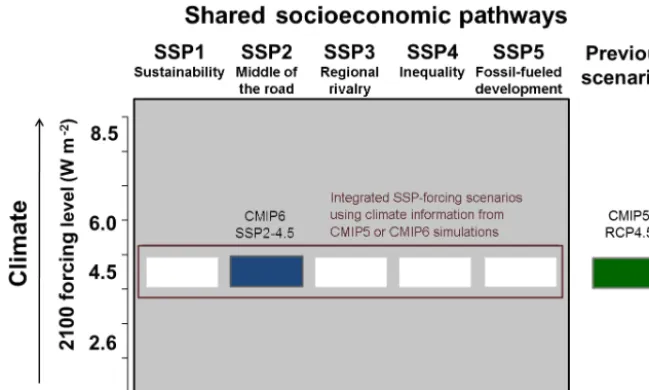
Figure 1.SSP forcing scenario matrix illustrating the combination of a 4.5 W m−2forcing pathway with alternative SSPs. The dark blue cell illustrates a scenario serving as part of the design of ScenarioMIP. The green cell represents RCP4.5 in CMIP5, which was based on a previous emissions and land use scenario. White cells indicate scenarios for which climate information would come from either the CMIP5 or CMIP6 simulations.
by its long-term global average radiative forcing level.3In the example shown in the figure, mitigation policies would be added to each SSP to produce a forcing pathway that sta-bilized at 4.5 W m−2, and SSP2-4.5 is singled out as the spe-cific scenario that would be used as input to climate model simulations in ScenarioMIP.
Currently, RCP simulations from CMIP5 are available to provide climate information for integrated scenarios combin-ing SSP-based socioeconomic and energy–emissions–land use scenarios (as, e.g., SSP2-4.5) with the climate change projections from CMIP5 (e.g., the RCP4.5 simulations). CMIP5 RCPs were derived from earlier emissions and land use scenarios (van Vuuren et al., 2011b), and therefore the regional pattern of climate change resulting from an RCP climate simulation would not be identical with an SSPx–y
simulation following a similar global forcing pathway. An enabling hypothesis of the parallel process is that differences in climate change projections would be small enough to still warrant integration of the two sets of information into mit-igation, impacts and adaptation analysis. The ScenarioMIP design will include an updated and expanded set of forc-ing pathways directly derived from SSPs. Once they become available, climate model simulations based on these path-ways will then be used to provide climate information for integrated studies.
3Following practice established for the RCPs, the forcing level
usually refers to the forcing achieved in 2100 but in some cases refers to an intended forcing stabilization level that is reached be-yond 2100. Forcing is reported as global average radiative forcing, not effective radiative forcing (Myhre et al., 2013).
2.4 Scientific questions addressed by ScenarioMIP
As noted in Sect. 2.2, the highest priority objective for Sce-narioMIP is to provide climate model simulations that can facilitate a wide range of integrated research on the climate impact on societies, including considerations of mitigation and adaptation. Thus, an overarching interdisciplinary science question addressed by ScenarioMIP simulations is
What are the mitigation efforts, climate outcomes, im-pacts, and adaptation options that would be associated with a range of radiative forcing pathways?
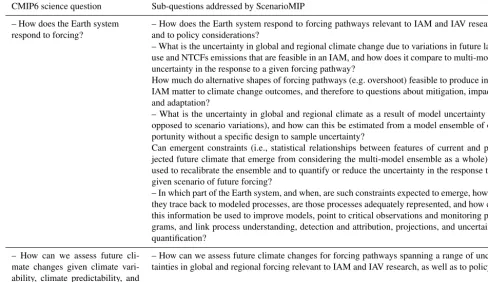
However in addition, ScenarioMIP simulations will be key to addressing two of the three CMIP6 science questions that have informed the overall CMIP6 design and the endorse-ment of proposed MIPs, related to the effects of external forcings on the Earth system and to the confounding effects of different sources of uncertainty on future anthropogenic climate change outcomes. Table 1 lists the two questions along with a number of sub-questions that ScenarioMIP ex-periments are intended to explore. In addition, studies ad-dressing WCRP Grand Challenges (clouds, circulation and climate sensitivity, melting ice and global consequences, cli-mate extremes, regional sea-level change and coastal impacts and water availability) will benefit from the availability of outcomes from future scenario simulations.
Table 1.Scientific questions addressed by ScenarioMIP related to the CMIP6 science questions.
CMIP6 science question Sub-questions addressed by ScenarioMIP
– How does the Earth system respond to forcing?
– How does the Earth system respond to forcing pathways relevant to IAM and IAV research and to policy considerations?
– What is the uncertainty in global and regional climate change due to variations in future land use and NTCFs emissions that are feasible in an IAM, and how does it compare to multi-model uncertainty in the response to a given forcing pathway?
How much do alternative shapes of forcing pathways (e.g. overshoot) feasible to produce in an IAM matter to climate change outcomes, and therefore to questions about mitigation, impacts, and adaptation?
– What is the uncertainty in global and regional climate as a result of model uncertainty (as opposed to scenario variations), and how can this be estimated from a model ensemble of op-portunity without a specific design to sample uncertainty?
Can emergent constraints (i.e., statistical relationships between features of current and pro-jected future climate that emerge from considering the multi-model ensemble as a whole) be used to recalibrate the ensemble and to quantify or reduce the uncertainty in the response to a given scenario of future forcing?
– In which part of the Earth system, and when, are such constraints expected to emerge, how do they trace back to modeled processes, are those processes adequately represented, and how can this information be used to improve models, point to critical observations and monitoring pro-grams, and link process understanding, detection and attribution, projections, and uncertainty quantification?
– How can we assess future cli-mate changes given clicli-mate vari-ability, climate predictvari-ability, and uncertainties in scenarios?
– How can we assess future climate changes for forcing pathways spanning a range of uncer-tainties in global and regional forcing relevant to IAM and IAV research, as well as to policy?
which variants of ScenarioMIP scenarios will be run by other MIPs.
Are differences in regional forcing, or forcings not in-cluded in definition of targets (e.g., biophysical effects), a source of significant differences in climate outcomes across a matrix row?
The rows of the SSP forcing matrix shown in Fig. 1 are defined by forcing pathways that achieve the same level of global average radiative forcing in 2100. ScenarioMIP will carry out climate model simulations for one particular land use and concentration pathway that leads to this level of ra-diative forcing. However, in principle this forcing level can be achieved via pathways of emissions and land use that dif-fer widely in terms of regional land use patterns, regional patterns of emissions of NTCFs, and mixes of global emis-sions of greenhouse gases (GHGs) and NTCFs. For example, the different SSPs making up a given row of the matrix will have different patterns of regional economic growth, energy system development, air quality policies, land use, and other characteristics that will lead to the same global average forc-ing outcome beforc-ing achieved by different means in each case. Thus, an open scientific question is the degree to which cli-mate outcomes can be expected to differ between land use and emissions pathways that achieve the same global
aver-age radiative forcing level in 2100 but have different patterns of regional forcing.
An assumption underlying the parallel process (Moss et al., 2010) and the SSP scenario framework is that these dif-ferences in climate outcomes are likely to be small relative to the overall uncertainty in applications of these simulations to integrated analyses (including impact assessments). This assumption is critical to be able to combine a ScenarioMIP climate simulation for a given SSP and forcing level with sce-narios based on other SSPs achieving the same forcing level. Experiments carried out in other MIPs based on scenarios in the ScenarioMIP design will help test this assumption (see Sect. 3.3.3). If it turns out that climate outcomes are much more sensitive to local forcing differences than currently as-sumed, the ability to use ScenarioMIP simulations for each forcing level for all SSPs might not be possible for all studies. In that case, Earth system model (ESM) simulations specific to each combination of SSP and forcing pathway would be required.
the biophysical effects of land use change, would produce substantially different climate outcomes.
What are global and regional climate differences between scenarios with small differences in forcing levels?
The experimental design includes six out of eight 21st century scenarios that are within a maximum of 1.0 W m−2 of another scenario in terms of global average radiative forcing in 2100. Early in the design of the scenario frame-work, a criterion for selecting RCPs was that they be well separated in terms of radiative forcing (Moss et al., 2008). More recent work (Tebaldi et al., 2015) has refined this view, indicating that regional temperature outcomes that are statistically significantly different at a 5 % level for more than half the land surface area, and robustly so across the multi-model ensemble, require a separation of at least 0.3◦C
in global average temperature. This difference in global temperature is roughly equivalent to about 0.75 W m−2 of global average forcing in an idealized 1 % yr−1CO2increase experiment, although the equivalent value is sensitive to the forcing pathway. For regional precipitation, a much wider separation is required to ensure that scenarios are statistically different. From a policy-making perspective the issue of scenario separation is also important, as policy interest often focuses on the differential impacts between climate change or forcing levels that are relatively close to each other. The ScenarioMIP design will allow for further analysis of these types of questions, providing simulations that will allow addressing region- and variable-specific sensitivities, dependence on geographic and temporal scale of variable differences, and the role of internal variability.
What are the effects of declines in forcing (overshoot scenarios)?
There is both scientific and policy interest in the climate outcomes associated with forcing pathways that exceed a given forcing level and later peak and decline back to that level (overshoot pathways). Such pathways may become increasingly a point of discussion if there is a persistent gap between moderate near-term emission reduction efforts and the ambition to limit climate forcing and global mean warm-ing to very low levels. To this end, the lowest RCP (RCP2.6), and the low SSP scenarios, already exhibit a limited degree of concentration overshoot. One of the scenarios within the ScenarioMIP design describes a much stronger overshoot pathway with radiative forcing that peaks and declines within the 21st century and declines further thereafter, allowing for investigation of the effect of overshoot and declining forcing on the climate system and society. In particular, it allows investigating to what extent climate impacts are higher and what long-lasting and potentially irreversible changes in the climate system occur in an overshoot scenario.
Can pattern scaling, or other approaches to climate model emulation, be used to produce climate outcomes for forcing pathways not represented in the ScenarioMIP design?
Climate model emulators have the potential to provide a computationally efficient means of generating climate outcomes for arbitrary scenarios and, in so doing, facilitate the representation of uncertainty in applications to impact studies (Tebaldi and Arblaster, 2014). However, the state of development of such emulators is such that many situations remain where they are not suitable, their behavior deviating significantly from the more computationally complex, physically based models that they seek to emulate, or falling short of producing temporally coherent projections, or projections of multiple variables physically inter-related. A more systematic exploration and development of such tech-niques in order to realize their potential will be facilitated by the availability of ScenarioMIP simulations, according to a design that deliberately explores a large range of forcings (both with respect to a lower and upper end, recently found to be important in training emulators by Herger et al., 2015), non-traditional pathways like substantial overshoots and long-term extensions and, together with collaborating MIPs, the effects of regionally and time-varying forcers other than well-mixed, long-lived GHGs, in particular land use changes and NTCFs.
Can emergent constraints (i.e., statistical relationships between features of current and projected future climate that emerge from considering the multi-model ensemble as a whole) be used to recalibrate the ensemble and to reduce the uncertainty in the response to a given scenario of future forcing?
albedo feedback on climatological timescales. The observ-able variation in the seasonal cycle of the snow albedo is then a useful proxy for constraining the unobservable feedback strength to climate warming, as both are driven by the same physical mechanisms on different timescales. Other exam-ples include constraints on climate–carbon feedbacks (Cox et al., 2013; Wenzel et al., 2014), the Austral jet stream posi-tion (Wenzel et al., 2016), cloud feedbacks and equilibrium climate sensitivity (Huber et al., 2011; Fasullo and Trenberth, 2012; Fasullo et al., 2015; Klein and Hall, 2015; Knutti et al., 2006; Sherwood et al., 2014), and relations of past and future sea ice or temperature trends (Boé et al., 2009; Knutti and Tomassini, 2008; Mahlstein and Knutti, 2012; Massonet et al., 2012). The ScenarioMIP design will allow for testing emergent constraint results under various forcing pathways. The results will be valuable for guiding the design of future ensembles, e.g., how many and which models are needed to maximize information at minimal computational cost.
3 Overview of ScenarioMIP experiment design
The ScenarioMIP experimental design consists of a set of eight pathways of future emissions, concentrations and land use, with additional ensemble members and long-term exten-sions, grouped into two tiers of priority (of which only the first constitutes a required set for modeling centers partici-pating in ScenarioMIP). We first discuss the rationale behind the types of pathways identified for inclusion in the design and then present a summary of the pathways constituting the design. Finally, we describe in more detail the features of the ScenarioMIP design and the specific scenarios on which it is based.
3.1 Rationale for scenario selection
The identification of the forcing pathways to be included in the ScenarioMIP design can be described in two parts: de-ciding on the forcing levels to include, and then on the spe-cific SSP-based scenario that each forcing pathway should be based on. Additional decisions were then necessary on the number of ensemble members to request from each model for each scenario, and on long-term extensions beyond 2100. 3.1.1 Choosing forcing levels for CMIP6 scenarios Choices of the global average forcing level for scenarios to include in ScenarioMIP were based on the objectives out-lined in Sect. 2.2. These objectives imply that the global av-erage forcing pathways should cover a wide range of forcing levels, provide continuity with CMIP5 experiments, and fill in gaps in CMIP5 forcing pathways that would be of interest to the climate science, IAM, and IAV communities.
Based on these considerations, two types of pathways were included in the ScenarioMIP design:
1. Updated CMIP5 RCPs: new versions of the four RCPs used in CMIP5, based on the Shared Socioeconomic Pathways and new IAM simulations derived from them. This implies new, SSP-based versions of RCPs 2.6, 4.5, 6.0, and 8.5.
2. “Gap scenarios”: new forcing pathways not covered by the RCPs, including new unmitigated SSP baseline sce-narios and new mitigation pathways. Pathways iden-tified of special interest, as discussed further below, were those reaching 7.0, 3.4, and below 2.6 W m−2in 2100 (the latter explicitly to inform understanding of the 1.5◦C goal in the Paris agreement). The 7.0 W m−2 pathway represents an unmitigated baseline scenario, whereas the 3.4 and <2.6 W m−2 pathways are new mitigation scenarios. In addition, there was interest in a scenario with a substantial overshoot in radiative forcing within the 21st century. An overshoot of the 3.4 W m−2pathway was identified as the preferred can-didate.
Moreover, 21st century scenarios in ScenarioMIP were also required to be feasible in a narrow sense; i.e., specific sce-nario outcomes had to be able to be produced with an inte-grated assessment model (Hare et al., 2010). Each scenario in ScenarioMIP is thus based on a set of internally consis-tent assumptions leading to a distinct evolution of the un-derlying socioeconomic systems. The details of the underly-ing IAM scenarios help identify broader socioeconomic and technological conditions under which specific pathways may be attained in the real world. Feasibility in an IAM model needs to be strictly differentiated, however, from the feasi-bility of a scenario in the real world, i.e. whether or not the scenario is capable of being attained. The latter hinges on a number of additional factors, such as political and social con-cerns, which might render feasible model solutions unattain-able in the real world (see, e.g, Riahi et al., 2015). There might also be feasible developments in the real world that are not anticipated by the IAM. Results from major international IAM comparison projects (Clarke et al., 2009; Kriegler et al., 2014b; Riahi et al., 2015) indicate that not all scenarios considered in ScenarioMIP may be equally attainable. For example, under specific conditions (e.g., limited availability of technologies or delayed mitigation) some models find the low forcing target of 2.6 W m−2unattainable.
3.1.2 Choosing SSP-based scenarios
lead to different climate outcomes, even if they reached the same global average forcing level in 2100 (see Sect. 2.4.2). The prevailing hypothesis is that differences in climate out-comes produced by different scenarios for the same global forcing pathway are likely small relative to regional climate variability, uncertainty across climate models, and uncer-tainty in impact models used to investigate outcomes of in-terest to the IAV community (see Sect. 2.4.2). Therefore, cli-mate simulations based on a forcing pathway produced with one SSP scenario will be used in studies aimed at investigat-ing the effects of that same global average forcinvestigat-ing pathway but under future socioeconomic conditions given by a differ-ent SSP.
However, the degree to which this hypothesis is correct re-mains an open scientific question. We therefore choose an SSP for each global average forcing pathway by taking into consideration the possibility that the sensitivity of climate outcomes to SSP choice may be larger than anticipated. To account for that possibility, choices were based on one or, when compatible, more of the following goals:
1. Facilitate climate research so that one can learn more about the climate effects of aspects of forcing that may vary by SSP for the same global average forcing pathway, particularly those from land use changes and aerosol emissions.
2. Minimize differences in climate between the outcomes produced by the SSP chosen for a given global aver-age forcing pathway and the climate that would have been produced by choosing other SSPs. These differ-ences would be minimized by choosing an SSP with land use and aerosol pathways that are central relative to other SSPs for the same global average forcing path-way. However, given difficulties in identifying a cen-tral scenario (due for example to consideration of mul-tiple variables and regions), in practice this goal implies avoiding SSPs with trends for land use or aerosols that are outliers relative to other SSPs.
3. Ensure consistency with scenarios that are most rele-vant to the IAM/IAV communities. Not all scenarios for a given global average forcing pathway are anticipated to be equally relevant to IAM and IAV research. This goal implies choosing the SSP that we anticipate to be especially relevant, so that if the climate effects of land use and aerosols turn out to be larger than anticipated, climate simulations will still be consistent with that sce-nario.
3.2 Scenarios
3.2.1 General features of design
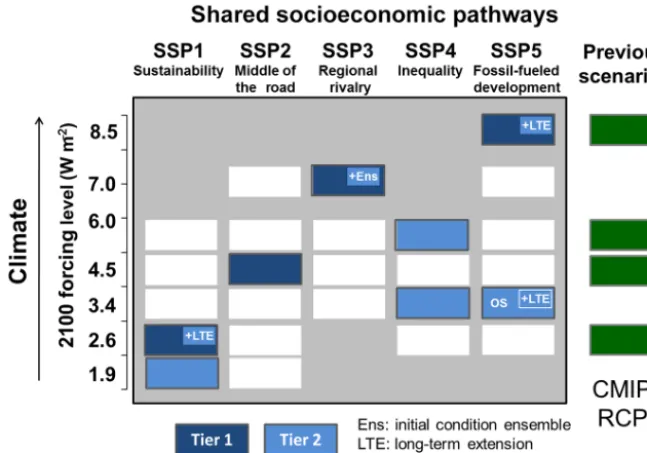
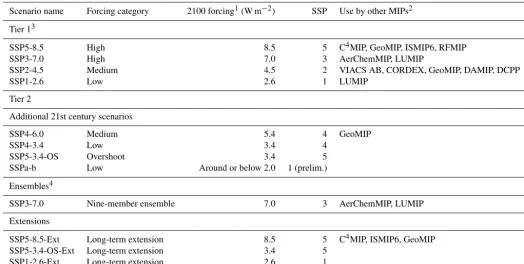
Table 2 lists all simulations being included in the Scenari-oMIP experimental design, divided into two tiers by priority,
and the design is summarized visually within the context of the scenario matrix in Fig. 2. Overall, the design has the fol-lowing general features:
– Four new SSP-based scenarios that update the RCPs, achieving forcing levels of 2.6, 4.5, 6.0, and 8.5 W m−2 in the long run.
– Four new “gap” scenarios that define forcing pathways not represented by the RCPs to address new questions of interest for integrated analysis. Two of these fill in gaps between RCPs, one represents a substantial forc-ing overshoot pathway, and one investigates a forcforc-ing pathway below the RCP2.6.
– Scenarios that inform the Paris Agreement goals of lim-iting warming to below 2 or 1.5◦C. One of the up-dated RCPs (2.6 W m−2)is expected to produce 1.7◦C
warming by 2100 (and would have a likely probabil-ity to stay below 2.0◦C), while one of the gap scenarios (<2.6 W m−2)is designed to produce a global warming that would likely be below 1.5◦C by 2100.
– Three long-term extensions of scenarios to 2300 to al-low investigation of questions related to climate change beyond 2100.
– Scenarios that can anchor experiments in a number of other MIPs (see below) to investigate targeted ques-tions, including for example the influence of land use, aerosols and other NTCFs, and overshoot on cli-mate outcomes; carbon cycle feedbacks; and ice sheet– climate interactions.
– Only four scenarios (in Tier 1) with only one simulation per scenario are required for any climate model partici-pating in this MIP.
These scenarios are arranged into two Tiers as follows: – Tier 1 spans a wide range of uncertainty in future
forc-ing pathways important for research in climate sci-ence, IAM, and IAV studies, while also providing key scenarios to anchor experiments in a number of other MIPs (see last column in Table 2). It includes new SSP-based scenarios as continuations of the RCP2.6, RCP4.5, and RCP8.5 forcing levels, and an additional unmitigated forcing scenario (SSP3-7.0) with particu-larly high aerosol emissions and land use change. – Tier 2 includes additional scenarios of interest as well
Figure 2.SSP-RCP scenario matrix illustrating ScenarioMIP simulations. Each cell in the matrix indicates a combination of socioeconomic development pathway (i.e., an SSP) and climate outcome based on a particular forcing pathway that current IAM runs have shown to be feasible (Riahi et al., 2016). Dark blue cells indicate scenarios that will serve as the basis for climate model projections in Tier 1 of ScenarioMIP; light blue cells indicate scenarios in Tier 2. An overshoot version of the 3.4 W m−2pathway is also part of Tier 2, as are long-term extensions of SSP5-8.5, SSP1-2.6 and the overshoot scenario, and initial condition ensemble members of SSP3-7.0. White cells indicate scenarios for which climate information is intended to come from the SSP scenario to be simulated for that row. CMIP5 RCPs, which were developed from previous socioeconomic scenarios rather than SSPs, are shown for comparison. Note the SSP1-1.9 scenario indicated here is preliminary (see text).
lower than the RCP 2.6 forcing pathway aims to help in-form policy discussion of a global average temperature limit below 1.5◦C warming relative to pre-industrial
levels. It also includes SSP5-3.4-OS, an overshoot path-way, which explores the climate science and policy im-plications of a peak and decline in forcing during the 21st century.
3.2.2 Description of each scenario and its rationale We provide here more specific descriptions and justifications for each of the experiments in the design, as well as for some over-arching features of the design. For each of the 21st cen-tury scenarios, we describe the relevance of the forcing path-way and also the rationale for the choice of the driving SSP. Figures 3 and 4 summarize the emissions and land use path-ways associated with each scenario, and also provide atmo-spheric concentrations and global average temperature re-sponses as estimated with a simple climate model.
Tier 1: 21st century scenarios
SSP5-8.5: this scenario represents the high end of the range of future pathways in the IAM literature, updates the RCP8.5 pathway, and is planned to be used by a num-ber of other CMIP6-Endorsed MIPs (Table 2) to help
address their scientific questions. SSP5 was chosen for this forcing pathway because it is the only SSP scenario with emissions high enough to produce a radiative forc-ing of 8.5 W m−2in 2100.
Table 2.ScenarioMIP experimental design.
Scenario name Forcing category 2100 forcing1(W m−2) SSP Use by other MIPs2
Tier 13
SSP5-8.5 High 8.5 5 C4MIP, GeoMIP, ISMIP6, RFMIP
SSP3-7.0 High 7.0 3 AerChemMIP, LUMIP
SSP2-4.5 Medium 4.5 2 VIACS AB, CORDEX, GeoMIP, DAMIP, DCPP
SSP1-2.6 Low 2.6 1 LUMIP
Tier 2
Additional 21st century scenarios
SSP4-6.0 Medium 5.4 4 GeoMIP
SSP4-3.4 Low 3.4 4
SSP5-3.4-OS Overshoot 3.4 5
SSPa-b Low Around or below 2.0 1 (prelim.)
Ensembles4
SSP3-7.0 Nine-member ensemble 7.0 3 AerChemMIP, LUMIP
Extensions
SSP5-8.5-Ext Long-term extension 8.5 5 C4MIP, ISMIP6, GeoMIP
SSP5-3.4-OS-Ext Long-term extension 3.4 5
SSP1-2.6-Ext Long-term extension 2.6 1
1Forcing levels are nominal identifiers. Actual forcing levels of the scenarios depend, for non-climate policy scenarios, on socioeconomic developments while for scenarios that
include climate policy, the objective was to replicate forcing in the RCPs run as part of CMIP5. These values differed somewhat from the nominal levels. In addition, for SSP4-6.0, the 6.0 W m−2forcing refers to a stabilization level achieved beyond 2100.2Current plans by other MIPs to use ScenarioMIP scenarios either directly or as a basis for a variant to be run
as part of their own design are indicated here. These plans are subject to change in the final versions of MIP designs.3We strongly recommend that modeling groups participating in ScenarioMIP run at least the four scenarios in Tier 1, and as many additional scenarios as possible, guided by this prioritization. However, for any group running fewer than four scenarios, SSP5-8.5 should be considered the highest priority.4We request that models run nine or more additional initial condition ensemble members for the SSP3-7.0 scenario (if
not nine, then as many as possible).
SSP2-4.5: this scenario represents the medium part of the range of future forcing pathways and updates the RCP4.5 pathway. It will be used by several other CMIP6-Endorsed MIPs as a reference experiment, for example by the Coordinated Regional Climate Down-scaling Experiment (CORDEX, which will also use SSP5-8.5) for regional downscaling (a product that will be valuable to the IAV community), by Decadal Cli-mate Prediction Project (DCPP) for short-term predic-tions until 2030, and by the Detection and Attribution MIP (DAMIP) as a continuation of the historical simu-lations to update regression-based estimates of the role of single forcings beyond 2015 and to run single forc-ing experiments into the future by usforc-ing it as the ref-erence scenario. SSP2 was chosen because its land use and aerosol pathways are not extreme relative to other SSPs (and therefore appear as central for the concerns of DAMIP and DCPP), and also because it is relevant to IAM/IAV research as a scenario that combines interme-diate societal vulnerability with an intermeinterme-diate forcing level.
SSP1-2.6: this scenario represents the low end of the range of future forcing pathways in the IAM literature and
updates the RCP2.6 pathway. It is anticipated that it will produce a multi-model mean of significantly less than 2◦C warming by 2100 (Fig. 3), and therefore can support analyses of this policy goal. SSP1 was chosen because it has substantial land use change (in particu-lar increased global forest cover) and will be used by LUMIP to help address their scientific questions. From the IAM/IAV perspective this scenario is highly relevant since it combines low vulnerability with low challenges for mitigation as well as a low forcing signal.
Tier 2: 21st century scenarios
SSP4-6.0: this scenario fills in the range of medium forcing pathways and updates the RCP6.0 pathway. SSP4 was chosen because together with SSP4-3.4 it could be used to investigate differences in impacts across global aver-age forcing pathways even if the regional climate effects of land use and aerosols turn out to be strong.
Figure 3.CO2emissions(a), concentrations(b), anthropogenic radiative forcing(c), and global mean temperature(d)for the 21st century scenarios in the ScenarioMIP design, from Riahi et al. (2016). Concentration, forcing, and temperature outcomes are calculated with a simple climate model (MAGICC version 6.8.01 BETA; Meinshausen et al., 2011a, b). Temperature outcomes include natural forcing in the historical period; projections assume zero volcanic forcing and maintain 11-year solar forcing cycles, consistent with the CMIP5 approach (Meinshausen et al., 2011c). Gray areas represent the range of scenarios in the scenarios database for the IPCC Fifth Assessment Report (Clarke et al., 2014).
the RCPs, Clarke et al., 2014). Climate model simu-lations would allow for impacts of a 3.4 W m−2 sce-nario to be compared to those occurring in the 4.5 or 2.6 W m−2scenarios, to evaluate relative costs and ben-efits of these scenarios. SSP4 was chosen because it is relevant to IAM/IAV research as a scenario with rela-tively low challenges to mitigation (SSP4) and therefore is a plausible pairing with a relatively low forcing path-way.
SSP5-3.4-OS: this scenario fills a gap in existing climate simulations by investigating the implications of a sub-stantial 21st century overshoot in radiative forcing rela-tive to a longer-term target. There is substantial inter-est in the impact, mitigation and adaptation implica-tions of such overshoot, which begins with understand-ing the climate consequences of such a pathway. This scenario follows SSP5-8.5, an unmitigated baseline sce-nario, through 2040, at which point aggressive mitiga-tion is undertaken to rapidly reduce emissions to zero by about 2070 and to net negative levels thereafter (Fig. 3). This design will enable climate modeling teams to run
the scenario by branching from their Tier 1 SSP5-8.5 simulation in 2040. The final design of the overshoot scenario is subject to additional consideration of spe-cific features including the emissions reduction rates af-ter 2040 and the amount of net negative emissions by the end of the century.
warm-Figure 4.Changes in cropland(a), forest(b), pasture(c), and other natural land(d)for the 21st century scenarios in the ScenarioMIP design, from the same IAM runs used to produce Fig. 3. Land use change for the RCPs (van Vuuren et al., 2011b) is shown for comparison.
ing in the 22nd century (Fig. 5), can inform analyses of the implications of the 1.5◦C target. To provide addi-tional information on this target, the ScenarioMIP de-sign will include a scenario with forcing substantially below RCP2.6 in 2100. Multiple IAM groups produc-ing SSP-based scenarios have been able to produce preliminary scenarios based on SSP1 that reach about 1.9 W m−2in 2100, leading to a likely (>66 %) prob-ability of staying below 1.5◦C in 2100 (but a lower probability around mid-century). We therefore consider SSP1-1.9 to be a preliminary candidate for this sce-nario. The final design is subject to additional consid-eration of specific features of this scenario, including the SSP on which it is based, its 2030 emissions level, the likelihood of peak warming exceeding 1.5◦C, and the likelihood of warming being below 1.5◦C in 2100. The emission profile will be characterized by a rapid de-cline to zero and a long period of negative emissions for CO2. Research groups interested in comparing climate outcomes between SSPa-b and SSP1-2.6 (anticipated to lead to below 1.5 and 2◦C, respectively) are encouraged to run additional ensemble members of both scenarios to enhance the detection of differences that can be dis-tinguished from natural variability.
Tier 2: initial condition ensemble
It is important for scenario-based research to represent the influence of internal variability on climate outcomes. To ac-commodate this need, while also economizing on model runs, we include an initial condition ensemble for one sce-nario, based on the assumption that variability estimated for one scenario can be applied to outcomes for others. This ini-tial condition ensemble should be carried out for SSP3-7.0 (a Tier 1 scenario), which has been selected among the Tier 1 experiments for two reasons:
– SSP3-7.0 has relatively strong land use change and high emissions of NTCFs (unlike the SSP5-8.5 scenario), and therefore has been identified as an important ex-periment on which variants will be conducted by LU-MIP and AerChemLU-MIP to investigate the climate impli-cations of regional differences in land use and aerosol emissions. This topic is also very important to scenario-based studies. In those MIPs, the opportunity to conduct signal-to-noise studies made possible by multiple initial condition ensemble members will be critical.
We request that models run nine additional ensemble mem-bers (if not nine, then as many as possible). These addi-tional ensemble members would be considered Tier 2 sce-narios (i.e., not required model runs for participation in Sce-narioMIP). For all other scenarios, only a single ensemble member is requested.
Tier 2: long-term extensions
There is strong interest from the climate and impacts com-munities in long-term extensions of scenarios beyond 2100 to address questions of long term feedbacks and reversibil-ity which might not be apparent from a shorter simulation. The ScenarioMIP long-term extensions will consist of three experiments (Fig. 5).
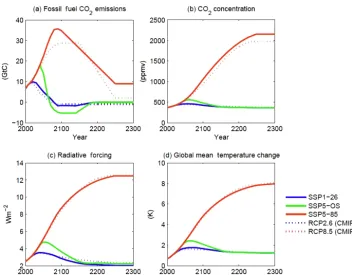
– Two of these will provide low and high cases for long-term change, comprising extensions for SSP5-8.5 and SSP1-2.6 in a style similar to the extensions of RCP8.5 and RCP2.6 in CMIP5. For the extension of SSP5-8.5, this involves CO2 emissions that are reduced linearly starting in 2100 to less than 10 GtC yr−1in 2250, while all other emissions are held constant at 2100 levels. This emissions pathway is estimated to produce equi-librated radiative forcing over the period 2200–2300 at a level similar to the level reached in the long-term ex-tension of RCP8.5 designed for CMIP5 (Meinshausen et al., 2011c; just above 12 W m−2in the simple climate model used in Fig. 5). For SSP1-2.6 the rate of nega-tive carbon emissions from fossil fuels reached in 2100 is extended to 2140 and then increases linearly to zero in 2185, with all other emissions (including CO2from land use) held constant at 2100 levels, leading to slowly declining forcing that approximately stabilizes beyond 2200 around 2.0 W m−2. This extension is expected to achieve a long-term equilibrium temperature of 1.25◦C above pre-industrial temperatures, based on the simple climate model used in Fig. 5.
– A third case will extend the overshoot scenario (SSP5-3.4-OS) such that forcing continues to decline beyond 2100 to eventually reach very low forcing levels, in the vicinity of the SSP1-2.6 extension. In this way, the sce-nario can be seen as an overshoot of the 3.4 W m−2level (which it exceeds and then returns to by about 2100) and
of the 2.6 W m−2 level, which it returns to in the first half of the 22nd century. The extension assumes that the level of negative CO2 emissions from fossil fuels reached in 2100 remains constant until 2140, and then increase linearly to reach zero by 2190. CO2emissions from land use are linearly reduced from 2100 to reach the SSP1-2.6 level in 2120 (and then remain at that level thereafter), while all other emissions are held constant at 2100 levels. Like the SSP1-2.6 extension, this path-way also produces a global mean temperature that equi-librates at about 1.25◦C above pre-industrial tempera-tures beyond 2200, but with a higher peak temperature (about 2.4◦C) during the 21st century.
3.3 Other design features
3.3.1 Emissions driven vs. concentration driven The scenarios specified in the ScenarioMIP design are to be run as concentration-driven experiments for long-lived greenhouse gases. Such scenarios are more consistent with the “integration” role that these scenarios will play in the broader research community. The conceptual framework for scenario-based research (Sect. 2.3) is based on investigating the implications of alternative climate futures. In order for re-search using ScenarioMIP climate projections to be as com-parable across studies as possible, it is important to ensure that the climate outcomes of the experiments roughly repre-sent the intended forcing levels.
The scenario simulations specified in ScenarioMIP are to be performed in the same configuration as the one used in the CMIP6 historical simulations, ensuring continuity in the climate simulations. In addition, this means that the config-uration used for the scenario simulations can benefit from the model evaluation over the historical period. This im-plies that the modeling groups must use the ScenarioMIP-provided concentrations for all long-lived greenhouse gases (CO2, CH4, N2O, CFCs). For all other radiatively active con-stituents (i.e., aerosols and ozone), the modeling groups will use either the ScenarioMIP emissions (from anthropogenic and biomass burning sources only, consistent with the histor-ical emissions) or the CMIP-provided concentrations.
Figure 5.CO2emissions(a)and concentrations(b), anthropogenic radiative forcing(c), and global mean temperature change(d)for the three long-term extensions. As in Fig. 3, concentration, forcing, and temperature outcomes are calculated with a simple climate model (MAGICC version 6.8.01 BETA; Meinshausen et al., 2011a, b). Outcomes for the CMIP5 versions of the long-term extensions of RCP2.6 and RCP8.5 (Meinshausen et al., 2011c), as calculated with the same model, are shown for comparison.
an assessment of a range of sources of uncertainty will be possible by combining the results from several of the CMIP6-Endorsed MIPs.
3.3.2 Relation to CMIP5
CMIP6 climate projections will differ from those for CMIP5 due to a new generation of climate models, a new start year for the future scenarios (2015 for CMIP6 vs. 2006 for CMIP5), as well as a new set of scenarios of concentrations, emissions, and land use (Figs. 3 and 4). We recognize that such an approach could be problematic for uncertainty anal-ysis, as the separation of model vs. scenario uncertainty is unclear (Knutti and Sedláˇcek, 2013). For multiple research communities it will be useful to evaluate the difference in climate outcomes that is due to the changes in climate mod-els alone, in particular to understand how the new modmod-els have revised our understanding of the climate response to anthropogenic forcing. Such an evaluation is also valuable in order to determine whether CMIP5 and CMIP6 results could be used together in research on impacts and adapta-tion (and how), or whether IAM and IAV researchers should abandon CMIP5 simulations in favor of CMIP6 simulations when they become available. It is not part of the ScenarioMIP design to carry out simulations that would inform this eval-uation. However, it would be interesting to the community
if climate modeling teams investigated this question. Possi-ble approaches include running the CMIP6 SSP-based RCPs with single models of the previous (CMIP5) generation, run-ning the CMIP5 RCPs using new (CMIP6) model versions, or carrying out relevant analyses with climate model emula-tors.
3.3.3 Relation to other CMIP6-Endorsed MIPs, the DECK, and the CMIP6 historical simulations The ScenarioMIP design is intended to provide a basis for targeted scenarios to be run in other CMIP6-Endorsed MIPs in order to address specific questions regarding the sensitiv-ity of climate change outcomes to particular aspects of these scenarios, especially land use and emissions of NTCFs. We describe here current plans for coordinated experiments. A summary of the scenarios within the ScenarioMIP design that are currently part of plans for other CMIP6-Endorsed MIPs is provided in the experimental design table (Table 2).
DECK and CMIP6 historical simulations
and the CMIP6 historical simulations by using the end of the historical simulations (31 December 2014) as the starting point of future projections (1 January 2015, with consistency ensured through the harmonization of emissions, concentra-tions, and land use across scenarios and between scenarios and historical simulations). Analysis of present-day climate will likely connect the first few years of the climate projec-tions to the historical runs for those studies using the most up-to-date observational data sets (extending to the years af-ter 2015). An evaluation of the CMP6 historical simulations will provide insights into the reliability of the CMIP6 mod-els and emergent constraints (see Sect. 2.2) can be will be sought to recalibrate the ensemble and to reduce the uncer-tainty in the response to a given scenario of future forcing. Internal variability characterized through the pre-industrial control runs of the DECK will also serve as a basis of com-parison with internal and forced variability simulated with future scenarios.
Aerosols and Chemistry MIP (AerChemMIP)
AerChemMIP (Collins et al., 2016) has a Tier 1 experiment (with additional Tier 2 and 3 related studies) directed at the sensitivity of climate to near-term climate forcers. This ex-periment will use the SSP3-7.0 scenario from ScenarioMIP as a starting point and devise a lower air pollutant variant of this scenario by assuming pollution controls, or maximum feasible reductions in air pollutants. In addition, AerChem-MIP will make use of the LUAerChem-MIP land use variant on SSP3-7.0 (with land use from SSP1-2.6) to study couplings be-tween land use changes and atmospheric chemistry.
Coupled Climate Carbon Cycle MIP (C4MIP)
ScenarioMIP will coordinate with C4MIP (Jones et al., 2016) on targeted scenarios regarding concentration vs. emission-driven simulations. While the ScenarioMIP protocol will request CO2 concentration-driven simulations (see above), C4MIP/Tier 1 will recommend emission-driven simulations for SSP5-8.5 in order to explore the implications of carbon cycle feedbacks on projected atmospheric CO2and hence on climate change. As mentioned before, C4MIP also has an in-terest in the extensions of scenarios beyond 2100 (e.g. up to 2300 as in CMIP5). C4MIP/Tier2 proposes an uncoupled simulation (called BGC mode) for SSP5-8.5 and its exten-sion beyond 2100 in order to investigate climate change im-pacts on Earth system components that operate on longer timescales (vegetation, permafrost, oceanic circulation and carbon export, etc.). C4MIP has expressed high interest in analyzing the ScenarioMIP overshoot scenario.
Detection and Attribution MIP (DAMIP)
DAMIP (Gillett et al., 2016) plans to use SSP2-4.5 as an anchoring scenario on the basis of which individual forc-ing simulations extended to the end of the century will be
specified and then compared. These experiments are aimed at distinguishing the climate effects of different forcers and facilitating the identification of observational constraints and their use in future projections. SSP2-4.5 will also be used to extend the historical (all forcing) runs to 2020 for use in regression-based estimates of the role of individual forcings within the observational constraint provided by observational records up to the years beyond 2015 (by the time CMIP6 output will be available and the next IPCC assessment report will be written).
Decadal Climate Prediction Project (DCPP)
DCPP (Boer et al., 2016) plans to use SSP2-4.5 forcings for its initialized short-term predictions out to 2030, and SSP2-4.5 runs as comparison to evaluate the skills of those predic-tions.
Geoengineering MIP (GeoMIP)
GeoMIP (Kravitz et al., 2016) has proposed several exper-iments that will use two scenarios from ScenarioMIP as a basis from which geoengineering measures would be im-plemented. Forcing pathways from other ScenarioMIP sce-narios would serve as targets for those measures. In par-ticular, SSP5-8.5 would be used as a basis for four experi-ments: using geoengineering to reduce forcing to a medium forcing (G6Sulfur and G6Solar experiments) or low forcing (G6Sulfur_SSP1-2.6) Tier 1 scenario, investigating the effect of cirrus cloud thinning (G7Cirrus experiment), and investi-gating the effect of fixed levels of stratospheric aerosol in-jections (GeoFixed10, 20, 50). The G6Sulfur and G6Solar experiments will also be extended beyond 2100, with geo-engineering applied to reduce forcing from the extension of RCP8.5 down to the forcing level of SSP2-4.5 (the medium forcing Tier 1 scenario). In addition, SSP2-4.5 would be used as a basis for a stratospheric aerosol injection experiment (G4SSA). Overshoot scenarios are also of potential interest to GeoMIP given that geoengineering may be an option for avoiding overshoot.
Ice Sheet MIP for CMIP6 (ISMIP6)
ISMIP6 (Nowicki et al., 2016) will be proposing two types of experiments that will draw on long-term extensions of a sce-nario from Scesce-narioMIP in order to investigate ice sheet re-sponse and ice–climate interactions on centennial timescales. In particular, an extension of SSP5-8.5 to 2300 would be used to provide climate model output for offline (uncoupled) ice sheet simulations, and to provide emissions/concentrations for fully coupled ice sheet–climate model experiments. Land Use MIP (LUMIP)
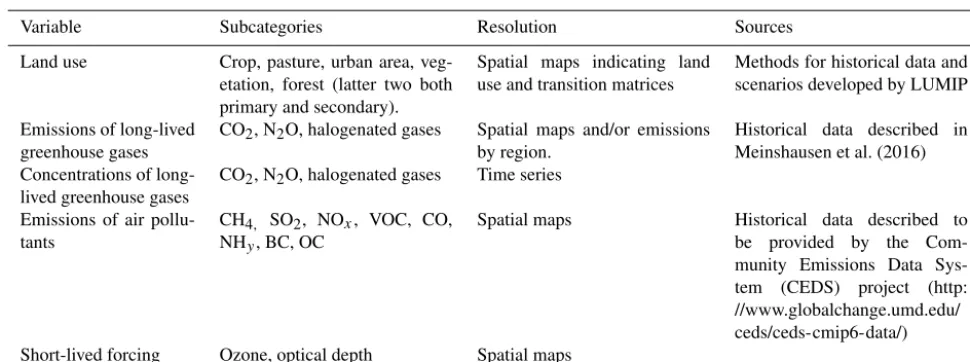
Sce-Table 3.Anthropogenic forcing in ScenarioMIP experiments.
Variable Subcategories Resolution Sources
Land use Crop, pasture, urban area, veg-etation, forest (latter two both primary and secondary).
Spatial maps indicating land use and transition matrices
Methods for historical data and scenarios developed by LUMIP
Emissions of long-lived greenhouse gases
CO2, N2O, halogenated gases Spatial maps and/or emissions by region.
Historical data described in Meinshausen et al. (2016) Concentrations of
long-lived greenhouse gases
CO2, N2O, halogenated gases Time series
Emissions of air pollu-tants
CH4, SO2, NOx, VOC, CO,
NHy, BC, OC
Spatial maps Historical data described to
be provided by the Com-munity Emissions Data Sys-tem (CEDS) project (http: //www.globalchange.umd.edu/ ceds/ceds-cmip6-data/) Short-lived forcing Ozone, optical depth Spatial maps
narioMIP as a basis for testing sensitivity to land use change. The two scenarios would differ both in forcing levels, span-ning a range of approximately 4.5 W m−2 by 2100, and in land use change, with substantial deforestation in the SSP3-7.0 scenario and net afforestation in SSP1-2.6.
Radiative Forcing MIP (RFMIP)
RFMIP (Pincus et al., 2016) has plans to estimate radiative forcing in different models for a future scenario, preferably a high forcing pathway. At the moment the candidate is SSP5-8.5, whose forcings would be applied to current day fixed SSTs (sea surface temperatures) in the idealized setting of the RFMIP experiments.
Vulnerability, impacts, adaptation and climate services (VIACS) advisory board
Researchers examining the consequences of climate change and potential adaptations are a key user group of CMIP out-puts and products. ScenarioMIP will establish a close link with the impact community through the VIACS Advisory Board (Ruane et al., 2016) and other relevant groups to facil-itate integrated research that leads to a better understanding not only of the physical consequences of these scenarios on the climate system, but also of the climate impact on societies and ecosystems. In particular ScenarioMIP will link with the VIACS Advisory Board to ensure that the climate model out-put from the scenarios allows for sector-specific indices be-ing derived (e.g., heat damage degree days for ecosystems, consecutive dry days for agriculture and water resources).
4 Inputs (forcings) and outputs
The forcings required to run the climate model simulations of the experiments listed in Table 2 include global spatial
distri-butions of emissions and concentrations of greenhouse gases, ozone concentrations (or precursors, for emissions-driven ex-periments), and aerosols and land use, at a level of spatial detail suitable for the generation of climate models that will be used in CMIP6. Table 3 provides a list of input variables. These projections will be the results of IAM-based scenarios at the level of world regions with a time horizon of 2015– 2100. The underlying IAM scenarios are documented in a Special Issue in Global Environmental Change (Riahi et al., 2016).
The IAM output will be harmonized to be consistent with recent historical data for land use, greenhouse gas and air pollutant emissions and concentrations (which will also be used for the historical runs in CMIP6). In a subsequent step the data will be downscaled to spatial grids. This process will basically be done using the methods applied earlier for the RCPs (Van Vuuren et al., 2011a). The methods and results for land use data are described in detail in Hurtt et al. (2016). Figures 3 and 5 show preliminary versions of the forc-ing pathways associated with the eight 21st century scenarios and three long-term extensions, as calculated by the IAMs.
Future simulations will also require specification of nat-ural forcings, in particular solar forcing and volcanic emis-sions. For CMIP6, these forcings will differ from what was used in CMIP5. Solar time series will be provided as described on the SOLARIS-HEPPA website at http:// solarisheppa.geomar.de/cmip6 and in Matthes et al. (2016). Volcanic forcing will be ramped up from the value at the end of the historical simulation period (2015) over 10 years to the same constant value prescribed for the piControl simulations in the DECK, and then will be kept fixed.
communities as identified by the CMIP6 VIACS advisory board, see the contribution on the CMIP6 data request to this Special Issue for further details.
5 Conclusions
The ScenarioMIP experimental design aims to facilitate a wide range of integrated studies across the climate science, integrated assessment modeling and IAV communities. It will do so as one element of a larger scenario process that also includes a new set of societal development pathways (the SSPs) over the 21st century. Integrating climate simu-lations from ScenarioMIP with the SSPs or other character-izations of societal futures will allow for analyses of future mitigation, adaptation, and impacts that account for both cli-mate and societal change in a coherent fashion. Multi-model climate model projections from ScenarioMIP will also pro-vide the basis for investigating a number of targeted scientific questions regarding the role of specific forcings and the con-tribution of forcing uncertainty to the total uncertainty bud-get, the effect of a peak and decline in forcing, and long-term climate system outcomes beyond the 21st century. The multi-model approach will allow for a better characterization of uncertainty in climate outcomes than would otherwise be possible, and the design also calls for a large initial condition ensemble that will allow for representation of internal vari-ability in impact studies as well as improved signal detec-tion in experiments in other MIPs that will carry out variants of this scenario. Ultimately, the success of ScenarioMIP lies in the broad participation of the CMIP6 modeling groups in Tier 1 experiments, but also in Tier 2 experiments since they offer the opportunity to study additional interesting and new science and policy questions.
Beyond the establishment of the experimental design, re-maining tasks for ScenarioMIP include ensuring that emis-sions, concentrations, and land use scenarios from inte-grated assessment models are provided to participating cli-mate models as inputs for their simulations. While Scenari-oMIP will participate in this process, primary leadership for the emissions will come from separate groups. The IAMC Scenarios Working Group is coordinating the production of SSP-based IAM scenarios, which include emissions and land use generated at the level of world regions. That group will also coordinate a process for harmonizing emissions across IAMs to be consistent with a common estimate of recent his-torical data, as well for downscaling emissions to the grid cell level needed for climate model input. Land use scenarios produced by IAMs will be downscaled using a methodology developed within LUMIP, in coordination with the IAMC working group.
Once climate model simulations for ScenarioMIP have been completed, the SSC will coordinate some of the first analyses of results, aiming at delivering the initial description of the new scenarios’ principal physical climate outcomes,
ideally in comparison to the CMIP5 RCP outcomes. How-ever, we do not include a specific comprehensive analysis plan in this paper, because the research communities that are interested in analyzing our MIP results are well established, diverse, and large. Individual modeling and research groups and investigators will likely self-organize to carry out studies of future changes on variables, regional domains, impacts, and mitigation measures of interest.
6 Data availability
The climate model output from ScenarioMIP experiments described in this paper will be distributed through the Earth System Grid Federation (ESGF) with DOIs assigned. As in CMIP5, the model output will be freely accessible through data portals after registration. In order to document CMIP6’s impact and enable ongoing support of CMIP, users are obli-gated to acknowledge CMIP6 and the participating modeling groups (see details on the CMIP panel website at http://www. wcrp-climate.org/index.php/wgcm-cmip/about-cmip). In or-der to run the experiments, data sets for future natural and an-thropogenic forcings are required. The recommendation for the future solar forcing data sets and background volcanic aerosol are described in separate contributions to this Spe-cial Issue. These data sets for natural forcings will be made available through the ESGF with version control and DOIs assigned. All other forcing data (land use, emissions, con-centrations, extensions) required for the future SSP-RCPs selected in ScenarioMIP will be made publicly accessible on the SSP database at https://tntcat.iiasa.ac.at/SspDb/dsd? Action=htmlpage&page=about.
Acknowledgements. CRESCENDO project members (V. Eyring, P. Friedlingstein, E. Kriegler, R. Knutti, J. Lowe, K. Riahi, D. van Vuuren) acknowledge funding received from the Horizon 2020 European Union’s Framework Programme for Research and Inno-vation under grant agreement no. 641816. C. Tebaldi, G. A. Meehl and B. M. Sanderson acknowledge the support of the Regional and Global Climate Modeling Program (RGCM) of the U.S. Department of Energy’s, Office of Science (BER), Cooperative Agreement DE-FC02-97ER62402.
Edited by: S. Easterbrook
Reviewed by: two anonymous referees
References
Alfieri, L., Feyen, L., Dottori, F., and Bianchi, A.: En-semble flood risk assessment in Europe under high end climate scenarios, Global Environ. Chang., 35, 199–212, doi:10.1016/j.gloenvcha.2015.09.004, 2015.