https://doi.org/10.5194/gmd-11-2231-2018 © Author(s) 2018. This work is distributed under the Creative Commons Attribution 4.0 License.
A new region-aware bias-correction method for simulated
precipitation in areas of complex orography
Juan José Gómez-Navarro1,2,3,6, Christoph C. Raible1,2,6, Denica Bozhinova1,2, Olivia Martius2,4,6, Juan Andrés García Valero3,5, and Juan Pedro Montávez3
1Climate and Environmental Physics, University of Bern, Bern, Switzerland 2Oeschger Centre for Climate Change Research, Bern, Switzerland
3Department of Physics, University of Murcia, Murcia, Spain 4Institute of Geography, University of Bern, Bern, Switzerland 5Agencia Estatal de Meteorología (AEMET), Murcia, Spain 6Mobiliar Lab for Natural Risks, Bern, Switzerland
Correspondence:Juan José Gómez-Navarro ([email protected]) Received: 31 December 2017 – Discussion started: 13 February 2018 Revised: 15 May 2018 – Accepted: 30 May 2018 – Published: 15 June 2018
Abstract.Regional climate modelling is used to simulate the hydrological cycle, which is fundamental for climate impact investigations. However, the output of these models is af-fected by biases that hamper its direct use in impact mod-elling. Here, we present two high-resolution (2 km) climate simulations of precipitation in the Alpine region, evaluate their performance over Switzerland and develop a new bias-correction technique for precipitation suitable for complex topography. The latter is based on quantile mapping, which is applied separately across a number of non-overlapping re-gions defined through cluster analysis. This technique allows removing prominent biases while it aims at minimising the disturbances to the physical consistency inherent in all statis-tical corrections of simulated data.
The simulations span the period 1979–2005 and are car-ried out with the Weather Research and Forecasting model (WRF), driven by the ERA-Interim reanalysis (hereafter WRF-ERA), and the Community Earth System Model (here-after WRF-CESM). The simulated precipitation is in both cases validated against observations in Switzerland. In a first step, the area is classified into regions of similar temporal variability of precipitation. Similar spatial patterns emerge in all datasets, with a clear northwest–southeast separation following the main orographic features of this region. The daily evolution and the annual cycle of precipitation in ERA closely reproduces the observations. Conversely, WRF-CESM shows a different seasonality with peak precipitation
in winter and not in summer as in the observations or in WRF-ERA. The application of the new bias-correction tech-nique minimises systematic biases in the WRF-CESM sim-ulation and substantially improves the seasonality, while the temporal and physical consistency of simulated precipitation is greatly preserved.
1 Introduction
Coordinated Downscaling Experiment (EURO-CORDEX). These authors indicate that newer simulations exhibit no clear agreement on the projection of a reduction in summer precipitation and rainy days, and point out the use of differ-ent convection parameterisations as one of the main sources of this uncertainty. In this regard, Giorgi et al. (2016) have shown how convective precipitation is indeed a fundamental mechanism that modulates the response of precipitation in the Alpine region to climate change.
To gain insights into the hydrological cycle, different sources of information are available, namely observations and model simulations. Particularly important for this study are gridded observational products (e.g. Haylock et al., 2008; MeteoSwiss, 2016), as their spatial homogeneity be-comes particularly useful in the validation of climate models (Gómez-Navarro et al., 2012). Simulation of the climate is performed with a wide variety of models ranging from sim-ple box models to state-of-the-art comprehensive Earth sys-tem models (ESMs) (e.g. Hurrell et al., 2013; Lehner et al., 2015). These models are used in, e.g. process understand-ing, as well as in simulating past, present and future climate conditions. Observations and simulations offer complemen-tary viewpoints to climate variability. The cornerstone of cli-mate simulations is their internal physical consistency, which emerges from the underlying set of physical equations that are solved internally as part of the simulation. However, in-ternal variability, the counterpart of natural variability in the model world, precludes the simulation from following the ac-tual path of climate, which indeed can be seen as a single random realisation of such variability. As a compromise be-tween models and observations, reanalysis products combine the physical consistency of climate simulations with the as-similation of observations, therefore blending physical con-sistency with a temporal evolution that mimics the actual past evolution of climate (e.g. Dee et al., 2011). Both ESMs and reanalysis products are useful in different contexts, and the choice of using one over the other depends ultimately on the question being addressed.
Regardless of the type of simulation being employed, a bottleneck is the spatial resolution. Global reanalysis prod-ucts or simulations with state-of-the-art ESMs, e.g. in the Cli-mate Model Intercomparison Project (CMIP5) (Taylor et al., 2012; Wang et al., 2014), have a spatial resolution of 50 to 200 km (Dee et al., 2011; Rienecker et al., 2011; Taylor et al., 2012; Lehner et al., 2015). Although this spatial resolution is sufficient to explicitly simulate the physical processes that dominate the large-scale atmospheric dynamics, it cannot re-solve the subgrid physical processes that are important for the hydrological cycle, e.g. microphysics and convective pro-cesses, and therefore have to be parameterised, thereby being an important source of uncertainty in current climate pro-jections (Rajczak and Schär, 2017). This is especially prob-lematic for the accurate simulation of the climate in areas of complex topography, such as the Alps (Rajczak et al., 2013; Torma et al., 2015; Giorgi et al., 2016; Rajczak and Schär,
2017, among others), and in variables for which the inter-action with terrain is very important, such as precipitation and wind (Montesarchio et al., 2014; Gómez-Navarro et al., 2015).
One way to overcome these problems is to increase the spatial resolution enabling the explicit simulation of a wider range of physical phenomena over the area of interest with help of a RCM. This so-called dynamical downscaling ap-proach allows to simulate the climate over a limited-area do-main according to the initial and boundary conditions pre-scribed by either a ESM or a reanalysis product (Jacob et al., 2013; Rajczak et al., 2013; Kotlarski et al., 2014; Torma et al., 2015; Fantini et al., 2016; Giorgi et al., 2016, among others). The use of RCMs has proven to be a very valu-able tool to downscale global datasets in the Alpine region, and indeed it has been the target area of various studies un-der the umbrella of large coordinate projects such as EN-SEMBLES and more recently EURO-CORDEX and MED-CORDEX (e.g. Torma et al., 2015; Casanueva et al., 2016; Giorgi et al., 2016). For wind, Gómez-Navarro et al. (2015) proved that a change in spatial resolution from 6 to 2 km has a great impact on the ability of the simulation to reproduce the observed surface wind. Regarding hydrological variables, several studies within the frame of EURO-CORDEX have re-cently evaluated the added value of increasing the RCM res-olution from 0.44 to 0.11◦in the spatial patterns and daily variability of precipitation (Torma et al., 2015; Casanueva et al., 2016; Fantini et al., 2016; Giorgi et al., 2016). At even higher spatial resolution, Ban et al. (2014) showed that an in-crease in horizontal resolution from 12 to 2.2 km leads to a noticeably increased ability of the same model configuration to simulate the observed frequency of heavy hourly precip-itation events. This improvement with increasing resolution has been confirmed using a different RCM in a similar area of study (Montesarchio et al., 2014). The reason for this im-provement is that convective precipitation is explicitly sim-ulated, which otherwise has to be parameterised, as it is a major source of model uncertainties (Awan et al., 2011).
the same model setup but at a coarser resolution of 25 km. Ban et al. (2014) carried out a similar simulation also with COSMO-CLM for the 10-year period (1998–2007) driven with ERA-Interim with an increased resolution of 2.2 km, therefore being able to explicitly simulate convection pro-cesses.
Still, noticeable and systematic biases remain that can be attributed to either limited process understanding, insuffi-cient resolution or biases introduced by the driving dataset (Themeßl et al., 2011). To overcome this, statistical post-processing of RCM output is used to remove known sys-tematic biases (Gudmundsson et al., 2012; Teutschbein and Seibert, 2012; Maraun, 2016). The underlying idea is to apply a statistical transformation to the simulated model output so that the distribution of modelled data resembles the observed one. There is a variety of correction meth-ods which can be broadly classified into distribution-derived transformations, parametric transformations and nonpara-metric transformations (Gudmundsson et al., 2012). Vari-ous studies have reviewed the possibilities, with an over-all emphasis on hydrological variables, and quantile map-ping has emerged as a nonparametric method that slightly outperforms other approaches, at least in areas of com-plex topography (Themeßl et al., 2011; Gudmundsson et al., 2012; Teutschbein and Seibert, 2012). Different versions of these techniques have been tested in the recent literature, and even software packages have been specifically devel-oped and made publicly available, e.g. downscaleR (https: //github.com/SantanderMetGroup/downscaleR, last access: 11 June 2018, Bedia et al., 2018) . Casanueva et al. (2016) applied three different methodologies to correct daily precip-itation within the EURO-CORDEX ensemble and found that the improvements introduced by the correction depend on the model, region and details of the methodology, concluding that there is no single optimal approach. Dosio (2016) used the same RCM ensemble to produce an ensemble of bias-corrected projections of climate change based on a number of climate indices from the Expert Team on Climate Change. The authors conclude that results depend on the index, season and region of interest. In particular, percentile-based indices are barely affected by bias adjustment, whereas absolute-threshold indices are very sensitive to the techniques. Fur-ther, some refinements to these techniques have been pro-posed. Wetterhall et al. (2012) proposed to correct the model output differently for each day, conditioned to several types of circulation patterns. Argüeso et al. (2013) introduced a variant of quantile mapping that is not corrected against grid-ded observations but rather station data. This allows to over-come an emerging problem in very high-resolution simula-tions, namely that they produce fewer rainy days than gridded observations, which is an assumption most bias-correction techniques are based on. Felder et al. (2018) applied a pre-liminarily bias-corrected version of the dataset of simulated precipitation we thoughtfully present here as part of a larger study aimed at the simulation of impacts of extreme events
with a compressive model chain. In this study, the authors apply and briefly evaluate a simple bias-correction method, where some limitations of the technique, imposed by the complexity of the Alpine region and the high resolution of the dataset, stand out. Indeed, the latter study motivated some of the improvements to the bias correction we introduce and analyse in the present study.
Despite the abundant literature on the suitability and added value of these techniques, the use of bias correction is still intensely debated. Maraun (2016) argues that it is difficult to establish the actual performance of these techniques in climate simulations, and Maraun et al. (2017) demonstrate how statistical corrections cannot overcome fundamental de-ficiencies in climate models, pointing out that new process-informed methods should be developed. These limitations have implications in studies addressing climate change and impacts, as the climate change signal can be unrealisti-cally yet unwittingly modified (see discussion in Teng et al., 2015; Casanueva et al., 2018). These concerns are acknowl-edged and summarised in a report from the IPCC (Stocker et al., 2015). Among other recommendations, this report advises to identify and try to understand most prominent model deficiencies prior applying any bias corrections, as well as always proving the raw uncorrected data along with a clear description of the methodology applied to remove bi-ases. In this direction, a new initiative associated with the CORDEX experiment called the Bias Correction Intercom-parison Project (BCIP; Nikulin et al., 2015) has been cre-ated and aims to “(i) quantify what level of uncertainties bias adjustment introduces to workflow of climate informa-tion, (ii) advance bias-adjustment technique and (iii) provide the best practice on use of the bias-adjusted climate simula-tions”.
recom-mendations by the IPCC for the AR6 (Stocker et al., 2015), while it enables the identification of robust features, which increases the reliability of both simulations. Second, the new process-informed bias-correction technique for precipitation is introduced and applied to the simulation driven by the ESM. Thereby we can evaluate improvements with respect to previous results obtained with more simple bias-correction techniques that do not explicitly account for complex topog-raphy (Felder et al., 2018).
2 Data, model and experimental design 2.1 Gridded observational dataset
This study relies on an observational dataset to evaluate and bias correct precipitation in our model simulations. We use the gridded product RhiresD, developed by MeteoSwiss (2016). This product is based on daily precipitation totals as recorded by a network of rain-gauge stations of MeteoSwiss. It uses quality-checked observations to ensure maximum ef-fective resolution and accuracy. The observations undergo an interpolation to fill a homogeneous 1 by 1 km grid with an effective resolution of 15 to 20 km. To directly compare the observations to the simulations, we bilinearly interpolated the observations to 2 km. Although this dataset is considered generally reliable, it may underestimate precipitation in high altitudes due to the data sparsity (e.g. Messmer et al., 2017). More generally, observational products contain uncertainty whose magnitude can be sometimes comparable to model er-rors (Gómez-Navarro et al., 2012). Still, in this study, we do not explicitly consider this uncertainty, and instead assume that these observations represent the true precipitation with-out errors.
2.2 Global reanalysis: ERA-Interim
The ERA-Interim reanalysis (Dee et al., 2011) is used to provide boundary conditions for one of the RCM simula-tions. ERA-Interim is a reanalysis product released by the European Centre for Medium-Range Weather Forecasts and is generated by running the Integrated Forecasting System (IFS) model at a spectral resolution of T255 and 60 vertical levels while it assimilates observational data. The assimila-tion technique is the 4-D variaassimila-tional analysis that digests a number of observations of the actual state of the atmosphere (Dee et al., 2011). While the reanalysis covers the period from 1979 to today, a shorter period spanning 1979–2005 is downscaled. The reanalysis data used have a 6-hourly tem-poral resolution and a spatial resolution of 0.75◦×0.75◦. 2.3 Global model simulation: CESM
The second dataset which provides boundary conditions of the RCM simulations is obtained from a seamless tran-sient simulation with the Community Earth System Model
(CESM, 1.0.1 release; Hurrell et al., 2013). This model is a state-of-the-art fully coupled Earth system model developed by the National Center for Atmospheric Research and run at a resolution of about 1◦ in all physical model components (atmosphere, ocean, land and sea ice) (CCSM; Gent et al., 2011) and the carbon cycle module. The latter interactively calculates CO2concentrations and exchanges these between
the model components. Further details for the particular set-ting are presented in Lehner et al. (2015).
The transient simulation spans the entire last millennium from 850 to 2099 AD, but for this study we focus on the period 1979 to 2005. The simulation is initialised from a 500-year control simulation under perpetual 850 AD con-ditions. The transient external forcing is obtained from the Paleo Model Intercomparison Project 3 (PMIP3) protocols (Schmidt et al., 2011). It consists of total solar irradiance (TSI), volcanic and anthropogenic aerosols, land use change and greenhouse gases. TSI forcing deviates from the PMIP3 protocol, as the amplitude between the Maunder Minimum (1640–1715) and today is doubled. Note further that CO2
concentrations obtained by the carbon cycle module are ra-diatively inactive. Instead, observed/reconstructed CO2
con-centrations (according to the PMIP3 protocol) are applied in the radiation schemes of the physical model components. Be-yond 2005 AD, the external forcing is obtained from the Rep-resentative Concentration Pathway (RCP) 8.5, which corre-sponds to a radiative forcing of approximately 8.5 W m−2in the year 2100. Further details on the simulation are sum-marised in Lehner et al. (2015) and analyses of this simu-lation are presented elsewhere (Keller et al., 2015; PAGES 2k-PMIP3 group, 2015; Camenisch et al., 2016; Chikamoto et al., 2016).
2.4 The regional climate model WRF
10° W 5° W 0° 5° E 10° E 15° E 20° E 25° E
35° N 35° N
40° N 40° N
45° N 45° N
50° N
50° N
55° N
55° N
0 400 800 1200 1600 2000 2400 2800 3200
D1
D2
D3
D4
(a)
(b)
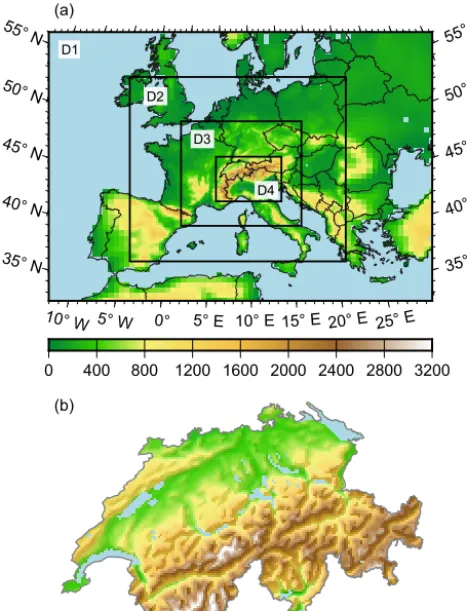
Figure 1. (a)Configuration of the four nested domains used in both the Weather Research and Forecasting model driven by the ERA-Interim reanalysis (WRF-ERA) and by the Community Earth Sys-tem Model (WRF-CESM) simulations.(b)Detail of the actual orog-raphy implemented in the 2 km resolution simulation over Switzer-land.
fully non-local scheme developed at Yonsei University (here-after YSU) (Hong et al., 2006), which accounts for unre-solved orography (Jiménez and Dudhia, 2012). The radiation is treated by the Rapid Radiative Transfer Model (RRTM) (Mlawer et al., 1997) and the short-wave radiation scheme by Dudhia (1989). Finally, land processes are simulated by the Noah land soil model (Chen and Dudhia, 2001).
2.5 Experimental design: downscaling ERA-Interim and CESM
Two RCM simulations for the European Alps are conducted for the same period (1979–2005). This period is chosen for being the overlap between the ERA-Interim and the CESM simulation. First, the ERA-Interim reanalysis dataset is dy-namically downscaled with Weather Research and Forecast-ing model (WRF) (hereinafter referred as WRF-ERA). The simulation is run in so-called reforecast mode. This con-sists of dividing the full period into small tranches of 6 days with a spin-up period of 12 h. This approach allows to
ef-ficiently parallelise the problem, although it has the draw-back of reducing the coupling between the land and the at-mosphere. This can, in turn, introduce biases in the simu-lation of phenomena where the feedback between both sys-tems is of prominent relevance, e.g. severe drought or certain types of flooding. Still, it does not impose a bottleneck of the model performance in terms of its ability to simulate surface wind, as shown by Gómez-Navarro et al. (2015), or in pre-cipitation, as demonstrated here. Further, analysis nudging of wind, temperature and humidity above the planetary bound-ary layer (PBL) is allowed within the regional model domain, as this setting proved to outperform other configurations for this domain and model setup (Gómez-Navarro et al., 2015).
Secondly, this period of the CESM simulation is dynami-cally downscaled (hereinafter referred as WRF-CESM). For this simulation, the WRF setup is almost identical to the one of WRF-ERA in order to facilitate comparison between the simulations and to be able to analyse the influence of dif-ferent driving datasets. Still, one important difference exists: the absence of analysis nudging. The rationale behind this choice is that avoiding nudging gives the model more free-dom to develop a more precise representation of the physical processes at regional scales (due to the higher resolution) and thus is potentially able to better correct systematic biases of the ESM, which, e.g. simulate a too strong zonal circulation (Bracegirdle et al., 2013).
The comparison between WRF-ERA and WRF-CESM al-lows the identification of biases attributable to the driving conditions for the RCM, as described below. In this regard, it would be desirable to repeat the latter simulation using dif-ferent global climate models. Unfortunately, the high reso-lution used in the RCM configuration demands a high com-putational cost that currently precludes the repetition of the experiment to produce an ensemble.
3 Bias-correction technique
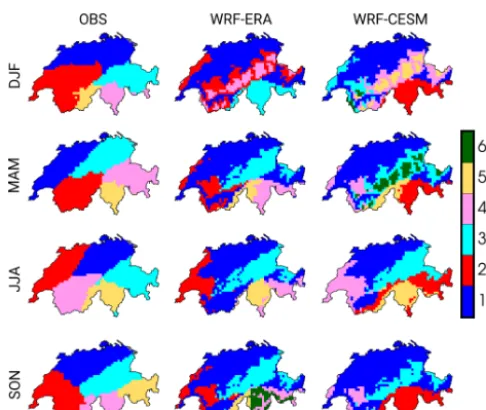
Figure 2.Regions obtained from the cluster analysis described in Sect. 3. The maps correspond to the 12 possible combinations, 3 for each dataset (OBS, WRF-ERA and WRF-CESM) and 4 for each season. Note that the colours are set arbitrarily as a label within the algorithm, so no one-to-one correspondence is implied between regions of the same colour in different maps.
In the first step, regions of similar variability are defined according to an objective criterion. In doing so, an empirical orthogonal function (EOF) analysis is applied to the precip-itation series in order to obtain a rank-reduced phase space where the search of distances necessary in the subsequent cluster analysis is facilitated. We retain seven leading EOFs, as they account for more than 80 % of the total variance in the original datasets, while drastically reduces the computa-tional cost. Then, a hierarchical clustering approach identi-fies regions of similar precipitation variability in the rank-reduced EOF space according to the Ward algorithm (Ward, 1963). To minimise the inherent subjectivity in the choice of the number of clusters to retain, we use a method based on the spectra of distances after every merge. To find the num-ber of cluster centroids, the Euclidian distances between the centroids need to show a noticeable gap in the dendrogram that is built as part of the clustering procedure (not shown). A complementary criterion consists of aiming at retaining a low number of cluster centroids (and thus regions) so that a large number of grid points per centroid are available, which will improve the estimation of the transfer function in the quantile mapping step. The resulting cluster centroids are then used as initial seeds for ak-means clustering, which allows for fine-rearranging of grid points across regions (as one drawback of the hierarchical clustering is that a grid point once attributed to a specific cluster centroid will belong to it despite the fact that it might be more meaningfully attached to another clus-ter centroid in the end). Note that this regionalisation is not only a preliminary step of the bias-correction procedure, but
it is also used as an analysis technique to investigate the vari-ability of precipitation over Switzerland and how consistent it is through various datasets.
In the second step, quantile mapping is applied sepa-rately to each of the regions identified within the first step. This nonparametric method corrects the empirical cumula-tive distribution function (ECDF) of the simulated precipi-tation with the observation (Themeßl et al., 2011; Rajczak et al., 2016). Assume that the climate model daily time series isXmodel(t, x, y)withtthe time andx, ythe location. To
ob-tain a corrected time seriesXcorr(t, x, y), the following rule
is used:
Xcorr(t, x, y)=(ECDFobs(t, x, y))−1(ECDFmodel(t, x, y)) ,
with ECDF−1 indicating the inverse ECDF, i.e. a quantile. Therefore, it can be seen as a transfer function between the ECDFs of the simulation and the observations. The quantile interval is set to 1, so quantiles corresponding to percentiles from the 1st to the 99th are corrected. The transfer func-tion is obtained for each region independently by pooling all grid points that belong to it (therefore, a larger number of grid points per cluster facilitates the estimation of such func-tion, as outlined above). Finally, the correction is applied to the daily series of precipitation in every grid point, with a transfer function that is common to all elements within the same region, but varies across the various regions defined by the cluster analysis. A small drawback of the separation into regions is that they lead to artificial and abrupt bound-aries across the domain that would leave a fingerprint in the corrected data. To minimise these artificial boundaries, we perform a spatial smoothing in the obtained quantiles with a radius of 4 km, which smooths out the transfer functions prior to the correction, effectively removing such artifacts. Note that this scheme can lead to wet biases after the cor-rection when the dry-day frequency is underestimated by the model, which then become systematically mapped onto pre-cipitation days. These biases can be further removed with frequency adaptation techniques (Themeßl et al., 2012), al-though we do not consider them in our scheme, which can be related to wet biases in the corrected precipitation in winter (see discussion below).
2 4
2 4 1 2 3 4
1 2 3 4 2 4 6
2 4 6
2 4
2 4 2 4
2 4 2 4 6
2 4 6
2 4
2 4 2 4
2 4 2 4
2 4
2 4
2 4 2 4 6
2 4 6 1 2 3 4
1 2 3 4
OBS WRF−ERAIN WRF−CESM
DJF
MAM
JJA
SON
0.0 0.1 0.2 0.3 0.4 0.5 0.6 0.7 0.8 0.9
Cor
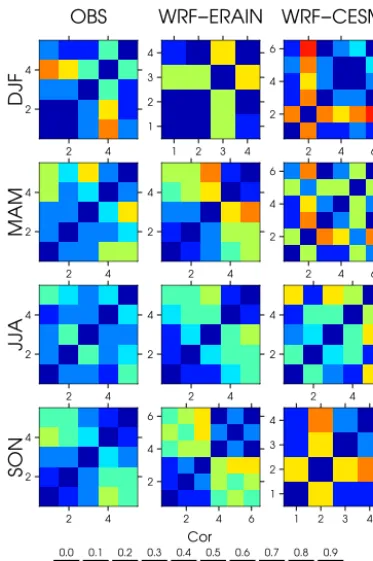
Figure 3.Temporal cross-correlation matrices between all regional series. The calculation, as the definition of regions, is carried out independently for each dataset and season. The order of matrices is from region 1 (bottom left) to region 6 (top right), and the spatial distribution of the regions is shown in Fig. 2. Note that all matrices are symmetrical with 1 across the diagonal.
In this sense, the new bias-correction technique based on ob-jective regionalisation presents a compromise between these two extremes, as regions with similar precipitation behaviour are corrected coherently and jointly, thus preserving a great part of the physical self-consistency of this variable for each region dictated by the RCM but still avoiding the cancellation of positive and negative biases.
We note that the application of this methodology implies a previous regionalisation of the series for each month sepa-rately, which in general involves notable computational cost. Further, months belonging to the same season behave simi-larly, so that the resulting regions are hardly distinguishable and the analysis presents some level of redundancy. For these reasons, we propose a simplified form of the methodology, which we apply hereafter, and consists of carrying out the regionalisation on a seasonal basis. Once identified, these re-gions can be regarded as representative and common for the 3 months within each season, so that the final correction can be applied on a monthly basis.
4 Evaluation of the simulations
4.1 Regions of common variability and time behaviour Using the cluster analysis introduced in Sect. 3, the num-ber of regions with common variability (clusters) slightly varies per season and dataset (Table 1). Their spatial distri-bution is depicted in Fig. 2, where different colours repre-sent grid points belonging to each region, and the number of grid points within the Swiss domain that belong each re-gion is shown in Table 2. Note that in the smallest rere-gion the number of grid points is 60, which implies that 48 600 pairs of numbers (i.e. 27 years×30 days per year×60 points per day) are used to obtain the transfer function that effectively carries out the correction in the less favourable case. This ensures that such function is efficiently estimated from the sample in all regions and cases. The number of clusters ob-tained is similar in all cases, and a clear northwest–southeast pattern emerges concurrently with the main orographic fea-tures over Switzerland (see bottom of Fig. 1). The resem-blance between the regions obtained for both WRF simula-tions is remarkable. In all cases, a large region that includes the plains in the centre of Switzerland, but also the Valais and Engadin valleys, stands out. Further, the southern part of the country, south of the Alps also emerges as a distinct region, although in some cases it is further subdivided (see SON in the WRF-ERA simulation). The Alps themselves are another cluster in most of the seasons and datasets. The orographic pattern is explicit, with a cluster encompassing the mountain tops, in winter in both simulations and spring in the WRF-CESM case. Such strong differentiation as a function of ter-rain height is not so explicit in other seasons. Still, it should be noted that differences in the subregions beyond north and south of the Alps are not so robust and might be attributed to the subjective component in the choice of number of re-gions. The similarity between the regions in both simulations indicates that the precipitation regimes across Switzerland are mostly imposed by the RCM, being robust regarding the boundaries that impose the temporal evolution of the simula-tion. This is a non-trivial finding, as the CESM simulation is affected by acknowledged biases compared to ERA-Interim, and thus the output of the regionalisation might provide very different results. Instead, and although such biases leave a strong footprint in the amount and location of the simulated precipitation (further discussed below), the CESM boundary conditions led to a spatial distribution of precipitation vari-ability that, once dynamically downscaled, is greatly consis-tent with ERA-Interim.
obvi-Standard deviation
0.0 0.5 1.0 1.5
0.0
0.5
1.0
1.5
0.2 0.4 0.6 0.8 1 1.2
0.1 0.2 0.3
0.4 0.5
0.6 0.7
0.8
0.9
0.95
0.99 Correlation ●
DJF MAM JJA SON
Region
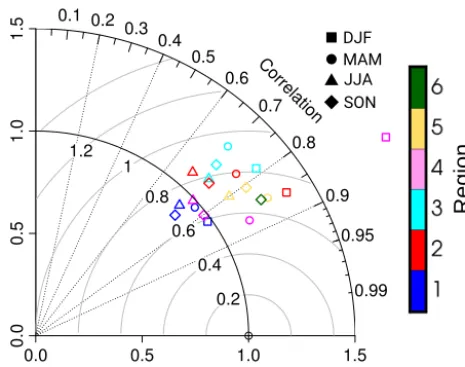
Figure 4.Taylor diagram showing the temporal correlation and ra-tio of standard deviara-tion between the regional series in the WRF-ERA simulation and the observations across all four seasons. For obtaining the regional series, the regions defined for WRF-ERA are used in both datasets. Different symbols denote the result for each season, whereas the colours correspond to the different regions ac-cording to the legend and spatial structure shown in the middle col-umn in Fig. 2.
Table 1. Number of regions obtained after the cluster analysis of daily precipitation. The shape of such regions is shown in Fig. 2. The number of EOFs retained is kept to seven in all cases, which corresponds to a explained variance above 80 % in all cases.
OBS WRF-ERA WRF-CESM
DJF 5 4 6
MAM 5 5 6
JJA 5 5 5
SON 5 6 4
ous, and the regions are defined with clear boundaries. There are a number of reasons that help to explain such differences. The most prominent is the different resolution. OBS has an effective resolution of about 20 km (see Sect. 2.1), whereas both simulations reach 2 km in the innermost domain (al-though the regionalisation has been obtained with a coarser-resolution version of the data of 6 km due to computational constrains). Note that the effective resolution of the simula-tions is coarser than 2 km, as it is between 2 and 4 times the one implemented in the simulation (Pielke Sr., 2013). The coarser resolution in the gridded product of observations con-tributes to the smoothing of the regions and therefore to their clearer definition. The absence of strong orographic features (mountain tops, valleys, etc.) that can be recognised in Fig. 2 for the gridded observations might be attributable to the com-bined effect of coarser effective resolution plus the fact that
there are fewer observations in the high mountain regions. This is an important limiting factor in gridded products for precipitation in complex topography areas.
The rationale of regionalisation consists of finding groups of grid points where precipitation variability within such gion is coherent, whereas differences between different re-gions are maximised. The discussion so far has focussed on a qualitative description of the outcome of the regionalisa-tion, without analysing in detail to what extent these regions can be regarded as different (the dendrograms used to es-tablish the number of regions are not shown, for instance). Therefore, we analyse next in a quantitative fashion the co-herence of the regions through correlation analysis. For this, the daily precipitation series in each grid point is grouped for each region and averaged to obtain regional series. Then, the cross correlation between all series is calculated for each dataset and season, and shown with a colour scale in Fig. 3. Note that there is no one-to-one correspondence between the regions in different datasets and seasons, so the labelling (1 to 6) of these figures has to be carefully read from Fig. 2. Correlations of daily regional-averaged precipitation are gen-erally large, above 0.7 in many cases and never negative. This indicates that, despite the complex orography of the regions under study, precipitation evolves very coherently across Switzerland. Still, there are noticeable exceptions that appear as bands with more greenish and reddish colours. In winter, region 4 in the observations, 3 in WRF-ERA and 2 in WRF-CESM exhibit the lowest correlations, reaching 0.2 in certain combinations of regions. Compared with Fig. 2, these regions are located south of the Alps and largely cor-respond to southern Switzerland, which stand out as regions with a remarkable, different behaviour. Similarly, in spring, the regions most strongly detached from the behaviour of the rest are regions 4 and 5 in the observations, regions 4 and 5 in WRF-ERA and regions 2 and 5 in WRF-CESM, which again correspond to the same southeastern part of the country (see Fig. 2). In summer, the northwest–southeast separation is still apparent and similar in both simulations (region 5 in both simulations, which corresponds to Ticino, is the most clearly decoupled), while such differentiation, although qual-itatively similar, is not so strong in the observations, which exhibit correlations of up to 0.6 with region 1 in the north-east. Finally, in autumn, the number of regions in both simu-lations is different (6 and 4) in WRF-ERA and WRF-CESM, respectively. However, the correlations in the bottom row in Fig. 3 show that this apparently different regionalisation can be understood in the same terms of northwest–southeast sep-aration, as regions 4, 5 and 6 in WRF-ERA are the coun-terpart of region 2 in WRF-CESM, and the three former re-gions behave collectively as the latter in terms of separation with respect to the rest of the domain. The observations also reproduce this pattern in autumn, although less clear, as cor-relations between regions are never below 0.4.
Table 2.Number of grid points that belong to each of the regions shown in Fig. 2. Only grid points within the Swiss domain, i.e. those not missing values in OBS, are counted. Note that in some cases the number of regions is lower than 6; therefore, we indicate it with en dash.
DJF MAM JJA SON
OBS WE WC OBS WE WC OBS WE WC OBS WE WC
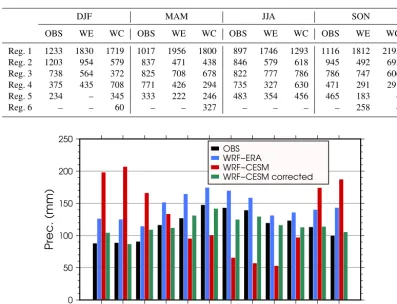
Reg. 1 1233 1830 1719 1017 1956 1800 897 1746 1293 1116 1812 2193 Reg. 2 1203 954 579 837 471 438 846 579 618 945 492 693 Reg. 3 738 564 372 825 708 678 822 777 786 786 747 606 Reg. 4 375 435 708 771 426 294 735 327 630 471 291 291 Reg. 5 234 – 345 333 222 246 483 354 456 465 183 –
Reg. 6 – – 60 – – 327 – – – – 258 –
0 50 100 150 200 250
Prec. (mm)
Jan Feb Mar Apr May Jun Jul Aug Sep Oct Nov Dec OBS
WRF−ERA WRF−CESM
WRF−CESM corrected
Figure 5.Seasonal cycle of monthly precipitation over Switzerland in the observations (black), the ERA simulation (blue), the WRF-CESM simulation (red) and bias-corrected WRF-WRF-CESM simulation (green).
1979–2005 is explored through a Taylor diagram that com-pares this dataset to the observations. Note that in this case the comparison with WRF-CESM is not meaningful due to the lack of assimilation of observations in the CESM simula-tion; therefore, we skipped that dataset in the following anal-ysis. The skill is assessed for each regional series separately. This generates an inconsistency that complicates the calcula-tion, as the number and shape of regions are different for the observations and WRF-ERA (see first and second columns in Fig. 2). We solve this by using the same regions to obtain the regional series in both datasets, which correspond to the ones obtained with WRF-ERA (second column in Fig. 2). The as-sessment of the skill is shown in Fig. 4, which depicts the results for each season (symbols) and region (colours). Daily correlations between WRF-ERA and OBS range between 0.6 and 0.9 in all cases, with an average of 0.78 (0.74 for sum-mer and 0.83 for winter, respectively). This supports the lack of systematic errors attributable to driving conditions. Differ-ences also appear in the ability of the simulation to mimic the temporal variability of precipitation. Region 1, which repre-sents fairly consistently the central plains of Switzerland in all seasons, is where the agreement between the simulation
and observations is best, with a ratio of standard deviations close to 1. In the rest of regions, the model overestimates the variance about 20 % compared to the observations. Part of this bias can be explained in terms of the systematic over-estimation of precipitation through the annual cycle in the WRF-ERA simulation described in the next section. How-ever, a striking feature is the severe overestimation of simu-lated precipitation in region 4 in winter, which corresponds to a cluster that is only identified in the simulation, and spans the highest mountains in the Alps (see Fig. 2). As argued above, the observations in such locations are generally less reliable and are more strongly affected by extrapolation arti-facts (due to data sparsity), and therefore a plausible expla-nation for this outlier is the underestimation of actual precip-itation and its variance in the observational product.
0 100 200 300 400 500 600 700 800 900 1000 (a) OBS (b) WRF-ERA (c) WRF-CESM
DJF
JJA
MAM
SON
(d) WRF-CESM cor.
Prec (mm)
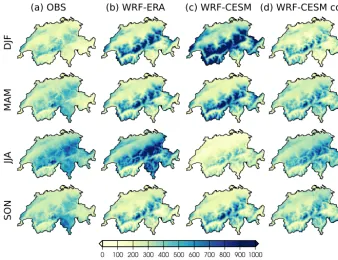
Figure 6.Mean seasonal accumulated precipitation over Switzerland across seasons (different rows) in the gridded observations(a), the WRF-ERA simulation(b), the WRF-CESM simulation(c)and the bias-corrected WRF-CESM simulation(d).
example, the lack of correlations below 0.4 in summer or 0.3 in autumn). The more pronounced differentiation of regional characteristics in the simulations compared to the observa-tions might be explained by the effectively coarser resolution of the observational gridded product of precipitation. More-over, the Taylor diagram demonstrates the acceptable perfor-mance of the WRF-ERA simulation as a plausible surrogate of the evolution of precipitation in Switzerland during the ERA-Interim period.
4.2 Climatology and annual cycle
In this section, we compare the downscaled precipitation driven by ERA-Interim and CESM to observations to iden-tify systematic model deficiencies leading to biases of the downscaled precipitation (Figs. 5 and 6). Figure 5 shows the precipitation averaged over Switzerland separately for each month, thereby emphasising the annual cycle, whereas Fig. 6 presents the maps of accumulated precipitation for each sea-son (by columns) and dataset (columns 1 to 3).
The seasonality of precipitation is well reproduced by the WRF-ERA simulation (see blue bars in Fig. 5, as well as first and second columns in Fig. 6), showing a peak in the summer months (June to August) and the driest months in winter. However, the WRF-ERA simulation generally over-estimates precipitation throughout the year, in particular dur-ing December and January, which can be linked to the over-estimation of precipitation variability identified in the pre-vious section. This overestimation is especially noticeable
0.03 0.06 0.09
1 2 5 10 20 50
DJF
0.03 0.06 0.09
1 2 5 10 20 50
MAM
0.03 0.06 0.09 0.12 0.15 0.18
1 2 5 10 20 50
Prec (mm) JJA
0.03 0.06 0.09
1 2 5 10 20 50
Prec (mm) SON
OBS WRF−CESM
WRF−ERA Corrected
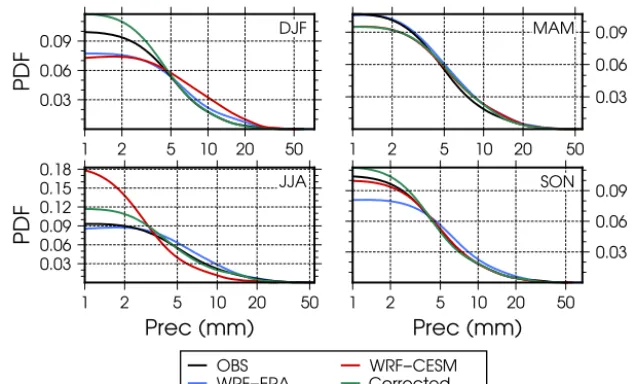
Figure 7.Estimated probability density functions (PDFs) of daily precipitation averaged over Switzerland. Each panel depicts the result for a season, and different colours are representative of the results for different datasets according to the choice in Fig. 5. Note the logarithmic scale in thexaxis, which precludes the area below all curves being equal.
observed patterns (Fig. 6) lies between 0.78 (in winter) and 0.84 (in summer). These results can be compared to those ob-tained with an ensemble of RCM simulations driven by ERA-Interim within the EURO-CORDEX and MED-CORDEX projects. Figure 2 in Fantini et al. (2016) is similar to Fig. 6 here, although the model resolution and observational grid-ded product used to validate the models are different. Further, Fig. 5 in Fantini et al. (2016) shows a similar annual cycle as Fig. 5 here, but the Alps domain they consider is consider-ably larger, including western France, a great part of Aus-tria and the northern half of Italy. The comparison of these figures shows strong agreements; e.g. the simulations repro-duce an orographical pattern with the highest precipitation over the Alps, they consistently overestimates precipitation, and they closely follow the annual cycle with the respective observational product. However, a remarkable difference is that the annual cycle in the Alps domain in Fantini et al. (2016) presents a bimodal curve without the unique and clear summer maximum we find for Switzerland and is consistent between WRF-ERA and the observations. Since the observa-tional products are both of high quality and similar character-istics, this discrepancy is attributable to the disparity between the domains both studies consider.
As expected, the performance of the simulation when WRF is driven by CESM is lower (see red bars in Fig. 5, and first and third columns in Fig. 6). WRF-CESM shows strong deviations in the seasonal cycle with a maximum of precipitation in the extended winter season from November to March and a strong underestimation of precipitation in summer (Fig. 5). Strikingly, this behaviour is reversed for the observations, which show a peak in the summer months from June to August and less precipitation in winter. The spatial disaggregation of these biases is further explored in the
DJF MAM
JJA SON
0.80 0.82 0.84 0.86 0.88 0.90 0.92 0.94 0.96 0.98 1.00 Correlation
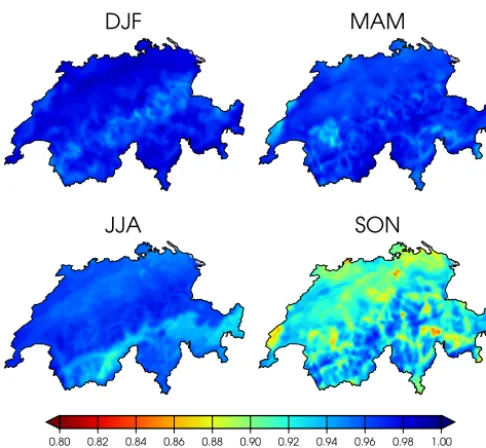
Figure 8.Correlation maps between the daily series of precipitation in the raw WRF-CESM simulation and the output of the bias cor-rected. The analysis is carried out separately by seasons to minimise the effect of the annual cycle on correlation.
An important outcome of these simulations is the potential application to the study of extreme events. This type of study demands the disaggregation of precipitation into shorter pe-riods than monthly averages. Although the daily correlation between WRF-ERA and OBS was shown in the Taylor dia-gram in Fig. 4, the ability of WRF to reproduce daily precip-itation has not been explicitly analysed so far. Therefore, we evaluate model biases at daily scale by showing the proba-bility density function (PDF) of daily precipitation averaged over Switzerland for each season (Fig. 7). The overestimation of winter precipitation in the WRF-CESM simulation stands out as an underestimation of the frequency of days with pre-cipitation below 5 mm, i.e. the so-called “drizzling effect”, and its counterpart in the higher frequency of precipitation above 10 mm. WRF-ERA behaves similar to WRF-CESM, although the magnitude of this bias is lower. In summer, the WRF-ERA simulation is able to mimic the distribution of precipitation. The WRF-CESM simulation exhibits a dis-torted PDF of daily precipitation in summer, as the frequency of days with precipitation below 3 mm is strongly overesti-mated. This leads to the severe underestimation of precipita-tion apparent in Fig. 6. The comparison with the simulaprecipita-tion driven by ERA-Interim, as well as the aforementioned re-sults within the EURO-CORDEX ensemble (Fantini et al., 2016), shows that this systematic error becomes attributable to biases in the boundary conditions provided by the CESM model. In the intermediate seasons of spring and autumn, both simulations exhibit an mixed behaviour, and their skill is remarkably good in spring. Indeed, WRF-CESM allegedly outperforms WRF-ERA in autumn. However, the latter is not
a demonstration of model performance, but an error cancel-lation artifact, as can be shown evaluating the performance through moving seasons (not shown). The behaviour of bi-ases during this season is a combination of the ones in sum-mer and winter, which are opposites and therefore tend to cancel out when pooled to obtain the PDF.
5 Bias correction of the WRF-CESM simulation From the results described so far, three important conclusions can be drawn:
– WRF-ERA mimics many important features of the ob-served spatiotemporal distribution of precipitation, even at daily scale and through the annual cycle.
– The spatial structure of precipitation variability is strongly affected by orographic features and is pre-scribed by the RCM. This leads to consistency between WRF-ERA and WRF-CESM, and together with the first point, supports the reliability of the latter simulation. – The temporal evolution is driven by the boundary
condi-tions, and in particular WRF-CESM presents important systematic biases through the annual cycle that cannot be removed with dynamical downscaling alone. These conclusions together suggest that although the out-put of WRF-CESM is a valuable resource with potential ap-plications, it might be desirable to postprocess this dataset in a way that systematic biases are ameliorated. Therefore, the new bias-correction method binding cluster analysis and quantile mapping (Sect. 3) is applied to the WRF-CESM sim-ulation.
of days with very low precipitation in winter is corrected, al-though it leads to a slight overestimation. This effect occurs when models tend to underestimate the dry-day frequency, as all days become mapped onto a precipitation day, producing a wet bias. This could be further corrected using frequency adaptation techniques (Themeßl et al., 2012), although we have not considered such techniques here. Above 5 mm, the precipitation PDF is remarkably well captured. Similarly, in summer, the bias correction improves the PDF, although it does not completely remove the overestimation (underesti-mation) of the frequency of dry (wet) days; above 4 mm the simulated PDF is barely distinguishable from the observed one. Again, intermediate seasons exhibit a mixed behaviour. In autumn, the PDF of bias-corrected WRF-CESM simula-tion is apparently worse than the uncorrected WRF-CESM simulation. This reinforces the argument developed above re-garding the apparent skill of the simulation in this season due to error cancellation.
As the proposed bias correction employs a non-linear transformation on a daily basis, which is based on a trans-fer function that diftrans-fers for each month within the annual cycle, it does not simply scale precipitation but modifies it in a complex manner. Such modification slightly changes the temporal evolution of precipitation at every grid point. This is an undesired side effect, as the temporal co-evolution of all simulated variables is bounded by the equations being solved by the model, and therefore modifications to this evolution may underscore the most valuable aspects of the dynamical downscaling: its physical consistency (Maraun, 2016). This effect is unavoidable; it depends on factors such as the mag-nitude of the biases, their location within the precipitation distribution or their variability through the annual cycle, and should be ideally kept to a minimum. We demonstrate how the applied bias correction has only slightly affected the tem-poral evolution in Fig. 8, which shows the daily correlation separately by seasons to avoid the overestimation of correla-tion due to the annual cycle. The point-wise correlacorrela-tion be-tween the raw and corrected simulations is well above 0.8 in all seasons across the domain and lower than 0.9 in autumn in just a few quasi-random locations. The lower correlation in this season is motivated by the larger variability of the na-ture of biases within this season, which drives a large spread between the transfer functions for the 3 months and therefore reduces the linear relationship between raw and corrected series (not shown). There is no obvious indication in these maps of geographical influences (orographic, longitudinal, etc.) that might point out systematical errors attributable to a misrepresentation of physical processes at regional scales.
6 Conclusions
This study presents the performance and biases of two high-resolution climate simulations and introduces a new bias-correction technique that reduces systematic biases based on
the regionalisation of precipitation. The simulations span the recent past (1979–2005) over the entire Alpine region, al-though we limit the analysis and bias correction of the sim-ulation to the area of Switzerland due to the limited spa-tial coverage of the observational product we use as refer-ence. Both simulations are carried out with a RCM driven by two global datasets, an ESM (CESM) and a reanalysis prod-uct (ERA-Interim). The bias correction is based on quantile mapping, but it is separately applied to different regions of common variability, which are identified by objective cluster analyses.
The comparison between simulations and observations shows that regions of common variability agree between the two simulations and to a great extent with the observations. Still, the observed regions of common variability lack of many fine details found in the simulations due to the coarser effective resolution RhiresD data and potentially the sparse data network at high altitudes. Besides the regional classifi-cation, further agreements and differences between the sim-ulations and observations are found. The WRF-ERA simu-lation is able to simulate the seasonal cycle but consistently overestimates precipitation by about 20 %. The day-to-day variability is captured by the WRF-ERA simulation with rather high positive correlation, but the simulated variabil-ity is again larger than in the observations. At least for win-ter, overestimation of simulated variance is related to a po-tential underestimation of observed precipitation due to the sparsity of observations in high mountains. The biases of the WRF-CESM simulation are expected to be larger as the driv-ing CESM data do not incorporate observations. The WRF-CESM simulation is not able to simulate the seasonal cycle correctly with a strong overestimation (underestimation) of winter (summer) precipitation.
To correct for these systematic biases, a new bias-correction technique is applied to the WRF-CESM simula-tion. The separation in regions of common variability by the cluster analysis acknowledges the fact that biases in differ-ent regions and seasons are produced by differdiffer-ent physical mechanisms, and minimises the risk of error cancellation. This method clearly improves simpler approaches that do not account for this heterogeneity, and is an issue when quantile mapping is applied to larger regions like all of Switzerland (Felder et al., 2018). The spatial structure of bias-corrected precipitation is preserved compared to the original WRF-CESM, but the seasonality is corrected in a way that nearly mimics the observations. This improvement is also found when analysing the daily scale. This means that the temporal evolution of the simulation, which emerges from the phys-ical consistency of the simulation, is greatly preserved, as the daily temporal correlation between the raw and corrected versions of the WRF-CESM simulation is above 0.9 in most cases, except for few quasi-random grid points in autumn.
it here to daily precipitation in Switzerland as it is a variable strongly affected by complex orographical details that lead to strong horizontal gradients. With more generality, spatial re-gionalisation is an efficient method to break down complex-ity in areas and variables whose behaviour strongly varies through the domain. Still, the bias correction applied sepa-rately to subregions can be in principle adapted to other cases with simpler topography or other variables with lower hori-zontal gradients. The only practical difference is that in this case the regionalisation will naturally lead to a lower num-ber of subregions which are necessary to obtain clusters with coherent features.
Finally, the applicability of the three datasets, i.e. ERA, the raw CESM or the corrected version of WRF-CESM, depends on the nature of the question to be ad-dressed. For applications where a match with the actual ob-served climate is needed, the ERA-Interim-driven simula-tions is suitable. However, there are research quessimula-tions for which a simulation driven by an ESM, such as WRF-CESM, is necessary. This is, for example, the case for climate change projections, but also climate simulations of past conditions or studies of extreme situations in long simulations (Felder et al., 2018) or sensitivity studies (Messmer et al., 2015). Fi-nally, the use of corrected variables is advisable only when an accurate simulation of the magnitude of the variable un-der consiun-deration is critical for the application. An example is the use of output of climate simulation as input in hydro-logical modelling (Camici et al., 2014; Felder et al., 2018), as the magnitude of rainfall in a given location, and not only its large-scale structure or temporal consistency, is crucial for an realistic simulation of river discharge.
Code availability. All code used through this paper is open source. WRF is a community model that can be downloaded from its web page (http://www2.mmm.ucar.edu/wrf/users, Skamarock et al., 2015). The code to perform the regionalisation, as well as the Taylor diagram, is based on R and Bash scripts, whereas quantile map-ping and PDF estimation is implemented with Fortran 90. The source code of these tools is available in a GitHub repository (https: //github.com/Onturenio/BiasCor, Gómez-Navarro, 2018). Simple calculations carried out at each grid point (means, correlations, etc.) have been performed with CDO (https://code.mpimet.mpg.de/ projects/cdo, The CDO developing team, 2018). The figures have been prepared with GMT (http://gmt.soest.hawaii.edu, Wessel et al., 2018).
Data availability. The CESM simulation was carried out at the University of Bern and is available once approved by the orig-inal authors. The ERA-Interim dataset can be downloaded from the ECMWF web page, although it requires previous registration. The two datasets produced, WRF-ERA and WRF-CESM, consist of hourly output of a number of variables and therefore occupy several terabytes, and are not freely accessible. Still, they can be accessed upon request to the authors of this paper.
Author contributions. JJGN coordinated the work, carried out the WRF-ERA simulation and the calculations of this paper. CR con-tributed to the design of the simulations and their analysis. DB car-ried out the WRF-CESM simulation. OM helped in the design of the simulations and the discussion of the results. JAGV provided the code to carry out the regionalisation and helped in its analysis. JPMG provided ideas for new approaches in the analysis of the sim-ulations that have been integrated in the final manuscript. The paper has been written by JJGN and CR, and all authors have contributed reviewing the text.
Competing interests. The authors declare that they have no conflict of interest.
Acknowledgements. This work is supported by the Mobiliar Lab and the Swiss National Science Foundation (grant pleistoCEP – no. 200020_159563). The CESM and WRF simulations were performed on the supercomputing architecture of the Swiss National Supercomputing Centre (CSCS). JJGN acknowledges the CARM for the funding provided through the Seneca Foundation (project 20022/SF/16). Special thanks are due to Flavio Lehner who performed the seamless transient simulation with CESM.
Edited by: Augustin Colette
Reviewed by: two anonymous referees
References
Argüeso, D., Evans, J. P., and Fita, L.: Precipitation bias correction of very high resolution regional climate models, Hydrol. Earth Syst. Sci., 17, 4379–4388, https://doi.org/10.5194/hess-17-4379-2013, 2013.
Awan, N. K., Truhetz, H., and Gobiet, A.: Parameterization-induced error characteristics of MM5 and WRF operated in climate mode over the Alpine region: an ensemble-based analysis, J. Climate, 24, 3107–3123, https://doi.org/10.1175/2011JCLI3674.1, 2011. Ban, N., Schmidli, J., and Schär, C.: Evaluation of the
convection-resolving regional climate modeling approach in decade-long simulations, J. Geophys. Res.-Atmos., 119, 7889–7907, https://doi.org/10.1002/2014JD021478, 2014.
Bedia, J., Bhend, J., De Felice, M., Fernández, J., Frías, M. D., Gutiérrez, J. M., Herrera, S., Iturbide, M., Manzanas, R., Med-ina, J. B., Szabo-Takacs, B., and Tuni, M.: downscaleR: An R package for climate data bias correction and downscaling (part of the climate4R bundle), available at: https://github.com/ SantanderMetGroup/downscaleR, last access: 11 June 2018. Bracegirdle, T. J., Shuckburgh, E., Sallee, J.-B., Wang, Z.,
Mei-jers, A. J. S., Bruneau, N., Phillips, T., and Wilcox, L. J.: As-sessment of surface winds over the Atlantic, Indian, and Pacific Ocean sectors of the Southern Ocean in CMIP5 models: histor-ical bias, forcing response, and state dependence, J. Geophys. Res.-Atmos., 118, 547–562, https://doi.org/10.1002/jgrd.50153, 2013.
González-Rouco, F., Grosjean, M., Hoffmann, R. C., Huhtamaa, H., Joos, F., Kiss, A., Kotyza, O., Lehner, F., Luterbacher, J., Maughan, N., Neukom, R., Novy, T., Pribyl, K., Raible, C. C., Riemann, D., Schuh, M., Slavin, P., Werner, J. P., and Wetter, O.: The 1430s: a cold period of extraordinary internal climate vari-ability during the early Spörer Minimum with social and eco-nomic impacts in north-western and central Europe, Clim. Past, 12, 2107–2126, https://doi.org/10.5194/cp-12-2107-2016, 2016. Camici, S., Brocca, L., Melone, F., and Moramarco, T.: Impact of climate change on flood frequency using different climate mod-els and downscaling approaches, J. Hydrol. Eng., 19, 04014002, https://doi.org/10.1061/(ASCE)HE.1943-5584.0000959, 2014. Casanueva, A., Kotlarski, S., Herrera, S., Fernández, J.,
Gutiér-rez, J. M., Boberg, F., Colette, A., Christensen, O. B., Go-ergen, K., Jacob, D., Keuler, K., Nikulin, G., Teichmann, C., and Vautard, R.: Daily precipitation statistics in a EURO-CORDEX RCM ensemble: added value of raw and bias-corrected high-resolution simulations, Clim. Dynam. 47, 719– 737, https://doi.org/10.1007/s00382-015-2865-x, 2016. Casanueva, A., Bedia, J., Herrera, S., Fernández, J., and
Gutiérrez, J. M.: Direct and component-wise bias correc-tion of multi-variate climate indices: the percentile adjust-ment function diagnostic tool, Climatic Change, 147, 411–425, https://doi.org/10.1007/s10584-018-2167-5, 2018.
Chen, F. and Dudhia, J.: Coupling an advanced land surface-hydrology model with the Penn State-NCAR MM5 model-ing system. Part I: Model implementation and sensitivity, Mon. Weather Rev., 129, 569–585, https://doi.org/10.1175/1520-0493(2001)129<0569:CAALSH>2.0.CO;2, 2001.
Chikamoto, M. O., Timmermann, A., Yoshimori, M., Lehner, F., Laurian, A., Abe-Ouchi, A., Mouchet, A., Joos, F., Raible, C. C., and Cobb, K. M.: Intensification of tropical Pacific biological productivity due to volcanic eruptions, Geophys. Res. Let., 43, 2015GL067359, https://doi.org/10.1002/2015GL067359, 2016. Dee, D. P., Uppala, S. M., Simmons, A. J., Berrisford, P., Poli,
P., Kobayashi, S., Andrae, U., Balmaseda, M. A., Balsamo, G., Bauer, P., Bechtold, P., Beljaars, A. C. M., van de Berg, L., Bid-lot, J., Bormann, N., Delsol, C., Dragani, R., Fuentes, M., Geer, A. J., Haimberger, L., Healy, S. B., Hersbach, H., Hólm, E. V., Isaksen, L., Kållberg, P., Köhler, M., Matricardi, M., McNally, A. P., Monge-Sanz, B. M., Morcrette, J.-J., Park, B.-K., Peubey, C., de Rosnay, P., Tavolato, C., Thépaut, J.-N., and Vitart, F.: The ERA-Interim reanalysis: configuration and performance of the data assimilation system, Q. J. Roy. Meteor. Soc., 137, 553–597, https://doi.org/10.1002/qj.828, 2011.
Dosio, A.: Projections of climate change indices of tem-perature and precipitation from an ensemble of bias-adjusted high-resolution EURO-CORDEX regional cli-mate models, J. Geophys. Res.-Atmos., 121, 5488–5511, https://doi.org/10.1002/2015JD024411, 2016.
Dudhia, J.: Numerical study of convection ob-served during the winter monsoon experiment us-ing a mesoscale two-dimensional model, J. Atmos. Sci., 46, 3077–3107, https://doi.org/10.1175/1520-0469(1989)046<3077:NSOCOD>2.0.CO;2, 1989.
Fantini, A., Raffaele, F., Torma, C., Bacer, S., Coppola, E., Giorgi, F., Ahrens, B., Dubois, C., Sanchez, E., and Verdecchia, M.: Assessment of multiple daily precipitation statistics in ERA-Interim driven Med-CORDEX and EURO-CORDEX
experi-ments against high resolution observations, Clim. Dynam., 1–24, https://doi.org/10.1007/s00382-016-3453-4, 2016.
Felder, G., Gómez-Navarro, J. J., Zischg, A., Raible, C. C., Röth-lisberger, V., Bozhinova, D., Martius, O., and Weingartner, R.: From global circulation to local flood loss: Coupling mod-els across the scales, Sci. Total Environ., 635, 1225–1239, https://doi.org/10.1016/j.scitotenv.2018.04.170, 2018.
Froidevaux, P. and Martius, O.: Exceptional integrated vapour transport toward orography: an important precursor to severe floods in Switzerland: Integrated Vapour Transport and Floods in Switzerland, Q. J. Roy. Meteor. Soc., 142, 1997–2012, https://doi.org/10.1002/qj.2793, 2016.
Gent, P. R., Danabasoglu, G., Donner, L. J., Holland, M. M., Hunke, E. C., Jayne, S. R., Lawrence, D. M., Neale, R. B., Rasch, P. J., Vertenstein, M., Worley, P. H., Yang, Z.-L., and Zhang, M.: The Community Climate System Model Version 4, J. Climate, 24, 4973–4991, https://doi.org/10.1175/2011JCLI4083.1, 2011. Giorgi, F., Torma, C., Coppola, E., Ban, N., Schär, C., and Somot,
S.: Enhanced summer convective rainfall at Alpine high eleva-tions in response to climate warming, Nat. Geosci., 9, 584–589, https://doi.org/10.1038/ngeo2761, 2016.
Gómez-Navarro, J. J., Montávez, J. P., Jerez, S., Jiménez-Guerrero, P., and Zorita, E.: What is the role of the observational dataset in the evaluation and scoring of climate models?, Geophys. Res. Lett., 39, L24701, https://doi.org/10.1029/2012GL054206, 2012. Gómez-Navarro, J. J., Raible, C. C., and Dierer, S.: Sensitivity of the WRF model to PBL parametrisations and nesting techniques: evaluation of wind storms over complex terrain, Geosci. Model Dev., 8, 3349–3363, https://doi.org/10.5194/gmd-8-3349-2015, 2015.
Gómez-Navarro, J. J.: A repository with programs and scripts to perform bias correction of RCM data, available at: https://github. com/Onturenio/BiasCor, last access: 11 June 2018.
Gudmundsson, L., Bremnes, J. B., Haugen, J. E., and Engen-Skaugen, T.: Technical Note: Downscaling RCM precipitation to the station scale using statistical transformations – a com-parison of methods, Hydrol. Earth Syst. Sci., 16, 3383–3390, https://doi.org/10.5194/hess-16-3383-2012, 2012.
Haylock, M. R., Hofstra, N., Klein Tank, a. M. G., Klok, E. J., Jones, P. D., and New, M.: A European daily high-resolution gridded data set of surface temperature and pre-cipitation for 1950–2006, J. Geophys. Res., 113, D20119, https://doi.org/10.1029/2008JD010201, 2008.
Hong, S. and Lim, J.: The WRF single-moment 6-class micro-physics scheme (WSM6), Journal of Korean Meteorology So-ciety, 42, 129–151, 2006.
Hong, S.-Y., Noh, Y., and Dudhia, J.: A new vertical dif-fusion package with an explicit treatment of entrain-ment processes, Mon. Weather Rev., 134, 2318–2341, https://doi.org/10.1175/MWR3199.1, 2006.
Houze, R. A., James, C. N., and Medina, S.: Radar observations of precipitation and airflow on the Mediterranean side of the Alps: Autumn 1998 and 1999, Q. J. Roy. Meteor. Soc., 127, 2537– 2558, https://doi.org/10.1002/qj.49712757804, 2001.
Mar-shall, S.: The Community Earth System Model: A framework for collaborative research, B. Am. Meteorol. Soc., 94, 1339–1360, https://doi.org/10.1175/BAMS-D-12-00121.1, 2013.
IPCC: Climate Change 2013: The Physical Science Basis. Contri-bution of Working Group I to the Fifth Assessment Report of the Intergovernmental Panel on Climate Change, Cambridge Uni-versity Press, Cambridge, United Kingdom and New York, NY, USA, https://doi.org/10.1017/CBO9781107415324, 2013. IPCC-SREX: Managing the risks of extreme events and disasters
to advance climate change adaption: special report of the Inter-governmental Panel on Climate Change, Cambridge University Press, Cambridge, United Kingdom and New York, NY, USA, 582, 2012.
Isotta, F. A., Frei, C., Weilguni, V., Perˇcec Tadi´c, M., Lasségues, P., Rudolf, B., Pavan, V., Cacciamani, C., Antolini, G., Ratto, S. M., Munari, M., Micheletti, S., Bonati, V., Lussana, C., Ronchi, C., Panettieri, E., Marigo, G., and Vertaˇcnik, G.: The climate of daily precipitation in the Alps: development and analysis of a high-resolution grid dataset from pan-Alpine rain-gauge data: CLI-MATE OF DAILY PRECIPITATION IN THE ALPS, Int. J. Cli-matol., 34, 1657–1675, https://doi.org/10.1002/joc.3794, 2014. Jacob, D., Petersen, J., Eggert, B., Alias, A., Christensen, O. B.,
Bouwer, L. M., Braun, A., Colette, A., Déqué, M., Georgievski, G., Georgopoulou, E., Gobiet, A., Menut, L., Nikulin, G., Haensler, A., Hempelmann, N., Jones, C., Keuler, K., Kovats, S., Kröner, N., Kotlarski, S., Kriegsmann, A., Martin, E., Meijgaard, E. v., Moseley, C., Pfeifer, S., Preuschmann, S., Radermacher, C., Radtke, K., Rechid, D., Rounsevell, M., Samuelsson, P., Somot, S., Soussana, J.-F., Teichmann, C., Valentini, R., Vautard, R., Weber, B., and Yiou, P.: EURO-CORDEX: New high-resolution climate change projections for European impact research, Reg. Environ. Change, 14, 563–578, https://doi.org/10.1007/s10113-013-0499-2, 2013.
Jiménez, P. A. and Dudhia, J.: Improving the representation of resolved and unresolved topographic effects on surface wind in the WRF model, J. Appl. Meteorol. Clim., 51, 300–316, https://doi.org/10.1175/JAMC-D-11-084.1, 2012.
Kain, J. S.: The Kain-Fritsch convective pa-rameterization: An update, J. Appl. Meteo-rol., 43, 170–181, https://doi.org/10.1175/1520-0450(2004)043<0170:TKCPAU>2.0.CO;2, 2004.
Keller, K. M., Joos, F., Lehner, F., and Raible, C. C.: Detecting changes in marine responses to ENSO from 850 to 2100 C.E.: Insights from the ocean carbon cycle, Geophys. Res. Let., 42, 2014GL062398, https://doi.org/10.1002/2014GL062398, 2015. Kotlarski, S., Keuler, K., Christensen, O. B., Colette, A., Déqué,
M., Gobiet, A., Goergen, K., Jacob, D., Lüthi, D., van Meij-gaard, E., Nikulin, G., Schär, C., Teichmann, C., Vautard, R., Warrach-Sagi, K., and Wulfmeyer, V.: Regional climate model-ing on European scales: a joint standard evaluation of the EURO-CORDEX RCM ensemble, Geosci. Model Dev., 7, 1297–1333, https://doi.org/10.5194/gmd-7-1297-2014, 2014.
Lehner, F., Joos, F., Raible, C. C., Mignot, J., Born, A., Keller, K. M., and Stocker, T. F.: Climate and carbon cycle dynamics in a CESM simulation from 850 to 2100 CE, Earth Syst. Dynam., 6, 411–434, https://doi.org/10.5194/esd-6-411-2015, 2015. Maraun, D.: Bias correcting climate change simulations – a
crit-ical review, Current Climate Change Reports, 2, 211–220, https://doi.org/10.1007/s40641-016-0050-x, 2016.
Maraun, D., Shepherd, T. G., Widmann, M., Zappa, G., Walton, D., Gutiérrez, J. M., Hagemann, S., Richter, I., Soares, P. M. M., Hall, A., and Mearns, L. O.: Towards process-informed bias cor-rection of climate change simulations, Nat. Clim. Change, 7, nclimate3418, https://doi.org/10.1038/nclimate3418, 2017. Martius, O., Zenklusen, E., Schwierz, C., and Davies, H. C.:
Episodes of alpine heavy precipitation with an overlying elon-gated stratospheric intrusion: a climatology, Int. J. Climatol., 26, 1149–1164, https://doi.org/10.1002/joc.1295, 2006.
Messmer, M., Gómez-Navarro, J. J., and Raible, C. C.: Climatol-ogy of Vb cyclones, physical mechanisms and their impact on extreme precipitation over Central Europe, Earth Syst. Dynam., 6, 541–553, https://doi.org/10.5194/esd-6-541-2015, 2015. Messmer, M., Gómez-Navarro, J. J., and Raible, C. C.:
Sensitiv-ity experiments on the response of Vb cyclones to sea surface temperature and soil moisture changes, Earth Syst. Dynam., 8, 477–493, https://doi.org/10.5194/esd-8-477-2017, 2017. MeteoSwiss: Daily precipitation (final analysis): RhiresD,
available at: http://www.meteoswiss.admin.ch/content/ dam/meteoswiss/de/service-und-publikationen/produkt/ raeumliche-daten-niederschlag/doc/ProdDoc_RhiresD.pdf (last access: 11 June 2018), 2016.
Mlawer, E. J., Taubman, S. J., Brown, P. D., Iacono, M. J., and Clough, S. A.: Radiative transfer for inhomogeneous atmospheres: RRTM, a validated correlated-k model for the longwave, J. Geophys. Res.-Atmos., 102, 16663–16682, https://doi.org/10.1029/97JD00237, 1997.
Montesarchio, M., Zollo, A. L., Bucchignani, E., Mercogliano, P., and Castellari, S.: Performance evaluation of high-resolution re-gional climate simulations in the Alpine space and analysis of extreme events, J. Geophys. Res.-Atmos., 119, 2013JD021105, https://doi.org/10.1002/2013JD021105, 2014.
Nikulin, G., Bosshard, T., Yang, W., Bärring, L., Wilcke, R., Vrac, M., Vautard, R., Noel, T., Gutiérrez, J. M., Herrera, S., Fernán-dez, J., Haugen, J. E., Benestad, R., Landgren, O. A., Grillakis, M., Ioannis, T., Koutroulis, A., Dosio, A., Ferrone, A., and Swi-tanek, M.: Bias Correction Intercomparison Project (BCIP): an introduction and the first results, vol. 17, abstract number 2250, EGU General Assembly 2015, Vienna, Austria, 2015.
PAGES 2k-PMIP3 group: Continental-scale temperature variabil-ity in PMIP3 simulations and PAGES 2k regional temperature reconstructions over the past millennium, Clim. Past, 11, 1673– 1699, https://doi.org/10.5194/cp-11-1673-2015, 2015.
Panziera, L., James, C. N., and Germann, U.: Mesoscale organi-zation and structure of orographic precipitation producing flash floods in the Lago Maggiore region: Orographic Convection in the Lago Maggiore Area, Q. J. Roy. Meteor. Soc., 141, 224–248, https://doi.org/10.1002/qj.2351, 2015.
Pielke Sr., R. A.: Mesoscale meteorological modeling, vol. 98, Aca-demic press, San Diego, California, USA, 2013.
Rajczak, J. and Schär, C.: Projections of Future Precipitation Extremes Over Europe: A Multimodel Assessment of Cli-mate Simulations, J. Geopyhs. Res.-Atmos., 122, 10773–10800, https://doi.org/10.1002/2017JD027176, 2017.
Rajczak, J., Kotlarski, S., and Schär, C.: Does quantile map-ping of simulated precipitation correct for biases in transi-tion probabilities and spell-lengths?, J. Climate, 29, 1605–1615, https://doi.org/10.1175/JCLI-D-15-0162.1, 2016.
Rienecker, M. M., Suarez, M. J., Gelaro, R., Todling, R., Bacmeis-ter, J., Liu, E., Bosilovich, M. G., Schubert, S. D., Takacs, L., Kim, G.-K., Bloom, S., Chen, J., Collins, D., Conaty, A., da Silva, A., Gu, W., Joiner, J., Koster, R. D., Lucchesi, R., Molod, A., Owens, T., Pawson, S., Pegion, P., Redder, C. R., Re-ichle, R., Robertson, F. R., Ruddick, A. G., Sienkiewicz, M., and Woollen, J.: MERRA: NASA’s Modern-Era Retrospective Anal-ysis for Research and Applications, J. Climate, 24, 3624–3648, https://doi.org/10.1175/JCLI-D-11-00015.1, 2011.
Schmidt, G. A., Jungclaus, J. H., Ammann, C. M., Bard, E., Bra-connot, P., Crowley, T. J., Delaygue, G., Joos, F., Krivova, N. A., Muscheler, R., Otto-Bliesner, B. L., Pongratz, J., Shindell, D. T., Solanki, S. K., Steinhilber, F., and Vieira, L. E. A.: Climate forcing reconstructions for use in PMIP simulations of the last millennium (v1.0), Geosci. Model Dev., 4, 33–45, https://doi.org/10.5194/gmd-4-33-2011, 2011.
Skamarock, W. C., Klemp, J. B., Dudhia, J., Gill, D. O., Barker, D. M., Wang, W., and Powers, J. G.: A description of the ad-vanced research WRF version 3, Tech. Rep. TN-475+STR, Na-tional Center for Atmospheric Research, 2008.
Stocker, T. F., Dahe, Q., Plattner, G.-K., and Tignor, M.: IPCC Workshop on Regional Climate Projections and their Use in Im-pacts and Risk Analysis Studies, chap. Breakout Group 3bis: Bias Correction, 21–23, IPCC Working Group I Technical Sup-port Unit, University of Bern, Falkenplatz 16, 3012 Bern, Switzerland, 2015.
Taylor, K. E., Stouffer, R. J., and Meehl, G. A.: An overview of CMIP5 and the experiment design, B. Am. Meteorol. Soc., 93, 485–498, https://doi.org/10.1175/BAMS-D-11-00094.1, 2012. Teng, J., Potter, N. J., Chiew, F. H. S., Zhang, L., Wang, B.,
Vaze, J., and Evans, J. P.: How does bias correction of regional climate model precipitation affect modelled runoff?, Hydrol. Earth Syst. Sci., 19, 711–728, https://doi.org/10.5194/hess-19-711-2015, 2015.
Teutschbein, C. and Seibert, J.: Bias correction of regional climate model simulations for hydrological climate-change impact stud-ies: Review and evaluation of different methods, J. Hydrol., 456– 457, 12–29, https://doi.org/10.1016/j.jhydrol.2012.05.052, 2012. The CDO developing team: Climate Data Operators 2918, available
at: http://www.mpimet.mpg.de/cdo, last access: 11 June 2018. Themeßl, M. J., Gobiet, A., and Leuprecht, A.: Empirical-statistical
downscaling and error correction of daily precipitation from re-gional climate models, International J. Climatol., 31, 1530–1544, https://doi.org/10.1002/joc.2168, 2011.
Themeßl, M. J., Gobiet, A., and Heinrich, G.: Empirical-statistical downscaling and error correction of regional climate models and its impact on the climate change signal, Climatic Change, 112, 449–468, https://doi.org/10.1007/s10584-011-0224-4, 2012. Torma, C., Giorgi, F., and Coppola, E.: Added value of regional
climate modeling over areas characterized by complex terrain – Precipitation over the Alps, J. Geophys. Res.-Atmos., 120, 3957– 3972, https://doi.org/10.1002/2014JD022781, 2015.
Wang, C., Zhang, L., Lee, S.-K., Wu, L., and Mechoso, C. R.: A global perspective on CMIP5 climate model biases, Nat. Clim. Change, 4, 201–205, https://doi.org/10.1038/nclimate2118, 2014.
Ward, J. H.: Hierarchical grouping to optimize an ob-jective function, J. Am. Stat. Assoc., 58, 236–244, https://doi.org/10.1080/01621459.1963.10500845, 1963. Wessel, P., Smith, W. H. F., Scharroo, R., Luis, J., and Wobbe,
F.: The Generic Mapping Tools, available at: http://gmt.soest. hawaii.edu/projects/gmt/, last access: 11 June 2018.