Open Access
R E V I E W
Bio
Med
Central
© 2010 Paterson and Warburton; licensee BioMed Central Ltd. This is an Open Access article distributed under the terms of the CreativeCommons Attribution License (http://creativecommons.org/licenses/by/2.0), which permits unrestricted use, distribution, and repro-duction in any medium, provided the original work is properly cited.Review
Physical activity and functional limitations in older
adults: a systematic review related to Canada's
Physical Activity Guidelines
Donald H Paterson*
1,2and Darren ER Warburton
3,4Abstract
Background: The purpose was to conduct systematic reviews of the relationship between physical activity of healthy community-dwelling older (>65 years) adults and outcomes of functional limitations, disability, or loss of
independence.
Methods: Prospective cohort studies with an outcome related to functional independence or to cognitive function were searched, as well as exercise training interventions that reported a functional outcome. Electronic database search strategies were used to identify citations which were screened (title and abstract) for inclusion. Included articles were reviewed to complete standardized data extraction tables, and assess study quality. An established system of assessing the level and grade of evidence for recommendations was employed.
Results: Sixty-six studies met inclusion criteria for the relationship between physical activity and functional
independence, and 34 were included with a cognitive function outcome. Greater physical activity of an aerobic nature (categorized by a variety of methods) was associated with higher functional status (expressed by a host of outcome measures) in older age. For functional independence, moderate (and high) levels of physical activity appeared effective in conferring a reduced risk (odds ratio ~0.5) of functional limitations or disability. Limitation in higher level
performance outcomes was reduced (odds ratio ~0.5) with vigorous (or high) activity with an apparent dose-response of moderate through to high activity. Exercise training interventions (including aerobic and resistance) of older adults showed improvement in physiological and functional measures, and suggestion of longer-term reduction in incidence of mobility disability. A relatively high level of physical activity was related to better cognitive function and reduced risk of developing dementia; however, there were mixed results of the effects of exercise interventions on cognitive function indices.
Conclusions: There is a consistency of findings across studies and a range of outcome measures related to functional independence; regular aerobic activity and short-term exercise programmes confer a reduced risk of functional limitations and disability in older age. Although a precise characterization of a minimal or effective physical activity dose to maintain functional independence is difficult, it appears moderate to higher levels of activity are effective and there may be a threshold of at least moderate activity for significant outcomes.
Introduction
This review is focused on the relationship between physi-cal activity and functional outcomes for older adults (>65 years of age, but <85 years of age) in the general "commu-nity-dwelling" population. A significant body of research has also examined the relationship between physical
activity and outcomes of premature all-cause mortality and morbidity (of various chronic diseases). This evi-dence has been detailed in the companion paper review-ing physical activity for "adults" [1] and has been reviewed previously (see [2,3]). This research has demon-strated compelling support for the health benefits of physical activity across the adult lifespan.
Previous studies of morbidity and mortality in adults have provided important information for "older" individ-* Correspondence: [email protected]
1 School of Kinesiology, University of Western Ontario, London, Ontario, Canada
uals. In fact, studies with a group mean age of 45-50 years often included participants who were at least 65 years of age, and a follow-up period of 5 years or more (see [2]). The findings of these studies are weighted strongly by the outcome incidence or prevalence being much greater in the older groups, and thus the information is very appli-cable to the older population. Indeed some studies have focused on older adults; and some have sub-divided their population by age facilitating interpretations for different age groups. In gestalt overview these latter groups of studies suggest a somewhat lower requisite "intensity" of exercise (even in relative terms) to delay mortality or reduce the incidence of disease for older adults compared to middle-aged groups [2]. A number of these studies have specifically examined walking and whether the "amount" of walking relates to outcomes. Indeed these data show that walking is a physical activity that leads to decreases in all-cause mortality and in morbidity. The amount of walking is often equivalent to approximately 1000 to 1500 kcal/week (4200 to 6300 kJ/week), but sometimes less (minimally 500 kcal/week; 2100 kJ/week); and the intensity within the walking domain may be important for health benefits (see [4]), but again, mini-mally, even normal walking speeds have been related to better outcomes. Further research is clearly warranted to evaluate the minimal requisite intensity of physical activ-ity or exercise for (morbidactiv-ity and mortalactiv-ity) health bene-fits in the older adults.
It is essential to highlight that many older individuals consider the capacity to carry out activities of daily living (i.e., functional independence) to be of greater concern than prevention of disease [5-7]. Moreover, the health-related quality of life and life expectancy of individuals who live in a dependent state is greatly reduced. The associated nursing home or long-term care health-care costs of are high. Research (as reviewed in this paper) has increasingly examined the role that habitual physical activity plays in the maintenance of functional indepen-dence. However, questions remain regarding the minimal, and dose-response characteristics of the intensity and amount of physical activity or exercise required for the maintenance of functional independence in older adults.
Accordingly, the present paper analyses the relationship between physical activity and outcomes related to func-tional limitations, disability and loss of independence in older adults. The primary purpose of this systematic review is to examine the role of physical activity in the maintenance of functional independence in the elderly. Furthermore, it is our intention to focus on the functional (physical) and cognitive determinants of independence in healthy (asymptomatic) individuals and derive a recom-mended types of physical activity and volume and inten-sity dose-response relationships required to achieve these health benefits.
The present "aging population" will result in substantial increase in the numbers and proportion of older adults. Aging is characterized by loss of function and prevalence of chronic diseases and older adults are among the most sedentary (physically inactive) segment of society. In many respects the increased life expectancy now appears to be exceeding our ability to maintain function and func-tional independence. A large proportion of older adults may live perilously close to important thresholds of phys-ically ability that may render them dependent. The reduced quality of life and the social and economic (health-care) consequences are staggering. In terms of public health the benefits that may be derived with a more physically active older population may be essential in the maintenance of our health-care system.
Methods
for the vigorous high-volume group; moderate levels of activity from participation in normal walking or garden-ing with a volume of 3-5 days/week and 30 min per day; participation mainly in light activities of daily living with only occasional walking or gardening.
Additionally it was recognized that as well as reviewing studies of the relationship of physical activity with out-comes in the long-term, or the effects of life-long physical activity (as characterized in prospective cohort studies with a relatively long-term follow-up), it was also essen-tial to analyse the short-term outcomes of the more immediate effects consequent to physical activity inter-ventions over a few weeks to months. Thus, the more immediate effects of exercise training programmes on physiological outcomes related to increased cardiorespi-ratory fitness or strength aspects which were reviewed in Paterson et al. [2] were supplemented in this review with results of short-term exercise interventions that reported functional outcomes. Thus, aerobic and strength exercise training programmes with functional outcomes were reviewed.
Criteria for considering studies for this review
The review was restricted to published, original, scientific journal manuscripts written in English. Studies evaluat-ing the relationship between the "intervention" of any physical activity (or cardiorespiratory or strength assess-ment) and outcomes of variables related to functional independence and of cognitive function were included. Population samples included asymptomatic "community-dwelling" older adults between 65 and 85 years of age.
The review was restricted to participants with "mini-mal" initial impairment or functional inability; thus, stud-ies of rehabilitation, subject groups initially very old (e.g., > 85 years of age), those considered to be "frail", individu-als in nursing home environments, and those in long-term care were excluded. Studies of samples with specific disease or conditions (e.g., diabetes, heart disease, prior stroke) were also excluded, with the exception of studies including participants with arthritis as this condition affects a large portion of older adults.
As a functional outcome, the extensive literature regarding "falls" as a major outcome was not included, since a falls outcome differs from an outcome of disability or functional limitation, and studies have suggested that falls can be prevented through specific modification to the physical activity prescription (i.e., by including bal-ance activities). Additionally, outcomes of anxiety and depression are not reviewed as these are specific clinical (or sub-clinical) conditions and their treatment may allow modification of the "general" physical activity "prescrip-tion" to achieve an outcome related to the specific clinical condition. Similarly, studies examining persons with
pre-existing dementia and/or Alzheimer's disease were excluded from the analyses.
Search strategy
Literature searches were conducted in the following elec-tronic bibliographical databases:
• MEDLINE (1966-March 2008, OVID Interface); • EMBASE (1980-March 2008, OVID Interface), • CINAHL (1982-March 2008, OVID Interface); • PsycINFO (1840-March 2008, Scholars Portal Inter-face);
• Cochrane Library (-March 2008), • SPORTDiscus (-March 2008).
The Medical Subject Headings (MeSH) were kept broad. See Tables s1 and s2 (see additional file 1) for examples of the complete MEDLINE search strategy and keywords used. The electronic search strategies were cre-ated and carried out by researchers experienced with sys-tematic reviews of the literature. Searches were limited to the English language, human subjects, and participants over age 65 years. The citations and applicable electronic versions of the article (where available) were downloaded to an online research management system (RefWorks, Bethesda, Maryland, USA). Duplicate citations were removed.
Screening
Data Extraction
Two reviewers (research staff ) completed standardized data extraction forms. One person performed the data extraction for each paper assigned to them and the extraction was verified by another reviewer. Information was extracted regarding the study design, the country where the study was conducted, the participant charac-teristics, the sample size, the objectives of the study, the methodologies employed, the major outcomes of func-tional decline or limitation, disability or dependence, and the results and conclusions of the studies. The reviewers were not blinded to the journal or the author names when extracting information from the articles. Subsequently, one author (and one research staff ) extracted further detail or clarifications as needed in assembling the Tables, and completed the tabular data for references obtained from cross-referencing subsequent to the elec-tronic search.
Level of Evidence
The approach used to establish the level and grade of evi-dence was consistent with that used during creation of the "Canadian clinical practice guidelines on the manage-ment and prevention of obesity in adults and children" [8]. The level of evidence provides information regarding the strength of the evidence in favour of physical activity/ exercise in the primary prevention of functional limita-tions, disability or dependence. This evaluation process is based on a pre-defined and objective criteria (see Table s3 in additional file 1). Thus, grade and level of evidence were assessed for both general recommendations regard-ing physical activity for older adults, and also for more specific guidelines regarding the appropriate dose of physical activity and the strength of the data supporting the recommendation. A physical activity guideline that receives the highest grading would indicate that the bene-fits clearly outweigh the risk and receive a strong support. However in the present review "risks" of physical activity were not assessed. Studies reviewed in this paper did not report or assess risks such as acute cardiovascular events associated with increased physical activity (see American Heart Association Scientific Statement by Thompson et al. [9]). The studies reviewed also did not report on the incidence of injury in more physically active individuals, or with increases in physical activity.
Quality Assessment
The Downs and Black [10] scale was selected to assess the quality of each study as it is appropriate to evaluate non-randomised investigations, and it contained the highest number of relevant items for the needs of this review. However, as not all items were relevant to the various study types included in this review, a modified version of the checklist was employed for each of prospective, RCT
(randomised control trials), and non-RCT study types. Thus, the quality of each study was also established simi-lar to the method of Gorber et al. [11] to include the most relevant components of the scoring tool. Therefore, a modified version of the Downs and Black checklist was used with the final checklist consisting of 12 items with a maximum score of 12 points for the studies of a prospec-tive cohort design (with functional outcomes or cogniprospec-tive outcomes). For studies of exercise training interventions the scale was modified to 22 items or an additional one item for the RCT exercise training interventions and total score of 23 or 24, respectively. Higher scores reflected a superior quality of investigation.
Integration of Findings
Due to the heterogeneity across study populations, meth-ods used, and outcomes assessed in drawing conclusions and recommendations from the review we conducted a narrative synthesis of the results.
Results
Functional Independence
Search Results: Physical Activity and Functional Independence
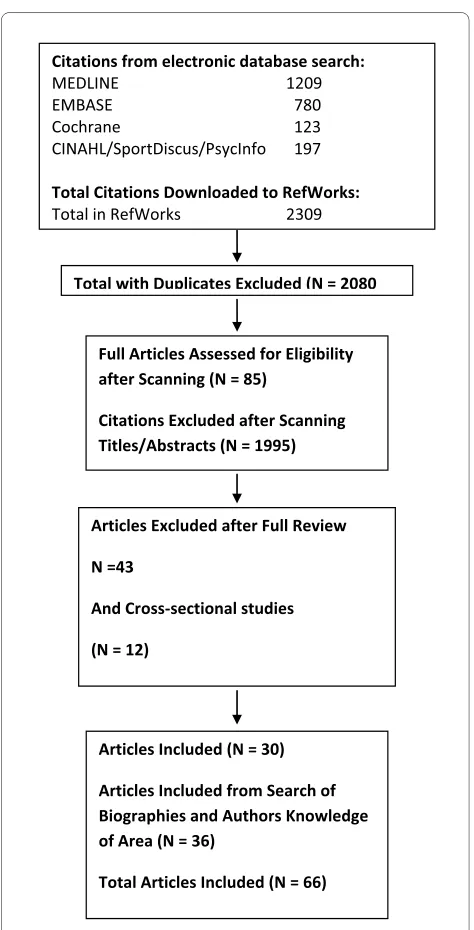
litera-ture was tracked from reference citations and author files. These searches provided an additional 36 studies (and 11 supplementary reports). Therefore, a total of 66 unique studies were included in the systematic review of the lit-erature regarding the relationship between physical activ-ity and functional independence.
Data from longitudinal or prospective studies with an outcome of functional limitation were considered most influential in our analyses. Cross-sectional or retrospec-tive studies were considered; however, these studies were often limited as they did not adequately discriminate whether the factors associated with functional limitations
antedated the functional decline or were a consequence of the functional decline. Thus, for cross-sectional or ret-rospective analyses of the relationships between physical activity and functional outcomes we have not performed an exhaustive systematic review but have cited some studies that were influential in the field. Exercise training studies that included an outcome of function were also examined. These included exercise training interventions of either aerobic or aerobic supplemented with resistance training, or programmes of resistance training alone. These studies allow for the examination of the more immediate effects of increased physical activity, but usu-ally only assessed proxy measures of function that might be related to subsequent limitations or disability, whereas, the longitudinal studies generally indicated the relationships of physical activity status with function over a more prolonged period of time.
Prospective cohort studies of physical activity and functional limitations in older adults
Description of Studies (population, intervention, outcome) The present review captured articles analysing associations between physical activity or cardiorespira-tory fitness or muscle (strength) fitness with outcomes of impairment or functional limitation (or functional status decline) or disability in older adults using a longitudinal, prospective cohort design. Table s4 (see additional file 2) provides summary details of 35 prospective cohort stud-ies (plus 7 "supplemental" reports from the same data base with different outcome measures or with a longer follow-up). Table s4 (see additional file 2) captures studies from 1995 to 2008; earlier studies have been frequently reviewed (see [12,13]). The 35 studies included 83,740 participants with study sizes ranging from 141 to 10,209 participants. About half of the studies (n = 19) were of larger sample sizes with subject numbers from ~1000 to 10,000 (median 3075) with most of the remaining studies with sample sizes usually of 200 to 400 (but with up to 800 subjects, median = 387). Ethnicity was generally not reported explicitly, although two studies reported on African Americans ("Blacks") and Caucasians ("Whites"), one was of Japanese Americans and one of Mexican Americans. Data were obtained from studies from a vari-ety of countries and regions including the USA (21), Fin-land (3), Denmark (2), UK (2), Canada (1), Taiwan (1), Israel (1), and a combination of countries (Finland, Italy and the Netherlands, n = 2; Europe, n = 1; and USA with England, n = 1).
Age groups studied included samples: of "younger" age, starting the study in their 6th decade with follow-up gen-erally at a mean age of 65 to 70 years (11 studies); "older" groups initially aged 60 to 70 years and followed-up in their mid-seventies (13 studies); and, "oldest" groups aged 70 years and up with many followed into their late-seven-ties and older (5 studies); and the other studies surveyed a Figure 1 Results of the literature search for functional limitations.
Citations from electronic database search: MEDLINE 1209
EMBASE 780
Cochrane 123
CINAHL/SportDiscus/PsycInfo 197
Total Citations Downloaded to RefWorks:
Total in RefWorks 2309
Total with Duplicates Excluded (N = 2080
Articles Excluded after Full Review
N =43
And Cross-sectional studies
(N = 12)
Articles Included (N = 30)
Articles Included from Search of
Biographies and Authors Knowledge
of Area (N = 36)
Total Articles Included (N = 66) Full Articles Assessed for Eligibility after Scanning (N = 85)
Citations Excluded after Scanning
very broad age range. Most studies included both men and women, but a few were of men only (n = 7) or women only (n = 1).
The "intervention" of interest was physical activity. Physical activity reports were almost all from self-report questionnaires (with one study also having an objective assessment of physical activity, and two studies also mea-suring cardiorespiratory fitness). About one-half of the studies used "walking as exercise" and various other activ-ities described as "vigorous" as those "counting" toward being physically active (mostly in samples of younger baseline age). Thus, it was possible from studies to char-acterize the variety of aerobic activities as being of light, moderate or vigorous intensity. About one-third of the studies used some assessment of total score for a breadth of activities, with a few focused mainly on assessing fre-quency and distance of walking as the main activity (usu-ally in older groups), but in general a distinction between frequency and duration was not clear and thus only total "volume" of activity could be characterized. In six [14-19] reports the "exercise group" were members of a jogging club (over the long-term) or long-term adherents to exer-cise programmes, compared with a reference group. In general physical activity level was categorized into groups with the studies using two groups (n = 9) or three groups (often tertiles, n = 9) or more groups or a continuous variable (n = 8). In a small group of studies physical activ-ity assessment was made on more than one occasion, thus allowing groups to be formed to assess change in activity level (e.g. became active, or became inactive, or always active or inactive) over time [14,20,21]. For three studies the report was on the association of strength with func-tional outcomes [22-24].
Outcomes of impairment or functional limitations, or functional status decline, or disability were all considered. Across the studies a very wide range of measures (from disability to self-report difficulties in tasks like walking 400 m or taking a flight of stairs, and to performance tests involving walking speed, chair rises or carrying a load) were used to assess these functional independence out-comes. The outcome measures were mostly by self-report questionnaires. About one-half (n = 19) of the studies used functional status questionnaires of abilities (or level of difficulty) in activities of daily living (ADLs) and instrumental ADLs (i.e. IADL) or the Health Assessment Questionnaire for Disabilities (HAQ-D1). Other categori-zations of similar low level functional capacity or depen-dence included self-report of functional status and "quality of life" questionnaires (including the Medical Outcomes "Short-form 36" scale, SF36). In a few studies the report of a mobility limitation was also used as the outcome. Eleven of the studies reviewed used functional limitations or reported performance abilities at a much higher level usually in the younger samples. These
assessed physical performances such as ability in stair climbing or walking a distance, or tasks involving both the upper and lower extremity (e.g., Huang et al.[25]), and five studies reported on both ADL-type measures as well as higher level performances. Only a very few studies used a measured physical performance (a physical perfor-mance test battery, and/or short distance gait speed). "Performance" measures used as the outcome included walking speed or chair rises, with a common proxy of mobility disability relating to various tests of walking such as the 400 m walk.
The period of follow-up ranged from 2 years up to 35 years with many in the 5 to 10 year range (median follow-up 7 years), and included one-time follow-follow-up (n = 22), but also follow-up at multiple time points (two to four time points, or in some cases annual evaluations), (n = 13). In analyses of the relationship of physical activity and func-tional outcomes in all papers there were statistical adjust-ments for confounding variables.
Results, Data Greater physical activity (categorized by various methods) predicted higher functional status (expressed in a variety of ways) in older age. To facilitate analysis of these studies they have been grouped into those with an outcome related to disability, and those with an outcome related to a higher level of functions such as functional limitation.
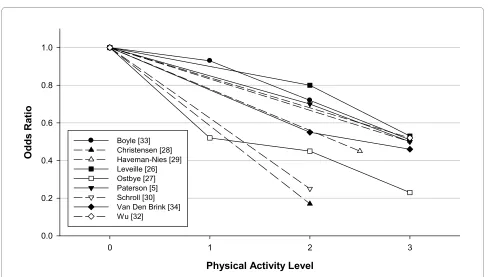
physi-cal activity needed for a reduction in risk of functional outcomes is not feasible, Figure 2 does suggest a 50% reduction in risk of functional limitation/disability is pos-sible with physical activity categorized as moderate to higher levels in total amount and at least of moderate sus-tained intensity.
It is instructive to examine some of the individual stud-ies to determine the physical activity categorizations that resulted in reduced risk of functional disability. Chris-tensen et al. [28] reported being active versus sedentary at age 70 years had an OR for disability at age 75 years of 0.17. Haveman-Nies et al. [29] found for the intermediate and high-active versus low-active the risk of functional dependence in ADLs was 0.53 in men and 0.38 in women. Schroll et al. [30] summarized studies in a Danish popula-tion; in older age the OR for mobility dependence was ~0.25 in physically active (approximately 20 min/day or 2-3 hours/week) versus sedentary. Unger et al. [31] showed greater frequency of walking was related to lower
levels of impairment and functional decline. In Wu et al. [32] those who participated in "routine exercise" had an OR of 0.52 for subsequent ADL disability.
From five studies (see Figure 2) it is possible to analyse dose-response relationships between different physical activity levels and a disability outcome. Boyle et al. [33] noted a 7% reduction in disability risk for each hour of walking (and/or other exercise), or expressed another way a 40-50% reduction in risk with 1 hour of such activities daily (7 to 8 hours per week). Leveille et al. [26], for the probability of disability versus being free from ADL dis-ability prior to death, expressed a 0.53 odds ratio in those of higher levels of physical activity, but not for intermedi-ate activity levels, versus the low activity group; neverthe-less, the statistical trend across categories of physical activity was significant. Østbye et al. [27] reported the OR for ADL disability or dependence was more linearly related to activity level from light with OR ~0.5, through moderate with OR ~0.4, to vigorous OR of ~0.2, with the Figure 2 Prospective cohort studies of the odds ratio of functional limitations or disability in ADLs and IADLs or quality of life disability in-dexes in relation to physical activity level. The odds ratio (OR) for each level (1,2,3) of physical activity are compared with the lowest physical activity group assigned as the referent (physical activity group = 0, OR = 1). The odds ratios are those reported for analyses statistically adjusted for confounder variables. The OR is an approximation as the actual data may have been separated into men versus women, or other groupings and thus in assembling the data these values have been combined. The level of physical activity was determined from analysis of types of activities that were reported for each activity level in each study; for example, in a number of studies there were only two activity groups but to be in the higher group there had to be report of vigorous activities or walking of 1 hour per day. Thus the physical activity groups were determined to require: 3 - vigorous activities and/ or high volume of systematic activity (walking for exercise); 2 - moderate level of activity from participation in normal walking or gardening with a volume of 3-5 days/week and 30 min per day; 1 - participation mainly in light activities of daily living with only occasional walking or gardening; and some physical activity groups were scored as 2.5 as they included vigorous activity (not included in group 2) or exercise walking but at a lower volume than group 3. Dashed lines indicate study data where only two activity groups were categorized, whereas solid lines join the data points for studies in which more than two activity groups were formed.
Physical Activity Level
0 1 2 3
Odds Rati
o
0.0 0.2 0.4 0.6 0.8 1.0
statistical test of trend across physical activity groups again significant. From Van Den Brink et al. [34] total physical activity in walking cycling and gardening reduced risk of disability with OR in the range of 0.6 for the middle-tertile and 0.4 for the highest-tertile com-pared to lowest, with duration of these activities (up to 100 min per day) being the important criteria. Paterson et al. [5] reported the OR for those living independently becoming dependent in follow-up in relation to their car-diorespiratory fitness and demonstrated a ~30% reduc-tion in those of moderate and ~50% reducreduc-tion in those of higher fitness versus the low fit group; however in this study the reported physical activity levels among the older groups were not related to subsequent dependence. There were two studies that had negative findings in terms of supporting the relationship of greater physical activity with functional limitations or disability. Hirven-salo et al. [35] noted that for those with intact mobility the risk of dependency did not differ between active and sedentary. Wannamethee et al. [21] found that the inverse relationship between physical activity and mobility limi-tation showed a trend, but was not significant, when the odds ratio of moderately vigorous activity related to mobility limitation was adjusted for the presence of chronic disease.
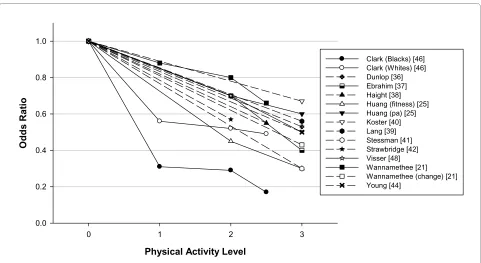
In study samples at the "higher" function level the rela-tive risk or odds of functional decline or limitation was significantly reduced in those more physically active, usu-ally defined by regular, vigorous activities. Again a meta-analysis was not possible due to heterogeneity in the physical activity categorizations and in the outcome mea-sures. Nevertheless, Figure 3 depicts in these studies the risk of a functional limitation outcome was again ~50% reduced in the high active group, and also a reduced odds ratio was evident in the moderately physically active group. Although a few studies (see below) showed a dose-response relationship only two studies actually had a light physical activity group to compare to a sedentary group and thus to date there is not enough data or consistency to support a recommendation of light activity. Thus, in overview in preventing decline or limitations in "higher" levels of performance the comparisons have often revealed that the physical activity is "exercise", or "vigor-ous", but there is some evidence for "moderate" activity as well (e.g., a "middle" moderate-activity group versus sed-entary group).
Again it is instructive to attempt to discern the levels of physical activity that were protective. The studies of Dun-lop et al. [36], Ebrahim et al. [37] (and follow-up report by Wannamethee et al. [21], Haight et al. [38] and Lang et al. [39] each reported that "vigorous" exercise (3 times/week of greater than 30 min) or as one stated "exercise at high aerobic levels" limited functional decline and functional limitation in "high level" physical functioning tasks with
odds ratios consistently close to 0.5. Huang et al. [25] also assessed higher level physical functions and reported an OR for prevalence of functional limitation of ~0.4 for those of moderate and high fitness versus lower fitness, and an OR of ~0.7 for moderate and high versus low physical activity. Koster et al. [40] reported the protective effect of physical activity (particularly for the high versus low activity groups) on incident mobility limitation across different adiposity levels and in overview the OR was ~0.6. Stessman et al. [41] found an OR of 0.2 to 0.4 for continued "ease" of performance of ADLs and IADLs in the group "exercising" at least 4 times/week. Straw-bridge et al. [42] reported an OR of 0.57 for various descriptors of loss of function in those who reported "often walking for exercise" versus those who did not report walking for exercise. Wang et al. [43] included per-formance-based physical function measures and noted that those who exercised 3 times/week or more had bet-ter functional outcomes and decreased rates of functional decline. Young et al. [44] found those who were high ver-sus low active on total activity level maintained optimal function for basic ADL with an OR of 0.43, and for physi-cal endurance type tasks an OR of 0.59 versus the low active subjects (and in those with a chronic disease at least moderate physical activity appeared sufficient to maintain physical functioning).
The study of Wannamethee et al. [21] is of importance as it examined the effect of change in physical activity level in older age. Wannamethee et al. [21] noted in the moderately vigorous physically active group the OR of a mobility limitation was 0.77, compared to no vigorous activity, and maintaining or taking up physical activity was associated with less mobility limitation such that becoming active yielded an OR of 0.43 for mobility limi-tation versus remaining inactive.
mod-erately-vigorous group, compared to the sedentary group, although from these data Wannamethee et al. [21] reported the trend (after adjustment for chronic disease) was marginally non-significant. Huang et al. [25] reported significant linear trends across both activity and fitness categories. From Visser et al. [48] in those meeting 30 min of moderate activity on most days the hazard ratio (HR) of mobility functioning was ~0.5 versus the inactive, and in those who were "life-style active" but did not meet the "exercise group criteria" the risk compared to the inactive was intermediate at ~0.7; also noted was the importance of walking and expending 400 kcal/week (1680 kJ/week) in walking versus the inactive which yielded a HR of ~0.6.
The longitudinal data also include six studies [14-19] wherein analyses are done for older adults who were committed "joggers" or long-term exercisers. In these studies the jogging groups or those exercising at high lev-els in middle-age and later clearly postponed a disability or functional limitations and prolonged disability-free
life. However, it does not seem feasible to extrapolate these findings in an exceptionally active group to deter-mine useful interventions for the general older popula-tion.
Three studies related hand grip strength to subsequent disability. With greater hand grip strength there was a decrease in functional limitations and disability in ADLs [22-24]. These studies show a relationship with strength but do not provide the evidence that regular, strength-related activities are associated with reduced risk of func-tional limitations. Buchman et al. [49] reported that both physical activity and leg strength were independent pre-dictors of mobility decline in older persons (age 80 years). Schroll et al. [30] reported that an increase in leg muscle strength over a 5-year period in women aged 75 years was related to mortality (but not to functional outcomes) and the strength factor was not significant for men. Neverthe-less a dose- response relationship was reported for declining muscle mass in relation to functional limita-tions in both men and women.
Figure 3 Prospective cohort studies of odds ratio of lower functional performance or functional limitations in "higher" level functions (such as walking a distance or climbing stairs) in relation to physical activity level. The odds ratio (OR) for each level (1,2,3) of physical activity are com-pared with the lowest physical activity group assigned as the referent (physical activity group = 0, OR = 1). The odds ratios are those reported for anal-yses statistically adjusted for confounder variables. The OR is an approximation as the actual data may have been separated into men versus women, or other groupings and thus in assembling the data these values have been combined. The level of physical activity was determined from analysis of types of activities that were reported for each activity level in each study; for example, in a number of studies there were only two activity groups but to be in the higher group there had to be report of vigorous activities or walking of 1 hour per day. Thus the physical activity groups were determined to require: 3 - vigorous activities and/or high volume of systematic activity (walking for exercise); 2 - moderate level of activity from participation in normal walking or gardening with a volume of 3-5 days/week and 30 min per day; 1 - participation mainly in light activities of daily living with only occasional walking or gardening; and some physical activity groups were scored as 2.5 as they included vigorous activity (not included in group 2) or exercise walking but at a lower volume than group 3. Dashed lines indicate study data where only two activity groups were categorized, whereas solid lines join the data points for studies in which more than two activity groups were formed.
Physical Activity Level
0 1 2 3
O
dds Ratio
0.0 0.2 0.4 0.6 0.8 1.0
Interpretation Overall it can be concluded from pro-spective studies that regular physical activity (in "aerobic" activities) in middle-aged and older adults confers a reduced risk of functional limitations and disability in older age. The reduction in risk for the effect of physical activity on a variety of outcomes related to function most often appears to be in the range of 30 to 50%.
A modified scale [10] for the evaluation of quality of the prospective studies was employed (with the following items omitted: items 4, 5 and 8 in the reporting scale; items 12, 13 in the external validity section; 14, 15, and 19 in the section on bias; items 21-26 relating to confound-ing; and item 27 addressing power). The final checklist was made up of 12 items with a maximum score of 12 points (with higher points indicating superior quality) rather than the original 32 points. The studies examined were of good quality scoring 8 to 12 (median 9) on the modified Downs and Black scale (Table s5, see additional file 3).
The strength of the recommendations is related to a consistency in the findings across studies. This strength of evidence is underscored by the fact that there is a con-sistency of the effect of physical activity across a very wide range of outcome measures from disability in ADL or scores on quality of life or the SF36, to self-report diffi-culties in tasks like walking 400 m or taking a flight of stairs, and to performance tests involving walking speed, chair rises or carrying a load. Furthermore the effect of physical activity has been demonstrated with short-term follow-up of a couple of years as well as for long-term fol-low-up. In the former there is some concern that the physical activity groups formed initially may have differed in undetected ways in "health status" and the physical activity effect was exaggerated; however, in the long-term follow-up it is likely that the effect of physical activity is underestimated in that in the initially designated active group it is likely that many became much less active over the long-term follow-up and thus should have been in the inactive group. Nevertheless, an additional strength of the data comes from studies that assessed physical activ-ity at different time points and have shown that being consistently active was associated with a reduced risk of functional limitations, a perhaps of even greater impor-tance that becoming physically active (from inactive in older age) similarly reduced risk of functional limitations. A further reassurance is the evidence of a dose-response relationship of physical activity level with the various out-comes of function.
The included studies have some limitations. A clear weakness in the data available to date is in the limitations of the physical activity assessments. Most studies have used just two categories of physical activity, sedentary versus active, but there is a large variation in how these categorizations were derived from the active being
defined as those who participated in a grouping of vigor-ous activities, to defining the active as the middle-tertile or even middle two quartiles of the physical activity "scores" of the sample. It is not possible to discern for most categorizations when a "high" or "moderate" physi-cal activity score was related to intensity of activities undertaken or a score from total volume of activities. Thus, whereas there appears to be a dose-response rela-tionship with physical activity and functional outcomes the expression of this "dose" in terms of a recommenda-tion is not precise. Particularly, whereas there is data to show that "higher" levels of physical activity are beneficial there is not the data to support that "lower" physical activity levels are effective and thus there is need to estab-lish whether there is a minimal threshold of physical activity for benefit. In this aspect we reviewed only pub-lished literature and there is the possible publication bias of rejection of studies that did not show significant results, which would be more likely if studies had pared light activity groups to sedentary rather than com-parisons of heavy or at least mid-range activity groups to the inactive group. This bias in publication (that non-sig-nificant comparisons for light activity groups that may have been found would not get published) underscores the caution in recommending activities of less than mod-erate intensity and volume.
of minimally 60 min/week (20 min, 3 times/week), although the dose-response data suggest that some lower levels of physical activity may also have influence in this "older" group.
With regard to studies where the outcome was func-tional decline or funcfunc-tional limitation or ability to per-form or perper-formance on "higher" level tasks, in six studies [21,36-39,41] in sample groups usually younger (60 to 70 years of age at baseline) the active group were defined by a rather vigorous or a "high" level of activity and in another group of studies with sample ages usually in their 70s the protective activity was at least moderate (and usu-ally >4 times/week) [16,20,42,44-46,48]. Nevertheless in a number of studies there was a dose-response relationship of physical activity level (usually inactive, to moderate, to high) with the outcome [20,25,40,45-48]. Thus, moderate to higher levels of activity of at least 4 times/week or 180 min/week are effective; although there may be an inverse dose-response relationship of physical activity level with functional limitations and disability there remains the possibility that there is a minimal threshold of at least a "moderate" activity level for a significant effect on out-comes. For younger groups (generally age 60-70 years) the activities proven effective were vigorous or at a high level, although again there was a noted dose-response between moderate and heavy in a couple of these studies [20,25,45].
Beyond the aspects of intensity or duration, or total energy expenditure, as Keysor [50] point out, it remains unknown as to what aspects of physical activity (or exer-cise) behaviours are important in terms of disablement outcomes, or for that matter functional outcomes. Thus as well as conventional physical activities or exercise, multi-factorial activities that include balance, endurance, trunk rotation, transfers, weight shift transitions and strengthening may be effective as they relate directly to specific functions or disabilities, but for the present only recommendations of aerobic activities are supported by the data. In this regard the physical activity of walking seems ideal in direct relation to daily functions of older individuals and prevention of mobility disability. Never-theless, a host of aerobic activities are suitable including other recreational activities (e.g., cycling), sport partici-pation (of an aerobic nature, e.g., squash, soccer, basket-ball, ice-hockey), or household chores of an aerobic nature (e.g., mowing the lawn).
Recommendations The prospective cohort studies pro-vide epro-vidence that a 50% reduction in risk of functional limitations and disability is possible in more physically active older individuals. The evidence of this relationship is Level 2, Grade A. It appears that this degree of protec-tive effect requires physical activity of moderate to higher levels (or moderate to high cardiorespiratory levels), again supported by Level 2, Grade A evidence. The dose
descriptors equate moderate to higher levels of physical activity as about 30 to 60 min/day or totalling about 150 to 180 min/week (and approximating 1000 kcal/week; 4200 kJ/week) with intensity descriptors of moderately vigorous to vigorous or "walking for exercise" (Level 2, Grade A). Although there is a dose-response trend across at least moderate to high activity levels, a recommenda-tion of lower level (light) physical activity lacks evidence and may be ineffective (i.e., a recommendation of light activity would be at Level 3 or 4, and Grade B). At pres-ent, based on prospective cohort studies, only recom-mendations of aerobic physical activities are supported by the data, as there is little data regarding the relation-ship between strength-related activities and reduced risk of functional limitations (although there is evidence that these may be recommended in persons with clinical con-ditions, functional limitations, disability or frailty of old age). Thus, from prospective studies a recommendation of strength-related activities would be Level 3 or 4 and Grade B.
Cross-sectional and retrospective cohort studies of physical activity and functional limitations in older adults
Other studies reported relationships of moderate phys-ical activity with SF36 scores [56]; relatively high physphys-ical activity significantly related to lower ADL or IADL dis-ability [57]; and a better functional status index in those who "exercised" even a minimal amount [58]. Others related fitness measures to functional performance with VO2max related to functional limitations [59]; aerobic exercise capacity explaining 25% of the variance of physi-cal function on the SF36 questionnaire [60]; VO2max, but not strength, being related to SF36 scores [61]; and VO2max relating to ability to perform functional tests and ADL activities [62]. Additionally, cross-sectional analyses have related strength measures to various func-tional outcomes [59,62-65]. Overall, the cross-secfunc-tional information relates physical activity or aerobic or strength fitness to "better" functional measures, but the studies essentially do not add to the determination of rec-ommended physical activity levels.
Exercise training studies in older adults with functional outcomes: Aerobic programmes and "combined" programmes
Description of Studies (population, intervention, outcome) This systematic review also examined the influence of exercise training programmes on functional outcomes. Exercise training intervention studies, of either aerobic or aerobic supplemented with resistance training, are summarized in Table s6 (see additional file 4). A total of 14 articles (14 unique data sets, and 3 sup-plementary reports) met the criteria for inclusion in the evaluation of the effects of aerobic training programmes on indicators of functional status in older adults. This included 1,938 unique participants with study sizes rang-ing from 13 to 582 (median n = 114). Five studies were of female samples only, with the remaining including both men and women. The median training duration of the studies (excluding a study that used a 10-year telephone based follow-up [66]) was 24 weeks. Ethnicity was gener-ally not reported explicitly. However, data were obtained from studies from a variety of countries and regions including the USA (8), Canada (2), Japan (2), Turkey (1), and Greece (1). The articles were published between 1996 and 2009.
Results, Data From exercise training programmes the functional outcomes include changes in physical perfor-mance functions such as walking speed/distance, or self-report functional abilities such as physical function assessed by the SF36. To date these studies have used proximal outcomes taken at the end of the training pro-gramme; but, the effects on distal outcomes, whether impairments and functional limitations, or disability are not as apparent (Table s6, see additional file 4). Nonethe-less, the literature was consistent in supporting the reduction in the risk for functional impairments and
lim-itations in older persons after aerobic or combined exer-cise training.
The pilot data reported by Pahor et al. [67] is perhaps most important to date. A combined exercise programme for ~400 men and women of mean age 77 years reported data up to 12 months. The physical activity programme resulted in higher physical performance scores; and this study used the 400 m walk as an indicator for mobility disability finding that there was a lower incidence of the inability to complete the walk in the physical activity group versus an educational control group, with an odds ratio of 0.71 approaching significance in this pilot data. Thus, this study has examined the proximal outcomes of a 12 month programme, but with a measure that is an indicator of disability rather than just functional mea-sures.
Interpretation The quality of the studies reviewed is summarized in Table s7 (see additional file 5). For RCT studies, a modified scale was employed (with the follow-ing items omitted: item 13 in the external validity section; 14 in the section on bias; item 24 relating to confounding; and item 27 addressing power). The final checklist was made up of 23 items with a total score of 24. For non-RCT studies, a modified scale was employed (with the following items omitted: item 13 in the external validity section; 14 in the section on bias; items 23 and 24 relating to confounding; and item 27 addressing power). The final checklist was made up of 22 items with a total score of 23. The median score of the 10 RCT studies was 21 of a pos-sible 24, thus the studies were of good quality. For the four non-RCT studies the median was 17.5 of a possible 23.
It is not possible to clearly define the minimal volume and intensity of exercise training required to elicit the improvements in functional status owing to the variabil-ity in the methodologies employed and the lack of descriptive information regarding the volume of activity in many studies. Indeed the majority of the studies employed moderate intensity aerobic exercise for 3 days/ week and generally 30 to 45 min/session.
to prevention of physiological limitations or future dis-ability; however, the link between physiological and func-tional limitations has been established in the cross-sectional studies. And the prospective cohort study of Paterson et al. [5] showed a relationship of VO2max with subsequent dependent living.
Recommendations Thus, the prospective studies pro-vided evidence regarding a long-term lifestyle of physical activity, whereas these exercise training interventions add that a short-term physical activity intervention (exercise programme of moderate intensity, 3 times/week) is also effective (and adds to prospective study conclusions) in reducing functional impairment or limitation with Level 2, Grade A evidence. It is also notable that functional out-comes were more greatly affected using combined aero-bic and muscle resistance exercise programmes [68,69]. Thus resistance training of older adults appears to com-plement aerobic physical activity benefits, and could be a recommended adjunct to a physical activity programme, but at Level 3, Grade B.
Exercise training studies in older adults with functional outcomes: Resistance training programmes
Description of Studies (population, intervention, outcome) Exercise training intervention studies of pro-grammes of resistance training (or muscle function train-ing) are summarized in Table s8 (see additional file 6). A total of 17 articles met the criteria for inclusion in the evaluation of the effects of resistance training pro-grammes on indicators of functional status in older adults (Table s8, see additional file 6). This included 845 unique participants with study sizes ranging from 10 to 124 (median n = 40), and 11 studies included both males and females with six of females only. The average training duration of the studies (excluding a study that used a 7.7 year follow-up [70] was approximately 24 weeks (ranging from 6 to 72 weeks). Ethnicity was generally not reported explicitly. However, data were obtained from studies from a variety of countries and regions including the USA (9), UK (3), Canada (1), Chile (1), Italy (1), Austria (1), and South Africa (1). The articles were published over a 12 year period ranging from 1995 to 2007.
Results, Data Similar to the aerobic training literature, the effects of resistance training programmes on disabil-ity are not as apparent as the more immediate measures of effects on functional impairments and limitations. In general the subject groups were of mean age between 70 and 80 years, and most studies of 6 to 24 weeks showed changes in strength or muscle power in various muscle groups. With regard to functional outcomes, there was some compelling evidence that moderate intensity resis-tance training was effective in improving functional sta-tus in older adults. Five studies [71-75] showed that with training programmes ranging from 6 weeks to one year, and resistance training programmes that ranged from
moderate intensity (50% of 1 RM (repetition maximum) or moderate weights allowing 12-15 repetitions), there were improvements on a number of functional abilities [71] or specific functions such as a chair rise test [74] or stair climb [75]. Nevertheless four studies [68,76] (reported on Table s4, see additional file 2); [73,77] each of greater than 16 weeks and relatively heavy resistance training programmes showed adequate strength gains but marginal or no improvement in various functional per-formances. Other studies listed in Table s8 (see additional file 6) also did not clearly demonstrate substantial func-tional changes.
Interpretation As reviewed in Table s9 (see additional file 7) the resistance training studies were on average of fair to good quality with RCT studies scoring a median of 17/24 and non-RCT 15/23. (As per the aerobic table, for RCT studies, a modified scale was employed with the fol-lowing items omitted: item 13 in the external validity sec-tion; 14 in the section on bias; item 24 relating to confounding; and item 27 addressing power. The final checklist was made up of 23 items with a total score of 24. For non-RCT studies, a modified scale was employed with the following items omitted: item 13 in the external validity section; 14 in the section on bias; items 23 and 24 relating to confounding; and item 27 addressing power. The final checklist was made up of 22 items with a total score of 23.)
However, in summary, as in a detailed in a review by Latham et al. [78], although progressive resistance inter-ventions in older people yield increases in strength and can have a positive effect on some functional limitations, the evidence of improved functional performances is controversial, and the effect on substantive outcomes of disability or aspects of health are not clear. Resistance training alone (i.e., without the aerobic training mendations) does not seem to be a supportable recom-mendation for functional outcomes, or for morbidity or mortality in older adults (although a greater muscle mass may be associated with reduced mortality reportedly sec-ondary to a reduced risk of type 2 diabetes).
Recommendations Thus, progressive resistance strength programmes may yield improvements in some selected functional tasks but to date it cannot be con-cluded that these will result in reduced functional limita-tions or disability. If a recommendation of resistance strength programmes based on the evidence from these training interventions were to be made it would be at Level 3, Grade B or C.
Mechanisms of the relationship of physical activity and functional limitations
related to aerobic fitness, muscle strength and power and also improved functional abilities. Lang et al. [39] sug-gested a number of factors: i) physical activity may relate specifically to physical function; for example muscle strength may have a mediating role between physical activity and disability; ii) physical activity is protective against the metabolic syndrome thus reducing incidence of conditions whose consequences include reduced phys-ical function; iii) exercise and physphys-ical activity are associ-ated with lower inflammatory markers in older adults and may reduce the damaging effects of inflammation, including those associated with excess adipose tissue; iv) physical activity provides psychological benefits; v) physi-cal activity may maintain body weight and strength (and mitigate against age-related loss of lean body mass).
Boyle et al. [33] also suggested mechanisms that may underlie the complex association between physical activ-ity and disabilactiv-ity. They included the effects of: improved aerobic capacity, muscle strength, and flexibility; protec-tion against development and progression of disabling conditions (diseases such as cardiovascular, respiratory, osteoporosis, as well as nerve growth factors relating to cognitive function and protection against ischemic and neurotoxic damage); and, favourable psychological effects.
As noted earlier, a variety of recreational, sport or household activities may be appropriate for aerobic exer-cise. And as a caveat to recommended physical activities regarding sex difference - in older women exercise train-ing yields minimal change in heart stroke volume (central adaptation, see [79]); thus specificity of exercise program-ming to the muscle groups used in mobility of daily activ-ities is important. Walking is of course specific, and an activity such as cycling would probably have carry-over to aerobic adaptations in muscle groups used in mobility of daily activities, whereas swimming (arm exercise) lacks the specificity and would not be a recommended activity for older women wishing to gain aerobic fitness for accomplishing daily functions.
Cognitive Function
Search Results: Physical Activity and Cognitive Function
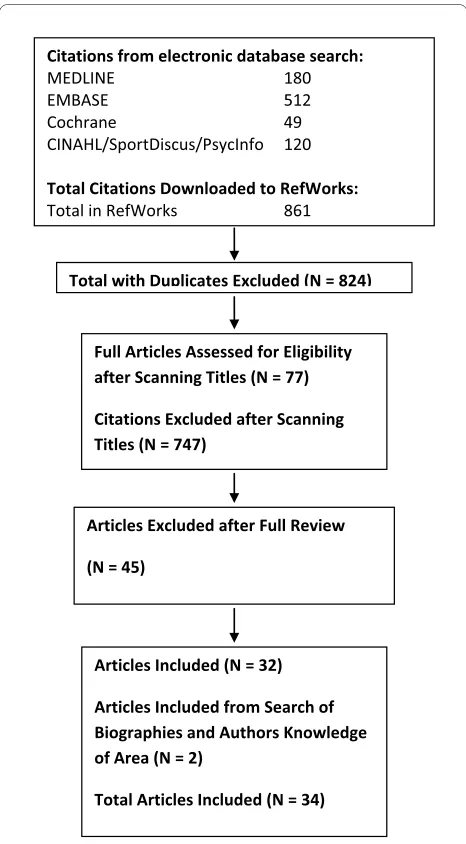
A total of 861 citations were identified during the elec-tronic database search (Figure 4). Of these citations, 180 were identified in MEDLINE, 512 in EMBASE, 49 in Cochrane, and 120 in the CINAHL/SportDiscus/ PsychInfo search. A total of 37 duplicates were found, leaving a total of 824 unique citations. A total of 747 arti-cles were excluded after scanning, leaving a total of 77 articles for full review. From these articles 45 were excluded after full review leaving 32 articles for inclusion in the systematic review. The reasons for exclusion included: participant group did not meet the inclusion criteria for age, absence of disease (i.e., study was of a
clinical population) or for life-style (community-dwell-ing); functional measure not reported; physical activity level or exercise capacity not reported; the citation was a review, dissertation, thesis, or abstract.
A total of 32 articles met the criteria for inclusion in the systematic review of the literature regarding the relation-ship between physical activity and cognitive function in older adults (Table s10, see additional file 8). Additional literature was tracked from reference citations and author files. These searches provided an additional 2 citations. Therefore, a total of 34 articles were included in the sys-tematic review of the literature regarding the relationship between physical activity and cognitive function.
Description of Studies (population, intervention, outcome) The systematic review captured articles analysing associations between physical activity or
car-Figure 4 Results of the literature search for cognitive function. Citations from electronic database search:
MEDLINE 180 EMBASE 512 Cochrane 49 CINAHL/SportDiscus/PsycInfo 120
Total Citations Downloaded to RefWorks:
Total in RefWorks 861
Total with Duplicates Excluded (N = 824)
Articles Excluded after Full Review
(N = 45)
Articles Included (N = 32)
Articles Included from Search of Biographies and Authors Knowledge of Area (N = 2)
Total Articles Included (N = 34) Full Articles Assessed for Eligibility after Scanning Titles (N = 77)
diorespiratory or muscle fitness and a cognitive function outcome and included prospective cohort studies, cross-sectional studies, and exercise training intervention stud-ies. These studies included 19,988 participants with study sizes ranging from 14 to 4,615 participants. Ethnicity was generally not reported explicitly. However, data was obtained from studies from a variety of countries and regions including the USA (15), Australia (6), Canada (1), Turkey (1), France (1), Brazil (1), UK (2), Sweden (1), Japan (1), Greece (1), Italy (1), Nigeria (1), Netherlands (1), and a combination of countries (Finland, Italy and the Netherlands). The articles were published over an 18 year period ranging from 1989 to 2007.
The "intervention" of interest was physical activity. Physical activity reports were almost all from self-report questionnaires, and a few studies used cardiorespiratory fitness measures, or strength measures, to relate to cogni-tive function. The physical activity descriptors used total amount of activity, categories of frequency of participa-tion, or intensity of activities to categorize groups.
There was considerable variability in the measures employed to evaluate cognitive function, which made the interpretation of the findings difficult. In fact, there was no consistent battery of tests to evaluate cognitive func-tion. Measures may have included cognitive speed (e.g. simple reaction time, choice reaction time), visual mem-ory (e.g. Wechsler Memmem-ory Scales visual reproduction, Benton visual retention test), verbal memory (e.g. Randt memory test, Weschler memory scale), motor function (finger tapping), working memory (e.g. digit span tests), perception (face recognition), executive functions (e.g. verbal fluency, problem solving, word comparison), cog-nitive inhibition (e.g. Stroop test), visual attention (e.g. letter search, visual search), and auditory attention (e.g. Digit span forward).
Results, Data The majority of the articles (24 (71%)) demonstrated a positive relationship between physical activity/fitness and indices of cognitive function.
Nine studies provided prospective "follow-up" cohort data with 7 (78%) of these demonstrating a positive rela-tionship between the physical activity level and cognitive function outcomes. The two negative studies did not find a relationship to cognitive performance or impairment related the amount of walking or sports [80] and a contin-uous 0-70 point activity scale [81]. The positive studies had physical activity descriptors of physical activity or not [82], walking greater than 2 miles per day (versus less than 1 mile [83]), engaging in a number of activities [84], or various activities more versus less than 3 times per week [85], or for less than 30 up to greater than 120 min/ day [86], and high intensity versus low or moderate inten-sity [87], or grouped by fitness tertile [88]. The positive outcomes ranged from better cognitive function, to less likely to develop dementia or Alzheimer's disease, or a
delayed onset of dementia. In overview from these stud-ies it would appear that positive cognitive outcomes are generally associated with a "higher" amount or intensity of physical activity.
The literature that employed an exercise intervention (n = 12) provided some controversy in the findings. A slight majority of these studies (7 (58%)) demonstrated a positive effect on at least one measure of cognitive func-tion. These studies employed moderate intensity aerobic physical activity interventions; however, it is difficult to quantify the actual volume of exercise used in each inter-vention. The positive studies generally showed small changes in usually just one or two cognitive measures. One study showed some beneficial cognitive functions scores with either moderate or higher intensity resistance training over 24 weeks [89]. Nevertheless in the negative studies the exercise intervention appeared to be very good and the finding of no significant change in outcome cognitive function measures extended across a number of variables. Thus, each of the negative studies appeared to be well-conducted [90-93]. Other studies in the cognitive function category were of a cross-sectional nature and again mixed results were found as to whether there was a relationship of physical activity level, or fitness level, with cognitive function measures. Therefore, there is mixed evidence to support or refute the benefits of habitual physical activity and/or exercise training on cognitive function in older individuals.
Interpretation The quality of investigations was evalu-ated for the various studies (Table s11, see additional file 9). The Downs and Black [10] scale was varied according to the different types of study designs (as described ear-lier). Of the prospective/longitudinal designs, the studies were of generally good quality ranging from 8 to 11 (median 10.0 out of a possible 12). The randomised con-trol trials were varied in quality ranging from 15 to 19 (out of possible score of 24) with a median score of 17.5. The non-randomised control intervention trials and the non-prospective cohort trials were generally of lower quality (median 15.0 out of 23) with a range of 14 to 17. It is important to note that there is insufficient data to con-clude that a change in aerobic or musculoskeletal fitness is required to elicit positive changes in cognitive function [94,95]. Some evidence does however demonstrate posi-tive changes in cogniposi-tive function with improvements in both aerobic [96] and musculoskeletal [89,97] fitness [95]. Moreover, and more convincing, there is consistent evi-dence that habitual physical activity reduces the subse-quent risk for dementia and Alzheimer's disease in healthy older individuals [82,84,85,98].
train-ing can result in an improvement in cognitive function in healthy older adults. However, these conclusions must be tempered owing to the balance of negative and positive studies and considerable variability in the battery of tests used to measure cognitive function. Thus, it appears that there is a relationship between physical activity (probably of a relatively "high" level of physical activity) and better cognitive function outcomes; however, to date it cannot be concluded that an exercise training programme will necessarily maintain or improve cognitive function or in the longer-term alter the course of dementia. To make a recommendation for a "standard" aerobic or resistance training programme to affect cognitive function of older adults would at the moment be at Level 3, Grade B.
Other factors to be considered related to physical activity recommendations
What other factors should be considered in recommen-dations of physical activity for older adults?
Stretching and flexibility exercises, primarily for shoul-der and hip joints, may have some benefit in relation to function and may be recommended in rehabilitation where joint range of motion has been compromised by disuse or injury, but in general a recommendation of flex-ibility exercises is not supported by the scientific litera-ture. Thus, although greater flexibility may facilitate some aspects of daily life, and stretching activities are incorpo-rated into most physical activity programmes there are no known health benefits of greater flexibility and stretching exercises have not been demonstrated to reduce risk of activity-related injuries or reduce post-exercise muscle soreness. In fact pre-performance stretching exercises have been shown to reduce scores on some performance-related tasks (see [99]). Observation of many older adult activity classes and programmes gives evidence of an inordinate emphasis on flexibility and at the expense of aerobic and strength programming; thus in guidelines or recommendations it may be prudent to discourage spending an excessive amount of time in flexibility exer-cises and suggest stretching exerexer-cises be done at the con-clusion of an activity session.
On the other hand a general whole body warm-up by gradually increasing the physical activity intensity up to that of the exercise session target level is advisable, and a gradual cool-down back toward baseline is a prudent safety factor to avoid "pooling of blood in the periphery" and potentially depriving the heart and brain of needed blood flow.
Comments on starting a programme of increased phys-ical activity are also warranted. Often at the start of a pro-gramme it is not possible or feels too demanding to meet the recommended guidelines. Although scientists have not established a standard for how to gradually increase physical activity over time it is prudent (and a safe
approach) to begin at a lower intensity and duration of a physical activity session (either in relation to aerobic or resistance exercises) and then incrementally progress to meet the duration goal and subsequently the intensity goal. Nevertheless research has shown that older adults do adapt physiologically to a given imposed exercise stress over a similar time frame to that observed in younger individuals [100]. Further exercise training pro-grammes of community-dwelling older adults have been safe and effective with progression to 70% VO2max (vig-orous exercise) within one or two weeks (and similar rapid progression in resistance training). If one starts too low and has a minimal "overload" the adaptation will be small, and if progression is too slow one loses the motiva-tion of seeing and feeling, the "improvements" and gain in fitness and function; reward of improvement likely helps maintains adherence to the activity programme.
Integration of Data from Different Study Designs and Different "Health" Outcomes
Studies of the relationship between long-term physical activity and morbidity and mortality outcomes were reviewed in the "adult" paper [1] and the previous review specific to older adults [2]. With regard to achieving a reduced risk of various morbidities, or of all-cause mor-tality, the recommended physical activity was of a moder-ate (brisk walking was a descriptor) with a total volume of 150 to 200 min/week to moderately-vigorous intensity (with >4.5 METS recommended, but scaled relatively lower in older adults) and volume of 90 min/week, and energy equivalent approaching 1000 kcal/week. Higher intensity was seen to engender additional benefit. There was little evidence to support the concept of accumulat-ing or "countaccumulat-ing-up" light, moderate short-duration activ-ities like walking (here and there during the day), or short duration non-aerobic activities (taking stairs), or small muscle group activities (like raking leaves, or painting a wall). Evidence does support 10-min segments of "exer-cise training" being additive [101].
From the point of view of maintaining cardiorespira-tory fitness above important functional thresholds (per-formance-related fitness) and postponing functional loss, the earlier review [2] determined that this could be achieved with a moderate exercise programme of 150 min/week or vigorous exercise of 90 min/week, but that light intensity activity or an accumulated volume of activ-ity throughout the day was not effective in maintaining or increasing cardiorespiratory fitness of older adults.