PhD Dissertation
International Doctorate School in Information and Communication Technologies
DISI - University of Trento
Bridging the gap between theory and
implementation in cognitive networks:
developing reasoning in today’s networks
Christian Facchini
Advisor:
Prof. Fabrizio Granelli
University of Trento
Co-Advisor:
Prof. Nelson L.S. da Fonseca
State University of Campinas, SP, Brazil
Abstract
Communication networks are becoming increasingly complex and dynamic. The network-ing paradigm commonly employed, on the other hand, has not changed over the years, and, as a result, performs poorly in today’s environments. Only very recently, a new paradigm named cognitive networking has been devised with the objective to make networks more intelligent, thereby overcoming traditional limitations and potentially achieving better per-formance. According to such vision, networks should be able to monitor themselves, reason upon the environment, act towards the achievement of specific goals and learn from expe-rience. Thus far, several cognitive network architectures have been conceived and proposed in the literature, but, despite researchers seem to agree on the need for a holistic approach, their architectures pursue such a global vision only in part, as they do not consider net-works nor network nodes in their entirety.
In the present work, we analyze the aspects to be tackled in order to enable this holistic view and propose to base reasoning on both intra- and inter-node interactions, with the ul-timate aim to devise a complete cognitive network architecture. After a thorough analysis of advantages and drawbacks of generic reasoning framework, we select the most apt to form the basis on which to build the cognitive network we envision. We first formalize its application in network environments, by determining the steps to follow in the process to equip traditional network with cognitive capabilities. Then, we shift the focus from the de-sign side to the implementation side, by identifying the problems that could be faced when realizing such a network, and by proposing a set of optional refinements that could be taken into account to further improve the performance in some specific situations. Finally, we tackle the problem of reducing the time needed for the cognitive process to reason.
Validation through simulations shows that explicitly considering cross-layer intra- and inter-node interactions when reasoning has a twofold effect. First, it leads to better per-formance levels than those that can be achieved by today’s non-intelligent networks, and second, it helps to better understand existent causal relationships between variables in a network.
Keywords
Acknowledgments
This achievement would not have been possible without the help and support of many people, and this page is here to thank them all.
First, I would like to thank my advisor, Prof. Fabrizio Granelli. It was an invaluable opportunity to have you as mentor, not only for the doctoral program, but also for the Master’s and Bachelor’s degrees. Thanks to you I could grow up as a student, first, and as a researcher, then. You taught me how to perform research independently and objectively, fostered in me the ability to look at problems from different perspectives, and put your trust in me by giving me increasing responsibility, since the very beginning.
I would like to thank Prof. Nelson L.S. da Fonseca, who has been my co-advisor during the PhD program and allowed me to visit him at the University of Campinas in Brazil and become part of his research team. You have been an excellent guide and role model: from you I have learned many things, the value of dedication, drive, and determination, in particular. Thank you especially for doing literally everything to make me have a wonderful time in Brazil.
A special thanks goes also to Dr. Oliver Holland, who agreed to be my supervisor and made it possible for me to spend a period at King’s College London and work as part of his research team. I have really enjoyed working with you: doing field research was fantastic—definitely beyond any expectation!
Fabrizio, Nelson, and Oliver, the three of you have been far more than mentors to me, you have been and are wonderful persons.
Agora, os agradecimentos mais pessoais. Quero agradecer a galera do LRC: Nelson, que j´a citei, Carlos, Cesar, Luciano, Flavio, Daniel, Joana, Jorge, Neumar, Cleo, Pedro e Andr´e. Se o tempo que passei no Brasil foi t˜ao legal, foi s´o gra¸cas a vocˆes. E se eu aprendi o sentido de conceitos como amizade, honestidade e hospitalidade, foi tamb´em s´o gra¸cas a vocˆes. N˜ao poderia ter pedido nada melhor que encontrar vocˆes no meu caminho.
Thanks to the friends I met at King’s College, Oliver, Paul, Andrej, Reza, and Helen. I enjoyed every minute with you, but especially the insightful talks we had—not to mention the pints of Guinness.
avuto la fortuna di incontrare in questo percorso, che ha saputo spronarmi nei momenti pi`u difficili, aiutarmi in quelli pi`u complicati, e offrirmi il suo supporto, sempre. Grazie davvero per esserci. Un grazie va anche a Martina, che nello stesso percorso ho perso di vista, ma che mi `e stata vicina agli inizi ed `e stata presente quando ne avevo bisogno.
Contents
Contents ix
List of Tables xi
List of Figures xiii
1 Introduction 1
1.1 The Context . . . 1
1.2 The Problem . . . 3
1.3 The Solution . . . 4
1.4 Innovative Aspects of the Thesis . . . 8
1.5 Structure of the Thesis . . . 9
2 State of the Art 11 2.1 Cognitive Architectures and Guiding Principles . . . 11
2.2 Research Challenges . . . 14
2.2.1 Reasoning and Learning . . . 14
2.2.2 Adaptation . . . 15
2.2.3 Information Representation . . . 16
2.3 State-of-the-art Solutions . . . 17
2.3.1 Reasoning and Learning . . . 17
2.3.2 Adaptation . . . 19
2.3.3 Information Representation . . . 20
2.4 Research Directions . . . 21
2.5 Conclusion . . . 23
3 The proposed approach 25 3.1 Towards a Model for Quantitative Reasoning in Cognitive Nodes . . . 27
3.1.1 Introduction . . . 27
3.1.2 Fuzzy Cognitive Maps . . . 29
3.1.3 Fuzzy Cognitive Maps for Cognitive Nodes . . . 32
3.1.4 The Proposed Approach . . . 38
3.1.5 Conclusion . . . 40
3.2.2 A Cognitive Service-oriented Infrastructure . . . 43
3.2.3 Reasoning in Cognitive Service-Oriented Infrastructures: the Fuzzy Cognitive Maps . . . 44
3.2.4 Validation . . . 46
3.2.5 Conclusion . . . 60
3.3 Cognitive Rate Adaptation in Wireless LANs . . . 62
3.3.1 Introduction . . . 62
3.3.2 Related Works . . . 63
3.3.3 The Proposed Approach . . . 64
3.3.4 Simulation Results and Discussion . . . 73
3.3.5 Conclusion . . . 79
3.4 Dynamic Green Self-Configuration of 3G Base Stations using FCMs . . . . 80
3.4.1 Introduction . . . 80
3.4.2 Related Works . . . 81
3.4.3 The Proposed Energy-efficient Architecture . . . 83
3.4.4 Embedding Fuzzy Cognitive Maps in Radio Network Controllers . . 85
3.4.5 Simulation Scenario . . . 95
3.4.6 Results . . . 98
3.4.7 Conclusion . . . 100
3.5 Dimensionality Reduction in Fuzzy Cognitive Maps . . . 103
3.5.1 Introduction . . . 103
3.5.2 Motivation . . . 104
3.5.3 Fuzzy Cognitive Maps in Cognitive Processes . . . 105
3.5.4 Identification of non-Relevant Cross-layer Relations . . . 105
3.5.5 Test Case . . . 110
3.5.6 Conclusion . . . 113
4 Conclusion 117
Bibliography 121
A List of Publications 129
List of Tables
3.1 Characteristics of the measuring process, depending on node location and layers involved . . . 37 3.2 Domains of the input variables in the first scenario . . . 48 3.3 Domains of the input variables in the second scenario . . . 58 3.4 Cumulative amount of data transferred by the algorithms. Average over 20
random simulations. The proposed scheme is referred to Fuzzy Cognitive Map (FCM), in the case it does not use information related to the Signal-to-Noise Ratio (SNR), and FCMS, in the case it does. . . 78 3.5 Parameters utilized for the validation. Unity of measurement appears next
to the value, surrounded by square brackets. . . 88 3.6 Simulation configuration parameters. dis the distance in km. Traffic
mod-eling parameters obtained from [1]. . . 97 3.7 Domains of the input variables . . . 112 3.8 Cross-layer relations characterizing the test case analyzed . . . 112 3.9 Performance achieved using different subsets of elements to perform the
List of Figures
1.1 Broadband and mobile subscriptions in OECD countries. Elaboration of the data published on www.oecd.org/sti/ICTindicators. . . 2 1.2 Global IP traffic growth as forecasted by Cisco. Elaboration of the data
published in [2]. Managed IP includes corporate IP WAN traffic and IP transport of television and video on demand. . . 3 1.3 The cognition loop (adapted from [3]) . . . 6 1.4 Alternative loops . . . 6 1.5 Scope of: a) Software-defined radio, b) Cognitive radio, c) Cognitive network 6 1.6 Domains of cognitive radios, cognitive radio networks, and cognitive
net-works. Adapted from [3]. . . 8
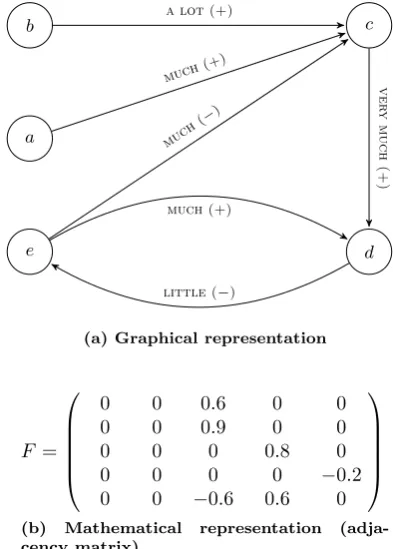
3.1 Fuzzy Cognitive Map example . . . 29 3.2 FCM inference process example. As can be seen, the reasoning process
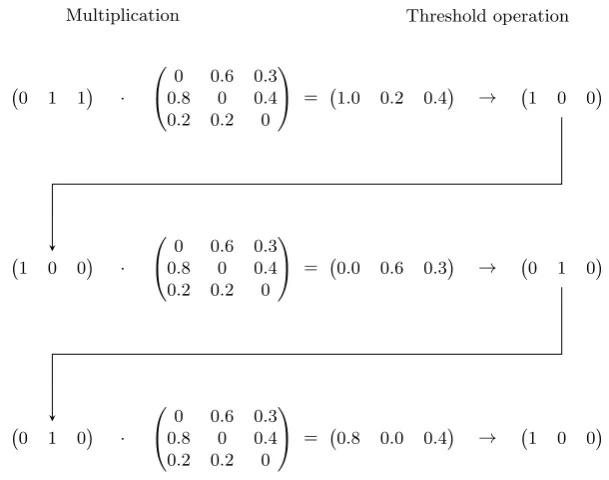
results into the cycle limit (1,0,0)→(0,1,0) in three iterations. Concepts mapped to the {0,1} domain and threshold set to 0.5. . . 30 3.3 Merging multiple Fuzzy Cognitive Maps. Arrows intentionally omitted for
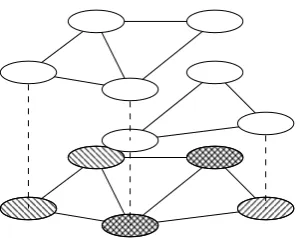
clarity. . . 31 3.4 Possible evolution of the TCP congestion window and its transformation
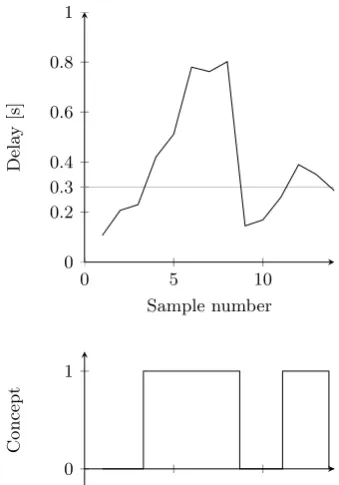
into binary concept. . . 34 3.5 Transformation of delay measurements into a concept. Threshold can be
chosen as the maximum tolerable delay. . . 35 3.6 Cognitive networking and service-oriented architecture stacks (based on [4]) 44 3.7 A Web Service Policy (WS-Policy) example . . . 45 3.8 Validation steps. First, a database is populated with the simulations of all
possible combinations of the input variables. Then, the prediction skills of the cognitive engine are tested against the simulation results. . . 47 3.9 Network topology in the first scenario. AP denotes the access point while
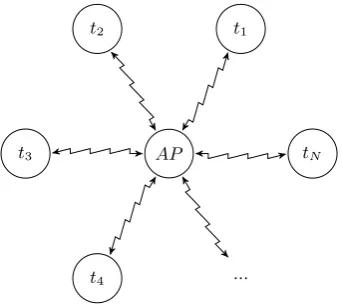
{t1, t2, . . . , tN} are the terminals. . . 47
3.11 WS-Policy (based on [5]) describing the service provided in the first scenario under optimal network conditions: service consumers can opt for the audio quality they want (Application-level Packet Error Rate (PER) greater or smaller than 5%). When conditions worsen, and the cognitive entity is not able to effectively thwart wireless channel imperfections, the WS-Policy will be updated, for instance by removing the bold part, implying that the service provider cannot guarantee calls characterized by a PER lower than 5%. . . 50 3.12 FCM employed in the first scenario. e,d,r,i, andn stand for packet error
rate, physical data rate, maximum number of retransmissions, voice packet interval, and number of calls supported, respectively. . . 52 3.13 Performance achieved enabling the FCM update at each step. η = 0.5.
Compare with Figure 3.14. . . 53 3.14 Performance achieved enabling the FCM update only in case of prediction
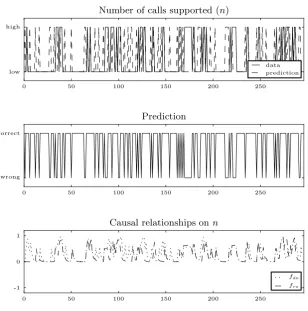
errors. η= 0.5. The sub-graph in the middle shows that, by updating the FCM only when errors occur, predictions are more reliable. Compare with Figure 3.13. . . 54 3.15 Prediction performance achieved by the reasoning entity in the first
sce-nario. η = 0.2. When predictions are correct, the structure of the FCM does not change. . . 55 3.16 Throughput as a three-valued concept. η= 0.1. . . 56 3.17 Impact of the learning parameterηon the prediction reliability. Confidence
intervals computed with p= 0.995, DoF= 14. . . 57 3.18 Feedback example. The action profile tested at t1 (high data rate, d, low
voice packet interval,i, and low retransmission number, r) does not permit to achieve a greater number of calls while providing an acceptable quality. The action profile tested at t2 (high d, highi, and highr), on the contrary,
seems to allow the system to forward all the calls while providing the callers with an acceptable quality. . . 58 3.19 Network topology in the second scenario . . . 58 3.20 The WS-Policy (based on [5]) describing the service provided in the second
scenario states that users can be choose between two levels of performance, under optimal network conditions. In case the cognitive engine cannot keep network conditions at an optimal level, the WS-Policy may be republished to inform potential users that only a best effort service will be available (bold part removed). . . 59 3.21 FCM employed in the second scenario. t, n, e, d, r, and f stand for
throughput, number of nodes, bit error rate, physical data rate, Request to Send (RTS)/Clear to Send (CTS) handshake, and fragmentation, respec-tively. . . 60 3.22 Prediction performance achieved by the reasoning entity in the second
3.23 Speficic implementation of the proposed cognitive data rate control mech-anism. Station N2 gathers information about throughput, Frame Error Rate (FER) and Signal-to-Noise Ratio (SNR) that it sends to station N1. . 65 3.24 High-level view of the proposed cognitive network architecture . . . 67 3.25 Action model of a sensing variable. Different groupings identify different
functions, as implemented in the simulator. Function names are reported as labels for each grouping. . . 69 3.26 Action model of the cognitive entity. The striped background indicates
activities that logically belong to the sensing entity, but are implemented in the cognitive entity for convenience. The squared background indicates activities that belong to the reasoning formalism and may differ depending on the specific formalism employed—they are reported in the diagram for completeness. Dashed actions are not mandatory. . . 71 3.27 Specific implementation of the mechanism to avoid sub-optimal solutions
based on a three-step counter. Every time the timer expires the counter is decremented, and different actions are taken. Different time intervals are used, in order to limit the use of the reinforcement mechanism. . . 72 3.28 Simulation setup. Numbers along the paths indicate the second in which
the node started and stopped. For instance, interfering node A started mov-ing at 0 seconds, stopped at 120, started again at 230 and finally stopped completely at 350 seconds. The shadowed area around nodes of interest N1 and N2 represents the transmission range. . . 73 3.29 Throughput comparison with other data rate adjustment algorithms. . . . 75 3.30 Details of the comparison with other data rate adjustment algorithms. . . . 76 3.31 (a) Evolution of throughput and data rate as a function of time. (b)
Evo-lution of causality as a function of time. The letters d, e, and t stand respectively for data rate, errors FER, and throughput, respectively. . . 77 3.32 How the proposed architecture fits in a UTRAN. Node B monitors the
environment and sends the data to the Radio Network Controller (RNC), which upon reasoning and learning, drives the acting modules in Node B, thereby closing the cognitive loop. . . 84 3.33 Relations among the concept sets and the FCM. . . 87 3.34 Extreme-case time evolutions of variable values and thresholds . . . 89 3.35 Lagged-coordinated plot of the evolution of an FCM edge when updated
by different learning algorithms. Starting point is (0,0). The sequence of variations is as follows: 2 positive, 10 negative, and 3 positive. Learning rate η set to 0.25, unless otherwise stated. . . 93 3.36 Differentiation of multiple solutions through the assignment of a
perfor-mance score (λ= 1, µ= 2). At t = 9, solutions that could improve enand snr, enbut not snr,snr but not en, neither ennor snr, would score 1.13, 0.13, 1, and 0, respectively. . . 94 3.37 Layout of the simulated scenario. The coverage radius r is set to 600 m in
3.38 Hourly variation of traffic load as a percentage of busy hour load over a typical day for a mobile network operator in London, UK. . . 96 3.39 (a) Consumed energy in traditional and cognitive base stations, and (b)
energy saved by employing the cognitive scheme over a period of 72 hours. (c): example of the evolution of the blocking rate. . . 99 3.40 Evolution of the action concepts: (a) use of higher frequencies (hi) and (b)
use of tri-sectorized mode (tri) . . . 101 3.41 Example of evolution of the causal relationships: (a) between hi (use of
higher frequencies) and the quality-related concepts, and (b) between tri (use of tri-sectorized mode) and the quality-related concepts. . . 102 3.42 Toy example showing the first steps in the application of the Logic Circuit
Minimization approach with c = 3 and n = 6. First, the elements of the FCM are serialized. Then, reasoning is performed considering different combinations of the FCM elements and assigned a binary value indicating the performance level obtained. For instance, considering fca alone, or fca
and fcb (second and third combination) allowed the reasoning process to
achieve an acceptable performance level, whereas considering fcb only did
not. . . 106 3.43 Decomposition as AND-expressions of the logic formula B, hypothetically
synthesizing the Karnaugh map resulting from the toy example depicted in Figure 3.42 . . . 107 3.44 Extreme-case time evolutions of a cause-effect relation . . . 108 3.45 Test case network topology . . . 110 3.46 Test case Fuzzy Cognitive Map. Concepts t, n, e, d, r, and f stand for
throughput, number of nodes, error rate, physical data rate, RTS/CTS handshake, and fragmentation, respectively. . . 111 3.47 Karnaugh map of the test case (reduced for better clarity) . . . 111 3.48 Evolution of the discriminating index of the cross-layer relations in the test
Chapter 1
Introduction
This chapter describes the research problem at a high level and glances at the potential solutions.
Section 1.1 will describe the context of the research problem and will discuss its po-sitioning in the area of information and communication technologies. The problem itself will be analyzed in Section 1.2, while Section 1.3 will hint at possible ways to solve it. We will review in Section 1.4 the innovative aspects that characterize the work presented in this document and we will lay out its structure in Section 1.5.
1.1
The Context
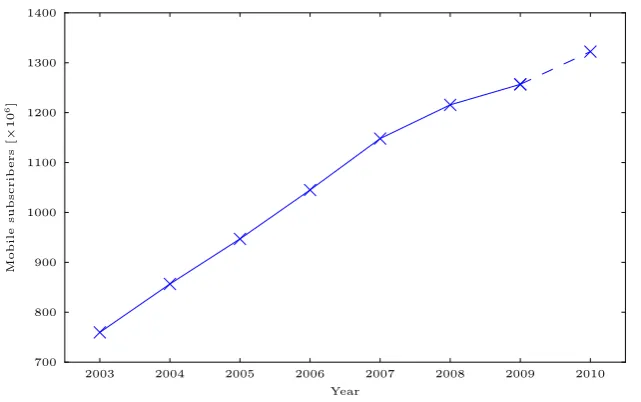
In the last few decades, communication networks have grown considerably in size, and the growth has not stopped yet. According to a recent report on information technology by the Organisation for Economic Co-operation and Development (OECD), among the OECD economies the development of the broadband infrastructure still retains high pri-ority “both in general terms and as part of the economic recovery” [6]. Indeed, the data shown in Figure 1.1a indicate that, though in the most recent years the annual rate has sensibly decreased, the total number of broadband subscriptions is still rising.
Similar considerations can be drawn by analyzing the evolution of the number of mobile subscribers in the same period, as shown in Figure 1.1b. In this area of communications as well, figures seem bound to increase in the next future.
Given these premises, it is clear that global traffic is also expected to grow, and, according to the estimates performed by Cisco Systems and reported in Figure 1.2, such growth will likely be exponential in time [2].
In other words, as both the amount of end users and traffic volumes are bound to rise, nodes both at the edges of networks and in the core networks will inevitably expand in number, and the amount of interactions among said nodes will continue to rise accordingly. The number of such interactions, potentially increasing as the square of the number of nodes, has caused networks to become more complex and dynamic—and still does so.
Evidence of both higher complexity and greater dynamics can be easily recognized in today’s networks.
emer-Chapter 1. Introduction
2003 2004 2005 2006 2007 2008 2009 2010 Year 0 5 10 15 20 25 30 B r o a d b a n d s u b s c r ip t io n s [p e r 1 0 0 in h a b it a n t s ] Total DSL Cable Other
(a) Average number of broadband subscriptions per 100 inhabitants in the OECD countries.
2003 2004 2005 2006 2007 2008 2009 2010 Year 700 800 900 1000 1100 1200 1300 1400 M o b il e s u b s c r ib e r s [ × 1 0 6]
(b) Total number of mobile subscribers in the OECD countries (in millions). Data for year 2010 is projected.
Figure 1.1: Broadband and mobile subscriptions in OECD countries. Elaboration of the data published
1.2. The Problem
2010 2011 2012 2013 2014 2015
Year 0 10000 20000 30000 40000 50000 60000 70000 80000 90000 IP t r a ff ic [P B / m o n t h ] Total Fixed Internet Managed IP Mobile data
Figure 1.2: Global IP traffic growth as forecasted by Cisco. Elaboration of the data published in [2]. Managed IP includes corporate IP WAN traffic and IP transport of television and video on demand.
gence. As a general term, emergence indicates that complex evolution patterns may appear from multiple, possibly non-complex, interactions. Specifically for the networking research area, emergence means that to fully understand a network, not only its nodes must be studied, but also the interactions among them. More importantly, at a finer scale, even the behavior of a node cannot be completely explained by studying separately the protocols it is made of without taking into account the relationships existing among them.
The evolution of network dynamics is the other aspect we mentioned. Early networks can be seen as quasi-static environments, the most peculiar features of which being the homogeneity of devices and the fact that they were mostly wired. Heterogeneity of net-work devices and communication channels—among which we should most notably recall the introduction of wireless communications—and more recently, heterogeneity of appli-cations, along with the already cited increase in size, made networks start becoming more and more dynamic.
The most evident direct consequence is undoubtedly an increased difficulty in man-aging and tuning networks so as to achieve and continually maintain optimal levels of performance.
1.2
The Problem
Albeit it is a fact that networks have grown in terms of size, and consequently, in terms of complexity and dynamics, no major breakthroughs have been introduced in network management.
Chapter 1. Introduction
networks are based have substantially remained unchanged. The fact that the seven-layer ISO/OSI “model of architecture for connecting open systems” [7] is still the de facto reference model is a fitting example in this sense. The motivation behind such a design choice is to be sought in compatibility. The adoption of the ISO/OSI model ensured compatibility throughout the years, ultimately favoring modest yet repeated modifications and improvements over a clean-slate approach that would otherwise not allow legacy technology to function anymore.
However, although it is acknowledged that these principles are sound, it is likewise evi-dent that they carry intrinsic implications that allow the creation of networks performing optimally only in static and well-defined environments, such as they were in the begin-ning. On the other hand, they are unable to adapt effectively to complex and dynamic environments where conditions keep changing. This represents a limitation, in that in such environments only sub-optimal performance can be achieved. A relevant example in this sense is the behavior of transport protocols on either wireless or high bandwidth-delay product links. As they were conceived, in none of these environment they can reach optimal performance [8].
Two crucial observations should be discussed at this point.
The first observation regards timing. Operations at different levels of the stack are characterized by different timings. Protocols at the link layer act upon receiving feedback from the next recipient, which is usually among the closest neighbors. On the contrary, transport protocols receive feedback after the so-called round-trip time, i.e. the time it takes for a packet to travel from source to destination (at the same layer) and back. The destination in this case may be placed several hops away, even in another continent. In general, as we go down the protocol stack, feedback times tend to reduce and become as short as fractions of seconds. The need to react within this timescale definitely rules out human intervention.
The second observation is about determinism. Even though intervention by human beings is not an option, if the environment shows to be, to some extent, deterministic, one could rely on algorithms to perform continuous optimization. This could well be the case for early networks. However in today’s networks, as we pointed out, increased complexity and dynamics concur in increasing unpredictability. Essentially, this means that algorithms incapable of adaptation are likely to fail in such environments.
1.3
The Solution
New network paradigms were recently proposed to lower the complexity of network management and to achieve better performance in dynamic environments. A noteworthy approach in this sense—the principles of which are at the basis of this work—is known as the cognitive networking paradigm [9]. To fully understand its origins we have to take a few steps back in history, at the time software (and software-defined) radios were born.
1.3. The Solution
later, refined the original concept to represent the ensemble of: (i) a set of Digital Signal Processing (DSP) primitives, (ii) a system to combine said primitives into communication-related functions, and (iii) a set of digital processors to be used as hosts [11]. Today, the term is used to refer more simply to radio transceivers, in which functions that are typically implemented in hardware are implemented as software.
Independently from the definition, the implications of such a revolutionary system are paramount, flexibility likely being the most important. For example, let us consider the transmission of signals using different modulation techniques while exploiting the same hardware, or the opportunity to employ algorithms (e.g. to operate at different frequencies) that would not otherwise be possible to include.
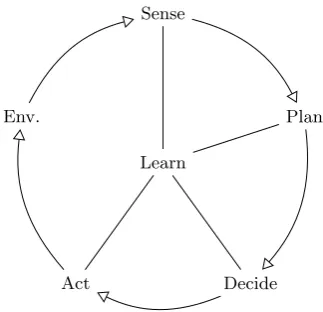
In 1999 a novel technology, building on the advantages brought by Software Defined Radios (SDRs) and attempting to add intelligence to flexibility, was proposed and labeled cognitive radio. Cognitive radios are reconfigurable radio devices based on SDRs that, in addition, are able to perform a cognitive process: they reason about the environment they are placed in and act in order to maximize spectrum utilization, all while continuously learning [12]. This process, graphically represented in Figure 1.3, is usually referred to as the cognitive loop, and is peculiar not only to cognitive radios but also to cognitive networks (and, to a certain extent, to cognitive architectures in general). It must be said that different representations of said loop exist [13, 12]. However, barring minor nuances, all versions share the same steps shown in Figure 1.3. Different versions appear in other fields as well. Connoisseurs of the military art may have already heard of Col. Boyde’s OODA loop in Figure 1.4a, devised to understand opponents’ moves [13]. Researchers in the autonomic area sure know about the existence of the autonomic loop in Figure 1.4b [14]. Finally, keen observers may have noticed some resemblances with Deming’s cycle for quality improvement (Figure 1.4c). Notably, the sequence of stages described by each loop is the process human beings normally go through when coping with a problem. Indeed, it is no wonder that all such loops stem from the scientific method, according to which hypotheses are made (plan/decide), experiments performed (act/execute/do), and results evaluated (sense/observe/monitor/check).
An important aspect to stress is that, in cognitive radios only a part of the node is intelligent: the physical and the medium access layer, i.e. at most the two layers at the bottom of the seven-layer ISO/OSI reference model, representing the interface between a network node and the communication medium. The network perspective is generally not considered. The approach aiming to fill this gap was proposed in 2005 under the name cognitive networking [13].
Actually, in cognitive networks the idea is not restricted to include just the network layer in the cognitive process. Rather the aim is to add intelligence to network nodes in their entirety and not to just parts of them. For better clarity, the reader is referred to Figure 1.5, which compares the scope of SDRs, cognitive radios and cognitive networks.
Chapter 1. Introduction
Sense
Env.
Act Decide
Plan
Learn
Figure 1.3: The cognition loop (adapted from [3])
Observe
Orient Decide
Act
(a) Col. J. Boyde’s OODA loop
Monitor
Analyze Plan
Execute
(b) Autonomic loop
Check
Act Plan
Do
(c) Deming’s cycle (PDCA)
Figure 1.4: Alternative loops
Physical Data Link
Network Transport
Session Presentation
Application
a) b) c)
1.3. The Solution
For completeness, another movement should also be mentioned, that goes by the name of autonomic communication [15, 8]. It represents an evolution of the autonomic comput-ing concept, first stated by IBM [16]. The target is to have systems (autonomic computcomput-ing) and networks (autonomic communication) manage themselves and adapt as the environ-ment evolves, so that the overall manageenviron-ment complexity is significantly lowered. The underlying idea is based on the concept governing human body’s vital functions: in the same way the nervous system takes care of such vital functions without ever involving the brain, a network should be able to manage itself, thus relieving technicians from having to deal with the burden of network management.
The areas investigated by either the paradigms presented overlap to some extent with one another and this is reflected in a noteworthy confusion in the terminology adopted in the literature. Different research groups tend to identify their work with a paradigm instead of the other, often to stress some precise characteristics (the ability to reason and learn, and the end-to-end performance, in the case of cognitive networking, or the self-management aspect, in the other). However, most works can be thought of as belonging to both the paradigms, since often being able to self-manage implies the capability to reason, and vice versa.
Fortuna and Mohorˇciˇc [3] have suggested considering autonomic those networks that use a mere algorithmic approach to perform their tasks. Networks where nodes are re-quired to be capable of reasoning and learning should instead be called cognitive. Signif-icant in this sense and similar in spirit is the position of Clarket al. in their vision paper [17], in which it is stated that cognitive techniques are somewhat in contrast with algo-rithmic approaches. Indeed, algoalgo-rithmic solutions should not be regarded as cognitive, as opposed to approaches that are capable of learning through experience. Throughout the remainder of this work we will adhere to this classification and consider cognitive those networks that reflect this consideration.
Finally, two remarks should be made. First, it is of utmost importance to draw a clear distinction between cognitive networks and cognitive radio networks. A great difference lies in the domain they belong to: the former can be either wired or wireless, whereas the latter only wireless. This concept is represented graphically in Figure 1.61. An even
greater difference concerns the scope: while cognitive radio network may refer to a bare ensemble of cognitive radios and may hence describe a network in which devices try to improve performance only locally, in a cognitive network actions always strive towards better global performance. This, in particular, means that not necessarily a cognitive radio network is also a cognitive network.
Second, it is a fact that cross-layer techniques are utilized in virtually any cogni-tive network implementation. Nevertheless, cognicogni-tive networking must absolutely not be identified simply with cross-layering. What distinguishes the two concepts is adapta-tion combined with learning: while cross-layering can be seen as a memoryless technique for spreading information across the layers of a node’s protocol stack aiming (at most) at “static” stack-wide optimization, cognitive networking aims at network-wide optimization through continuous adaptation and learning.
Chapter 1. Introduction
Figure 1.6: Domain of cognitive radios , cognitive radio networks , and cognitive networks . Adapted from [3].
1.4
Innovative Aspects of the Thesis
Though the cognitive networking research area is very recent, several works already exist in the literature. Among them, some theorize about the best tools a cognitive entity should use to carry out their optimization tasks [18, 13]. Others, instead, adopt specific reasoning techniques, but often do not justify the choice behind such techniques [3].
This work centers around a reasoning formalism known as Fuzzy Cognitive Map (FCM), which can be used to perform causal reasoning. The first innovative aspect lies in the adoption of such a tool to explicitly exploit cause-effect relationships among variables in the protocol stack of network nodes. The motivation behind this choice is grounded on the idea that variables at different layers of the protocol stack share cause-effect relation-ships. Indeed, though according to the layering principles protocols at one layer should be independent from one another, what happens in reality is that actions performed at one level may lead to variations in others. The fact itself to use cross-layer relationships as the basis of reasoning was not discussed until now, to the best of the author’s knowl-edge. In addition, it appears that the cognitive networks proposed in the literature, when addressing the reasoning problem, do not explicitly consider cross-layer relations.
Novelty is not restricted to the sheer application of this tool. Indeed, as the reasoning formalism in question originates from the need to analyze problems in fuzzy domains, such as social science [19], a formal approach to embed it in network nodes was missing. The second innovative aspect of this work is the development and illustration of such general approach.
Conse-1.5. Structure of the Thesis
quently, for the formalism to work without any external intervention, techniques have been devised and introduced in this work, which represent the third element of novelty.
1.5
Structure of the Thesis
Chapter 2
State of the Art
So far several architectural designs have been presented in the research community of cognitive networking. Likely due to the novelty of the topic, several proposals aim to provide design guidelines by presenting general cognitive architectures, rather than showing a specific implementation. Section 2.1 presents the most relevant works in this sense and discusses some of the indications given. Section 2.2 analyzes some specific aspects of the research challenges present in the field and Section 2.3 assesses some possible ways to tackle them. Finally, we identify in Section 2.4 some of the primary research directions to be explored and draw the conclusion in Section 2.5.
2.1
Cognitive Architectures and Guiding Principles
The pioneer work envisioning cognition-enhanced networks has been undertaken by Clarket al.[17], who focus primarily on the ability of a network to self-recover. Motivated by the fact that further improving already existent algorithms is not enough to achieve such an objective, they suggest to revise the networking paradigm by introducing a key component that they call “Knowledge Plane” (KP). The KP they conceive is basically a distributed cognitive system equipped with reasoning and learning capabilities and designed as a closed-loop control system. It is in charge of creating and maintaining a model of the network at a high-level point of view and its ultimate purpose should be that of being able to properly advise network elements about what to do in specific situations. According to the researchers’ view, the KP spans both vertically through the protocol stack and horizontally across the network nodes and should be designed taking into consideration some precise tenets. Specifically, the KP should:
– take advantage of the different observations that can be made in different points of the network, that is, it should exploit observation diversity;
– implement a unified approach to solve problems, avoiding ad-hoc solutions, which may appear simpler at first but sub-optimal in the long run;
Chapter 2. State of the Art
– be able to function in dynamical, continuously changing environments, also in the presence of misleading and/or incomplete information, and under conflicting high-level goals.
It is important to note that these basic principles are shared by virtually any other cognitive-network-related work present in the literature. As a matter of fact, Clark’s KP is a possible instantiation of the already mentioned cognitive loop, depicted in Figure 1.3. The researchers also envision fairly advanced features for their architecture, such as the ability of the KP to reason by itself on information trade-off and routing, i.e. understand when local information is to be preferred to measurements of the global situation of the network, and understand what and where knowledge is needed in given situations. Interestingly, though, they admit of the possibility for the cognitive architecture to be driven by human input. Indeed they advance the hypothesis that there might be occasions in which only a person would be able to discern the best action to take and give the cognitive system proper guidance.
In summary, however, there seems to be no agreement in the literature on which cognitive network model should be taken as a reference. Rather, there is a proliferation of architectures based on the KP concept, with minor adjustments.
The first formal research about cognitive networks has been performed by Thomas
et al., who, with regard to the characteristics a cognitive architecture should have, list: (i) extensibility, flexibility, and proactivity; (ii) the capability by the decision process to use network metrics as input and provide actions as output; (iii) the capability to achieve higher performance levels with respect to traditional networks. Besides offering a definition for this new paradigm, also delineate a possible framework for the development of cognitive networks, logically divided in three layers, mirroring the defining aspects of a generic cognitive entity (behavioral, computational, neuro-physical) [13]. Specifically, the guiding end-to-end objectives are specified at the top layer, where they are also redefined in terms of local objectives. Such local objectives are successively handed to the middle (cognitive) layer, which reasons about them and selects the appropriate actions to take. According to the actions selected, the bottom layer sets the tunable elements it controls. It also senses the environment and reports to the cognitive layer, in order to make it learn, thereby closing the cognitive loop. A remarkable characteristic of this cognitive network model is that no strict rules are defined about how the three layers should be mapped with respect to the actual network nodes. This means that, for instance, the cognitive process may be performed by just one cognitive element, comprising all the devices of a network, or by multiple elements, each one in charge of controlling just a part of the ensemble. In other words, no design limits are imposed. Insightful is also the evaluation of network performance as a function of some characteristics of the cognitive nodes, to wit, the degree of selfishness, of information, and of control on the other elements they have: the researchers demonstrate that not always characteristics that could be deemed beneficial, like altruism or perfect knowledge of the environment, lead to better results.
2.1. Cognitive Architectures and Guiding Principles
the cognitive networking paradigm is particularly appealing, as it represents a valid al-ternative to basic cross-layer optimization. Emphasis is also given on the collaborative aspect: according to the researchers, a local view of the network is simply not sufficient to perform global optimization. Collaboration is, therefore, fundamental to perform dis-tributed information gathering with the objective to build a comprehensive knowledge of the environment. Lastly, it is interesting to note that the architecture they propose is heavily based on that by Clarket al.[17], with the difference that, in their opinion, both the sensing and the reasoning parts have to be executed in real-time.
The thesis of holism is supported also by Suttonet al. [20], who hold that the limited scope of communication protocols prevents a node from performing a global optimization. In this sense, they propose an architecture characterized by a network-wide scope, similar to that peculiar to the already mentioned KP, extending over both the protocol stack and the network itself. An interesting point of such architecture is that the cognitive process is explicitly split between two distinct entities: a reconfigurable entity is in charge of manipulating sensors and actuators and a separate cognitive entity takes care of reasoning and learning tasks. This separation may give rise to concerns regarding how commands and measurements flow between the cognitive entity and the reconfigurable entity, and how much should one expect communication overhead to be. However, no specific details are offered in merit. According to their vision, the cognitive entity can comprise all the layers of a node or even just a subset of them, whereas the reconfigurable entity involves reconfigurations not only inside a single node but possibly also in each node of the network. It is not clear, though, whether more than one cognitive entity is allowed in a network or not. Nor it is clear how, in the case there exist multiple cognitive entities, problems related to multiple reconfiguration issued by different cognitive entities can be tackled, or, in more general terms, how cooperation should be achieved.
Another project, named CogNet [21], aims to use all the information each layer can provide. A particularly interesting feature of this model with respect to the ones previously analyzed is the introduction of a memory. Thanks to it, this architecture possesses the ability to exploit the temporal and spatial characteristics associated with information gathered from the various layers and use a repository where experience can be stored and consulted. The cognitive process in this case is accomplished by an entity they refer to as the CogPlane, which runs joint-layer optimization algorithms, distributed throughout the network. However, in the test case provided, the situation when multiple cognitive planes interact with one another is not investigated.
Chapter 2. State of the Art
networking is a complementary rather than a supplementary technique, and therefore co-operation schemes between network operators still have to be present, at least to a certain degree.
Finally, the architecture designed by Raychaudhuri et al. [23] should also be cited, although tailored for the evaluation and design of cognitive radio networks rather than cognitive networks. Precisely because it is targeted at cognitive radio networks, it is interesting to note that it explicitly considers not only the physical and data link layers but also the network layer. This has a twofold implication. First, it implies that layer-three protocols (and, in general, protocols at even higher layers) should not be thought of as being independent from the rest and should be included in the cross-layer optimization procedure, so as to achieve joint optimization of the stack. Second, it is a clear sign that also cognitive radio network research is leaning toward the higher layers of the stack, thus trying to include the end-to-end scope peculiar to cognitive networks.
As a side note, it is significant to observe that the research area of cognitive networking (and adapting/intelligent networking in general) aroused increasing interest in the last few years. Meaningful in this sense are the ARAGORN project [24], funded through the seventh Framework Programme (FP) and focusing on both cognitive radios and cognitive networks, and the End-to-End Reconfigurability project (E2R) [25] and its continuation,
the End-to-End Efficiency project (E3) [26], funded respectively through the sixth and the
seventh FPs and studying the cognitive networking paradigm for the previously mentioned Beyond 3G era.
Another representative initiative is the even more recent approval of the COST Action IC0902, devoted to the study, in the mid-term, and to the standardization, in the long-term, of cognitive networks [27].
2.2
Research Challenges
Research in the area of cognitive networking is at an early stage [3, 27]. Consequently, several problems still have to be resolved. Among the greatest challenges are reasoning and learning, adaptation, and information representation.
2.2.1 Reasoning and Learning
2.2. Research Challenges
therefore are to be considered when performing the cognitive process.
To cope with these challenges, an appropriate reasoning technique has to be chosen. However, as noted in [3], in the networking architectures proposed in the literature only a few reasoning techniques are employed and often their use is not completely justified over the available alternatives.
Reasoning exploits the knowledge that an entity has been able to build by learning to draw new inferences and beliefs [17]. Similar is the definition by Langleyet al. [28], who state that to reason is to infer conclusions starting from beliefs that are already present in an agent’s mind. Therefore, a necessary condition is for a cognitive entity to possess the capability (i) to draw relationships among such beliefs and (ii) to use them in order to derive some conclusions.
Thomas et al. suggest to think of cognition as a machine learning problem [29]. For-malisms like neural networks, genetic algorithms, expert systems, and control theory (e.g., Kalman filters and learning automata) can therefore be employed [13]. However, rather than on analyzing the theoretic aspect of cognition, they focus more on providing prac-tical guidelines for bringing intelligence in communication networks, by arguing that a cognitive process need not involve exactly one reasoning strategy. On the contrary, de-pending on the type of problem to be solved and the objectives to be achieved, more than one technique can be used, possibly creating hybrids.
Along the same lines is the opinion of M¨ah¨onenet al., who propose to equip cognitive network nodes with an ensemble of tools to perform reasoning tasks [18]. Besides the already mentioned neural and Bayesian networks, also pattern recognition and classifica-tion techniques, and multidimensional optimizaclassifica-tion algorithms, like simulated annealing or genetic algorithms, are included in such a toolbox. The authors, though, give no indi-cation about what technique should be preferred in a given situation nor on what basis it should be selected.
Eventually, independently from the technique used, what seems to really matter is convergence time: whatever the solution chosen, it is of utmost importance that its con-vergence time be less than any environmental change time [13].
Another key research topic is learning, which can be seen as a planned and ordered gathering of knowledge, and can happen in several ways. Being strictly connected to reasoning, it is given little attention as a topic on its own. Besides, learning techniques are usually straightforward and reflect those techniques actually used by living organisms. According to [17], knowledge can be built thanks to external input, the same way children learn at school thanks to their teachers, or by trial and error, as happens with people facing new problems when no one is available to give indications. Other techniques to boost learning cited are by analogy and by generalization.
2.2.2 Adaptation
Complementary to reasoning is adaptation [30], i.e. the process of turning reasoned decisions into actions.
Chapter 2. State of the Art
themselves jointly, in order for the effect to take place. Adaptation means therefore that nodes have to able to coordinate themselves to carry out a common goal, or in more general terms, to extend the cognitive process to the whole network.
Network-wide adaptation in cognitive networks, though, seems not to have received much attention in the literature thus far. Instead, proposals have focused more on the need of inter-node communications (or lack thereof). It can be argued that inter-node communication may not be fundamental in cognitive networks, as there exist studies on cognitive networking that do not consider it. For instance, this is the case presented in [21], in which the centralized architecture of the wireless network analyzed suggests that information exchange among the base station and the wireless clients may be not nec-essary. However, other researchers plan instead to have their cognitive devices explicitly talk with other peers [22, 18], stating that the more the shared information, the higher the performance could be, in principle. This may not always be true, though, as in some scenarios better performance can be achieved when nodes do not share information with one another [9].
2.2.3 Information Representation
The topic of representation is partly related to both learning and adaptation. Many re-searchers agree on the need of a means to represent objectives and knowledge. Inevitably, pursuing the vision of a knowledge-centric network makes knowledge representation fairly important [17]. Information representation plays a key role also in optimization processes: as optimization can be performed with respect to different, possibly contrasting, aspects (e.g. performance, reliability), representation is necessary to establish priorities and decide to which dimension optimization should aim [14]. Goals of the system, as well, should be clearly expressed so that no misinterpretation can take place. However, even when goals were not correctly specified, the system should be able to act reasonably well anyway [16]. Linked to information representation is information propagation, both within nodes and across the network. As a general guideline, a desirable feature of the information propagation scheme to be used is that it should be independent from the underlying communication technology [14].
As for its implementation, it can be analyzed from both the semantic and the syntactic points of view. The semantic questions concern what information we want network nodes to exchange. Updating all the nodes in a network with all the network knowledge may not be the best option, mainly for two reasons: first, the waste of resources may be too high and second, an “information overload” may be burdensome, not to say misleading, for the reasoning process. To this end, it is imperative to understand which nodes need what kind of information, so that can be defined what to pass and to whom [17]. Syntax is about
2.3. State-of-the-art Solutions
2.3
State-of-the-art Solutions
Several techniques can be used as the reasoning core of a cognitive entity, yet some of them could be more fitting than others. The characteristics of the main potential reasoning formalisms are surveyed in Section 2.3.1. In Section 2.3.2, instead, we illustrate how literature copes with the issues related to adaptation and we conclude the analysis in Section 2.3.3 by identifying how information is represented and exchanged.
2.3.1 Reasoning and Learning
A popular technique used to infer general conclusions is represented by first-order logic [28] and is typically used by agents who can rely on certain knowledge [3]. However, communication networks can hardly be classified as certain-knowledge domains. It is not unlikely to foresee situations, e.g. in wireless environments or wired peer-to-peer scenarios, in which nodes go on and off at any time, causing abrupt changes in topologies. Nor it is uncommon that services offered by servers become suddenly unavailable with little notice, if any at all. As a consequence, employing first-order logic schemes in cognitive nodes may not appear as the best choice. This seems also to be acknowledged in the literature, since, to the best of the author’s knowledge, there is no cognitive network architecture based on such a formalism.
Some researchers deem expert systems, i.e. systems aiming to store human experts’ knowledge in a specific field, useful to perform reasoning in cognitive network, provided the problem to be solved is characterized by a limited number of variables [13]. Oth-ers, however, maintain that the overly narrow domain of application peculiar to expert systems clashes with the concept of cognitive architecture, which should instead seek to reason across a variety of diverse domains [28]. The author, however, does not have any knowledge of cognitive networks based on this paradigm.
Structural equation modeling, although not a proper artificial intelligence technique, has been mentioned as a potential formalism for reasoning purposes in [31]. However, the same authors admit that such a formalism is more suitable for confirming already defined causal structures (hypothesis testing), rather than discovering them. This could place a limit in cognitive entities, which may be prevented from adapting to new situations, thus not evolving over time.
Chapter 2. State of the Art
Neural networks are often considered as a standard artificial intelligence technique and, thus far, have been applied to a wide range of applications [35], including cognitive networks [3], where they have been used for carrying out cognitive routing functions [36, 37]. The main drawback lies in the fact that they are black boxes: once a neural network reaches a solution, its inner structure does not necessarily reflect the motivation behind that outcome [33]. In another way, the actual relationships that exist among the variables of a system are not reflected by the configuration of the neural network that led to the solution [31]. On the one hand, this may not represent a problem in case we, as designers, are not interested in the mechanisms of a network. On the other hand, if we want to gain some insights into a network’s internals, so that we can understand potential problems and build more and more efficient solutions, neural networks are inapplicable.
Bayesian networks are another reasoning tool traditionally associated with artificial intelligence, their peculiarity being the capability of representing cause-effect relationships among variables of a given problem. Generally they are suited, as well as neural networks, to being applied when knowledge is uncertain [3]. As they are based on directed acyclic graphs, their major limitation lies in the impossibility to deal with causality loops [38, 31]. Most notably, Bayesian networks were already envisioned by Clark et al. in their pioneer work on cognitive networking [17].
Strictly related to Bayesian networks are Markov random fields. Similarly to Bayesian networks, they are generative models, i.e. they represent a probability model for all the variables of a problem; however, unlike Bayesian networks, they need not represent causal relationships. Other formalisms derived from Markov random fields are Markov logic networks, which combine Markov random fields and first-order logic, and conditional random fields, which are a discriminative type of model, i.e. they model the dependency of unobserved variables on observed variables. Markov random fields (and all models based on them), being represented by means of undirected graphs, suffer less from the limitation peculiar to Bayesian networks about loop-free networks: when loops are present in the problem structure, the inference process is performed by approximate algorithms (so-called loopy belief propagation), which, however, are not guaranteed to converge. It is also worth noting that the undirected nature of such structures prevents them to handle induced dependencies1. As far as the author knows, no cognitive network is based on any
of these models.
Fuzzy Cognitive Maps (FCMs) are mathematical structures for modeling dynamical systems. They emphasize the cause-effect relationships present among the variables of a system and upon them they base reasoning [19]. From a graphical point of view, they are direct graphs, in which nodes represent generic concepts (be them events, variables or other generic entities) and edges portray the cause-effect relationships among those concepts. FCMs offer some advantages over other potential reasoning techniques. First, differently from the edges in a neural network, those in an FCM reflect the actual re-lationships among the variables of the problem being inspected. Then, in opposition to the cases of both Bayesian and Markov networks, the inference procedure used in FCMs
1Situation that happens when two nodes of the model are marginally independent but become conditionally dependent
thanks to a third common node. For example, letA, B represent weather conditions in two independent cities and letC
2.3. State-of-the-art Solutions
is computationally light, involving only vector-by-matrix multiplications and threshold operations and can be applied independently from the presence of causality loops. More-over, it is guaranteed to converge to a solution provided that the vertices have their value in a discrete set [39]. Finally, multiple FCMs can be exchanged and merged with one another (upon a weighting operation, if necessary), mimicking the exchange of opinions peculiar to human beings: this is an advantageous feature when dealing with uncertain knowledge, thus being better suited in such environments than other formalisms, such as, for instance, first-order logic. Nevertheless, FCMs are characterized by some drawbacks as well. The most limiting drawback is that abductive reasoning, i.e. the process of dis-covering the causes that led to some effects, is NP-hard, exactly as in the case of Bayesian networks [40].
With respect to learning, the techniques used so far in the cognitive networking field are usually straightforward, such as the use of a knowledge base to be updated as new situations are experienced [41, 21]. Specific techniques are used to update connections in neural networks and FCMs. Popular algorithms commonly employed in neural networks are backpropagation learning [37], in which error with respect to a target outcome is re-peatedly back-propagated through the network, and reinforcement learning [14], in which a reinforcement signal is a measure of the performance level achieved after the system has performed a set of actions. As for FCMs, updating techniques are based on Hebbian learning, according to which connections between concepts that are activated together should be given more weight [42].
2.3.2 Adaptation
Papers in the literature provide hints at techniques that could be used to accomplish network-wide adaptation, but examples of implementations are limited.
Clarket al.have in mind a distributed and decentralized model that lets them partition the network so that different parts can work toward the achievement of divergent goals [17]. However, they acknowledge that classic artificial-intelligence techniques are not suited to be employed in distributed environments and suggest that robust, highly dynamic algorithms are needed.
They also mention multi-agent systems, a tool to model and design systems popu-lated with intelligent agents, each capable of (and responsible with) its own actions, as a framework that could potentially represent a base for building such algorithms. However, they cautiously warn that this may not be the best solution, depending on the timing constraints posed by a network environment.
In [43], Friends et al. declare to be in favor of a distributed implementation of the cognitive process, claiming it is more convenient when compared to the centralized coun-terpart. Their preference stems not only from the typical advantages such a model offers, but also from the benefits it presents in the specific case of cognitive networking. First, a centralized architecture would lead to a greater communication overhead. Second, in environments populated by nodes that already have cognitive capabilities (e.g. where there are some cognitive radios), the centralization of cognition would inevitably lead to a greater waste of channel resources.
Chapter 2. State of the Art
behavior of a network [9]. Besides the already cited multi-agent systems, he advances the use of game theory, that aims to analyze the interactions occurring among a popu-lation of rational decision-makers who attempt to behave strategically. He makes use of game theory to devise a cognitive network, and, though acknowledging that such theory accurately captures the behavior of selfish agents, he urges that methods more apt to explore cooperative behavior should be sought. He does not consider cooperative games, where players are allowed to constitute coalitions and commit agreements. However, the author has no notion of cognitive networks in which cooperative game theory has been applied. One potential drawback of game theory is that, usually, assumptions are made in order to make game analysis tractable: common assumptions in this sense are a homoge-neous player set (which means nodes have to share similar characteristic), or that players have complete information (that is, nodes exactly know what other nodes want and what they can do). Were such assumptions not acceptable, a game would likely become more complicated and, possibly, not presenting equilibrium points.
Another tool Thomas promotes as a means to investigate interacting elements is the set of so-called interaction models, thanks to which it should be feasible to identify fixed points of complex systems. Some of the models listed are infinite particle systems (like the Ising model, originally conceived as a model for the analysis of ferromagnetism), and Petri nets, to model general distributed discrete systems.
2.3.3 Information Representation
Unsurprisingly, most of the works offering practical insights on information repre-sentation, resort to the use of markup languages, such as the Extensible Markup Lan-guage (XML).
For example, though pertaining to the field of autonomic computing, an interesting solution comes from Kephart and Chess [16], for whom autonomic elements should register the services they offer in a public registry, such as the Universal Description, Discovery and Integration (UDDI). Ultimately, said registry will contain high-level descriptions of the objectives and policies offered by autonomic elements, and how they should be invoked.
Another suggestion is to use the Radio Knowledge Representation Language (RKRL), first promoted by Mitola [12, 13] with the objective to represent radio knowledge through the use of structured, yet natural, language.
Finally, the last scheme for the representation of knowledge worth mentioning is the DARPA Agent Markup Language (DAML) by the Defense Advanced Research Projects Agency (DARPA), that capitalizes on both XML and the Resource Description Frame-work (RDF) to support ontologies for web objects. Nevertheless, a caveat is necessary: whatever the scheme, valuable information would probably come from other places, such as in Management Information Bases (MIBs) [17].
As for information propagation, it is acknowledged that in order to foster cross-network communication a signaling architecture must first be devised [44]. However, to the best of the author’s knowledge, so far no mechanism has been proposed specifically for cognitive networks, and only generalized guidelines have been discussed.
2.4. Research Directions
we implement an in-band signaling scheme, where signaling messages are mixed with data messages, or an out-of-band signaling scheme, where messages constitute a separate communication. A signaling scheme belonging to the first category may be realized by embedding information in header fields that are normally not used by a protocol. Among the advantages of such a solution are the facts that no overhead is added and that it is possible to reuse already existent protocols. However, nodes along a path may misclassify such ‘enhanced’ packets as malicious or malformed and discard them. Other drawbacks are represented by the limited room to allocate information, and the fact that information passing becomes dependent on the communication technology used (i.e. the protocols). An out-of-band signaling scheme needs a separate communication setup (and possibly the design of a new protocol). The quantity of information that can be sent is greater than in the complementary scheme, but greater are also complexity and overhead.
Depending on the architecture chosen for the cognitive process, different message pass-ing schemes can be deployed. In a centralized network a natural option would be that of a master-slave communication scheme, but direct communications among slaves may be desirable as well. In a distributed network, a na¨ıve scheme could be that of flood-ing. Such an approach is not recommended, not only because of the great overhead, but also because not every node may be interested in receiving a particular message. For instance, two neighboring nodes may harbor the same beliefs about the environment: as a consequence neither of the two will benefit from the other’s information. Naturally, more elaborate protocols can be employed: as an example, a seemingly popular choice in distributed scenarios is represented by epidemic protocols, i.e. protocols that to spread information imitate the diffusion typical of diseases, as they are generally scalable and failure resistant [45, 17, 14].
2.4
Research Directions
It has been argued that interactions between protocols inside a node and among nodes themselves play a critical role in determining network performance. As a consequence, it becomes of paramount importance to evaluate which reasoning techniques are capable of dealing with both intra- and inter-node relationships, and among them, to select the most appropriate to be employed.
Chapter 2. State of the Art
Techniques to reduce the dimensionality of the problem have, therefore, to be sought. Alternatively, parallel solutions may be promoted, such as storing the experience acquired in a long-term memory, to be consulted with the purpose of reducing search times and avoid local maxima.
Partly related is the fact that most of the reasoning formalisms surveyed in Section 2.3.1 do not consider the temporal dimension of causality, which could, in principle, represent a limitation when dealing with communication networks: since different layers are involved in the cognitive process, one could expect that causal relationships are characterized by different timings. In case this aspect represents a major concern in the reasoning phase, more sophisticated techniques or even completely different mathematical models may have to be employed.
The continuous update of the reasoning engine itself must also not be underestimated. Independently from the formalism employed, learning is fundamental to obtain accurate results over time. Proper learning techniques must be chosen, possibly depending on the context in which the cognitive entity is placed.
As for the adaptation/coordination aspect, neither the centralized nor the distributed model can be discarded a priori. Even more important, a cognitive network may feature both schemes and switch from one to the other in an adaptive manner. Ideally, the cognitive architecture should impose no restrictions on the communication mechanism, thus allowing full flexibility.
The same concept can be applied to cross-network information exchange. Also in this case, both in-band and out-of-band signaling schemes are to be investigated and neither of the two is to be a priori rejected. In demanding scenarios chances are that, due to their lower overhead, in-band schemes represent the best choice. If resources are not a problem, e.g. in optical or delay-tolerant networks, out-of-band schemes are likely to offer greater flexibility of application. The bottom line is the same as before: no constraints on signaling should be imposed by the cognitive architecture. Minor communication-related research questions are, for instance, whether signaling messages should be read only by the communication end-points or also by nodes along the way. In general, whether (and how) intermediate nodes would actually benefit from learning signaling information cannot be known beforehand and it likely depends on the application scenario.
Security is another direction carrying important implications, yet barely considered by the cognitive networking research community. Important, especially in view of possible real-world implementations, is to determine if and how much signaling schemes are prone to security issues, and understand if and how techniques such as authentication and encryption can be implemented, without impairing the overall performance.
2.5. Conclusion
exhaustively evaluated.
2.5
Conclusion
The choice of a reasoning formalism to use as the base of a cognitive network is of great importance, as it can potentially affect all the other aspects, namely learning, adaptation, and information representation/passing.
Considering the research directions outlined in Section 2.4, Fuzzy Cognitive Maps, though characterized by some weak points, seem to offer some advantages over other reasoning techniques. Representing a valid candidate to address the research challenges of the research field, they have been chosen as the basis for this work.
In this context, techniques aimed at reducing reasoning time will focus on the elimina-tion of unimportant edges and nodes. Likewise, learning will concentrate on the strength-ening of the edges that best reflect real-world cause-effect relationships. Besides, thanks to the possibility to be exchanged and merged with other FCMs, they naturally lend themselves to be employed in multiple nodes, thus imposing no limitation on the vision of an all-distributed cognitive network.
Chapter 3
The proposed approach
This chapter aims to describe the approach proposed to solve the problem analyzed in Section 1.2.
Section 3.1 will introduce a formalism known as Fuzzy Cognitive Map (FCM), created in the ’80s as a tool to represent causal reasoning [19]. Initially devised to be used in “soft knowledge domains”, such as history and social science, throughout the years it has been applied to problems in different fields. The main purpose of this section is to familiarize with the tool and explain the steps of the conceived process that are needed in order to use such a tool for the cognitive networking paradigm. The basis of reasoning in this framework will be laid, as well as the fundamentals of learning.
An application example will be given in Section 3.2, in which the concepts illustrated so far will be further extended to devise a whole intelligent architecture, to which we will refer as Cognitive Service-Oriented Infrastructure (CoSOI). By analysis and simulation of this architecture in two wireless scenarios, centralized and decentralized, we will see how FCMs can empower cognitive networks.
Whereas the application examples in Section 3.2 are limited to prediction, i.e. they show the potential of FCMs to forecast future situations, Section 3.3 will take it a step further by enabling actions, thereby closing the cognitive loop (Figure 1.3). Specifically, this section will show that actions can be triggered automatically to achieve optimality in certain situations. The problem tackled here is that of rate adaptation in Wireless Local Area Networks (WLANs), in which the application of the cognitive formalism allows the rate to be adjusted automatically, depending on the environmental conditions. A thorough description of the implementation details completes the section.
As the efficacy of the tool is demonstrated, Section 3.4 dwells on some refinements that can be introduced in the system, at virtually all stages of the cognitive cycle. First, at the sensing level, the details of pre-processing operations such as time averages, discretization, and threshold operations will be analyzed; next, novel learning schemes will be explained; and finally, a technique will be shown for choosing a solution when multiple options are available. The application of this refinements has been validated via simulations of a mobile access network, in which the goal was to abate energy consumption while not increasing the blocking rate.
Chapter 3. The proposed approach
time-consuming task to perform if too many variables are taken into account, the i

![Figure 3.6: Cognitive networking and service-oriented architecture stacks (based on [4])](https://thumb-us.123doks.com/thumbv2/123dok_us/704540.2068157/60.595.166.397.121.342/figure-cognitive-networking-service-oriented-architecture-stacks-based.webp)