
Effect of polymers and gas forming agents on gastro-retentive floating tablets of acyclovir
7
0
0
Full text
(2) 89. was found especially useful in this field.[4] Hydroxy propyl methyl cellulose (HPMC), commonly used as hydrophilic polymer, is a mixed alkyl hydroxyalkyl cellulose either contains methoxy or hydroxy gruop. The hydration rate of HPMC increases with an increase in hydroxypropyl content, solubility of HPMC is pH independent. It is a widely accepted pharmaceutical excipient, because HPMC is available in a wide range of molecular weights and the effective control of gel viscosity is easily possible. [5] The most important variable in hydrophilic matrix systems is the rate at which the drug substance is released. The release of drug is controlled by the formation of a hydrogel layer around the matrix following exposure to aqueous fluid. When a hydrophilic matrix comes into contact with water the pores near the surface of the matrix are filled with water and drug release is initially controlled by the dissolution of the drug in the water filled pores and by its diffusion in water. The high viscosity of the polymer solution in the pores slows down the drug transport by forming a gel layer. The factors influencing the release of drugs from hydrophilic matrices include viscosity of the polymer, the ratio of the polymer to drug, mixtures of polymers, compression pressure, thickness of the tablet, particle size of the drug.[4] A Floating drug delivery system was planned for acyclovir as such a system when administered would remain buoyant on the gastric fluids for the prolonged period of time and the drug would be available in the dissolved form at the main site of its absorption, i.e. stomach. This was led to improvement in the bioavailability of the drug. In this way, it stands an advantage over conventional dosage form. In the present investigation floating tablets of Acyclovir are prepared by an effervescent approach using two different grades of HPMC (K4M and K100M). The aim of the work was to evaluate the effect of different viscosity grades of polymer like HPMC K4M and HPMC K100M on the drug release profile and the effect of gas forming agent like sodium bi-carbonate and citric acid on the buoyancy lag time.. Materials and Methods. Acyclovir was a gift sample from Biodeal Laboratories Pvt. Ltd, Surendranagar, Gujarat. HPMC K4M & HPMC K100M was provided by Colorcon Asia Pvt. Ltd. PVP K30 was purchased from Himedia Lab. Pvt. Ltd, Mumbai. Mg. stearate was purchased from Loba Chemical Pvt. Ltd, Mumbai. Lactose, Sodium bicarbonate & Talc were purchased from S.D. Fine chemicals. Citric acid was purchased from Nice Chemicals Pvt. Ltd. All Polymers and excipients used were of pharmaceutical or analytical grade. Preparation of acyclovir floating matrix tablets All the ingredients except magnesium stearate, and talc were blended in glass mortar uniformly. We mixed all the ingredients and passed through the sieve no.: 40 and then added Isopropyl Alcohol as a wetting agent to make a coherent mass. The coherent mass was then dried in a hot air oven at a temperature of 450C for 1 hrs. The dried granules were passed through sieve no.: 20 and were lubricated with Int. J. Pharm & Ind. Res. Vol - 01. magnesium stearate and talc, which already passed through the sieve no.: 60. The tablets were compressed in a Mega rotary punching machine for 300 mg tablet. The compression force was adjusted to obtaining tablets with hardness in the range of 7-10 kg/cm2. The formulations of all the batches were shown in table 1. The tablets were around and flat with an average diameter of 10±0.1 mm and a thickness of 3±0.4 mm. Evaluation of Floating Tablets The prepared floating tablets were evaluated for Angle of Repose, hardness (Monsanto tester), and friability (Roche type friabilator), drug content, in vitro buoyancy and in vitro dissolution studies. The results are expressed as mean ± S.D. (n=3). In vitro buoyancy studies The in vitro buoyancy was determined by floating lag time. The tablets were placed in a 100 ml beaker containing 0.1N hydrochloric acid. The time required for the tablet to rise to the surface and float was determined as floating lag time. The duration of time the dosage form constantly remained on the surface of a medium was determined as the total floating time.[3] Drug content Weigh and finely powder 20 tablets. To a quantity of the powdered tablets containing 0.1 g of Acyclovir add 60 ml of 0.1M sodium hydroxide and disperse with the aid of ultrasound for 15 minutes. Add a sufficient quantity of 0.1M sodium hydroxide to produce 100 ml, mix well and filter. To 15 ml of the filtrate add 50 ml of water and 5.8 ml of 2M hydrochloric acid and sufficient water to produce 100 ml. To 5 ml of the solution add sufficient 0.1M hydrochloric acid to produce 50 ml and mix well. Measure the absorbance of the resulting solution at the maximum at 255 nm, using 0.1M hydrochloric acid in the reference cell.[6] Water uptake study (determination of swelling index) Swelling of the tablet excipients particles involves the absorption of a liquid resulting in an increase in weight and volume. Liquid uptake by the particles may be due to saturation of capillary space within the particles or hydration of the macromolecule. The liquid enters the particles through pores and bind to large molecule; breaking the hydrogen bond and resulting in the swelling of particle. The extent of swelling can be measured in the terms of % weight gain by tablet. One tablet was weighted and placed in a containing 200 ml of 0.1N HCl. After each hour, the tablet was removed from a beaker and weighed again upto 5 hrs. The % weight gain by the tablet was calculated by the formula, Swelling Index (S.I) = {(Wt- Wo)/ Wo} x 100 Where, S.I. = swelling index, Wt = weight of tablet at time t, Wo = weight of tablet before immersion [7] In Vitro dissolution studies. Issue - 02. Apr - Jun 2011.
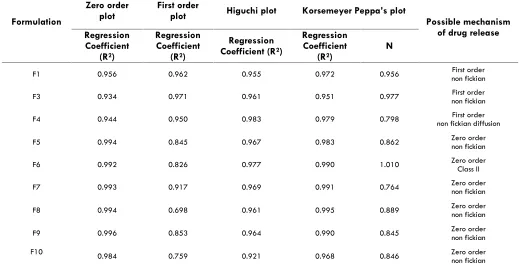
(3) 90 In-vitro release studies were carried out using USP XXIII, paddle dissolution test apparatus. 900ml of simulated gastric fluid (pH 1.2) was taken in a dissolution vessel and the temperature of the medium was maintained at 370C0.50C. The speed was 50rpm. 5ml of sample was withdrawn at predetermined time intervals dilute up to 50ml with medium and same volume of a fresh medium was replaced. The samples were analyzed for drug content against 0.1N HCl as a blank at max 255nm using U.V. Spectrophotometer.[6]. Result and Discussion. Angle of Repose: The angle of repose for the formulated blend was carried out. It concludes all the formulations blend was found to be in the range 24.12' to 27.49'. Thickness of tablet: The Thickness for the formulated tablet was carried out. It concludes all the formulated tablet was found to be in the range 2.650mm to 3.207mm. Friability Test: The % friability was less than 1% in all the formulations ensuring that the tablets were mechanically stable. Drug content: The drug content for the formulated tablet was carried out. It concludes all the formulated tablet was found to be in the range 96.11% - 98.72% which is within limit as per B.P. 2007 (95-105%). Buoyancy / Floating test All the tablets were prepared by the effervescent approach. Sodium bicarbonate was added as a gas-generating agent. Sodium bicarbonate induced carbon dioxide generation in the presence of the dissolution medium (0.1N hydrochloric acid). The combination of sodium bicarbonate and citric acid provided desired floating ability and therefore this combination was selected for the formulation of the floating tablets. The tablet floating lag time (FLT) was found to be minimum 30s and total floating time more than 12h. The floating lag time may be explained as a result of the time required for dissolution medium to penetrate the tablet matrix and develop the swollen layer for entrapment of CO 2 generated in situ. The tablet mass decreased progressively due to liberation of CO2 and release of drug from the matrix. On the other hand, as solvent front penetrated the glassy polymer layer, the swelling of HPMC K4M and K100M caused an increase in volume of the tablet. The combined effect is a net reduction in density of the tablets, which prolongs the duration of floatation beyond 15h. The pH of the stomach is elevated under the condition (~3.5), therefore citric acid was incorporated in the formulation to provide an acidic medium for sodium bicarbonate; more over citric acid has an stabilizing effect on Acyclovir formulation.. Int. J. Pharm & Ind. Res. Vol - 01. Formulations containing sodium bicarbonate and citric acid in different ratios were studied for their effect on floating lag time of Acyclovir. It was observed that formulation F1 contains sodium bicarbonate and citric acid in the ratio of 7:1showed FLT 92S., formulation F2 contains ratio 12:1 showed disintegrate or blast the tablet due to more concentration of gas forming agent and formulation F3 to F10 contains a ratio of 9:1 showed FLT 30 to 62S. Water uptake study The swelling of the polymers used could be determined by water uptake of the tablet. The complete swelling was achieved by the end of 5 hours, so percent swelling was determined at the end of 5 hours for all the developed formulation. The values of swelling index of various batches were evaluated as shown in table 3. There was a significant increase in the percent swelling of the tablet with increase in concentration of polymers. After 5 hours swelling index was observed between 73.49 to 85.24 %. In vitro dissolution studies The initial batches [F1-F4], made with HPMC K4M alone showed the complete release in 6 to 9 hrs. Tablets formulated with HPMC K100M alone (F5-F6), too showed a complete drug release in 9 to 11 hrs and where a formulation F7 showed a drug release in 12 hrs with 90.63% due to more concentration of HPMC K100M. The formulation [F8 to F10], made with the combination of HPMC K4M & HPMC K100M showed a drug release in 10 to 12 hrs. This was because tablets which are composed of a hydrophilic polymeric matrix, on contact with water build a gel layer around the tablet core which governs the drug release. The drug release from HPMC matrices is controlled for water soluble drug by diffusion and for water insoluble drugs by erosion of outer polymer layer. Kinetic modeling of drug release The formulations F1, F3, and F4 showed higher Regression values for first order plot and non- fickian indicating that the drug releases from these formulations were concentration dependent. The formulations F5, F6, F7, F8, F9 and F10 showed higher Regression values for zero order plots and non- fickian indicating that the drug releases from these formulations were concentration independent. The effervescent-based floating drug delivery was a promising approach to achieve in vitro buoyancy. The addition of gel-forming polymer HPMC (K4M and K100M) and gas-generating agent sodium bicarbonate along with citric acid was essential to achieve in vitro buoyancy. The drug release from the tablets was sufficiently sustained and non-Fickian transport of the drug from tablets was confirmed.. Acknowledgement. The authors are thankful to Mr. Hitesh Koradia from Biodeal Lab. Pvt. Ltd. Surendranagar, Gujarat, India for their support and cooperation in carrying out the research work.. Issue - 02. Apr - Jun 2011.
(4) 91. Ingredients. F1. Table No. - 1 Formulation of Floating Tablets of Acyclovir F2 F3 F4 F5 F6 F7. F8. F9. F10. Qty(mg/tab). Acyclovir. 100. 100. 100. 100. 100. 100. 100. 100. 100. 100. Lactose(mono). 106. 66. 84. 74. 94. 84. 74. 84. 74. 64. HPMC K 4 M. 30. 40. 40. 50. -. -. -. 10. 20. 30. -. -. -. -. 30. 40. 50. 30. 30. 30. Sod.bicarbonate. 42. 72. 54. 54. 54. 54. 54. 54. 54. 54. Citric Acid. 6. 6. 6. 6. 6. 6. 6. 6. 6. 6. PVP K 30. 12. 12. 12. 12. 12. 12. 12. 12. 12. 12. Isopropyl Alcohol. qs. qs. qs. qs. qs. qs. qs. qs. qs. qs. Magnesium Stearate. 2. 2. 2. 2. 2. 2. 2. 2. 2. 2. Talcum. 2. 2. 2. 2. 2. 2. 2. 2. 2. 2. 300. 300. 300. 300. 300. 300. 300. 300. 300. 300. HPMC K100 M. Total Weight. Table No. - 2: Floating Lag Time, Total Floating Time Formulation Code. Floating Lag Time-FLT (sec.). Total Floating Time TFT(mins). F1. 92. 555. F2*. 0. 0. F3. 62. 685. F4. 51. 760. F5. 48. 670. F6. 56. 695. F7. 55. 870. F8. 30. 665. F9. 33. 695. F10. 35. 765. *Formulation F2 tablet was disintegrate or blast after putting in 0.1N HCl, so it’s don’t have FLT and TFT.. Time (In Hrs) 1 2 3 4 5. Table No. - 3 Swelling Index of Floating Tablet of Acyclovir Swelling Index (%) F1 28.23 39.76 54.32 66.07 76.18. Int. J. Pharm & Ind. Res. F3 30.56 47.18 56.03 69.47 73.49. F4 34.45 45.04 53.61 68.59 75.36. Vol - 01. F5 32.82 47.68 58.55 70.71 77.29. F6 36.49 49.57 60.22 73.44 80.06. F7 32.53 39.34 59.66 76.62 79.16. Issue - 02. F8 36.64 46.27 58.18 70.72 83.63. F9 35.39 49.45 65.01 80.07 82.44. F10 34.87 46.09 68.33 79.68 85.24. Apr - Jun 2011.
(5) 92. Table No. - 4 Comparative Cumulative Percentage Drug Release Data for F1 - F10 Time in hrs. F1. F3. F4. F5. F6. F7. F8. F9. F10. 0. 0. 0. 0. 0. 0. 0. 0. 0. 0. 1. 18.66. 14.66. 17.61. 15.19. 10.38. 13.78. 12.11. 12.98. 12.02. 2. 39.09. 35.13. 34.97. 21.35. 15.9. 23.00. 22.38. 21.34. 19.84. 3. 65.77. 60.95. 48.29. 35.72. 27.27. 28.21. 30.45. 29.31. 24.22. 4. 84.61. 79.01. 66.13. 40.68. 39.98. 35.9. 42.01. 33.93. 29.08. 5. 91.8. 85.12. 75.84. 52.56. 45.87. 41.41. 47.06. 43.93. 34.95. 6. 96.35. 89.69. 85.17. 67.42. 58.99. 48.76. 55.11. 50.62. 41.09. 7. --. 95.84. 93.19. 72.13. 68.18. 54.94. 63.62. 61.25. 48.82. 8. --. --. 96.64. 82.83. 79.93. 61.48. 75.66. 71.19. 57.87. 9. --. --. 98.2. 95.86. 90.94. 71.04. 86.32. 79.73. 68.41. 10. --. --. --. --. 92.20. 81.68. 98.57. 86.6. 79.39. 11. --. --. --. --. 98.84. 84.27. --. 95.27. 89.81. 12. --. --. --. --. --. 90.63. --. --. 97.1. Table No. – 5 Kinetic Values Obtained from Different Plots of Formulations (F1-F10) of Acyclovir Zero order plot. First order plot. Higuchi plot. Regression Coefficient (R2). Regression Coefficient (R2). Regression Coefficient (R2). Regression Coefficient (R2). N. F1. 0.956. 0.962. 0.955. 0.972. 0.956. First order non fickian. F3. 0.934. 0.971. 0.961. 0.951. 0.977. First order non fickian. F4. 0.944. 0.950. 0.983. 0.979. 0.798. First order non fickian diffusion. F5. 0.994. 0.845. 0.967. 0.983. 0.862. Zero order non fickian. F6. 0.992. 0.826. 0.977. 0.990. 1.010. Zero order Class II. F7. 0.993. 0.917. 0.969. 0.991. 0.764. Zero order non fickian. F8. 0.994. 0.698. 0.961. 0.995. 0.889. Zero order non fickian. F9. 0.996. 0.853. 0.964. 0.990. 0.845. Zero order non fickian. 0.984. 0.759. 0.921. 0.968. 0.846. Zero order non fickian. Formulation. F10. Int. J. Pharm & Ind. Res. Vol - 01. Korsemeyer Peppa’s plot. Issue - 02. Possible mechanism of drug release. Apr - Jun 2011.
(6) 93. Figure -1 Swelling Index of Floating Tablet of Acyclovir. Figure - 2 Comparative Cumulative % of Drug Release Data for F1-F10. Int. J. Pharm & Ind. Res. Vol - 01. Issue - 02. Apr - Jun 2011.
(7) 94. Reference. 1. Devi Kusum V, Bhosale U.V. Formulation and optimization of polymeric Nano drug delivery system of acyclovir using 3² Full factorial design. International Journal of PharmTech Research 2009; 1: 644-653. 2. Rajesh Kaza, Usharani E, Nagaraju R, Haribabu R, Siva Reddy P.V. Design and Evaluation of Sustained release Floating tablets for the treatment of Gastric Ulcers. J. Pharm. Sci. & Res. 2009; 1 :81-87. 3. Sanjay S. Patel, Ray S, Thakur R.S. Formualtion and evaluation of floating drug delivery System containing clarithromycin for helicobacter pylori. Acta Poloniae Pharmaceutica – Drug Research 2006; 63 :53-61.. Int. J. Pharm & Ind. Res. Vol - 01. 4. Maria E.C, Leopold V.R. Influence of the viscosity grade and the particle size of HPMC on metronidazole release from matrix tablets. European Journal of Pharmaceutics and Biopharmaceutics 1997; 43: 173- 178. 5. Deepa Karthikeyan, Karthikeyan .M, Ramasamy .C. Effect of Different Viscosity Grades of HPMC on Drug Release Profile. Journal of Pharmacy Research. 2008;1 :23-28. 6. British Pharmacopoeia, Official Monographs. 2008; 3: 2394- 2395. 7. Kshirsagar.R.V, Vikas Jain, Wattamwar.S. Effect of different viscosity grade HPMC polymers on gastroretentive drug delivery of Metformin HCl. International journal of applied pharmaceutics 2009; 1: 44-50.. Issue - 02. Apr - Jun 2011.
(8)
Figure

Related documents
The most important contributions of this paper are (i) the proposal of a concern mining approach for KDM, what may encourage other groups to start researching on
Over a one-year recruitment period per study site, all treatment naïve adult patients newly diagnosed with wet age-related macular degeneration, visual impairment due to
The objective of the CROSS trial is to compare median survival rates and quality of life (before, during and after treatment) between patients treated with neoadjuvant
Antihypertensive therapy in hypertensive patients imme- diately post stroke may be effective and cost-effective compared with placebo from the acute hospital perspec- tive at
By using transfer learning, it is possible to use a deep learning model that has been pretrained on large dataset to learn from relatively smaller dataset.. The use of this con-
A ttracting and retaining human capital , which is represented by the stock of senior professionals in them , constitutes the cornerstone of their competitive edge ( Calvo , 2011
Culturing of acute myeloid leukemia (AML) KG1a cells in FN-coated PU/PLLA 60:40 shows increased cell adhesion and cell adhesion-mediated drug resistance to the drugs cytarabine
From the Columbia University Pediatric AIDS Program at Babies Hospital and Harlem Hospital, New York; Pediatric, Adolescent, and MaternalAlDS Branch, Center for Research for Mothers
