LIBOL
: A Library for Online Learning Algorithms
Steven C.H. Hoi [email protected]
Jialei Wang [email protected]
Peilin Zhao [email protected]
School of Computer Engineering Nanyang Technological University Singapore 639798
Editor:Mark Reid
Abstract
LIBOL is an open-source library for large-scale online learning, which consists of a large family of efficient and scalable state-of-the-art online learning algorithms for large-scale online classification tasks. We have offered easy-to-use command-line tools and examples for users and developers, and also have made comprehensive documents available for both beginners and advanced users. LIBOL is not only a machine learning toolbox, but also a comprehensive experimental platform for conducting online learning research.
Keywords: online learning, massive-scale classification, big data analytics
1. Introduction
Online learning represents an important family of efficient and scalable machine learning algorithms for large-scale applications. In general, online learning algorithms are fast, sim-ple, and often make few statistical assumptions, making them applicable to a wide range of applications. Online learning has been actively studied in several communities, including machine learning, statistics, and artificial intelligence. Over the past years, a variety of online learning algorithms have been proposed, but so far there is very few comprehensive library which includes most of the state-of-the-art algorithms for researchers to make easy side-by-side comparisons and for developers to explore their various applications.
In this work, we develop LIBOLas an easy-to-use online learning tool that consists of a
large family of classical and recent state-of-the-art online learning algorithms for large-scale online classification tasks. In contrast to many existing software for large-scale data classi-fication, LIBOL enjoys significant advantages for massive-scale data classification in the era of big data nowadays, especially in efficiency, scalability, parallelization, and adaptability. Our goal is to make LIBOL not only a useful machine learning tool for practical users, but also a comprehensive experimental platform for machine learning researchers to conduct
on-line learning research. The LIBOL software is available athttp://libol.stevenhoi.org/.
A more comprehensive and up-to-date documentation for the latest software is available at
2. A Family of Online Learning Algorithms for Linear Classification
Online learning operates on a sequence of data examples with time stamps. At each step
t, the learner receives an incoming example xt ∈ X in a d-dimensional vector space,
that is, X = Rd. It first attempts to predict the class label of the incoming instance,
ˆ
yt=sgn(f(xt;wt)) =sgn(wt·xt)∈ Y, andY ={−1,+1}for binary classification tasks.
Af-ter making the prediction, the true labelyt∈ Y is revealed, and the learners then computes
the loss `(yt,yˆt) based on some criterion to measure the difference between the learner’s
prediction and the revealed true labelyt. Based on the result of the loss, the learner finally
decides when and how to update the classification model at the end of each learning step.
The following algorithmic framework gives an overview of most online learning algorithms1
for linear classification, where ∆(wt; (xt, yt)) denotes the update of the classification
mod-els. Different online learning algorithms in general are distinguished in terms of different
definitions and designs of the loss function `(·) and their various updating functions ∆(·).
Algorithm 1:LIBOL: Online Learning Framework for Linear Classification.
1 Initialize: w1 = 0
2 for t= 1,2, . . . , T do
3 The learner receives an incoming instance: xt∈ X;
4 The learner predicts the class label: ˆyt=sgn(f(xt;wt));
5 The true class label is revealed from the environment: yt∈ Y;
6 The learner calculates the suffered loss: `(wt; (xt, yt));
7 if `(wt; (xt, yt))>0 then
8 The learner updates the classification model:
9 wt+1←wt+ ∆(wt; (xt, yt));
10 end
11 end
The goal of our work is to implement a large family of diverse online learning methods in literature to facilitate research and development of online learning techniques to real-world applications. In particular, this software consists of 29 different online learning algorithms and variants for both binary and multiclass classification tasks. In general, they can be grouped into two major categories: (i) first order learning (Rosenblatt, 1958; Crammer et al., 2006), and (ii) second order learning (Dredze et al., 2008; Wang et al., 2012a; Yang et al., 2009). Examples of online learning algorithms in the first order learning category include the following list of classical and popular algorithms:
• Perceptron: the classical online learning algorithm (Rosenblatt, 1958);
• ALMA: A New Approximate Maximal Margin Classification Algorithm (Gentile, 2001);
• ROMMA: the relaxed online maximum margin algorithms (Li and Long, 2002);
• OGD: the Online Gradient Descent (OGD) algorithms (Zinkevich, 2003);
• PA: the Passive Aggressive (PA) online learning algorithms (Crammer et al., 2006).
To improve the efficacy of first order learning methods, recent years have witnessed the emerging active studies of second order online learning algorithms. One family of recent second order algorithms (Dredze et al., 2008) assume the weight vector follows a Gaussian
distribution w ∼ N(µµµ,Σ) with mean vector µµµ ∈ Rd and covariance matrix Σ ∈
Rd×d.
The model parameters, including both Σ andµµµare updated in the online learning process.
Examples of the second order online learning algorithms include the following:
• SOP: the Second Order Perceptron (SOP) algorithm (Cesa-Bianchi et al., 2005);
• CW: the Confidence-Weighted (CW) learning algorithm (Dredze et al., 2008);
• IELLIP: online learning algorithms by improved ellipsoid method (Yang et al., 2009);
• AROW: the Adaptive Regularization of Weight Vectors (Crammer et al., 2009);
• NAROW: New variant of Adaptive Regularization (Orabona and Crammer, 2010);
• NHERD: the Normal Herding method via Gaussian Herding (Crammer and Lee, 2010)
• SCW: the recently proposed Soft Confidence Weighted algorithms (Wang et al., 2012a).
3. The Software Package
The current version (V0.3.0) of LIBOL implements a large family of online learning algo-rithms and their variants, including 16 algoalgo-rithms for binary classification, and 13 algoalgo-rithms for multiclass classification. The package includes the MATLAB library and command-line tools for both online binary and multiclass classification tasks. In addition to MATLAB implementation, we also provide C/C++ implementation for the core functions. The data formats used by this software are compatible with popular machine learning and data mining packages, such as LIBSVM, SVM-light, and WEKA, etc.
3.1 Practical Usage
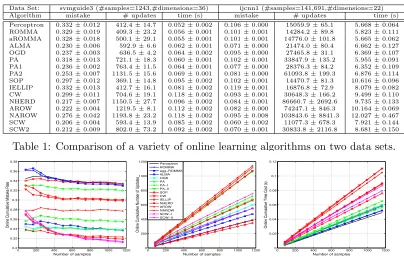
To illustrate the online learning procedure, we take two data sets from the LIBSVM website, including one small data set “svmguide3” with 1243 instances and one large data set “ijcnn1” with 141,691 instances. In the following example, we use the default “Perceptron” algorithm to demo the usage of LIBOL for a binary classification (’bc’) task:
$ demo(’bc’,’Perceptron’,’svmguide3’)
The results output by the above command are summarized as follows:
Algorithm: mistake rate nb of updates cpu time (seconds)
Perceptron 0.3318 +/- 0.0118 412.45 +/- 14.66 0.0516 +/- 0.0008
To ease researchers to run a full set of experiments for side-by-side comparisons of different algorithms, we offer a very easy-to-use example program as follows:
$ run experiment(’bc’,’svmguide3’)
Data Set: svmguide3 (#samples=1243,#dimensions=36) ijcnn1 (#samples=141,691,#dimensions=22) Algorithm mistake # updates time (s) mistake # updates time (s) Perceptron 0.332±0.012 412.4±14.7 0.052±0.002 0.106±0.000 15059.9±65.1 5.668±0.064 ROMMA 0.329±0.019 409.3±23.2 0.056±0.001 0.101±0.001 14284.2±89.8 5.823±0.111 aROMMA 0.328±0.018 500.1±29.1 0.055±0.001 0.101±0.001 14776.0±101.8 5.665±0.062 ALMA 0.230±0.006 592.9±6.6 0.062±0.001 0.071±0.000 21474.0±80.4 6.662±0.127 OGD 0.237±0.003 636.5±4.2 0.064±0.002 0.095±0.000 27465.8±31.1 6.369±0.107 PA 0.318±0.013 721.1±18.3 0.060±0.001 0.102±0.001 33847.9±135.2 5.955±0.091 PA1 0.236±0.002 763.4±11.5 0.064±0.001 0.077±0.000 28376.3±84.2 6.352±0.109 PA2 0.253±0.007 1131.5±15.6 0.069±0.001 0.081±0.000 61093.8±199.3 6.876±0.114 SOP 0.297±0.012 369.1±14.8 0.095±0.002 0.102±0.001 14470.7±81.3 10.616±0.096 IELLIP 0.332±0.013 412.7±16.1 0.081±0.002 0.119±0.001 16876.8±72.9 8.079±0.082 CW 0.299±0.011 704.6±19.1 0.118±0.002 0.093±0.001 30648.3±166.2 9.499±0.110 NHERD 0.217±0.007 1150.5±27.7 0.096±0.002 0.084±0.001 86660.7±2692.6 9.735±0.133 AROW 0.222±0.004 1219.5±8.1 0.112±0.002 0.082±0.000 74247.1±846.3 10.164±0.069 NAROW 0.276±0.042 1193.8±23.2 0.118±0.002 0.095±0.008 103843.6±8841.3 12.027±0.467 SCW 0.206±0.004 593.4±13.9 0.085±0.002 0.060±0.002 11077.3±678.3 7.921±0.144 SCW2 0.212±0.009 802.0±73.2 0.092±0.002 0.070±0.001 30833.8±2116.8 8.681±0.150
Table 1: Comparison of a variety of online learning algorithms on two data sets.
0 200 400 600 800 1000 1200 0.2 0.22 0.24 0.26 0.28 0.3 0.32 0.34 0.36 0.38
Number of samples
Online Cumulative Mistake Rate
0 200 400 600 800 1000 1200 0 200 400 600 800 1000 1200
Number of samples
Online Cumulative Number of Updates
0 200 400 600 800 1000 1200 0 0.02 0.04 0.06 0.08 0.1 0.12
Number of samples
Online Cumulative Time Cost (s)
Perceptron ROMMA agg−ROMMA ALMA OGD PA PA−I PA−II SOP CW IELLIP NHERD AROW NAROW SCW−I SCW−II
Figure 1: Comparison of a variety of online learning algorithms on data set “svmguide3”.
3.2 Documentation and Design
The LIBOL package comes with comprehensive documentation. The README file de-scribes the setup and usage. Users can read the “Quick Start” section to begin shortly. All the functions and related data structures are explained in detail. If the README file does not give the information users want, they can check the online FAQ. In addition to software documentation, theoretical properties of the algorithms and comparisons can be found in Wang et al. (2012a). The authors are also willing to answer any further questions.
The design principle is to keep the package simple, easy to read and extend. All codes follow the MATALB standards with core functions implemented in C/C++. It generally needs no external libraries, except for the support of popular data formats, such as LIBSVM and WEKA data sets for which existing libraries are included. LIBOL is written in a
modular way. All the online learning algorithms can be called via the uniform “ol train()”
function by setting proper options. One can easily develop a new algorithm and make side-by-side comparisons with the existing ones in the package. Our goal is to make LIBOL not only a machine learning tool, but also an experimental platform for online learning research.
4. Conclusion
References
Nicol`o Cesa-Bianchi, Alex Conconi, and Claudio Gentile. A second-order perceptron
algo-rithm. SIAM J. Comput., 34(3):640–668, 2005.
Koby Crammer and Daniel D. Lee. Learning via gaussian herding. InNIPS, pages 451–459,
2010.
Koby Crammer, Ofer Dekel, Joseph Keshet, Shai Shalev-Shwartz, and Yoram Singer. Online
passive-aggressive algorithms. Journal of Machine Learning Research, 7:551–585, 2006.
Koby Crammer, Alex Kulesza, and Mark Dredze. Adaptive regularization of weight vectors.
In NIPS, pages 345–352, 2009.
Mark Dredze, Koby Crammer, and Fernando Pereira. Confidence-weighted linear
classifi-cation. In ICML, pages 264–271, 2008.
Claudio Gentile. A new approximate maximal margin classification algorithm. Journal of
Machine Learning Research, 2:213–242, 2001.
Steven C. H. Hoi, Rong Jin, Peilin Zhao, and Tianbao Yang. Online multiple kernel
classi-fication. Machine Learning, 90(2):289–316, 2013a.
Steven C. H. Hoi, Jialei Wang, Peilin Zhao, Jinfeng Zhuang, and Zhi-Yong Liu. Large scale
online kernel classification. In IJCAI, 2013b.
Yi Li and Philip M. Long. The relaxed online maximum margin algorithm. Machine
Learning, 46(1-3):361–387, 2002.
Francesco Orabona and Koby Crammer. New adaptive algorithms for online classification.
In NIPS, pages 1840–1848, 2010.
Frank Rosenblatt. The perceptron: A probabilistic model for information storage and
organization in the brain. Psych. Rev., 7:551–585, 1958.
Jialei Wang, Peilin Zhao, and Steven C. H. Hoi. Exact soft confidence-weighted learning.
ICML, 2012a.
Jialei Wang, Peilin Zhao, and Steven CH Hoi. Cost-sensitive online classification. InIEEE
12th International Conference on Data Mining (ICDM), pages 1140–1145. IEEE, 2012b.
Liu Yang, Rong Jin, and Jieping Ye. Online learning by ellipsoid method. In ICML, page
145, 2009.
Peilin Zhao, Steven C. H. Hoi, and Rong Jin. Double updating online learning. Journal of
Machine Learning Research, 12:1587–1615, 2011a.
Peilin Zhao, Steven C. H. Hoi, Rong Jin, and Tianbao Yang. Online auc maximization. In
ICML, pages 233–240, 2011b.
Martin Zinkevich. Online convex programming and generalized infinitesimal gradient ascent.