International Journal of Engineering and Management Research, Vol.-2, Issue-6, December 2012
ISSN No.: 2250-0758
Pages: 67-71
www.ijemr.net
Secure and Efficient Framework for Wireless Sensor Networks by Using
Keying Mechanisms
M.Ganeshkumar1, P.Sreedevi2, G.Soma Sekhar 3,C.Venkateswarlu Sonagiri4 1,2
Dept. of CSE, Holymary Institute of Technology and Science, Hyderabad, A.P. INDIA 3
Research Scholar in CSE Department, Acharya Nagarjuna University, INDIA 4
Professor & Head, Dept. of CSE, Holymary Institute of Technology and Science, Hyderabad, A.P. INDIA
ABSTRACT
Sensors are inexpensive, low-power devices which have limited resources, designing cost-efficient, secure network protocols for Wireless Sensor Networks (WSNs) is a challenging problem because sensors are resource-limited wireless devices. Since the communication cost is the most dominant factor in a sensor’s energy consumption. RAPIDLY developed WSN technology is no longer nascent and will be used in a variety of application scenarios. Typical application areas include environmental, military, and commercial enterprises.
In a battlefield scenario, sensors may be used to detect the location of enemy sniper fire or to detect harmful chemical agents before they reach troops. In another potential scenario, sensor nodes forming a network under water could be used for oceanographic data collection, pollution monitoring, assisted navigation, military surveillance, and mine reconnaissance operations. Future improvements in technology will bring more sensor applications into our daily lives and the use of sensors will also evolve from merely capturing data to a system that can be used for real-time compound event alerting. From a security standpoint, it is very important to provide authentic and accurate data to surrounding sensor nodes and to the sink to trigger time-critical responses (e.g., troop movement, evacuation, and first response deployment). Protocols should be resilient against false data injected into the network by malicious nodes. Otherwise, consequences for propagating false data or redundant data are costly, depleting limited network resources and wasting response efforts.
Keywords— Accurate, Low-Power Devices, Reconnaissance, Security and wss.
I.
INTRODUCTION
Designing cost-efficient, secure network protocols for Wireless Sensor Networks (WSNs) is a challenging problem because sensors are resource-limited wireless devices. Since the communication cost is the most
dominant factor in a sensor’s energy consumption. RAPIDLY developed WSN technology is no longer nascent and will be used in a variety of application scenarios. Typical application areas include environmental, military, and commercial enterprises. For example, in a battlefield scenario, sensors may be used to detect the location of enemy sniper fire or to detect harmful chemical agents before they reach troops.
In another potential scenario, sensor nodes forming a network under water could be used for oceanographic data collection, pollution monitoring, assisted navigation, military surveillance, and mine reconnaissance operations. Future improvements in technology will bring more sensor applications into our daily lives and the use of sensors will also evolve from merely capturing data to a system that can be used for real-time compound event alerting.
From a security standpoint, it is very important to provide authentic and accurate data to surrounding sensor nodes and to the sink to trigger time-critical responses (e.g., troop movement, evacuation, and first response deployment). Protocols should be resilient against false data injected into the network by malicious nodes. Otherwise, consequences for propagating false data or redundant data are costly, depleting limited network resources and wasting response efforts.
II.
METHODOLOGY
sensor’s energy consumption [14, 15], in this thesis, the problem of providing security to sensor-based applications is tackled with a new approach. As opposed to other ”chatty” dynamic key management and enroute filtering schemes, we focus on eliminating specific control messages for keying or rekeying in the network so that some of the energy savings from transmission cost can be utilized for the computation of local security operations. Specifically, the following four areas are investigated under this thesis and each of them is described in the following subsections:
• Designing Secure Protocols for Wireless Sensor Networks
• Virtual Energy-Based Encryption and Keying (VEBEK) protocol for Wireless Sensor Networks
• Time-Based Dynamic Keying and En-Route Filtering (TICK) for Wireless Sensor Networks
• Secure Source-Based Loose Time Synchronization (SOBAS) for Wireless Sensor Network.
BLOCK DIAGRAM
Figure2.1: Block Diagram
Sender
Sender module deals with sender operations and allows sender to transmit data to the receiver. The sender needs to select the file and Encrypt the file using key and send through the network to the Receiver.
Receiver
Receiving Module will deals with the receiving operations. It receives the encrypted file which is send by the sender and it will decrypt the file using key and show the message to the user.
III.
ALGORITHMS
Algorithm 1.
a. Compute Dynamic Key b. Computer Dynamic Key (E,ID) c. Begin
d. J---txIDcnt e. If j=1 then
f. Kj ---F(K(j-1), Evc) g. end if
III.
RESULTS AND DISCUSIONS
Home page
Screen shot for Homepage
Figure 3.1: Home page
Description: This is the starting page of my project. It contains two menus sender and receiver.
Figure 3.2: Sender Form
Description: This Screen is used to send the file to the destination.By the given IP Address the file content is encrypted and it provides secret key by using RC5 Algorithm.
Screen shot for Reciever Form
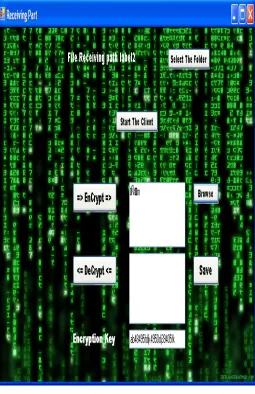
Figure3.3: Receiver Form
Description: This Screen shot is used to receive the file from the source which is send by the authorised user. Using the secret key which is generated in sender form, wer can decrypt the file in the receiver form.
IV.
CONCLUSION
Communication is very costly for wireless sensor networks (WSNs) and for certain WSN applications. Independent of the goal of saving energy, it may be very important to minimize the exchange of messages (e.g., military scenarios). To address these concerns, we presented a secure communication framework for WSNs called Virtual Energy- Based Encryption and Keying.
energy savings) than others while providing support for communication error handling, which was not the focus of earlier studies.
Future Enhancements
Our future work will address insider threats and dynamic paths.
Future improvements in technology will bring more sensor applications into our daily lives and the use of sensors will also evolve from merely capturing data to a system that can be used for real-time compound event alerting
REFERENCES
[1] I.F. Akyildiz, W. Su, Y. Sankarasubramaniam, and E. Cayirci, “Wireless Sensor Networks: A Survey,” Computer Networks, vol. 38, no. 4, pp. 393-422, Mar. 2002.
[2] C. Vu, R. Beyah, and Y. Li, “A Composite Event Detection in Wireless Sensor Networks,” Proc. IEEE Int’l Performance, Computing, and Comm. Conf. (IPCCC ’07), Apr. 2007.
[3] S. Uluagac, C. Lee, R. Beyah, and J. Copeland, “Designing SecureProtocols for Wireless Sensor Networks,” Wireless Algorithms, Systems, and Applications, vol. 5258, pp. 503-514, Springer, 2008. [4] G.J. Pottie and W.J. Kaiser, “Wireless Integrated Network Sensors,” Comm. ACM, vol. 43, no. 5, pp. 51-58, 2000.
[5] R. Roman, C. Alcaraz, and J. Lopez, “A Survey of Cryptographic Primitives and Implementation for Hardware-Constrained Sensor Network Nodes,” Mobile Networks and Applications, vol. 12, no. 4, pp. 231-244, Aug. 2007.
[6] H. Hou, C. Corbett, Y. Li, and R. Beyah, “Dynamic Energy-Based Encoding and Filtering in Sensor Networks,” Proc. IEEE Military Comm. Conf. (MILCOM ’07), Oct. 2007.
[7] L. Eschenauer and V.D. Gligor, “A Key-Management Scheme for Distributed Sensor Networks,” Proc. Ninth ACM Conf. Computer and Comm. Security, pp. 41-4, 2002.
[8] M. Vuran and I. Akyildiz, “Cross-Layer Analysis of Error Control in Wireless Sensor Networks,” Proc. Third Ann. IEEE Comm. Soc. Conf. Sensor, Mesh, and Ad Hoc Communications and Network (SECON ’06), vol. 2, pp. 585-594, Sept. 2006.
[9] F. Ye, H. Luo, S. Lu, and L. Zhang, “Statistical En-Route Filtering of Injected False Data in Sensor Networks,” IEEE J. Selected Areas in Comm., vol. 23, no. 4, pp. 839-850, Apr. 2005.