Carla Deisiane de Oliveira Costa (Correspondence)
[email protected]
+
1
Departament of Rural Engineering, Faculty of Agricultural Sciences, State University, FCA-UNESP, Botucatu (SP), Brazil
2
Departament of Phytosanitary, Rural Engineering and Soils, Faculty of Engineering, State University, FEIS-UNESP, Ilha Solteira (SP), Brazil
Abstract: This study was carried out in Jardim Novo Horizonte sub-basin river, in Ilha Solteira municipality, northwest São Paulo state, Brazil, a region with environmental issues such as soil erosion and river silting. The aim of the research was to assess the aggregates stability in the soils of the sub-basin river in order to verify the susceptibility to erosion. Soils in the sub-basin river are classified as Oxisol and Alfisol, both with medium texture. The analysis was carried out in samples from ten locations, six located in the Oxisol and four in the Alfisol and in each location five replications were made consisting of the following uses: one with mango cropping, four with pasture and one with an annual crop in the Oxisol and two with pasture, one with annual crop and one with forest fragment in the Alfisol. The different uses and managements influenced aggregate stability only in the Oxisol. The areas cropped with pasture presented the highest percentages of the largest aggregate classes in the two soils studied. The opposite effect was observed in the areas under annual crops, with greater percentages of the small aggregate classes. The greatest mean weighted diameter values were found for the pasture and the smallest for the annual crops, regardless of the soil. The areas cultivated with annual crops had a higher susceptibility to erosion.
Keywords: soil use and occupation, soil aggregate, susceptibility to erosion, mean weighted diameter, soil structure.
1. Introduction
Lack of environmental planning and unsuitable use of the soils in river basins has caused their degradation, affecting mainly water quality. One of the main aspects of a basin is the interrelationship between its various components, such as soil, water, plant cover and atmosphere, and systemic action because an action in any of them is certainly reflected in the others. Anthropic action breaks the balance among these components causing especially increase in surface runoff and erosion, sediment transport and accumulation in the channels and their silting and contamination, causing according to Magrini and Santos (2001) a change in the water regime.
It is important to understand the factors that make up the soil erosion process, because they serve as parameters to elaborate measures to maximize the use of the natural resources available and prevent negative effects resulting from sediment production, transport and deposition (Paiva, 2001). These factors depend on the nature of the soils, that is, on their properties and especially on the management of their use and occupation. Soil physical properties are among those that can be altered.
The cultivation of the soil changes its physical properties, such changes are more pronounced in conventional tillage systems, which are manifested in the density, volume and distribution of pore size and soil aggregates stability, influencing water infiltration into the soil the erosion and plant development (Bertol et al., 2004).
Aggregate stability is one of the main physical properties of the soil and should be analyzed in diagnostic studies for erosion susceptibility as it characterizes the resistance of the soil to rupture caused by external agents. According toMielniczuk et al. (2003),one of the main attributes of soil quality is related to the formation of stable macroaggregates, which are responsible for the soil structure. In addition, according to Matos et al. (2008), water stable aggregates help improve porosity and consequently greater infiltration and resistance to erosion.
http://www.ijSciences.com
Volume 3 - February 2014 (2)
62
practices are components of management which most influence the resistance of a soil to erosion, since they impose physical conditions at the soil surface that will interfere with the action of erosive agents (Volk et al. 2004).
The intensive cropping, allied to a high turnover rate, accounts for reduced organic matter content in the soil that is one of the main aggregate formation and stabilization agents. According to Wendling et al. (2005), reducing the content of organic matter in the soil by cultivation is a major cause of deterioration of soil structure.
The increase underground plant biomass and of soil stability aggregates by their adequate management increase their quality to resist erosion (Volk, 2006). According to Volk and Cogo (2008), the effectiveness of plant roots in reducing erosion can manifest itself in two ways, due to mechanical action exerted by plants, and as the aggregating agent of the soil particles.
Some authors refer the pasture as important soil coverage due to the dense root system, which according to Marchão (2007) acts as aggregating agent, besides the absence of tillage in the pasture cycle, rapidly increasing stability of soil aggregates. Salton et al. (2008) and Pinheiro et al. (2004) studied the influence of different management systems on aggregate stability and observed that soils under pasture presented bigger aggregates than soils with annual crops.
The Jardim Novo Horizonte sub-basin river, located in the municipality of Ilha Solteira in the northwest of São Paulo state, Brazil, is very important because it is located in the proximity of the Ilha Solteira hydroelectric plant. This region has environmental issues, such as soil erosion and river silting, and there is little native vegetation. All these problems were caused by lack of environmental planning and improper management of natural resources. The objective of the present study was to assess aggregate stability in the soils of the Jardim Novo Horizonte
sub-basin river in order to verify the susceptibility to erosion.
2. Materials and Methods
The study was carried out in the Jardim Novo Horizonte sub-basin river, located in the municipality of Ilha Solteira, northwest São Paulo state, Brazil (figure 1), with 2.200 ha in area. The geographical coordinates are 20º 25’ latitude South and 51º 15’ longitude West of Greenwich and 320 m mean altitude.
Figure 1. Location of the municipality of Ilha Solteira, northwest São Paulo state, Brazil.
The climate of the region is the Aw type by the Köppen classification, defined as wet tropical with a rainy season in the summer and dry season in the winter. The mean annual temperature is 23°C, the average rainfall is 1370 mm and the mean annual relative air humidity is between 70 and 80% (Vanzela, 2003).
The original vegetation of the region was Cerrado (Brazilian Savannah). The most representative soils of the Jardim Novo Horizonte sub-basin river are dystrophic red Oxisol and eutrophic red-yellow Alfisol, representing 70 and 30% of the total area, respectively (Queiroz, 2008). Table 1 shows the particle size analysis of the soils studied. Table 1. Soil particle size analysis, in the 0 to 0.10 m and 0.10 to 0.20 m layers.
Use and occupation
Layers Clay Sand Silt Textural
Classes
(m) (g kg-1)
Oxisol
M 0.0 - 0.1 208 684 108 Sandy clay loam
0.1 - 0.2 284 623 93 Sandy clay loam
P1 0.0 - 0.1 195 710 95 Sandy loam
0.1 - 0.2 238 666 96 Sandy loam
P2 0.0 - 0.1 60 873 67 Loamy sand
0.1 - 0.2 89 838 73 Loamy sand
P3 0.0 - 0.1 183 670 147 Sandy loam
http://www.ijSciences.com
Volume 3 - February 2014 (2)
63
P4 0.0 - 0.1 167 732 101 Sandy loam
0.1 - 0.2 220 649 131 Sandy clay loam
CA 0.0 - 0.1 125 791 84 Sandy loam
0.1 - 0.2 148 772 80 Sandy loam
Alfisol
FM 0.0 - 0.1 249 554 197 Sandy clay loam
0.1 - 0.2 277 520 203 Sandy clay loam
P arg1 0.0 - 0.1 235 592 173 Sandy clay loam
0.1 - 0.2 245 583 172 Sandy clay loam
CA arg 0.0 - 0.1 339 186 475 Silty clay loam
0.1 - 0.2 362 178 460 Silty clay loam
P arg2 0.0 - 0.1 172 701 127 Sandy loam
0.1 - 0.2 238 613 149 Sandy clay loam
M = Mango crop, P1 = Pasture, P2 = Pasture, P3 = Pasture, P4 = Pasture, CA = Annual crop, FM = Forest fragment, P
arg1 = Pasture, CA arg = Annual crop and P arg2 = Pasture.
The soil samples were collected in ten locations along the Jardim Novo Horizonte sub-basin river, six located in the Oxisol and four in the Alfisol. The samples were taken randomly within the different forms of soil use and occupation. Samples were collected at five points in each determined location from the 0 to 0.10 m and 0.10 to 0.20 m layers, to perform the analyses.
The uses and occupations in the Oxisol were: mango cropping (M), four locations with pasture (P1, P2, P3
and P4) and an annual crop (CA) with soil prepared
for the corn crop. The uses and occupations in the Alfisol were: two locations with pasture (P arg1 and P
arg2), annual crop (CA arg) with soil prepared for the
corn crop and forest fragment (FM) that were found in a transition area between the Alfisol and Oxisol. Table 2 shows the soil uses and occupation.
Table 2. Description of the uses and occupations of the soils studied in the Jardim Novo Horizonte sub-basin river, Ilha Solteira municipality, northwest São Paulo state, Brazil.
Use and occupation Characthers
Perennial crop Area being planted with the mango crop (Mangifera indica L.) for twelve years.
Annual crop Area has been cultivated for twenty years with corn crop (Zea mays L.) under conventional tillage (disc plow and plough grader).
Pasture Area with pasture (Brachiaria decumbens Stapf) implanted ago eight years.
Forest fragment Area of degraded vegetation with small fragments of area with native vegetation.
The areas with pasture, both in the Oxisol and Alfisol, had been established eight years ago at the same time and were all cropped with the same species (Brachiaria decumbens Stapf), and the particle size and soil characteristics differentiated one from another. Pasture occupies 50% of the total area of the Jardim Novo Horizonte sub-basin river, that justifies the greater quantity of locations sampled under this soil use and occupation.
The method used to determine the aggregate stability in water was reported by Angers and Mehuys (2000) by which the unformed samples were dried in the air and passed through a 6 mm mesh sieve. The aggregates were removed in the sieve with 4 mm opening to determine aggregate stability in water, using a sieve with 4, 2, 1, 0.5 and 0.25 mm mesh opening and gentle shaking for 10 min.
The results were represented by the mean weighted diameter (MWD), the sum of the products among the mean diameter of each fraction of aggregate and the proportion of the sample mass, obtained by dividing the aggregate mass retained in each sieve by the mass of the sample corrected for water content in the soil. The aggregate classes were also expressed in percent, and the following sizes were considered: between 6 and 4; 4 and 2; 2 and 1; 1 and 0.5; 0.5 and 0.25, and <0.25 mm.
http://www.ijSciences.com
Volume 3 - February 2014 (2)
64
3. Results and Discussion
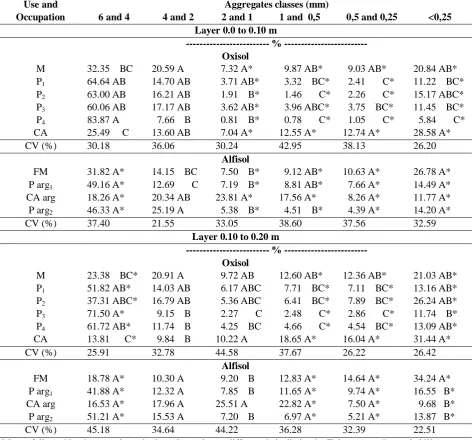
The greatest values observed for the largest aggregate class, between 6 and 4 mm, were for pasture in both
the layers studied and in the two soils, but significant difference was not found among the uses in the Alfisol (Table 3).
Table 3. Mean percentage value of water stable aggregates for the six aggregate size classes in the two soils studied and different forms of use and occupation in the 0 to 0.10 m and 0.10 to 0.20 m layers.
Use and Aggregates classes (mm)
Occupation 6 and 4 4 and 2 2 and 1 1 and 0,5 0,5 and 0,25 <0,25 Layer 0.0 to 0.10 m
--- % --- Oxisol
M 32.35 BC 20.59 A 7.32 A* 9.87 AB* 9.03 AB* 20.84 AB*
P1 64.64 AB 14.70 AB 3.71 AB* 3.32 BC* 2.41 C* 11.22 BC*
P2 63.00 AB 16.21 AB 1.91 B* 1.46 C* 2.26 C* 15.17 ABC*
P3 60.06 AB 17.17 AB 3.62 AB* 3.96 ABC* 3.75 BC* 11.45 BC*
P4 83.87 A 7.66 B 0.81 B* 0.78 C* 1.05 C* 5.84 C*
CA 25.49 C 13.60 AB 7.04 A* 12.55 A* 12.74 A* 28.58 A*
CV (%) 30.18 36.06 30.24 42.95 38.13 26.20
Alfisol
FM 31.82 A* 14.15 BC 7.50 B* 9.12 AB* 10.63 A* 26.78 A* P arg1 49.16 A* 12.69 C 7.19 B* 8.81 AB* 7.66 A* 14.49 A*
CA arg 18.26 A* 20.34 AB 23.81 A* 17.56 A* 8.26 A* 11.77 A*
P arg2 46.33 A* 25.19 A 5.38 B* 4.51 B* 4.39 A* 14.20 A*
CV (%) 37.40 21.55 33.05 38.60 37.56 32.59
Layer 0.10 to 0.20 m
--- % --- Oxisol
M 23.38 BC* 20.91 A 9.72 AB 12.60 AB* 12.36 AB* 21.03 AB*
P1 51.82 AB* 14.03 AB 6.17 ABC 7.71 BC* 7.11 BC* 13.16 AB*
P2 37.31 ABC* 16.79 AB 5.36 ABC 6.41 BC* 7.89 BC* 26.24 AB*
P3 71.50 A* 9.15 B 2.27 C 2.48 C* 2.86 C* 11.74 B*
P4 61.72 AB* 11.74 B 4.25 BC 4.66 C* 4.54 BC* 13.09 AB*
CA 13.81 C* 9.84 B 10.22 A 18.65 A* 16.04 A* 31.44 A*
CV (%) 25.91 32.78 44.58 37.67 26.22 26.42
Alfisol
FM 18.78 A* 10.30 A 9.20 B 12.83 A* 14.64 A* 34.24 A*
P arg1 41.88 A* 12.32 A 7.85 B 11.65 A* 9.74 A* 16.55 B*
CA arg 16.53 A* 17.96 A 25.51 A 22.82 A* 7.50 A* 9.68 B*
P arg2 51.21 A* 15.53 A 7.20 B 6.97 A* 5.21 A* 13.87 B*
CV (%) 45.18 34.64 44.22 36.28 32.39 22.51
Means followed by the same letter in the column do not differ statistically by the Tukey test at 5% probability. * The letters refer to comparison of the data transformed to square root.
M = Mango crop, P1 = Pasture, P2 = Pasture, P3 = Pasture, P4 = Pasture, CA = Annual crop, FM = Forest fragment, P
arg1 = Pasture, CA arg = Annual crop and P arg2 = Pasture.
This showed that the aggregates formed were fairly stable in water for this type of soil use and occupation. Silva and Mielniczuk (1998) and Salton et al. (2008) also reported similar results. According to Salton et al. (2008) there is an effect of the permanent pasture root system on the macroaggregate formation process. Bronick and Lal (2005) in a revision study highlighted important effects of the
root, especially the rhyzosphere, in aggregate formation and stability.
http://www.ijSciences.com
Volume 3 - February 2014 (2)
65
of intensive soil use, these results were in line with those reported by Salton et al. (2008).
According to Aina (1979), the mean aggregate diameter will be smaller when the movement of the soil is more intense, caused by the cropping system. Crop treatments or even intensive soil use, especially when carried out incorrectly, increase the number of small aggregates (Aina, 1979; Elliot, 1986).
The annual crop (CA) in the Oxisol in the smaller aggregate classes did not differ from the mango crop (M). Nevertheless, the mango (M) presented higher aggregate percentages in the 4-6 mm class, because unlike the annual crop, there is no soil movement with this use.
There was significant difference for the different uses and occupation in the two layers studied for the Oxisol but there was no significant difference for the Alfisol (Table 4).
Observed high values of coefficient of variation for
the aggregate stability for the two layers evaluated, it was observed an average of 25.25% for the Oxisol and Alfisol to 41.42%. This may be due to spatial variability of organic matter, and also by soil conditions, because they are different tillage systems, causing greater variability, as it turns out this effect for both soils.
Souza et al. (2004) studied the spatial variability of aggregate stability observed high coefficient of variation of 33.92% for the mean geometric diameter (MGD). Sá et al. (2000) studied the stability of aggregates by classical statistics found a coefficient of variation of 38.2% for the DMG, showing the spatial variability of this property, as observed in this work.
Soils have variability across the landscape due to the intensity factors and processes of soil formation. The greater the variation of these factors, principally the material origin and relief, the greater the heterogeneity of the soil (Souza et al. 2006).
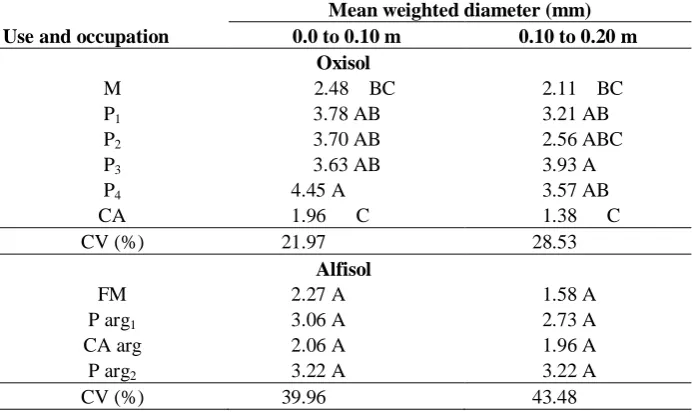
Table 4. Mean weighted diameter (MWD) of the water stable aggregates for the two soils studied under the different forms of uses and occupation in the 0 to 0.10 m and 0.10 to 0.20 m layers.
Use and occupation
Mean weighted diameter (mm) 0.0 to 0.10 m 0.10 to 0.20 m
Oxisol
M 2.48 BC 2.11 BC
P1 3.78 AB 3.21 AB
P2 3.70 AB 2.56 ABC
P3 3.63 AB 3.93 A
P4 4.45 A 3.57 AB
CA 1.96 C 1.38 C CV (%) 21.97 28.53
Alfisol
FM 2.27 A 1.58 A P arg1 3.06 A 2.73 A
CA arg 2.06 A 1.96 A P arg2 3.22 A 3.22 A
CV (%) 39.96 43.48
Means followed by the same letter in the column do not differ statistically by the Tukey test at 5% probability. M = Mango crop, P1 = Pasture, P2 = Pasture, P3 = Pasture, P4 = Pasture, CA = Annual crop, FM = Forest fragment, P
arg1 = Pasture, CA arg = Annual crop and P arg2 = Pasture.
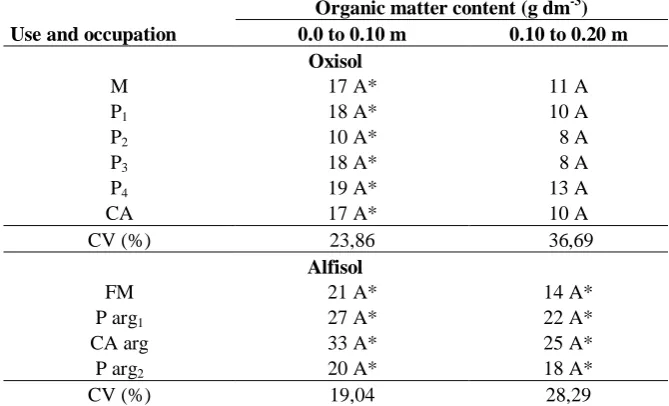
The greatest values were found in the soil surface layer, for the two soils studied, due to the greater organic matter content in this layer (Table 5) but these were influenced by the different uses and management only in the Oxisol.
With respect to organic matter, there was no significant difference for the different soil uses, and there is high coefficients of variation, as observed for aggregate stability. In this study we observed an average of 30.27% for the Oxisol and Alfisol to 23.66%, these results agree with Lacerda at al. (2005)
found that the mean coefficient of variation equal to 27.26% for the organic matter content.
http://www.ijSciences.com
Volume 3 - February 2014 (2)
66
Table 5. Organic matter content for the two soils studied under different forms of use and occupation, in the 0 to 0.10 m and 0.10 to 0.20 m layers.
Use and occupation
Organic matter content (g dm-3) 0.0 to 0.10 m 0.10 to 0.20 m
Oxisol
M 17 A* 11 A
P1 18 A* 10 A
P2 10 A* 8 A
P3 18 A* 8 A
P4 19 A* 13 A
CA 17 A* 10 A
CV (%) 23,86 36,69
Alfisol
FM 21 A* 14 A*
P arg1 27 A* 22 A*
CA arg 33 A* 25 A*
P arg2 20 A* 18 A*
CV (%) 19,04 28,29
Means followed by the same letter in the column do not differ statistically by the Tukey test at 5% probability. * The letters refer to comparison of the data transformed to square root.
M = Mango crop, P1 = Pasture, P2 = Pasture, P3 = Pasture, P4 = Pasture, CA = Annual crop, FM = Forest fragment, P
arg1 = Pasture, CA arg = Annual crop and P arg2 = Pasture.
According to Haynes and Swift (1990), organic matter is one of the main aggregate formation and stabilization agents and decrease of its content in the soil is one of the greatest causes of deterioration of soil structure. Matos et al. (2008) mentioned that using cropping systems that increased organic matter in the soil can contribute to increased aggregate stability and consequently to improved soil physical quality.
As mentioned previously, another factor to be considered is the soil texture. The clay fraction is a positive factor for soil stability because it is an agglutinating agent that links the big particles forming larger aggregates. According to Gollany et al. (1991), aggregate stability increases with the clay contents.
Salton et al. (2008) compared aggregate stability in two locations, one in the municipality of Maracaju and the other in Campo Grande, both in the state of Mato Grosso do Sul, Brazil. Greater mean weighted diameter (MWD) values were observed for Maracaju and the authors attributed this fact to the higher clay contents present in the soil. Dulfranc et al. (2004) observed lower aggregate stability for the areas with low clay content.
The greatest value found in the Oxisol in the 0 to 0.10 m layer was for pasture (P4) with 4.45 mm, and the
smallest value was for the annual crop (CA) with 1.96 mm. Pinheiro et al. (2004) observed similar values for a Oxisol, with 4.2 mm mean weighted diameter (MWD) when cropped with grasses and 2
mm for the conventional system. The same occurred in the Alfisol, with the greatest value for pasture (P arg2) with 3.22 mm and smallest for the annual crop
http://www.ijSciences.com
Volume 3 - February 2014 (2)
67
the greater soil cover, compared to the annual crops, as observed previously. Dried leaves deposited on the surface remain in contact with the soil and give greater cover and higher organic matter content. Furthermore, the soil is not turned over in these two use systems.
The lowest values observed for the annual crops in the Oxisol (CA) of 1.9 mm, and in the Alfisol (CA arg) of 2.06 mm, were due to the soil turn over. Conventional planting consists of excessive use of ploughs and graders in soil preparation, especially the plough grader that decreases aggregate stability causing their destruction (Figueiredo et al. 2008). Wright and Frank (2005) in a study carried out in United States also observed lower mean weighted diameter (MWD) values for soils cropped with soybean, wheat and sorghum.
The highest mean weighted diameter (MWD) value in the Oxisol in the 0.10 to 0.20 m layer found for the pasture (P3) was 3.93 mm and the lowest value for the
annual crop (CA) with 1.38 mm. In the Alfisol the highest mean weighted diameter (MWD) value was observed for the pasture (CA arg) with 3.22 mm, and the lowest value for the forest fragment (FM) with 1.58 mm, followed by the annual crop (CA arg) with 1.96 mm. Following the same tendency as the surface layer, in which the pasture presented the highest mean weighted diameter (MWD) values and the annual crops the lowest, these results were in line with those obtained by Salton et al. (2008).
The lowest values of MWD and the predominance of smaller aggregate classes, assigns a lower aggregate stability to areas cultivated with annual crops, especially in Oxisol, which presented the lowest values of MWD and predominance of aggregates in class <0.25 mm, thus causing to these areas more susceptibility to erosion. As previously noted, the areas cultivated with pasture had a higher aggregate stability, which gives a lower susceptibility to erosion. The sub-basin river Jardim Novo Horizonte is vegetated with pasture for 50% of its area, it gives you a lower risk of erosion in relation to this property of the soil.
4. Conclusion
Different uses and management influenced aggregate stability only in the Oxisol. The areas cropped with pasture presented the greatest percentages of the bigger aggregate classes in both soils, the contrary effect was observed in the areas cultivated with annual crops, where greater percentages were observed in the smaller aggregate classes. The highest mean weighted diameter (MWD) values were found for the pasture and the smallest for the annual crops, regardless of the soil. The areas cultivated with annual crops had a higher susceptibility to erosion.
5. References
1. AINA, P.O. 1979. Soil changes resulting from long-term management practices in Western Nigeria. Soil Science Society American Journal, v.43, p.173-177. 2. ANGERS, D.A.; MEHUYS, G.R. 2000. Aggregate
stability to water. In CARTER, M.R., ed. Soil sampling and methods of analysis. p.529-539. Lewis Publishers, Florida, USA.
3. BERTOL, I.; ALBUQUERQUE, J.A.; LEITE, D.; AMARAL, A.J.; ZOLDAN JUNIOR, W.A. 2004. Propriedades físicas do solo sob preparo convencional e semeadura direta em rotação e sucessão de culturas, comparadas às do campo nativo. Revista Brasileira de Ciência do Solo, v.28, p.155-163.
4. BRONICK, C.J.; LAL, R. 2005. Soil structure and management: A review. Geoderma, v.124, p.3-22. 5. DUFRANC, G.; DECHEN, S.C.F.; FREITAS, S.S. &
CAMARGO, O.A. 2004. Atributos físicos, químicos e biológicos relacionados com a estabilidade de agregados de dois Latossolos em plantio direto no Estado de São Paulo. Revista Brasileira de Ciência do Solo, v.28, p.505-517.
6. ELLIOT, E.T. 1986. Aggregate structure and carbon, nitrogen, andphosphorus in native and cultivated soils. Soil Science Society American Journal, v.50, p.627-633.
7. FIGUEIREDO, C.C., RAMOS, M.L.G.; TOSTES, R. 2008. Propriedades físicas e matéria orgânica de um Latossolo Vermelho sob sistemas de manejo e cerrado nativo. Bioscience, v.24, p.24-30.
8. GOLLANY, H.T., SCHUMACHER, T.E., EVENSON, P.D., LINDSTROM, M.J. & LEMME, G.D. 1991. Aggregate stability of an eroded and desurfaced Typic Argiustoll. Soil Science Society American Journal, v.55, p.811-816.
9. HAYNES, R.J.; SWIFT, R.S. 1990. Stability of soil aggregates in relation to organic constituents and soil water content. European Journal Soil Science, v.41, p.73-83.
10. LACERDA, N.B.; ZERO, V.M.; BARILLI, J.; MORAES, M.H.; BICUDO, S.J. 2005. Efeito de sistemas de manejo na estabilidade de agregados de um Nitossolo Vermelho. Engenharia Agrícola, v.25, p.686-695.
11. MAGRINI, A.; SANTOS, M.A. 2001. Gestão ambiental de bacias hidrográficas. 271p. Instituto Virtual Internacional de Mudanças Globais, Rio de Janeiro, RJ, Brasil.
12. MARCHÃO, R.L. 2007. Integração lavoura-pecuária num latossolo do cerrado: impacto na física, matéria orgânica e macrofauna. 153p. Tese de Doutorado, Universidade Federal de Goiás, Goiânia, Goiás, Brasil. 13. MATOS, E.S., MENDONÇA, E.S., LEITE, L.F.C.;
GALVÃO, J.C.C. 2008. Estabilidade de agregados e distribuição de carbono e nutrientes em Argissolo sob adubação orgânica e mineral. Pesquisa Agropecuária Brasileira,v.43, p.1221-1230.
14. MIELNICZUK, J.; BAYER, C.; VEZZANI, F.; LOVATO, T.; FERNANDES, F.F.; DEBARBA, L. Manejo de solo e culturas e sua relação com estoques de carbono e nitrogênio do solo. In CURI, N.; MARQUES, J.J.; GUILHERME, L.R.G.; LIMA, J.M.; LOPES, A.S.S.; ALVAREZ V., V.H., eds. 2003. Tópicos em ciência do solo. Sociedade Brasileira de Ciência do Solo, Viçosa, Brasil, v.3, p.209-248. 15. NUNES, M.C.M.; CASSOL, E.A. 2008. Estimativa da
erodibilidade em entressulcos de Latossolos no Rio Grande do Sul. Revista Brasileira de Ciência do Solo, v.32, p.2839-2845.
http://www.ijSciences.com
Volume 3 - February 2014 (2)
68
17. PINHEIRO, E.F.M.; PEREIRA, M.G.; ANJOS, L.H.C.2004. Aggregate distribution and soil organic matter under different tillage systems for vegetable crops in a Red Latosol from Brazil. Soil Tillage Research, v.77, p.79-84.
18. QUEIROZ, H.A. 2008. Caracterização fisiográfica e de alguns atributos físicos e químicos dos solos da microbacia Jardim Novo Horizonte, em Ilha Solteira, SP. 61p. Dissertação de Mestrado, Universidade Estadual Paulista “Júlio de Mesquita Filho”, Faculdade de Engenharia de Ilha Solteira, Ilha Solteira, São Paulo, Brasil.
19. SÁ, M.A.C.; LIMA, J.M.; SILVA, M.L.N.; DIAS JUNIOR, M.S. 2000. Comparação entre métodos para estudo da estabilidade de agregados em solos. Pesquisa Agropecuária Brasileira, v.35, p.1825-1834.
20. SALTON, J.C., MIELNICZUK, J., BAYER, C., BOENI, M., CONCEIÇÃO, P.C., FABRÍCIO, A.C., MACEDO, M.C.M.; BROCH, D.L. 2008. Agregação e estabilidade de agregados do solo em sistemas agropecuários em Mato Grosso do Sul. Revista Brasileira de Ciência do Solo, v.32, p.11-21.
21. SCHLOTZHAVER, S.D.; LITTELL, R.C. 1997. SAS: System for elementary statistical analysis, 2nd ed. 905p. SAS Institute, Cary, USA.
22. SILVA, I.F. ; MIELNICZUK, J. 1998. Sistemas de cultivo e características do solo afetando a estabilidade de agregados. Revista Brasileira de Ciência do Solo, v.22, p.311-317.
23. SOUZA, Z.M.; MARQUES JÚNIOR, J.; PEREIRA, G.T. 2004. Variabilidade espacial da estabilidade de agregados e matéria orgânica em solos de relevos diferentes. Pesquisa Agropecuária Brasileira, v.39, p.491-499.
24. SOUZA, Z.M.; MARQUES JUNIOR, J.; PEREIRA, G.T.; BARBIERI, D.M. 2006. Small relief shape variations influence spatial variability of soil chemical attributes. Scientia Agricola, v.63, p.161-168.
25. VANZELA, L.S. 2003. Caracterização da microbacia do cinturão verde de Ilha Solteira – para fins de irrigação. In Congresso Brasileiro de Engenharia Agrícola, 32. Anais… Goiânia: Sociedade Brasileira de Engenharia Agrícola. CD/ROM.
26. VOLK, L.B.S. 2006. Condições físicas da camada superficial do solo resultantes do seu manejo e indicadores de qualidade para redução da erosão hídrica e do escoamento superficial. 148p. Dissertação de Mestrado, Universidade Federal do Rio Grande do Sul, Porto Alegre, Rio Grande do Sul, Brasil.
27. VOLK, L.B.S.; COGO, N.P.; STRECK, E.V. 2004. Erosão hídrica influenciada por condições físicas de superfície e subsuperfície do solo resultantes do seu manejo, na ausência de cobertura vegetal. Revista Brasileira de Ciência do Solo, v.28, p.763-774. 28. VOLK, L.B.S.; COGO, N.P. 2008. Inter-relação
biomassa vegetal subterrânea – estabilidade de agregados – erosão hídrica em solo submetido a diferentes formas de manejo. Revista Brasileira de Ciência do Solo, v.32, p.1713-1722.
29. WENDLING, B.; JUCKSCH, I.; MENDONÇA, E.S.; NEVES, J.C.L. 2005. Carbono orgânico e estabilidade de agregados de um Latossolo Vermelho sob diferentes manejos. Pesquisa Agropecuária Brasileira,v.40, p.487-494.