International Journal of Education and Social Science Research
ISSN 2581-5148
Vol. 1, No. 01; 2018
EMERGING TECHNICAL SKILLS EXPECTED OF STUDENTS OF MOTOR VEHICLE MECHANIC WORKS IN THE MAINTENANCE OF TRANSMISSION
SYSTEM FOR SUSTAINABLE MANPOWER DEVELOPMENT
Okwelle, P. Chijioke1 and Beako Y. Tombari
Department of Vocational and Technology Education, Rivers State University, Port Harcourt 1Email Address: [email protected]
ABSTRACT
The study investigated the emerging technical skills expected of students of Motor Vehicle Mechanic Works in the maintenance of transmission system in Rivers State. The population of the study consisted of 153 respondents, comprising 140 Motor Vehicle Industry technicians and 13 Motor Vehicle Technical Teacher in Rivers state. No sampling was done considering the small and manageable size of the population. Four research questions were posed while four null hypotheses wereformulated. A self-developed instrument tagged” Emerging Technical skills of Motor Vehicle Mechanic Works Questionnaire (ETSMVMQ) was used to gather information for the study. This instrument was face validated by three experts, while reliability coefficient of 0.87 was obtained using Cronbach-Alpha reliability technique. The research questions were answered using the mean and standard deviation, whereas t-test statistics was used to test the four null hypotheses at 0.05 level of significance. Following the analysis, 10 emerging technical skills needed in maintaining the transmission system were identified. It was recommended among other things that the government should embark on training and retaining technical educators of motor vehicle mechanic in technical colleges in order to upgrade their capacity.
INTRODUCTION
The Motor Vehicle Mechanic trade as one of the mechanical trade in technical colleges is subdivided into Auto electric works, Vehicle body building, Agricultural Implement mechanics as well as motor vehicle mechanic works (NBTE, 2011). Ede andOlaitan (2010) asserted that the introduction of motor vehicle mechanic work (MVMW) and other trades in technical colleges are geared towards imparting basic knowledge as well as training skills that will leads to skilled graduates that would improve manpower, self-employed and competent workforce to meet the demands in the world of work. These components as stated by the NBTE (2011) are service station mechanic, petrol engine mechanics, steering and brake system Mechanics and Diesel Engine Maintenance Mechanics. Hence, MVMW students of technical colleges in Rivers State are expected to be acquainted with maintaining and repairing completely any fault relating to the motor vehicles assembly to a set standard.
Motor vehicle is a self-propelled land vehicle typically contains four wheels and an internal combustion engine, used for private or public transportation. This vehicle is of diverse types base on it styles, number of doors and purpose of uses. They are of different brands and models depending on the company or country that manufactured it, and are used for either public or convenience for private use (Bhandari, 2011). According to the National Board for Technical Education (2011) the petrol engine maintenance mechanic module is designed to produce petrol engine maintenance craftsmen who should understand the basic principles of motor vehicle operations and carry out general maintenance and reconditioning work on petrol engine. NBTE further stated that motor vehicle craftsmen are expected to test, diagnose, service and completely repair any fault on transmission system of motor vehicle to manufacturer’s specification.
A transmission system is the device that transmits the power established through the engine of automobile for the driving wheels. This is composed with clutch, gearbox, propeller shaft, universal joints, rear axle, wheel as well as tyres (Erjavec,2010).According to Mayur (2013),transmission system is a mechanism linked through the back of the engine and transmits the power from the engine to rotate wheels. Jack (2014) explained that the requests of transmission system include providing means of linking and discontinuation of engine with rest power train deprived of shock and smoothly, a varied leverage amongst the engine and the drive wheels, make available means for transmission of power in reverse direction, allow power transmission at varied angles and varied lengths, allow speed reduction amongst engine and the drive wheels in the of 5:1, permit change of power flow at right angles, make available means to drive the driving wheels at diverse speeds where necessary and bear the consequence of torque reaction, driving thrust and braking effort efficiently in the engine of motor vehicle
Skills is a talent and capacity acquired through cautious, systematic and constant effort to smoothly and adaptively carryout intricate activities or job roles involving ideas (cognitive skill), things (technical skills), and/or people (interpersonal skills) (Bekijk, 2016). Furthermore, Cranmer (2014) asserted that there is a lack of evidence which confirms skills development in technical college which enhances student workplace performance. Cranmer further explained that technical skills are the specialized skills and knowledge needed to perform specific duties, sometimes refer to as “work skills”. In this study, emerging technical skills refers to contemporary skills needed by students of motor vehicle mechanic work in technical college for the sustainable manpower development in repairing expertly modern vehicles in line with the set standard.Nna (2011) opined that modern motor cars contain set of electronic mechanisms and controls. This situation will require competent technical skills manpower that will bring sustainable development into the motor vehicle maintenance sector
Development as defined by Ukadike and Iwegbu (2015) is the transformation of society through its various sub-systems that make-up the society and making the society responsive to desire modern changes within it. Development of an individual has to do with increased skills and capacity, greater political freedom, creativity, self-discipline, responsibility and mental wellbeing. Gardiner (2011) described manpower as labour available (Human resources) in a country. Gardiner further explained that Manpower development involves training and competency improvement of its human resources optimal organizations usage. Urama and Okorieocha (2012) viewed manpower development as exposing individual or group of individuals to those experiences that will enhance their abilities in solving their personal and financial problems. In light of this, Ibeneme (2010) posited that no nation can develop beyond the level of the human resources at its disposal. However, the technical college students contribute to human resources of every develop nation
Technical college students are persons or trainees who offer vocational courses in technical college in order to acquire practical skills and basic scientific knowledge through vocational technical training. In line with this study, technical college students refers to trainees who are receiving training on motor vehicle mechanic works in technical college to improve technical skills on maintenance of engine components towards manpower development.
Maintenance is a repair activity carried out on vehicles or other machines to keep them unaltered, and if altered, to restore them to their original state. For effective maintenance, Okwelle, Beako and Ajie (2017) further stated that expert opinion of mechanical technical skills obtained through organised vocational skills at the mechanical workshops and other skill acquisition centers that will improve entrepreneurships in the economy is essential and demanding. According to Usman (2007) maintenance implies taking specific steps and precautions to care for an automobile to ensure that it reaches its maximum life span. The life span of a vehicle will be shortened if emerging technical skills are not adopted in maintaining its components especially the transmission system for effective service delivery
Statement of the Problem
that the low level of maintenance transmission systems to motor vehicle posed serious challenges because there are instances where some motor vehicle mechanic are trained and employed but are not able to provide current technical skills expected to maintain the transmission system of modern motor vehicle. If solutions are provided to the ugly situation, it will guarantee the production of skilled manpower that will contribute their quota in the economic and technological development of the Nation. It is in light of these that there is need to carry out a study on the emerging technical skills expected of students of motor vehicle mechanic in the maintenance of transmission system.
Purpose of the Study
The purpose of the study was to determine the emerging technical skills expected of students of Motor Vehicle Mechanic Works (MVMW) in the Maintenance of Transmission System in Rivers State. Specifically, the study sought to:
1. Identify emerging technical skills expected of students of Motor Vehicle Mechanic Works in the maintenance of transmission system for sustainable manpower development in Rivers State.
Research Question
One research question is posed to guide the study;
1. What are the emerging technical skills expected of students of Motor Vehicle Mechanic Works in the maintenance of transmission system for sustainable manpower development in Rivers State?
Hypothesis
One null hypothesis (H0) was formulated and tested at 0.05 level of significance.
H01: There is no significant difference in the mean responses of Motor Vehicle Mechanic Industrial
Technicians and Motor Vehicle Technical Teachers on emerging technical skills expected of students of Motor Vehicle Mechanic Works in maintaining transmission system for sustainable manpower development.
MATERIALS AND METHODS
The study adopted descriptive survey design. The population of this study consisted of 153 respondents, comprising 140 technicians of motor vehicles industries registered with Rivers State Ministry of Commerce and Industry; Port Harcourtand thirteen (13) Motor Vehicle Mechanic Works Teachers of four NBTE accredited Technical Colleges in Rivers State. There was no sampling considering the small and manageable size of population. As such, the entire population of the study was used.
The self-structured instrument titled “Emerging Technical Skills of Motor Vehicle Mechanic Works Questionnaire” (ETSMVMQ) was used to collect data for the study. The instrument was divided into two sections A and B. Section A sought information on the respondents demographic data while section B was used to obtain information on the Emerging Technical Skills Expected of students of Motor Vehicle Mechanic Works for sustainable manpower development. This section has ten (10) items patterned to solicit response in five point Liker type scale of Highly Needed (5), Needed (4), Moderately Needed (3), Not Needed (2), Highly Not Needed (1).
Department of Vocational and Technology Education, Rivers State University, Nkpolu-Oroworukwo Port-Harcourt, Rivers State, respectfully for face and content validity.
Cronbach Alpha reliability method was applied on data collected through a pilot test on six respondents to determine the internal consistency of the instrument to obtain the reliability coefficient value of 0.87.A total of 153 copies of the questionnaire were distributed to the respondents. Only one hundred and forty three (143) copies of the instrument were completely filled and retrieved, given rise to 93 percent return rate. The 143 copies were analyzed and used for the study. Mean and standard deviation were used to answer the research questions. In analyzing the data, any mean value equal and above a mean value of 3.50 was accepted as “Needed” and below this mean value was regarded as “Not needed”. Standard deviation values were used to determine the level of homogeneity among the respondents. The hypothesis was accepted if the calculated t-test value is less than the table or critical t value, and if the calculated t value is greater than the critical t value, the hypothesis was rejected.
RESULTS
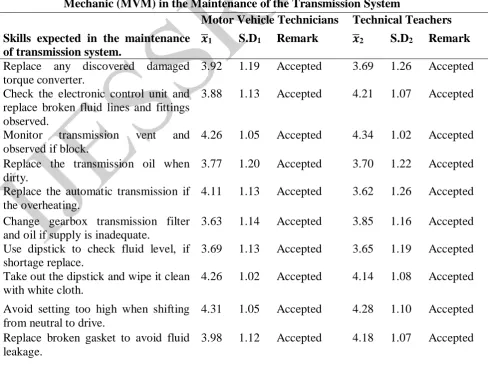
The analysis of data in relation to the research question and hypothesis are presented in Tables 1- 2
Research Question 1
What are the emerging technical skills expected of students Motor Vehicle Mechanic works in the maintenance of the transmission system for sustainable manpower development?
Table 1: Mean and standard deviation on the Emerging Technical Skills of Motor Vehicle Mechanic (MVM) in the Maintenance of the Transmission System
Motor Vehicle Technicians Technical Teachers
S/No Skills expected in the maintenance of transmission system.
𝒙
̅1 S.D1 Remark 𝒙̅2 S.D2 Remark
1. Replace any discovered damaged
torque converter.
3.92 1.19 Accepted 3.69 1.26 Accepted
2 Check the electronic control unit and
replace broken fluid lines and fittings observed.
3.88 1.13 Accepted 4.21 1.07 Accepted
3 Monitor transmission vent and
observed if block.
4.26 1.05 Accepted 4.34 1.02 Accepted
4 Replace the transmission oil when
dirty.
3.77 1.20 Accepted 3.70 1.22 Accepted
5 Replace the automatic transmission if
the overheating.
4.11 1.13 Accepted 3.62 1.26 Accepted
6 Change gearbox transmission filter
and oil if supply is inadequate.
3.63 1.14 Accepted 3.85 1.16 Accepted
7 Use dipstick to check fluid level, if
shortage replace.
3.69 1.13 Accepted 3.65 1.19 Accepted
8 Take out the dipstick and wipe it clean
with white cloth.
4.26 1.02 Accepted 4.14 1.08 Accepted
9 Avoid setting too high when shifting
from neutral to drive.
4.31 1.05 Accepted 4.28 1.10 Accepted
10 Replace broken gasket to avoid fluid
leakage.
GRAND MEAN/S.D 3.98 1.12 3.97 1.14
The data presented in Table 1 shows the views of respondents which have the grand means 3.98 and 3.97. These grand means are greater than the cut off mean of 3.50, indicating that all the technical skills are accepted by both group as emerging technical skills expected of students of Motor Vehicle Mechanic works in the maintenance of the transmission system for sustainable manpower development. The table also showed thestandard deviation range from 1.02 to 1.20 and 1.02 to 1.26 for both groups. These signify that the respondents are close in their opinions.
Test of Hypothesis
H01: There is no significant difference in the mean responses of Motor Vehicle Mechanic Industrial
Technicians and Motor Vehicle Technical Teachers on emerging technical skills expected of students of Motor Vehicle Mechanic Works in maintaining transmission system for sustainable manpower development.
Table 2: Summary of t-test Analysis of the Responses of Motor Vehicle Mechanic (MVM) Industry Technicians and Motor Vehicle Technical Teachers on the Emerging Technical Skills
Expected in the Maintenance of Transmission System
Group 𝒙̅ SD N Df P tcal tcrit Decision
MVM Industry
Technicians 3.98 1.12 130 141 0.05 0.029 ±1.96 Accepted
MVM Technical Teachers 3.97 1.14 13
The results in Table 2 show the calculated t-value of 0.029 at 141 degree of freedom is less than the table t-value of 1.96 at 0.05 level of significance. Hence, the null hypothesis is accepted, implying that there was no significant difference in the mean responses of Motor Vehicle Technical Teachers and Motor Vehicle Industry Technicians on the emerging technical skills expected of students of Motor Vehicle Mechanic works for sustainable manpower development in Rivers State.
Discussion
maintenance of transmission system for sustainable manpower development. These responses indicated that the motor vehicle technical teachers and motor vehicle industry technicians agreed strongly that the 10 skills item listed are emerging technical skills expected by students of motor vehicle mechanic in the maintenance of transmission system for sustainable manpower development. This finding further showed that these skills items are basic, dynamic and necessary for regular and effective maintenance of transmission system of modern motor vehicles towards sustainable man power development in Rivers State.
Conclusion
Technical colleges in Nigeria are set up to equip youths in different trades, either paid or self-employed. Researcher observation uncovered facts that emerging technical skills are the major expectation for self-employment of graduates which are absolutely deficient in the technical college curriculums and modules. This situation has made most of the students of motor vehicle mechanic unemployed after graduation, as a result of their failure to acquire these emerging technical skills expected in the contemporary society. These skills deficiencies have brought about joblessness and idleness on the part of the products of technical colleges in Rivers State.
Recommendations
1. Student of motor vehicle mechanic should be given opportunities to embark upon compulsory six months industrial training to acquire these identified skills at a government recognized and approved motor vehicle maintenance and services industries conversant with the working of modern vehicles. 2. The Industries should within a short period of time upgrade materials and equipment for transmission system of motor vehicles in the motor vehicle mechanic workshop of Technical Colleges to enhance improvement on instructional materials for easy understanding and learning. 3. The government should embark upon training and retaining of teachers of motor vehicle mechanic in technical colleges in order to upgrade their capacity.
REFERENCES
Ayonmike, S.C. (2010). Skill training in Nigerian Technical Colleges: Benefits and Challenges. Journal of qualitative education, 6(1), 75-86.
Beako, T.Y, Okoriecha, C.N,Ojotule, D.I. &Kooli, P.L. (2017). Safety practice skills needed in handling and storage of fuel oil by students of motor vehicles mechanic in Technical Colleges in Rivers State. International Journal of Advanced Academic Research/Science, Technology & Engineering, 3(9), 66 – 75.
Bekijk, A.O. (2016). How to invest in people. London: Webfinance Inc. Bhandari, V.B. (2011). Design of machine elements, Tata McGraw Hill p. 472 Retrieved 9 Feb. 2016.
Crammer, J.K. (2014).Career centre, building the Western Australian Workforce by increasing Government of Western Australia, Department of Training and Workforce Development.
Ede, E.O. &Olaitan, O.O. (2010). The utilization of Information and Communication Technologies (ICT) in the teaching of metalwork for quality assurance of technical college graduates in South Western State of Nigeria. Nigeria Vocational Teacher Education, University of Nigeria, Nsukka 115 – 127.
Gardiner, N.V. (2011). National career service Gov-uk.http://nationalcareerservice.direct-gov.uk/jobprofile/gardener 8/9/6.
Ibeneme, O.T. (2013). Vocational education in the era of economic down-turn visa-a-vis vision 2020 in Nigeria. Journal of Vocational and Technical Education, 7(1), 8 – 17.
Jack, E. (2014). Automotive technology. A systems approach (5th Ed.) The Thomson Delmar Learning Company, Inc.
Mayur, B.C. (2013). Comparative study between automatic and manual transmission car.International Conference on Mechanical Motor Vehicle and Bi diesel Engineering (ICMABE) February 26 – 28, 2013 Dubai (UAE).
National Board for Technical Education (2011).The development of national vocational qualifications framework (NVQF) for Nigeria.A report of the national steering committee NBTE Press.
Nna, K.P. (2011). The marketing of MBO transit Liner. News Agency of Nigeria, 6(2) p.35.
Okwelle, P.C, Ayonmike, C.S. (2014). Towards value re-orientation of youths on the role of Technical Vocational Education and Training (TVET) for sustainable development in Nigeria.Journal of Education and Practice.5(8), 25-34.
Okwelle P.C, Beako, T.Y &Ajie M.P (2017). Technical Skills needed by Motor vehicle mechanic apprentice to establish standard motor mechanic enterprise in Port Harcourt Metropolis, Rivers State. International Journal of Innovative Scientific &Enginering Technologies research 5(4):27-34. Olaitan, O.O. &Ikeh, J.O. (2015). Employability and technical skills required to establish a small scale automobile workshop. Journal of education and practice.6(13). 261-269
Tezu,B.V.(2014).Introduction to transmission system.
http://www.tezu.ernet.in/sae/download/transmission/PDF.
Thomas, R. (2013). How vehicle computers work. Retrieved from http://www.howstuffworks.com on 17/11/2016.
Ukadike, F. &Iweghu, F. (2015). The role of founding geography in strengthening sustainable nationaldevelopment.Journal of Forum of Academic for Educational Advancement and Initial Perspective in Nigeria.
Urama, M.S. &Okorieocha, N. (2012). Manpower development in technical and vocational education
(TVE).A pre-requisite for the technological development of Nigeria.Journal of Knowledge Review, 26(4), 129 – 135.