Query Induction with Schema-Guided Pruning Strategies
Joachim Niehren [email protected]
Jérôme Champavère [email protected]
Aurélien Lemay [email protected]
Links Project-Team –INRIALille &LIFL
Parc Scientifique de la Haute Borne
Park Plaza – Inria Bat. B – 40 Avenue Halley 59650 Villeneuve d’Ascq
France
Rémi Gilleron [email protected]
Magnet Project-Team –INRIALille &LIFL
Parc Scientifique de la Haute Borne
Park Plaza – Inria Bat. B – 40 Avenue Halley 59650 Villeneuve d’Ascq
France
Editor:Mehryar Mohri
Abstract
Inference algorithms for tree automata that define node selecting queries in unranked trees rely on tree pruning strategies. These impose additional assumptions on node selection that are needed to compensate for small numbers of annotated examples. Pruning-based heuristics in query learning algorithms for Web information extraction often boost the learning quality and speed up the learning process. We will distinguish the class of regular queries that are stable under a given schema-guided pruning strategy, and show that this class is learnable with polynomial time and data. Our learning algorithm is obtained by adding pruning heuristics to the traditional learning algorithm for tree automata from positive and negative examples. While justified by a formal learning model, our learning algorithm for stable queries also performs very well in practice ofXML information
extraction.
Keywords: XMLinformation extraction,XMLschemas, interactive learning, tree automata,
gram-matical inference
1. Introduction
A fundamental problem ofXMLinformation extraction is query induction from annotated examples.
The problem is to select “relevant” elements in collections ofXMLdocuments, while knowing only
few positive and negative examples for relevant elements. The target of this learning problem is thus a query for elements inXMLdocuments.
Most approaches for XML information extraction can be found in the context of Web
2007), to inductive logic programming (Cohen et al., 2002). Queries for information extraction can also be produced by visual programming (Baumgartner et al., 2001) possibly with learning enhance-ment (Carme et al., 2006a). Unsupervised approaches based on ontology knowledge were proposed recently (Sellers et al., 2011a).
< c o u n t r y >
<name> F r a n c e < / name> < c i t y > P a r i s < / c i t y > < r e g i o n >
<name>Nord−Pas de C a l a i s < / name> < p o p u l a t i o n >3 996 588< / p o p u l a t i o n > < c i t y > L i l l e < / c i t y >
< / r e g i o n > < r e g i o n >
<name> V a l l ée du Rhône< / name> < c i t y >Lyon< / c i t y >
< c i t y > V a l e n c e < / c i t y > < / r e g i o n >
< / c o u n t r y >
Figure 1: A tiny geographicalXMLdatabase.
country
name
France
city
Paris
region
name
Nord - Pas de Calais
population
3 996 588
city
Lille
region
name
VallÃe du Rhônec city
Lyon
city
Valence
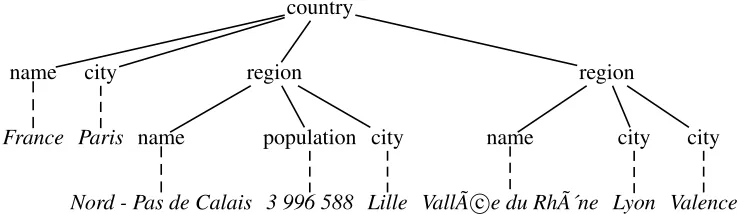
Figure 2: Data tree of the geographical database in Figure 1.
For illustration, we consider in Figure 1 an XML document for a geographical database with
information about regions in France. ThisXMLdocument can be parsed into the data tree in Figure 2.
A user may then want to select, for instance, all those regions for which the size of the population is known in the database. This goal can be translated to a query to data trees of geographical databases, which selects all nodes labeled by regionand having a child labeled bypopulation, that is the
XPath query//region[population].
However, finding this query requires knowledge on XPath and theXMLschema of geographical
Figure 3: Two positive examples annotated via the user interface.
The query induction algorithm then learns the query from the XMLtrees with some annotated
elements. The main difficulties of query induction are the following:
1. the availability of only few annotated examples,
2. missing semantic information about the meaning ofXMLtags, and
3. the difficulty to understand natural language texts in data trees.
We do not tackle the third problem in the present paper. Instead, we restrict ourselves to node selection queries in unranked trees without data values. In order to limit the burden of annotation and to obtain relevant annotations quickly, we will rely on interactive learning in Angluin style (Angluin, 1987), where selected nodes proposed by the learner are corrected by the teacher in an annotate-learn-select loop. This corresponds to the usual user interaction loop of Web information extraction systems (see, e.g., Muslea et al., 2003).
In this article, we study the relevance of schema-guided pruning heuristics for query induction.1
Pruning consists in removing useless information for learning. Schema-less pruning strategies were essential for good quality with few examples of query induction algorithms based on tree automata inference by, for example, Raeymaekers et al. (2008) or Carme et al. (2007), and also for decent efficiency. So far, however, pruning strategies were always defined in ad hoc manners. Thus, our first objective is to define them systematically. Pruning strategies must be aggressive on the one hand side, since the more subtrees are pruned, the more efficient the learning algorithm will be. On the other hand side, pruning strategies must preserve the information required to learn the query. Our second objective is hence to formalize the relationship between pruning strategies and learnable classes of queries. Finally, schemas express semantic information onXMLtrees which should allow
to learn larger classes. Our third objective is thus to use schemas to improve learning algorithms and to understand the relevance of schemas for pruning strategies in particular.
country → name·city·region∗
region → name·populationε·city+ name → ε
city → ε
population → ε
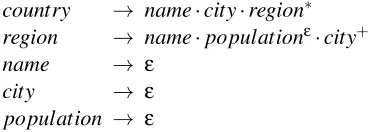
Figure 4: SchemaGeofor a geographicalXMLdatabase restricted to the description of a country.
It is defined by aDTDwhere country is the label of the root.
Document type definitions (DTDs) are the simplest schemas forXMLdocuments. For instance, let us consider the DTD in Figure 4 for our geographical database example. It says that under
the root with label country, there is its name, followed by a city, followed by a possibly empty list of regions. Each region is described by its name, its population but it is not mandatory, and a non empty list of cities. For sake of simplicity, we assume that subtrees with root label name, city and population only contain data values that we do not consider here. For instance, the unranked treeu=country(name,city,region(name,population,city),region(name,city,city))is
valid for the DTD Geo, it is the tree presented in Figure 2 without the data values. Schemas can also be defined by deterministic tree automata. These are finite state machines adapted to trees. They process trees in a bottom-up way (from the leaves to the root) according to a finite set of rules. The result is a tree annotated with states. For instance, a tree automaton associ-ated with the DTD Geo can be defined with states qcountry, qname, etc., and a state qinvalid, and rules expressing the conditions given by the DTD. For an invalid tree, the state qinvalid will ap-pear along the run of the automaton and the tree will be rejected, while a valid tree will be pro-cessed and annotated by the correct states. For instance the unranked treeu will be annotated as
qcountry(qname,qcity,qregion(qname,qpopulation,qcity),qregion(qname,qcity,qcity)), and will be accepted
be-cause the root state isqcountry.
We next introduce schema-guided pruning strategies by example and illustrate their relationship to query classes. Pruning strategypath-onlyapplied to a node of theXMLdatabase keeps only the
path leading from the root to the node, and replaces all subtrees adjacent to this path by a special symbol⊤. Pruning strategypath-onlyGeokeeps that same path but replaces the adjacent subtrees by the state assigned to them by the tree automaton forGeo. In Figure 5, the result of applying both pruning strategies to thename-child of the region-node in Figure 2 is presented. It will turn out
that more complex pruning strategies will be needed for ranked trees, in order to deal with the above pruning strategies for unranked trees via binary encoding.
We call a query stablefor a pruning strategy if the result of applying the strategy to a tree at some selected node does always justify the node’s selection. In this case, we call this result the critical region for selecting the node. For illustration, let us consider the query that selects all names of regions whose population is known in our geographicXMLdatabase with schemaGeo, that is the XPath query//region[population]/name. Whether a node with labelnameis selected depends
only on its local environment, more precisely, on whether its father is labeled byregionand whether
its right-sibling is labeled bypopulation. It is easy to see that pruning strategypath-onlyapplied
country
region
name
⊤ ⊤ ⊤
⊤ ⊤
country
region
name
qname qcity qregion
qpopulation qcity
Figure 5: Pruning the tree from Figure 2 at the name-child of the first region-node, by strategies
path-only(left) andpath-onlyGeo(right).
country
region
(name,1)
name city region
population city (name,0) city city
Figure 6: An annotated tree in which the first region name has been annotated positively (it must be selected) and the second region name has been annotated negatively (it must not be selected).
of the right sibling in stateqpopulation, so that this relevant information is preserved. Therefore, the query//region[population]/nameis stable for pruning strategypath-onlyGeo.
A user of the learning system may want to learn the above XPath query since he does not know how to express it formally. He might not be an XPath expert or might not have access to the schema
Geo of our geographic database. Such users may still be willing to annotate some selectedname
-nodes by the Boolean value 1 and some rejected -nodes by the Boolean value 0 with the help of a graphical interface. An example for a partial annotation of our geographical database that could be obtained this way is given in Figure 6. Pruning strategies can be lifted to pruning functions on positively annotated trees. The easiest way to do so is to keep only the union of the critical regions of all nodes annotated by 1 jointly with their annotations.
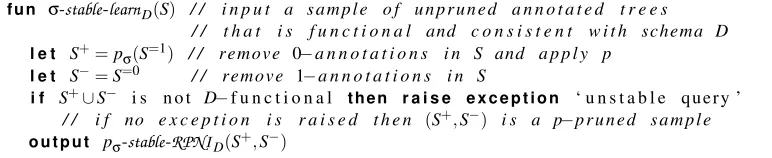
Given a pruning strategyσ, the next question is whetherσ-stable queries can be learned from σ-pruned samples of annotated examples. These are finite sets that contain σ-pruned trees with positive annotations and unpruned trees with negative annotations, such that all annotations are consistent with respect to the target query. For any pruning strategy σ, we will distinguish the
samples. Depending on the pruning strategy, this yields a hierarchy of query classes that is essential for understanding the difficulty of query learning in practice.
1.1 Contributions
We study the impact of pruning strategies on learning algorithms for classes of regular queries for the first time. We recall that XPath queries (without tests on data values) are regular, even if imposing schema restrictions byDTDs or tree automata.
1. We define schema-guided pruning strategies for schemas defined by deterministic bottom-up tree automata, both for ranked and unranked trees. We introduce the notion of stable queries for a given pruning strategy. We show how to characterize stable queries by languages of pruned annotated trees. For regular queries these languages can be recognized by tree automata.
2. We lift pruning strategies to pruning functions that can be applied to positively annotated trees, in order to produce pruned samples for our learning algorithm.
3. We show how to represent pruning functions by means of tree automata. Thereby we define the notion of regular pruning functions. We present an algorithm that decides in polynomial time whether a regular query is stable for a regular pruning function.
4. We present a learning algorithm, based on the RPNI algorithm (García and Oncina, 1993), that identifies regularσ-stable queries in polynomial time fromσ-pruned samples of polyno-mial cardinality.
5. We present experimental results that confirm the relevance of our query learning algorithm in an interactive learning environment, both for Web information extraction and for XML
information extraction.
6. We compare different pruning strategies with respect to their aggressiveness. It turns out that more aggressive pruning strategies yield better learning quality. We also discuss how to select appropriate schema-guided pruning strategies in practice.
1.2 Outline
For sake of clarity, we first give definitions, results and proofs for ranked trees. All results can be lifted to the case of unranked trees via a binary encoding. Experiments will be done on information extraction tasks over unranked trees (HTMLtrees orXMLtrees).
learning algorithm for stable queries from pruned annotated examples based on these algorithms. In Section 8, we lift all previous results to unranked trees via a binary encoding. Experimental re-sults on query induction inXMLinformation extraction are discussed in Section 9. Future work and
conclusions are presented in Section 10. The appendix completes the proofs of results that are not essential for the main contributions.
1.3 Related Work
There exist two previous approaches for inducing regular languages that can account for the consis-tency with some domain of the target language. Both of them guarantee that the current hypothesis
Lof the learning algorithm does satisfyL⊆
L
(D), wereDis a deterministic finite automaton defin-ing the domain, in which the target language must be included. The first dynamic approach is to test language inclusion after each generalization step (Coste et al., 2004). This is the approach we here generalize to query induction. The second static approach is to ensure inclusion (Oncina and Varó, 1996) by typing all states of the currentDFAAby the states of the domainDFAD. This means that the target automaton will be a product with the domain automatonD. Formal learnability re-sults were missing for both approaches so far. In the present article, we provide such rere-sults for the first time for the dynamic approach. Furthermore, we show that the dynamic approach is feasible in practice even in the case of tree automata, where inclusion testing is more tedious. The static approach performs worse in our applications in most cases.Schema induction forXMLdocuments was invested by Bex et al. (2006). The interest there is to
produce readableDTDs with regular expressions. Query induction, as presented here, usually tries to avoid the induction of schemas, since queries may only rely on parts of the schema. Conversely, however, one might use induced schemas for query induction. Induction of XPath queries was considered by Carme et al. (2006b) and Staworko and Wieczorek (2011). Induction algorithms for top-down deterministic tree transducers were presented by Lemay et al. (2010).
2. Schemas and Tree Automata
In this section, we recall facts on tree automata on ranked trees and illustrate how to use them as schemas. Unranked trees will be treated later on via a binary encoding. Most results we will remind here are standard with the exception of an efficient inclusion test, which will be fundamental for the efficiency of our schema-guided learning algorithm.
LetNbe the set of non-zero natural numbers. A ranked signature is a setΣequipped with a
function rankΣ from ΣtoN∪ {0}. Fork≥0, we denote by Σ(k)the set{f ∈Σ|rank
Σ(f) =k}. We write f(k) to indicate that f is of rank k. The set
T
Σ of ground terms over Σ is the least set that contains all tuples f(t1, . . . ,tk) where f ∈Σ(k) andt1, . . . ,tk ∈
T
Σ. Ground terms inT
Σ are equivalently called rankedΣ-trees or simply trees. As usual we write f instead of the single node tree f()where f(0)∈Σis a constant. We denote bynodes(t)⊆N∗the (prefix-closed) set of nodes of the treet. The label of a nodeνintis denoted byt[ν]. Given a subsetΣ′⊆Σof labels, we denotebynodesΣ′(t) ={ν∈nodes(t)|t[ν]∈Σ′}the set of all nodes oftlabeled inΣ′.
Atree automatonis a tupleD= (Σ,X,R,F)whereΣis a finite ranked signature,X is a finite set of states,F⊆X is a set of final states, andR⊆Sk≥0Σ(k)×Xk+1 is a set of (transition) rules. We
denote by|D|the sum of the lengths of the rules ofDand call it the size ofD. A transition ruler∈R
is a tuple(f(k),q
by f(q1, . . . ,qk)→q and call f(q1, . . . ,qk) its left-hand side. A tree automaton Dis (bottom-up)
deterministicif no two rules ofDhave the same left-hand side.
The evaluator of D is a function evalD :
T
Σ → 2X such that for all trees f(t1, . . . ,tk) ∈T
Σ:evalD(f(t1, . . . ,tk)) ={q| f(q1, . . . ,qk)→q in D,∀i∈ {1, . . . ,k}: qi∈evalD(ti)}. If D is deter-ministic, then, for anyt, the setevalD(t)contains at most one element. The language recognized by Dis the set of all trees in
T
ΣthatDcan evaluate into some final state:L
(D) ={t∈T
Σ|evalD(t)∩F6=/0}.A tree languageL⊆
T
ΣisregularifL=L
(D)for some tree automatonDwith signatureΣ.Example 1 We consider libraries (lib) which contain lists of books (b) with lists of authors (a). We use cons and nil as list constructors as usual for ranked trees, so we use the following sig-nature ΣLib={lib(1),b(1),a(0),cons(2),nil(0)}. The unranked library lib(b(a,a),(b(a,a),b)) with
three books of which the last one has no author is represented by the following rankedΣ-tree, which is also illustrated graphically on the left of Figure 8:
lib(cons(b(cons(a,cons(a,nil))),cons(b(cons(a,cons(a,nil))),cons(b(nil),nil))))
The schema of libraries is defined by the tree automaton Lib′ with signature Σ
Lib with state set
X={qlib,qbs,qas,qb,qa}, final state qlib, and the rules:
lib(qbs) → qlib, b(qas) → qb, nil → qbs,
cons(qb,qbs) → qbs, nil → qas, cons(qa,qas) → qas,
a → qa.
Note that Lib′ is nondeterministic, since symbol nil may be analyzed as the end of a book-list or as
the end of an author-list. Let Lib be the determinization of Lib′. This can be done by mapping nil to
some new state{qas,qbs}, while adding the necessary rules for this state.
We will need some basic constructions on tree automata and complexity results which can be found in Comon et al. (2007). Given a tree automatonD, it is decidable in timeO(|D|) whether
L
(D) = /0. Given another tree automatonD′over the same signature, a tree automatonD∩D′withL
(D∩D′) =L
(D)∩L
(D′)can be computed in timeO(|D| |D′|).Our learning algorithm will heavily rely on language inclusion tests for deterministic tree au-tomata. We will use a recent inclusion test, proposed by the authors, which can be implemented highly efficiently and incrementally (w.r.t. adding rules toD′):
Proposition 1 (Efficient Inclusion Test, Champavère et al., 2009) Let D′and D be tree automata
over Σ. If D is deterministic then language inclusion
L
(D′) ⊆L
(D) can be decided in timeO(|D′| |D|).
3. Schema-Guided Pruning Strategies
3.1 Pruned Trees
We fix a ranked signatureΣand a schemaDwhich is a deterministic tree automaton with signature
Σand state setX. We define apruned treeto be a tree over signature Σ∪X, that is, the states of
Dbecome additional constants. WheneverDis unclear from the context, we will talk ofD-pruned treesequivalently to pruned trees.
We will write
T
Σ(X)instead ofT
Σ∪X for the set of pruned trees. It should be noted that schemaDcan be also abused to recognize pruned trees. In order to do so, it is sufficient to add the rules
q→qfor all statesq∈X. In this way, the evaluatorevalDfor unpruned trees can be lifted to pruned trees.
Lettandt′be two pruned trees in
T
Σ(X). We say thatt is subsumed by t′, or equivalently thatt′
is a D-instance of t, and writet≤t′ ift′can be obtained fromtby replacing occurrences of states
qby pruned trees that can be evaluated toqby D. We call a finite set of pruned treesL⊆
T
Σ(X) compatible(with respect to D) if all trees in Lhave a common instance, that is, if there exists a treet′ such thatt≤t′ for allt∈L. In this case,Lhas a least upper bound, that we denote by⊔L such thatt≤ ⊔L for allt∈L. The existence of least upper bounds follows, since we assume thatDis deterministic, so that no subsets ofX with two different states{q,q′} ⊆Xare compatible. For instance, ifΣ={f(2),g(1),a(0)}andDcontains the rulesa→q′,g(q′)→q, and f(q,q)→q′′where
q′′is final then:
⊔{f(g(a),q),f(q,g(q′)),f(q,q),q′′}= f(g(a),g(q′)).
AD-completion of a pruned treet∈
T
Σ(X) is a treet′∈T
Σ such thatt≤t′. Every pruned treet defines a sublanguage of
T
Σ that we denote by complD(t) containing all itsD-completions. Note thatcomplD(q)is the set of all treest∈T
ΣthatDcan evaluate toq.3.2 Pruning Strategies
The purpose of a pruning strategy is to remove all parts of a tree that are irrelevant for the selection of a given node. Removed subtrees are always replaced by the state into which they are evaluated by the schema, so that some information about removed subtrees may still be preserved.
Definition 2 A pruning strategy for D is a functionσthat maps any tree t∈
L
(D) and nodeν∈ nodes(t)to a pruned treeσ(t,ν)∈T
Σ(X)of which t is a D-instance, such thatνis preserved with its label.Since schema Dis a deterministic tree automaton, there is no choice by which state a subtree is to be replaced. Thus, a pruning strategy can be specified by the subset of nodes rooting pruned subtrees. Let us introduce the four pruning strategies that will be used in the experiments. The pruning strategypath-onlyis total. It prunes away all maximal subtrees that are not ancestors ofν
and replaces them by⊤. The pruning strategypath-onlyD is more restrictive in that it can only be applied to trees satisfying schemaD. Note that if
U
is the unique universal tree automaton with a single state⊤that recognizes all trees, thenpath-only=path-onlyU. Pruning strategypath-extDcan be applied to any tree satisfying schemaD. When applied to a treetwith nodeν, the extended path from the root toνremains unchanged, that is, all children of siblings of nodes on the path toν
are substituted by their state, as well as all children ofν. The pruning strategypath-extis equal to
path-only
path-onlyD path-ext
path-extD aggressiveless
more aggressive
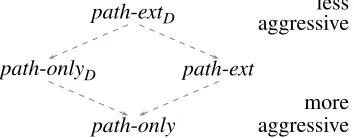
Figure 7: Example pruning strategies ordered by aggressiveness.
Definition 3 Letσandσ′ be two pruning strategies for schema D and D′ respectively such that
L
(D)⊆L
(D′). We callσ less aggressive thanσ′ if any tree t∈L
(D) with nodeνsatisfies thatcomplD(σ(t,ν))⊆complD′(σ′(t,ν)).
We will use the following sufficient criterion to prove thatσis less aggressive thanσ′:
1. Schema Dshould always evaluate to more informative states thanD′, that is, for any treet and stateq∈evalD(t), there exists a stateq′∈evalD′(t) such thatcomplD(q)⊆complD′(q′),
and
2. strategyσshould always replace fewer subtrees thanσ′, that is, for anyt∈
L
(D)with nodeν:nodesΣ(σ(t,ν))⊇nodesΣ(σ′(t,ν)).
Clearly,path-extDis less aggressive thanpath-onlyDsincepath-onlyDalways leaves the minimal number of nodes unchanged, butpath-extDleaves children of ancestor nodes on the path unchanged too. The strategy path-only is more aggressive thanpath-onlyD since both prune the same nodes away, whilepath-onlyDsubstitutes them by more informative states thanpath-only.
The notion of aggressiveness defines a partial order on pruning strategies, which is illustrated for our example strategies in Figure 7. This order is usually not total sincepath-onlyDandpath-ext
are incomparable for most choices ofDandΣ.
3.3 Stable Queries
A query Q with schema D is a partial function with domain
L
(D) which maps treest from this domain to sets of nodesQ(t)⊆nodes(t). Note that queries can be applied to complete trees only. Now, we define the class of those queries that are stable with respect to a given schema-guided pruning strategy.Definition 4 Letσbe a pruning strategy and Q a query, both with schema D. We call Qσ-stable if all trees t∈
L
(D), selected nodesν∈Q(t), and D-completions t′ofσ(t,ν)satisfyν∈Q(t′).For a selected node ν∈Q(t) of aσ-stable query Q, we callσ(t,ν) the critical region ofνin
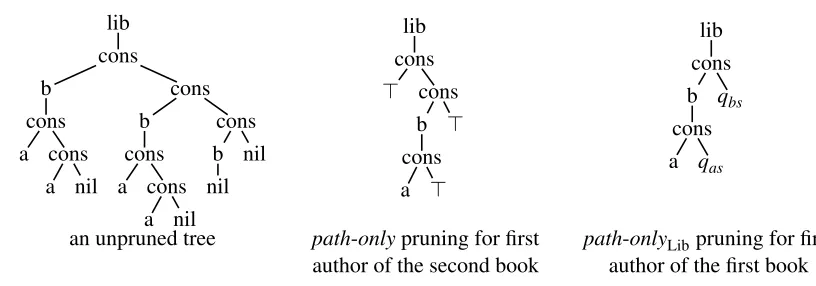
lib cons b
cons a cons
a nil
cons b cons a cons
a nil cons b nil
nil
lib cons
⊤ cons b cons
a ⊤
⊤
lib cons b cons a qas
qbs
an unpruned tree path-onlypruning for first path-onlyLibpruning for first author of the second book author of the first book
Figure 8: Illustration of “path-only” pruning strategies at the library from Example 1 without schema and with schema Lib.
Example 2 Let Lib be the deterministic tree automaton recognizing libraries from Example 1. On the left of Figure 8, we present an example library (lib), which contains three books (b), of which the first two have two authors (a), while the last has none. Given that we use ranked trees, lists are build by a binary list constructor (cons), and a constant (nil) for the empty list. We consider the following queries on libraries with this schema:
Q1 selects the first author of all books of the library.
Q2 selects the first author of all books of the library with at least two authors.
Query Q1is stable for both pruning strategies path-only and thus for path-onlyLibwhile query Q2 is stable only for path-onlyLib but not for path-only. This becomes clear when considering the applications of these pruning strategies to the nodes, that correspond to the first authors of the first two books.
The result of applying path-only to the first author of the second book is illustrated in the middle of Figure 8. Note that all the information needed for the selection of this author by Q1is preserved. However, since the second author of the same book is pruned away and replaced by ⊤, one can-not know whether there was a second author before, so necessary information is lost for deciding selection by Q2.
The result of applying path-onlyD to the first author of the first book is shown on the right of Figure 8. This time, the pruned tree contains enough information to select the first author of the first book by Q2, since now, the second author of this book is replaced by the state qaswhich stands for
a nonempty author list.
Our next objective is to restrict pruning strategies to schemas recognizing smaller languages. So letσ′be a pruning strategy with some schemaD′such that
L
(D)⊆L
(D′). We now define the pruning strategyσ′|Dwith schemaDsuch that it replaces for all treest∈L
(D)the same subtreest0asσ′by the unique state inevalD(t0), but not by the unique state inevalD′(t0)as chosen byσ′. Note
Proposition 5 Letσandσ′ be pruning strategies with respective schemas D and D′ such thatσis
less aggressive thanσ′. Any query Q with schema D then satisfies that:
Q isσ′|D-stable⇒Q isσ-stable.
Proof Let treet0 be aD-completion of σ(t,ν) for some selected nodeν∈Q(t). Since σis less aggressive thenσ′,t0is also aD′-completion ofσ′(t,ν). Sincet
0∈L(D)and
L
(D)⊆L
(D′), it isalso aD-completion of σ′|D(t,ν). Theσ|′D-stability ofQ thus yieldsν∈Q(t0), so that νremains
selected on anyσ-variant oftatν, which shows thatQis alsoσ-stable.
4. Languages of Annotated Examples for Stable Queries
We will characterize stable queries in terms of languages of pruned positively annotated trees. In order to do so, we will lift pruning strategies to pruning functions that can be applied to example trees with positive annotations. There are several manners to do so, depending of whether only a single positive annotation is permitted or else many of them. Only once the choice of the pruning function is fixed, the characteristic language of a stable query can be defined in a unique manner.
The main idea of the learning algorithm for regular stable queries in Section 7 will be to identify the characteristic languages of the target query from annotated examples. Different methods for lifting pruning strategies to pruning functions will give rise to different target languages and thus to different learning algorithms.
4.1 Annotated Trees
Intuitively, annotated examples for a target query are trees in which some selected nodes are an-notated by the Boolean 1 (“true”) and some rejected nodes by the Boolean 0 (“false”). We will support partial annotations, so that only few annotations have to be added by a user. Nodes without annotation may either be selected or rejected. Some subtrees may be pruned away and replaced by a state of the schema of the query.
We next formalize the notion of annotated trees (independently of any target query or pruning strategy). Let B={0,1} be the set of Booleans. As before, we fix a ranked signature Σand a
deterministic tree automatonDwith state setX. Anannotated treeis a tree with ranked signature
Σ∪(Σ×B)∪X, where allq∈X have arity 0 while Boolean annotations preserve the arity. Nodes
labeled by states inX are placeholders for subtrees which may contain both selected or rejected nodes. For instance, (f,0)(a,f((b,1),q)) is an annotated tree where f(2),a(0),b(0)∈Σ andq∈ X. We call an annotated treeunprunedif none of its nodes is labeled in X. We call itpositively annotated if none of its nodes is labeled inΣ× {0} andnegatively annotated if none its nodes is labeled inΣ× {1}.
Anannotation of a pruned tree t∈
T
Σ(X)is a partial functionβmapping a subset ofΣ-nodes oftto a Boolean. Letdom(β)⊆nodesΣ(t)be the domain ofβ. For instance, the annotationβ= [17→
1,27→0]maps node 1 to 1 and node 2 to 0. We denote byt∗βthe annotated tree obtained fromt
by relabeling all nodesνin the domain ofβto(t[ν],β(ν))while preserving the labels of all other nodes. LetQbe a query with schema D. We call an annotationβ fort Q-consistentif all nodes
ν∈dom(β)satisfy:
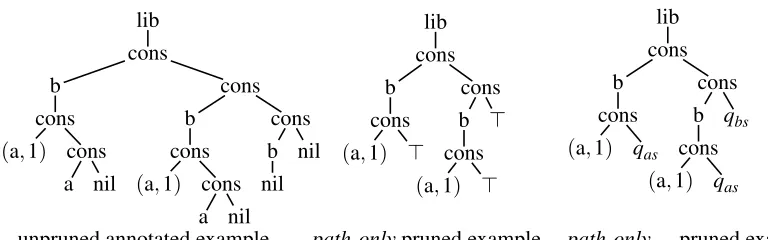
lib cons b
cons
(a,1) cons a nil
cons b cons
(a,1) cons
a nil cons b nil nil lib cons b cons
(a,1) ⊤
cons b cons
(a,1) ⊤ ⊤
lib cons b cons
(a,1) qas
cons b cons
(a,1) qas
qbs
unpruned annotated example path-onlypruned example path-onlyLibpruned example Figure 9: An unpruned annotated example for the two queries from Example 2 and two pruned
annotated examples obtained by applying the “path-only” pruning function respectively without and with schema Lib.
In this case, we callt∗βanannotated example for Q. Note that annotations may be partial. Note also that 0-annotations are strict in that all nodes annotated by 0 in some annotated example forQ
must be rejected byQ.
We will need a projection operation on annotated trees which deletes all annotations. The Σ -projection of a language L of annotated trees is the language ΠΣ(L) of pruned trees t∈
T
Σ(X)where everytis theΣ-projection of some treet∗β∈L. For every tree automatonAwith signature
Σ∪(Σ×B)∪X, one can compute in linear time a nondeterministic automatonΠ
Σ(A)overΣ×X such that
L
(ΠΣ(A)) =ΠΣ(L
(A)).4.2 From Pruning Strategies to Pruning Functions
We next show how to lift pruning strategies in order to prune positively annotated trees. There are two main manners to do so, depending on whether one permits to prune trees with many positive annotations or trees with a single positive annotation only.
Given a pruning strategy σ, our first objective is to define a pruning function pσ that can be applied to all positively annotated treest∗β witht∈
L
(D), while preserving the critical regionsσ(t,ν)of all positively annotated nodesνwith their annotations:
pσ(t∗β) = ⊔ν∈dom(β)σ(t,ν)
∗β.
The least upper bound ⊔ defines the least common instance of the σ relevant regions of all
1-annotated nodes oft. Note that this least upper bound does always exist because t is an upper bound of allσ(t,ν). The above least upper bound thus requires that a node is substituted by a state if and only if it is substituted by some of these prunings and not preserved by any other. Since we assume thatβis a positive annotation, note thatβ(ν) =1 for allνin the domain ofβ.
The concrete pruning functions ppath-onlyD and ppath-extD keep all paths (respectively extended paths) to 1-annotated nodes.
example, and on the right the annotated example obtained by applying function ppath-onlyD. The
ppath-onlypruned example in the middle contains the minimal information relevant for query Q1for first-authors, while the ppath-onlyD pruned example on the right contains the minimal information
relevant for query Q2for first-authors that are not single authors. It should be noticed that negative information will be provided to the learning algorithm independently through negatively annotated examples.
Alternatively, we could permit to prune only trees with a single positive annotation. This is done by the following pruning functionpcan
σ , which is defined for allt∗[ν7→1]witht∈
L
(D)as below and undefined for all other annotated trees:pcanσ (t∗[ν7→1]) =σ(t,ν)∗[ν7→1].
If using such “canonical” pruning functions in our learning algorithm with a universal schemaD=
U
, we will obtain back the learning algorithm from Lemay et al. (2006) restricted to monadic queries. In our experiments, we will exclusively work with pruning functions pσ, even though the alternative pruning functionpcanσ is highly promising for learningn-ary queries in particular.In our theoretical framework, we wish to capture both cases. Therefore, we now propose a unifying definition of pruning functions by which our learning algorithm will be parameterized.
Definition 6 A pruning function with schema D is a partial function p whose domain dom(p)is a subset of positively annotated trees t∗βwith t∈
L
(D)such that:(P1) every annotated tree t∗β∈dom(p)is a D-instance of p(t∗β), and
(P2) for every tree t∈
L
(D)with nodeν, p(t∗[ν7→1])is defined and preserves nodeνwith its label.Lemma 7 For any pruning strategyσ, both pσand pcan
σ are pruning functions.
The proof is straightforward. It should also be noticed that pruning functions need to be adapted to unranked trees, before they become suitable for our experiments onXMLquery induction. Any
pruning function on unranked trees can be compiled back to a (more involved) pruning function on ranked trees via a binary encoding of unranked trees (see Section 8).
4.3 Stability for Pruning Functions
We next lift the notion of stability to pruning functions. Lett∗βbe an annotated example for query
Qwith schemaDandpa pruning function with the same schema. We callt1 a(β,p)-variant of a tree t ift1is aD- completion of the unique treet1′ such thatt1′∗β′=p(t∗β)for someβ′. Note that
βprovides positive annotations only given thatpis a pruning function. Furthermore,β′must be the
restriction ofβtonodesΣ(t1). The nodes ofdom(β′)are called determined by the(β,p)-variantt1
oft.
Proposition 9 Letσbe a pruning strategy and Q a query with the same schema D, then:
Q isσ-stable⇔Q is pσ-stable.
Proof “⇒”. Lett∗β∈dom(pσ)be an annotated example forQandt′ a(β,p
σ)-variant oftthat determinesν. SinceβisQ-consistent it follows thatν∈Q(t). We have to show thatν∈Q(t′). By definition ofpσ,t′=⊔
ν′∈dom(β)σ(t,ν′), so thatt′is aD-completion ofσ(t,ν). Theσ-stability ofQ
then implies thatν∈Q(t′)as required.
“⇐”. Let ν∈Q(t) andt1 a D-completion of σ(t,ν). We have to show that ν∈Q(t1). The
annotationβ= [ν7→1]is aQ-consistent fort and satisfiesσ(t,ν)∗β=pσ(t∗β). Hence,t1 is a
(β,pσ)-variant oftthat determinesν. Thepσ-stability ofQyields thatν∈Q(t1).
4.4 Stability Characterization
We now characterize p-stable queries by languages of p-pruned positively annotated trees. LetD
be a deterministic automaton and pbe a pruning function with schema D. For any queryQwith schemaD, let
L
QL
Q={t∗β|βis aQ-consistent annotation oft∈L
(D)}.be the set of unpruned annotated examples forQ. Note that users of a query induction system will provide elements of
L
Qfor the target queryQ. Then, the set of pruned annotated examplesp(L
Q) is the set of all p-images of positively annotated examples forQthat belong todom(p). Note thatin our XMLinformation extraction tool, example trees will contain both positive annotations and negative annotations. In a preprocessing step, we collect positively annotated examples to which the pruning function will be applied. We will also collect negatively annotated examples which must remain unpruned in contrast.
Conversely, every language of pruned annotated trees defines a query. Let Lbe a language of annotated trees, it defines a query with domain
L
(D)that we denote byQ
Lsuch that for all treest inL
(D):Q
L(t) ={ν| ∃t′∗β∈Lsuch thatβ(ν) =1 andt∈complD(t′)}.The following proposition shows that stable queries can be uniquely identified by their language of pruned positively annotated trees, under the assumption that the schema is known.
Proposition 10 Any p-stable query Q is defined by the language L=p(
L
Q), that isQ
L=Q.Proof We assume that Qisp-stable and show that
Q
L=Q. Both queries have the same domainL
(D), so it is sufficient to show that, for allt∈L
(D)thatQ
L(t) =Q(t).“⊇” Assumeν∈Q(t). Thenβ= [ν7→1]is aQ-consistent annotation oft, so that by(P2), the tree
t∗βcan be pruned by pwhile preservingνwith its label. By definition ofL= p(
L
Q), we have p(t∗β)∈L. Lett′∗β′be equal to p(t∗β). Sinceνis the only nodeνin the domain ofβand is preserved, we can deduce thatβ′=β, so thatt′∗β∈L. Furthermore,t∈compl D(t′) as a consequence of condition (P1) on pruning functions. Therefore,ν∈
Q
L(t)by definition“⊆” Assumeν∈
Q
L(t). Then, by definition ofQ
L, there existst′∗β∈Lsuch thatt∈complD(t′) andβ(ν) =1. Now, by definition ofL=p(L
Q), there exists an annotated example t1∗β1forQsuch thatt′∗β=p(t
1∗β1). We haveβ1(ν) =1 by condition(P1)in the definition of
pruning functions, thus ν∈Q(t1)by definition of Q-consistency. Finally, notice thatt is a
(β1,p)-variant oft1that determinesν. Thereforeν∈Q(t)follows fromp-stability.
Theorem 11 Let D be a deterministic tree automaton, p a pruning function and Q a query both with schema D. The following two properties are then equivalent:
1. Query Q is p-stable.
2. Language L=p(
L
Q)defines query Q in that Q=Q
L.Proof The implication “1 ⇒ 2” was shown by Proposition 10, so it remains to prove “2⇒ 1”. We assume
Q
L=Qand show that Q isp-stable. Lett∗β be aQ-consistently annotated tree indom(p) andt1 a (β,p)-variant oft determining ν. Variantt1 is then a D-completion oft′
1 where t′
1∗β′=p(t∗β)for someβ′. TheQ-consistency ofβontimplies thatt1′ ∗β′∈L. Furthermore, it
implies thatν∈Q(t)sinceβmust be all positive by definition of pruning functions. Since variantt1
determinesν, it follows thatβ′(ν) =1. Henceν∈
Q
L(t1)by definition ofQ
L. With our assumptionQ
L=Q, we can conclude thatν∈Q(t1)as required.5. Regularity
From the view point ofXMLinformation extraction, XPath queries withDTDschema restrictions are
of highest interest for query induction. Modulo binary encoding of unranked trees, DTDschemas
can be expressed by deterministic tree automata. Furthermore, since we ignore data values, XPath queries can be defined by tree automata too, that operate on binary encodings of unranked trees. This motivates our study of the class of regular queries for query induction.
In our learning algorithm we will represent regular p-stable queries by tree automata that rec-ognize the language p(
L
Q) of pruned positively annotated examples forQ. The objective of this section is to show that every regular p-stable query can be represented in this manner under the assumption that the pruning functionpis regular too, a notion that we will introduce.5.1 Regular Stable Queries
We recall a definition of regular queries and show how to represent stable regular queries by regular languages of pruned annotated examples.
Definition 12 A query Q is regular if the set
L
Qof unpruned annotated examples for Q is a regular tree language.As before, letDbe a fixed deterministic tree automaton with signatureΣand state setX, so that pruned annotated tree have the signatureΣ∪(Σ×B)∪X. Given a tree automatonAthat recognizes
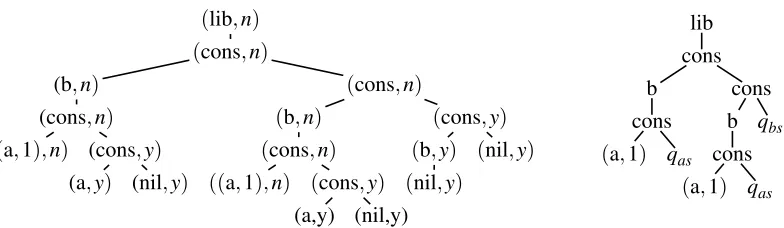
(lib,n) (cons,n)
(b,n)
(cons,n) ((a,1),n) (cons,y)
(a,y) (nil,y)
(cons,n) (b,n)
(cons,n) ((a,1),n) (cons,y)
(a,y) (nil,y)
(cons,y) (b,y) (nil,y)
(nil,y)
lib cons b cons
(a,1) qas
cons b cons
(a,1) qas
qbs
Figure 10: The unpruned annotated tree of Figure 9 with nodes annotated with the symbolsyand
n according to “path-only” pruning functions is on the left. Its pruning according to pruning functionppath-onlyLib is shown on the right.
Query answering for regular queries is an important task for every interactive query induction system. Fortunately, queries defined by tree automata can be answered efficiently. Indeed, for every treet in
L
(D), the setQ
A(t)of query answers can be computed in timeO(|A| |D| |t|) even without determinism. This result is folklore. It can be shown, for instance, by converting(A,D)into a monadic Datalog program of size O(|A| |D|) that defines the same query and applying the
algorithms for monadic Datalog from Gottlob and Koch (2002).
Lemma 13 A query Q with schema D is regular if and only if Q=
Q
Lfor some regular language Lof D-pruned annotated trees.
Proof For the one direction, note that
Q
LQ =Q, so that we can choose L=L
Q ifL
Q is regular. The other direction is more tedious. Given automataAandDwe have to construct an automaton recognizingL
QA depending onD. How this can be done is shown in Appendix A.It should be noticed that the automaton construction in the above proof requires exponential time in the size ofA. Fortunately, this construction will only be used to clarify the expressiveness of our query representation formalism in Theorem 18. It will not be used by our query induction algorithm.
Proposition 14 A p-stable query Q is regular if its language p(
L
Q)is regular.Proof LetQbe a p-stable query andL=p(
L
Q). Proposition 10 shows thatQ=QL. Lemma 13 thus implies thatQLis regular, under the assumption thatLis regular.The converse holds only for regular pruning functions introduced next (see Theorem 18).
5.2 Regular Pruning Functions
Example 4 We reconsider the example on pruned libraries for the pruning function obtained from the path-onlyLibstrategy. All maximal subtrees in which no node is annotated by1must be pruned and all nodes above nodes annotated by 1must be preserved. This can be done by a finite state machine. For this, we will annotate nodes that are to be pruned by y and nodes that must be preserved by n. For instance, the annotation of the tree of Figure 9 is shown in Figure 10. Then, it is easy to define a tree automaton which checks whether the definition of a “path-only” pruning function is satisfied. This automaton can also be used to apply the pruning function.
Formally, let us consider a pruning function pand an annotated treet∗βin its domain. We call
a nodeνoft∗βunpruned if it belongs tonodesΣ∪Σ×B(p(t∗β))and pruned otherwise. Lett∗β∗p be the tree obtained fromt∗βby annotating all nodes that were pruned by pwithyand all others byn. This way we can identifypwith the language
L
p={t∗β∗p|t∗β∈dom(p)}. Note thatL
p contains unpruned trees only. We say that a tree automatonPwith signature(Σ∪(Σ×B))× {y,n}defines a pruning function pwith schemaDif
L
p={s∈L
(P)|ΠΣ(s)∈L
(D)}. Note that schema validation forDis considered as an external issue forP. This pruning functionpis then denoted by℘P,D.
Definition 15 A pruning function p with schema D is calledregularif it is equal to℘P,Dfor some
tree automaton P.
For instance, the pruning function ppath-onlyD is regular. It can be defined by the same automaton with 2 states for allD(since schema validation is done externally). This automaton checks whether a node has a 1-annotated descendant (state 1) or not (state 0). Nodes in state 1 must be labeled byn
and nodes in state 0 byy. Both states are final. For all symbols f(k)inΣwherek≥0 we define the following rules, where each occurrence of symbol∗stands for either state 0 and 1.
(f,y)(0, . . . ,0)→0 ((f,1),n)(∗, . . . ,∗)→1 (f,n)(∗, . . . ,∗,1,∗, . . .∗)→1.
Pruning function ppath-extD is also regular. It is sufficient to add a further state to the previous automaton, which checks whether a node is a sibling of a positively annotated node (or not). We leave the precise automaton construction to the reader.
Any pair(P,D)can be transformed in polynomial time into a linear bottom-up tree transducer (Comon et al., 2007) that defines the same pruning function℘P,D. Such transducers, however, may become nondeterministic even ifPandDare deterministic, as for instance for ppath-extD. Further-more, if we avoid such a conversion, we can indeed evaluate the application of a pruning functions to an annotated tree efficiently, as we show next.
Lemma 16 Let P and D be deterministic tree automata, p=℘P,D, and t∗βan unpruned annotated
tree. One can decide whether t∗β belongs to dom(p) and in this case compute p(t∗β) in time O(|P| |t|+|D|+|t|).
Proof We compute the projection automatonP′=Π
Σ∪(Σ×B)(P)by “integrating” the labelsyandn into the states ofP. Note thatP′may be nondeterministic despite of the determinism ofP. Lett∗β be an unpruned annotated input tree. SinceDis deterministic we can decide in timeO(|D|+|t|)
whethert∈
L
(D). If not, we return thatt∗βdoes not belong to dom(p). Otherwise, there existssatisfying
L
p={s∈L
(P)|ΠΣ(s)∈L
(D)}. Therefore, and sincePis deterministic,P′ may have at most one successful run ont∗βand possibly many unsuccessful runs. This unique successfulrun would contain all information on whether a node is to be pruned or not in the{y,n}component of its state. It is thus sufficient to compute the successful run ofP′ ont∗βif it exists and to detect is nonexistence otherwise. This can be done by running the nondeterministic automaton P′ ont in timeO(|P′| |t|)in a bottom up phase, then testing whether a final state got reached, and if yes selecting the successful run in a top-down phase. Since P′ contains at most twice as many states asP, its size is linear in that that ofP. The overall computation time is thus inO(|P| |t|+|D|+|t|).
Lemma 17 Let D, A, and P be deterministic tree automata. If L=
L
(A)is a language of unpruned annotated trees and p=℘P,Da pruning function then p(L) can be recognized by a deterministictree automaton of size O(|D|2|P| |A|).
Proof Let p=℘P,D andL=
L
(A) for deterministic tree automata P,D,A. We rely on a similar algorithm as for computingp(t∗β)fromt∗βexcept that we must deal with states fromXin pruned trees p(t∗β). So we use the projection automatonP′=ΠΣ∪(Σ×B)(P)but we add rulesq→(r,y) for all states q∈X andr of P. Then, we determinize automatonP′, lift Dto the automaton D′ onΣ∪(Σ×B)∪X that runsDon the Σcomponent of any pruned input trees, while adding rules
q→q for all q∈X. We note that the determinism of D inherits to D′. We then compute the productP′∩D′∩A. By running this product on a pruned input treet∗β, we can test whether there exists aD-completiont′∗β′ such thatt′∈
L
(D) and p(t′∗β′) =t∗β. The product automaton is deterministic, recognizesp(L), and is of sizeO(|D|2|P||A|).Theorem 18 Let Q be a p-stable query for a regular pruning function p. Then:
Q is regular⇔p(
L
Q)is regular.Proof IfQis regular then
L
Qis regular, and thus p(L
Q)by Lemma 17. The converse implication was shown in Proposition 14.This shows that every regular p-stable queryQcan be represented by a (minimal deterministic) tree automaton that recognizes the language p(
L
Q) of p-pruned positively annotated examples forQ. This is the representation on which we will base our learning algorithm for regular p-stable queries.5.3 Deciding Stability
For our experimental validation, it will be necessary to decide whether a regular query is stable for a regular pruning function. This can be done in polynomial time:
Theorem 19 Let D and P be deterministic automata defining a regular pruning function p=℘P,D
and Q a query with domain D. For any tree automaton A recognizing
L
Q we can decide in time O(|A|2|D| |P|)whether Q is p-stable.6. Algorithms for Consistency Checking
In this section, we will present algorithms for checking consistency properties for regular sets of annotated examples that we will introduce: D-functionality and p-consistency. These consistency checks will be the prime subroutines of our learning algorithm. They help us to avoid the need for further negative examples for the target language, beside the negatively annotated examples for the target query.
6.1 D-Functionality
We consider languages of pruned annotated trees with mixed positive and negative annotations.
D-functionality is a consistency notion for such sets which requires that positive and negative anno-tations are non-contradictory.
Definition 20 We call a language L⊆
T
Σ∪(Σ×B)(X)of annotated trees D-functionalif for any t∗β,t′∗β′∈L, if t and t′are compatible with respect to D thenβandβ′coincide on dom(β)∩dom(β′).
The language {(a,1)(⊤),(a,0)(⊤)}, for instance, is not
U
-functional. We next relate p-stable queries toD-functional languages.Proposition 21 If Q is a p-stable query with schema D, then the language p(
L
Q)∪L
Q isD-functional.
Proof The proof is by contradiction. Let us assume that p(
L
Q)∪L
Q is notD-functional. Since domains of pruning functions contain positively annotated trees, there must exist a p-pruned example t′1∗β′1 ∈ p(
L
Q) for Q and an unpruned examplet2∗β2∈L
Q for Q such thatt1′ and t2are compatible with respect toD, so that there exists a nodeνwithβ′1(ν) =1 andβ2(ν) =0. By
definition of p(
L
Q), there exists an unpruned examplet1∗β1 for Qsuch thatt1′∗β′1= p(t1∗β1).Property (P1) of pruning functions implies that β1(ν) =β′1(ν) =1. Since β1 is a Q-consistent
annotation of t1, it follows that ν∈Q(t1), and since β2 is a Q-consistent annotation of t2 that
ν6∈Q(t2). Compatibility implies thatt2is aD-completion oft′
1. Hence,t2is a(β1,p)-variant oft1
that determinesν. Thep-stability ofQyieldsν∈Q(t2). Contradiction.
We now show thatD-functionality can be tested efficiently for regular queriesQA, by reduction to testing emptiness of tree automata. Note that determinism does not help to improve emptiness tests, so that it will not help to assume thatAis deterministic here.
Theorem 22 Let D be a deterministic tree automaton with signatureΣand state set X, and A be a tree automaton with signatureΣ∪(Σ×B)∪X. Whether
L
(A)is D-functional can be decided intime O(|D| |A|2).
Proof We writes1⊛s2 for the overlay of treess1 ands2, where missing nodes are filled up with
a fresh⊥-symbol. Let us consider the language Lcontra of overlays (t1∗β1)⊛(t2∗β2) such that t1∗β1and t2∗β2are accepted byA, thatt1andt2have a common completion, that is,complD(t1)∩ complD(t2)6= /0, and that there exists a node νwith contradicting annotations β1(ν)6=β2(ν). By
definition ofD-functionality,
L
(A)isD-functional if and only ifLcontra=/0.More precisely, if a node int1⊛t2is labeled by(f,⊥)thenDruns on the left component and if it is
labeled with(⊥,f)then it is run on the right component. Nodes with labels(f,q),(q,f)are correct,
if the state reached byDis equal toq. From this time point on,Dcontinues on both components while testing their equality. Labels (q1,q2) with different state contradicts the compatibility oft1
andt2(sinceDis deterministic), as well as labels(f1,f2)with different function symbols. We have
also to test that the joined run ofDont1andt2does reach a final state.
Membership oft1∗β1andt2∗β2to
L
(A)can be checked by running two copies ofAin parallelon their overlay. Last but not least, the existence of a contradiction between annotations can be checked by a very simple automaton with a single state. Thus, Lcontra can be recognized by a product automaton of sizeO(|D| |A|2). As emptiness is testable in linear time for tree automata, the
theorem follows.
Note that if one can assume that theΣ-projections of all trees recognized byAsatisfy schemaD, as we can do for our learning algorithm, then the test in the proof can be simplified, since neverD
has to be run in parallel with both copies ofA. In this case,D-functionality can be checked in time
O(|D| |A|+|A|2).
6.2 p-Consistency
In our learning algorithms, we will need to check whether a language of annotated trees contains onlyp-pruned trees for a given regular pruning functionp.
Definition 23 We call a language L of annotated trees p-consistentif all trees in L are p-pruned, that is, if L⊆p(
T
Σ∪(Σ×B)).Proposition 24 Let p=℘P,Dbe a regular pruning function, let L=
L
(A)be a regular set of prunedannotated trees defined by a deterministic automaton with signatureΣ∪(Σ×B)∪X. Whether
L
(A)is p-consistent can be decided in time O(|A| |D|2|P|).
Proof By definition of p-consistency, we must test whether
L
(A)⊆p(T
Σ∪(Σ×B)). By Lemma 13, we can construct a deterministic tree automaton recognizing p(T
Σ∪(Σ×B)) in timeO(|D|2|P|). We can thus decide p-consistency by inclusion checking. According to Proposition 1, inclusion can be checked in timeO(|A| |D|2|P|).7. Learning Stable Regular Queries
In this section, we present a learning algorithm for stable queries and prove a formal learnability result.
7.1 Learning from p-Pruned Samples
We present a learning algorithm that infersp-stable queries from p-pruned samples and show that it satisfies the learning model from polynomial time and data. The nontrivial aspect is that p-pruned samples are indeed sufficient.
We suppose that the schema is fixed by a deterministic automaton D, and that the pruning functionp=℘P,Dis fixed by a deterministic tree automatonP. As shown before, ap-stable regular query Q is uniquely defined by the language L= p(
L
Q) of all p-pruned examples for Q. The idea is therefore to identify the minimal deterministic tree automaton for the languageL=p(L
Q) associated with thep-stable target queryQ. As input, it will receive ap-pruned sample for the target query.Definition 25 A p-pruned sample is a pair(S+,S−)where S+is a p-consistent finite set of positively annotated trees and S−a finite set of negatively annotated trees such that S+∪S−is D-functional.
Note that only positively annotated examples can bep-pruned, since pruning functions do not apply to examples with negative annotations. We can now state our main result of the learnability of
p-stable queries from p-pruned samples.
Theorem 26 Let schema D be a deterministic tree automaton and p be a fixed regular pruning function with schema D. Let
A
be the class of deterministic tree automata that recognize lan-guages p(L
Q)of some regular p-stable query Q andS
the class of p-pruned samples of annotated examples. Then, the class of p-stable regular queries represented by automata in classA
is learn-able in polynomial time with polynomially many examples from samples in the classS
. I.e. any automaton A inA
has a characteristic sample char(A)inS
whose cardinality is polynomial in the size of A and there is an algorithm p-stable-RPNIDsuch that, for any sample S′inS
that subsumesthe characteristic sample char(A)of an automaton A recognizing the language L=p(
L
Q)of ap-stable query Q, algorithm p-stable-RPNID outputs in polynomial time in the size of S′ the unique
minimal deterministic tree automaton recognizing L.
Proof The proof is by reduction to the problem of learning regular tree languages represented by deterministic tree automata from positive and negative examples (García and Oncina, 1993). Let
A
′be the class of deterministic tree automata with signatureΣ′=Σ∪(Σ×B)∪X andS
′ the classof samples(S′+,S′−) of positive and negative examples S′+,S′−⊆
T
Σ′ withS′+∩S′−= /0. From
the learnability result for deterministic tree automata, we know that every automatonAin
A
′ has a characteristic sample char′(A) = (S′+,S′−) inS
′ with S′+ ⊆L
(A) and S′−∩L
(A) = /0 whose cardinality is polynomial in the size of A. Also, there is an algorithm RPNI such that, for every sample S inS
′ that subsumes the characteristic sample char′(A), RPNI with input S outputs in polynomial time in the size ofSthe unique minimal deterministic tree automaton recognizingL
(A).In the first step of the proof, we construct the characteristic samplechar(A) = (S+,S−)in
S
forAin
A
. We fix a total order on trees overΣ, such that trees with fewer nodes become smaller. LetAbe a deterministic tree automaton recognizing the languageL=p(
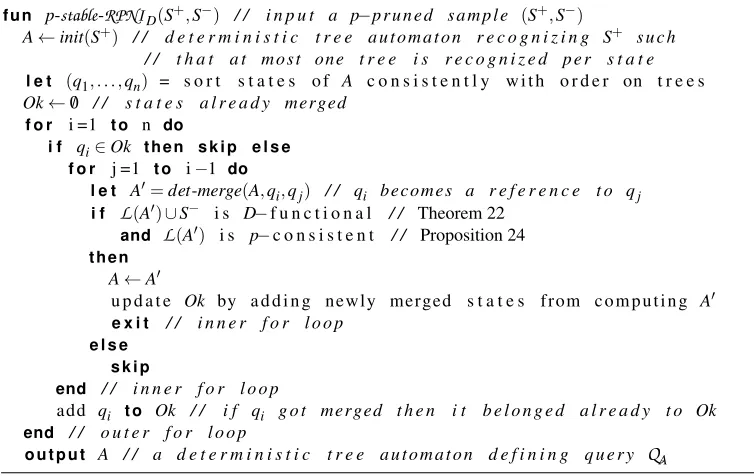
L
Q)of the p-stable target queryf u n p-stable-RPNID(S+,S−) / / i n p u t a p−p r u n e d s a m p l e (S+,S−)
A←init(S+) / / d e t e r m i n i s t i c t r e e a u t o m a t o n r e c o g n i z i n g S+ s u c h / / t h a t a t most one t r e e i s r e c o g n i z e d p e r s t a t e l e t (q1, . . . ,qn) = s o r t s t a t e s o f A c o n s i s t e n t l y w i t h o r d e r on t r e e s
Ok←/0 / / s t a t e s a l r e a d y merged f o r i =1 t o n do
i f qi∈Ok t h e n s k i p e l s e f o r j =1 t o i−1 do
l e t A′=det-merge(A,qi,qj) / / qi becomes a r e f e r e n c e t o qj i f L(A′)∪S− i s D−f u n c t i o n a l / / Theorem 22
and L(A′) i s p−c o n s i s t e n t / / Proposition 24 t h e n
A←A′
u p d a t e Ok by a d d i n g newly merged s t a t e s from c o m p u t i n g A′ e x i t / / i n n e r f o r l o o p
e l s e s k i p
end / / i n n e r f o r l o o p
add qi t o Ok / / i f qi g o t merged t h e n i t b e l o n g e d a l r e a d y t o Ok end / / o u t e r f o r l o o p
o u t p u t A / / a d e t e r m i n i s t i c t r e e a u t o m a t o n d e f i n i n g q u e r y QA
Figure 11: Learning algorithm forp-stable queries fromp-pruned examples.
in
S
′. We definechar(A)inS
fromchar′(A)as follows. All trees inS′+ belong toL=p(L
Q), so we put them intoS+. For all treessinS′−we proceed as follows:• Ifsdoes not belong to the image of pthen we can safely ignores, since our algorithm will always check that the language of the target automaton will be p-consistent (recall that pis fixed and known by the algorithm).
• Otherwise, lettbe the least tree in the total order fixed above such thats=p(t∗β)for some
β, and fix one of thoseβs. By definition of pruning functions,βmust be a positive annotation.
Sinces∈S′−, however,βcannot be consistent withQ, so there exists a nodeν6∈Q(t)such thatβ(t) =1. We addt∗[ν7→0]toS−.
We obtain a samplechar(A) = (S+,S−)whose cardinality is at most linear in the cardinality of
char′(A), and thus polynomial in the size ofA. Moreover, it follows from Proposition 21 thatS+∪S− isD-functional sinceQisp-stable. Therefore,char(A)is ap-pruned sample in the class
S
. In Figure 11, we define our learning algorithm p-stable-RPNIDwhich receives p-pruned samples(S+,S−)inS
as input. It is parameterized by a deterministic tree automatonDand a regular pruning functionpwith schemaD. It remains to show for every sample(S+,S−)in
S
that subsumes the characteristic samplechar(A)of an automatonArecognizing the languageL=p(L
Q)of ap-stable queryQ, thatp-stable-RPNID(S+,S−)is the unique minimal deterministic tree automaton recognizingLand that it is computed in polynomial time.
For this, letA∈
A
be an automaton. We considerchar(A)as defined before from thecharacter-istic samplechar′(A). We first show that: