Syncope: A Practical Approach to Diagnosis
Hygriv Rao B1,*1Senior consultant cardiologist and electrophysiologist, Krishna Institute of Medical Sciences, Minister Road, Secunderabad - 500003, AP, India
Abstract
Syncope is commonly encountered clinical problem by practicing clinicians. This is defined as a transient loss
of consciousness resulting from decrease in cerebral perfusion. The importance of evaluation of this condition
cannot be undermined as it has been said that syncope and death differ from each other in that in the former the
patient wakes up while in the latter he does not. Occurrence of this event on one hand results in psychological duress to the patient and their relatives while on the other hand, it can be sometimes be a challenge to the
treating physician to be able to confidently classify this as benign. Patient with syncope may present to different
medical specialists - physician, cardiologist, neurologist, emergency room physician or to a psychiatrist. Unless
there is clarity in the mind of the clinician of the diagnostic plan, what will result is large number of expensive and non-contributory diagnostic tests, prolonged hospital stay leading to financial burden to the patient and
frustration to the doctor. In the following paragraphs I will try to summarize the approachto the diagnosis of
common conditions causing syncope. One should nevertheless be aware that in a significant number of cases, the cause of syncope cannot be exactly pinpointed. A physician should however be able to definitively exclude
life threatening causes of syncope. This is a more achievable and important objective to achieve.
Dr. Hygriv Rao B
JMSR
History
the 1st question - Is it Syncope?
The first step in the evaluation of syncope is to
decide if the patient really has syncope or pre-syncope. Obtaining history from the patient is not always easy. Dizziness is so common a symptom that physician is sometimes unclear in which cases to investigate further or to refer to a cardiologist/ Electro physiologist and when to just reassure the patient. Syncope that has led to injuries to the body should be taken very seriously however transient it may be. Sometimes patients who have syncope
and suffer head injuries often have the injuries
treated but evaluation of syncope is forgotten. Tonic clonicseizures usuallyindicate a neurological problem but one should remember that seizure like activity may also occur during cardiac arrest caused *Corresponding author: Dr. B.Hygriv Rao, MD., DM., FISE.,
EP Fellowship (USA), Senior consultant cardiologist and electrophysiologist, Krishna Institute of Medical Sciences, Minister Road, Secunderabad - 500003, AP, India, Tel.: +91 40 44885000; E-mail: [email protected]
Received 3 January 2012; Revised 2 February 2013; Accepted 11
February 2013
Citation: Hygriv Rao B (2013) Syncope: A practical approach to
diagnosis. J Med Sci Res 1(1): 23-28.
Copyright:© 2013 KIMS Foundation and Research Centre. All Rights Reserved.
by ventricular fibrillation (VF) or with complete heart
block. Many young children with congenital long QT syndrome and recurrent VFhave been treated with multiple anti epileptic drugs with this mistaken diagnosis. Most often, the vital clues to diagnosis are obtained from history rather than from multiple tests. The sequence of events leading to syncope and the background medical history should dictate the investigations to be done in a particular patient. The person from whom the history is obtained is very important.Ideally if possible, history is best obtained from a witness to the syncope, as the recollection of events by the patient may be at variance with the true picture. The patient can however be relied
upon to tell us the symptoms experienced prior to
loss of consciousness, which can give a pointer to the diagnosis.
Different clinical situations
Vasovagal or Neurocardiogenic syncope
By far this is the most common condition causing
syncope. It can occur in any age group though more common in the elderly. Frequently encountered situations are when a child standing in the school for a long time, some individuals on seeing blood,
hearing some unexpected news, extremes of emotions or smelling a noxious stimuli. Patients seek
medical advice when they have recurrent symptoms. Typically these occur when the patient is in upright position often after sitting or lying down for a long time, like getting up in the middle of night to go to the toilet. They can occur during prolonged standing and infrequentlyin the sitting position too. They never occur in lying down position. The benign nature of these episodes is seen by the fact that patients
experience these symptoms for many years before
approaching a physician. After a few episodes some patients learn to recognize prodromal symptoms before syncope. The episodes are characteristically very transient half a minute to 2-3 minutes, and there are no sequelea following the episode. Syncopal episodes may however result in injuries. Tonic- clonic movements or seizures are not a part of this neither are bladder or bowel incontinence. If there is a trained observer, he may note that the pulse rate was low or weak at the time.
Sudden cardiac arrest
While neurocardiogenic syncope is most common, cardiac arrest is the most dangerous. In every patient
with syncope this diagnosis must be deliberately
considered and conclusively excluded. In fact the physician’s job is incomplete if he has not excluded
this condition when dealing with a patient with syncope. What may be a self-terminating ventricular arrhythmia this time may result in sudden death
next time. This condition should be suspected in any
patient with syncope having history of myocardial infarction in the past, or ventricular dysfunction (Echocardiogram showing EF 40%). This should also be considered in patients who have undergone coronary angioplasty or bypass surgery in the past or those with cardiomyopathies. It should be
remembered that cardiac arrest could be the first
manifestation of coronary artery disease (CAD) and patients with coronary risk factors having syncope should be actively investigated for the presence of CAD. Presence of chest pain preceding the syncope may point to the diagnosis but is not always present. Syncope in this situation is not posture related,
but can get precipitated on exertion. It is transient
and may be associated with severe sweating. The patient needs to be hospitalized for evaluation as these patients are at high risk of sudden death. Family history of sudden death should make one suspect inheritable genetic syndromes like long QT
syndrome, or Brugada syndrome.
Arrhythmias and conduction system
disease
Apart from dangerous arrhythmias like ventricular
tachycardia and fibrillation which can cause sudden
cardiac arrest, other apparently benign arrhythmias like supraventricular tachycardia can also sometimes cause syncope when there are associated with very fast ventricular rates.Typically these patients
experience palpitations first then lose consciousness
if the tachycardia is too rapid compromising cardiac output. Once lying posture is achieved, blood pressure improves and they regain consciousness. This is also
the mechanism in patients with paroxysmal atrial fibrillation (AF) whomay experience syncope when
the ventricular rates are very rapid. Syncope may also occur or when the fast AF suddenly terminates with a long pause, particularly with underlying sinus node disease. Ventricular tachycardia even when occurring in normal hearts can result in syncope.
One of the causes of exertional syncope is RVOT VT.
Syncope is a very important symptom of advanced AV block and in this situation patient needs to be hospitalized. Sometimes these are transient and should be suspected in a patient with bradycardia or
ECG showing LBBB or RBBB. Some of the drugs used
in cardiovascular medicine may be responsible hence history of usage of medications like beta blockers,
Digoxin, Amidarone must be carefully looked for.
In a patient with suspected conduction disease
occurrence of syncope on exertion may indicate an
advanced AV block needing a pacemaker.
Neurological causes
Clinical picture that points to a neurological etiology includes associated seizures, focal neurological
deficit, and presence of a carotid bruit. In the
absence of these pointers, neurological work up is to be undertaken once common and life threatening
cardiovascular causes are excluded. Every patient
with syncope does not need CT/MRI of brain and conversely having a normal imaging of brain does not convey any conclusive information to the doctor.
Investigations
Every patient must have routine blood chemistry which includes complete blood picture, blood sugar, serum electrolytes, serum creatinine, and thyroid
profile as a baseline. The most important factor influencing management of the patient is the presence
of heart disease and hence ECG and echocardiogram constitute the front line investigations.Generally
with few exceptions, if ECG and Echo are totally
normal, life threatening causes of syncope can be
excluded. It is important to remember that in a given
patient all investigations need not be done. The clinical background and history should dictate the choice of tests to be done.
eCG/Holter
Many clues can be seen on ECG and in some cases the diagnosis is solely made with the help
of ECG. Holtermonitoring is an extension of ECG
and is helpful in situations which are episodic. Thepresence of pathological Q waves indicates the presence of myocardial infarction of some duration, which would make the possibility of sudden cardiac arrest being responsible for syncope strong; the suspicion is increased if this is associated with frequent Ventricular ectopy. Reversible ST-T changes indicate presence of underlying ischemia. This and
the presence of prolonged QT interval both make the occurrence of polymorphic VT possible which can lead to cardiac arrest. Prolonged QT may be acquired or may be present since birth in which situation it is termed as congenital long QT syndrome. Another condition increasing risk of cardiac arrest is the
Brugada syndrome which is recognized in the ECG as presence of incomplete RBBB and ST elevation
in leads V1 and V2. Sinus pauses or obvious AV
block (more p waves than QRS complexes) suggest
conduction system disease as cause of syncope and would need pacemaker implantation. The presence of sinus bradycardia alone may warrant electrophysiological studies to assess function of
the sinus node. ECG showing RBBB or LBBB with or without prolonged PR interval (≥ 200 msec) should
raise the suspicion of AV conduction block being responsible for syncope and these patients need to
be further evaluated. Presence of LBBB and RBBB in the same individual at different time makes them
at a high risk of complete heart block. Presence of increased QRS voltage in the precordial leads suggests ventricular hypertrophy and should be further
investigated for Hypertrophic cardiomyopathy
which is one of conditions that can lead to sudden death. Occurrence of ventricular ectopics of the same morphology consistently should make one consider the possibility of ventricular tachycardia. As arrhythmias occur episodically resting ECG may be normal in which case a holter or a long term rhythm monitoring device can document the arrhythmia when it occurs. Another important ECG
finding is presence of pre excitation in a resting ECG,
which is recognized by the presence of a short PR interval and a delta wave. These patients are prone
to develop atrial fibrillation with fast ventricular
rates which is manifested as a wide QRS irregular tachycardia that can lead to syncope.
Long term Rhythm monitoring
For patients whose syncope is infrequent, 24/48 hour holter is inadequate. Such patients need long term recording. One of them is implantable loop recorder which is implanted under the skin and can
be kept in situ for few years. A noninvasive external
recorder (ELR) is now made recently available which is wearable and can be used for a few months.
echocardiogram
structural heart disease from those who have not.
By far this is the most cost effective investigation
which helps in decision making in a patient with syncope and should be performed in all the patients. The most important information it gives is the assessment of ventricular function as a decreased ejection fraction makes the patient prone for cardiac arrest and sudden death. Presence of akinetic or dyskinetic segments or thinned out areas indicate
scarring and fibrosis of the myocardium making
it vulnerable for occurrence of VT /VF. Dilated left atrium or a LA thrombus should make one suspect
paroxysmal atrial fibrillation. Dilated, restrictive or
hypertrophic cardiomyopathies increase patients risk for malignant rhythms. Rarely cardiac tumors obstruct the valves compromising cardiac output and can lead to syncope.
Newer imaging- cardiac MRI
Assessment of structural abnormalities of heart has
extended today beyond echocardiogram. Cardiac
MRI is very useful in demonstrating ventricular myocardial scars and is a useful investigation in patients in whom cardiac arrest is suspected a cause for syncope. This is used today in patients with ischemic cardiomyopathies to demonstrate ventricular aneurysms or scars.
treadmill test
Some patients have syncope on effort. This occurs
in patients with some types of VT (RVOT VT) or advanced AV block. In such cases treadmill test may help to diagnose the cause of syncope. It is important to make sure that the ECG and Echo are normal before subjecting the patient to TMT. This is
because severe aortic stenosis may cause exercise
induced syncope but should not be subjected to this test. Patients with severe coronary artery disease
may also experience syncope on effort.
tilt table test
This is one of the underutilized and inexpensive tests
largely because of unavailability in many hospitals. This test requires a tilt table which is usually a
modified x ray table. It should be able to be tilted to
75 degrees and rapidly brought down to horizontal position if need arises. It is useful for the diagnosis of neurocardiogenic syncope. The advantages of this test
are firstly as it reproduces the symptoms, the patients confidence is gained, the patient knows what causes
his problem and what relieves it. Though not curable the diagnosis of Neurocardiogenic syncope clearly demonstrates the benign nature of the problem, and once positive obviates the need for further often
expensive diagnostic testing. This test is ordered in
a patient who has syncope on upright posture and whose echo and ECG are normal. There are 3 types of positive tilt test vasodepressor – associated with fall in blood pressure, cardio inhibitory- associated
with bradycardia and mixed which has both drop in
blood pressure and heart rates.
electrophysiological study
In selected patients EP study can demonstrate the cause for syncope. The most important use of EP study is to identify patients having high risk of sudden death. EP study is indicated in patients with myocardial infarction in past, or having LV dysfunction presenting with syncope or dizziness. Ability to induce Ventricular tachycardia (VT) during EP study makes these patients at a high risk of sudden death and warrants implantation of ICD. Patients presenting with pre-syncope or syncope where the
ECG shows a bifascicular block (RBBB with axis deviation, or LBBB) with or without prolonged PR
interval, may undergo EP study. Demonstration of an infra hisian conduction disease in these patients
by a prolonged HV interval or a H-V block, stratifies
them as having a high risk for complete heart block in the future. One can assess sinus node function or hypersensitivity of carotid sinus. EP studies can also be used to induce suspected arrhythmias
and these can be ablated offering a permanent
cure for the patient’s problem. Radiofrequency
ablation generally can be offered to patients with
arrhythmias and structurally normal hearts. These are supraventricular tachycardia (SVT), WPW
syndrome, RVOT VT, Fascicular VT, Atrial flutter, and atrial fibrillation.
treatment: Following is a summary of various conditions that can present with syncope and their treatment options.
Diagnosis Treatment
Neurocardiogenic syncope Medical, rarely pacemaker
SVT & WPW syndrome Radiofrequency ablation
Ventricular tachycardia with normal Heart Radiofrequency ablation
Spontaneous or inducible ventricular tachycardia with LV dysfunction/ past MI/ structural heart disease ICD
Long QT syndrome Beta blockers/ ICD
Hypertrophic cardiomyopathy/ Brugada syndrome ICD
Following are some real life examples of patients presenting with syncope
(A) (B)
Figure 1: (A) Tilt table test used for diagnosis of vasovagal/neurocardiogenic syncope. (B) ECG in a patient undergoing tilt test showing a long pause. This was associated with significant drop in his blood pressure with syncope proving the diagnosis.
(A) (B)
(A) (B)
Figure 3: (A) 55 yr old lady with dizziness. ECG shows RBBB with left axis with prolonged PR interval. (B) EP study of this patient shows 2:1 AV block with atrial pacing at 100/minute. HIS channel shows infra hisian block. This indicates high degree AV block and a need for
permanent pacemaker.
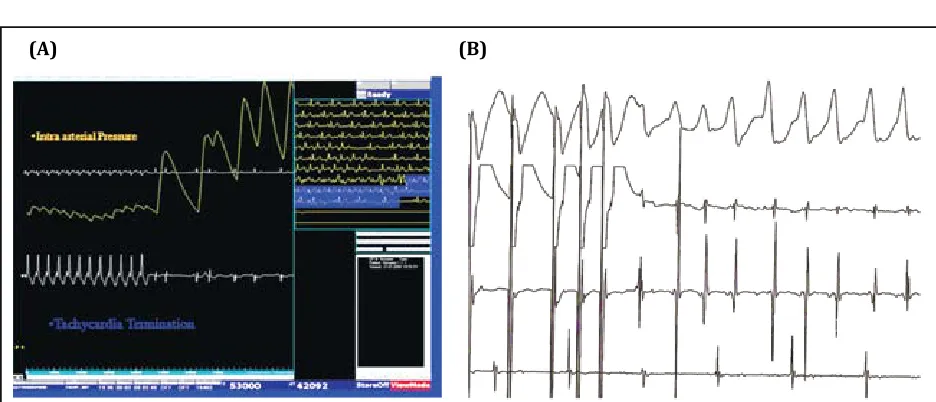
Figure 4: (A) EP study in a young lady with syncope. Induction of SVT is associated with a drop in blood pressure which recovers
immediately with termination. The cause for syncope is established. She underwent a curative radiofrequency ablation. (B) EP study
in a 50 year old man with MI 5 years back presenting now with syncope. On ventricular pacing VT is induced easily with drop in blood
pressure. The study shows that he is at a high risk of sudden death. He was implanted an ICD.