Available Online at www.ijpret.com 50
INTERNATIONAL JOURNAL OF PURE AND
APPLIED RESEARCH IN ENGINEERING AND
TECHNOLOGY
A PATH FOR HORIZING YOUR INNOVATIVE WORK
A THEORETICAL EVALUATION OF COHERENCE LENGTH, ELECTRON PHONON
COUPLING PARAMETER AND DENSITY OF STATES AT THE FERMI LEVEL OF La-AL
ALLOYS
VIJAY KUMAR VERMA
Associate Professor, Department of Physics, Gaya College, GAYA. 823001. (Bihar) Accepted Date: 06/01/2015; Published Date: 01/02/2015
\
Abstract: Coherence length, electron-phonon coupling parameter and density of state at Fermi surface were calculated by using well known formula used for these parameters for different percentage of Al in La-Al alloys. The obtained theoretical results indicate that Coherence length, Debye temperature increase and electron coupling and density of state decrease with % Al Concentration in La- Al alloys. The evaluated results are in good agreement with those of other theoretical workers also with the experimental data.
Keywords: Allotropic forms, Stoichiometric compounds, Superconducting transitions temperature, Hybridization, Liquid quenching technique, Amorphous alloys, Flux quantum, Upper critical field, Mc Millan’s equations, electron-phonon interaction.
Corresponding Author: MR. VIJAY KUMAR VERMA
Access Online On:
www.ijpret.com
How to Cite This Article:
Available Online at www.ijpret.com 51 INTRODUCTION
There has been considerable interest in Lanthanum and its compounds because of their electronic and structural properties. Two allotropic forms of La exist: the dhep Tc 4.9k and fcc Tc phases. Relative to its position in the periodic table, La has an anomalously high
superconducting transition temperature
Tc and, in fact, under high-pressure conditions
150kbar
, it has the highest observed Tc
12K
for any elemental superconductor [1].For polycrystalline La [1,2], or stoichiometric La compounds like La Al LaCu andLa Ga3 , , 3
2 ,inwhich La was determined to play the dominant role in the superconducting properties ,
extremely larger positive value of the pressure coefficient of
,
0 c c
P T T
P
,have been
observed. From recent tunnelling studies, it has been found that La is a moderately strong-coupled superconductor at normal pressure and that the coupling increase in strength under increasing pressure [3]. Another interesting property of La is its anomalously low melting point as compared with those of other group-III-B elements with similar outer electronic configuration for the neutral atom (i.e., Sc, Y, and Lu ) [4]. Its negative thermal expansion coefficient at low temperature is also unusual [5].
It is now experimentally established that the Tc of pure La and some of its compounds depends largely on the La-La nearest –neighbour distance [2,6]. However, there is no general agreement on the type of electrons primarily responsible for the other unusual properties of La and its compounds. In some models, La is regarded as a pure sd-band transition metal [7], while in others it is assumed that a narrow band of 4f electron is present near the Fermi level [4,8]. Among the 4f-band models, there is a further split of opinion as to the importance of the 4f electron in the observed superconducting properties of La and its compounds. For example, in
order to explain the strong increase of Tc with pressure in La, Ratto et al [8] claim that the 4f electrons at the Fermi level actually inhibit superconductivity. In their model, increasing pressure results in a reduction of the f-electron character at the Fermi level and therefore
produces an increase Tc .On the other hand, Witting and co-workers [1,4] believe that the pressure of 4f state close to the Fermi level enhances superconductivity in La. They assume a degeneracy 4f states with conduction-electron states, resulting in a hybridization between them with the 4f electron taking on conduction electron character. High pressure is thought to
Available Online at www.ijpret.com 52 materials. The occurrence of photon softening in La under pressure ,its low Debye temperature and low melting point have also been discussed by Wuhl et al.[3] in terms of enhancing effect of the 4f electrons.
One way to gain additional insight into the problem is to study the effect of other elements on the various properties over a significantly wide range of alloy concentration. However most elements of interest have limited or vanishing small solubility in La so that such a study is impossible. For this reason, previous efforts have been concentrated on some stoichiometric compounds of La[2]. Because of their limited number, it is difficult to see any systematic trend in the correlation between the electronic structure and superconductivity. Amorphous alloys provide systems in which the same structure can persist over a large composition range. Superconductivity in amorphous La-Au alloys has been reported by Johnson et al.[9]. However, the composition range over which sharp superconducting transitions were obtained in these alloys was relatively small. In this chapter one discuss the superconductivity in two new La-based amorphous alloys systems La-Al and La-Ge, prepared by the liquid-quench techniques. The La-Al system is particularly interesting since it is relatively free from problem of rapid oxidation in air, unlike the La-Au alloys. Furthermore, the amorphous structure is found over a much larger of concentration than other La-based systems reported previously.
EXPERIMENTAL PROCEDURES: The alloys were prepared by inductive melting of the weighted constituents under argon. Samples were then prepared by the liquid-quenching technique [10], in which the melted alloy is splat cooled between “piston and anvil”. The main improvements one introduced that seemed to insure a high yield of single phase amorphous alloys included
the following: (i) doing the quenching in a vacuum of better than 103 Torr(this probably helped to reduce the oxygen content in the samples) and (ii) the ability to remelt the alloy very quickly prior to quenching.
Several criteria were used to check for the amorphous structure in the samples. The structure was determined by X-ray diffraction which gave the intensity as a function of scattering angle
2. For a single-phase amorphous sample, the x-ray (Cu K
) pattern gave a prominentAvailable Online at www.ijpret.com 53 Transition temperatures were determined resistively by means of the
Standard four-pointed probe technique. Temperature measurements with an absolute accuracy of 0.05K were done with a calibrated Ge resistance thermometer. By definition, the point at
which the resistance of the sample reduced to 50% of its normal-state value
R0 was taken asc T
. The transition width T was arbitrarily defined as the temperature interval between
points corresponding to 0.1R to0 0.9R0 of the transition curve.
Upper critical magnetic fieldHc2 were determined as a function of temperature for a number
of the La-Al alloys. This was done using a superconducting magnet capable of producing fields
up to 30KG. Temperature during the Hc2 measurement were obtained using a 100Ω
Allen-Bradley carbon resistor which had been calibrated in zero magnetic field with a Ge resistance thermometer. The critical fields were obtained by fixing the perpendicular magnetic fields value at the sample and determining the corresponding transition temperature.
The alloys reported here were of the La1xMx
M Al Ge orAu, ,
with the following ranges or: 0.18 0.34 ,0.17 0.22 , 0.18 0.25
x x forAl x forGe and x for Au. Of the three alloy
systems, La1xAlx
withx0.20
was the least chemically reactive and, if fact, hardly showedany signs of oxidation even after several weeks of exposure to air . On the other hand, the La-Ga and the La-Au alloys oxidized so rapidly in air that it was necessary to cover them with a protective coating until ready for measurements .Under the same conditions. It was much easier to obtain the amorphous structure in the La-Al system than in the other two alloys systems.
In all three alloy systems the temperature coefficient of resistivity values were nearly zero for 0.20
x and because progressively more negative with increasing values of x. Residual-
Available Online at www.ijpret.com 54 Over the whole range of compositions studied, the superconducting transitions were quite sharp, as shown for the case of the La-Al system in Fig. A, which gives the normalized
resistance as a function of temperature of several samples. A plot of Tc versus composition is given in Fig. B. With the exception of the points for the La-Ge alloys, the transition widths T
were equal to or smaller than the symbols used to represent the data points in Fig. B. Tc varies linearly with composition for the three alloy systems, through this is more obvious for the La-Al and La-Au alloys . It is interesting to note that the straight lines drawn through the three sets of data are parallel to each other , and that they extrapolate to approximately 6K, which is roughly
the T ofc
La, the fcc phase of pure crystalline La[2]. The alloys containing Ge tended tohave higher T sc' than other alloys with same La content while the Au alloys generally had
Available Online at www.ijpret.com 55 MATERIALS AND METHODS: Results of critical field measurements are shown in Fig. C for a number of La-Al alloys. It can be seen that, within the temperature range available from the
30KG magnet ,the Hc2 2
curves are linear and approximately parallel to each other . Thislinearity of Hc2 2
over a temperature range large compared with the zero-field transitiontemperature TCO has been observed for a number of amorphous superconductors [9; 11].
The values of
2
co
c
T T dH
dt
for the La-Al alloys are comparable to the La-Au values obtained by
Available Online at www.ijpret.com 56 25.4Kg/K. Form the definition of the upper critical magnetic field Hc2,the zero -temperature
coherence length can be determined from the following expression
1 1 2 0 2 0 2 co c T co dH T dT --- (1)
Where 0 is the flux quantum. The values of
0 calculated from equation (4.1) vary from53.6 to 62.4
0
for the amorphous La-Al alloys . These short –coherence-length values are
typical of superconductors in the extreme “dirty limit”. This is to be expected [12] since
amorphous materials are characterized by very short normal-state electronic mean free paths
(of the order of an atomic spacing), and extremely high Ginsburg-Landau parameter K. The
density of states at the Fermi level N(
) can be estimated from knowledge of the initial slope
of the upper critical field
2 co c T dH dT
and the residual resistivity
0 .The relevantexpression is [11]
0
2 2 0 1 2 16 0 c c T F B dH h dT N E k e
Where the electron-phonon coupling and all the other quantities is are expressed in Gaussian cgs units. Equation (2) was modified from GorKov’s original expression [13] to give the
conventional units of states eV1 atom1 spin1 for the density of states. In Fig. D one see that, for the La-Al alloys,N(EF)(1+λ) decreases monoatomically as the A1 content increases.
Tunnelling experiments of La under high pressure [5] have shown that its electron-phonon coupling parameters have increases with pressure .The opposite effect on is observed on
alloying as the La content is decreased. For example, in the La-A1 alloys, one estimates that
changes from 0.81 to 0.68 when La is lowered from 80 to 68 at. %. These values were obtained from McMillan’s Equation [13], which gives TC in terms of , the Debye temperature
D
, and the electron-electron coulomb pseudopotential
*Available Online at www.ijpret.com 57 estimated from recent specific-heat measurements on similar alloys [14]. In accordance with
normal practice, and in the absence of tunnelling data, one used a fixed value of 0.1 for
*
.As discussed by McMillan [15], the electron-phonon coupling parameter can be expressed.
2 2
( F) / ,
N E I M
……….(3)
Where<I2> is the squared average phonon interaction, M is the atomic mass, and <ω2
> is the
squared average phonon frequency, which is related to D Through a proportionality constant
[16]. From the estimated change in D when the A1 content is increased from 20 at. % to 32
at. % and the calculated values of and N(EF) it is found that <I2> remains fairly constant over
the Composition range for the amorphous La-A1 alloys studied, changing by only 5% . The
value of <I2>/M<2 >is found to be even more constant. In fact, the ratio of this quantity at the two extremes of composition for the amorphous La-A1 alloys, for example, is nearly 1.0. Since the last observation implies that is directly proportional to N(EF), it can be concluded
that the observed change in , and therefore in TC results directly from variation in N(EF).
The above results have several interesting implications: First, the constancy of <I2>/M<2 > is in agreement with a work of varma and Dynes [17]. They found that this quantity is approximately constant for a given class of similar materials which are characterized by a dominant orbital of the same nature near the Fermi surface. Second, through the observations agree with the claim that superconductivity in the amorphous state is largely determined by the
parameter
N E( F) <I2>,it is further noted that, for those La-based alloys, variation in is determined by N(EF). Originally taken to be a purely local atomic parameter [16], is nowconsidered to represent an overlap integral among the atoms [18]. Third, all the observations suggest that, in the La-based alloys, the mechanism responsible for superconductivity is
localized at the La atom, and that variation in Tc is largely dependent on the La-La
nearest-neighbour distance. The last point is confirmed in Fig. B where Tc is shown to be relatively insensitive to the second constituent, and also demonstrated in several experiments [2,6]. Wittig et al. [1,4] have developed a model of superconductivity in La in which the dominant
Available Online at www.ijpret.com 58 elements , is simply to change
, the fraction of conduction electron bound in a 4f scatteringresonance. Pressure increases
and therefore increase Tc , while alloying presumablydecreases
, resulting in the observed systematic Tc decrease in Fig. B.The possible relation between this kind of hybridization and orN E
F is provided by the microscopic theory of Hanke et al.[19] which seeks to explain the interdependence of phonon
softening and high Tc in some transition-metal compounds . Hybridization between localized d states and extended p states at the Fermi level is shown to result in anomalously high nonlocal dielectric function (i.e. an increase in the screening). This increased screening accounts for the
observed phonon anomalies or soft modes and a consequent increase in Tc due to an
enhancement of . Future theoretical work extending the concepts of Hanke et al.[19] to La is desirable since it could shed some light on the still baffling topic of the electrons responsible for superconductivity in La. Encouranging signs that the theory can be applied to La include its high
c T
, the observation of phonon softening under pressure , and the moderately strong-coupling
character of La even at normal pressure
32 0
3.75
B k T
.
RESULTS AND DISCUSSION
In this paper, we have evaluated the coherence length
0 , electron-phonon couplingparameter and density of states at the Fermi level N(FF) together with unremorlized
electronic density of states near the Fermi surface N E
F 1
for La-A1 alloys. Thereproperties have been studied at different percentage of in La-A1 alloys. We have also calculated
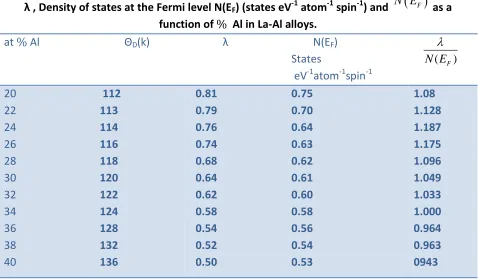
Available Online at www.ijpret.com 59 Table T1. Results of estimated Debye temperature θD(k), electron-phonon coupling parameter
λ , Density of states at the Fermi level N(EF) (states eV-1 atom-1 spin-1) and N E
F
as a function of Al in La-Al alloys.
at Al ΘD(k) λ N(EF)
States
eV-1atom-1spin-1
( F) N E 20 22 24 26 28 30 32 34 36 38 40 112 113 114 116 118 120 122 124 128 132 136 0.81 0.79 0.76 0.74 0.68 0.64 0.62 0.58 0.54 0.52 0.50 0.75 0.70 0.64 0.63 0.62 0.61 0.60 0.58 0.56 0.54 0.53 1.08 1.128 1.187 1.175 1.096 1.049 1.033 1.000 0.964 0.963 0943
Table T2. Results of residual resistivity r(0) (µ , zero-magnetic field transition
temperature Tco(k) ,
2 co T dH dT
(KGK-1), zero-temperature coherence length x(0) and N(E F)(I+1)
(state eV-1 atom-1 spin-1) at (µΩ cm) Tco (k) 2 co c T dH dt KGK-1
o Å N(EF) (λ+1)
Available Online at www.ijpret.com 60
34 36 38 40
194 196 200 205
3.38 3.27 3.20 3.17
-25.4 -36.8 -47.9 -53.4
67.3 69.5 71.4 73.9
1.05 1.03 1.00 0.996
These result have been given in table T1 and T2 along with residual resistivity
0
and zero –
field transition temperature Tc0,
slope of upper critical field
0
2
C
c
T dH
dT
.
Our theoretical calculation indicates that Debye temperature D increases with %A1
concentration in La-A1alloys.However the values of electron-phonon coupling parameter ,
Density of states at Fermi Level N E
F decrease of % Al concentration. The other evaluatedparameters like zero magnetic field coherence length (0) increase with increase of % A1 concentration in La-Alalloys .Our theoretical results are in good agreement with those of the earlier workers [20,21] and also with the experimental data [10].
In La-band amorphous alloy of Al change in Tc results mainly from changes in N E
F . Fromthe observed near constancy of I2/M2andI2 over a large concentration range it can be inferred that localized electronic states play a prominent role in the superconductivity mechanism. As far as the superconductivity in this amorphous alloys is concerned , the added element Al appear to act as diluting agent .It merely varying the La-La nearest-neighbour distance which affects the overlap integral among the atoms. In this amorphous alloy, we note that the structure is not a fundamental consideration. This is demonstrated by high pressure
works [22-25] on amorphous for which the Tc behaviour under pressure was qualitatively the
same as the behaviour of polycrystalline La and stoichiometric compounds like La Al La Ga3 , 3
and LaCu. Because of rather attractive oxidation properties of La-Al system, a tunnelling study with be useful in providing more definite information on the electron-phonon coupling strength in these alloys. It was shown by Bller [16] that f-like electron states at the Fermi surface can play in the superconductivity of transition metals. His detailed calculation are for 4d transition
Available Online at www.ijpret.com 61 the effects of d-f and possibly f-g scattering could be even more important in producing high Tc due to more advantageous positioning of the atomic f-orbital. However, in his view,
achievement of high Tc may not be possible for these materials because of exchange effects.
For La, in which such exchange effects are not expected, one believes that the unusually high Tc is consistent with Bulter’theory. Recent calculations [27-35] also reveal the same behaviour.
Conclusion: In this paper, Debye temperature D
, electron –phonon coupling parameter , density of states at the Fermi level N E
F as a function of Al in La-Al alloys werecalculated. The obtained results indicate that
D increases with % Al concentration but and
F N Edecreases with % Al concentration in La-Al alloys. The obtained results for zero
magnetic field coherence length
0 also increases with % Al concentration. The obtained theoretical results are in good agreement with the other theoretical workers [20-21] and also with experimental data10.Acknowledgement
I express my sincere thanks to Prof. L.K.Mishra (H.O.D. Department of Physics M.U. BODH-GAYA) for his valuable suggestion and discussion in this paper.
REFERENCES:
1. J. Wittig, C.Probst,and W. Wiedeman, in Low Temperature Physics LT-13, superconductivity , edited by K.D. Timmerhaus, W.J.O Sullivan, and E.F. Hammel (Plenum, New York), vol.3,p.491 (1974).
2. T.F.Smith, and H.L.Luo, J.,Phys.Chem. Solids, 28,569 (1967).
3. W.Wuhl, A.Eichler, and J. Wittig,.,Phys.Rev. Lett., 31, 1393 (1973).
4. J. Wittig, Comments Solid State Phys., 5, 13 (1974).
5. K. Andres, Phys. Rev., 168, 708 (1968).
6. C.C. Chao,H.L. Luo, and T.F. Smith, J.Phys.Chem. Solids. , 27 , 1555 (1966).
7. K.H.Bennemann, and J.W. Garland , AIP Conf. Proc.,4 , 103,(1972).
8. C.F. Ratto , B.Coqblin , and E.G. d’Agliano, Adv.Phys.,18 , 489 (1969).
9. W.L.Johnson ,S.J.Poon,and P.Duwez , Phys.Rev. b11 ,150 (1975)).
Available Online at www.ijpret.com 62 11. R.Koepke ,and G. Bergmann, Solid state Commun.,19 , 435 (1976).
12. C.Caroli, P.G. De Gennes, and J.Matricon ,Phys .Kond. Mater, 1 ,176 (1963).
13. L.P. Gorkov, Zh. Eksp. Teor.Fiz., 37, 1407 1959); Sov.Phys. JETP 10 ,998 (1960).
14. W.H.Shull and D.G. Naugle ,Phys. Rev.Lett.,39 ,1580 (1977).
15. W.L. McMillan Phys. Rev.B 167 ,331 (1968).
16. J.J.Jopfield , Phys.Rev., 186 ,443 (1969).
17. C.M.Varma and R.C. Dynes, in Superconductivity in d- and f- Band metals, edited by D.H.Gouglass (Plenun New York) ,p.507 (1976).
18. S. Barisic, J. Labbe ,and J. Friedel ,Phys. Rev. Lett.,25, 919(1970).
19. W.Hanke, J. Hafner, and H. Bilz,Phys .Rev.Lett.,37, 1560 (1976).
20. W.H.Bulter,Phys. Rev. ,B15, 5267 (1977).
21. G.Fasol,J.S.Schilling , and C.C. Tsuei ,Phys. Rev., 19 , 199(1979).
22. D.U.Guber , H.R.Off ,and K.Girgis ,Phys . Rev.,B 39, 272 (1989).
23. T.F.Smith, J.Low Temp. Phys., 36 ,171 (1990).
24. P.B.Allen, and R.C.Dynes , Phys .Rev., B40 ,92 (1990).
25. I.Nakayana ,J.Phys. Soc.Japan 63 ,1533 (1991).
26. W.H.Butler, Phys. Rev., B 40 ,5626 (1991).
27. T.Valla ,A.V.Fedorov, P.D. Johnson and S.L.Hublert , Phys . Rev. Lett.(PN) 83 ,2085 (1990).
28. N.Del Fatti, C.Voison , M.Aehermann and F.Vallu, Phys. Rev. B 61 ,16956 (2000).
29. B.Rethfeld, A. Kaiser, M.Vieaner and G.Simon, Phys. Rev. B 65,214303 (2002).
30. M.Merschdorf ,C.Kennerknecht and W.Pfeiffer , Phys. Rev. ,B 70 , 193401 (2004).
31. O.V.Misochko , M.V. Cebedev , H.Schafer and T. Dekorsm , J.Phys. Conden. Matter ,19 406220 (2007).
32. H.S.Jeevan , Z.Hosoani , D. Kasinathan and P. Gegenwart , Phys. Rev.,B 78, 052502 (2008) .
33. S.L.Johson, P. Beard, E.Vorobova , C.J. Milne and G.Ingold , Phys . Rev. Lett. (PN) 102 ,175503 (2009).