6426 PREPARATION AND EVALUATION OF AMBROXOL MICROSPHERE BY
EMULSIFICATION METHOD Dr. Ashish Dixit*, Jyoti Goswami
Translam Institute of Pharmaceutical Education & Research, Meerut 250001, Uttar Pradesh, India.
*Corresponding author E-mail:[email protected]
ARTICLE INFO ABSTRACT
Key Words
Sustained Release formulation of Ambroxol, Cross-linked microspheres,
Guar-gum.
.
Ambroxol is oral hypoglycemic drug which lowers blood glucose level and has been selected to prepare sustain delivery system.Microspheres enhancing oral protein or peptide delivery that facilitates the precise release of the desired amount of a component at the site of action and its reduction at non-targeted sites.
The present study is aimed to Prepare & Evaluate of Ambroxol Microsphere in which an attempt has been made to design and develop Ambroxol loaded microspheres using Guar-gum as release retarding polymers.Cross-linked microspheres of Guar-gum loaded with Ambroxol were successfully prepared by the emulsification method using Soybean oil in the external phase. Tween 80 used for wetting of Guar-gum.The formulations were optimized by Particle size, Shape and Surface Morphology, Drug-Polymer Interaction, Swelling Studies, Drug-Loading Capacity and Encapsulation efficiency in addition, In-vitro Drug Release Compatibility studies & FT-IR study was done.
INTRODUCTION
Sustained release dosage forms are designed to release a drug at a predetermined rate in order to maintain a constant drug concentration for a specific period of time with minimum side effects. Hydrophilic polymer matrix is widely used for formulating a Sustained dosage form. Continued issue drug delivery system had the intended to attain a protracted the therapeutically result of continuing the discharging medicine at the over an extends the age of the time after the administrations of a only dose. Different methods such as issue system, solvent release system, release n diffusion system, ion exchange resin for pharmaceutical complexes, pH-based design n osmotic
pressure methods. Oral administration has some potential advantages such as continuous release speed and maintenance of plasma doses. A sustainable discharge formulation contains some candles or a flammable polymer or both that control the issue rates. The usage of the tank method is also known as relief speed.
The advantages of sustained release drug delivery system:
1. It reduced local and systemic side effects& reduced gastrointestinal irritation.
2. The quality of drug utilization reduction in the total value of drug used.
6427 3. Improved efficiency in treatment,
optimized therapy, more uniform blood concentration.
4. Reduction of variation in drug level and hence more uniform pharmacological response,cure off control of condition more quickly &less reduction in drug activity with chronic use.
5. Increased patient compliance, less frequent dosing, decrease patient care time, decrease night-time dosing, reduced patient care time. The importance of patient compliance in successful drug therapy is well known. It has been found that there is an oppositeaffiliation between the number of dosages per day and the compliance rate.
6. Even if the initial unit cost of sustained release products is usually greater than that of conventional dosage forms because of the unique nature of these products, the average charge of treatment over an extended time period may be less. The economy may also result from a decrease in nursing time and hospitalization time.
Disadvantages of The Sustained Drug Delivery System:
1. Decrease systemic availability as per comparison of immediate release dosage forms, which be may arise due to uncompleted release, increased the first-pass metabolism action, increased instability &specific site absorption etc.
2. Recovery of drug difficulties in the case of the toxicity or hypersensitivity reactions.
3. Reduced probable for dose adjustments of drugs, normally administered in changeable strengths. 4. If there are requires immediate change
during the therapy or if any significant adverse effect is noted and on time termination of therapy is needed, Sustained drug release does not permit immediate termination of therapy.
5. First pass clearance is increased potential.
6. In the case of the accidental failure of the product effects, antidote may be complicated to use.
Ambroxol is an active metabolite of Bromhexine a mucolytic. It is chemically described as trans-4-[(2-Amino-3, 5-dibromobenzyl) amino]-cyclohexanol. It is an expectoration improver and a mucolytic agent used in the treatment of acute and chronic disorders characterized by the production of excess or thick
mucus(Shabbeeret al.).
Ambroxolissolublein methanol, sparingly soluble in water, practically insoluble in dichloromethane.
The half–life of Ambroxol drug is 3-4 hours and their bioavailability is 70-80% after oral administration. Due to its short half-life it has to be taken 3-4 times daily which challenges patient compliance. To formulate the drug in sustained drug delivery system may overcome the problem.It should never be served along with antitussives.
Chemical Structure of Ambroxol:
Molecular formula of Ambroxol Hydrochloride is C13H18Br2N20, melting point is233- 234.50C&Class II (low solubility, high permeability) in BCS Classification System.
Pharmacodynamics of Ambroxol Hydrochloride:
Ambroxol is an agent having mucolytic property which is systematically active, when it is administered orally its onset of action occurs after about 30 minutes the
breakdown of acid
mucopolysaccharidefiber having the role to make it thinner viscosity of sputum and decreases its viscosity too resulting easily removal of sputum although The volume
6428 decreases eventually during coughing
mostly remains low if the treatment maintained longer.
Pharmacokinetics of Ambroxol Hydrochloride:
Ambroxol hydrochloride is absorbed rapidly approximate (70-80%) after its oral administration. It takes approximate 2 hours to reach it Peak plasma concentration.It’s distribution half-life-1.3 hours. It’s metabolite is Di bromoanthranilic acid which have unspecified activity. It is excreted primary through the kidneys, the rate of renal Clarence having approximate value 53 ml/minute and approximate value for dose that remains unexcreated in the urine is 5-6%.The Ambroxol hydrochloride having tits elimination half-life biphasic in nature and the half-life is of 1.3 hoursand a beta half-life of is 8.8 hours.90 % dose of Ambroxol excreted after the body in urine in the system of metabolites and 10 % remains unchanged.Ambroxol having ability to cross blood-brain, placental fences and it is expelled in breast milk.
Adverse Side Effect of Ambroxol Hydrochloride:
Ambroxol can be tolerated. It causeHeadache, Nausea, and gastrointestinal disorders
Other toxic and harmful effects like eye frustration, skin annoyance, breathing tract frustration.Administration of large doses can produce gastrointestinal tract irritation with decrease in motility rate or constipation, development of ulcer or bleeding from stomach or duodenum & peritonitis.Also Affect behavior/CNS (convulsions,convulsions,tremor, ataxia & somnolence) respiration (respiratory stimulation, dyspnoea) the liver blood (change in the white blood cell count) the urinary system.
Microspheres: The microspheres were spherical in shape, by which the drug stayed dispersed in the polymer matrix at
the amorphous state. Differential scanning calorimetric, Scanning electron microscopy (SEM) and in vitro dissolution studies were performed and characterize the microspheres. The main objective of the present study was the development and evaluation of anti-infective microspheres, containing cephalexin & using various mucoadhesive polymers for the prolonged absorption. The micronpapulation process is based on Ionic Chelation Technique, that involves alginate polymers alone and/or in combination with the other mucoadhesive polymers. Types of Microsphere are Bio-adhesive
microspheres, Magnetic
microspheres,Floating microspheres, Radioactive microspheres &Polymeric microspheres.
Experimental Work Materials
Ambroxol was obtained as a gift sample from Shree Krishna India. Other substances used were all of analytical grade.
Preparation of Guargum microsphere by emulsification method:
A guar-gum microsphere was prepared by using the modified emulsification method.
6429 Evaluation of Microsphere:
Formula optimization: In formulation,firstly required tooptimized the concentration of guar-gum from the 1.0, 1.5 and 2.0 %(w/w).It could influence the preparation and properties of the microspheres were identified and optimized to obtained smooth surface, small, discrete, uniform and spherical microspheres. The process variables included stirring speed: 2000 RPM; stirring time: 1 hour, 2 hours, 3 hours, 4 hours, 5 hours; and temperature of the system: 350C.
Particle size: The microsphere size distribution was determined by the optical microscopy method used a calibrated stage micrometer (μm) and was calculated by using following equation (1);
Eye piece division = Y × least count (1)
X
Where,
Y= number of stage micrometer division X = number of eye piece divisions Shape and Surface Morphology: The shape and surface morphology of microspheres were evaluated by using scanning electron microscopy. Samples were prepared by lightly sprinkling the microsphere powder on a double adhesive tape in scanning electron microscopy, which jammed to an aluminum stub and
coated the stubs with gold to a thickness of ~300 Å using a sputter coater and click photographs of samples.
Figure 1: showing photomicrograph of placebo guar-gum microspheres
Figure 2: showing SEM of placebo guar-gum microspheres
Drug-Polymer Interaction: The equilibrium dialysis technique was used to determine the amount of interaction of the drug with the polymer. Weigh 11 mg of Ambroxol Hydrochloride (eq.to 10 mg of Ambroxol) dissolved in phosphate-buffer (pH 6.8), and prepared 2.0% wt/wt solution of polymer with continuous stirring of the polymer in the drug solution for 1.5 hours. 10 ml of Polymer solution containing 10 mg of the Ambroxoland this solution introduced to a moistened cellulose dialysis tube (donor compartment) that suspended in 200 ml of phosphate-buffer (pH 6.8) (recipient
compartment) and gently stirred using a magnetic stirrer at 370C for 4 hours, After the 4 hours withdrawn 2 ml of sample from the recipient compartment and diluted with Phosphate (pH 6.8). Measure the absorbance of sample at 244 nm using spectrophotometer A control medium was created using pure polymer solution. The extent of drug-polymer interaction (β) was expressed by the ratio of Sb to StasEq. (2):
βǀ =Sb = (St - Sf )(2) St (ST- SR)
6430 Sb and St = the amount of bound drug
molecules in the donor compartment and the total Amount of drug used
St = amount of drug in the donor compartment after equilibrium is accomplished,
SR= amount of drug in the receptor compartment after equilibrium is accomplished.
Sf= amount of free drug in the donor compartment.
Swelling Studies of Microspheres: Preparation of Simulated Gastric fluid:Weigh and transfer about 2.0 g of Sodium chloride, 3.2 g of purified pepsin (derived from procine stomach mucosaof 800 to 2500 units per mg of protein), add 7.0 ml of concentrated hydrochloric acid and add250 ml water and dissolved and make up the volume up to 1000 ml and adjust Ph to 1.2 of resulting solution. Weigh and transfer about 100 mg of guar-gum microspheres in simulated intestinal fluid (SIF) (pH 6.8) and allowed to swell upto a constant weight. The microspheres were removed and filter with filter paper, and measured their changed weight as Eq. (3).
α = Wg – Wo ×10(3)
Wo
Where,
α = Degree of swelling, Wo= Initial weight of the microspheres , Wg= Weight of the microspheres at equilibrium swelling in the medium.
Drug-Loading Capacity and Encapsulation Efficiency: Loading capacity is the maximum amount of drug that can be added in the microspheres. Loading capacity determined by estimating the maximum amount of Ambroxol obtained in 50 mg of microspheres. The amount of encapsulated drug added in microspheres formulation is known as Encapsulation efficiency. Encapsulation
efficiency calculated as the ratio of drug in the final formulation to the amount of added drug. Weigh and dispersed 50 mg of microspheres formulation in 100 ml of distilled water. Resulting solution sonicate for 3 repeated periods of 5 minutes each, with 5 minutes resting period for each. Allow to stand for 24 hours at room temperature forequilibration.After 24 hours, centrifuged at 3000 rpm for 15 minutes and diluted supernatant with water and analyzed for concentrations of Ambroxol using UV spectrophotometeras Eq. (4)&(5).
Entrapment efficiency = weight of drug – weight of free drug × 100(4)
Weight of drug added: Loading Capacity = weight of drug – weight of free drug × 100 weight of microsphere
Drug Release Studies: Ambroxol release study was performed by diffusion method using Franz diffusion cell & Phosphate buffer saline pH 7.4.
Treatment of diffusion membrane: The dialysis bag is treated by boiling the membrane in 2% sodium bicarbonate solution. Then wash the membrane with distilled water. Further the membrane is treated with boiling 2% EDTA solution. Rinse the membrane 2-3 times with distilled water. The membrane was placed in such a way that one side exposed to the donor compartment, while the other side was bathed with the PBS (pH 7.4). The contents of the receptor compartment stirred with magnetic stirrer. The temperature of this solution was maintained at 37oC using circulating water bath.
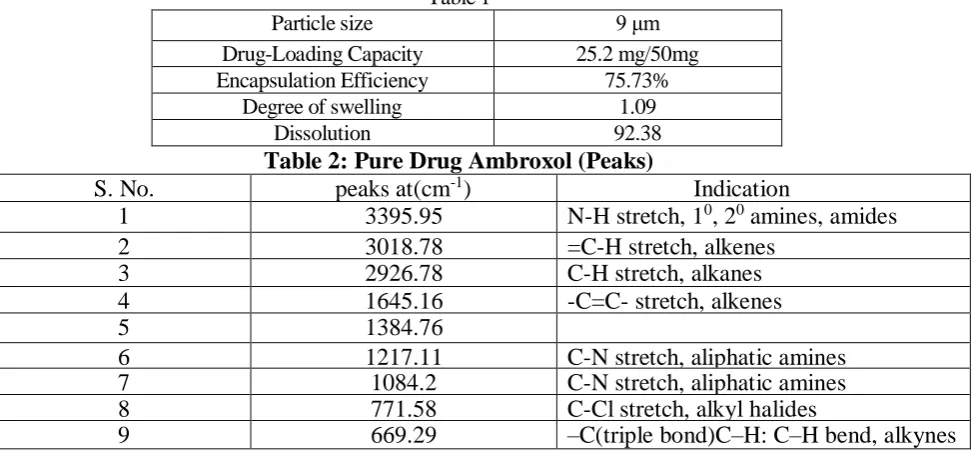
6431 Table 1
Particle size 9 μm
Drug-Loading Capacity 25.2 mg/50mg Encapsulation Efficiency 75.73%
Degree of swelling 1.09
Dissolution 92.38
Table 2: Pure Drug Ambroxol (Peaks)
S. No. peaks at(cm-1) Indication
1 3395.95 N-H stretch, 10, 20 amines, amides
2 3018.78 =C-H stretch, alkenes
3 2926.78 C-H stretch, alkanes
4 1645.16 -C=C- stretch, alkenes
5 1384.76
6 1217.11 C-N stretch, aliphatic amines
7 1084.2 C-N stretch, aliphatic amines
8 771.58 C-Cl stretch, alkyl halides
9 669.29 –C(triple bond)C–H: C–H bend, alkynes
Table 3: Ambroxol + Guar-gum FTIR spectrum (Peaks)
S. No Peaks at Indication
1 3399.63 N-H stretch, 10, 20 amines, amides
2 1644.66 -C=C- stretch, alkenes
3 1384.73
4 1084.25 C-N stretch, aliphatic amines
Table 4: IR Interpretations for Ambroxol Drug + Polymer
Peak Name X Y X Y
9 669.29 48.79 --- ---
8 771.58 27.93 --- ---
7 1084.2 43.18 --- ---
6 1217.11 39.77 --- ---
5 1384.76 41.26 --- ---
4 1645.16 43.87 1084.25 43.87
3 2926.43 46.24 1384.73 41.47
2 3018.78 46.08 1644.66 44.05
1 3395.95 42.68 3399.63 43.18
6432 Figure 4: FTIR spectrum of Ambroxol +guargum
Figure 5: Graph Dissolution percentage cumulative drug release from glutaraldehyde cross-linked Microsphere (B1, B2 & B3 Batch)
To ensure intimate contact between diffusion membrane and the receptor solution. After suitable dilution i.e. 1ml of sample withdrawn from the receptor compartment is diluted to 10 ml with buffer solution. Further 1 ml is taken from it and again diluted to 10 ml with buffer solution. In this way all the samples are diluted and the absorbance was recorded at 244 nm spectrophotometrically against the blank solution PBS (pH 7.4). The observations are recorded as Eq. (6), (7) &
(8). Absorption=
(Slope)x(Concentration)+Intercept[Obtain ed from Calibration Curve](6)
Cumulative Drug Release = Conc.×Vol. of Dissolution Medium x Dilution Factor(7) 1000
% Cumulative Drug Release = Cumulative Drug Release x 100(8)
Dose of Drug
Drug Loading Capacity and Encapsulation Efficiency: Encapsulation efficiency was calculated as the ratio of the weight of Ambroxol content in the final microspheres and the Ambroxol (50 mg)introduced in the process. Present encapsulation efficiency, increased upto 22.9 with increasing polymer concentration up to 1.5%.
In-vitro Drug Release: PBS (pH 7.4) was used in the receptor compartment of Franz
0.00 0.20 5.79
12.14 20.26 23.82
23.82 23.82
0.00
3.76 7.64
39.56
72.07
90.35 91.87 92.38
0.00
3.50 7.57
22.55
38.55
50.23
58.61 60.39
-20.00 0.00 20.00 40.00 60.00 80.00 100.00
0 20 40 60 80 100 120
P
e
r
c
e
n
t
C
u
m
u
lati
v
e
D
r
u
g
R
e
le
as
e
(%
)
Time (min) Dissolution Study
Series1
Series2
6433 diffusion cell. Sample (1ml) were
withdrawn at the time intervals of 0, 1 hour,2 hours…. up to 8 hours and 24 hours from the receptor solution, which was replaced immediately with the same volume of the fresh elution solution to keep the volume in the receptor compartment constant and to ensure intimate contact between diffusion membrane and the receptor solution. After suitable dilution i.e. 1ml of sample withdrawn from the receptor compartment is diluted to 10 ml with buffer solution. Further 1 ml is taken from it and again diluted to 10 ml with buffer solution. In this way all the samples are diluted and the absorbance was recorded at 244 nm spectrophotometrically against the blank solution PBS (pH 7.4).
RESULT & DISCUSSION:
Characterization of Ambroxol Microsphere in shown by Table 1 by the characterization by Particle size, Degree of swelling & Dissolution.
Compatibility studies (FTIR studies): The compatibility study performed by IR spectrum of API and physical mixture of API and polymer (1:1), studied making a KBr disc. The characteristic absorption peaks of Ambroxol obtained at different wave numbers in different samples. The obtained peaks in the spectra of each formulation correlate with thedrug spectrum peaks. It indicates the compatibility of drug with formulation. The spectra for all formulations are shown below. The scanning range and resolution were 450- 4000 cm-1 and 4 cm-1, respectively (Soni et al)
In vitro Drug release: The percent cumulative drug release of microspheres was found to be B1batch 23.82%, B2 batch was found to be 92.38% and B3 batch was found to be 60.39% but duration of drug release B2 batch was high cumulative drug release from B3 and B1 Batch because B2 batch increase in polymer concentration. Drug release of microsphere micro particles is Achieved sustained delivery of ambroxol. Drug
release is the result B2 batch 92% cumulative drug release into achieved sustained delivery of ambroxol drug.
CONCLUSION:
In present research to design and develop Ambroxol loaded microspheres using Guar-gum as release retarding polymers. Among the various formulations prepared, formulation B2 with drug-polymer ratio 1:1 showed similar drug release profiles (B2= 92.38%) as that of the commercial formulation studied. The release of drug from the guar-gum formulations containing microcrystalline cellulose was found to be governed by diffusion controlled process.
ACKNOWLEDGMENT: Authors are thankful to Management of Translam institute of pharmaceutical education and research, Meerut.
REFERENCES:
1. David Train,“Some aspects of the angle of repose of the powders.” Journal of Pharmacy and pharmacology,no.10 (1958): 127T-135T.
2. Smith H.A, (1960) Evanson R.V and Sperandio G.J, J.Am Pharm Assoc, Sci Ed, 49:94-97.
3. H.Lapidus and N.G Lordi,“Drug release from compressed hydrophilic matrices” Journal of Pharmaceutical Sciences,no.57 (8) (1968): 1292-1301
4. Chien YW andH J.
Lambert,“Solubilization of steroids by multiple co-solvent systems.”Chem Pharm Bull,no.23 (1975):1085-90.
6434 subcutaneous release of
norgestomet from
hydrophilicimplants.”J Pharm Sci., no. 65 (4) (1976):488-92.
6. Kondo, A., (1979) Microcapsule processing and technology. 1st ed. New York: Marcel Dekker; pp. 54-88.
7. Deasy, PB,
(1984) Microencapsulation and related drug process. 1st ed. New York:
Marcel Dekker; pp. 34–55.
8. Martin. A., (1993) Physical Pharmacy, 4th Edn, B, I Waverly, New Delhi, 480-481.
9. J.L. Ford, M.H.Rubinstein and J.E.Hogan, “Formulation of sustained-release promethazone hydrochloride tablets using HPMC matrices”. International Journal. Pharmacy,no.24, (1995). 327-338.
10.Peters, K., Mu¨ ller, R. H., “Nanosuspensions for the oral application of poorly soluble drugs. In: Proceedings European Symposium on Formulation of Poorly-availableDrugs for Oral Administration”. APGI, Paris,(1996): PP 330–333.
11.B.R. Mathews,“Regulatory aspects of stability testing in Europe”, Drug Development Indian Pharma. 25(1999):831-856.
12.Abraham Rubinstein. "Natural polysaccharides as targeting tools of drugs to the human colon",
Drug Development