Available Online At www.ijpret.com
INTERNATIONAL JOURNAL OF PURE AND
APPLIED RESEARCH IN ENGINEERING AND
TECHNOLOGY
A PATH FOR HORIZING YOUR INNOVATIVE WORK
“SEISMIC ANALYSIS OF RC FRAME WITH SOFT GROUND STOREY”
AMIT S. GAWANDE
Department of civil engineering, College of Engg. & Tech. Akola
Accepted Date:
27/02/2013 Publish Date:
01/04/2013
Keywords
Analysis
Frame
Storey
Corresponding Author
Mr. Amit S. Gawande
Abstract
Now a day’s Reinforced concrete frame buildings are common
used in India with a ground storey as parking purpose called
open ground storey buildings. The first storey become soft and weak relative to the other upper storeys, Structurally those
unbalances are unhealthy. It is necessary to study to examine various alternative models of reinforced concrete moment
resisting frame building with open first storey & unreinforced
to promote safety without too much changing the concrete structures. This study focuses on the seismic performance of
soft-first-storey buildings. Multistoried buildings with soft ground floor subjected to dynamic earthquake loading. The
aim of this paper was to investigate the seismic performance
Available Online At www.ijpret.com 1. INTRODUCTION
Reinforced concrete (RC) frame buildings
are becoming increasingly common in
urban India. Many such buildings
constructed in recent times have a special
feature - the ground storey is left open for
the purpose of parking (as shown in figure) ,
i.e., columns in the ground storey do not
have any partition walls (of either masonry
or RC) between them. Such buildings are
often called open ground storey buildings
or buildings on stilts. Open first storey is
now a day’s unavoidable feature for the
most of the urban multistory buildings for
vehicle parking, shops, reception etc. The
first storey become soft and weak relative
to the other upper storeys, since the first
stories are composed of only the columns
and upper storeys are divided by the rigid
walls. Structurally those unbalances are
unhealthy and the soft first storey buildings
are well known for being susceptible to
collapse through past big earthquakes (for
example during 1999 Turkey, 1999 Taiwan,
2001 Bhuj and 2003 Algeria earthquakes).
The most frequent failure mode of
reinforced concrete (R.C.) moment frame
buildings is the so called "soft storey"
mechanism. It consists in a localization of
buildings seismic deformations and rupture
in the bottom storey of the building. This
phenomenon is caused by the fact that the
overall
shear force applied to the building by an
earthquake is higher at the base.
Figure 1: Ground storey’s of reinforced
concrete Buildings are left open to facilitate
parking
Definition :- (according to IS 1893 part I:
2002)
Soft Storey
A soft storey is one in which the lateral
stiffness is less than 70 percent of that in
the storey above or less than 80 percent of
average lateral stiffness of the three
storey’s above.
Available Online At www.ijpret.com A extreme soft storey is one in which the
lateral stiffness is less than 60 percent of
that in the storey above or less than 70
percent of average lateral stiffness of the
three storey’s above. The presence of walls
in upper storey’s makes them much stiffer
than the open ground storey. Thus, the
upper storey’s move almost together as a
single block, and most of the horizontal
displacement of the building occurs in the
soft ground storey itself. Thus, such
buildings swing back-and-forth like inverted
pendulums during earthquake shaking (see
figure), and the columns in the open ground
storey are severely stressed (see figure). If
the columns are weak (do not have the
required strength to resist these high
stresses), they may be severely damaged
which may even lead to collapse of the
building
The main aim of this study is to examine
various alternative models of same
einforced concrete moment resisting frame
building with open first storey &
unreinforced brick infill in the upper storey
for their empirical & analytical fundamental
natural periods as well as the stiffness of
open first store in relation to the stiffness of
upper storey by using ETABS analysis
package. The objective of the work is to
promote safety without too much changing
the constructional practice of reinforced
concrete structures
2. LITERATURE REVIEW
The various literature is collected from
books, magazines and websites. From this
literature data is summarized for work.
Abstracts of collected literatures are as
Available Online At www.ijpret.com Arlekar, Jain and Murty [1]
This paper highlights the importance of
explicitly recognizing the presence of the
open first storey in the analysis of the
building. The error involved in modeling
such buildings as complete bare frames,
neglecting the presence of infill in the upper
storeys, is brought out through the study of
an example building with different
analytical models. This paper argues for
immediate measures to prevent the
indiscriminate use of soft first storeys in
buildings, which are designed without
regard to the increased displacement,
ductility and force demands in the first
storey columns. Alternate measures,
involving stiffness balance of the open first
storey and the storey above, are proposed
to reduce the irregularity introduced by the
open first storey. In this paper, stiffness
balancing is proposed between the first and
second storey of a reinforced concrete
moment-resisting frame building with open
first storey and brick infill in the upper
storeys. A simple example building is
analyzed with different models. The
stiffness effect on the first storey is
demonstrated through the lateral
displacement profile of the building, and
through the bending moment and shear
force in the columns in the first storey
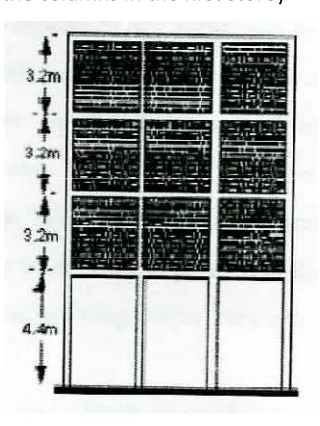
fig. Elevation of building model considered
in this study
Nagae, Suita, Nakashima [2]
This study focuses on the seismic
performance of soft-first-storey buildings,
which are demanded specially in urban
areas. Six-story reinforced concrete
buildings are focused on, and the seismic
response of the soft-first-storey structures
and typical frame structures are statistically
assessed based on the results of dynamic
response analyses. The mean annual
Available Online At www.ijpret.com ratio exceeding the specified value is
computed, and the mean annual
frequencies for the plural values are shown
as a seismic hazard curve for each case.
Eventually the probabilities of the
maximum interstorey drift ratios
exceedingsafety limit states are computed
and compared. The soft-first-story buildings
with the yield strength coefficient of more
than 0.7 showed the same level of safety in
comparison with typical frame structures,
on the condition that the same deformation
capacities are given to the main structural
members.
S.Haque, Khan Mahmud Amanat [3]
In the present paper, an investigation has
been performed to study the behavior of
the columns at ground level of multistoried
buildings with soft ground floor subjected
to dynamic earthquake loading. The
structural action of masonry infill panels of
upper floors has been taken into account by
modeling them as diagonal struts. Finite
element models of six, nine and twelve
storied buildings are subjected to
earthquake load in accordance with
equivalent static force method as well as
response spectrum method. It has been
found that when infill is incorporated in the
FE model, modal analysis shows different
mode shapes indicating that dynamic
behavior of buildings changes when infill is
incorporated in the model. Natural period
of the buildings obtained from modal
analysis are close to values obtained from
code equations when infill is present in the
model. This indicates that for better
dynamic analysis of RC frame buildings with
masonry walls, infill should be present in
the model as well. Equivalent static force
method produces same magnitude of
earthquake force regardless of the infill
present in the model. However, when the
same buildings are subjected to response
spectrum method, significant increase in
column shear and moment as well as total
base shear has been observed in presence
of infill. In general, a two fold increase in
base shear has been observed when infill is
present on upper floors with ground floor
open when compared to the base shear
given by equivalent static force method.
The study suggests that the design of the
columns of the open ground floor would be
Available Online At www.ijpret.com moment twice the magnitude obtained
from conventional equivalent static force
method. Study of the sway characteristics
also reveals significantly high demand for
ductility for columns at ground floor level.
Presence of in filled wall on upper floors
demands significant enhancement of
column capacity or ductility to cope up with
increased sway or drift.
Samir Helou & Abdul Razzaq Touqan |4]
This paper illustrates the importance of the
judicious distribution of shear walls. The
selected building is analyzed through nine
numerical models which address the
behavior of framed structures. The
parameters discussed include, the
fundamental period of vibration, lateral
displacements and ending moment. It is
noticed that an abrupt change in stiffness
between the soft storey and the level above
is responsible for increasing the strength
demand on first storey columns. Extending
the elevator shafts throughout the soft
storey is strongly recommended.
Tuladhar and Kusunoki [5]
The aim of this paper was to investigate the
seismic performance and design of the
masonry infill reinforced concrete fame
structure with the soft first storey under a
strong ground motion. The study also
highlighted the error involved in modeling
of the RC frame buildings as completely
bare frame neglecting stiffness and strength
of the masonry wall in the upper floors.
The attempt was made to determine the
strength increasing factor to account the
effect of the soft storey through various 2D
analytical models using capacity spectrum
method and established its relationship
with initial stiffness ratio. In this study, the
non linear dynamic time history analysis
was also carried out with a 3D practical
model in order to verify the proposed
strength increasing factor.
Yong Lu,Tassios, Zhang and Vintzileou |6]
Two six-story, three-bay, reinforced
concrete frames, one having a tall first
story, and the other a discontinuous interior
column, were designed in accordance with
Eurocode 8, and their models were
constructed and tested on an earthquake
Available Online At www.ijpret.com investigation were to study the structural
effects of these particular irregularities and
to check the relevant design code
provisions. During tests, Frame having tall
first storey performed in a reasonably
regular manner. For discontinuous interior
column frame , the response during
moderate earthquakes was strongly
influenced by the increased flexibility in the
direction towards the missing column side,
combined with the gravitational effects on
the suspended beam spans. The response
of discontinuous interior column frame to
strong earthquakes was dominated by an
apparent soft first-story mechanism. Both
frames exhibited a weakness at the fifth
story where discontinuity in stiffness
occurred. A base shear over strength factor,
with respect to the design required base
shear, approximately of the order of three
and two, was achieved for tall first storey
frame and discontinuous interior column
frame, respectively.
R.K.L. Su [7]
A literature review has been conducted
aimed at improving the general
understanding of the seismic response of
concrete buildings with transfer structures
in low-tomoderate seismicity regions. This
paper summarizes and discusses the
existing codified requirements for transfer
structure design under seismic conditions.
Based on the previous shaking table test
results and numerical findings, the seismic
effects on the inelastic behaviors of transfer
structures are investigated. The
mechanisms for the formation of a soft
storey below transfer floors, the abrupt
change in inter-storey drift near transfer
storey and shear concentration due to local
deformation of transfer structures are
developed. Design principles have been
established for controlling soft-storey type
failure and minimizing shear concentration
Available Online At www.ijpret.com structures. The influence of the vertical
positioning of transfer floors on the seismic
response of buildings has also been
reviewed.
Yong Lu [8]
In this paper a comparative study of the
nonlinear behavior of reinforced concrete
(RC) multistory structures is carried out on
the basis of measured response of four
six-story, three-bay framed structures, namely
a regular bare frame, a
discontinuous-column frame, a partially masonry-infill
frame and a wall-frame system. The
structures were designed for seismic
requirements in accordance with Eurocode
8 and their models were subjected to
similar earthquake simulation tests.
Experimental observations and numerical
analyses show that the distribution of the
story shear over strength is a rather stable
indicator of the general inelastic behavior of
frames and hence can be employed as a
characteristic parameter to quantify the
frame irregularity for design purposes.
Abrupt discontinuity of the geometry or
arrangement of structurally effective
elements, where unavoidable, may be
compensated by strength enhancement
targeting a smoothed over strength profile
to allow for distributed inelastic
deformation, and this principle applies as
well to nominiformly masonry infill frames.
For the wall-frame system, adequate
countermeasures against rocking of the RC
wall is shown to be a key to maintaining the
effectiveness of the system at advanced
inelastic response
Available Online At www.ijpret.com In the present paper natural frequency of a
seven storey reinforced concrete frame
structure with open stilt floor were
determined by monitoring its ambient
vibrations using a triaxial seismometer and
the results were compared with those of
the analytical models. The framed structure
was modeled as bare frame, frame with
floor slabs and with staircase to determine
most appropriate model to predict its
natural frequencies and thereby its seismic
behaviour. The effective modulus of
elasticity of concrete to be used in the
analysis was obtained by matching the
experimental and analytical values. The
contribution of staircase and lift well in
sharing the lateral force was also
investigated, particularly in the sensitive
stilt floor. Suggestions to improve the
performance of the building by introducing
additional structural elements at stilt floor
level without affecting parking
requirements are also included.
03. OBJECTIVES
Following are some objectives of this
dissertation work.
1. To promote safety without too much
changing the constructional practice of
reinforced concrete structures.
2. The main objective of this dissertation is
to focused on the behaviour of RC frame
building with soft first storey during
earthquake.
3. To investigate appropriate model for
resisting earthquake effect.
4. To analyze the performance of RC frame
in relation to the storey stiffness,
fundamental natural periods, storey drift,
bending moment and shear force by using
equivalent static analysis method and
multimodal dynamic analysis using standard
package of ETABS.
5. To investigate the soft storey behaviour
of RC frame building so as to arrive at
suitable practical conclusion for achieving
earthquake resistant RC frame building.
6. The following parameters will be
investigated in the proposed studya) The
effect of beam size at first floor level for
realizing soft storey and extreme soft storey
criterion as per IS 1893 (Part I) 2002.
b) The effect of change in column size and
direction of placement in the first storey
Available Online At www.ijpret.com c) The effect of introduction of shear walls
in the stilt floor including study of
importance of the selection of the location
of shear walls in practice.
04. SCOPE OF THE WORK
Open first storey is a typical feature in the
modern multistory constructions in urban
India. Such features are highly undesirable
in buildings built in seismically active areas.
I In normal practice, only the load due to
masonry is considered, and do not consider
the . composite action. This work might be
helpful to consider this action and reduce
the bending moments in beams supporting
the masonry infill. It will be interesting if the
comparison made between the provisions
of the codes of other countries and
provisions of Indian code. 12
REFERENCES
1. Jaswant N. Arlekar, Sudhir K. Jain and
C.V.R. Murty, "Seismic Response of RC
Frame Buildings with Soft First Storeys"
Proceedings of the CBRI Golden Jubilee
Conference on Natural Hazards in Urban
Habitat, 1997,' New Delhi.
2. Takuya Nagae, Keiichiro Suita,
Masayoshi Nakashima, "Performance
Assessment for Reinforced Concrete
Buildings with soft first stories" Annuals of
Disas.Res.Inst,Kyoto Univ.,No.49C, 2006,pp
189-196.
3. Sharany Haque, Khan Mahmud Amanat,
"Seismic Vulnerability of Columns of RC
Framed Buildings with Soft Ground Floor"
International Journal of Mathematical
Models And Methods In Applied Sciences,
Issue 3, Volume 2,2008, pp 364-371.
4. Samir Helou and Abdul Razzaq Touqan,
"Dynamic Behavior of RC Structures With
Masonry Walls" An-Najah Univ. J.
Res.(N.Sc.), Volume 22, 2008, pp 77-92.
5. Prakirna Tuladhar and Dr.Koichi
Kusunoki, "Seismic Design Of The Masonry
Infill RC Frame Buildings With First Soft
Storey"
6. Yong Lu, T. P. Tassios, G.-F. Zhang, and
Elizabeth Vintzileou, "Seismic Response of
Reinforced Concrete Frames with Strength
and Stiffiiess Irregularities", ACI Structural
Journal Technical Paper, Volume 96, No. 2,
Available Online At www.ijpret.com
7. R.K.L.Su, "Seismic Behaviour of Buildings
with Transfer Structures in Low-to-
Moderate Seismicity Regions" EJSE Special
Issue Earthquake Engineering in the low and
moderate seismic regions of Southeast Asia
and Australia, 2008, pp 99-109.
8. Yong Lu "Comparative Study of Seismic
Behavior of Multistory Reinforced Concrete
Framed Structures" Journal of Structural
Engineering, Volume 128, No. 2, February
2002, pp 169-178.
9. M.Koti Reddy, D.S.Prakash Rao and
A.R.Chandrasekaran, "Modeling of RC
Frame Buildings With Soft Ground Storey",
The Indian Concrete Journal, Volume 81,
No. 10, October 2007, pp 42-49.
10. C.V.R.Murty, "Why Are Open Ground
Storey Buildings Vulnerable In
Earthquakes", Indian Institute of
Technology Kanpur, Earthquake tip
21,December 2003.
11. IS 1893 (Part 1 ):2002, "Criteria For