ISSN:2230-7346 Available online http://WWW.JGTPS.COM
Research Article
Journal of Global Trends in Pharmaceutical Sciences
Vol.2, Issue 1, pp -31-42, January–March 2011
FORMULATION AND IN VITROEVALUATION OF FLOATING ALGINATE GEL BEADS FOR
SITE SPECIFIC DELIVERY OF ACYCLOVIR
M.D. Raja1, Narra Kishore1, U. M. Dhanalekshmi1, C. Senthil kumar 2, G. Rangaraj2, P. Neelakanta Reddy1, T.S. Uma1, P. K. Sehgal1
1. Bio-products Laboratory, Central Leather Research Institute, (Council of Scientific and Industrial Research), Adyar, Chennai-600020, India.
2. Department of Pharmaceutical Technology, Anna University of Technology Tiruchirappalli, Tiruchirappalli- 620024, India
Corresponding author E-mail: [email protected] ABSTRACT
Acyclovir, an antiviral drug has low oral bioavailability of about 15-30%. It shows more absorption in the upper gastro intestinal tract. The main objective of this study is to evaluate the potential of floating alginate beads as a drug carrier for acyclovir to prolong gastric residence time of drug in its absorption window. Floating beads were prepared from sodium alginate solution containing CaCO3as gas-forming agent. In order to overcome the limitation of
treated beads prepared with alginate & guar gum not only showed improved percentage drug loading, it also exhibited sustained drug release in the pH 1.2. So these floating alginate beads may act as a promising carrier for acyclovir to improve its oral bioavailability.
KEY WORDS: Floating alginate beads, Acyclovir, Sodium Alginate, ionic gelation method; controlled release
INTRODUCTION:
Gastric residence time (GRT) is an important factor affecting the drug bioavailability of dosage forms.[1] Because of the short gastric emptying time, number of drug delivery systems are suffering with the low drug release in its absorption window that ultimately leads to scarce bioavailability of the administered dose. Gastro retentive systems are the current approach to overcome the above problem of GRT. Among the number of approaches floating drug delivery system (FDDS) is one of the promising delivery system which has a lower density than gastric fluids and thus remains buoyant in the stomach without affecting the gastric emptying rate for a prolonged period of time. While the system is floating in the gastric content the drug is released slowly from the system at a desired rate which could leads to increase in absorption of drugs at their absorption window site.[2,3] Moreover FDDS is more suitable to those drugs that has absorption
window in the stomach or in the upper small intestine.[4]
FDDS is classified as effervescent and non effervescent systems include carbon dioxide gas-forming agents (carbonate or bicarbonate compounds) [5], highly swellable hydrocolloids [1,6], Multiple unit systems [7,8], and hollow systems prepared by solvent evaporation methods.[9]
Acyclovir [9-(2-hydroxyethoxymethyl) guanine] a potent antiviral agent has a relatively short plasma half-life (3 hr). When orally administered, it is showing slow and incomplete absorption from the gastrointestinal tract. The total bioavailability of acyclovir is between 15 - 30% and decreases with increasing dose
[10, 11]. Moreover Acyclovir is showing the
maximum absorption in the upper GIT. So that a delivery system that float on gastric fluids delivering acyclovir in sustained manner to the proximal part of gastrointestinal tract (absorption window)
In this present study floating delivery system prepared was sodium alginate floating beads. Sodium alginate is a water soluble linear polysaccharide composed of alternating blocks of 1-4 linked α- L – glucoronic and ß- D-mannuronic acid residues which finds extensive application in the development of oral dosage forms because of its valuable properties like biocompatibility, bioadhesiveness , pH sensitivity and non immunogenic .The gelation of alginate can be achieved under the extremely mild environment with the help of non-toxic reagents. The gels formed with reaction of alginate and ca 2+, sr2+, ba2+ ions have reticulated structure which can entrap the drugs and able to release the drugs in the sustained manner. The plain beads has limitation such as drug loss due to leaching and so now the recent trend is to form polyelectrolyte complexes of alginate with other polymers to have a influence on network complexity which will check drug leaching and release.[12]
Chitosan poly [(1- 4) 2 amino- 2-deoxy – ß-D-glucan] is a weak cationic polysaccharide forms poly electrolyte
complexes with alginate reduces the porosity of alginate beads and decrease the leakage of encapsulated drugs[12].Guar gum is a non-ionic polysaccharide commonly is used as a binder, disintegrant, suspending, thickening and stabilizing agent in Pharmaceutical formulations. It is used as matrix forming material and as a compression coat. [13] Guar gum is a potential hydrophilic matrix carrier for oral controlled delivery of drugs with varying solubility.[14] HPMC was used with alginate which improves the sustained release properties of alginate beads.
The present work is focused on the design of a floating alginate beads with CaCo3 [15] as a gas forming agent and to
MATERIALS AND METHODS: Materials:
Acyclovir was a gift sample from Ranbaxy Research Laboratories (Gurgaon, India), sodium alginate was purchased from SD fine Chem. Ltd (Mumbai, India.), Chitosan was a gift sample from India sea
foods (Cochin, India.), and HPMC was purchased from sigma Aldrich (USA), Guar gum was purchased from Hi media (Mumbai, India). All other reagents and chemicals used were of analytical grade Methods:
Preparation of floating beads:
Specified quantity of drug was dispersed in the alginate solution (3%w/v). Then calcium carbonate was added to the above solution in the ratio of 0.5:1 (CaCO3:
alginate wt/wt). The resulting solution was dropped through a 26 gauge needle in to the 100 ml cross linking solution (calcium chloride (1%w/v) + acetic acid (10%v/v)). For Preparing alginate/HPMC and alginate/Guar gum beads, HPMC (0.5%W/V) and Guar gum (0.5%W/V) were added respectively to drug /alginate/CaCo3
solution and dropped in to cross linking solution. For preparing the chitosan treated alginate beads the drug/polymer solution was dropped in to the cross linking solution containing 0.5%w/v chitosan. The beads were allowed to remain in the solution for 30 min to improve the mechanical strength. Then the formed beads were separated, washed with water thrice and dried in an oven at 500c.
Table 1: FORMULATION DESIGN:
Formulation code
Sodium alginate
(ALG) %
Drug
(mg) Caco3:Alg Hpmc (%)
Guar gum
(%)
Cacl2
(%)
Chitosan
(%)
F1 3 250 0.5:1 -- -- 1
--F2 3 250 0.5:1 -- 0.5 1
--F3 3 250 0.5:1 0.5 -- 1
--F4 3 250 0.5:1 -- 0.5 1 0.5
Evaluation of the Floating Beads:
Percentage drug loading and entrapment efficiency: The prepared beads were evaluated
for the percentage drug loading and drug entrapment efficiency. An accurately weighed quantity of dried beads (100mg) was crushed in the mortar and added to 100 ml of phosphate buffer pH 7.4. After
complete dissolution of the beads, the solution was filtered and analysed spectrophotometrically at max 254 nm. The percent drug loading (DL) and entrapment efficiency (EE) was calculated as follows.
Morphological Analysis:
Surface morphology of the beads was examined with a scanning electron microscope (Jeol JSM 6360, Japan). Beads were mounted on the metal grids using
double sided adhesive tape and platinum coated under vacuum for specific period of time and analysed under scanning electron microscope.
FT-IR Spectroscopy:
Individual beads were crushed in mortar with pestle. The crushed powder was mixed with KBr in 1:10 proportion and compressed to a semitransparent thin disk by applying a pressure of 5 tons for 3mins.The FT-IR
spectra was recorded over the wavelength range of 400-4000 cm-1 using FT-IR spectrometer (Thermo Nicolet, Avatar 320, USA).
Floating properties:
Floating properties of dry beads were analysed in the in 0.1 N Hcl. Temperature was maintained at 37oC. The time taken for the beads to start float (floating lag time)
In vitro Release Study:
Release studies were performed by taking 100mg of beads in to the conical flask containing 100ml of release medium which was kept under shaking (100rpm) at 37oC .The release media used in release study was acid buffer pH 1.2. At definite intervals, 5ml of the solution was withdrawn
from the conical flask. The solution was filtered, appropriately diluted and analysed spectrophotometrically at 254 nm. The same amount of fresh medium was replaced after every sample collection, to maintain the sink condition.
In vitro release kinetics:
In order to investigate the release kinetics , the release data were analyzed with the following mathematical models:
zero-order kinetic (equation 1), first-order kinetic (equation 2) and Higuchi kinetic (equation 3).
t K
Q 0 --- Eq (1)
2.303 t K Q Log Q
Log t 0 1 --- Eq (2)
t K
Q 1/2
H
--- Eq (3)
The following plots were made: Qt vs. t
(zero order kinetic model), log (Q0 - Qt) vs. t
(first-order kinetic model) and Qt vs. t1/2
(Higuchi model), where Qt is the percent of
drug released at time t, Q0 is the initial
amount of drug present in the formulation and K0, K1and KHare the rate constants of
the equations 3, 4 and 5 respectively. Mechanism of release:
To find out the mechanism of drug release, drug release data was fitted in equation of Korsmeyer– Peppas model.
Mt/ M∞ = K tn --- Eq (4)
Log (Mt/M∞) = logk + n logt --- Eq( 5)
Where Mt / M∞ is fraction of drug released at time t, k is the rate constant and n is the
<0.89 for non-Fickian (anomalous) release; and >0.89 indicates super case II type of release. Case II generally refers to erosion of the polymeric chain and anomalous
transport (non-Fickian) refers to a combination of both diffusion and erosion controlled-drug release.
Results and Discussion:
Surface Morphology:
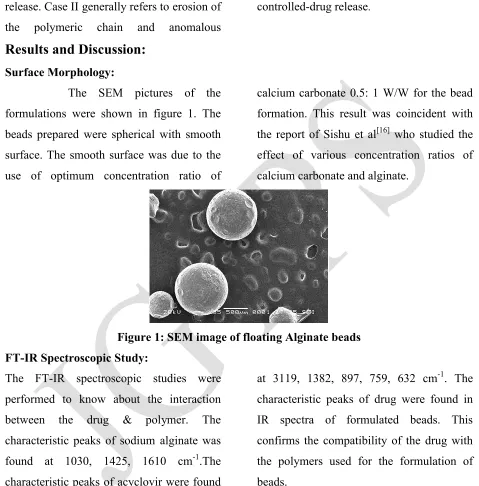
The SEM pictures of the formulations were shown in figure 1. The beads prepared were spherical with smooth surface. The smooth surface was due to the use of optimum concentration ratio of
calcium carbonate 0.5: 1 W/W for the bead formation. This result was coincident with the report of Sishu et al[16] who studied the effect of various concentration ratios of calcium carbonate and alginate.
Figure 1: SEM image of floating Alginate beads FT-IR Spectroscopic Study:
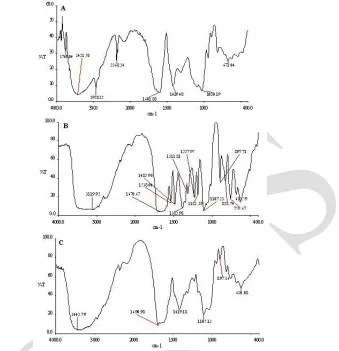
The FT-IR spectroscopic studies were performed to know about the interaction between the drug & polymer. The characteristic peaks of sodium alginate was found at 1030, 1425, 1610 cm-1.The characteristic peaks of acyclovir were found
Figure 2. FT-IR Spectras of sodium alginate(A), Acyclovir(B) and drug loaded alginate beads(C) Drug loading and Entrapment efficiency:
The percentage drug loading & entrapment efficiency of the prepared formulations were given in table 2.
Table 2: LOADING AND ENTRAPMENT EFFICIENCY OF FORMULATIONS S.No Formulation
code
Drug loading
%
Entrapment efficiency
%
Floating lag time
Floating time
1 F1 18.49 ± 0.12 54.10± 0.07 < 30 sec >24 hrs
2 F2 22.17 ± 0.10 66.53± 0.11 < 30 sec >24 hrs
3 F3 16.98 ± 0.08 48.91± 0.04 < 30 sec >24 hrs
4 F4 25.33 ± 0.05 78.02± 0.13 < 30 sec >24 hrs
Effect of Guar gum and HPMC:
The loading and entrapment efficiency of the formulation F2 was found to be high than F1. It may be due to the addition of guar gum in preparation of alginate floating beads. The reticular structure was formed as a result of addition
of guar gum which may lead to better entrapment efficiency.[17] The formulation, F3 showed slight decrease in the drug loading than F1.This was similar to the reports of Argyrios Nochos et al.[18]
Effect of Chitosan:
The formulation F4 (chitosan treated alginate/Guar gum beads) and F5 (Chitosan treated alginate/ HPMC beads) showed a marked increase in the drug loading. The addition of chitosan in the gelation medium
provided a skin coating upon the alginate beads due to the polycationic property of chitosan, which prevents drug leaching and leads to more entrapment of drug.[19]
Floating Properties:
The floating ability of the prepared beads was evaluated in 0.1 N Hcl and it was found that all the formulation floated
immediately or with a very short lag time of
about <30 sec only. Similarly floating time of all the batches was about > 24hrs.The results prove that all the batches had good floating property.
In vitro release studies:
The drug release from the floating alginate beads was studied in the buffer pH 1.2. The drug release from all the formulations shown initial burst release followed by sustained release. This sustained release was due to the shrinkage property of alginate in the acid media. More over the release from F2 and F4 was slow compare to the F1. This may be due to the presence of guar gum in these formulations which swells in the pH 1.2 and forms a thick viscous layer that dissolves
Figure -3: In vitro release studies of prepared formulations at pH 1.2 ,In vitro release kinetics and mechanism of drug release
Formulation Zero order r2
First order r2
Higuchi r2
Kosermayer- peppas n value
F4 0.867 0.954 0.964 0.506
The release data of the formulation, F4 which showed better drug loading and release characteristics, was fitted in to equations of various kinetic models and the data was given below.
It could be concluded that release from batch F4 followed the Higuchi model i.e. square root kinetics. Thus the release from
these batches was diffusion controlled. The n value of the kosermayer - peppas equation was about 0.506 which indicate that the mechanism of release of F4 beads was Non-fickian type.
Conclusion:
In the present study floating beads of acyclovir were formulated to achieve sustained release of drug in the absorption window of GIT. The Sodium alginate beads prepared with guar gum and chitosan showed better loading and floating
Acknowledgements:
Authors thank Ranbaxy Laboratories, Gurgaon and India sea foods, Cochin for providing the Acyclovir and chitosan as a gift sample. Authors thank Director, CLRI, for support in research
work. Authors also thank Council of Scientific and Industrial Research (CSIR), India, for providing the fellowship to carry out this research work.
References:
1. Desai S, Bolton S. A floating controlled release drug delivery system: in vitro & invio evaluation.Pharm Res. 1993;10: 1321-1325.
2. Whitehead L, Fell JT. Collett JH, Sharma HL, and Smith AM. Floating dosage forms: an in vivo study demonstrating prolonged gastric retention. J Control Release. 1998;55: 3–12.
3. Singh BN, and Kim KH. Floating drug delivery systems: an approach to oral controlled drug delivery via gastric retention. J Control Release. 2000; 63: 235– 259.
4. Rouge N, Buri P, and Doelker E. Drug absorption sites in the gastrointestinal tract and dosage forms for site-specific delivery. Int J Pharm. 1996;136:117–139
5. Baumgartner S, Kristl J, Vrecer F, Vodopivec P, Zorko B. Optimisation of floating matrix tablets and evaluation of their gastric residence time. Int J Pharm. 2000;195:125–135
6. Murata Y, Sasaki N, Miyamoto E, Kawashakima S. Use of floating alginate beads for stomach specific drug delivery.Eur J Pharm Biopharm. 2000;50:221-226 :
7. Iannuccelli, V, Coppi G, Sansone R, Ferolla G. Air compartment multiple-unit system for prolonged gastric residence. part II. in vivo evaluation. Int J Pharm. 1998;174: 55–62.
8. Ichikawa M, Kato T, Kawahara M, Watanabe S, Kayano M. A new multiple-unit oral floating dosage system. ii: in vivo evaluation of floating and sustained-release characteristics with p-aminobenzoic acid and isosorbide dinitrate as model drugs. J Pharm Sci. 1991;80: 1153– 1156. 9. Kawashima Y, Niwa T, Takeuchi H, Hino T, and Itoh Y. Hollow microspheres for use as a floating controlled drug delivery system in the stomach. J Pharm Sci.1992.81:135–140.
10. John J.O, and Deboral M.C.R. Acyclovir: an update review of its antiviral activity, pharmacokinetic properties and therapeutic efficiency. Drugs.1989;37:233–309.
12. Meera George T, Emilia Abraham. Polyionic hydrocolloids for the intestinal delivery of protein drugs: alginate and chitosan – a review. J Control Release. 2006;114: 1-14.
13. RamaPrasad YV, Krishnaiah YS, Satyanarayana S. In vitro evaluation of guargum as a carrier for colon-specific drug delivery. J Control Release. 1998;51: 281–287;
14. Krishnaiah YSR, Karthikeyan RS, Satyanarayana V. A three layer guagum matrix tablet for oral controlled delivery of highly soluble metoprolol tartrate. Int. J. Pharm. 2002; 241:353–366 15. Choi BY, Park HJ, Hwang SJ, Park J.B. Preparation of alginate beads for floating drug delivery system: effects of CO2gas - forming agents. Int. J.Pharm. 2002;239: 81-91
16. Shishu, Neeta Gupta, Nidhi Agarwaal. Stomach specific drug delivery of 5 fluoro uracil using floating alginate beads. AAPS Pharm sci tech 2007; 8 (2) Article 48 DOI 10.1208/pt 0802048
17. George M, Abraham TE. pH sensitive alginate–guar gum hydrogel for the controlled delivery of protein drugs. Int. J. Pharm. 2007;335:123–129