5499 FORMULATION, EVALUATION AND OPTIMIZATION OF FLOATING PULSATILE
RELEASE TABLETS OF ESOMEPRAZOLE MAGNESIUM TRIHYDRATE
P Pratyusha Ande*, R. Nagaraju
Institute of Pharmaceutical technology, Sri PadmavathiMahilaVisvavidyalayam, Tirupati. Andhra Pradesh, India
*Corresponding author E-mail:[email protected]
ARTICLE INFO ABSTRACT
Key Words
Floating pulsatile, full factorial design,
chronotherapy, pulsatile drug delivery
system, nocturnal acid break
through
The aim of present study was to develop, evaluate and optimisefloating pulsatile release system of esomeprazole by combining floating and pulsatile principles in achieving the chronotherapeutic approach of nocturnal acid break through. The system consists of primarily preparation of rapid release core tablets using superdisintegrants like croscarmellose sodium, crospovidone and sodium starch glycolate. The prepared core tablets were evaluated for various flow properties, post compression parameters, drug content, disintegration and dissolution studies.Different concentrations of methocel E15 and E50 was used for dry coating of selected core tablet and evaluated the formulations for hardness, friability and Invitro dissolution studies.A 32 full factorial design was employed to investigate the influence of buoyant layer on the lag time and % drug release. For the experimental runs created from the factorial design dissolution studies were performed to obtain theoptimised formulation with desired lag time.X-ray scintigraphy and pharmacokinetic studies were performed for the optimised formulation in rabbits. The data were statistically analyzed using ANOVA, and P < 0.05 was statistically significant.
INTRODUCTION:
Conventional pulsatile release
dosage forms following oral administration are meant to release drug after lag period of 5-6 h usually in the large intestine. However, the viscous content of lower part of GI tract cause hindrance to the drug diffusion and also enzymatic degradation of some drugs makes it an unfavourable site for drug release. Further, highly variable nature of
gastric emptying process may result in invivo variability and bioavailability
problems.[1]Gastro retentive dosage forms
reside in stomach only and are not affected by variability in pH, local environment or gastric emptying rate. These considerations led to the development of pulsatile release possessing gastro retention capabilities. Of the numerous approaches to prolong gastric
Journal of Global Trends in Pharmaceutical Sciences
5500 retention, floating drug delivery system is
the most widely used technique to increased gastric residency through inherent buoyancy.
[2]. Esomeprazole is a proton pump inhibitor
that suppresses gastric acid secretion by
specific inhibition of H+k+ATPase in gastric
parietal cell. It blocks the final step in acid production , thus reducing gastric acidity. Esomeprazole is used for the treatment of gastro esophageal reflux disease (GERD) ,Peptic ulcer disease, H pylori eradication and prevention of gastrointestinal bleeds
with NSIADs use. [3] 32FFD was employed
using design expert version 11 to investigate the effect of two factors i.e. different amounts of HPMC K15 (polymer used in the buoyant layer) and sodium bicarbonate (independent variables) on the dependent variables like lag time and % drug
release.Response surface methodology
(RSM) is a collection of statistical and
mathematical techniques, useful for
developing, improving and optimizing
process. [4]
The current study was aimed to develop a floating pulsatile drug delivery system of esomeprazole to provide night time relief from gastric acid break through. It was developed by combining pulsatile and floating principles to modulate pulsatile release profile from a time-lagged press coating of different concentrations of erodible polymers like methocel E15 and methocel E50.
MATERIALS AND METHODS Materials:
Esomeprazole magnesium trihydrate was a gift sample from Aurobindo lab
Hyderabad. superdisintegrants such as
crospovidone, cross carmellose sodium,
Sodium starch glycolate, talc,Mg
stearateobtained from Bright scientifics Hyderabad, were used as the components for the preparation of rapid release core tablets by direct compression method. Methocel
E15 and Methocel E50obtained from Bright scientifics, Hyderabad, were used as components or the dry coating. HPMCK15 and sodium bicarbonate are the components of buoyant layer.All other ingredients and reagents were used of analytical grade.
METHODS
Preparation of rapid release core tablets (RCT):The rapid release core tablets were prepared using superdisintegrants such as crospovidone, cross carmellose sodium,
Sodium starch glycolate by direct
compression method. All the ingredients were mixed in geometrical order and blended in a dry form using double cone blender for about 15min. The resultant powder blend were evaluated for flow properties such as true density, bulk density, angle of repose, Hausner’s ratio and Carr’s index and compressed using single punch compression machine to get RCT of 80mg. The composition of RCT was shown in
Table 1.[5]
Evaluation of RCT: The RCTwere evaluated for its thickness, hardness, friability, Drug content, disintegration time and dissolution studies.
In vitro release studies of RC: The
invitrorelease studiesfor the RCT
formulations were carried out using USP
type- II dissolution apparatus at 37.5±0.5oC
in 0.1N HCl at a speed maintained at 50rpm. The samples were withdrawn at time intervals of 0, 5, 10, 15, 30, 45 and 60 minutes respectively and analysed at 300nm using UV-Visible spectrophotometer.
5501 polymer in 10mm die followed by RCT in
the center of the die slightly compress to fix the polymer around the RCT and then remaining quantity was added and compressed using single punch tablet machine .
Evaluation of PRS: The prepared PRS were evaluated for its hardness, thickness, %
friability and invitrodissolution studies.
Based on the results obtained the best formulation was selected for floating pulsatile release system (FRS)
Application of 32 full factorial design: The
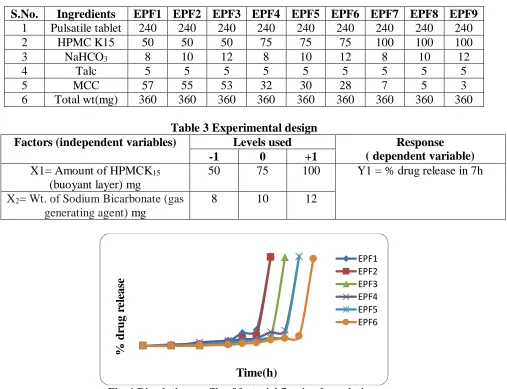
composition of experimental runs are shown in Table 2.Totally nine formulations were created using different concentrations of independent variables as explained above. The experimental design for the drug is shown in the Table 3.
Preparation of floating pulsatile release tablet: The FRS was prepared by placing buoyant layer on the top of selected PRS and compressing the layer to obtain FRS.The
mixture of buoyant layer and NaHCO3 were
passed through the sieve # 60 to obtain uniformly dispersed powder and addition of talc to that powder blend. The buoyant powder were filled into the 10mm diameter die and PRS was placed and compressed using single punch tablet machine to get the
required hardness.[6]
Evaluation of FRS: Prepared FRS was evaluated for its hardness, floating onset time (time period between placing of FRS into the container and beginning of
buoyancy), floating duration and
invitrodissolution studies.
Drug-Excipient interactions: The physicochemical compatibilities of the drug and the used excipients were tested by FTIR studies and DSC studies.
X-ray Scintigraphic studies in rabbits:Scintigraphic studies were performed for the optimisedformulation at
time intervals of 2,6 and 8h respectively useful in tracing the dosage form and its release in Gastro intestinal tract.
Estimation of pharmacokinetic parameters in rabbits: Four healthy adult male rabbits (Weighed: 3.2 - 3.5 Kg, mean 3.3 ± 0.12 Kg, aged: 8-10 months) were enrolled in the study. The studies were carried out with
registration no.
IAEC/769/2011/CPCSEA.Rabbits were
fasted for 12 hours with free access to water by add libitum before the study started. A single dose, two crossover design study was used in rabbits. There was a washout period of one week between the two doses. In first stage,four rabbits received a dose of test formulations of esomeprazole whereas after one week, the in second stage rabbits received the same dose of Esofag 40mg (Reference product) to complete the cross-over design.
RESULTS AND DISCUSSION
Evaluation of RCT: The hardness values ranges from 4.2 ± 0.16 to 5.2± 0.18 possesses good mechanical strength. The thickness values were in between 3.5 ± 0.083 to 3.51±0 .11mm. The friability ranged from 0.15 ± 0.05 to 0.56 ± 0.01. The disintegration time of core tablets prepared were in the range of 3.33 ± 0.5 to 12.33 ± 1.52 minutes. The formulation EC3 showed lowest disintegration time compared with the remaining formulations i.e. 180 sec. The % drug content of all formulations ranged
from 98.87 ± 0.29to 101.17±0.97%
fallwithin the acceptable limits.
5502 release compared to other formulations and
therefore was selected for pulsatile coating.
Evaluation of PRS: The hardness values of all coated formulations ranged from 4.8 - 5.2
kg/cm2which revealssatisfactory mechanical
strength. The thickness values were found to be between 3.7- 3.78mm. The average weight was in the range of 240 - 242 mg. The friability ranged from 0.10 - 0.22%. All the obtained values are in acceptable limits. The drug release from all the formulations except EP5 and EP6 started from 30 minutes onwards. The formulation EP1 showed
complete drug release in 4th hour. EP2, EP3
and EP4 at 5th hour. The formulation EP6
sustain the release of drug upto 5h and burst release of drug was observed. Hence the formulation was selected for floating pulsatile system.
Evaluation of PRS: Totally nine formulations were created and prepared by
applying 32 full factorial design. The release
profiles were shown in Figures 1& 2.The "Pred R-Squared" of 0.8992 is in reasonable agreement with the "Adj R-Squared" of 0.9061, i.e the difference is less than 0.2. "Adeq Precision" measures the signal to noise ratio. A ratio greater than 4 is desirable. The suggested ratio of adeq Precision 19.01 indicates an adequate signal. This model can be used to navigate the design.
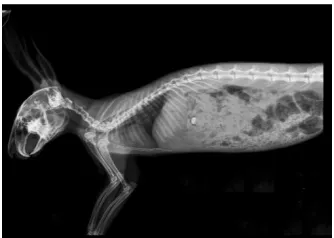
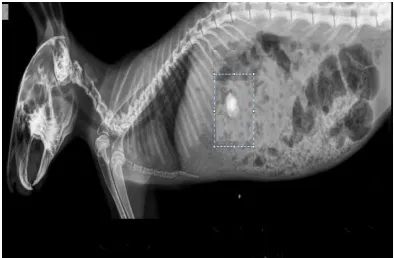
X-ray scintigraphic studies in rabbits: InvivoX-ray imaging was conducted in rabbits in order to trace the movement and behaviour of the capsule in GI tract. Images were taken at 2, 4 and 6h after administration of radiolabeled tablet .The results of X- ray imaging study are shown in Figures 18, 19 and 20.Scintigraphy scans obtained for the optimised formulation at the time intervals of 2h, 4h and 7h. The figures showed that there was no drug release observed at 2h and 4h. After completion of
lag time (6h) burst release of dosage was observed.The results showed that the values
of pharmacokinetic parameters like Tmax ,
AUC0-t and AUC0-∞ for the optimised novel
formulation were found to be higher compared with the marketed product which met the chronotherapuetic approach for the treatment nocturnal acid break through.This floating pulsatile release system was formulated using RCT of 80mg, PRS of 240mg and compressed with mixture of buoyant layer and gas generating agent of 100mg, 12mg was successful in relieving from nocturnal acid secretions with the desired lag time of 6h. Hence this novel
formulation desired to achieve
chronotherapeutic approach of anti-ulcer activity.
SUMMARY AND CONCLUSION
The present study demonstrates that
esomeprazole floating pulsatile release system could be successfully achieved the chronotherapeutic approach of nocturnal acid secretion which is high during night time needs the release of drug at higher concentrations.Regarding the optimization, central composite design can be successfully used for achieving desired responses, floating lag time and drug release profile, after preprogramed off period. From the response surface methodology, it is easy to understand the change of responses with independent variables and for locating the
desired area of interest. In vivoX-raystudy
has shown the prepared optimised
formulation maintained the desired lag time of 6h followed by burst release of drug.The optimized formulation when compared to the marketed formulation shown better
pharmacokinetics parameters for the
5503 Table 1: Composition of rapid release core tablet (RCT)
S.no Ingredients EC1 EC2 EC3 EC4 EC5 EC6 EC7 EC8 EC9
1 Esomeprazole 40 40 40 40 40 40 40 40 40
2 Cross carmellose
sodium
5 7 9 - - - -
3 Cross povidone - - - 5 7 9 - - -
4 Sodium starch
glycolate
- - - 5 7 9
5 Aerosil 2 2 2 2 2 2 2 2 2
6 Magnesium stearate 2 2 2 2 2 2 2 2 2
7 MCC (Avicel) 31 29 27 31 29 27 31 29 27
8 Total wt(mg) 80 80 80 80 80 80 80 80 80
Table 2 Composition of factorial experimental runs
S.No. Ingredients EPF1 EPF2 EPF3 EPF4 EPF5 EPF6 EPF7 EPF8 EPF9
1 Pulsatile tablet 240 240 240 240 240 240 240 240 240
2 HPMC K15 50 50 50 75 75 75 100 100 100
3 NaHCO3 8 10 12 8 10 12 8 10 12
4 Talc 5 5 5 5 5 5 5 5 5
5 MCC 57 55 53 32 30 28 7 5 3
6 Total wt(mg) 360 360 360 360 360 360 360 360 360
Table 3 Experimental design
Factors (independent variables) Levels used Response ( dependent variable)
-1 0 +1
X1= Amount of HPMCK15
(buoyant layer) mg
50 75 100 Y1 = % drug release in 7h
X2= Wt. of Sodium Bicarbonate (gas
generating agent) mg
8 10 12
Fig. 1.Dissolution profile of factorial floating formulations
%
d
ru
g
re
le
as
e
Time(h)
5504 Fig. 2.Dissolution profile of factorial floating formulations
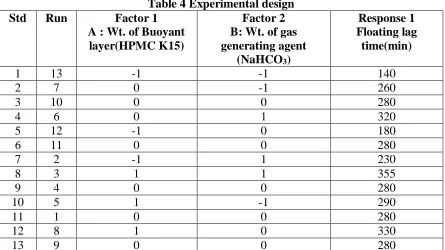
Table 4 Experimental design Std Run Factor 1
A : Wt. of Buoyant layer(HPMC K15)
Factor 2 B: Wt. of gas generating agent
(NaHCO3)
Response 1 Floating lag
time(min)
1 13 -1 -1 140
2 7 0 -1 260
3 10 0 0 280
4 6 0 1 320
5 12 -1 0 180
6 11 0 0 280
7 2 -1 1 230
8 3 1 1 355
9 4 0 0 280
10 5 1 -1 290
11 1 0 0 280
12 8 1 0 330
13 9 0 0 280
Fit statistics for response: floating lag time
%
dr
ug
re
le
as
e
Time (h)
EPF7
EPF8
EPF9
Std. Dev. 19.90 R² 0.9430
Mean 269.92 Adjusted R² 0.9061
C.V. % 7.37 Predicted R² 0.8992
5505 Diagnostics plots and Model graphs
Fig. 13: Predictedvs Actual plot
5506 Fig. 18, 19& 20: X-ray images at 2, 4 and 7h
Pharmacokinetic values ofoptimised and marketed formulation
C max (ng/ml) 1138.6 972.5
Tmax 12hrs 8hrs
AUC (0-t)(ng.mg/ml) 10049.25 5664.5
Ke 0.092 0.234
T 1/2 7.532609 2.96158
AUC (t-inf)(ng.mg/ml 1408.696 0
AUC (0-inf)(ng.mg/ml 11457.95 5664.5
REFERENCES
1. Pallab Roy., AliasgarShahiwala.,
2009. Statistical optimization of ranitidine HCl floating pulsatile delivery system for chronotherapy of
nocturnalacid breakthrough.
European journal of pharmaceutical sciences. 37, 363-369.
2. M. D. WasimulHasan.,
AndePratyusha., 2014. Formulation and evaluation of press coated tablets of salbutamol sulphate for time controlled release. Asian journal of pharmaceutics. 8, 161-170.
3. SwathiC.Jagdale., Nilesh A. Bari.,
Bhanudas S. Kuchekar ., Anirudh R. Chabukswar., 2013. Optimization
studies on compression coated
floating – pulsatile drug delivery of
Bisoprolol. Biomed research
international.1-11.
4. Haribansh Narayan Singh.,
ShivangiSaxena., Sunil singh.,Ajit Kumar Yadav., 2013. Pulsatile drug delivery system: Drugs used in the pulsatile formulations. Research J. Pharma. Dosage Forms and Tech. 3, 115-121.
5. Sunil Patel., Moin. K. Modasiya.,
Vishnu .M. Patel.Anand .K.Patel., 2012. Design and development of floating pulsatile drug delivery
system using meloxicam.
International journal of
pharmaceutical research and Bio-science. 2, 215-235.
6. Yamaoka, T. Nakagawa, and T. Uno,
“Statistical moments in
pharmacokinetics,” Journal of
Pharmacokinetics and Bio
5507
7. C.Y. Wu and L. Z. Benet,
“Predicting drug disposition via
application of BCS:
transport/absorption/ elimination
interplay and development of a biopharmaceutics drug disposition
classification system,”
Pharmaceutical Research, vol. 22, no. 1, pp. 11–23, 2005.
8. T.A. Aguirre, V. Aversa, M. Rosa,
S.S. Guterres, A.R. Pohlmann, D.J. Brayden. Coated minispheres of salon calcitonin target rat intestinal
regions to achieve Systemic
bioavailability: Comparision
between intestinal instillation and oral gavage, J. Control release 238 (2016) 242-252.
9. Ministry of Health and Family
Welfare. Government of India.Indian
Pharmacopoeia.Vol.2, Ghaziabad,
Indianpharmacoepia commission