Available Online at www.ijpret.com
879
INTERNATIONAL JOURNAL OF PURE AND
APPLIED RESEARCH IN ENGINEERING AND
TECHNOLOGY
A PATH FOR HORIZING YOUR INNOVATIVE WORK
COMPARATIVE STUDY OF HYBRID NETWORK USING DIFFERENT ROUTING
PROTOCOL
MS. PRACHI KAMAT TIMBLE, PROF. NAYANA SHENVI
Goa Engineering College, Ponda, Goa, India.
Accepted Date: 27/02/2014 ; Published Date: 01/05/2014
\
Abstract: This project presents the design and implementation of hybrid network using
different IP Routing Protocols. Opnet IT guru is used to study campus/university are hybrid network scenario using different IP Routing Protocols. The network consist of LANs and WLANs which are connected through the router by applying different IP routing mechanisms. The parameter such as HTTP Page and Object Response Time, HTTP traffic sent and received ,Wireless delay and media access delay are used to measure performance of the network.
Keywords: Routing Protocol, BGP, RIP, OPNET
Corresponding Author: MS. PRACHI KAMAT TIMBLE
Access Online On:
www.ijpret.com
How to Cite This Article:
Prachi Timble, IJPRET, 2014; Volume 2 (9): 879- 887
Available Online at www.ijpret.com
880
INTRODUCTION
Main purpose of Internet Routers is to forward packets[1]. Routing protocol would be
standardized way of learning routes and moving data from one network to another. . Routing protocols can be classified into different groups according to this characteristics: Interior Gateway Protocol (IGP) or Exterior Gateway Protocol (EGP) ; Distance vector or Link state ;
classful or classless[1]. Some of the most commonly used Routing protocols are as follows: RIP:
Routing Information Protocol, IGRP: Interior Gateway Routing Protocol, EIGRP: Enhanced Interior gateway Routing Protocol, OSPF: Open Shortest Path First, BGP: Border Gateway Protocol.
There are several ways to differentiate routing protocols.[1] An important characteristic of a
routing protocol is how quickly it converges when there is a change in the topology. The network has converged when all routers have complete and accurate information about the network. Other characteristics include HTTP Page and Object Response Time, Wireless Lan delay and Media Access Delay. The primary goal of this paper is to analyze these characteristics under variety of network settings by
using professional simulation software called OPNET.
[1]In real world situations when nodes are to be added or when there is link failure or when
there is topology change , routes must change automatically otherwise it is difficult for the network administrator (large networks). In my paper , same scenario is simulated using two different routing mechanism(RIP & BGP), keeping same settings , and analyzed characteristics such as HTTP Page and Object Response Time, Wireless delay and Media Access Delay.
RIP is dynamic, distance vector routing protocol and was developed for smaller IP based networks. RIP uses UDP port 520 for route updates. RIP calculates best route based on hop count. Like all distance vector routing protocols , RIP takes some time to converge While RIP requires less CPU power and RAM than some other routing protocols. RIP have some limitation. Some RIP calculate best route to destination based solely on how many hops to destination network. RIP tends to be insufficient in network using more than 1 LAN protocol such as Fast Ethernet or serial or Token Ring. This is because RIP prefers path with shortest hop count might be over with slowest link in the network. It cannot handle more than 15 hops. Anything more than 15 is said to be unreachable by RIP. This is used by RIP to prevent routing loops.
Available Online at www.ijpret.com
881
Linux programs such as Zebra. GP uses a TCP connection to send routing updates using TCP port 179. BGP is therefore by definition a 'reliable' protocol. While BGP version 3 provides for the dynamic learning of routes, BGP 4 adds additional route dampening functionality, communities, MD5 and multicasting capability
OUR APPROACH
OPNET’s IT guru provides a virtual network Environment that models the behavior of entire network, including its routers, switches, protocols, servers, and individual applications. By working in the Virtual Network Environment, IT managers, network and system planners, and operations staff are empowered to diagnose difficult problems more effectively, validate changes before they are implemented, and plan for future scenarios including growth and failure.
SCENARIOS AND SETTINGS
[2]
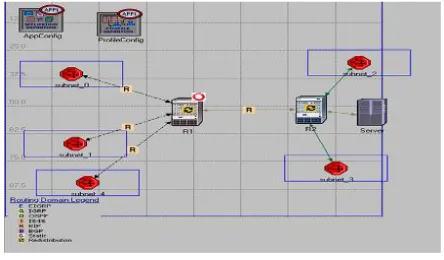
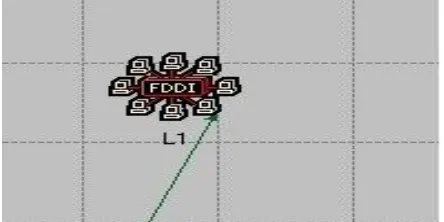
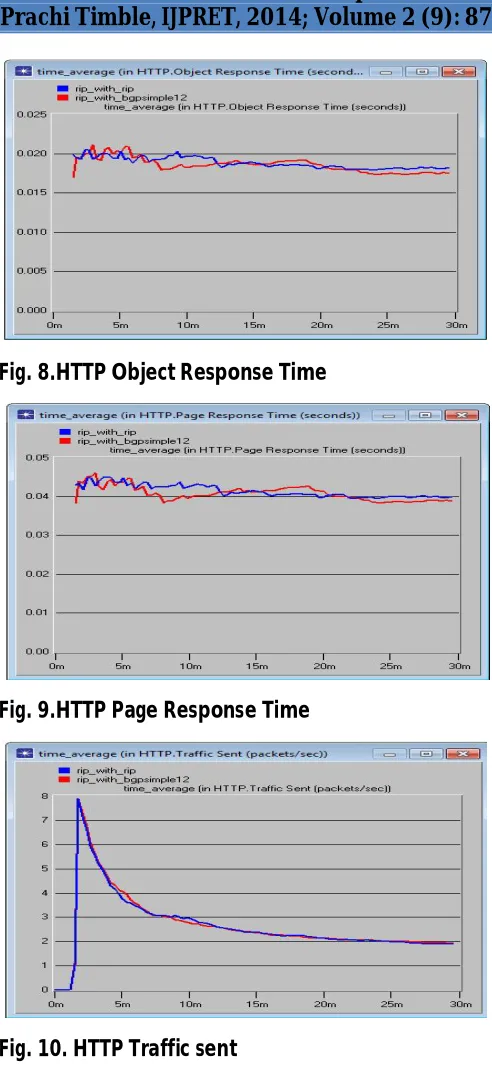
Multiple LANs and WLANs are connected through a Router by applying different routing protocols. RIP and BGP routing protocols are used for both the scenarios. Hybrid Network is the combination of wired and wireless network connected with FTP Server, ATM and Router. The LANs are connected via 10base T and FDDI and multiple LANs are connected via ATM backbone cable. The network has FDDI LAN with switched technology and WLANs has FTP and HTTP clients.
Two different scenarios and setting have been considered to optimize the network.
Scenario I: Hybrid Network with RIP routing protocol
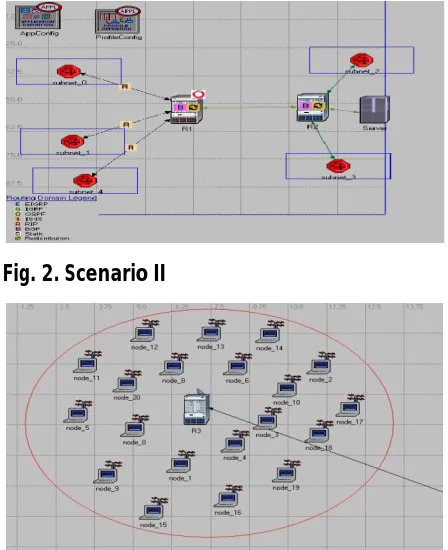
Scenario II: Hybrid Network with RIP and BGP routing protocols.
Available Online at www.ijpret.com
882
Fig. 2. Scenario II
Fig. 3. Subnet 3:Mix of FTP and HTTP clients
Fig. 4. Subnet 1:Mix of FTP and HTTP clients
Available Online at www.ijpret.com
883
Fig. 6. Subnet 2:FDDI LAN with switched Technology
Fig. 7. Subnet 3:FDDI LAN with switched Technology
SIMULATION EVALUATION & RESULT ANALYSIS
Available Online at www.ijpret.com
884
Fig. 8.HTTP Object Response Time
Fig. 9.HTTP Page Response Time
Available Online at www.ijpret.com
885
Fig. 11.HTTP Traffic received
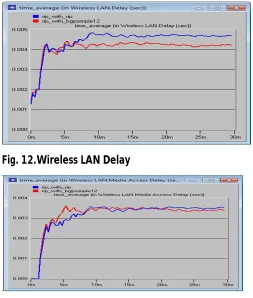
It has been observed that wireless delay and media access delay is less in scenario where RIP and BGP protocol is used. In Fig wireless delay with RIP and RIP and BGP varies from 0.0ms to 29.40ms The delay increases and remains constant after some time as the simulation progress in both scenarios as shown in Figure . Therefore it is concluded that the results are better with RIP and BGP routing protocol.
Fig. 12.Wireless LAN Delay
Available Online at www.ijpret.com
886
Fig. 14. Server Task Processing Time
CONCLUSION
The comparative investigations have been reported for RIP and RIP with BGP. The simulations were evaluated with respect to the HTTP Page and Object Response time , Wireless LAN delay and Media Access Delay and Server Task Processing Time.
There is significant improvement in the HTTP Page response time which is reduced. The performance metrics like: wireless LAN delay which has been decreased and also the Media Access Delay in the modified protocol. HTTP traffic sent and received is same in both scenarios.
From the obtained results, it is concluded that there is improvement in Server task proceeding time with the same server load.
Moreover, the HTTP Object response time is lower with the modified version of dynamic routing protocol.
The future work can be done on performance analysis with FRIP and other existing methods.
REFERENCES
1. Performance Issues and Evaluation consideration of web traffic for RIP and OSPF dynamic
Routing Protocols for Hybrid network using OPNET by Vasudha Bahl , International journal of Advanced Research in computer Science and software engineering Vol 2 ,Issue 9, sept 2012
2. Design and Implement the Hybrid Network for different IP Routing Protocol and comparative
Available Online at www.ijpret.com
887
3. Performance Evaluation of Hybrid Network using EIGRP and OSPF for different application.
Inderjeet Kaur, Manju Sharma International Journal of Engineering Science and Technology (IJEST)
4. Performance Analysis of RIP,OSPF,IGRP, and EIGRP Routing protocols in the Network. Pankaj
Rankheja, Prabhjot kaur, Anjali Gupta, Aditi Sharma International Journal of Computer Applications (0975 – 888) Volume 48– No.18, June 2012
5. Investigation and Performance Evaluation of Dynamic Routing Protocol with New Proposed