Volume 10, Number 2, pp. 189–199. http://www.scpe.org 2009 SCPE
THE INFLUENCE OF THE IBM PSERIES SERVERS VIRTUALIZATION MECHANISM ON DYNAMIC RESOURCE ALLOCATION IN AIX 5L
MACIEJ MLYNSKI∗
Abstract. This paper presents analysis of the influence of the virtualization mechanism of IBM pSeries servers on dynamic resource allocation in AIX 5L operating system. It raises issues of economic use of resources and distribution of processing power. Some innovative solutions are proposed as methods for dynamic resource allocation. These are: micro-partitioning and partition load manager utility. Some results of experiments are presented. The goal of these experiments was to estimate the influence of selected AIX 5L operating system adjustments on computation efficiency.
Key words: virtualization, AIX, DLPAR, dynamic resource allocation, PLM, VIO, hypervisor, micro-partitioning
1. Introduction. At present, the demand for server processing power begins to go beyond its processor capabilities. However, installing more processors and memory causes the resources to become more expensive [3, 14, 15]. Therefore research is being undertaken to investigate how to utilize the resources more efficiently. In this direction important research are grid and autonomic computing [3, 12, 17]. During the computer systems design phase we need to consider installing more than one application and database onto one individual server [2].
Many factors can influence multiple applications, such as splitting of mission critical applications and development, creating an environment for patch installation as well as computer systems for many different customers. A multi-instance environment could also be motivated by efficiency reasons [4, 5, 6]. Efficiency would also influence amulti-instanceenvironment. Unfortunately, several conflicting instances of databases or applications on one server may create a problem with conflicting processing power resources. The problems can be resolved by adequate parameters modifications inside the operating system or server microcode.
The dynamic resource allocation mechanisms are based on well documented theory concerning mainly elements of the operational research such as queuing and resource management theory, Markov chains, analysis of time series and gradient methods [9, 16].
The paper discusses efficient use of resources and distribution of processing power in IBM pSeries servers. Three solutions for the improved dynamic resource allocation are being discussed: micro-partitioning, capped and uncapped processing power as well as the partition load manager utility. Results of experiments are presented, and the influence of virtualization technology on IBM pSeries server efficiency are analysed. The following are the main contributions of the paper:
• Efficiency problems in IBM pSeries servers have been experimentally analysed. The experiments have been done at customer sites in banks and others complex installations.
• Implementation of an efficient policy for partition load manager utility has been done.
• The set of virtual machine parameters has been analysed in concern with dynamic modification ability. • It has been proved that to improve entire hardware efficiency by dynamic changes of the amount of assigned memory and the number of virtual processors, selected parameters in the operating system should be changed as well.
Dynamic resource allocation in operating systems involves a huge amount of parameters, but only their correct adjustment can give the expected results. The set of experiments presented in section four shows that increasing of processing resource in logical partition not always improve the overall system efficiency.
The goal of this paper is to indicate possibilities of improvement of dynamic resource allocation character-istics. In particular the attention was turned onto mechanisms of tuning operating systems and tuning the I/O subsystems.
2. The virtualization and workload management on AIX. A progress in methods for data transmis-sion and information processing enforces changes in computer systems architecture. In the AIX 6.1 operating system modern virtualization mechanisms have been introduced. The mechanisms enable creating flexible con-figurations by administrators and systems architects. In the IBM pSeries servers environmentmicro-partitioning (dividing resources into small pieces),IVE (Integrated Virtual Ethernet), Shared Ethernet, and virtualization have just been introduced.
∗ASpartner Sp. z o.o., ul. Jaworowa 5, 05-816 Michalowice, Poland, ([email protected]).
Conception of virtualization mechanism in IBM pSeries servers is similar to the concepts implemented in other virtual environments such as Xen and VMWare [19]. The conception assumes that physical resources like processors units, memory, I/O drawers and adapters can be shared. Fig. 2.1 shows the scheme of logical partitions on IBM pSeries architecture. [1] The new computer system architecture has introduced a number of new elements, which system architects should consider when designing information systems.
Virtual Ethernet
Virtual Storage
Processor resources Memory resources I/O resources
MEM CPU
CPU
CPU CPU
MEM
CPU
Hardware CPU
CPU
CPU CPU CPU
MEM
MEM MEM
MEM
MEM
MEM MEM
MEM
MEM
MEM
Adapter
Adapter
Adapter
Adapter
Adapter
Adapter
Adapter
Adapter
Adapter
Adapter
Adapter
Adapter
POWER Hypervisor
i/OS partition
AIX partition
AIX partition
I/O server
Fig. 2.1.Scheme of logical partitions on IBM pSeries Systems server architecture. [1, 15]
Another subject on which emphasis is placed today is dynamic resource allocation issue. Since not long time ago we know the Work Load Manager functionality on AIX operating system [8, 13, 14]. Now we can also use a new functionality called DLPAR (dynamic logical partitions). The functionality allows for on-line resources allocation between logical partitions e.g. processors, memory and I/O. Introduction of the DLPAR is possible because new servers have an intermediate layer called a hypervisor [7]. In this solution, memory is not addressed directly by the operating system. The hypervisor is serving a translation buffer role. Therefore these solutions allow for the use of a tool called Partition Load Manager. They also allow dynamic hardware manipulation. As a result, it is possible to configure a computer system so, that if required, we can dynamically add processors and memory to a particular partition. Virtualization technologies provide also abilities to switch resources between servers like WPARs (Workload partitions) which provides a single focal point for management of AIX 6.1 across an enterprise andLive Application Mobilitywhich allows on-line realocations between servers. Hardwarehypervisoris supporting a few kinds of operating systems installed together on one physical machine. On theIBM pSeries Systemhardware platform these operating systems, which can be installed in that way are AIX,i/OS, andLinux (SLES,RHEL). These operating systems can use shared and virtual resources.
In the partitioned environment, memory utilization is described by two parameters: the amount of allocated memory and the number of scans per second. Therefore, a partition load manager has its own knowledge database. In the database, the partition load manager stores information about system utilization. Resource allocation is realized on the basis of stored data and defined policy rules.
The process of making policy rules must be consistent with AIX specification. Memory space in AIX is divided into many sub spaces e.g. working, clientand persistent. The working memory is a memory, which is used by program codes and libraries. Therefore, the client and persistent spaces are dedicated to storing data. How much memory to be assigned for a file cache and how much for a program code is adjusted by theminperm
andmaxperm parameters. On the basis of these parameters, thepage stealerwill decide which memory pages
should be released.
and sends information to the hardware management console that the resources were released. Fig. 2.2 shows a schematic of connections of hardware management console with particular logical partitions, partition load manager and resource manager. [1]
AIX OS Database Application WebServer
POWER Hypervisor
Interface Interface Interface Interface
Partition Load Manager
Resource Manager Policy File
1394 ThinkCenter P72
HMC
Public VLAN
Private VLAN
Fig. 2.2.The scheme of physical connections to partition load manager. [1, 15]
The policy rules of partition load manager must estimate and define minimum, maximum and guaranteed amount of resources, priority, weight and thresholds for every partition. Administrator should also define minimum and maximum thresholds when events will be generated for every resource. If the same partition sends requests for new resources, the system will release them according to the following rules:
• Resources available and un-assigned, • Resources-allocated but not used,
• Resources from partitions with lowest priority.
From the above we can draw the conclusion, that the architects must plan the resources allocation before or during the design of a system, to ensure efficient resource allocation.
The design of policy rules has to respect both the architecture of a computer system and business application features. We have several system perspectives which should be respected on the basis of the P6 architecture, e.g.:
• Security,CAPP/EAL4+(controlled access protection profile and evaluation assurance level 4+) • Architecture of central processing units e.g. simultaneous multi threading, memory affinity,L3sharing
between processors,
• RASarchitecture (reliability, availability and scalability),
• Virtualandshared I/O,
• Virtualandshared Ethernet,
• Capacity on Demand, • Multiple operating systems.
H
y
p
e
rv
is
o
r,
V
IO
, I
V
E
,
V
irt
u
a
l E
th
e
rn
e
t,
S
h
a
re
d
E
th
e
rn
e
t
Hardware
dev prod
phisical processors and memory maximum cpu: 1
maximum memory: 1 processor type: dedicated
maximum cpu: 1 maximum memory: 1 processor type: dedicated
Gr
o
u
p
s
o
f
d
e
fi
n
e
d
v
irt
u
a
l p
a
rti
tio
n
s
Fig. 3.1. Resource group in Partition Load Manager.
ThePartition Load Manager has some parameters to define thresholds indicating when resources will be
allocated between logical partitions. Frequent physical changes can cause low system stability. However, setting the thresholds to high values can cause that resources will never swap.
Next, we have assigned logical partitions for particular physical group. During that, we had to determine
themaximum,minimumandguaranteed resourcesfor all logical partitions. This operation concerns processors
and memory.
G
ro
u
p
s
o
f t
h
e
r
es
o
u
rc
e
s
prs14
prs15
dev
prod
Dynamic
Logical
PARtition
Dynamic
Logical
PARtition
group of mem and cpu resources minimum, guarantee,
maximum and share
group of mem and cpu resources minimum, guarantee
and ahare
prs...
Def
ined
Dy
nam
ic
Logic
al
P
ar
tit
ions
Fig. 3.2.The definition of logical partitions in Partition Load Manager.
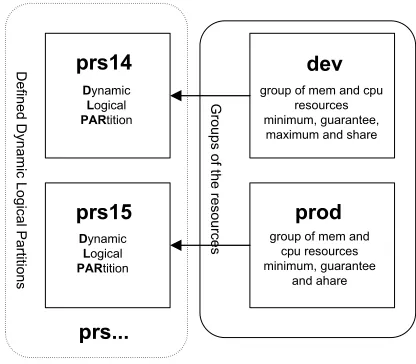
Two logical partitions for this experiment were created. The first was called prs1 and had 1 CPU and 4 GB RAM. The second logical partition was called prs14 and had 4 CPU and 6 GB RAM. Fig. 3.2 shows the scheme in which one group is assigned to one logical partition. The logical partition called prs15 is assigned to a production group. Therefore the logical partition called prs14 is assigned to the development group.
Table 3.1
Parameters of the logical partitions.
Instance Group Defaults
Entitled capacity delta 10 - 10
Memory delta 1 1 1
CPU notisy intervals 5 6 6
Memory notisy intervals 5 6 6
CPU load average high threshold 0.9 1.00 1.00
CPU load average low threshold 0.1 0.40 0.40
Minimum entitlement per VP 0.4 - 0.50
Maximum entitlement per VP 0.4 - 0.50
Memory utilization high threshold 50 50 90
Memory utilization low threshold 90 90 50
Memory page steal high threshold 0 0 0
Immediate release of free CPU yes no yes
Immediate release of free memory yes no no
In cases when there are fewer resources, some should be released from the running partition. Then, they are released on condition that the logical partition is using more resources than was guaranteed. If all logical partitions need their own resources, then the partition load manager decides which resources should be released on the basis of partition weight. The weight of a logical partition is specified during the server partitioning.
Table 3.1 shows the parameters of a logical partition. All logical partitions can have different parameters. However, the group restrictions should be valid and proper i. e. precise match with expected requirements. Also tunable resources entitlements should be defined. Entitlements are a kind of resources limits.
Resources are re-allocated mainly based on these parameters. Resources between logical partitions are distributed in harmony with defined maximum, minimum and guaranteed values for memory and processors. In P5 and P6 environment it is possible to change the CPU allocation by 0.01 of their processing power. More precise explanation of the tuning parameters can be found in Table 3.2.
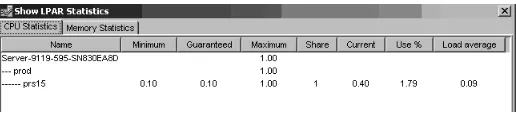
After the policy rules definition, we can run partition load manager. In our test environments, the system parameters were changed many times. After running the partition manager we were able to show statistics. Fig. 3.3 shows memory statistics for a logical partition prs15. Fig. 3.4 shows the processor utilization. Processing statistics show average processor utilization.
Fig. 3.3.Memory statistics for logical partitions.
Fig. 3.4.The CPU statistics for logical partition.
The partition load manager can be run in passive or active mode. In passive mode only the analysis of policy rules is possible. The next stage, after analyzing the partition load manager, is to be run in active mode. In this case, the dynamic resource allocation is possible.
Table 3.2
CPU-related parameters [2].
Tunable Description
Entitled capacity delta The amount of CPU entitled capacity to add or remove from a shared processor partition. The value specifies the percent of the partition’s current entitled capacity to add or remove. CPU notify intervals The number of 10 second sample periods that a CPU-related
sample must cross a threshold before the reallocation will take effect.
CPU load average high threshold
The processor load average high threshold value. A partition with an average load above this value is considered to need more processor capacity.
CPU average load low threshold
The CPU average load low threshold value. A partition with a average load below this value is considered to have unneeded CPU capacity.
Minimum entitlement per virtual processor
The minimum amount of entitled capacity per virtual pro-cessor. This attribute prevents a partition from having a de-graded performance due to too many virtual processors rela-tive to its entitled capacity. When entitled capacity is removed from a partition, virtual processors will also be removed if the amount of entitled capacity for each virtual processor falls be-low this number. Default value is 0.5. Minimum value is 0.1. Maximum value is 1.0.
Maximum entitlement per virtual processor
The maximum amount of entitled capacity per virtual pro-cessor. This attribute controls the amount of available capac-ity that may be used by an uncapped (uncapped means that amount of resources is not strictly limited) shared processor partition. When entitled capacity is added to a partition, vir-tual processors will be added if the amount of the entitled capacity for each virtual processor goes above this number. Increasing the number of virtual processors in an uncapped partition allows the partition to use more of the available pro-cessor capacity.
Immediate release of free CPU
Indicates when processor capacity not needed by a partition is removed from the partition. The value of no indicates un-needed CPU capacity remains in the partition until another partition has a need for it. The value of yes indicates un-needed CPU capacity is removed from the partition when the partition does not need it any longer.
can cause a crash. The physical resource allocation have also a big impact on system efficiency. The strength of the influence it has on I/O subsystems is discussed in the following paragraph.
4. The analysis of the influence of disk subsystem parameters on operating system efficiency. We distinguish sequential and random disk transfers. In random disk transfers, administrators do not have much freedom to tune it, but in sequential transfers there is a bigger possibility [10, 11]. The most important parameters areminpagereadaheadandmaxpagereadahead. How the mechanism works is shown in the following examples, assuming thatminpagereadahed=2and maxpagereadahead=16.
For this setup, in the case of sequential reading, first transfer from disk will read two pages. If system recognizes that the pages, which were read are sequential, the next transfers will read 4 pages, next one 8, 16 etc. All other transfers will read 16 blocks in one reading cycle. A maximum size of transfer is always equal
tomaxpagereadahead value. For the system to be efficient, it should have enough memory for every read. The
system should havemaxpagereadaheadfree pages. How many free pages will be adjusted byminfreeandmaxfree tuning parameters? The number of free pages should never fall below minfree. If the numbers of free pages reachminfree, then thepage stealerprocess will release pages until the amount equalsmaxfree. Maxfreevalue is defined by the following formula:
Table 4.1
Influence comparison of system values on their efficiency.
Min Max Max page Mem File Trans.
free free read ahead pools size type Time
1 960 1088 8 1 1GB read 1.14s
2 960 1088 16 1 1GB read 1.07s
3 960 1088 32 1 1GB read 1.01s
4 960 968 8 1 1GB read 1.10s
5 960 968 16 1 1GB read 1.15s
6 960 968 32 1 1GB read 1.18s
7 960 1088 8 1 1GB r/w 20.49s
8 960 1088 16 1 1GB r/w 16.44s
9 960 1088 32 1 1GB r/w 17.60s
10 960 968 8 1 1GB r/w 19.16s
11 960 968 16 1 1GB r/w 19.45s
12 960 968 32 1 1GB r/w 20.02s
The minfree value is determined by experiments. It is usually equal to the size of one of system processes, which should be run fast. We must remember that the memory belowminfreevalue is wasted. The experiment was carried on in highly loaded computer systems. To carry out the experiment, one should also have correction on the number of processors and memory pools. After the corrections, themaxfreeis defined by the following formula:
maxfree=minfree+ (maxpgahead∗nCPU) (4.2)
For small computer systems, themempool value is equal one. However, in quite big computers, the value is adjusted during an installation process. For example, in one of tested computers that has 40 GB RAM, the number ofmemorypoolswas equal 5. The value can be changed. After a correction for mampool, themaxfree will be defined by the following formula:
maxfree=minfree+ (maxpgahead∗nCPU/mempools) (4.3)
From this formula we see that during the dynamic memory allocations we should also modify theVirtual
Memoryvalues. The latest implementations of AIX require to restart the operating system after changes of
thememoolsvalue. In the future, when we change the mempoolsvalue without rebooting, themempools value
should be changed automatically during dynamic resource allocations. To check how big influence on system efficiency the parameters ofmaxfree,minfreeandmaxpagereadaheadhave, experiments were carried out. During the experiments some files were copied. The experiment was carried out on one of logical partition on p595 server. The logical partition has 0.4 CPU (POWER5 1.9 GHz) and 2047 MB RAM. In Table 4.1 the results have been presented.
The experiments (1-6) confirm that an increase ofmaxpagereadahedincreases system efficiency when we have enough free memory for pages to be allocated. The second part of this table shows the results of parallel read and write. The experiments 7-12, show that when we have small number of pages, the increase ofmaxpagereadahead value results in longer files copying time. It means that we should be careful about memory free pages. System will start running thememory stealerprocess when we do not have enough free pages, and so, it will result in weak system efficiency.
To better understand the dynamic resource partitioning another test was executed. The experiment was done on the p5 server with 11 virtual partitions and virtual VIO server. All eleven virtual partitions had no physical I/O adapters. All physical I/O were connected to the VIO server. The physical resources were divided and exported to particular partitions. Processing power was divided in shared and uncapped mode i. e. all partitions could use all CPU resources. The amount of utilized memory for each partition could be settled dynamically between 1 and 16 GB.
To measure the I/O efficiency the following tests have been executed: a) write the data to disk; b) read from disks; c) dynamic reallocating memory to particular partition during I/O operation.
0,0 0,0 0,0 0,1 0,1 0,1 0,1 0,1 0,2 0,2 0,2 1 1 :1 7 1 1 :1 9 1 1 :1 9 1 1 :1 9 1 1 :1 9 1 1 :1 9 1 1 :1 9 1 1 :1 9 1 1 :1 9 1 1 :2 0 1 1 :2 0 1 1 :2 0 Time # C P U s 0 5 10 15 20 25 30 35 40 45 50 D is k x fe rs PhysicalCPU IO/sec
Fig. 4.1.Lpar utilization during disk writing.
function of time. Most of processing power spent on communication between external storage and the server was used by Virtual I/O server. Therefore on the LPAR only 0.2 CPU was used.
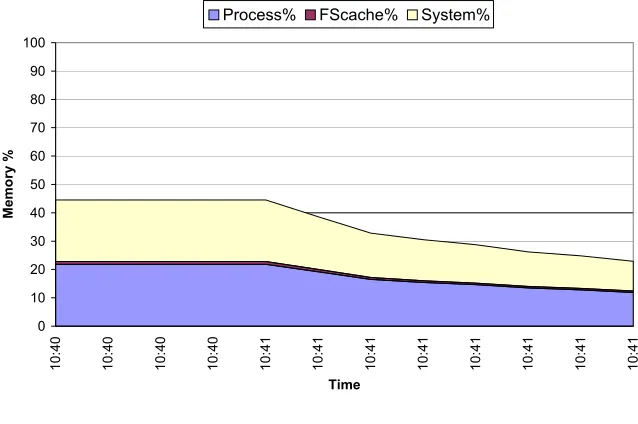
The second experiment showed the system behavior during dynamic memory reallocating. For one of partitions, the amount of memory was increased from 1 GB to 5 GB. As we can see in Fig. 4.2, the percentage of memory usage was decreased slightly. The dynamic memory reallocation works in the following way: the hardware management console is communicating with the hypervisor, if there is free memory than allocate it, then HMC is sending the message to operating system which information containing the memory address that might be used. Fig. 4.3 shows the same experiments which are shown in Fig. 4.2. The The numbers offorksand
execsdecreased in Fig. 4.2 at the same time when the amount of used memory changed in Fig. 4.3. For current
version it is possible to decrease, increase and relocate memory simultaneously between two partitions. When decreasing an amount of memory from a partition all applications must release particular memory segments.
0 10 20 30 40 50 60 70 80 90 100 1 0 :4 0 1 0 :4 0 1 0 :4 0 1 0 :4 0 1 0 :4 1 1 0 :4 1 1 0 :4 1 1 0 :4 1 1 0 :4 1 1 0 :4 1 1 0 :4 1 1 0 :4 1 Time M e m o ry %
Process% FScache% System%
Fig. 4.2.Memory usage.
More memory caused that the amount of forks and exec slightly decreased, also the numbers pswitchand
0 100 200 300 400 500 600 700 1 0 :4 0 1 0 :4 0 1 0 :4 0 1 0 :4 0 1 0 :4 1 1 0 :4 1 1 0 :4 1 1 0 :4 1 1 0 :4 1 1 0 :4 1 1 0 :4 1 1 0 :4 1 Time Nu mb ers o f execu ti o n s forks/sec execs/sec
Fig. 4.3.Processes.
The system statistics show that when the amount of memory was increased the utilization of kernel read/write system calls, hypervisor poolidle has decreased. The parameters show that the capacity of the partition should be better and disk transfers should increase. Then it shows that the disk transfers slow down after the dynamic changes.
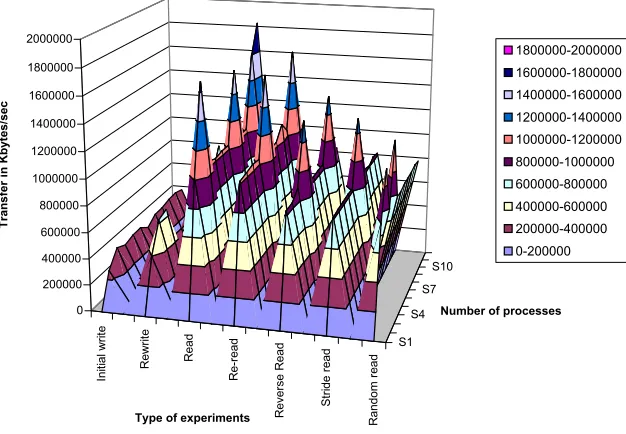
Next experiments show the system behavior when the numbers of processors and amount of memory has been changed. These experiments were taken in P5 server with 1.6MHZ CPUs with uncapped mode. The external devices were the following: (1) external storage DS4700 (2) logical volume created on RAID5 (3) fiber channel switches with 4Gbps adapters. Tests were generated by using the tools from iozone [18]. The first experiment has been done by using 0.1 CPU and 1GB RAM. The results are in Fig. 4.4.
In it ia l w ri te R e w ri te R e a d R e -r e a d R e v e rse R e a d S tr id e r e a d R a n d o m r e a d S1 S4 S7 S10 0 200000 400000 600000 800000 1000000 1200000 1400000 1600000 1800000 2000000 T ra n s fe r in K b y te s /s e c
Type of experiments
Number of processes
1800000-2000000 1600000-1800000 1400000-1600000 1200000-1400000 1000000-1200000 800000-1000000 600000-800000 400000-600000 200000-400000 0-200000
In it ia l w ri te R e w ri te R e a d R e -r e a d R e v e rs e R e a d S tr id e r e a d R a n d o m r e a d S1 S4 S7 S10 0 200000 400000 600000 800000 1000000 1200000 1400000 T ra n s fe r in K b y te s /s e c
Type of experiments
Number of processes
1200000-1400000 1000000-1200000 800000-1000000 600000-800000 400000-600000 200000-400000 0-200000
Fig. 4.5.Transfers with 6GB and 3CPU.
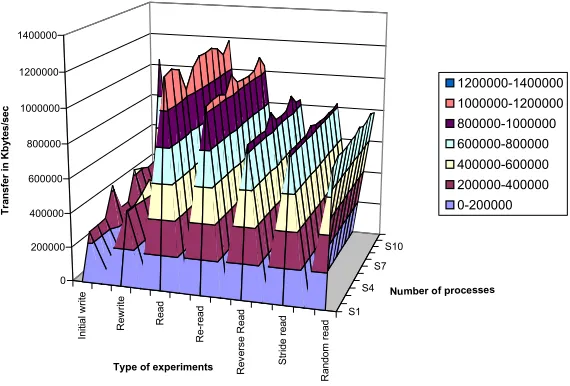
Because the intention of the experiments was to show an environment similar to a real system, the figures show series of experiments such as read, write, re-read, reverse read, stride read and random read. All of the tests have been done for various ranges of methods i. e. write, read, re-read, reverse read. The initial setup of this program was the following: minimum of processes equal 10, the maximum of processes equal 20. The generated plot (Fig. 4.4) shows S1 as the minimum numbers of processes, S10 as the maximum. Second experiment (Fig. 4.5) in the series has been done with 3 CPUs and 6 GB RAM.
The above experiments have shown that a logical partition with more memory and processing power (Fig. 4.5) has the ability to proceed with the I/O requests in a more stable way, because the transfer rate is the same for 10 and 20 processes. The Fig. 4.4 shows that average transfers are worst and also some unde-terminism has been found. Because the transfer rate for read reached 1800000 kBytes/sec this is more than for a read with 6 GB RAM i. e. 1200000 kBytes/sec.
The experiments have shown that the influence of processor frequency on system performance is less im-portant now than it was many years ago. For high frequency processors system parameters describing process scheduling have less influence on performance, because the parameters describing access to memory and storage are more important for this purpose these days.
5. Conclusions. Considering the fact that computer science and computer parallel systems architecture are still evolving, the problem of tuning dynamic resource allocation is a novelty. Continuously changing environment enforces the dynamic resource allocation mechanisms to improve.
This article concerns innovative techniques like virtualization and partition load management. Thanks to them, we can dynamically manage processing efficiency. The mechanisms make it possible to dynamically move resources between logical partitions on a server. Therefore the computer systems design can be more adequate to demands of new applications and databases. Consequently, we can say that it is possible to prepare methods for tuning operating system properties in order to improve suitability for dynamic resource allocation.
A reduction of the resource pool during normal system operation requires important changes in the operating system tuning values. The conclusion of the analysis and experiments is that in this respect even small changes in hardware can have big influence on system efficiency.
REFERENCES
[1] M. Mlynski,The analysis of influence of IBM pSeries servers’ virtualization mechanism on dynamic resources allocation in AIX 5L, Proceedings for IEEE CS International Conference ISPDC, 2008.
[3] Autonomic Computing,http://www.research.ibm.com/autonomic
[4] P. Bari, P. Cassier, A. Defendi, J. Hutchinson,A. Maneville, G. Membrini, C. Ong,System Programmer’s Guide to Workload Manager., IBM ITSO, Austin, 2005.
[5] P. Bari, D. Dillenberger, H. Morrill,System Programmer’s Guide to Workload Manager., IBM ITSO, Austin, 2005. [6] T. Cederlof, A. Klark, T. Herlin, T. Ostaszewski, IBM Certification Study Guide AIX Performance and System
Tuning., IBM ITSO, Austin, 2000.
[7] A. Dembeter, S. Dutta, A. Roll, S. Son,AIX 5L Differences Guide Version 5.3 Edition., IBM ITSO, Austin, 2004. [8] D. Clitherow, S. Herzog, A. Salla, V. Sokal, Trethewey J.,OS/390 Workload Manager Implementation and
Exploita-tion., IBM ITSO, Austin, 2004.
[9] T. Czachorski, Analitical Queuing Model for Performance Evaluation of Computer Systems and Computer Networks., ProDialog, no. 16, Poznan 2003.
[10] IBM AIX Technical Documentation: Performance Management Guide.,VMM page replacement tuning., 2008. [11] IBM AIX Technical Documentation: Performance Management Guide.,Tuning Logical Volume Striping., 2008.
[12] J. Jann, L. M. Browning, R. S. Burugula,Dynamic reconfiguration: Basic building blocks for autonomic computing on IBM pSeries server., IBM Systems Journal, vol. 42, no. 1, 2003 Autonomic Computing.
[13] M. Mlynski,Dynamic Resources Allocation in AIX 5L, Real Time Systems - Design and Applications., XII Conference of Real-Time Systems , Ustron 2005.
[14] M. Mlynski,Analysis of Using An AIX Dynamic Resource Allocation Mechanism to Describe a Utility Level of Server in Oracle Data Bases Environment, Studia Informatica, vol. 26 no. 3(64), Gliwice 2005.
[15] C. Matthys, M. Mlynski, N. Tollet, G. Barbati, H. Chauhan, B. Dierberger, R. Marchini, H. Wittmann,Planning, Installing and Using the IBM Virtualization Version 2.1, IBM ITSO Poughkeepsie (USA)2006.
[16] S. Wegrzyn,Informatics as Specific Domain on Motion and Processing of Information., ProDialog, no. 16, Poznan 2003. [17] S. Wegrzyn,Resource Management in Grids., ProDialog, no. 16, Poznan 2003.
[18] IOzone,http://www.iozone.org
[19] G. Vallee, T. Naughton, L. S. Scott,System Management Software for Virtual Environment., Proceedings of the 4th international conference on Computing frontiers, 2007.
Edited by: Marek Tudruj, Dana Petcu
Received: February 7th, 2009
![Fig. 2.1. Scheme of logical partitions on IBM pSeries Systems server architecture. [1, 15]](https://thumb-us.123doks.com/thumbv2/123dok_us/8750362.1748403/2.595.164.463.203.411/fig-scheme-logical-partitions-pseries-systems-server-architecture.webp)
![Fig. 2.2. The scheme of physical connections to partition load manager. [1, 15]](https://thumb-us.123doks.com/thumbv2/123dok_us/8750362.1748403/3.595.115.454.184.359/fig-scheme-physical-connections-partition-load-manager.webp)
![Table 3.2CPU-related parameters [2].](https://thumb-us.123doks.com/thumbv2/123dok_us/8750362.1748403/6.595.140.476.144.537/table-cpu-related-parameters.webp)