Value Management as an Efficient Risk Management Tool
Nnadi E. O. E.*, Ezemerihe A.
Department of Quantity Surveying, Federal University of Technology, Akure, Nigeria
Abstract
The twin processes of value and risk management are fundamental to the successful delivery of projects and should be used throughout project life cycle. While value management helps the client to identify the best way of meeting business needs, risk management is used to manage the risks associated with the solution that offers the best whole-life value to the project. This study evaluates value management as an efficient risk management tool. This research is exploratory in nature and it seeks to gauge a level of financial sustainability of the executors in the industry. A qualitative approach was adopted by painstakingly analyzing the literature. The research findings reveal that effective value management workshop and structure is a useful tool in handling risks and uncertainties that may come up during the project, and helps improve the effectiveness of risk responses. It is therefore recommended that risk experts should adopt value management techniques as a risk management tool for successful projects delivery.Keywords
Construction industry, Project risks, Risk management, Risk tool, Value management1. Introduction
The nature of the construction industry is such that employs variety of inter-related disciplines, stakeholders and resources simultaneously to achieve project success. Indeed, as [1] puts it ‘the construction industry is considered as a risky business due to its complexity and strategic nature incurring a numerous number of stakeholders, internal and external factors which lead to risks’. [2] says construction projects are exposed to risks both at the time of their coming into existence and in the various stages of the projects development. It therefore is worthwhile to consider risk management and attempt to minimize costs due to failure to take precautions or to avoid risks completely. Value has been an object of definition since the times of the ancient Greeks. Since then, the understanding of the measuring of ‘value’ has been changing and ‘value’ in construction is the latest interpretation [3].
Value thinking began in the USA in the 1940s with the work of Lawrence Miles, a purchase engineer in General Electric Company, being sent to purchase specific material and unable to get it. He discovered that, if he cannot obtain the specified product, he must obtain an alternative which performs the same function, [4]. He found that many of the substitutes were providing equal or better performance at a lower cost than the initially specified. He called this value analysis. He defined Value Analysis as an organized approach to providing the necessary function at the lowest
* Corresponding author:
[email protected] (Nnadi E. O. E.) Published online at http://journal.sapub.org/james
Copyright © 2018 Scientific & Academic Publishing. All Rights Reserved
cost. The techniques of value and risk management are utilized as a means of achieving value for money through clearly defining the objectives and establishing a consensus as to how to meet these objectives. These activities are encompassed in value management, again by ensuring the economic soundness of the project and dealing effectively with the problems which may occur that will affect project objectives is engaging in risk management [5]. There have been several papers on the similarities, benefits, and function of value and risk management. It is therefore sacrosanct to curb risk if the construction industry would grow to expected level. This paper thus examines the value management and its technique to affirm its relevance and importance as a risk management tool.
2. Review of Papers
discuss and solve the problems in the best possible manner that works best for the construction sector due to the nature of its activities that involve many disciplines and backgrounds [6]. Value is an attribute of an entity determined by the entity’s perceived (this means value differs from person to person, place to place, and time to time) usefulness (if the purpose is fulfilled and the function performed), benefits (means the advantages gained) and importance [8].
[5] defined Value as a measure expressed in currency, effort, exchange or on a comparative scale which reflects the desire to obtain or retain an item, or service; Value can also be seen as the ration of function and quality to the life cycle cost of an element; Value can also be defined as the most cost-effective way to accomplish a function that will meet the user’s needs, desires and expectations. However, Risk was defined as a positive or negative deviation of a variable from its expected value [2]. In the same vein [1] views risk in the construction industry as the likelihood of the occurrence of a definite event or a combination of events during the whole process of construction. He sees it as an exposure to the consequences of uncertainty. [10] defines project risk as an uncertain event or condition that if it occurs has a positive or negative effect on the project objective. It goes further to state that project risks which stems from uncertainty constitutes both threats to the projects objectives and opportunities to improve on the existing objectives of the project. [11] sees the definition given by [10] as a more updated definition from the traditional risk definition and it refers to the change from a chance of something happening that will have impact on the project objectives to the effect of uncertainty on project objectives. It is necessary therefore that identified risks are managed to achieve the project goals. [12] defines risk management in construction project management as a systematic way of identifying, analyzing and dealing with risks associated with a project in an aim to achieve project objectives.
Risk management in addition also involves treating, and monitoring the risks involved in any activity, while project risk management is a process that helps project managers in setting priorities, allocating resources and implementing actions that reduce the risk of a project not achieving its objectives [13]. [14] defined it as the process of identifying, analyzing, accessing, and communicating risk and accepting, avoiding, transferring or controlling it to an acceptable level considering associated costs and benefits of any actions taken.
3. Relationship between Value and Risk
Management
Value Management may be applied in association with, or as a part of risk management [8]. Value management and risk management are considered an essential part of project management, both relate to group activities that are based on a systematic process with teams of professionals and the
involvement of experienced facilitators from various multidiscipline working together in creative workshops [15]. Thus, integration of value management and project management in construction projects help to avoid duplication of work and deliver better value for money, this leads to a better project delivery and greater client satisfaction [16]. Good comparison between value and risk management was gotten from the work done by [15] and [5]. Value management was affirmed a means of defining project objectives, while risk management ensures that the pre-defined project objectives are not affected by future uncertain events. Both management processes require creativity; value management requires creativity to come up with alternative options that will yield higher or similar value without change in function, while risk management needs creativity to identify potential risks for whatever options for consideration, analysis, response and mitigation. A common technique used in both value and risk management is brainstorming technique. Value management establishes good communication and thereby prevents conflicts; risk management prevents conflicts by early identification, proper allocation and efficient management of such risks. Both value and risk management help to improve the decision-making process in the construction industry. The two processes both help to achieve cost savings on a project. When a risk is well managed, it is possible to achieve cost savings and enhancement of value; value engineering a component of value management eliminates unnecessary costs and thus, adds value to the project. Value management is usually thought of as requiring a positive and open frame of mind to consider every available alternative proposed; risk management especially during the risk identification stage requires a negative mind frame to critically look out for errors or likely events that can hinder the achievement of project objectives, whereas in the risk response stage, the team switches back to a positive outlook to mitigating those risks. When a risk is managed, it is possible to achieve cost saving and an enhancement in value; in the same vein, when carrying out value management on a project, the options considered may each have their inherent risks [15].
4. Integration of Value Management and
Risk Management
stage of the project life cycle such integration should occur with attention to the level of integration that needs to be made, we could achieve success in integrating both risk and value management practices. He went on to propose the following critical success factors that he views as important for the integration of risk management and value management in a single study process. In the selection of appropriate standards and methods, it will be beneficial to select methods that those participating are accustomed with, this is also an effective combination of risk management and value management phases. In integrating the two methods, risk and value should be addressed separately initially and linked at the idea generation phase of the value management study. Finally, selection of the appropriate tools or the most suitable techniques for each activity should be carefully carried out as it is critical to the success of the integration.
To make a successful integration of risk and value management, one must have a well-defined implementation strategy [17]. He proposes the following strategy:
Client’s willingness on each of the key success factors mentioned above: it is important to inform and educate the client on the importance and appropriateness of conducting an integrated workshop.
Scope of the value management and risk management studies: for the integration of value and risk management to be successful, the objectives and milestones that need to be achieved through the study should be defined. This should in no way be confused with the project’s scope and should be within the project’s scope; however, contingencies can be allowed to accommodate any new development and change in project scope.
Project scope: it is critical to the integration of both value and risk management to identify the scope of the project as soon as possible to limit constant and continuous changes in scope. Within the scope of the project, the objectives of the project should be identified in order of relative importance especially during the planning phase.
Facilitation of the workshop: it is advised that an experienced independent facilitator who understands both value and risk management should be hired, if possible one who is a certified practitioner of both value management and risk management.
Value and risk management studies/workshops are best driven through value management methods because value management improves functionality while delivering value for money which is a condition
precedent to addressing risk or uncertainties within the project.
It is best to have a neutral venue for the studies/workshops with adequate space and technical facilities that will assist the team.
It is important to involve key decision makers and possessors of information and experience to participate as team members of the workshops also involving the client in the workshops is of tremendous benefits at the early stage of the project.
It is also beneficial to involve a person with good knowledge and experience on the project but who is independent of the project to contribute to the workshops.
Sufficient time should be allocated for the workshops based on the nature of the project and it size to enable all possible options to be explored, with breaks in-between to help participants refresh and think over and develop new innovations.
All project stakeholders that are invited should be supplied with all relevant information regarding the project and its objectives. There should be a mechanism of collecting and sharing information with all activities properly documented for future reference.
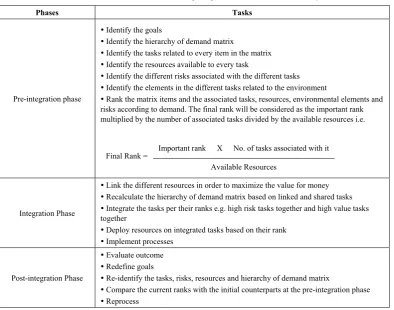
Table 1. Framework of new model for integrating value, risk and environmental systems
Phases Tasks
Pre-integration phase
Identify the goals
Identify the hierarchy of demand matrix
Identify the tasks related to every item in the matrix Identify the resources available to every task
Identify the different risks associated with the different tasks Identify the elements in the different tasks related to the environment
Rank the matrix items and the associated tasks, resources, environmental elements and risks according to demand. The final rank will be considered as the important rank multiplied by the number of associated tasks divided by the available resources i.e.
Final Rank = Important rank X No. of tasks associated with it Available Resources
Integration Phase
Link the different resources in order to maximize the value for money Recalculate the hierarchy of demand matrix based on linked and shared tasks Integrate the tasks per their ranks e.g. high risk tasks together and high value tasks together
Deploy resources on integrated tasks based on their rank Implement processes
Post-integration Phase
Evaluate outcome Redefine goals
Re-identify the tasks, risks, resources and hierarchy of demand matrix
Compare the current ranks with the initial counterparts at the pre-integration phase Reprocess
Source: Adapted from work of [16] Integrating value, risk and environmental management systems at the strategic definition stage
5. Benefits of Incorporating Value
Management and Risk Management
in Construction Projects
[19] explained the following as benefits of incorporating value and risk management for developing low cost housing which can also be adapted for various types of construction development:
Better understanding of the client’s needs and
requirements:both value and risk management is directed
towards understanding the objectives of the client and his requirements. Also, the client’s brief could be modified by analyzing the functions of each element and feeding back to the project for enhanced value.
Removing unnecessary cost: value engineering a branch of
value management aims at removing unnecessary cost. Also, for developed countries such as Australia, emphasis is moving into ‘designing out risk’ [17]. This in a great way helps to reduce cost overrun and the bane of abandoned projects. Using value and risk management the team could achieve:
a. Optimum value for money while satisfying the client’s requirements
b. Prevention of unnecessary expenditure c. Balance between cost and function
d. Substituting materials or processes to achieve better
results
e. Proper design review at milestones f. Improvement of life-cycle costing g. Avoidance of over specification
Reducing project time: value management helps to
simplify project design and construction method, it is most likely that during the workshops this is well thought out also by managing risks that may delay project completion
Improving communication and team spirit: value and risk
management because they involve multiple disciplines which come together for a common purpose ensure that each professional’s view is well perceived and adequately reflected in the design and construction. Since, there was a dynamic contribution towards decision making, there is most likely to be commitment and full participation on any decision agreed upon.
Creative and innovative ideas: following the steps of
carrying out both value and risk management together on a project, innovative alternatives are generated and evaluated, with the best alternatives selected and implemented, this forms a sort of research and development for the industry generating new materials and construction techniques and displacing traditional construction processes.
Effective management of change orders/variations: at
philosophies can be applied to the project. This enables proper management of variations that take place during the design and construction stages, the contractor in some cases are put on the workshops and thus, decisions concerning variations can be reached together and accomplished faster.
6. Tools of Value Management that
Make It Efficient for Managing Risk
[20] and [21] compiled a list of value management tools presently used in the UK and the EU as discussed. BusinessProcess Re-engineering takes a single focus on processes
and redesigns them for greater effectiveness, interfacing this with other factors helps to reduce costs and increase quality, service and speed without reducing overall value. Conjoint
analysis is useful in situations that demand a prediction of
respondent choices, it offers clients a different combination of features or services for them to compile preferences. It is best administered in the form of a questionnaire while
cost estimation deals with methods of estimating total
construction cost and whole-life cost. P/M/I refer to Plus/Minus/Interesting which are used in the workshops. The Plus, Minus and Interesting headings are put at the top of the columns and every idea is then discussed with the positive effect of its implementation put on the plus column. The negative effects put on the minus column and any other effect that will have impact on the project objectives but such an impact is uncertain is put in the interesting column.
Delphi is a method of getting groups of individuals to arrive
at a consensus decision without face to face discussion. This method avoids group thinking although it may prove helpful where some contributors’ dissent is suppressed by peer pressure. Design to Cost/Design to Life Cycle Cost/Design to
Objective on its part is considered as a performance that must
be attained. Here, the client or team determines what factors are relevant in the present circumstances and the objectives that are to be met. Other methods identified by authors such as [19] and [20] are Dots which the facilitator gives to the participants a few sticky dots to put across their favorite ideas, the ideas with the most number of dots is ranked most important and so on. It is useful in assigning relative importance to the ideas generated. Earned Value Analysis or
Management on the other hand is a method of assessing
whether a project is on track for completion within agreed time and cost targets. Elementary Skills Gap Analysis
involves comparing the skills that are needed for a task and those available within the project or value and/or risk management team with a view to filling any gaps by inviting new members or training existing ones. Excursions involves taking team members away from site to an environment that enhances creativity and thinking.
Facilitation is an interpersonal skill that helps others to
undertake a task and improve the way they work together. It requires an understanding of the process to be applied, the dynamics of the group, and the effect of the facilitator’s
actions on the group. Five W’s and one H tackles a problem by asking six basic questions starting with who; why; what; when; where; before how. Meanwhile, Function Analysis
System Technique (FAST) refers to a diagrammatic
representation of functions and their hierarchy, FAST works by asking how the functions relate to each other. Functional
Performance Specification is a document where the enquirer
expresses his needs in terms of user-related functions or service functions and constraints, it can be used for a product, a system, an industrial process or a management system.
Function priority matrix is a method of using functional
analysis but minimizing the time it takes by sorting functions as to whether they are tactical or strategic and in their order of importance. Information gathering methods is vital at the brief stage. It is important to understand the purpose of the study/workshop and correlate the information you are receiving with the basic information gotten during the briefing stage. It is usually better to use a checklist of questions at a strategic briefing meeting, questionnaires can also prove useful. Issues generation and analysis involves team members write their issues on sticky notes and display them on the wall under appropriate headings, they now narrow down their focus by voting a number out of the overall number of issues they have written and explore ways to address them. Managing difficult people is a much-needed skill by the facilitator and other members of the team. It deals with understanding the effects of behavior and of personalities driven by the desire to get the job done. Net
Present Value as alternatives examined based on a
discounted cash flow analysis. Peer Review involves seeking objective imputes or comments from similarly qualified individuals who are not part of the project under study.
SCAMPER helps to aid idea generation. S stands for
Substitute, C for Combine, A – Amend, M – Modify, P – Put to other value, E – Expand, R – Reverse or reduce. This helps to move from the creative thought to the practical idea.
SMART (Simple Multi Attribute Rating Technique) is a
technique for use during briefing and outline design stages.
Soft Systems Methodology (SSM) compares the current
situation with the ideal situation to generate acceptable actions for change. Stakeholder analysis helps in the identification of those people or groups with vested interest in the project and their attitudes towards it. It can assist in focusing the teams’ attention on key stakeholder interests.
Strategic Choice Approach focuses on uncertainties inherent
in the decision under review, it helps to shape a problem, design alternative responses and compare these responses to select the best. SWOT analysis compares the strengths, weaknesses, opportunities and threats of ideas generated to help in decision making. Systems thinking enhances analysis of a problem into its constituent parts to aid in understanding it better. Systems thinking focuses on the relationship between these constituents formed by their combination.
Target Costing sets target costs based on what the market
will pay rather than how much it costs to produce it. T Charts
A statement of the idea forms the top of the T. Value Metrics
refers to methods of measuring monetary and non-monetary enhancements in value for the project.
Therefore, the right combination of these methods and tools for each value management activity is critical to solve the problem being considered or to achieve the aim and objectives being pursued. It is important that team members of the study should have a thorough knowledge of the methods and tools before combining them or using them [20].
7. Conclusions
The creativity of the value management workshop and structure is a useful tool in handling risks and uncertainties that may come up during the project, and helps improve the effectiveness of risk responses. The integration of value and risk management can increase the knowledge of the project and therefore help in enhanced decision making. Therefore, promoting the integration of value and risk management will result in a powerful management tool and increase their application within the construction industry [15].
REFERENCES
[1] Renuka S.M., Umarani C., Kamal S (2014), A Review on Critical Risk Factors in the life cycle of Construction Projects; Journal of Civil Engineering and Research 2014, 4(2A): pp 31-36.
[2] Schieg M (2006), Risk Management in Construction Project Management, Journal of Business Economics and Management, 7:2, pp 77-83.
[3] Langford, D, Martinez V and Bititci U S, (2003), Best Value in Construction: Towards an Interpretation of Value from Client and Constructors Perspectives, Journal of Construction Procurement, vol. 9, no. 1, pp 56-67.
[4] Kelly J, Male S and Graham D (2004), Value Management of Construction Projects. Oxford: Blackwell.
[5] Othman, Ayman A.E (2004), Value & Risk Management for Dynamic Brief Development in Construction, Lambert Academic Publishers.
[6] Che Mat, M.M. (2010), Value Management–the Way Forward (www.vm-academy.com/lifecyclyvaluemgmt.pdf accessed 14/07/2017).
[7] Ann T.W and Ivan Y.L (2009), Application of Value Management in Construction CIOB Hong Kong and The Hong Kong Institute of Value Management.
[8] Australian Standard AS 4183:2007: Value Management (www.standards.org.au accessed 14/07/2017).
[9] Government of Western Australia Department of Treasury: Strategic Asset Management Framework; Value Management (accessed 30/05/2017)
(www.treasury.wa.gov.au/management/21_SAMF_Value_M anagement.pdf).
[10] A Guide to the Project Management Body of Knowledge (PMBOK Guide) 2000 Edition.
[11] Australian Government Department of Finance (2010), AS/NZS ISO 31000:2009 Risk Management Principles and Guidelines Fact Sheet (www.finance.gov.au accessed 14/07/2017).
[12] Zou P. X.W, Zhang G, Wang J (2007), Understanding key risks in construction projects in China, International Journal of Project Management, pp 601-614.
[13] Abdulaal R (2009), Introduction to risk management for construction projects: Vice Presidency for projects. (https://vp-projects.kau.edu.sa/GetFileasp
accessed 14/07/2017).
[14] Beers R (2010), Risk Steering Committee: Department of Homeland Security; DHS Risk Lexicon 2010 Edition (www.dhs.gov/dhs-risk-lexicon accessed 18/06/2017). [15] Hiley, A and Paliokostas, P (2001). “Value management and
risk management: an examination of the potential for their integration and acceptance as a combined management tool in the UK construction industry,” in Proceedings of the RICS Construction and Building Research Conference (COBRA ’01), Glasgow, Scotland, vol. 1, pp. 27–36.
[16] Alaqad M, Gidado K, and Piroozfar P (2015), Integrating value, risk and environmental management at the strategic definition stage. Proceedings of 31st Annual ARCOM
conference, pp 145-154.
[17] Ranesh A., Zillante G., Chileshe N., (2012), Towards the integration of risk and value management. Australian Journal of Construction Economics and Building, Conference Series, 1(2), pp 43-51.
[18] Othman A, Hassan T, Pasquire C (2005), Dynamic brief development for better construction briefing. Proceedings of the 5th International Postgraduate Research Conference, University of Salford, vol. 1 pp 55-65.
[19] Othman, Ayman A.E (2008), Incorporating value and risk management concepts in developing low cost housing projects. Emirates Journal for Engineering Research, 13(1), pp 45-52.
[20] Murphy P (2011), Management of Value (MoV) toolbox (www.axelos.com/MoV_Toolbox accessed 14/07/2017). [21] European Commission (1995), Value Management