Strojniški vestnik - Journal o f Mechanical Engineering 54(2008)2, 140-147
UDK - UDC 539.319:624.073 Paper received: 1.8.2006 Paper accepted: 28.9.2007
Investigation of Stress Concentration Factor for Finite-Width
Orthotropic Rectangular Plates with a Circular Opening Using
Three-Dimensional Finite Element Model
Kambiz Bakhshandeh* - Iraj Rajabi - Farhad Rahimi MUT University, A ir Naval Research Center, Iran
In this paper, theoretical stress concentration factorfor finite-width orthotropic plates with centered circular opening is investigated by use o f three-dimensional finite element analysis. In the first part, the finite element (FE) model is validated by comparison analytic equations fo r infinite orthotropic and isotropic plates. With verified model, the stress concentration factor is calculated fo r orthotropic rectangular plates with centered circular opening subject to uniform tension. The effect o f opening radius to width o f plate ratio fo r various orthotropic plates with different orthotropy ratia is investigated. This study shows the accuracy o f analytical method is dependent on orthotropy ratio and a/W ratio. In high opening radius to plate width ratio, the orthotropy ratio has a little effect on stress concentration factor.
© 2008 Journal o f M echanical Engineering. All rights reserved.
Keywords: stress concentration factor, finite element methods, orthotropic plates
0 INTRODUCTION
Stress concentrations around cutouts have g re a t p ra c tic a l im p o rta n c e b e c a u se th e y are normally the cause o f failure. For most materials, the failure strengths o f the materials are strongly notch (or hole) sensitive. The net failure stress, taking into account the reduction in cross-section area, is typically m uch less than the ultimate tensile strength o f the same materials without the notch or hole. Until now, the stress concentration factor for v a rio u s is o tro p ic s tru c tu re s is in v e s tig a te d . Heyw ood [1], Peterson [2] and Pilkey [3] have investigated various isotropic shape w ith w ide ran g e o f h o les. H o w lan d [4] d e te rm in e d the so lu tio n o f th e p ro b le m o f a lo n g iso tro p ic rectangular plate with a centered hole subject to a tension load. Peterson and Heyw ood introduced various equations for long length and finite width plate with different opening shapes.
L ek h n itsk ii [5] and Tan [6] introduced various form ulations for stress concentration in orthotropic materials. Lekhnitskii derives equations for infinite plate w ith circular holes. For finite- w idth orthotropic plate Tan introduces various equations. He derives these equations by use o f equilibrium relations, but he did not investigate the effect o f orthotropy ratio. The orthotropy ratio is
defined as the ratio o f two elastic moduli in both m ain d irectio n s. The an aly sis p resen ted here suggested, that Tan’s equations are applicable only for a specific range o f orthotropy ratio.
In this paper, the effect o f orthotropy ratio on the stress concentration factor o f rectangular fin ite -w id th p la te s w ith c irc u la r o p en in g is investigated. These plates are under action o f unidirectional tension loads. In the first part, the fin ite elem ent m odel is v alid ated for infinite orthotropic and isotropic rectangular plate with circular opening. With validated model, the effect o f orthotropy ratio on stress concentration factor is investigated.
1 THEORETICAL STRESS CONCENTRATION FACTOR FOR FINITE
WIDTH PLATE
A s is w ell know n the theoretical stress concentration factor (TSCF) for normal stress is defined according to [2] and [7]:
* r = — (1),
^n o m
where the stress omm represents the maximum stress to be expected in the member under the actual loads and the norm al stress anom is reference norm al
stress. In a rectangular plate under action o f un id irectio n al tension load 5 (Fig. 1), cr V CD / 7 n o m is calculated based on the whole cross-section o f the plate (gross area) as [2]:
where:
S - traction force, uniform on edges o f plate,
W - plate half-width,
h - plate thickness.
In this way, defined reference stress is in fact the far away field stress. TSCF calculated from Equations (1) and (2) is denoted by KTg and is very useful when investigating wide plates with small openings, i.e. when approaching infinite domain problems.
Som e v alu es o f the TSC F have been com piled by some m ajor references Peterson, Pilkey, Tan and Lekhnitskii, and are reproduced in a n u m b e r o f m e c h a n ic al d e sig n tex ts used worldwide.
F o r a fin ite w id th p la te , the stress concentration factor can be calculated by use o f finite-width correction (FWC) factor [6] and [8], FWC factor is a scale factor defined as the stress concentration factor o f an infinite to a finite-width plate. Thus, the stress concentration of finite-width plate can be calculated with specification o f FWC factor and stress concentration o f infinite plate with sim ila r opening and m aterial (orth o tro p ic or isotropic).
FW C fa c to r fo r iso tro p ic m a terial is independent o f m aterial properties thus can be determ ined accurately by use o f curve fitting technique. Whereas in orthotropic material, this factor must be obtained with stress analysis by use
Fig. 1. A finite-width plate containing a central elliptical opening
o f elasticity equations or m ainly using finite element methods [6].
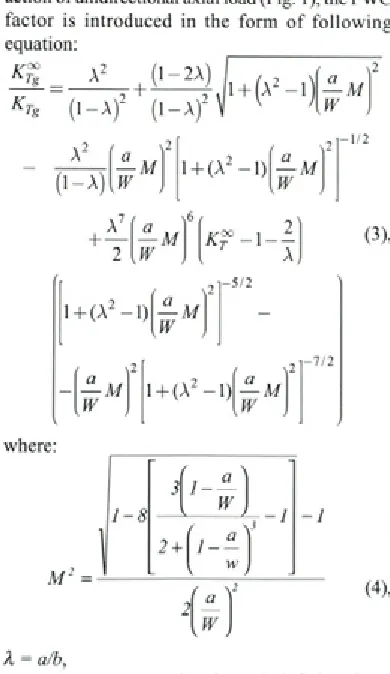
According to investigation o f Tan on rectangular orthotropic plate with elliptical opening under action o f unidirectional axial load (Fig. 1 ), the FWC factor is introduced in the form o f follow ing equation:
A2
(1 -A )2 ( l - A f
1
+\2 (a2 - 1)
\ ±
m\
V /
[w
1- 1/2
M )
w
-M 1 + (AZ — 1) W-MA7 a 6 2Ì
H--- — M K f -1
-2
[w
1 A(3),
- 5 / 2
1 + (A2 — 1)
W-M
x2 2- 7 / 2
— — a TirfM 1 + (A2 — 1)— M
W
[w
where:
- l
(4),
A = a/b,
- stress concentration factor in infinite plate,
K T - stress concentration factor in finite plate. The m agnification factor M, is only a function o f a/W and is independent o f material properties.
For a circular opening A = a/b = 1 with using the L’Hospital’s rule twice w.r.t A [6], Equation (3) becomes:
This equation can be used for orthotropic and isotropic finite-w idth plates w ith circular opening under action of unidirectional tension load for a/W up to 0.9 [6],
For calculation o f stress concentration factor in a finite-w idth plate besides o f FWC
1 - 8
3 i
w ) 1
2 +
w
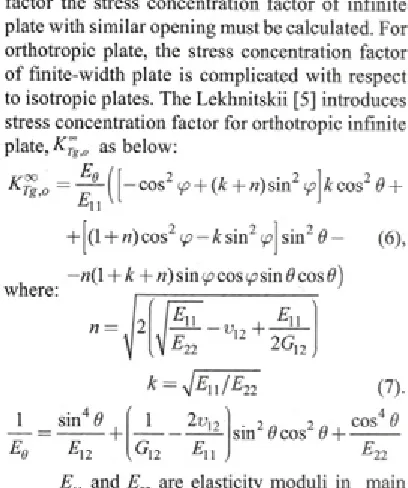
factor the stress concentration factor o f infinite plate w ith sim ilar opening must be calculated. For orthotropic plate, the stress concentration factor o f finite-width plate is com plicated w ith respect to isotropic plates. The Lekhnitskii [5] introduces stress concentration factor for orthotropic infinite plate, K^go as below:
^Tgo = ——( — cos2 <£ + (& + « )sin 2<p £ c o s20 +
Eu u J
+ |(l + « )co s2 </>-A:sin2 (y9]sin2 # — (6),
- « ( 1 + k + n) sin ip cos p sin 6 cos 6 )
where:
n =
k — \ IE 11! E 22 (7).
2^12
En ,
sin2 9 cos2 9 + cos4 9
E
22
E u and En are elasticity moduli in main directions, Gu is modulus o f rigidity in shear plane, t>12 is Poisson ratio, 9 is polar angle measured from
Xaxis (main direction 1 ) and (p is the angle o f acting force w ith respect to main direction 1 (Fig. 2).
For an infinite plate with circular opening u n d e r a c tio n o f u n id ire c tio n a l te n sio n , w ith direction o f the applied force aligned w ith the main direction 1, (p is 0 and polar angle 9 at points ‘c ’ and ‘d ’ on Figure 2 is 0 and 90 degree, respectively. The stress concentration factors for these two points are:
K
K
00,1 Tg,o
°°,2
Tg,o
= 1 + n
= —k
(8),
where:
K ^f0 - stress concentration factor o f point ‘c ’ for orthotropic infinite plate,
K'rg'j, - stress concentration factor o f p o in t’d ’ for orthotropic infinite plate.
In isotropic material E n = E22 and G = E/
2(1+v), and according to Equations (6) and (7), the stress concentration factor for point ‘c ’ and ‘d ’ are 3 and -1, respectively. Substituting, K ~g = 3 in the Equation (5), it is simplified to:
K rg _ 3(1- a / W ) K Tg 2 + { l - a/W y
T his is fam iliar H eyw ood equation for isotropic infinite-plate with circular opening. Also, Flowland determined the solution o f the problem o f a long rectangular plate w ith a central hole subject to tension in an open series form [4].
A nother w ay to approaching the stress c o n c e n tra tio n fa c to r and FW C fa c to r is the application o f the average normal stress across the net section (2(W-a)Ji) instead o f the whole width o f the plate (gross area). This stress concentration factor is known as net stress concentration factor,
K Tn and can be related to the prev io u s stress concentration factor, K by:
K T„ = K Tg( l - a / W ) (10).
In the common engineering sense it is more convenient to give stress concentration factors using reference stress based on the net area rather than the gross area [9]. Thus in this study the net stress concentration factor is used.
1.1 Finite Element Model Validation
The stress concentration o f an isotropic and orthotropic plate with circular opening under action o f unidirectional tension is calculated by use o f a finite element software MSC.Nastran [10].
Due to symmetry and using the appropriate displacement boundary conditions only one quarter o f the plate was used as occupied by the shaded area indicated in Figure 3. The utilized restrictions
Fig. 3. Finite element model region
are zero displacement in the X direction for all the mesh nodal points located on the line X = 0, and zero displacement in the Y direction for all mesh nodal points, located on the line Y = 0.
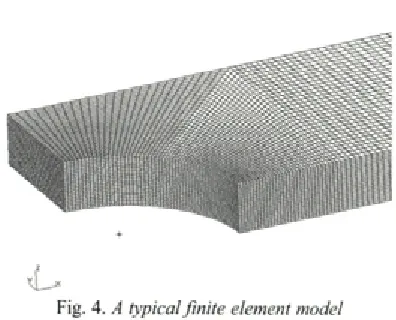
The finite element model is discretized with twenty-node solid brick elements (Fig. 4).
Various mesh densities for each o f plates are u sed to achieve a good m esh density for improving accuracy o f results. The mesh density is changed from coarser to finer. On the average and roughly the fine mesh have ten times more n o d es and elem en ts than the co arse m esh. D e n sify in g is ite ra tiv e ly re p e a te d u n til the difference between the consecutive results becomes s m a lle r th an 0.35% . In F ig u re 5 the final discrepancy o f the TSCF for various opening ratia is shown. This figure reflects the absolute value o f the difference (percent) in the magnitude o f the TSCF due to the mesh refinement. Between 67171 to 70501 elements are used in the study.
Because the isotropic material properties are not different in main directions, this is used for
Fig. 4. A typical finite element model
im proving the finite elem ent model accuracy besides o f orthotropic material.
The finite element model is created for various opening ratia, on plates with dimensions: half-length L = 1000 mm, half width W= 100 mm and thickness 10 mm for isotropic and orthotropic material. The opening radius to half-length o f plate ratio a/W is changed from 0.1 to 0.8.
The isotropic plate has elastic modulus £■ = 210 GPa, Poisson ratio v = 0.3 and mass density p = 7800 kg/m3.
The net stress co n cen tratio n facto r is calculated for isotropic plates by use o f Equations (9) and (10) and compared with FE method results.
Table 1 shows the net stress concentration factors that are concluded by FE and analytical method for isotropic plates.
The error e in this table is defined as:
TSCFTheory TSCFfem
TSCFTheory>i •00 (11), where TSCF _ and TSCF are, respectively, the
È g 0.2
u 0)
E fo 3 * ; 0.15
E .£
0 0.1 0.2 0.3 0.4 0.5 0.6 0.7 0.6 0.9 Opening radius to plate width [a/W]
Table 1. Net stress concentration factor fo r isotropic plate
N et Stress C o n cen tratio n F a c to r ERROR***
a/W Heywood* H ow land ’ FE e
%
0.1 2.72 2.72 2.73 0.37
0.2 2.61 2.62 2.59 0.61
0.3 2.34 2.36 2.35 0.31
0.4 2.22 2.24 2.23 0.35
0.5 2.12 2.16 2.11 0.41
0.6 2.06 2.09 2.05 0.29
0.7 2.03 2.05 2.04 0.24
0.8 2.01 2.03 2.02 0.40
* Eq. (9) **Ref. [4]
* * * Error (Eq. 11 ) o f FE results with respect to Heywood results stress concentration factors calculated w ith the
analytic and FE method.
As it can be seen from Table 1 the agreement between the finite element method and theoretical solution for isotropic plate is excellent.
The distribution o f net stress concentration factor in a vicinity o f circular opening for isotropic plate with a/W = 0.1 is shown in Figure 6.
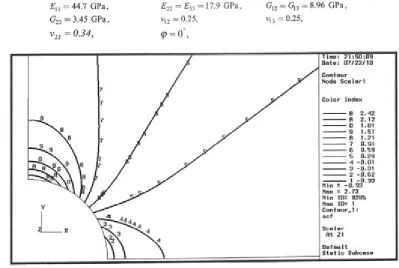
For orthotropic plate KTn is also calculated by use of FE and analytical method (Eqs. (5), (8) and (10)). The properties of the orthotropic material are:
C orresp o n d in g to a ty p ical orthotropic material [11].
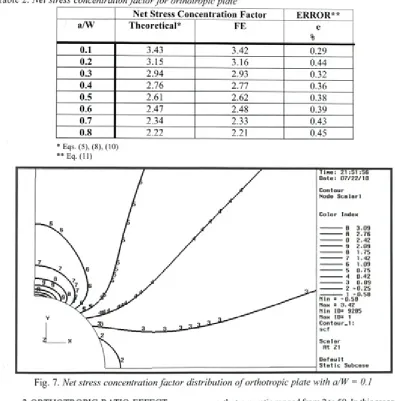
In T ab le 2, th e c a lc u la te d n e t stre ss concentration factor is compared. The error that is shown in this table is calculated by Equation
(ID-Similar to isotropic plate, the FE method has a good accuracy for orthotropic materials.
The distribution o f net stress concentration factor in a vicinity o f circular opening for orthotropic plate with a/W= 0.1 is shown in Figure 7 .
Eu = 44.7 GPa, G23 =3.45 GPa,
V 2J - 0.34,
E22= E n =\1.9 GPa, G12 = G, j = 8.96 GPa,
V|2 = 0.25, v13 = 0.25,
Table 2. Net stress concentration factor fo r orthotropic plate
Net Stress Concentration Factor ERROR**
a/W Theoretical* FE e
%
0.1 3.43 3.42 0.29
0.2 3.15 3.16 0.44
0.3 2.94 2.93 0.32
0.4 2.76 2.77 0.36
0.5 2.61 2.62 0.38
0.6 2.47 2.48 0.39
0.7 2.34 2.33 0.43
0.8 2.22 2.21 0.45
* Eqs. (5), (8), (10) ** Eq. (11)
Fig. 7. Net stress concentration factor distribution o f orthotropic plate with a/W =0.1
2 ORTHOTROPIC RATIO EFFECT INVESTIGATION PROCEDURE
In the previous section, the FE method was validated for an orthotropic and isotropic finite- width plate with different circular opening radius to plate width ratio. In this section, the effect of orthotropy ratio on the stress concentration factor is investigated. The orthotropy ratio E J E 22 is defined as the ratio o f elastic modulii in main directions.
The procedure employed in the research consisted in determining stress concentration factor for a group o f plates with a constant length to width ratio and different a/W and orthotropy ratio. The
a/W ratio is changed from 0.1 to 0.8 and for each ratio the stress concentration factor is calculated for
orthotropy ratio ranged from 2 to 50. In this research, the elastic modulus in width direction (E22) is assumed to be constant and has a value o f 17.9 GPa.
3 RESULTS AND DISCUSSION
The stress concentration factor for various
a/W ratio and orthotropy ratio is calculated by FE method and compared with analytical results (5), (8) and (10). The absolute difference of FE method and analytical method is calculated by Equation
11 and shown in Figure 8.
Fig. 8. Difference o f analytic and FE method results
have a little difference for various orthotropy ratio (difference is less than 4%), but w ith increasing the a/W ratio this difference increases. In low orthotropy ratio the difference between analytical and FE results have a little difference, but this difference increases w ith increasing orthotropy ratio. Thus, the accuracy o f Tan’s Equation (5) d e c re a ses w ith in c re a sin g the a /W ra tio and orthotropy ratio.
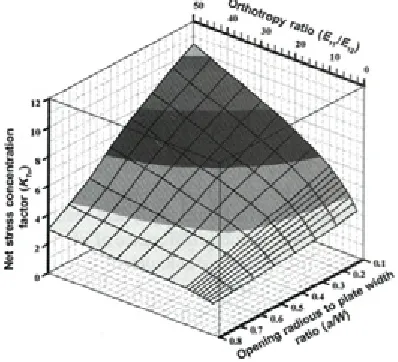
The variation o f the net stress concentration fa c to r w ith re sp e c ts to a/W ra tia fo r v ario u s orthotropy ratios is shown in Figure 9. According to this figure the higher orthotropy ratio have a higher stress concentration factor. In addition, the v ariatio n o f SCF resp ect to a/W ratio in high orthotropy ratio is higher than at low orthotropy ratio. The im portant observations regarding the
Fig. 9. Net stress concentration factor respect to orthotropy ratio and a/W ratio
graph o f this figure are that all curves converge together with increasing the a/W ratio. Indeed, with increasing the a/W ratio, the effect o f orthotropy ratio on net stress concentration factor is decreased.
A c c o rd in g to F ig u re 9, the n et stress concentration factor for low orthotropy ratio is near to each other and increasing this ratio the difference o f a/W c u rv es. T he v a rio u s a /W cu rv es are converged to each other with low E J E 22 ratio. In addition, with increasing the a/W ratio, the variation o f orthotropy ratio has a little effect on the net stress concentration factor. This effect is also shown in Figure 9.
4 CONCLUSION
Formulation and comparative finite element results have been presented for a conforming finite element method, which may be used to model a plate with circular opening under action o f tension load, and this comparison shows that appropriate finite element model has a good accuracy for stress concentration problems.
The stress concentration factor for low orthotropy ratio is near to each other and w ith increasing this ratio, the difference o f a/W curves increases. The variation o f net stress concentration factor, respect to orthotropy ratio increases with increasing the a/W ratio. In high a/W ratio the effect o f orthotropic ratio is decreased, thus in high a/W
T he a ccu racy o f a n a ly tic a l m ethod is dependent on orthotropy ratio and a/W ratio and it is suitable for a/W < 0.4. Increasing the a/W ratio, this accuracy decreases further the influence of o rth o tro p y ratio is sm all. At a/W ratio 0.8, discrepancy betw een analytical and num erical method is less than 6% , which is acceptable in engineering applications. Therefore, Tan’s Equation (5) can be used instead o f tedious and tim e c o n su m in g fin ite elem en t an a ly se s fo r all investigated ratia (up to 0.8).
5 REFERENCES
[ 1 ] Heywood, R.B. Designing by photoelasticity.
Chapman and Hall, 1952.
[2] Peterson, R.E. Stress concentration factors.
John Wiley & Sons, 1974.
[3] Pilkey, W.D. Peterson’s stress concentration factors. New York: John Wiley & Sons Inc.,
2nd Edition, 1997.
[4] H ow land, R .C .J. On the stresses in the neighborhood o f circular hole in a strip under tension. Phil. Trans. Roj. Soc.,Voi. 229, 1929, p. 49-86.
[5] Lekhnitskii, S.G. Anisotropic plates. Gordon and Breach, 1968.
[6] Tan, S.C. Finite-width correction factors for anisotropic plate containing a central opening.
J. o f Composite Materials, Voi. 22, 1988, p. 1080-18.
[7] Wang, Q.Z. Simple formulae for the stress concentration factor for two - and three- Dimensional Holes in Finite Domain. J. o f strain analysis, 37, 2002, p. 259-264. [8] Tan, S.C. Laminated composites containing
an elliptical opening. II. Experim ent and M odel M o d ificatio n . J. o f Composite Materials, Voi. 21, 1987, p. 949-20.
[9] H w ai-C hung,W ., Bin, M. On stress concentrations for isotropic/orthotropic plates and cy lin d ers w ith circ u la r hole. J. o f Composites, Part B: engineering, 34, 2003, p. 127-134.
[10] Manual: MSC.Nastran fo r Windows: Quick Start Guide. M acN eal-S ch w en d ler Corporation, 2004.
[11] Reddy, J.N. Mechanics o f laminated composite plates and shells: Theory and analysis. 2nd