REVIEW ARTICLE
Frequency lowering
Nariman Rahbar*
Department of Audiology, School of Rehabilitation Sciences, Iran University of Medical Sciences, Tehran, Iran
Received: 2 Nov 2016, Revised: 21 Nov 2016, Accepted: 23 Nov 2016, Published: 15 Jan 2017
Abstract
Background and Aim: It has been several dec-ades since the technology of frequency lowering (FL) has been proposed. However, primary res-earch has revealed no benefits regarding the use of this technique. Currently, new methods for FL and improvement of perception of speech and fricative sounds have led to the application of these methods by numerous companies to produce hearing aids. In this study, through reviewing the findings of recent studies we introduced several FL techniques used in vario-us companies.
Recent Findings: Results of studies conducted since the year 2000 on FL technology suggested that this technology could be used to improve speech perception in cases of high frequency hearing loss. Today, the majority of hearing aid manufacturers use different FL methods.
Conclusion: While the setting principles of FL methods are still vague, improved hearing of fri-cative sounds has been associated with increa-sed use of this technique by researchers. FL technique has its own benefits and setbacks, understanding of which would facilitate the use of FL techniques and adjustment of hearing aids for hearing-impaired individuals.
Keywords: Frequency lowering; transposing frequency; frequency compression; non-linear
frequency; compression; linear transposing fre-quency
Introduction
Hearing loss is a common phenomenon, which is present in 1-3 infants per 1000 [1]. Consi-dering acquired hearing loss during adulthood, this number increases in adulthood. In addition, hearing loss is more observed in high frequ-encies (HFs), compared to low frequfrequ-encies (LFs), which leads to the ability of receiving LFs, but having difficulties in receiving HFs [2]. Limitation in hearing high frequency sounds varies depending on the form and severity of hearing impairment. In this regard, individuals with ski slope or severe to profound hearing loss are more prone to limited perception of HFs sounds. This limitation is associated with not benefiting from HF signs and their information in speech. As a result, people with these types of hearing impairment have difficulties in speech perception and communication [3,4]. Limited hearing of HF sounds could result in some pro-blems in children, such as delay in the learning process and natural growth of speech and lan-guage of infants. Inaccurate and delayed speech learning process also causes difficulties in spee-ch production of spee-children. Moreover, this situa-tion can have several adverse impacts on the life style, education process, and social interactions of children [5]. Although the programs for early detection of hearing loss have led to the detection of this impairment during the first few months of birth (before six months), there are *
Corresponding author: Department of Audiology, School of Rehabilitation Sciences, Iran University of Medical Sciences, Shahid Shahnazari St., Madar Square, Mirdamad Blvd., Tehran, 15459-13487, Iran. Tel: 009821-22228051,
still many children suffering from this condition [6]. Limitation in obtaining high frequency spe-ech information has a negative effect on the number of learned words, as well as meaning and content of speech [7]. In addition, lack of hearing HFs could cause difficulties in hearing the surrounding sounds, such as alarms, tele-phone ring, car horn, and bird chirp. Hearing some of these sounds is crucial for individual’s safety, whereas some other sounds are pleasant to hear. People with ski slope or with severe to profound hearing loss are deprived from these types of sounds [8,9]. Another hearing problem in these cases is deficiency in hearing the pho-nemes, such as /θ/, /f/, /t/, /sh/, /š/, and /z/. They also may not be able to differentiate between some phonemes, including /š/ and /s/. This lack of ability to hear or differentiate some of the phonemes could result in inaccurate speech per-ception or grammar problems [10-14].
In cases with severe to profound hearing loss or those with ski slope hearing loss, the problem is in the structure of the inner ear and damage to the inner hair cells, which is called dead region [14]. When there is dead region (DR), informa-tion that reaches this secinforma-tion of the cochlear cannot produce action potential due to lack of hair cells. Therefore, the auditory nerve is not able to transmit the HF information to the brain. This phenomenon leads to the hearing of the main signal as a noise or in a distorted way [15]. Reinforced acoustic excitation is also not able to improve the function of this region. In addition, a distorted signal can adversely affect the sound quality and speech perception of the individual [16].
Nevertheless, hearing enhancement devices must be used in hearing-impaired individuals to create a sense of hearing. One of the most important challenges for audiologists is to pro-vide proper equipment for individuals with severe to profound or ski slope hearing loss (especially if the case is an infant). The com-monly used hearing aids cannot provide suffi-cient gain for receiving HF sounds for many reasons; firstly, all the conventional hearing aids have low output in the HF region (especially higher than 4000 Hz) [17]. Secondly, the
conventional hearing aids have a limited fre-quency bandwidth, while advancement in tech-nology has led to the production of hearing aids with broader bandwidth, limited perception of HFs remain a major problem in this regard. This bandwidth limitation is more crucial in children, who need to be able to hear voices with higher frequencies to produce speech [18].
Thirdly, the incidence of HF acoustic feedback might increase due to enhanced gain. Although the problem with the feedback is mainly solved in hearing aids designed with the recent advan-ced technologies, this problem is not completely resolved [19], and fourthly, an unwanted acou-stic resonance is created in the tubes or output of hearing aid receiver, leading to hearing dis-torted sounds [17,19].
Therefore, the conventional hearing aids cannot provide optimal amplification for individuals with hearing impairment. An alternative method is to use devices designed to change the frequ-ency of HF sounds to an audible level, which is best known as frequency-lowering technique [20].
The majority of studies conducted before the year 2000 draw on two traditional methods, which are less applied today. In addition, a small number of individuals were evaluated in the mentioned studies; however, their results were indicative of improvement/lack of impro-vement in speech perception of the participants [20]. From 2000 onwards, other FL techniques were evaluated due to progress in technology, faster processing systems of hearing aids manu-factured by various companies, and adopting a new perspective towards FL by manufacturers. Therefore, to carry out this study, we searched all the articles on the final and conventional methods, which were published from 2000 onwards in Scopus, PubMed, and Google Scholar Databases.
Frequency lowering techniques
In general, FL is divided into five different tech-niques. The first is in fact the most primary technique called “channel vocoders”, in which speech signals pass several band-pass filters and get evaluated.
In each band-pass filter, high frequency enve-lope push signal is restored by a number of nar-row band noises or pure tone generators; after-wards, it is modulated in low frequency, and then presented to the hearer. One of the benefits of this method is its adjustable setting. Never-theless, this technique has been used in none of the hearing aids manufactured by various com-panies. The major drawback of this method is lack of differentiation between voiced and voi-celess sounds. Moreover, the quality of output signal is not equal to speech signal [20].
The second technique is known as “slow play-back”, in which speech signal is recorded online and analyzed. The process system of FL is acti-vated in case of frequency components above 2.5 kHz in input signal; otherwise, the system remains inactivated. Afterwards, the recorded sound is adjusted for each individual and played at a lower speed. Frequency is declined due to lower speed of signals. This technique is used in the hearing aids manufactured by the AVR Sonovation company, first in the form of pocket hearing aids, and then behind the ear hearing aids. The advantage of this technique is main-tenance of harmonic dependency between the frequency components. However, given the lon-ger presentation of output signal, there is a lack of synchronicity between input and output spee-ch signals, whispee-ch might lead to the elimination of some parts of the main signal [20-22].
Frequency transposition
The third FL technique is called “frequency transposition” (FT), designed to move HFs tow-ard LFs. This technique was first applied by the Oticon company. Hearing aid input sounds up to 3000 Hz were amplified without any change in frequency. However, frequencies within the range of 4000-8000 Hz were moved toward frequencies lower than 1500 Hz by a processing system [20].
Another frequency transposition method was
proposed by Velmans in 1973, in which the whole frequency response region of the hearing aid is divided into low and high bands and the cut-off frequency is 4000 Hz. Frequencies higher than 4000 Hz are reduced to 4000 Hz by a processing system, combined with low-band reinforced sounds and presented as output signal [19].
Robinson proposed another method in 2007, in which the starting point of frequency transposi-tion activity is determined based on the cochlear dead region. Therefore, this device can be adjus-ted based on the need of each individual. In add-ition, sounds with higher frequencies would be transferred to lower frequencies. The transition system is activated when the input signal has high frequency [20,23].
HF noise in the surrounding could be heard due to the moving of frequency to lower or mid-frequencies. This can lead to the mask of main frequencies of speech signal.
Nevertheless, since the frequency transposition system is only activated if HFs are the main dominant signals and is not always active, the general information is preserved and the sound would be heard in a normal way [24,25].
Audibility Extender is a static method, the most improved version of which is known as Enhan-ced Audibility Extender and acts adaptively. Application of voice detector algorithms preve-nts the moving of HF background noise. In addition, the processed moved sounds have more gains in order to better differentiate the sounds in the new system. A signal-dependent system is also active, which leads to the diffe-rentiation of lowered voice phonemes from voiceless phonemes. Another added system to the Enhanced Audibility Extender helps with preserving the harmonics of voice phonemes similar to the main signal, which results in more natural sounds. In this method, bandwidth is also more widened [25].
The FL technique was proposed by the Starkey hearing aid company with the name “spectral IQ”. In general, this function is inactive and could be activated based on the choice of the audiologist. Even after the selection, the FL acts only when the HF is the dominant input signal. Adjustments are automatically made based on the severity of hearing loss and audi-ogram shape, which are different in each person. The start point is where the HFs are not audible and must decrease, and the target area is the place the reduced frequencies are moved to. The frequency region with the lowest rate is called corner frequency, also known as processing START frequency. Software determines the start point through the calculation of corner frequency. If a frequency with 20 dB difference is observed in the audiogram curve, that area is regarded as corner frequency. If the slope of audiogram is not within this limit, the HF border with a threshold of 70 dB is considered as the target frequency region. Spectral gain also refers to the amount
of gain for transferred sounds, which is calculated based on the required gain of the origin area. What distinguishes this method from others is the difference in the width of the area of origin and the target region, which depend on the form and severity of hearing loss [26].
Frequency compression
Frequency compression is also one of the fre-quency lowering techniques (the fourth met-hod), performed in two ways. The first way is linear, in which all frequency components in the frequency band are compressed with a fixed factor. This compression is conducted toward sounds with lower frequencies in all the frequency areas (e.g. high, mid, and low frequencies). Therefore, frequencies of for-mant peaks in the main speech signal are compressed with a constant ratio. While the general form of the signal remains the same, it will be slightly compressed. Nevertheless, the pitch of the signal is lowered and the sound becomes unnatural. Consequently, this method was not comercially used in hearing aids [20].
harmonic ratio [27].
Another method proposed by the Phonak Com-pany in 2016 is known as the SoundRecover2 technique, which underwent some modifica-tions, compared to the primary version. In this method, two cut-off points are adaptively used. At each moment, only one of the cut-off frequency points is active. Adaptive nature of this method means that based on the range of input signal frequency, the start point of the frequency compression algorithm is automa-tically selected. If the frequency energy of the input signal is within the range of low frequencies, an HF cut-off point is selected in order to increase the audibility of sounds. On the other hand, if high-frequency input signals are dominant, an LF cut-off point is selected (less than 1500 Hz). The switching is performed automatically. This leads to the use of a lower compression ratio so that the frequency ratio of harmonics is presserved better. Bandwidth of the hearing aid activity is also increased to 11 kHz. Moreover, it provides four different modes with various pre-determined clarity-comforts to manually adjust the settings of the device [28]. The Belton Company has used the FL method with the brand name of SoundShifter. In this company, LF is similar to the non-linear fre-quency compression (NFC) system; however, unlike the latter, it is mostly inactive. Four pre-determined adjustment modes, including off, mild (4 kHz), medium (3.5 kHz), and strong (2.5 kHz), are included in the software in order to select the start point of frequency compres-sion and comprescompres-sion ratio, which are both determined before the adjustments for the audi-ologist. The compression ratio for the mild mode is 1.3 and for the strong mode is 2 [29]. The frequency compression method is also used in GN Resound hearing aids, known with the brand name Sound Shaper [30]. In the Hansaton group, the frequency compression method is used with the name of Sound Restore. In addition, the Unitron Company used the frequency compression technique similar to the Phonak Company. The frequency compression method was also applied by the Siemens Company.
Composition
A new type of frequency lowering (FL) method was proposed by the Oticon Company in 2016, regarded as the composition technique (the fifth method). This FL technique is known with the brand name of Speech Rescue and designed based on maximum audible output frequency (MAOF).
A multi-layered technique is used in this meth-od. At first, the HF region is evaluated and then divided into two or three sections. Afterwards, the start point of LF is determined and collected in narrow regions with low signals. In practice, the HF sections are taken from a range of 3000 Hz and transferred to two or three narrow sec-tions within the range of 800-1600 Hz in the region of lower frequencies [31].
Discussion
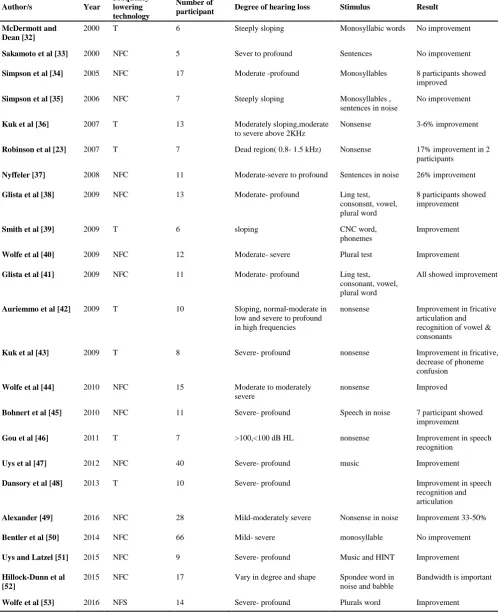
Table 1. Summary of studies using frequency transposition and non-linear frequency compression methods
Author/s Year
Frequency lowering technology
Number of
participant Degree of hearing loss Stimulus Result McDermott and
Dean [32]
2000 T 6 Steeply sloping Monosyllabic words No improvement
Sakamoto et al [33] 2000 NFC 5 Sever to profound Sentences No improvement
Simpson et al [34] 2005 NFC 17 Moderate -profound Monosyllables 8 participants showed improved
Simpson et al [35] 2006 NFC 7 Steeply sloping Monosyllables , sentences in noise
No improvement
Kuk et al [36] 2007 T 13 Moderately sloping,moderate to severe above 2KHz
Nonsense 3-6% improvement
Robinson et al [23] 2007 T 7 Dead region( 0.8- 1.5 kHz) Nonsense 17% improvement in 2 participants
Nyffeler [37] 2008 NFC 11 Moderate-severe to profound Sentences in noise 26% improvement
Glista et al [38] 2009 NFC 13 Moderate- profound Ling test, consonsnt, vowel, plural word
8 participants showed improvement
Smith et al [39] 2009 T 6 sloping CNC word, phonemes
Improvement
Wolfe et al [40] 2009 NFC 12 Moderate- severe Plural test Improvement
Glista et al [41] 2009 NFC 11 Moderate- profound Ling test, consonant, vowel, plural word
All showed improvement
Auriemmo et al [42] 2009 T 10 Sloping, normal-moderate in low and severe to profound in high frequencies
nonsense Improvement in fricative articulation and recognition of vowel & consonants
Kuk et al [43] 2009 T 8 Severe- profound nonsense Improvement in fricative, decrease of phoneme confusion
Wolfe et al [44] 2010 NFC 15 Moderate to moderately severe
nonsense Improved
Bohnert et al [45] 2010 NFC 11 Severe- profound Speech in noise 7 participant showed improvement
Gou et al [46] 2011 T 7 >100,<100 dB HL nonsense Improvement in speech recognition
Uys et al [47] 2012 NFC 40 Severe- profound music Improvement
Dansory et al [48] 2013 T 10 Severe- profound Improvement in speech recognition and articulation
Alexander [49] 2016 NFC 28 Mild-moderately severe Nonsense in noise Improvement 33-50%
Bentler et al [50] 2014 NFC 66 Mild- severe monosyllable No improvement
Uys and Latzel [51] 2015 NFC 9 Severe- profound Music and HINT Improvement
Hillock-Dunn et al [52]
2015 NFC 17 Vary in degree and shape Spondee word in
noise and babble
Bandwidth is important
reported better hearing of HFs in children after the intervention (compared to the frequency transposition system, 70%) [54].
A study was conducted by Souza et al. to eva-luate the effects of FL technology, using NFC technique, on the intelligibility of sentences and quality of sounds in adults with mild to mode-rate hearing loss after language learning. The participants were among individuals with ski slope hearing loss, aged 60-92 years, and homo-genous with the subjects of the control group in terms of age and natural hearing ability. Sentences were evaluated in silence and babble noise using different signal to noise ratios. According to the results of the mentioned study, moderate compression, which is the result of placing the cut-off frequency point in higher frequencies, had little impact on speech intelli-gibility. Individuals with greater HF hearing loss gained more benefit from NFC. When the compression is high (low frequency cut-off point), understanding of sentences also reduces. This condition is more affected in noisy envi-ronments. In quiet surroundings, more compre-ssion led to reduced sound qualities reported by hearers, especially by those with better HF threshold. In noisy environments, the quality of sound was decreased, whereas there was little change in compression parameters. It was also reported that NFC gain in adults is affected by compression adjustment parameters [55].
Glista et al. introduced two methods to evaluate the performance of FL. In the first method, live sound and the /sh/ and /s/ sounds were used. On the other hand, 1.3 high frequency band-pass octave filter was applied in the second method. The problem with live sound was that different speakers with different genders in an uncalib-rated environment were using it, which changed the final results. Application of the second method was associated with unnatural sound and frequency bandwidth limitation, which was due to the fact that the maximum output fre-quency was 6300 Hz [39]. In a study by Scollie et al., adjustments guide and protocol settings for FL signal process were published. Accor-ding to these researchers, when children cannot hear the sound /s/ (especially when produced
by a female), while using their hearing aids, application of hearing aids made with FL technology can be beneficial. In addition, use of aided response and/or level of hearing the fri-cative sounds can help validate the effectiveness of hearing aids [56].
According to Alexander, when the cut-off fre-quency is selected at 1.6 kHz, increased com-pression ratio can lead to decreased differen-tiation of consonants and vowels. On the other hand, increased cut-off frequency, even with high compression ratio, had no impact on the differentiation of consonants and vowels. In that study, 28 participants with mild to severe hea-ring loss were evaluated using nonsense syllabic stimulants in a noisy environment. In the severe group, a moderate correlation was observed between the second formant (caused by changes in NFS) and distinguishing of vowels [49]. Use of a slight compression ratio leads to less variations in the frequency range (from mode-rate to high), resulting in improved hearing of speech and surrounding sounds. In fact, the problem of frequency compression is resolved in the new method known as SoundRecover2 [49,53]. In addition, wider frequency band of hearing aid leads to improved understanding of HF sounds [40-57].
In a study by Wolfe et al., children who used sound recover 1 accepted SoundRecover2 easi-ly, and their acclimatization did not take a long time [53]. In another study by Kuk et al., it was demonstrated that acclimatization could happen in two weeks using the frequency transfer tech-nology [36].
observed with the audiogram slope. While individuals have different tinnitus pathologies, greater suppress was found in the group of tinnitus with sudden deafness etiology. 23 cases had history of exposure to noise. In this group, tinnitus suppress was only reported a few days after using the LOFT hearing aid. The tinnitus would return when the LOFT hearing aid was not used. On the other hand, the tinnitus would suppress after a few days of using the hearing aid again. The NFC hearing aid was used for a few participants, which led to no tinnitus suppression [58].
Conclusion
While the proper setting principles of FL meth-ods are still unclear, improved hearing of fri-cative sounds has led to the suggestion of this technique by researchers. Access to appropriate hearing input sounds, in terms of intensity and frequency in people with hearing loss, espe-cially children, is of paramount importance. Usually, individuals with hearing impairments have difficulties hearing HF sounds, leading to speech problems in these people. In this regard, the FL technique is used to resolve this problem. Each method has its own advantages and draw-backs, better understanding of which can help with adjusting each hearing aid based on the needs of people with specific hearing impair-ments.
If a hearing-impaired individual is able to hear HFs sound while using the hearing aid, there is no need for FL technology. On the other hand, lack of hearing the HF sounds can be a major cause of using the FL techniques, which impro-ves the hearing of HF sounds and enhances speech perception in such people.
REFERENCES
1. Lima GM, Marba ST, Santos MF. Hearing screening in a neonatal intensive care unit. J Pediatr (Rio J). 2006;82(2):110-4.
2. Flynn MC, Dowell RC, Clark GM. Aided speech recognition abilities of adults with a severe or severe-to-profound hearing loss. J Speech Lang Hear Res. 1998;41(2):285-99.
3. Elfenbein JL, Hardin-Jones MA, Davis JM. Oral communication skills of children who are hard of hearing. J Speech Hear Res. 1994;37(1):216-26. 4. Turner CW, Cummings KJ. Speech audibility for
listeners with high-frequency hearing loss. Am J Audiol. 1999;8(1):47-56.
5. Hogan CA, Turner CW. High-frequency audibility: benefits for hearing-impaired listeners. J Acoust Soc Am. 1998;104(1):432-41.
6. Yoshinaga-Itano C, Sedey AL, Coulter DK, Mehl AL. Language of early- and later-identified children with hearing loss. Pediatrics. 1998;102(5):1161-71.
7. Ching TY, Dillon H, Byrne D. Speech recognition of hearing-impaired listeners: predictions from audibility and the limited role of high-frequency amplification. J Acoust Soc Am. 1998;103(2):1128-40.
8. Chasin M, Russo FA. hearing aids and music. Trends Amplif. 2004;8(2):35-47.
9. Hockley NS, Bahlmann F, Chasin M. Programming hea-ring instruments to make live music more enjoyable. Hear J.2010;63(9):30-8.
10. Stelmachowicz PG, Pittman AL, Hoover BM, Lewis DE. Aided perception of /s/ and /z/ by hearing-impaired children. Ear Hear. 2002;23(4):316-24.
11. Kortekaas RW, Stelmachowicz PG. Bandwidth effects on children's perception of the inflectional morpheme /s/: acoustical measurements, auditory detection, and clarity rating. J Speech Lang Hear Res. 2000;43(3):645-60.
12. Stelmachowicz PG, Pittman AL, Hoover BM, Lewis DE, Moeller MP. The importance of high-frequency audibility in the speech and language development of children with hearing loss. Arch Otolaryngol Head Neck Surg. 2004;130(5):556-62.
13. Moeller MP, Hoover B, Putman C, Arbataitis K, Bohnenkamp G, Peterson B, et al. Vocalizations of infants with hearing loss compared with infants with normal hearing: Part I--phonetic development. Ear Hear. 2007;28(5):605-27.
14. Moore BC, Huss M, Vickers DA, Glasberg BR, Alcántara JI. A test for the diagnosis of dead regions in the cochlea. Br J Audiol. 2000;34(4):205-24.
15. Moore BC. Dead regions in the cochlea: conceptual foundations, diagnosis, and clinical applications. Ear Hear. 2004;25(2):98-116.
16. Cox RM, Alexander GC, Johnson J, Rivera I. Cochlear dead regions in typical hearing aid candidates: pre-valence and implications for use of high-frequency speech cues. Ear Hear. 2011;32(3):339-48.
17. Stelmachowicz PG, Pittman AL, Hoover BM, Lewis DE. Effect of stimulus bandwidth on the perception of /s/ in normal- and hearing-impaired children and adults. J Acoust Soc Am. 2001;110(4):2183-90.
18. Stelmachowicz PG, Lewis DE, Choi S, Hoover B. Effect of stimulus bandwidth on auditory skills in normal-hearing and normal-hearing-impaired children. Ear Hear. 2007;28(4):483-94.
19. Ricketts TA, Dittberner AB, Johnson EE. High-fre-quency amplification and sound quality in listeners with normal through moderate hearing loss. J Speech Lang Hear Res. 2008;51(1):160-72.
20. Simpson A. Frequency-lowering devices for managing high-frequency hearing loss: a review. Trends Amplif. 2009;13(2):87-106.
21. McDermott HJ, Knight MR. Preliminary results with the AVR impact frequency-transposing hearing aid. J Am Acad Audiol. 2001;12(3):121-7.
Improvements in speech perception with use of the AVR TranSonic frequency-transposing hearing aid. J Speech Lang Hear Res. 1999;42(6):1323-35.
23. Robinson JD, Baer T, Moore BC. Using transposition to improve consonant discrimination and detection for listeners with severe high-frequency hearing loss. Int J Audiol. 2007;46(6):293-308.
24. Kuk F, Korhonen P, Peeters H, Keenan D, Jessen A, Andersen H. Linear frequency transposition: extending the audibility of high frequency information. Hearing Review. 2006;13:42-8.
25. The audibility extender. 2010. Available in: https://www .widex.pro/en/evidence-technology/technological- excellence/widex-speech-technologies/audibility-extender
26. The Prescription of Spectral iQ. 2015. Available in:
https://starkeypro.com/pdfs/technical-papers/the_prescription_of_spectral_iq.pdf
27. Glista D, McDermott H. Phonak SoundRecover: A breakthrough in enhancing intelligibility. Naida Product Information. Stafa, Switzerland: Phonak Hearing Systems; 2008.
28. SoundRecover2 – the adaptive frequency compression algorithm. 2016. Available in: https://www.phonakpro .com/content/dam/phonakpro/gc_hq/en/resources/eviden ce/white_paper/documents/insight_soundrecover2_028-1512.pdf
29. Stender T, Haastrup A. Frequency compression through Beltone SoundShifter. 2016. Available in: http://www .belsound.hu/beltone/_/media/DownloadLibrary/Beltone /Beltone%20Product%20Page%20Downloads/M200993 GB1309RevAP2A2125.pdf?la=en
30. Sound Shaper frequency compression. Available in: http://www.gnresound.ru/en/professionals/technology- and-innovation/surround-sound-by-resound/sound-shaper
31. Angelo k, Alexande JM. Oticon Frequency Lowering Access to high-frequency speech sounds with Speech Rescue technology. 2016. Available in: http://web.ics .purdue.edu/~alexan14/Publications_files/SpeechRescue .pdf
32. McDermott HJ, Dean MR. Speech perception with steeply sloping hearing loss: effects of frequency transposition. Br J Audiol. 2000;34(6):353-61.
33. Sakamoto S, Goto K, Tateno M, Kaga K. Frequency compression hearing aid for severe-to-profound hearing impairments. Auris Nasus Larynx. 2000;27(4):327-34. 34. Simpson A, Hersbach AA, McDermott HJ.
Improve-ments in speech perception with an experimental nonlinear frequency compression hearing device. Int J Audiol. 2005;44(5):281-92.
35. Simpson A, Hersbach AA, McDermott HJ. Frequency-compression outcomes in listeners with steeply sloping audiograms. Int J Audiol. 2006;45(11):619-29.
36. Kuk F, Peeters H, Keenan D, Lau C. Use of frequency transposition in a thin-tube open-ear fitting. Hear J. 2007;60(4):59-63.
37. Nyffeler M. Study finds that non-linear frequency compression boosts speech intelligibility. Hear J. 2008;61(12):22-6.
38. Glista D, Scollie S, Bagatto M, Seewald R, Parsa V, Johnson A. Evaluation of nonlinear frequency compre-ssion: clinical outcomes. Int J Audiol. 2009;48(9):632-44.
39. Smith J, Dann M, Brown PM. An evaluation of frequency transposition for hearing-impaired school-age children. Deafness Educ Int. 2009;11(2):62-82.
40. Wolfe J, Caraway T, John A, Schafer E, Nyffeler M. Initial experiences with nonlinear frequency com-pression for children with mild to moderately severe hearing loss. Hear J 2009;62(9):32-5.
41. Glista D, Scollie S, Polonenko M, Sulkers J. A com-parison of performance in children with nonlinear frequency compression systems. Hearing Review. 2009;16(12):20-4.
42. Auriemmo J, Kuk F, Lau C, Marshall S, Thiele N, Pikora M, et al. Effect of linear frequency transposition on speech recognition and production of school-age children. J Am Acad Audiol. 2009;20(5):289-305. 43. Kuk F, Keenan D, Korhonen P, Lau CC. Efficacy of
linear frequency transposition on consonant identi-fication in quiet and in noise. J Am Acad Audiol. 2009;20(8):465-79.
44. Wolfe J, John A, Schafer E, Nyffeler M, Boretzki M, Caraway T. Evaluation of nonlinear frequency com-pression for school-age children with moderate to moderately severe hearing loss. J Am Acad Audiol. 2010;21(10):618-28.
45. Bohnert A, Nyffeler M, Keilmann A. Advantages of a non-linear frequency compression algorithm in noise. Eur Arch Otorhinolaryngol. 2010;267(7):1045-53. 46. J Gou, J Smith, J Valero, I Rubio .The effect of
frequency transposition on speech perception in adolescents and young adults with profound hearing loss. Deafness Educ Int. 2011;13(1):17-33.
47. Uys M, Pottas L, Vinck B, van Dijk C. The influence of non-linear frequency compression on the perception of music by adults with a moderate to severe hearing loss: subjective impressions. S Afr J Commun Disord. 2012;59(1):53-67.
48. El Danasourya IMS, Hazzaaa NMA, Saberb AE, Elkabarity RH. Efficacy of frequency transposition on speech perception and production in hearing impaired Arabic-speaking children. Egyptian Society of Ear Nose Throat and Allied Sciences. 2013;14(2):129-35. 49. Alexander JM. Nonlinear frequency compression:
Influence of start frequency and input bandwidth on consonant and vowel recognition. J Acoust Soc Am. 2016;139(2):938-57.
50. Bentler R, Walker E, McCreery R, Arenas RM, Roush P. Nonlinear frequency compression in hearing aids: impact on speech and language development. Ear Hear. 2014;35(4):e143-52.
51. Uys M, Latzel M. Long-term effects of non-linear frequency compression on performance of music and speech perception. Commun Disord Deaf Stud Hearing Aids. 2015;3(3):139.
52. Hillock-Dunn A, Buss E, Duncan N, Roush PA, Leibold LJ. Effects of nonlinear frequency compression on speech identification in children with hearing loss. Ear Hear. 2014;35(3):353-65.
53. Rehmann J, Jha S, Baumann SA. SoundRecover2 – the adaptive frequency compression algorithm More audi-bility of high frequency.sounds. 2016. Available from:https://www.phonakpro.com/content/dam/phonakp ro/gc_hq/en/resources/evidence/white_paper/documents/ insight_soundrecover2_028-1512.pdf
frequency transposition and frequency compression hearing aids. Egypt J Otolaryngol. 2015;31:10-8. 55. Souza PE, Arehart KH, Kates JM, Croghan NB, Gehani
N. Exploring the limits of frequency lowering. J Speech Lang Hear Res. 2013;56(5):1349-63.
56. Scollie S, Glista D, Seto J, Dunn A, Schuett B, Hawkins M, et al. Fitting frequency-lowering signal processing applying the American academy of audiology pediatric amplification guideline: updates and protocols. J Am
Acad Audiol. 2016;27(3):219-36.
57. Lau CC, Kuk F, Keenan D, Schumacher J. Amp-lification for listeners with a moderately severe high-frequency hearing loss. J Am Acad Audiol. 2014;25(6):562-75.