Journal of Caring Sciences, 2016, 5(4), 287-297
doi:10.15171/jcs.2016.030 http:// journals.tbzmed.ac.ir/ JCS
*Corresponding Author: Elnaz Asghari (MSc), email: [email protected]. This studywas approved and funded by the deputy of research in Tabriz University of Medical Sciences (Project number: 3079).
*
© 2016 The Author(s). This work is published by Journal of Caring Sciences as an open access article distributed
The Effect of Group Psychoeducation Program on Medication Adherence
in Patients with Bipolar Mood Disorders: a Randomized Controlled Trial
Farnaz Rahmani1, Hossein Ebrahimi2, Fatemeh Ranjbar1, Seyed Sajjad Razavi1, Elnaz Asghari3*
1Research Center of Psychiatry and Behavioral Sciences, Tabriz University of Medical Sciences, Tabriz, Iran
2Department of Psychiatric Nursing, Faculty of Nursing and Midwifery, Tabriz University of Medical Sciences, Tabriz, Iran 3Department of Medical Surgical Nursing, Student Research Committee, Faculty of Nursing and Midwifery, Tabriz University of
Medical Sciences, Tabriz, Iran
ARTICLE INFO ABSTRACT Article Type:
Original Article
Introduction: Medication nonadherence is highly prevalent in patients with bipolar disorders and often results in worsening disease prognosis. The purpose of this study was to investigate the effect of group psychoeducation on medication adherence in female patients with bipolar mood disorder type I.
Methods: This randomized controlled trial was conducted on 76 patients with bipolar mood disorder admitted in female psychiatric wards of Razi teaching hospital, Tabriz, Iran. The participants were selected by convenience sampling method and were randomly assigned to experimental and control groups. Patients in experimental group received 10 continuous 90 minutes sessions of psychoeducation, two times a week. Medication adherence was measured using the medicine check list and medication adherence rating scale (MARS) before and after intervention. Data analysis was performed with SPSS ver.13.
Results: There was no significant difference between two groups regarding medication adherence before the intervention. After the study intervention, the mean scores of medication adherence check list and medication adherence rating scale in the experimental group were significantly higher than the control group.
Conclusion: Since group psychoeducation was effective in improving patients' medication adherence, it could be recommended for psychiatric nurses to apply this intervention in the clinical setting.
Article History:
Received: 3 Oct. 2015 Accepted: 13 Jan. 2016 ePublished: 1 Dec. 2016
Keywords:
Bipolar disorder Group psychotherapy Medication adherence
Patient education
Please cite this paper as:Rahmani F, Ebrahimi H, Ranjbar F, Razavi SS, AsghariE.The effect of group psychoeducation program on medication adherence in patients with bipolar mood disorders: a randomized controlled trial. J Caring Sci 2016; 5 (4): 287-97. doi:10.15171/jcs.2016.030.
Introduction
Bipolar mood disorder (BMD) is a common and severe psychiatric disorder that high rate of readmission, relapse and nonadherence
medication are its main complications.1
According to WHO report in 2009, BMD is
the sixth cause of disability among people
aged 14-55.2 The lifetime prevalence of bipolar
mood disorder is 1%. Prognosis of this disorder is not so good and suicide attempts
occur in 25-50% of patients.3
Although pharmacotherapy is usually the
first line treatment in psychiatric disorders,4,5
nonadherence to medication is prevalent in
patients with bipolar mood disorder.6
Medication adherence is defined as the patient’s conformance with the provider’s re
commendation with respect to timing, dosage, and frequency of medication-taking during the
prescribed length of time.7,8
Adherence in psychiatric disorders often becomes more difficult when patients are required a complex medication regimen to
control their illness.9 Approximately 21 to 50%
of patients with BMD do not adhere to their
recommended treatment regimen.10 It has been
reported that more than one out of three BMD
patients
did not continue
the treatment twice orprescribed medication11 which leads to failure
in treatment and worsens prognosis.6 The
consequences of nonadherence to medication can be destructive for patients and their families in terms of personal suffering, readmission, prolonged hospital stays, and reduced quality of life, as well as, for society in general, due to loss of income and direct costs of healthcare.12,13
The Health Belief Model assumes that a person, when realizes one’s health is at risk and benefits of a proposed treatment outweigh the costs of that treatment, is willing to follow
up the treatment.14 The results of some studies
demonstrated several factors to be the causes of nonadherence medication such as patients
low awareness about their illness, general
beliefs and attitudes towards health and medication adherence based on previous experiences, cultural beliefs, socioeconomic
status15 and side effects of medications.9 In
addition, the findings of Lacro et al., showed that good therapeutic relationship between therapists and patients is resulted in higher
adherence rate.16
Although psychoeducation is a primary component of the collaborative model of treatment that advocates the rights of the patient to make informed about their
treatment plan,17 it has been reported that
individual psychoeducational strategies had lowest success in improving adherence to
treatment.18 Considering the role of peer in
person’s behaviors, it seems that group psychoeducation could lead to improved medication adherence in patients with bipolar
disorders.19 In addition, it seems that group
psychoeducation is more effective on reducing
relapse rate than individual education.20
Psychoeducation could increase patient’s responsibility when they faced with the illness. It allows them to actively collaborate with their
treatment plan.21,22 Patient collaboration with
treatment plan is a critical factor for medi-cation adherence. Collaborative commun-ication with considering the patient’s per-spective about treatment decisions plays the
main role in medication adherence.12
Implementation of evidence-based
collabor-ative care in Medicaid and in integrated care programs for individuals could substantially improve medical and mental health outcomes and functioning, as well as reduce health care costs.23
By reviewing the aforementioned studies, it can be concluded that, although individual psychoeducation seems to improve patients'
knowledge about illness and
pharmacotherapy, it is not clear about enhancement of medication adherence. While some studies showed that psychoeducation
has increased the treatment adherence,9,18,19,20-22
others state that there were no increase in the
adherence via education.17,24-27 Therefore, this
inconsistency in body of knowledge needs more attention.
As psychiatric nurses are in a close relationship with the patients throughout the treatment plan, they could play a key role in preparing psychoeducation programs for patients to improve adherence to treatment. Today, duration of hospitalization is decreasing and demand for low-cost interventions is increasing; so group psychoeducation can be considered as an effective intervention. This study aimed to
investigate the effect of group
psychoeducation program on medication adherence of female patients with bipolar disorder to remedy the current gap.
Materials and methods
Effect of psychoeducation on medication adherence
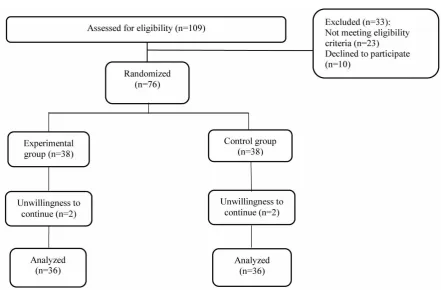
patients were selected through convenient sampling method within 3 month period. The eligible participants were randomly assigned to experimental or control group. Consort flow chart of participants is shown in figure 1. Allocation sequence was determined using computer-generated randomizer program. The person who collected and analyzed the data was unaware of the type of groups (experimental or control).
The inclusion criteria were being diagnosed as bipolar disorder type I based on specialists’ diagnostic interviews and SCID-I/CV test results, being in the age range of 18 to 50; being literate, having no comorbidity disorders like personality disorders based on SCID-II test results, first relapse or more, willingness to participate, having no mental retardation, and having the euthymic mood during the study (score less than or equal to 7 for Hamilton scale and score less than or equal to 14 for Young Mania scale). Exclusion criteria included: not having the insight toward illness and having psychotic features.
The study primary outcome was medicine adherence which was measured before the intervention (T1) and immediately after intervention (T2). Data were collected through a six part questionnaire as follows:
1- A demographic questionnaire included age,
marital status, education, job and number of hospitalizations.
2- Structured clinical interview for DSM-IV
(
Diagnostic and statistical manual of mental
disorders
) Axis I disorders (SCID-I) is adiagnostic tool used to determine DSM-IV Axis I disorders. All of SCID-I usually were administered in a session and take time from
45 to 90 minutes.28 The Persian translation of
SCID-I was used which its reliability and validity was previously confirmed in clinical
population.29
3- Structured clinical interview for DSM-IV
Axis II personality disorders (SCID- II) is a semi-structured diagnostic interview for assessing the 10 DSM-IV axis II personality disorders, depressed personality disorder, and passive-aggressive personality disorder in NOS (not otherwise specified) section of Axis
II. The SCID-II can be used in research and clinical settings. Its implementation takes less than 20 minutes. Reliability and validity of this
scale was previously reported as desirable.29,30
4- Hamilton Rating Scale for depression is an
instrument with a multiple items used to provide an indication of depression, and as a guide to evaluate recovery. Test-retest reliability for the Hamilton depression scale
ranged from 0.81 to 0.98.31 The validity of this
scale and its correlation with other instruments ranged 0.60 to 0.84 and also the validity of the internal assessment has been reported as 0.84-0.90.32
5- The Young Mania Rating Scale was used to
measure the severity of mania. This
questionnaire contains 11 questions.33 The
Cronbach’s alpha coefficient has been reported as 0.72 and the correlation coefficient between
raters was 0.96.34
The tests, Young Mania Rating Scale, Hamilton Rating Scale, SCID-I and SCID-II, were used to exclude non-eligible participants.
6- Medicine check list is consisted of 4 items in
5 point Likert. The check list was developed by
Ebrahimi et al.,35 with score range of 0 to 20.
Patients’ taking the medicine was observed by staff nurse and the acquired score was considered as patient’s medicine adherence.
7- The medication adherence rating scale
(MARS) which developed by Thompson et al., is an easy-to-use scale that includes 10 questions. It is answered with “yes” or “no”
response36 and measures the adherence to
medication in psychiatric patients. The
test-retest reliability coefficient was 0.91.37 Low
values (0–7) on the scale show the low adherence and the high values (8–10) show high adherence level.
SCID-I, SCID-II, Young Mania Rating Scale and Hamilton Rating Scale were conducted by psychiatrist. For face and content validity of the MARS, it was presented to 10 faculty
members of nursing and psychiatry
Cronbach's alpha at 0.87. The reliability of medicine check list also was determined by
inter-rater reliability. The correlation
coefficient between the two observers was determined using the kappa coefficient (0.8).
The study intervention was a
psychoeducation program which was
implemented in Razi teaching hospital in 10 continuous 90-minute sessions twice a week. The contents of each session were as follows: Session 1. The introduction of the researcher and participants to each other, explanation of rules of group therapy, roles of participants and the topics of group therapy.
Session 2. An overview of bipolar disorder and its effects on patients’ life, and problems associated with being diagnosed as mentally ill.
Session 3. Causes of hospitalizations and readmissions.
Session 4. Treatment modalities, role of medication, types of medication and side effects of medication.
Session 5. Negative consequences of
nonadherence to medication.
Session 6. Role of the patient in enhancement of treatment efficacy.
Session 7. Importance of continuing to taking medication in maintaining phase.
Session 8. Education of problem solving strategies.
Session 9. Protective role of medication adherence in prevention of relapse.
Session 10. Review and evaluation.
Protocol of psychoeducation program was
developed based on psychoeducation manual
for bipolar disorder.38
The intervention was performed by a MSc in psychiatric nursing (first author) who had received specialized training in this area. The sessions were managed under the supervision of a PhD in nursing education and a psychiatrist. The sessions were held at Tabriz Razi teaching hospital. After conducting pre-test, the control group continued routine psychiatric care with pharmacotherapy; but the experimental group participated in the group psychoeducation program along with routine treatment. Because of the large number
of experimental group, it was divided into 3 groups. Each session was started with an introducing learning objectives and patients’ task. Before starting the discussion, the participants’ opinions were asked on the subject. Then using interactive teaching methods (role playing, questions and answers, discussion and presentation), the topic of the session was discussed with all of patients. In the end, patients answered to question about the discussed topic. After the assignment of task, the session was over.
After completion of psychoeducation
program, the posttest was conducted for both groups. During the study period, two participants in the control group and two participants in the experimental group were unwilling to continue; therefore, final analysis was based on as treated (72 participants) (Figure 1). Data were analyzed using SPSS statistical version 13. The normality of data was confirmed by Kolmogorov-Smirnov test. Chi-Square and Independent-sample’s t-test was used for comparison of demographic data and the scores of two groups both before and after the intervention. In addition, paired-t test was used to compare the medicine check list score before and after the intervention within each group.
This study was approved by the ethics committee of Iran- Tabriz University of Medical Sciences (ethical code: 2324) and was submitted in IRCT registration system (IRCT
registration number: 201112108359N1).
Furthermore, other ethical issues like participants’ and their Legal guardians’ consent, respecting the principle of personal confidentiality and confidentiality of the data were considered. Furthermore, the participants of the control group were informed that if they were interested, the researcher would hold training sessions for them after conducting post-test for both groups.
Results
The mean (SD) of the patients, age was 29.3
Effect of psychoeducation on medication adherence
Figure 1. Flow chart of the study
control group respectively with no significant difference. The age of all participants ranged from 24 to 45 years. The majorities of them was housewife (61.1%), had diploma education
(37.5%), were married (41.6%)and hospitalized
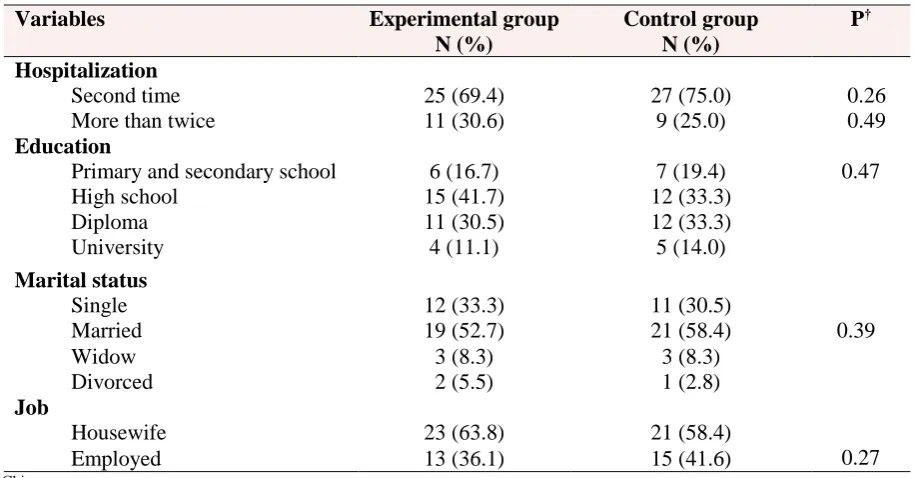
for second time (48.6%). As seen in table 1, there were no significant differences between the groups in terms of demographic characteristics. As shown in table 2, there was no significant difference in medicine check list
score before intervention between
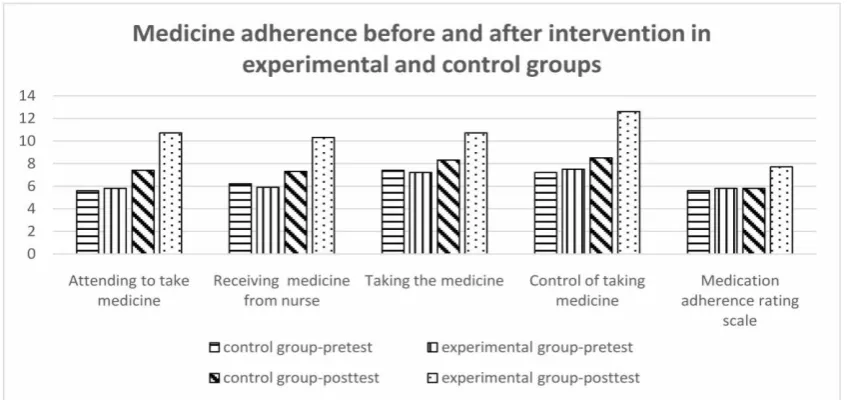
experimental and control groups. The mean (SD) of pretest of all patients was 10.6 (2.5). But, in comparison with the control group, medicine checklist score of posttest was significantly higher in experimental group (P<0.05) (Table 2& Figure 2).
As seen in table 3, there was no significant difference between the groups in terms of MARS score before intervention. But, in comparison with the control group, MARS score of post-test was significantly higher in
experimental group (P<0.05) (Table 3& Figure
2).
Discussion
This study aimed to investigate the effect of
group psychoeducation on medication
adherence among patients with bipolar mood disorders. This study revealed two major results. First, medication adherence rate was poor in all patients before intervention. This result is consistent with the findings of other studies in which nonadherence rates was reported high in patients with bipolar
disorder.9,18,39 The studies reported various
rates of nonadherence in the patients. In a study on 71 adolescents with BMD followed up for 1 year after their first hospitalization, results showed that 42% of patients were
partially adherent and 23% were
nonadherent.40 Sajatovic et al. found that 54%
of 44,637 patients being treated for BMD with lithium or anticonvulsants were completely adherent, 25% were partially adherent, and
Table 1. Comparison of demographic characteristics between two groups (n=36)
Variables Experimental group Control group P†
N (%) N (%)
Hospitalization
Second time 25 (69.4) 27 (75.0) 0.26
More than twice 11 (30.6) 9 (25.0) 0.49
Education
Primary and secondary school 6 (16.7) 7 (19.4) 0.47
High school 15 (41.7) 12 (33.3)
Diploma 11 (30.5) 12 (33.3)
University 4 (11.1) 5 (14.0)
Marital status
Single 12 (33.3) 11 (30.5)
0.39
Married 19 (52.7) 21 (58.4)
Widow 3 (8.3) 3 (8.3)
Divorced 2 (5.5) 1 (2.8)
Job
Housewife 23 (63.8) 21 (58.4)
0.27
Employed 13 (36.1) 15 (41.6)
† Chi square
Table 2. Comparison of mean scores for medicine adherence checklist before and after
intervention (n=36)
Variables Experimental group
Mean (SD)
Control group Mean (SD)
Mean Difference (95% CI)
P§
Attending to take medicine
Pre 3.8 (1.9) 3.6 (1.4) 0.2 (-1.3, 1.4) 0.70
Post 4.7 (2.4) 3.8 (2.2) 0.9 (1.2, 3.5) 0.02
Dependent t-test result t= 3.0, df=35,P=0.01 t=-2.4, df=35, P=0.22 Receiving medicine from nurse
Pre 3.9 (1.3) 3.2 (2.7) 0.2 (-0.9, 0.5) 0.19
Post 4.3 (2.7) 3.3 (2.2) 2.0 (1.4, 2.8) <0.001
Dependent t-test result t= 2.6, df=35, P<0.001 t=-0.4, df=35, P=0.28 Taking the medicine
Pre 2.2 (1.6) 2.3 (1.3) 0.1 (-1.0, 0.3) 0.39
Post 3.9 (2.4) 2.4 (2.3) 1.5 (1.6, 2.8) 0.007
Dependent t-test results t= 2.3, df=35, P=0.003 t=-0.8, df=35, P=0.41 Control of taking medicine
Pre 2.5 (1.9) 2.8 (1.7) 0.3 (-0.2 , 1.2) 0.26
Post 4.6 (3.6) 3.1 (1.5) 1.5 (1.2, 2.4) <0.001
Dependent t-test results t= 4.1, df=35, P=0. 02 t=-0.5, df=35, P=0.38 Total score
Pre 10.6 (2.5) 9.8 (2.2) 0.8 (-0.1, 1.0) 0.35
Post 17.8 (3.7) 10.1 (2.3) 7.7 (7.2, 9.5) <0.001 Dependent t-test result t= 4.2, df=35, P<0.05 t=-3.7, df=35, P=0.42
§ t-test
Table 3. Comparing mean scores for MARS before and after intervention (n=36)
Variable Experimental group
Mean (SD)
Control group Mean (SD)
Mean Difference (95% CI)
P€
Medication adherence
Pre 6.8 (1.9) 6.6 (1.4) 0.2 (-0.28, 1.02) 0.29
Post 9.4 (2.4) 7.1 (2.2) 2.3 (2.21, 2.14) <0.001
Paired t-test statistics t=2.0, df=37, P<0.05 t=0.4, df=37, P>0.05
Effect of psychoeducation on medication adherence
Figure 2. Comparing mean scores for medicine adherence before and after
intervention As mentioned earlier, bipolar mood disorder is
a chronic mental illness in which the patients have to take medicine for a long time, sometimes for a lifetime. Furthermore, in most cases, they are not informed about their treatment plan, nature of the disease and the need to continue taking the medicine during recovery. All of these along with side effects of medicine could be result in poor medication adherence.
The second major result of this study was that the mean score of medication adherence in the experimental group were increased as compared with control group. This finding is consistent with the results of previous studies.8,12,17,18,20-22,37,41
Some of the positive outcomes of psychoeducational program are improvement of patients’ knowledge and attitude toward the disease, about advantages of following the
treatment plan and about negative
consequences of nonadherence.9,14,18, 23,24,41,42
Colom et al., compared the plasma lithium
level of the patients who received
psychoeducation (n=49) with the patients who did not receive psychoeducation (n=44) for a period of more than two years. They concluded that the mean of plasma lithium levels in the patients of experimental group was higher and more stable than patients of
control group.22 Moreover, the results of
another study showed that a brief group psychoeducation program in patients with bipolar disorder decreased relapse rate and
improved medication adherence.21 It is
suggested that patients with a high level of awareness and insight into their illness were more likely to have good adherence to treatment.15,43,44
It seems that providing the opportunity for patients to participate in sessions of psychoeducation could improve their insight to disease and, finally decrease nonadherence rates. Furthermore, it seems that meeting other people with bipolar disorder normalized their view toward themselves, provided a feeling of solidarity and helps for de-stigmatizing.
Psychoeducation could be considered as a key element of a good medical practice. In this regard, Poole et al., concluded that group
psychoeducation may influence on
participants’ perceived social support,
knowledge and acceptance of bipolar disorder, personal insight, attitude towards medication and access to services. Participants pointed out the importance of informal elements of the group sessions, reporting that they benefited learning from others, and consequently felt
less lonely and isolated.45
the intervention group was divided into 3 groups to conduct the intervention in smaller groups. Despite, all the conditions were same for all groups, it is better to generalize the results with caution.
Conclusion
The findings revealed that group
psychoeducation seems an effective
intervention for enhancing of medication adherence in pharmacologically treated patients with bipolar disorders. Due to the low cost and simplicity of this intervention, mental health care providers can apply this intervention for all bipolar disorder patients when the patients are in euthymic phase of disease and discharge from hospital.
Therefore, the use of psychotherapeutic treatment along with pharmacotherapy in bipolar disorder patients is suggesting as
prophylactic factor for inhibition of
nonadherence and relapse occurrence
Acknowledgments
We appreciate the research deputy of Tabriz University of Medical Sciences for their financial support. We are also deeply grateful to staff working in female psychiatric wards of Tabriz Razi teaching hospital and all patients who participated in this study.
Ethical issues
None is to be declared.
Conflict of interest
The authors declare no conflict of interest in
this study.
References
1.
Fontaine KL. Mental health nursing. 6
thed.
UK: Pearson. 2008.
2.
Ayuso-Mateos JL. Global burden of
bipolar disorder in the year 2000. Geneva
:World Health Organization. Available
from:
http://www.who.int/
healthinfo/
statistics/ bod_ bipolar .pdf
3.
Merikangas KR, Akiskal HS, Angst J,
Greenberg PE, Hirschfeld RM, Petukhova
M,
et
al.
Lifetime
and
12-month
prevalence of bipolar spectrum disorder in
the
National
Comorbidity
Survey
replication. Arch Gen Psychiatry 2007; 64
(5): 543-52. doi: 10.1001/archpsyc. 64.
5.543
4.
Geddes JR, Burgess S, Hawton K, Jamison
K, Goodwin GM. Long-term lithium
therapy for bipolar disorder: systematic
review and meta-analysis of randomized
controlled trials. The American Journal of
Psychiatry 2004; 161 (2): 217-22. doi
:
10.
1176/ appi. ajp. 161.2.217
5.
Berk L, Hallam KT, Colom F, Vieta E,
Hasty M, Macneil C, et al. Enhancing
medication adherence in patients with
bipolar disorder. Hum Psychopharmacol
2010; 25 (1): 1-16. doi: 10.1002/hup.1081.
6.
Ketter TA. Strategies for monitoring
outcomes in patients with bipolar disorder.
Prim Care Companion J Clin Psychiatry.
2010; 12 (Suppl 1): 10–16. doi: 10.4088/
PCC.9064su1c.02
7.
Osterberg L, Blaschke T. Adherence to
medication. N Engl J Med 2005; 353 (5):
487-97. doi: 10.1056/NEJ Mra050100
8.
Brown MT, Bussell JK. Medication
adherence: WHO cares? Mayo Clin Proc
2011; 86 (4): 304-14. doi: 10.4065/mcp.
2010.0575
9.
Barkhof E, Meijer CJ, de Sonneville LM,
Linszen DH, de Haan L. Interventions to
improve
adherence
to
antipsychotic
medication in patients with schizophrenia–
a review of the past decade. Eur Psychiatry
2012; 27(1): 9-18. doi: 10.1016/j. eurpsy.
2011.02.005.
Effect of psychoeducation on medication adherence
11.
Buckley PF, Foster AE. Adherence to
mental health treatment.1
sted. New York:
Oxford University Press. 2009.
12.
Colom F, Vieta E, Sanchez-Moreno J,
Palomino-Otiniano
R,
Reinares
M,
Goikolea J, et al. Group psychoeducation
for stabilised bipolar disorders: 5-year
outcome of a randomised clinical trial. Br J
Psychiatry 2009; 194 (3): 260-5. doi:
10.1192/bjp.bp.107.040485.
13.
Svarstad BL, Shireman TI, Sweeney J.
Using drug claims data to assess the
relationship of medication adherence with
hospitalization and costs. Psychiatr Serv
2001; 52 (6): 805-11. doi:10.1176/ appi.
ps. 52.6.805
14.
Ryan P. Integrated theory of health
behavior
change:
background
and
intervention development. Clin Nurse Spec
2009; 23 (3): 161–72. doi: 10.1097/NUR.
0b0 13e3 181a 423 73.
15.
Klingberg S, Schneider S, Wittorf A,
Buchkremer
G,
Wiedemann
G.
Collaboration in outpatient antipsychotic
drug treatment: analysis of potentially
influencing factors. Psychiatry Res 2008;
161 (2): 225-34. doi: 10.1016/j. psy chres.
2007.07.027
16.
Lacro JP, Dunn LB, Dolder CR, Leckband
SG, Jeste DV. The Prevalence of and risk
factors for medication nonadherence in
patients
with
schizophrenia:
a
comprehensive review of recent literature.
J Clin Psychiatry 2002; 63 (10): 892-909.
17.
Sajatovic M, Chen P, Dines P, Shirley ER.
Psychoeducational
approaches
to
medication adherence in patients with
bipolar disorder. Disease Management &
Health Outcomes 2007;15 (3): 181-92.
doi: 10.2165/00115677-2007 15030-00006
18.
Eker F, Harkın S. Effectiveness of
six-week
psychoeducation
program
on
adherence of patients with bipolar affective
disorder. J Affect Disord 2012; 138 (3):
409-16. doi: 10.1016/j.jad.2012.01.004
19.
Driessen
E,
Hollon
SD.
Cognitive
behavioral therapy for mood disorders:
efficacy,
moderators
and
mediators.
Psychiatr Clin North Am 2010; 33 (3):
537-55. doi: 10.1016/j.psc. 2010.04.005.
20.
D'Souza R, Piskulic D, Sundram S. A brief
dyadic group based psychoeducation
program improves relapse rates in recently
remitted
bipolar
disorder:
a
pilot
randomised controlled trial. J Affect
Disord 2010; 120 (1): 272-6. doi: 10.1016
/j.jad. 2009.03.018.
21.
Colom F, Vieta E, Sánchez‐Moreno J,
Martínez‐Arán A, Reinares M, Goikolea J,
et al. Stabilizing the stabilizer: group
psychoeducation enhances the stability of
serum lithium levels. Bipolar Disord 2005;
7 (s5): 32-6. doi: 10.1111/j.1399-561 8.
2005. 00249.x
22.
Colom
F,
Vieta
E,
Tacchi
M,
Sánchez‐Moreno J, Scott J. Identifying and
improving
non‐adherence
in
bipolar
disorders. Bipolar Disord 2005;7 (s5):
24-31. doi: 10.1111/j. 1399- 5618. 2005. 00
248.x
23.
Ivbijaro GO, Enum Y, Khan AA, Lam
SSK, Gabzdyl A. Collaborative care:
models for treatment of patients with
complex medical-psychiatric conditions.
Curr Psychiatry Rep 2014; 16 (11): 506.
doi: 10.1007/s11920-014-0506-4
24.
de Andrés RD, Aillon N, Bardiot MC,
Bourgeois P, Mertel S, Nerfin F, et al.
Impact of the life goals group therapy
program for bipolar patients: an open
study. J Affect Disord 2006; 93 (1): 253-7.
doi: 10.1016/ j.jad. 2006.03.014
25.
Miklowitz DJ, George EL, Richards JA,
Simoneau TL, Suddath RL. A randomized
study of family-focused psychoeducation
and pharmacotherapy in the outpatient
management of bipolar disorder. Arch Gen
Psychiatry 2003; 60 (9): 904-12. doi
:
10.
1001/ archpsyc. 60.9.904.
27.
Perry A, Tarrier N, Morriss R, McCarthy
E, Limb K. Randomised controlled trial of
efficacy of teaching patients with bipolar
disorder to identify early symptoms of
relapse and obtain treatment. BMJ 1999;
318 (7177): 149-53. doi: 10.1136/bmj.
318.7177.149
28.
First MB, Spitzer RL, Gibbon Miriam,
Williams
JBW.
Structured
clinical
interview for DSM-IV Axis I disorders
SCID-I (clinician version), administration
booklet. 1
sted. Washington DC: American
Psychiatric Association. 1997.
29.
Sharifi V, Assadi SM, Mohammadi MR,
Amini H, Kaviani H, Semnani Y, et al. A
persian translation of the structured clinical
interview for diagnostic and statistical
manual of mental disorders: psychometric
properties. Compr Psychiatry 2009; 50 (1):
86-91. doi: 10.1016/j.comppsych. 2008.04.
004.
30.
Lobbestael J, Leurgans M, Arntz A.
Inter-rater reliability of the structured clinical
interview for DSM-IV axis I Disorders
(SCID I) and axis II Disorders (SCID II).
Clin Psychol Psychother 2011; 18 (1):
75-9. doi: 10.1002/cpp.693.31.
31.
Hamilton M. Development of a rating
scale for primary depressive illness. Br J
Soc Clin Psychol 1967; 6 (4): 278-96.
doi: 10.1111/j.2044-8260. 1967.tb00530.x
32.
Bagby RM, Ryder AG, Schuller DR,
Marshall MB. The hamilton depression
rating scale: has the gold standard become
a lead weight? American Journal of
Psychiatry 2004; 161 (12): 2163-77. doi :
10. 1176/appi. ajp.161. 12.2163
33.
Young R, Biggs J, Ziegler V, Meyer D. A
rating scale for mania: reliability, validity
and sensitivity. Br J Psychiatry 1978; 133
(5): 429-35. doi: 10.1192/ bjp.133.5.429
34.
Colom F, Vieta E, Martínez-Arán A,
Garcia-Garcia M, Reinares M, Torrent C,
Goikolea JM, Banús S, Salamero M.
Spanish version of a scale for the
assessment
of
mania:
validity
and
reliability of the Young Mania Rating
Scale. Medicina Clinica 2002; 119 (10):
366-371. doi: 10.1016/S0025-7753 (02) 73
41 9-2.
35.
Ebrahimi H, Ranjbar F, Namdar H,
Mosaffa F. The effect of therapeutic
relationship in schizopherenic pateints.
Journal of Urmia Nursing And Midwifery
Faculty 2014; 12 (6): 491-498. (Persian)
36.
Thompson K, Kulkarni J, Sergejew A.
Reliability and validity of a new
Medication
Adherence
Rating
Scale
(MARS) for the psychoses. Schizophr Res
2000; 42 (3): 241-7. doi: 10.1016/
S0920-9964(99)00130-9
37.
Javadpour A, Hedayati A, Dehbozorgi
G-R, Azizi A. The impact of a simple
individual psycho-education program on
quality of life, rate of relapse and
medication adherence in bipolar disorder
patients. Asian J Psychiatr 2013; 6 (3):
208-13. doi: 10.1016/j.ajp.2012.12.005.
Epub 2013 Feb 8.
38.
Colom F, Vieta E. Psychoeducation
manual for bipolar disorder. 1
sted.
Cambridge:
Cambridge
University
Publication. 2006.
39.
Latalova K, Prasko J, Diveky T,
Kamaradova D, Grambal A, Velartova H.
Prodromes, precipitants, and risk factors
for relapse in bipolar disorder. Neuro
Endocrinol Lett 2012; 33 (6): 619-25.
40.
DelBello MP, Hanseman D, Adler CM,
Fleck DE, Strakowski SM. Twelve-month
outcome of adolescents with bipolar
disorder following first hospitalization for
a manic or mixed episode. Am J
Psychiatry 2007; 164 (4):582-90.
41.
Bahredar MJ, Asgharnejad Farid AA,
Ghanizadeh A, Birashk B. The efficacy of
psycho-educational group program on
medication
adherence
and
global
functioning of patients with bipolar
disorder type I. Int J Community Based
Nurs Midwifery 2014; 2 (1): 12-9.
Effect of psychoeducation on medication adherence