ISSN Online: 2327-5227 ISSN Print: 2327-5219
DOI: 10.4236/jcc.2019.74005 Apr. 24, 2019 53 Journal of Computer and Communications
A Plant Image Compression Algorithm Based on
Wireless Sensor Network
Guiling Sun, Yuanqiang Chu, Xiaochao Liu, Zhihong Wang
College of Electronic Information and Optical Engineering, Nankai University, Tianjin, China
Abstract
This paper designs and implements an image transmission algorithm applied to plant information collection based on the wireless sensor network. It can effectively reduce the volume of transmitted data, low-energy, high-availability image compression algorithm. This algorithm mainly has two aspects of im-provement measures: the first is to reduce the number of pixels that transmit images, from interlaced scanning to interlaced neighbor scanning; the second is to use JPEG image compression algorithm [1], changing the value of the quantization table in the algorithm [2]. After image compression, the image data volume is greatly reduced; the transmission efficiency is improved; and the problem of excessive data volume during image transmission is effectively solved.
Keywords
Wireless Sensor Network, JPEG, Quantization Table, Image Transmission, Algorithm
1. Introduction
With the rapid development of the network information industry technology around the world, agricultural informatization has gradually entered people’s lives. The agricultural informatization includes many modern technologies. If the growth monitoring is carried out through digital image technology during plant growth, on the one hand, pests and diseases can be accurately controlled, and on the other hand, the growth cycle of plants can be recorded, so that Pick-ing takes place durPick-ing the cycle. Every step of data collection, transmission, sto-rage, display, etc. is extremely important. In the process of data acquisition and transmission, compressed data has become an important indicator to measure the transmission efficiency. From the perspective of the amount of data trans-How to cite this paper: Sun, G.L., Chu, Y.Q.,
Liu, X.C. and Wang, Z.H. (2019) A Plant Image Compression Algorithm Based on Wireless Sensor Network. Journal of Com-puter and Communications, 7, 53-64.
https://doi.org/10.4236/jcc.2019.74005
Received: February 25, 2019 Accepted: April 21, 2019 Published: April 24, 2019
Copyright © 2019 by author(s) and Scientific Research Publishing Inc. This work is licensed under the Creative Commons Attribution International License (CC BY 4.0).
DOI: 10.4236/jcc.2019.74005 54 Journal of Computer and Communications Traditional information transmission is carried out on a wired basis. Due to the complex agricultural production environment, wired transmission will be li-mited in many aspects. The emergence of wireless transmission solves this prob-lem and can greatly reduce the impact of wired transmission limitations. But now wireless transmission equipment is expensive and the equipment is not adaptable.
Due to the need for better stability and low power consumption of devices that use images with plants, the more mature technologies used in wireless communication are laser communication, ZigBee, Wi-Fi, and Bluetooth tech-nologies [3]. They all have corresponding technical features and usage scenarios. The Bluetooth transmission range is relatively close and cannot be covered by a large area. Wi-Fi cannot be used for a long time alone due to high power. ZigBee has become the wireless sensor of image transmission because of its low power consumption, long transmission distance and low price.
1.2. Existing Image Compression Technology
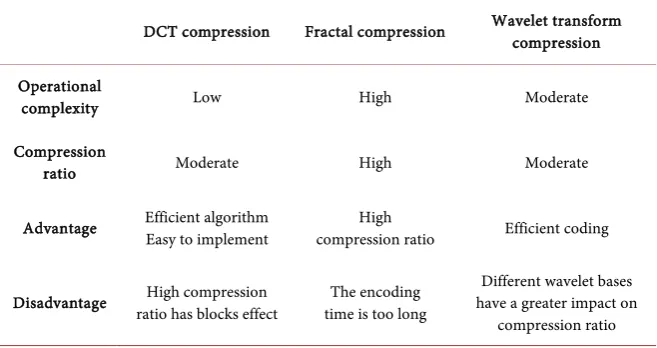
Image compression technology has been developed for decades. The most widely used image compression algorithms are fractal image compression technology, wavelet-based image compression technology, and DCT-based JPEG compres-sion technology [4]. The technical standards of these three algorithms are perfect and the construction methods are quite mature.
DOI: 10.4236/jcc.2019.74005 55 Journal of Computer and Communications Table 1. Compression technology feature comparison table.
DCT compression Fractal compression Wavelet transform compression
Operational
complexity Low High Moderate
Compression
ratio Moderate High Moderate
Advantage Efficient algorithm Easy to implement compression ratio High Efficient coding
Disadvantage ratio has blocks effect High compression time is too long The encoding have a greater impact on Different wavelet bases compression ratio
which may be too large after compression and cannot be transmitted. The situ-ation happened. So we chose DCT-based JPEG image compression.
1.3. Image Acquisition and Transmission
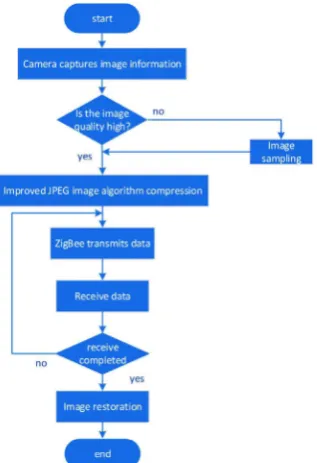
After understanding the selected transmission method and compression algo-rithm, we need to improve the algorithm in order to make the algorithm more efficient. Figure 1 is the flow chart of the algorithm. Firstly, the camera captures the image to determine whether high quality is needed. Image, this step needs to be set in advance. When high quality images are not needed, sampling begins, otherwise no sampling is taken. Then compress the image from the previous step and use the improved algorithm. Through ZigBee for wireless transmission, the receiving end receives data and determines whether the data reception is completed. If it is completed, the system restores the obtained number, and continues to receive it. When the restoration of an image is completed, the im-age will be stored in the database.
2. Design and Improvement of Sampling Methods
2.1. Traditional Image Sampling Problems
DOI: 10.4236/jcc.2019.74005 56 Journal of Computer and Communications Figure 1. Compression algorithm overall flow chart.
[image:4.595.266.479.335.718.2]Figure 2. Standard 8 * 8 pixel block.
DOI: 10.4236/jcc.2019.74005 57 Journal of Computer and Communications is expanded at the receiving end, bilinear interpolation and bicubic interpolation are generated. Calculation, wasting system resources, and accuracy is not ideal.
2.2. Image Sampling Improvement Method
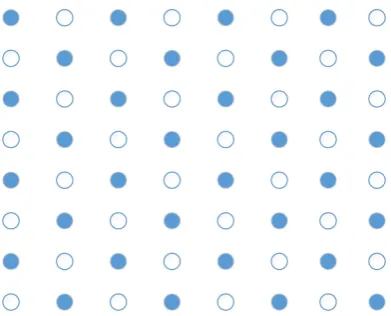
After the camera transmits the image data as a stream of data, we use interlaced neighbor acquisition to increase the correlation between the pixels of the entire image row and column, and because of the pixel points with correlation when performing pixel expansion. More, the restored image works better. Figure 4 shows the pixel block interlaced neighbor scan acquisition. The blue reserved pixels are in X arrangement. The collected data is stored as a matrix of two pixel points, so that the arrangement of the pixels can be avoided when the image is saved and transmitted. Figure 5 is a separation method for pixel block inter-leaved neighbor scan acquisition. It is the result of the acquisition in Figure 4, which constitutes a set of two image pixel points. The red pixel point and the blue pixel point are separated pixel point sets A and B, respectively, to form an image. The two images are respectively JPEG-compressed, transmitted, and synthesized and restored by the receiving end. During the restoration process, since the pixel points of the restored image are X-distributed, the sum of the points near the points to be replenished can be summed, the calculation amount is greatly reduced, and the system resources are also saved. Figure 6 extends the pixel value for the image. If the image to be transmitted is not very sharp, we can transfer one of the A and B pictures, which can greatly improve the sampling ef-ficiency.
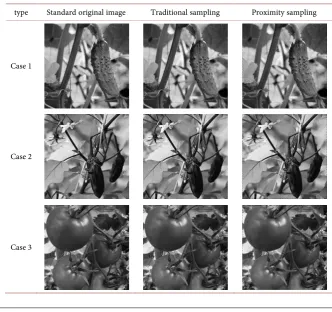
[image:5.595.276.472.548.706.2]By directly observing Table 2 through multiple experiments on the two me-thods, it is difficult for the human eye to distinguish the original image from the post-sampling reduction. Therefore, the peak signal-to-noise ratio (PSNR) is used as the quality index of the restored image [9]. The image obtained by the improved sampling method is partially improved by the improved image me-thod and the original image by the comparison of Table 3. Therefore, in the case of the same amount of transmission, the improved method has a good reduction effect.
DOI: 10.4236/jcc.2019.74005 58 Journal of Computer and Communications Figure 5. Separation of pixel block interlaced neighbor scan acquisition.
Figure 6. Image expansion pixel value method.
Table 2. Simulation comparison of two image sampling methods.
type Standard original image Traditional sampling Proximity sampling
Case 1
Case 2
[image:6.595.204.537.430.742.2]DOI: 10.4236/jcc.2019.74005 59 Journal of Computer and Communications Table 3. PSNR/dB ratio of two image sampling methods.
Image\method Traditional sampling Proximity sampling
Case 1 39.3133 41.6501
Case 2 37.6921 40.2396
Case 3 40.1823 44.1394
3. Design and Improvement of JPEG Compression Algorithm
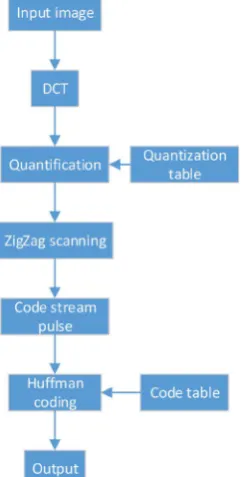
JPEG image compression can achieve a high compression ratio. The reason is that the lossy compression technique is used to remove the unimportant parts of the original data, so that it can be saved in a smaller volume. Considering that the color image volume size is about 3 times the gray image volume, in order to further reduce the transmitted image volume, here we use the gray image for image sampling and compression. As shown in Figure 7, the image is first di-vided into 8 * 8 pixel blocks, and then the didi-vided sub-blocks are respectively DCT-transformed, and all coefficients are currently quantized. The ZigZag scan is continued on the quantized result to form a code stream, and finally the com-pression code rate is further increased by Huffman coding with respect to the code table.
DCT transform:
After DCT transformation, the total energy in the transform domain remains unchanged, but the energy is rearranged. The energy of the matrix is concen-trated on the DC component of the upper left corner of the matrix, while the other values are smaller because the image is coherent. So there won’t be a big change.
( )
( )
( )
( )
7 7
0 0
, alpha alpha
2 1 2 1
, cos π cos π , , 1,2, ,7
16 16
x y
F u v u v
x y
f x y u v u v
= = = ∗ + + ∗ =
∑ ∑
(1)( )
1 when 08alpha
1 when 0
2 u u u = = ≠ (2) Quantification:
DOI: 10.4236/jcc.2019.74005 60 Journal of Computer and Communications Figure 7. Flow chart of JPEG compression algorithm based on DCT transform.
, ,
,
, , 0,1,2, ,7
i j i j
i j G
B round i j
Q
= =
(3)
Here G is the DCT coefficient matrix we obtained, Q is the quantization coef-ficient matrix (Quantization matrices), round is the rounding function, and the JPEG algorithm itself provides a standard quantization coefficient matrix.
ZigZag scanning:
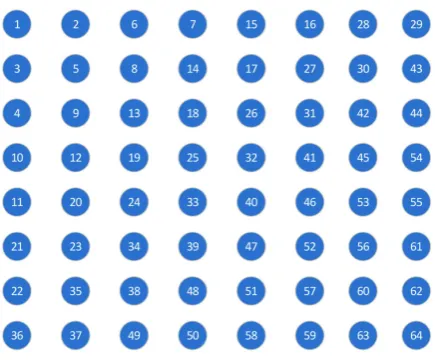
The data in the memory is stored linearly, but if you connect the first point and the last point of each row of the matrix, the two points are almost irrelevant, so we scan the Z-shaped order and transform the obtained quantized matrix into a one-dimensional array. This ensures that successive points of a one-dimensional array are also adjacent to each other at the pixel. Figure 8 shows the scan order.
Huffman coding:
Huffman coding is the basis of almost all compression algorithms. Its basic principle of use is to adjust the coding length of elements according to the fre-quency of use of elements in the data to obtain a higher compression ratio.
Improved Method of JPEG Compression Algorithm
DOI: 10.4236/jcc.2019.74005 61 Journal of Computer and Communications Figure 8. ZigZag scan order.
Human vision includes nonlinearity, multi-channel, and concealment. The main indicator describing the spatial characteristics of the human visual system includes the contrast-sensitive function CSF(f), which represents the response of the human visual system to different spatial frequency components in the image and the resolving power. Considering further compression of the image and less influence on the human eye observation, we use the CSF function to generate the quantization table. Considering the calculation amount and other reasons, we use the three-exponential model jointly proposed by Movshon and Kiorpes [10]. This function is (4).
( )
75 0.2 e0.8flum
CSF f = ∗f ∗ − (4)
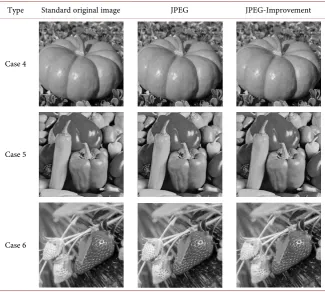
According to this, the improved quantization table is obtained, and then ac-cording to the observation angle of the scene, the observation distance, etc., the size of the f value is appropriately increased or decreased [11] [12] [13], and is substituted into the image compression process. Through comparison of the two methods, the comparison between the two methods is given. Table 4 shows the simulation comparison of the two compression algorithms. It can be seen from Table 5 and Table 6 that the value of the PSNR value of Case 2 is reduced to 9.5% by using the value of the double quantization table. The compression ratio is significantly improved, with Case 1 reaching 88.9%, Case 2 reaching 86.6%, and Case 3 reaching 100.8%. The reconstructed image can obtain better visual effects within a certain error range, and the human eye can hardly distinguish. Not only is data transmission efficiency improved, but the pressure on wireless sensor networks is also greatly reduced.
4. Conclusions
DOI: 10.4236/jcc.2019.74005 62 Journal of Computer and Communications Case 6
Table 5. PSNR/dB ratio of reconstructed images by two compression algorithms.
Image/method JPEG JPEG-Improvement
Case4 38.0570 34.9751
Case5 36.5008 34.3013
Case6 37.5631 33.9623
Table 6. Compression ratio of reconstructed image by two compression algorithms.
Image/method JPEG JPEG-Improvement
Case4 17.961 33.932
Case5 17.930 33.475
Case6 14.337 28.792
improvement of the plant image sampling method and the quantization table to meet the needs of the human eye to observe the details of the plant image. Compared with the traditional JPEG algorithm, the plant image sampling process can increase the fit of the restored image to the original image, and can obtain a larger compression ratio.
[image:10.595.209.540.412.479.2] [image:10.595.209.539.512.577.2]DOI: 10.4236/jcc.2019.74005 63 Journal of Computer and Communications satellite imagery. Image compression in the future big data era is becoming more and more important. The JPEG image compression algorithm based on DCT transform can be used in sampling, time domain, and the frequency domain transformation and coding methods are improved in order to achieve further compression and increase the image reduction degree.
Acknowledgements
This work was partially supported by the National Nature Science Foundation of China (No. 61771262), by Major Science and Technology Projects of Tianjin (No. 2018ZXRHNC00140 and No. 2017ZXHLNC00100) and by Tianjin Key Laboratory of Optoelectronic Sensor and Sensing Network Technology.
Conflicts of Interest
The authors declare no conflicts of interest regarding the publication of this pa-per.
References
[1] Wang, Z.-F., Zhu, L., Zeng, C.-Y., Min, Q.-S. and Xia, D. (2018) Survey on Recom-pression Detection for Digital Images. Computer Science, 45, 20-29.
[2] Douak, F., Benzid, R. and Benoudjit, N. (2011) Color Image Compression Algo-rithm Based on the DCT Transform Combined to an Adaptive Block Scanning. AEU-International Journal of Electronics and Communications, 65, 16-26.
https://doi.org/10.1016/j.aeue.2010.03.003
[3] Gheorghiu, R. and Iordache, V. (2018) Use of Energy Efficient Sensor Networks to Enhance Dynamic Data Gathering Systems: A Comparative Study between Blu-etooth and ZigBee. Sensors, 18, 1801. https://doi.org/10.3390/s18061801
[4] Feng, F., Liu, P.-X., Li, X.-Y. and Yan, N.-B. (2016) Research of Discrete Cosine Transform for Image Compression Algorithm. Computer Science, 43, 240-241 + 255.
[5] Yang, P.Z., Wang, L.B., Pei, H.A.D., Qu, X. and Liang, S. (2019) Design of an Image Acquisition and Compression System with High Compression Ratio. Chinese Jour-nal of Electron Devices, 42, 163-167.
[6] Tongming, J.I. and Shengli, B. (2017) Application of JPEG2000 Image Compression Algorithm in Android Platform. Journal of Computer Applications, 37, 203-206. [7] Timofte, R., De Smet, V. and Van Gool, L. (2014) A+: Adjusted Anchored
Neigh-borhood Regression for Fast Super-Resolution. Asian Conference on Computer Vi-sion, Springer, Cham, 111-126.
[8] Yang, C.Y. and Yang, M.H. (2013) Fast Direct Super-Resolution by Simple Func-tions. Proceedings of the IEEE International Conference on Computer Vision, Syd-ney, NSW, 1-8 December 2013, 561-568.
[9] Chun, L., Kun, T., et al. (2018) Quality Assessment for Contrast-Distorted Images Based on Convolutional Neural Network. Microelectronics & Computer, 35, 84-88. [10] Movshon, J.A. and Kiorpes, L. (1988) Analysis of the Development of Spatial
Con-trast Sensitivity in Monkey and Human Infants. JOSAA, 5, 2166-2172.
https://doi.org/10.1364/JOSAA.5.002166