DEMOGRAPHIC RESEARCH
VOLUME 32, ARTICLE 25, PAGES 775
−
796
PUBLISHED 24 MARCH 2015
http://www.demographic-research.org/Volumes/Vol32/25/ DOI: 10.4054/DemRes.2015.32.25
Research Article
Women’s decision-making autonomy and
children’s schooling in rural Mozambique
Luciana Luz
Victor Agadjanian
©2015Luciana Luz &Victor Agadjanian .
This open-access work is published under the terms of the Creative Commons Attribution NonCommercial License 2.0 Germany, which permits use, reproduction & distribution in any medium for non-commercial purposes, provided the original author(s) and source are given credit.
1 Introduction 776
2 Conceptualization and hypotheses 777
3 The setting 779
4 Data and methods 780
4.1 Data 780
4.1.1 Dependent variable 781
4.1.2 Independent variable 781
4.1.3 Control variables 783
4.2 Method 784
5 Results 785
6 Discussion 790
7 Acknowledgements 791
Women’s decision-making autonomy and children’s schooling in
rural Mozambique
Luciana Luz1 Victor Agadjanian2
Abstract
BACKGROUND
Women’s decision-making autonomy in developing settings has been shown to improve child survival and health outcomes. However, little research has addressed possible connections between women’s autonomy and children’s schooling.
OBJECTIVE
To examine the relationship between rural women’s decision-making autonomy and enrollment status of primary school-age children living in their households and how this relationship differs by child’s gender.
METHODS
The analysis uses data from a 2009 survey of rural households in four districts of Gaza province in southern Mozambique. Multilevel logistic models predict the probability of being in school for children between 6 and 14 years old.
RESULTS
The results show a positive association of women’s decision-making autonomy with the probability of being enrolled in primary school for daughters, but not for sons. The effect of women’s autonomy is net of other women’s characteristics typically associated with enrollment and does not mediate the effects of those characteristics.
CONCLUSIONS
Based on the results, we argue that women with higher levels of decision-making autonomy may have a stronger preference for daughters’ schooling and may have a greater say in making and implementing decisions regarding daughters’ education, compared to women with lower autonomy levels. Results also illustrate a need for
considering a broader set of autonomy-related characteristics when examining the effects of women’s status on children’s educational outcomes.
1. Introduction
The connections between women’s position in the household and children’s outcomes have been widely examined in the literature. Evidence from both developing and developed countries has shown that when women are in control of household resources they are more likely to act for the benefit of their children (Haddad et al. 1997; Quisumbing 2003). The positive effects of women’s autonomy on child survival and nutritional status are particularly well documented (Caldwell 1986; Dyson and Moore 1983; Mason 1984). Following this evidence and the conceptualization of women’s decision-making autonomy as a distinct component of women’s status (Kabeer 1999; Yabiku, Agadjanian, and Sevoyan 2010), we examine the association between women’s autonomy and primary school enrollment in a rural sub-Saharan setting.
The focus on women’s autonomy seems particularly appropriate when analyzing factors affecting primary schooling in a context like rural sub-Saharan Africa, where direct pecuniary costs of attending primary school are usually low. In such settings, the decision-making process regarding a child’s school enrollment is made not as a function of the resources available in the household and the allocation of these resources but in relation to the opportunity cost of the child’s labor (Lloyd and Blanc 1996). In addition, women’s perception of the opportunity cost of their children’s enrollment may not be the same for boys and girls because they play gender-specific roles in economic and domestic activities. The gender bias may be magnified in settings marked by significant gender inequalities and rapid changes in the family context due to economic growth, modernization, and mobility (Yabiku, Agadjanian, and Sevoyan 2010).
making and implementing decisions regarding daughters’ education. The higher value placed on girls’ schooling can be a sign of women’s changing ideas about the role of daughters and the way they envision their daughters’ futures regarding returns for their education.
2. Conceptualization and hypotheses
The literature on women’s status supports the view that women’s status is a multidimensional complex that comprises multiple characteristics of women and their relations to others (Durrant and Sathar 2000, Roushdy 2004). Previous research has typically focused on the relationship between women’s education and work and children’s outcomes, showing that higher educational levels and employment are positively related to children’s survival chances (Basu and Basu 1991, Hobcraft 1993, Cleland 2010) and their schooling (Lam and Duryea 1999, Buchmann and Hannum 2001). However, more recent research has also emphasized the importance of women’s decision-making autonomy for children’s outcomes (e.g., Durrant and Sathar 2000,
Yabiku, Agadjanian, and Sevoyan 2010, Shroff et al. 2011). The concept of women’s autonomy is usually defined in terms of women’s ability to formulate, negotiate, and carry out their preferences (Smith et al. 2003, Ghuman, Lee, and Smith 2006). As a distinct dimension of women’s status, decision-making autonomy captures aspects of women’s status that are not represented in the conventional measures. Thus Kabeer (1999) argues that the ability to make choices and act upon them should be viewed as separate from personal resources and outcomes when analyzing women’s empowerment. According to her, this dimension encompasses behavioral processes like negotiation and bargaining, and cognitive processes of reflection and analysis. Furthermore, women’s autonomy is a relational concept; it designates women’s abilities to articulate choices and make decisions relative to those of men (Smith et al. 2003).
on school enrollment and attainment (Schultz 1990, Lloyd and Gage-Brandon 1994, Bruce et al. 1995). In this study we build upon this research and the literature on autonomy and child health outcomes to examine the association between women’s decision-making autonomy and children’s enrollment while controlling for conventional measures of women’s status, such as educational level, work outside the household, and marital characteristics.
Following the conceptualization of autonomy as a marker of women’s agency, we argue that women’s autonomy might affect children’s schooling separately from conventional attributes of women’s status. In this study, while accounting for conventional characteristics such as educational level, work outside the household, and marital characteristics, we focus on the association between women’s decision-making autonomy and children’s enrollment net of these characteristics.
Additionally, we examine whether women’s autonomy may have a different impact for enrollment of girls and boys. Previous studies have produced mixed results regarding the direction of these effects. Some studies point to a more beneficial effect of women’s autonomy for girls’ well-being relative to boys’. Thus, a cross-national study using data from Bangladesh, Ethiopia, Indonesia, and South Africa found that women’s control over household resources reduced gender differences in children’s education in Bangladesh but not in the other three countries (Quisumbing and Maluccio 2003). Fuller et al. (1995) found that in Botswana mothers were more likely to invest in their daughters than were fathers and tended to support their daughters’ schooling more equitably in relation to their sons. It has been argued that empowered mothers are better able to negotiate social and domestic labor demands faced by their daughters that favor their school participation (Schultz 1990; Fuller et al. 1995). Moreover, higher autonomy levels are related to higher mobility and exposure to extra-familial influences, which could change the way mothers envision their daughters’ futures and perceived future returns from their education (Ahmed and Bould 2004; Yount 2005). Yet women’s autonomy may also be associated with larger gender differences in resources allocated to children. Women with greater power to negotiate their preferences within the household may be better able to translate their preferences into outcomes, but their preferences may still be shaped by dominant community gender norms. In contexts with strong preferences for sons, or where women’s social and financial well-being depends disproportionally on sons, as is typical in patrilineal settings, autonomy may have a more favorable effect for boys’ outcomes (Das Gupta 1987, Eswaran 2002).
Based on the reviewed literature and on the proposed conceptualization of female decision-making autonomy, we test the following hypotheses about the association between women’s autonomy and school enrollment of co-resident children in rural southern Mozambique:
H1. Women’s decision-making autonomy will have a positive association with their children’s enrollment status.
H2. Women’s decision-making autonomy will have an independent association with children’s enrollment and will not mediate the effect of traditional measures of women’s status, such as women’s education, employment, and marriage characteristics.
H3. The association between women’s decision-making autonomy and children’s enrollment will vary by child’s gender. Here two alternative hypotheses are tested:
H3a: The positive relationship between women’s autonomy and children’s enrollment will be stronger for daughters because women with greater decision-making autonomy may be more able to negotiate social and labor demands preventing their daughters from attending school.
H3b: The positive relationship between women’s autonomy and children’s enrollment will be stronger for sons because in the prevailing patrilineal and patrilocal system the real and perceived future returns of schooling are higher for boys than for girls and greater decision-making autonomy may help to realize the corresponding schooling preferences.
3. The setting
the least developed nations in the world, with an average per capita annual income of $440, an infant mortality rate of 92 per thousand children, and adult literacy rate of 55% (Unicef 2011).
Since colonial times, Mozambicans have worked in South African mines, and this legal migration flow continues to date (CEA-EMU 1997; Crush 2001). The area of our study has particularly high levels of out-migration to South Africa. Migration within Mozambique, particularly from rural to urban areas, has also been growing rapidly (Jenkins 1993; Knauder 2000). Changing migration regimes have been at the root of transformations of family, kinship, and gender systems.
After the country’s pacification and the first multi-party election in the mid-1990s, Mozambique had low educational outcomes, worsened by the lack of infrastructure, paucity of schools in the rural areas, difficulty in accessing areas outside provincial capitals, and shortage of teachers and school inputs (Fox et al. 2012). In the two following decades the country has seen progress in educational indicators such as literacy levels and enrollment rates. With the ongoing expansion of the educational system, access to basic education has increased fast, especially in the last decade. But despite vast improvements in access to primary education a sizeable share of children is left out of school, particularly girls and those in rural areas. The gender gap in indicators related to school enrollment shows the persistent, even if diminishing, disadvantage of girls. Thus, in 1999, the primary school net enrollment rate (NER)3 was 47.4% for males and 39.8% for females. Ten years later the NER was already 93% for males and 88% for females (Unicef 2011). The gender imbalance is even greater regarding students’ persistence in the school system. Primary school conclusion rates were 69% for males versus 48% for females in 2008 (Ministry of Education and Culture 2011).
4. Data and methods
4.1 Data
The sample of children analyzed in this study comes from a 2009 survey of rural women of reproductive age in four districts of Gaza province in southern Mozambique. The survey, conducted in 56 villages (14 per district), was the second wave of a longitudinal study that started with a survey in 2006. The 2006 sample consisted of 1,680 women (420 per district, 30 per village, one woman per household). The 2009
wave of data collection was carried out among women still living within the study area or who could be located elsewhere (N=1314, 78% of the 2006 sample). A refresher sample was randomly selected to replace women lost to follow-up. The total sample of the 2009 survey was 1,772 women.
The survey collected detailed demographic and socioeconomic information, including reproductive behavior, husband’s migration history, household material status, and HIV-related characteristics. The questionnaire also contained a battery of questions measuring women’s decision-making power and collected information on school enrollment of all household members. The analytical sample of this study consists of the survey respondents’ children between 6 and 14 years old living with their biological mothers who were in a marital relationship at the time of the survey (N=2026).
4.1.1 Dependent variable
The dependent variable is whether or not a child is enrolled in school at the time of the survey. Information on school enrollment comes from the question “Is he/she studying now?” asked about every member of the household. Measures of current school enrollment have been shown to be more informative than number of years of schooling (attainment) in sub-Saharan Africa: given frequent mobility of children between households and the lack of information on previous households of residence, current enrollment is more directly related to children’s current inputs (Lloyd and Blanc 1996).
4.1.2 Independent variable
spending money on her personal needs (such as clothes, shoes, or earrings); getting a job or engaging in commerce; and doing an HIV test. For each of the seven activities, respondents were scored 0, 1, or 2, based on the three possible answers listed above. A reliability analysis to assess whether the seven items are interrelated produced a Cronbach’s alpha of 0.91, indicating high internal consistency.
To ensure a starker contrast between women with higher levels of decision-making autonomy and the rest of the sample, we chose to condense this range into a dichotomous indicator with two values—those among whom the average of the seven responses were at least one standard deviation above the mean vs. the rest. Admittedly, the use of a dichotomous variable may have resulted in a loss of some nuances in women’s autonomy levels. However, an early exploratory analysis showed that the autonomy scores are not normally distributed, as individuals’ scores are clustered around certain values. This uneven distribution may be partly due to the inherently varying accuracy of responses to this type of behavioral self-assessment question, which is often shaped by respondents’ interpretations of the questions as well as the circumstances of interview and interviewer-respondent rapport. The chosen dichotomous specification therefore helps to reduce the potential noise resulting from inaccurate responses, while also allowing us to focus on the role of higher autonomy levels.
Women’s decision-making autonomy is related to a number of woman’s, family, and community characteristics. Women with greater decision-making autonomy are not a random group, and some characteristics that are particular to this group could affect both their autonomy and their children’s chances of being enrolled in school. Although we control for several observed characteristics, there could be unobserved characteristics affecting the relationship between women’s autonomy and children’s enrollment.
4.1.3 Control variables
The statistical model controls for women’s sociodemographic characteristics and those of their marriages. In examining the effect of women’s decision-making autonomy on enrollment it is important to include in the analysis factors associated with other dimensions of women’s status. For example, our autonomy construct could simply mediate the relationship of various attributes of women’s status with schooling. To confirm our hypotheses we therefore need to show that decision-making autonomy has a significant positive effect on enrollment, net of the women’s characteristics that have been traditionally shown to affect children’s schooling. Thus women’s educational level is related both to children’s schooling and to women’s autonomy. Women with higher educational levels are more likely to value education and to support their children’s schooling. At the same time, it is known that women with more education also have higher levels of autonomy. By including women’s education we control for this important predictor of children’s schooling and also separate it from women’s decision-making autonomy. Similarly, we control for women’s work outside the household. Women’s autonomy level is also likely to increase with their age. Our sample consists only of women in reproductive ages, with most women being between 20 and 35 years old. Therefore, we included three age categories as dummy variables: younger than 26 years old, between 26 and 30, or 31 years or older.
We included a set of marriage characteristics to account for aspects of women’s status related to their current marital relations. Bargaining power within marriage is likely to depend on the age and educational gaps between husband and wife. We included a dummy variable indicating whether or not the husband has 4 or more years more schooling than his wife. In addition, a set of dummies for the spousal age gap were included: husband is 5 to 9 years older, 10 to 14, or 15 years older or more. Husband who is less than 5 years older is the omitted category. A large proportion of women reported not knowing their husbands’ age or educational level, and an additional dummy variable was created to control for the lack of this information.
Agadjanian, and Sevoyan (2010), women whose husbands are migrants are more likely to have greater autonomy, which can be beneficial for children’s outcomes.
To account for potentially confounding factors in the relationship between women’s autonomy and child’s enrollment, we include a set of other controls in our multivariate analysis. Our model includes the characteristics typically associated with child’s educational outcomes (Knodel and Wongsith 1991; Buchman and Hannum 2001): child’s age, sex, and presence of other children of school age living in the household (aged 6 to 14). Child’s age4 is an important predictor of enrollment in the study setting. Older children are more likely to be enrolled in school, which is consistent with Mozambique’s high age-grade distortion rates and late enrollment. Because birth order and sex composition of siblings have been shown to be related to educational outcomes (Butcher and Case 1994; Alderman and King 1998) we disaggregate the information on presence of school age children in the household into four different dummy variables: older female sibling, older male sibling, younger female sibling, and younger male sibling. The presence of very young children in the household was found to be associated with a lower probability of attending school by older children because of the tradeoff between the enrollment of school-age children and their domestic labor in childcare (Lloyd and Blanc 1996); the presence of children younger than 5 years old in the household was therefore also included as a control.
An index of household’s standard of living based on ownership of selected consumer goods (radio, bicycle, motorcycle, or automobile) and size of agricultural land were included to account for the household socioeconomic status. Distance to nearest town and presence of a clinic at the village were introduced as measures of proximity to urban areas and access to public services, respectively. In addition, a dummy variable for whether there is a school offering primary education in the village controls for variation in enrollment due to differences in access to the school system.
4.2 Method
In this study we use multilevel logistic regression for binary outcomes to predict the probability of a child being currently enrolled. Because of the design of the survey sample, in which the primary unit of analysis was the woman, observations are not independent when we change the focus to children. Children are clustered within
respondents’ specific households, and therefore women’s characteristics are repeated for children living in the same household. To account for this non-independence of observations we fitted a two-level model with random intercepts in the first level (child) and second level (woman). Three sets of models were fitted: one for all children and one for children of each sex. All models were estimated using the GLIMMIX procedure in SAS 9.3.
5. Results
Table 1 shows the bivariate association between woman’s decision-making autonomy and child’s enrollment status. Overall, this association seems positive. Over 12% of boys and 14% of girls between 6 and 14 years old whose mother has a relative low level of decision-making autonomy are not enrolled in school. By contrast, about 11% of boys and 9% of girls living with a mother with a higher level of decision-making autonomy are not enrolled. Moreover, the bivariate association between mother’s decision-making autonomy level and children’s enrollment suggests differences by child’s sex. Although both boys and girls whose mothers have lower decision-making autonomy are more likely to be out of school than children of women with higher decision-making autonomy, girls seem to be considerably more affected by their mothers’ lower level of autonomy.
Table 1: Percent of children enrolled according to women’s decision-making
autonomy level and child’s sex, rural southern Mozambique 2009
Not enrolled Enrolled
Women's decision-making
autonomy: N Males Females Males Females
High decision-making autonomy 1238 10.77 9.40 89.23 90.60
Low decision-making autonomy 788 12.04 14.70 87.86 85.03
Total 2026
Source:Childbearing Dynamics in a Setting of High HIV Prevalence and Massive ART Rollout Survey, 2009.
over 30 years old have most children of school age. However, there is a noticeable difference by children’s enrollment status: 65% of the children enrolled in school and 73% of non-enrolled children have mothers in the oldest age group. Mothers of enrolled children are better educated, on average, than mothers of their non-enrolled peers: 28% of the children enrolled in school have mothers with no formal education, compared to 44% of non-enrolled children. At the same time, 26% of enrolled children have mothers with 5 or more years of schooling, while only 10% of non-enrolled children have mothers in the highest educational group. By comparison, there is almost no difference with respect to mother’s employment outside subsistence agriculture between enrolled and non-enrolled children
The husband-wife educational gap is higher for non-enrolled children. The educational lag for mothers in relation to their partners is 4 years or more among 38% of non-enrolled children, against 26% of enrolled children. The age gap between mothers and their partners is considerably higher for non-enrolled children. For children enrolled in school, most couples have small or no differences in their educational level. The age difference between mothers and their partners is less than 10 years for 55% of them. On the other hand, only 40% of the non-enrolled children have mothers who have a small age difference with their partners. Bridewealth payment is somewhat more prevalent in families of enrolled children than in families of their non-enrolled counterparts, 58% and 52% respectively. Forty-eight percent of children who are not in school have a migrant father, a higher share than among those who are currently enrolled, 42%. The presence of siblings in the household also differs by enrollment status. Children who are not enrolled in school are more likely to have older brothers in the household than are enrolled children, 39% and 30% respectively. The same pattern transpires in the presence of older sisters: 37% of non-enrolled children live with at least one older sister, against 31% of those enrolled. Not surprisingly, the patterns for younger siblings are mirror images of those for older siblings.
Table 2: Mean values of children’s, mothers’, and household characteristics by children’s enrollment status, rural southern Mozambique 2009
Enrolled Not enrolled
Child's characteristics
Age 9.29 8.74
Age squared 92.18 84.60
Gender
Female 0.49 0.51
Male 0.51 0.49
Mother’s characteristics
Age
25 or less 0.07 0.08
26 to 30 0.28 0.19
31 or more 0.65 0.73
Education
No education 0.28 0.44
1 to 4 years 0.46 0.46
5 years or more 0.26 0.10
Works outside subsistence agriculture 0.28 0.30
Marriage's characteristics
Husband-wife age gap
Less than 5 years 0.29 0.24
5 to 9 years 0.26 0.17
10 to 14 years 0.09 0.09
15 years or more 0.21 0.29
Doesn't know husband's age 0.15 0.22
Husband-wife educational gap
3 years or less 0.65 0.47
4 years or more 0.26 0.38
Doesn't know husband's education 0.09 0.15
Bridewealth has been paid 0.58 0.52
Husband is a migrant 0.42 0.48
Siblings
Has younger female sibling(s) 0.31 0.22
Has younger male sibling(s) 0.29 0.24
Has older female sibling(s) 0.31 0.37
Has older male sibling(s) 0.30 0.39
Sibling(s) aged less than 5 years 0.46 0.50
Household characteristics
Household material status index (1-4) 2.02 1.77 Size of agricultural land (in hectares) 1.79 1.60
Village characteristics
Distance to nearest town (in kilometers) 29.15 35.98
Primary school in the village 0.47 0.35
Clinic in the village 0.58 0.64
N 1797 229
Source:Childbearing Dynamics in a Setting of High HIV Prevalence and Massive ART Rollout Survey, 2009.
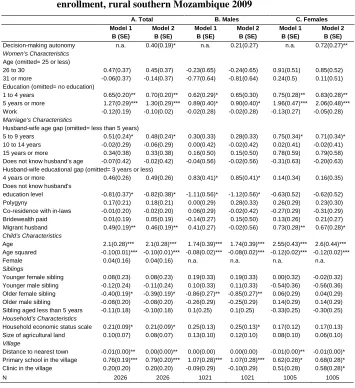
both the total sample and for male and female children. In each pair of models, Model 1 includes the effect of women’s status characteristics and other sociodemographic predictors on child’s enrollment. Model 2 adds the decision-making autonomy level to the previous model.
Consistent with the literature, Model A.1 shows a significant positive effect of women’s education on the chance of their children being enrolled in school. The effect of mother’s education on enrollment is statistically significant for both boys and girls, but is much stronger for the latter. However, other women’s status characteristics seem to operate differently by gender of the child. A higher educational gap is associated with higher likelihood of being enrolled for sons’ enrollment, while a smaller age gap between spouses seems beneficial for daughters’ enrollment.
Husband’s migration is also positively related with the likelihood of being enrolled for daughters but not for sons. Because we are controlling for household economic conditions, husband’s migration could be affecting daughter’s enrollment through its relationship to women’s status. As discussed previously, partner’s migration, in addition to providing the household with material resources, is associated with greater independence of women, which could lead to increased well-being of children living in the household.
Table 3: Effect of women’s decision-making autonomy level on child’s enrollment, rural southern Mozambique 2009
A. Total B. Males C. Females
Model 1 Model 2 Model 1 Model 2 Model 1 Model 2
B (SE) B (SE) B (SE) B (SE) B (SE) B (SE)
Decision-making autonomy n.a. 0.40(0.19)* n.a. 0.21(0.27) n.a. 0.72(0.27)**
Women’s Characteristics
Age (omitted= 25 or less)
26 to 30 0.47(0.37) 0.45(0.37) -0.23(0.65) -0.24(0.65) 0.91(0.51) 0.85(0.52) 31 or more -0.06(0.37) -0.14(0.37) -0.77(0.64) -0.81(0.64) 0.24(0.5) 0.11(0.51) Education (omitted= no education)
1 to 4 years 0.65(0.20)** 0.70(0.20)** 0.62(0.29)* 0.65(0.30) 0.75(0.28)** 0.83(0.28)** 5 years or more 1.27(0.29)*** 1.30(0.29)*** 0.89(0.40)* 0.90(0.40)* 1.96(0.47)*** 2.06(0.48)*** Work -0.12(0.19) -0.10(0.02) -0.02(0.28) -0.02(0.28) -0.13(0.27) -0.05(0.28)
Marriage’s Characteristics
Husband-wife age gap (omitted= less than 5 years)
5 to 9 years 0.51(0.24)* 0.48(0.24)* 0.30(0.33) 0.28(0.33) 0.75(0.34)* 0.71(0.34)* 10 to 14 years -0.02(0.29) -0.06(0.29) 0.00(0.42) -0.02(0.42) 0.02(0.41) -0.02(0.41) 15 years or more 0.34(0.38) 0.33(0.38) 0.16(0.50) 0.15(0.50) 0.78(0.59) 0.79(0.58) Does not know husband’s age -0.07(0.42) -0.02(0.42) -0.04(0.56) -0.02(0.56) -0.31(0.63) -0.20(0.63) Husband-wife educational gap (omitted= 3 years or less)
4 years or more 0.46(0.26) 0.49(0.26) 0.83(0.41)* 0.85(0.41)* 0.14(0.34) 0.16(0.35) Does not know husband's
education level -0.81(0.37)* -0.82(0.38)* -1.11(0.56)* -1.12(0.56)* -0.63(0.52) -0.62(0.52) Polygyny 0.17(0.21) 0.18(0.21) 0.00(0.29) 0.28(0.33) 0.26(0.29) 0.23(0.30) Co-residence with in-laws -0.01(0.20) -0.02(0.20) 0.06(0.29) -0.02(0.42) -0.27(0.29) -0.31(0.29) Bridewealth paid 0.01(0.19) 0.05(0.19) -0.14(0.27) 0.15(0.50) 0.13(0.26) 0.21(0.27) Migrant husband 0.49(0.19)** 0.46(0.19)** 0.41(0.27) -0.02(0.56) 0.73(0.28)** 0.67(0.28)*
Child’s Characteristics
Age 2.1(0.28)*** 2.1(0.28)*** 1.74(0.39)*** 1.74(0.39)*** 2.55(0.43)*** 2.6(0.44)*** Age squared -0.10(0.01)*** -0.10(0.01)*** -0.08(0.02)*** -0.08(0.02)*** -0.12(0.02)*** -0.12(0.02)***
Female 0.04(0.16) 0.04(0.16) n.a. n.a. n.a. n.a.
Siblings
Younger female sibling 0.08(0.23) 0.08(0.23) 0.19(0.33) 0.19(0.33) 0.00(0.32) -0.02(0.32) Younger male sibling -0.12(0.24) -0.11(0.24) 0.10(0.33) 0.11(0.33) -0.54(0.36) -0.56(0.36) Older female sibling -0.40(0.19)* -0.39(0.19)* -0.86(0.27)** -0.85(0.27)** 0.06(0.29) 0.04(0.29) Older male sibling -0.08(0.20) -0.08(0.20) -0.26(0.29) -0.25(0.29) 0.14(0.29) 0.14(0.29) Sibling aged less than 5 years -0.11(0.18) -0.10(0.18) 0.1(0.25) 0.1(0.25) -0.33(0.25) -0.30(0.25)
Household’s Characteristics
Household economic status scale 0.21(0.09)* 0.21(0.09)* 0.25(0.13) 0.25(0.13)* 0.17(0.12) 0.17(0.13) Size of agricultural land 0.10(0.07) 0.08(0.07) 0.13(0.10) 0.12(0.10) 0.08(0.10) 0.06(0.10)
Village
Distance to nearest town -0.01(0.00)** 0.00(0.00)** 0.00(0.00) 0.00(0.00) -0.01(0.00)** -0.01(0.00)* Primary school in the village 0.76(0.19)*** 0.79(0.20)*** 1.07(0.28)*** 1.07(0.28)*** 0.62(0.28)* 0.68(0.28)* Clinic in the village 0.20(0.20) 0.20(0.20) -0.09(0.29) -0.10(0.29) 0.51(0.28) 0.58(0.28)*
N 2026 2026 1021 1021 1005 1005
Source: Childbearing Dynamics in a Setting of High HIV Prevalence and Massive ART Rollout Survey, 2009. * p<.05; ** p<.01; *** p<.001
for overall community development, is associated with greater likelihood of being enrolled for both males and females, while the presence of a health clinic in the village is related to higher chances of enrollment for females only. Not surprisingly, the existence of a primary school in the village is positively associated with enrollment for boys and girls alike.
6. Discussion
The literature on the effects of women’s autonomy on child well-being has consistently found women’s autonomy to have positive effects on child survival, nutrition, and health (Caldwell 1986, Shroff et al. 2011). Studies of the effect of female autonomy on child’s schooling are fewer, and their results indicate that women’s higher autonomy may lead to better educational outcomes for children, based on the argument that household resource allocation is biased and children are better off when women have more control over the family’s resources (Lloyd and Blanc 1996). In a setting like rural Mozambique where education is free and therefore pecuniary costs of education are minimal, the decision to send a child to school may be less related to a family’s ability to incur such costs and more associated with the opportunity cost of children’s time and the perceived returns from children’s education. Therefore the power to influence children’s chances of enrollment would depend not so much on control over resources as on the ability to make independent decisions regarding family affairs, in particular regarding children.
Our results show that mothers’ level of decision-making autonomy affects daughters’ enrollment above and beyond the conventional measures of women’s status. However, women’s decision-making autonomy has no significant effect on their sons chances of enrollment. It could be expected that mothers would have gender preferences regarding children’s schooling, but not necessarily in favor of their daughters. On the contrary, in a patrilineal and patrilocal setting such as southern Mozambique mothers might have a preference for sons’ schooling because daughters leave the parental household after marriage and women depend mainly on their sons at older ages. Previous studies have presented evidence in support of this argument, showing that mothers would use their greater autonomy to better implement their preference for sons (Das Gupta 1987). Nonetheless, our results indicate that sons’ chances of enrollment are not affected by their mothers’ greater decision-making ability, while daughters can significantly benefit from it.
study provides evidence that the benefits of mother’s decision-making autonomy for their daughters’ schooling remain non-trivial even as the overall enrollment levels rise. With the data to hand, we cannot draw definitive conclusions about the pathways through which women’s decision-making autonomy may affect their daughters’ enrollment. We suggest, however, that decision-making autonomy, as measured in this study, refers to a broader set of daily decisions than those relating to household economy. It includes women’s perception of their ability to move, work, and relate with family, friends, and neighbors. By having greater autonomy, we argue, women may be exposed to extra-familial influences affecting the way they envision their daughters’ futures (Yount 2005). Moreover, it is possible that greater decision-making autonomy may enable women to negotiate demands for daughters’ labor within the household to minimize the tradeoff in girls’ time between school and domestic activities.
In sum, our findings suggest that women’s greater ability to make decisions in this context tend to benefit their daughters’ schooling and indicate the need for considering a broader set of autonomy-related characteristics when examining the effect of women’s status on children’s educational outcomes. As Mozambique and many other sub-Saharan countries strive both to raise the overall school enrollment rates and to close the gender enrollment gap, policymakers should take into account the potential gendered benefits of women’s decision-making autonomy.
7. Acknowledgments
References
Agadjanian, V., Yabiku, S.T., and Cau, B. (2011). Men’s migration and women’s fertility in rural Mozambique. Demography 48(3):1029–1048. doi:10.1007/ s13524-011-0039-y.
Ahmed, S.S., and Bould, S. (2004). “One daughter is worth 10 illiterate sons”: Reframing the patriarchal family. Journal of Marriage and Family 66(5):1332– 1341. doi:10.1111/j.0022-2445.2004.00096.x.
Alderman, H., and King, E.M. (1998). Gender differences in parental investment in education. Structural Change and Economic Dynamics 9(4): 453–468.
doi:10.1016/S0954-349X(98)00040-X.
Basu, A.M. and Basu, K.. (1991). Women’s economic roles and child survival: The case of India. Health Transition Review 1(1): 83–103.
Bruce, J., Lloyd, C.B., and Leonard, A. (1995). Families in Focus: New Perspectives on Mothers, Fathers, and Children. New York: The Population Council.
Brunson, E.K., Shell-Duncan, B., and Steele, M. (2009). Women’s autonomy and its relationship to children’s nutrition among the Rendille of northern Kenya.
American Journal of Human Biology 21(1): 55–64. doi:10.1002/ajhb.20815.
Buchmann, C. and Hannum, E. (2001). Education and stratification in developing countries: a review of theories and research. Annual Review of Sociology 27(1): 77–102. doi:10.1146/annurev.soc.27.1.77.
Butcher, K.F. and Case, A. (1994). The effect of sibling sex composition on women’s education and earnings. The Quarterly Journal of Economics 109(3): 531–563.
doi:10.2307/2118413.
Caldwell, J.C. (1986). Routes to low mortality in poor countries. Population and Development Review 12(2): 171–220. doi:10.2307/1973108.
CEA/UEM. (1997). The Mozambican Miner: A Study of the Export of Labor. Maputo, Mozambique: Center for African Studies (CEA), Eduardo Mondlane University (in Portuguese).
Cleland, J. (2010). The benefits of educating women. The Lancet 376(9745): 933–934.
doi:10.1016/S0140-6736(10)61417-1.
Cunguara, B. and Hanlon, J. (2012). Whose wealth is it anyway? Mozambique’s outstanding economic growth with worsening rural poverty. Development and Change 43(3): 623–647. doi:10.1111/j.1467-7660.2012.01779.x.
Das Gupta, M. (1987). Selective discrimination against female children in rural Punjab, India. Population and Development Review 13(1): 77–100. doi:10.2307/ 1972121.
Durrant, V.L. and Sathar, Z.A. (2000). Greater Investments in Children Through Women’s Empowerment: A Key to Demographic Change in Pakistan? New York: Population Council.
Dyson, T. and Moore, M. (1983). On kinship structure, female autonomy, and demographic behavior in India. Population and Development Review 9(1): 35– 60. doi:10.2307/1972894.
Eswaran, M. (2002). The empowerment of women, fertility, and child mortality: Towards a theoretical analysis. Journal of Population Economics 15(3): 433– 454. doi:10.1007/s001480100070.
Fox, L., Santibañez, L., Nguyen, V., and Pierre, A. (2012). Education Reform in Mozambique : Lessons and Challenges. Washington, DC: World Bank.
Fuller, B., Singer, J.D., and Keiley, M. (1995). Why do daughters leave school in Southern Africa? Family economy and mother’s commitments. Social Forces
74(2): 657–681. doi:10.1093/sf/74.2.657.
Ghuman, S.J., Lee, H.J., and Smith, H.L. (2006). Measurement of women’s autonomy according to women and their husbands: Results from five Asian countries.
Social Science Research 35(1): 1–28. doi:10.1016/j.ssresearch.2004.06.001.
Haddad, L., Hoddinott, J., and Alderman, H. (1997). Intrahousehold resource allocation in developing countries: models, methods, and policy. Johns Hopkins University Press.
Hobcraft, J.N. (1993). Women’s education, child welfare and child survival: A review of the evidence. Health Transition Review 3(2): 159–175.
Hossain, M.B., Phillips, J.F., and Pence, B. (2007). The effect of women’s status on infant and child mortality in four rural areas of Bangladesh. Journal of biosocial science 39(3): 355–366. doi:10.1017/S002193200600143X.
Kabeer, N. (1999). Resources, agency, achievements: Reflections on the measurement of women’s empowerment. Development and change 30(3): 435–464. doi:10.11 11/1467-7660.00125.
Knauder, S. (2000). Globalization, Urban Progress, Urban Problems, Rural Disadvantages: Evidence from Mozambique. Sydney: Ashgate.
Knodel, J. and Wongsith, M. (1991). Family size and children’s education in Thailand; evidence from a national sample. Demography 28(1):119–131. doi:10.2307/20 61339.
Lam, D. and Duryea, S. (1999). Effects of schooling on fertility, labor supply, and investments in children, with evidence from Brazil. Journal of Human Resources 34(1): 160–192.doi:10.2307/146306.
Lloyd, C.B. and Blanc, A.K. (1996). Children’s schooling in Sub-Saharan Africa: the role of fathers, mothers and others. Population and Development Review 22(2): 265–298. doi:10.2307/2137435.
Lloyd, C.B. and Gage-Brandon, A.J. (1994). High fertility and children’s schooling in Ghana: Sex differences in parental contributions and educational outcomes.
Population Studies 48(2): 293–306. doi:10.1080/0032472031000147806.
Mason, K.O. (1984). The status of women: A review of its relationships to fertility and mortality. New York: Rockefeller Foundation.
Ministry of Education and Culture of Mozambique. (2011). Estatísticas da Educação
2005–2009. Maputo, Mozambique.
Quisumbing, A.R. (2003). Household decisions, gender, and development: A synthesis of recent research. Washington, D.C.: International Food Policy Research Institute.
Quisumbing, A.R. and Maluccio, J.A. (2003). Resources at Marriage and Intrahousehold Allocation: Evidence from Bangladesh, Ethiopia, Indonesia, and South Africa. Oxford Bulletin of Economics and Statistics 65(3): 283–327. doi:10.1111/1468-0084.t01-1-00052.
Roushdy, R. (2004). Intrahousehold Resource Allocation in Egypt: Does Women’s Empowerment Lead to Greater Investments in Children? Cairo, Egypt: Economic Research Forum.
Shroff, M.R., Griffiths, P.L., Adair, L., Suchindran, C.M., and Bentley, M. (2009). Maternal autonomy is inversely related to child stunting in Andhra Pradesh, India. Maternal and Child Nutrition 5(1): 64–75. doi:10.1111/j.1740-8709. 2008.00161.x.
Shroff, M.R., Griffiths, P.L., Suchindran, C., Nagalla, B., Vazir, S., and Bentley, M.E. (2011). Does maternal autonomy influence feeding practices and infant growth in rural India? Social Science and Medicine 73(3): 447–455. doi:10.1016/ j.socscimed.2011.05.040.
Smith, L.C., Ramakrishnan, U., Ndiaye, A., Haddad, L.J., and Martorell, R. (2003). The importance of women’s status for child nutrition in developing countries.
Washington, D.C.: International Food Policy Research Institute.
Unicef (2011). The State of the World's Children. New York: UNICEF.
Wils, A. (2004). Late entrants leave school earlier: evidence from Mozambique.
International Review of Education 50(1): 17–37. doi:10.1023/B:REVI.00000 18201.53675.4b.
Yabiku, S.T., Agadjanian, V., and Sevoyan, A. (2010). Husbands’ labor migration and wives’ autonomy, Mozambique 2000–2006. Population Studies 64(3): 293–306.
doi:10.1080/00324728.2010.510200.
Yabiku, S.T., Agadjanian, V., and Cau, B. (2012). Labor migration and child mortality in Mozambique. Social Science & Medicine 75(12): 2530–2539.
Yount, K.M. (2005). Women’s family power and gender preference in Minya, Egypt.