in the population sciences published by the Max Planck Institute for Demographic Research Konrad-Zuse Str. 1, D-18057 Rostock · GERMANY www.demographic-research.org
DEMOGRAPHIC RESEARCH
VOLUME 19, ARTICLE 14, PAGES 403-454
PUBLISHED 01 JULY 2008
http://www.demographic-research.org/Volumes/Vol19/14/ DOI: 10.4054/DemRes.2008.19.14
Research Article
Czech Republic:
A rapid transformation of fertility and family
behaviour after the collapse of state socialism
Tomáš Sobotka
Anna Š
ť
astná
Kryštof Zeman
Dana Hamplová
Vladimíra Kantorová
This publication is part of Special Collection 7: Childbearing Trends and Policies in Europe (http://www.demographic-research.org/special/7/)
1 Introduction 404 2 Period and cohort fertility: major patterns and trends 406 2.1 Completed fertility and parity distribution 406
2.2 Period fertility trends 410
2.3 Parity-specific analysis of fertility shifts after 1990 413 2.4 The transformation of childbearing patterns among women
born after 1965
416 2.5 Selected trends and socio-economic differences in fertility 417
2.5.1 The sharp decline of teenage motherhood 417
2.5.2 The rise of extra-marital childbearing 420
2.5.3 Educational differences in the timing of first childbirth 422
2.5.4 Fertility among Roma 425
3 ‘Proximate’ factors affecting fertility 427
3.1 Union formation and living arrangements: the rising importance of cohabitation
427 3.2 The link between union formation and entering parenthood 429 3.3 High intensity of divorce and union dissolution 430 3.4 Sexual behaviour, contraception, and induced abortions 431 4 Societal conditions affecting fertility and the family 434 4.1 Economic transformation, employment, and educational expansion 434 4.2 Family change, secularisation, and attitudes towards family and
reproduction
436 4.3 Gender inequality, gender division of childcare and family roles 438
4.4 Ideal and intended family size 439
5 Family related policies 441
6 Discussion: major explanations of fertility shifts after 1990 444 6.1 New uncertainties and changed characteristics of the labour market 444
6.2 Educational expansion 445
6.3 ‘Disorder’ in the life course and the new character of partnerships 445
7 Conclusions: future outlook 447
8 Acknowledgements 448
Czech Republic:
A rapid transformation of fertility and family behaviour
after the collapse of state socialism
Tomáš Sobotka1 Anna Šťastná 2 Kryštof Zeman 3 Dana Hamplová 4 Vladimíra Kantorová 5
Abstract
Following the swift demise of the state-socialist regime in 1989, a profound transformation of family and fertility patterns has taken place in the Czech Republic. Family formation has been postponed and period fertility rates have fallen to very low levels, especially among young adults. Unmarried cohabitation has become relatively widespread and marriages have been progressively delayed or even foregone. These rapid shifts in family-related behaviour were primarily driven by a period change and resulted in a sharp discontinuity in cohort patterns of union formation and childbearing. We argue that the rapid change in family-related behaviour after 1990 was driven by a fundamental shift in the constraints and incentives for childbearing, which was conducive to later and more carefully planned family formation. The rapidity of observed changes can be explained as the outcome of a simultaneous occurrence of several factors, especially the expansion of higher education, the emergence of new opportunities competing with family life, increasing job competition, rising economic uncertainty in young adulthood, and changing partnership behaviour.
1 Vienna Institute of Demography (VID). E-mail: [email protected]
2 Research Institute for Labour and Social Affairs, Prague. E-mail: [email protected]
3 Czech Statistical Office, Prague. E-mail: [email protected]
4 Institute of Sociology, Academy of Sciences of the Czech Republic, Prague.
E-mail: [email protected]
5 Population Division, Department of Economic and Social Affairs, United Nations, New York.
1. Introduction
Following the swift demise of the state-socialist regime in the autumn of 1989, the Czech Republic experienced a profound transformation of the economy and society which led to the accession to the European Union on May 1, 2004. Many of the most crucial events took place shortly after 1989: the opening of the borders with Austria and (West) Germany, the establishment of democratic parliamentary political structures, the marketisation and privatisation of the once fully nationalised and rigid economy, and the dissolution of Czechoslovakia into two independent states as of January 1, 1993. Most institutions and businesses have been consistently re-oriented towards the ‘Western’ countries, and in particular the European Union.
While the pace of economic and political changes in the Czech Republic during the 1990s was impressive, these changes did not bring extreme shocks or turbulence as experienced in many other post-communist societies. Thanks to the existence of an extensive social security net, combined with a rapid expansion of small enterprises, the economic transformation did not entail severe consequences for the majority of the population (see Section 4.1 below). Following the accession to the European Union, the Czech Republic enjoys at present a period of accelerated economic growth combined with a rapid rise in wages and living standards. The GDP per capita, measured in terms of purchasing power parity, reached 79% of the EU level in 2006, surpassing Portugal and all countries of Central and Eastern Europe except Slovenia (Eurostat 2007).
Family life has undergone a considerable change as well. The most noticeable change is the intensive postponement of family formation. Fertility rates have fallen to very low levels, in particular among young women and between 1995 and 2005 the total fertility rates dropped below the ‘lowest-low’ threshold of 1.3. Less traditional union forms, especially unmarried cohabitation, have become widespread and marriages have been progressively delayed or even foregone by many younger men and women. Consequently, the proportion of extra-marital births has increased rapidly, surpassing 33% in 2006. Divorce rates, already high during the socialist era, have further increased. The rapid diffusion of modern contraception, particularly the Pill, has contributed to a more careful and cautious planning of family formation and to a steady fall in the number of induced abortions. Changes towards less traditional and less family-centred values and attitudes have been observed as well.
childlessness and non-marriage. The growing diversity in the timing and sequencing of family-related transitions indicates increasing heterogeneity of behaviour within the population (Rindfuss 1991), which is partly linked to increasing differences between social groups.
The period after 1989 was also characterised by rapid changes in other demographic trends (Pavlík and Kučera 2002). Following a long stagnation in the 1960s to 1980s, when life expectancy at birth stalled among men and increased only by two years among women, mortality conditions started to improve immediately after 1990. This resulted in a marked increase in life expectancy, in particular among men (to 73.4 years, i.e., by 5.8 years between 1990 and 2006) and a reduction in the life expectancy gap between men and women to 6.3 years in 2006 (down from 7.8 years in 1990). Investment in healthcare, especially modern technologies and drugs that were unavailable during the socialist era, combined with the spread of a healthier lifestyle, as well as a convergence between men and women in some adverse behaviours (e.g. smoking, stress), were responsible for this trend.
Despite mortality improvements, deaths outnumbered live births from 1994 to 2005. This trend has been increasingly offset by migration, which has become an important component of population balance. Consequently, the Czech Republic has registered a renewed population increase since 2003. In 2006 a combination of rising period fertility rates, falling mortality and the relatively large size of cohorts in reproductive age led to a renewed natural increase of population, which is likely to have a temporary character. This minor natural increase of 1.4 thousand was complemented by net migration of 34.7 thousand, resulting in an overall population increase of 0.35%. Immigration is mostly work-related; two-thirds of the net migration balance is attributable to citizens of Ukraine, Slovakia and Vietnam, who also form the largest immigrant communities. Although underreported, emigration of Czech citizens (only 2.3 thousand recorded in 2005) has not become as widespread as in Poland and some other post-communist countries.
The total population size (10.33 million in mid-2007) declined by 0.3% between 1990 and 2007. Fluctuating fertility levels in the past caused substantial irregularities in the age structure of the population, posing considerable challenges for the educational system and labour market, as well as for the sustainability of the pension system. Until recently, population ageing in the Czech Republic was not as pronounced as in some other European countries. However, very low fertility levels resulted in a falling proportion of children below age 15 from 21% in 1990 to 15% in 2005. In addition, the number of people in retirement age will increase rapidly after 2009.
societal transformation after 1989, but we also inspect long-term developments and analyse changes in cohort behaviour. In addition, we look at the transformation in family-related policies and the general character of the welfare state and discuss their possible contribution to the observed changes in family life.
This chapter is structured as follows: The next section provides an analysis of long-term changes in fertility tempo and quantum, focusing in detail on fertility decline after 1989 and the role of tempo effects in this process, as well as changes in cohort fertility trajectories among women born after 1965. In addition, this part looks in more detail at selected fertility differentials, namely at the decline in teenage motherhood, the sharp increase in extra-marital childbearing, educational differentiation in family formation, and fertility among the Roma minority. The subsequent section (Section 3) reviews changes in the ‘proximate’ factors affecting fertility, namely partnership and union formation and the spread of unmarried cohabitation, the high intensity of union dissolution, and the trends in reproductive behaviour. Section 4 outlines major social and economic factors that have contributed to the rapidly changing fertility patterns in the last fifteen years. This section also describes the changing character of the Czech family and provides a sketch of family-related attitudes and fertility intentions among Czech women. Section 5 outlines changes in family-related policies after 1989. Section 6 discusses some of the major factors contributing to the observed shift to lower and later fertility after 1990. Section 7 concludes the chapter.
2. Period and cohort fertility: major patterns and trends
2.1 Completed fertility and parity distribution
The area of the present-day Czech Republic had experienced a significant decline in fertility, linked to a conscious limitation of births within marriage, from the 1870s (Fialová, Pavlík and Vereš 1990). Women born in the early 20th century reached a low
after 1990. As a result, the mean number of children per woman in the early 1960s cohorts fell again below two (see Figure 1 and Section 2.4).
Whereas the completed fertility remained remarkably stable for most of the analysed cohorts, family size distribution underwent a substantial transformation. Increasing orientation towards a two-child family constituted the most characteristic trend that had begun among women born in the late 19th century and continued
uninterrupted thereafter. This trend became most pronounced during the socialist era; around 55% of women born between 1950 and the late 1960s had two children (Figure 2). Although the two-child family ideal has spread to other European regions as well, such a pronounced pattern of family size distribution is fairly unusual. Among 18 societies analysed by Shkolnikov et al. (2004), only Bulgarian women born in the early 1960s have given birth to two children more frequently (57%) than the Czech women.
Figure 1: Period (1925-2006) and cohort (1900-1966) fertility indicators, Czech Republic 1.0 1.5 2.0 2.5 3.0 19 00 19 25 19 05 19 30 19 10 19 35 19 15 19 40 19 20 19 45 19 25 19 50 19 30 19 55 19 35 19 60 19 40 19 65 19 45 19 70 19 50 19 75 19 55 19 80 19 60 19 85 19 65 19 90 19 70 19 95 19 75 20 00 19 80 20 05 Year Birth cohort T o ta l fe rt ilit y Period TFR adjPATFR Cohort CTFR
Birth cohort 1900 Birth cohort 1966
Sources: Completed cohort TFR: Authors’ computations based on vital statistics data for 1961-2004, Census 1980 (FSU 1982) for
birth cohorts 1921 through 1960; Census 1961 (Ústřední Komise 1965) for birth cohorts 1900-1920. Period fertility indicators:
CZSO (2000 and 2007) and authors’ computations based on vital statistics data for 1961-2005.
Note:Adjusted PATFR is an indicator of period fertility proposed by Kohler and Ortega (2002). It is based on multistate fertility table
Figure 2: Cohort parity distribution among Czech women born in 1900-1966
0 10 20 30 40 50 60
1900 1905 1910 1915 1920 1925 1930 1935 1940 1945 1950 1955 1960 1965
Birth cohort
P
ropo
rtion
of w
o
men
by the n
u
mbe
r of
chi
ldr
en b
o
rn
(P
er
ce
nt)
childless 1 child 2 children 3+ children
Sources: Authors’ computations based on vital statistics data for 1961-2004, Census 1980 (FSU 1982) for birth cohorts 1921 through
1960; Census 1961 (Ústřední Komise 1965) for birth cohorts 1900-1920.
The shift towards a two-child family model was accompanied by a continuous decline in childlessness, which reached very low levels among women born since the early 1930s. A universality of marriage and childbearing was typical of reproductive patterns throughout the socialist period, supported directly and indirectly by various institutional arrangements and population policies. Only 5 to 7% of women born in 1930-1963 remained permanently childless; this level is only slightly above the level of biological infertility and was partly achieved thanks to the prevailing habit of early family formation.
below the third-birth progression rate and stabilised above 0.20. Overall, less than one-fifth of women born after 1963 will eventually have three or more children.
Figure 3: Parity progression ratios among Czech women born in 1900-1966
0.0 0.1 0.2 0.3 0.4 0.5 0.6 0.7 0.8 0.9 1.0
1900 1905 1910 1915 1920 1925 1930 1935 1940 1945 1950 1955 1960 1965
Birth cohort
P
ar
ity
pr
og
res
si
o
n ra
tio PPR 0-1
PPR 1-2 PPR 2-3 PPR 3-4
Sources: Authors’ computations based on vital statistics data for 1961-2004, Census 1980 (FSU 1982, for birth cohorts 1921 through
1960); and Census 1961 for birth cohorts 1900-1920 (Ústřední Komise 1965).
families. In the cohorts born around 1960, close to 40% of women with a basic education had three or more children, compared to 11-12% among women with a university education. Part of this differentiation can be explained by a larger share of the higher-fertility Roma (Gypsy) ethnic minority in the group of low-educated women (see Section 2.5.4).
Religious affiliation, as declared in the population census, is associated with modest differences in family size. Catholics, who form the main religious group (26% of the population declared an affiliation to the Catholic Church in 2001), have a somewhat higher fertility at each age category than the majority of people with no religious affiliation. For instance, the 2001 Population Census recorded a mean number of 2.03 children per woman with no religious affiliation aged 40-49 and 2.18 children per woman of the same age with Roman Catholic affiliation (CZSO 2003).
2.2 Period fertility trends
Period fertility rates in the Czech Republic have been closely linked to external factors, such as wars, economic crises, population-related policies, and major societal upheavals. The economic crisis of the 1930s had already brought a marked decline in the total fertility rate (TFR) to a low level of 1.66 in 1936-37 (see Figure 1). In contrast, the early years of the Second World War, as well as the post-war period brought a pronounced rise in fertility rates.
Fertility trends during the socialist era can be seen as a sequence of “temporary booms and busts, explainable largely as compensatory responses of basically low-fertility cohorts to changing economic and political conditions” (Stloukal 1998: 110). Specifically, population-related policy measures such as the legalisation of abortion in 1957 or pronatalist policies implemented in the early 1970s, were associated with considerable fertility swings (Frejka 1980; Stloukal 1998). The brief baby boom of the mid-1970s followed a baby bust of the late 1960s, when the Czech Republic was one of the few European societies experiencing sub-replacement period fertility. These swings were typically short-lived and appeared to have only a limited effect on the long-term development in completed fertility and parity distribution (see Figure 1 and Section 2.1 above). Their main impact was thus on the tempo of fertility.
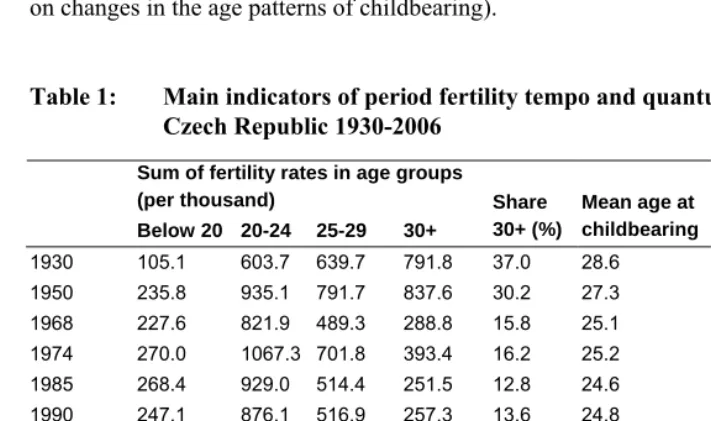
living arrangements. A considerable part of the observed reduction in the TFR was driven by a pronounced shift towards later timing of parenthood. Whereas during the socialist era most women had their first child at an early age, reaching their final family size relatively soon thereafter, the contemporary fertility pattern is characterised by a relatively late timing of parenthood, which is typical of the societies of Western, Southern and Northern Europe. This change is illustrated in the graph of age-specific fertility rates (Figure 4): the early-childbearing pattern, with a pronounced peak in fertility rates at ages 21-22 and very low fertility among women past age 30 has been rapidly replaced by a more heterogeneous age pattern of childbearing with a lower level of fertility and a less pronounced peak, which reached age 29 in 2006. Fertility rates after 1990 have plummeted in particular among young adults, declining by more than four-fifths at ages 18-20. On the other hand, a clear trend towards fertility ‘recuperation’ takes place at later ages. At ages 30-49, fertility rates more then doubled between 1995 and 2006 and their share on total fertility has consequently risen from 19 to 40% (Table 1; see Kantorová 2002, Zeman 2006, and CZSO 2007 for more details on changes in the age patterns of childbearing).
Table 1: Main indicators of period fertility tempo and quantum, Czech Republic 1930-2006
Sum of fertility rates in age groups (per thousand)
Below 20 20-24 25-29 30+
Share 30+ (%)
Mean age at childbearing
Mean age at first birth TFR
1930 105.1 603.7 639.7 791.8 37.0 28.6 24.9 2.14
1950 235.8 935.1 791.7 837.6 30.2 27.3 23.8 2.80
1968 227.6 821.9 489.3 288.8 15.8 25.1 22.5 1.83
1974 270.0 1067.3 701.8 393.4 16.2 25.2 22.6 2.43
1985 268.4 929.0 514.4 251.5 12.8 24.6 22.4 1.96
1990 247.1 876.1 516.9 257.3 13.6 24.8 22.5 1.90
1995 118.9 515.6 406.6 236.7 18.5 25.8 23.3 1.28
2000 64.1 333.4 447.4 297.1 26.0 27.2 24.9 1.14
2005 54.2 241.6 501.9 483.8 37.7 28.6 26.6 1.28
2006 54.4 232.7 502.5 538.3 40.5 28.9 26.9 1.33
Change
1990–1995 –52% –41% –21% –8% +1.0 years +0.8 years –0.62 Change
1995–2006 –54% –55% +24% +127% +3.1 years +3.6 years +0.05
Sources: Council of Europe (2005), CZSO (2004 and 2007), Zeman (2006), and authors’ computations based on vital statistics data
Figure 4: Age-specific fertility rates among Czech women aged 15-45; 1930-2006
0 50 100 150 200 250
15 20 25 30 35 40 45
Age
Fe
rtili
ty
rat
e (per tho
us
and wom
en)
1930 1950 1968 1974 1985
0 50 100 150 200 250
15 20 25 30 35 40 45
Age
F
erti
lity
rate
(pe
r t
hous
an
d w
om
en) 1930
1985 1995 2000 2006
Sources: CZSO (2004, 2007), EUROSTAT (2006), and authors’ computations based on vital statistics data for 1930, 2005 and 2006.
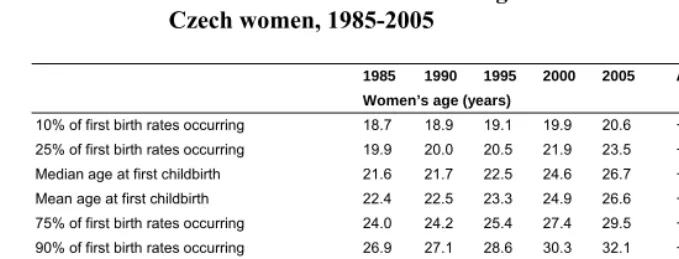
thirties. As a result, different indicators of age heterogeneity, such as interdecile and interquartile age differences, have risen sharply. This trend is linked to the rising educational differences in family formation (see Section 2.5.3).
Figure 5: Selected indicators of the timing of childbearing, Czech Republic 1920-2006
20 22 24 26 28 30 32
1920 1930 1940 1950 1960 1970 1980 1990 2000
Ag
e
Mean age at childbearing Mean age first births Median age first birth
Sources: CZSO (2000 and 2007), Zeman (2006) and computations based on EUROSTAT 2006 and vital statistics data for
1961-2006.
2.3 Parity-specific analysis of fertility shifts after 1990
Table 2: Selected indicators of the timing of first births among Czech women, 1985-2005
1985 1990 1995 2000 2005 Abs. change 1990-2005 Women’s age (years)
10% of first birth rates occurring 18.7 18.9 19.1 19.9 20.6 +1.7
25% of first birth rates occurring 19.9 20.0 20.5 21.9 23.5 +3.5
Median age at first childbirth 21.6 21.7 22.5 24.6 26.7 +5.0
Mean age at first childbirth 22.4 22.5 23.3 24.9 26.6 +4.1
75% of first birth rates occurring 24.0 24.2 25.4 27.4 29.5 +5.3
90% of first birth rates occurring 26.9 27.1 28.6 30.3 32.1 +5.1
Half of women become mothers (fertility table) 22.0 22.2 25.4 28.0 29.8 +7.6
Age heterogeneity (years of age)
Interquartile range (75%-25%) 4.1 4.2 5.0 5.5 6.1 +1.9
Interdecile range (90%-10%) 8.2 8.2 9.5 10.5 11.5 +3.3
Sources: Authors’ computations based on EUROSTAT 2006, and vital statistics data.
Note:These indicators are based on age-specific first birth incidence rates (rates of the second kind) except of ‘Half of women
become mothers’ indicator, which is based on age-specific first birth probabilities (rates of the first kind)
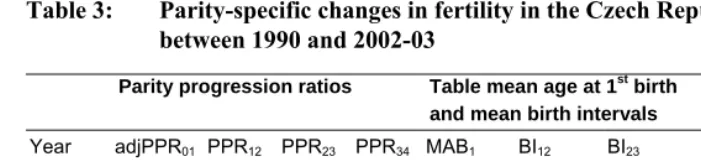
rates to the first, the second, and the third birth between 1990 and 2002-2003 (see Table 3). The summary indicator, termed ‘period average parity’ (for more details see Sobotka et al. 2005), which was adjusted for tempo effects in the case of first birth rates, declined by 7% during this period, reaching 1.74 in 2002-03. The birth interval analysis shows that not only have first births been postponed, but many women also delayed births of their second and third child: this trend is illustrated by a marked increase in mean birth intervals, especially between the first and second births (see Table 3 and Sobotka 2005).
If the recent parity progression rates prevailed over a long period of time, more women would remain childless (12%) or with only one child (23%), whereas the proportion of women with two or more children would decline. However, these changes would be relatively modest and the two-child family model would still remain dominant, with one half of women eventually having two children. This analysis gives further support to the hypothesis that the decline in total fertility rates in the 1990s was to a large extent driven by a substantial postponement of family formation.
Table 3: Parity-specific changes in fertility in the Czech Republic between 1990 and 2002-03
Parity progression ratios Table mean age at 1st birth and mean birth intervals
Indexes of total fertility
Year adjPPR01 PPR12 PPR23 PPR34 MAB1 BI12 BI23 adjPAP TFR 1990 0.92 0.78 0.26 0.20 22.6 3.7 5.5 1.87 1.89
2002–03 0.88 0.74 0.24 0.23 27.1 5.0 6.4 1.74 1.16
Sources: CZSO 2000, and authors’ computations based on EUROSTAT 2006 and vital statistics data for 1961-2005
Notes:First-order parity-progression rate (adjPPR01) is based on the period fertility table constructed from age-specific first birth
probabilities, which were adjusted for tempo distortions using a method proposed by Kohler and Ortega (2002). Parity progression rates to the second and subsequent births are based on fertility rates by birth order and duration since the last previous birth. The mean age at first birth was computed from the distribution of births in the fertility table for first births and is not comparable with the commonly used mean age derived from the schedule of age-specific rates of the second kind (incidence rates), showed in Table 1, Table 2, and Figure 5. The set of parity progression ratios serves for a computation of an
overall index of total fertility, the Period Average Parity (PAP, see Sobotka et al. 2005), adjusted for tempo effect.
Figure 6: Conditional period probability of having first child at selected age intervals among women who were childless at the beginning of these intervals (1962-2005)
0.00 0.10 0.20 0.30 0.40 0.50 0.60 0.70 0.80 0.90 1.00
1962 1967 1972 1977 1982 1987 1992 1997 2002
Con dit iona l p roba bil ity of havi ng a f irst chi ld i n a gi ve n age in te rv al 0 5 10 15 20 25 30 35 40 T abl e propo rt
ion of f
irst bi rt hs oc curr ing af te
r age 3
0 (
P
er
cent
)
Below age 25
25 to 29
30 to 34
After age 35
Proportion first births after age 30 (right y axis) adjusted PATFR1
tendency to ‘recuperate’ their postponed entry into motherhood later in life, generating an increase in first birth probabilities at ever-later reproductive ages. This increase is most intensive among women who were in their early 20s when the most pronounced fall of first birth intensities took place around the mid-1990s. The overall indicator of first birth intensity, adjusted for tempo effect (adjPATFR), displayed a relatively modest decline from 0.92-0.96 in the early 1990s to 0.86-0.88 in the early 2000s. However, the probability of having a first child before age 25 fell from 0.73 to 0.23 between 1990 and 2005. Thus, early childbearing, which would have been considered a ‘norm’ in the 1980s, had become relatively unusual by the early 2000s. Similarly, the probability of a woman having two children by age 25 fell dramatically: the set of age-parity birth probabilities in 2005 implies that only 6% of Czech women would reach the most common ideal family size of two children by age 25, down from almost 40% in the mid-1980s (see also Sobotka 2005).
2.4 The transformation of childbearing patterns among women born after 1965
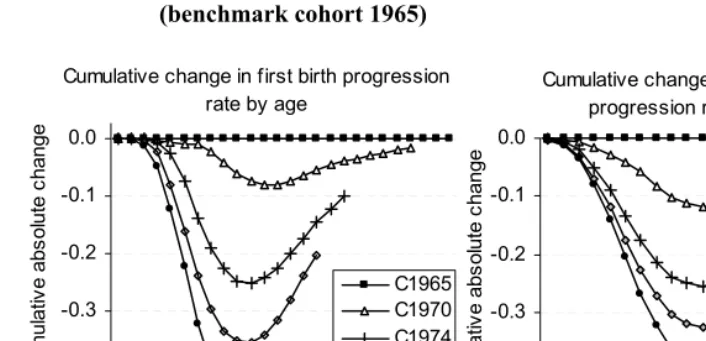
Whereas women born up to the mid-1960s had experienced most of their childbearing before 1990 and their fertility histories are typical of the ‘state socialist’ era, women born in the 1970s have experienced a massive postponement of parenthood and more differentiated fertility patterns. This shift resulted in a bimodal distribution of first birth intensities by age, observed for women born between 1970 and 1974 (see Figure 7a). Such bimodality has been observed, as well, in the United States during the 1990s. As Sullivan (2005: 271) points out, this appears “to be a temporary phenomenon based on the uneven adoption of fertility delay across groups of women”. Whereas the U.S. pattern is linked to racial and ethnic differentiation in family formation, the explanation for the Czech Republic lies in the profound postponement of childbearing coupled with rising educational differences in first birth timing. Many Czech women born in the early 1970s had become mothers at a young age, following the fertility model of the socialist era. After 1989, many women who were still childless had interrupted the initial course of their generation’s fertility pattern and delayed childbearing until a later age. Such a temporary ‘freeze’ on childbearing was even more extreme in the former German Democratic Republic, where the breakdown of the communist regime and the unification with West Germany have brought more radical institutional and cultural discontinuity with the past (Conrad, Lechner, and Werner 1996 and Dorbritz in this monograph).
experiences further reduction in first birth rates until about age 25, the graph of cumulated change in first birth rates by age (Figure 7c) indicates a substantial ‘catching up’ at higher ages. Sobotka (2006) estimates that 13-15% of women born in 1975 may remain permanently childless. Although this represents a substantial increase when compared with the childlessness at 7.5% reached among women born in 1965, the permanent childlessness among Czech women is likely to remain below the levels recorded or projected in other countries of Central Europe.
So far, the ‘catching up’ effects have been less pronounced in the case of progression to second birth, especially when analysed for all women irrespective of their parity status (Figure 7b and 7c). This may be partly explained by the sequential nature of fertility: the ‘recuperation’ of delayed childbearing among cohorts that have experienced intensive fertility postponement is initially apparent in the case of first births and only later becomes manifested in the case of second births. It is very likely, however, that the proportion of women with only one child will increase more rapidly than the proportion of women who are childless. This trend is also suggested by a gradual decline in second birth progression rates among women born in the mid-1960s (Figure 3 above).
2.5 Selected trends and socio-economic differences in fertility
2.5.1 The sharp decline of teenage motherhood
Fertility decline during the 1990s was strongly concentrated at younger childbearing ages (Table 1 above). Consequently, the share of fertility among women below age 20 as a proportion of the total fertility rate fell from 13% at the beginning of the 1990s to 4% in 2005 (Table 4), making teenage motherhood increasingly marginal and confined to specific social groups. The reduction of early childbearing has been achieved through a widespread adoption of modern contraception. Remarkably, abortion rates among women below age 20 fell drastically as well and induced abortions remained less frequent than childbearing: 37% of pregnancies among teenage women were terminated by an abortion in 2005.
Figure 7: Transition to first and second birth by age among Czech women born in 1965-1980
a) Conditional age-specific probabilities of having first and second birth
b) Cumulative progression rate to first and second birth 0.00 0.05 0.10 0.15 0.20 0.25
15 20 25 30 35 40 45
Age F irs t b irt h p ro ba bilit ie s C1965 C1970 C1974 C1976 C1980 First birth probabilities 0.00 0.05 0.10 0.15 0.20 0.25
18 22 26 30 34 38 42
Age S ec ond bi rt h pr obab ilit ie s C1960 C1965 C1970 C1974 C1976 C1980 Second birth probabilities 0.0 0.1 0.2 0.3 0.4 0.5 0.6 0.7 0.8 0.9 1.0
15 20 25 30 35 40 45
Age P ro por tion of w omen hav ing a ch ild C1965 C1970 C1974 C1976 C1980 Progression rate to first birth
0.0 0.1 0.2 0.3 0.4 0.5 0.6 0.7 0.8 0.9
18 22 26 30 34 38 42
Figure 7: (Continued) Transition to first and second birth by age among Czech women born in 1965-1980
c) Cumulative change in first and second birth progression rate by age (benchmark cohort 1965)
Sources: Authors’ computations based on EUROSTAT (2006) and vital statistics data for 1975-2006.
after 1989 have altered attitudes towards planned motherhood among young adults, who have themselves adopted more negative views on early childbearing. The impact of such changes on pregnancy rates among women below age 18 has been weaker. In this age group, pregnancy is almost always unplanned and unwanted, linked to insufficient information and use of less effective contraceptive methods.
Adolescent mothers exhibit the most noticeable increase in the proportion of extra-marital births. Only 13% of births among teenage mothers occurred within marriage in 2005, as compared to 82% in 1990. The social climate of the 1970s and 1980s made young women and their families go to great lengths to ‘legitimise' the pregnancy and the child itself. Recently, more tolerant attitudes and the increased acceptance of premarital cohabitation have given pregnant teenage girls the option of not marrying if the only reason for marriage would be to avoid being stigmatised by the community. Recent qualitative research among teenage mothers (Vašková 2005 and 2006) shows that the majority of teenage mothers is not abandoned by the father of the child and that the couple does maintain a stable partnership. However, the socio-economic situation of
-0.5 -0.4 -0.3 -0.2 -0.1 0.0 0.1
15 20 25 30 35 40
Age C um ul at iv e abs ol ute ch ange C1965 C1970 C1974 C1976 C1980 Cumulative change in first birth progression
rate by age
-0.5 -0.4 -0.3 -0.2 -0.1 0.0
18 22 26 30 34 38
Age C um ul at iv e abs ol ut e c hange C1965 C1970 C1974 C1976 C1980 Cumulative change in second birth
these women is not much better than that of women abandoned by their partners. Vašková found that the partners of teenage mothers tend to be unemployed, poorly educated, and are unable to contribute to a decent standard of living for their child and partner.
Table 4: Pregnancies and pregnancy outcomes among teenage women, Czech Republic 1990-2005
1990 1995 2000 2005 Change 1990–2005
Fertility and abortion rates per thousand women
Fertility rate (age 15-17) 10.5 6.4 4.3 4.6 –56% Fertility rate (age 18-19) 107.1 50.1 25.5 20.0 –81% Induced abortion rate (age 15-17) 13.7 7.1 5.5 5.2 –62% Induced abortion rate (age 18-19) 44.8 19.4 13.7 10.9 –76% Total rates below age 20
Sum of fertility rates below age 20 0.25 0.12 0.06 0.05 –78% Sum of induced abortion rates below age 20 0.13 0.06 0.04 0.04 –71% Sum of pregnancy rates below age 20 (incl.
miscarriages) 0.41 0.19 0.12 0.10 –75%
Other indicators Abs. change
Proportion extra-marital births (%) 17.8 36.1 65.6 86.6 +68.8 Proportion of pregnancies terminated by induced
abortion (%) 32.2 31.1 37.3 37.4 +5.2
Share of teenage fertility on the TFR (%) 13.0 9.3 5.6 4.2 –8.8
Sources: Authors’ computations based on vital statistics data for 1990–2005.
2.5.2 The rise of extra-marital childbearing
Figure 8: Extra-marital births and premarital conceptions in the Czech Republic, 1901-2006
0 10 20 30 40 50
1901 1911 1921 1931 1941 1951 1961 1971 1981 1991 2001
E
xtram
arital birt
hs
(per
cent)
Total First births
Premarital conceptions (percent)
Sources: CZSO (2000, 2007), Zeman (2006) and authors’ computations based on vital statistics data
Note: Proportion of pre-marital conceptions refers to the proportion of all marital first births in a given year that were realised within
eight months following the marriage.
more traditional districts of south-eastern Moravia. In contrast, the north-west Bohemian districts display an extreme level of secularisation combined with high employment in heavy industries, an ‘uprootedness’ of the local population frequently made up of post-war migrants, and also a history of elevated rates of extra-marital childbearing among the German population that resided here prior to 1945.
Figure 9: Proportion of extra-marital births by educational attainment
of mother, 1990-2005
0 10 20 30 40 50 60 70 80
Primary Lower secondary
Higher secondary
Tertiary TOTAL
Proport
ion of
ext
ra-mari
tal births (percent)
1990 1995 2000 2005
Sources: Authors’ computations based on vital statistics data.
2.5.3 Educational differences in the timing of first childbirth
Kantorová (2004a) and Klasen and Launov (2006) show that fertility postponement in the Czech Republic during the 1990s was particularly pronounced among highly educated women. Women with different levels of education follow increasingly divergent pathways of family formation with respect to the partnership context (Section 2.5.2 above), timing, and coordination with other life-course events.
addition, assumptions have been made on the completed level of education of women having children when studying6. While first birth intensities among women with a
primary education in 2001 peaked around the age of 20, women with secondary schooling typically entered motherhood at ages 26-28, and those with a university degree became mothers around age 30 (Figure 10). The relative differences in mean age at entering motherhood are similar to those reported for many other European countries (e.g., Lappegård and Rønsen 2005 for Norway; Städtner and Spielauer 2002 for Austria).
Figure 10: First birth intensity among women by educational attainment, 2001
0.00 0.02 0.04 0.06 0.08 0.10 0.12 0.14 0.16 0.18 0.20
15 20 25 30 35 40 45
Age
Fi
rs
t b
irt
h i
n
tens
ity
Primary Lower secondary Higher secondary Tertiary Total 2001 Total 1991
Sources: Authors’ computations based on Census and vital statistics data for 1991 and 2001
6 The highest attained level of education is measured at the time of childbirth (vital statistics) and at the time
Between 1991 and 2001, an intensive postponement of motherhood occurred among all women with higher than a primary education. A strong contrast exists in the early and late childbearing intensities: according to the 2001 tables, a majority of 64% of women with a primary education gives birth by age 25, whereas a comparable majority of women with a university education still remains childless by age 30 (Table 5). Women with a primary education who did not enter motherhood by the age of 30 have a low likelihood (19%) of ever having a child. By contrast, women with a university education show a strong propensity to achieve their delayed childbearing after that age: 61% of those still childless at age 30 would eventually enter motherhood later in their life. Thus, most of the educational differentiation in family formation is attributable to the timing of childbearing. The estimated overall first birth intensity is highest for women with lower secondary education (table childlessness of 16%) and lowest for women with university and upper secondary education (table childlessness of 24 and 26%, respectively).7
Table 5: Entry into parenthood among women by educational attainment; indicators based on period fertility tables for 1991 and 2001
Achieved level of education
Primary
Lower secondary
Higher
secondary Tertiary TOTAL
2001
Mean age at first childbirth 21.6 24.9 28.0 29.8 26.8 Proportion having a child by age 25 (%) 63.8 43.9 15.5 4.3 24.8 Proportion having a child by age 30 (%) 76.7 71.3 50.6 38.7 56.6 Probability of ever having a child when
childless at age 30 (%) 19.0 45.5 48.0 60.8 48.0
Table proportion childless (%) 18.9 15.7 25.7 24.0 22.6 Table proportion of first births after
age 30 (%) 5.5 15.5 31.9 49.1 26.9
1991
Mean age at first childbirth 20.8 21.4 23.6 25.9 22.6 Table proportion childless (%) 13.5 5.0 8.2 8.2 7.2 Table proportion of first births after
age 30 (%) 3.9 2.8 8.3 12.4 5.5
Sources: Authors’ computations based on Census and vital statistics data for 1991 and 2001
7 This period estimate is, however, affected by tempo distortion, and may not reflect educational differences
2.5.4 Fertility among Roma
The Roma (Gypsies) who first arrived to the Czech Lands around the fifteenth century constitute the only distinct minority whose fertility behaviour contrasts strongly with the majority population. Their fertility patterns are characterised by early and universal family formation, high fertility, and the absence of a two-child family norm. There are no precise statistics on the Roma population; most estimates put their number at 200-300 thousand, i.e., 2-3% of resident population in the Czech Republic (Langhamrová and Fiala 2003, UNDP 2003). Their traditional community ties were fragmented during the socialist era, when many Roma experienced forced settlement and employment in the manufacturing and construction sectors. They were hit particularly hard by the transformation of society after 1989 and are now facing widespread poverty, mass unemployment, marginalisation, and negative attitudes of the majority of the population (e.g., UNDP 2003, Cashman 2004).
age 20 (for the total population, only 9% of women born in 1979 became mothers by that age).
Figure 11: Mean number of children and the proportion of women with three or more children by age, total population (January 2002) and Roma population (December 2001)
0.32 1.28 2. 88 3.7 3 3.7 1 5.3 4 2. 38 2. 06 2.0 5 1.8 9 1.60 0.92 0.22 0. 01 0 1 2 3 4 5 6
15-19 20-24 25-29 30-34 35-39 40-49 50+ Age
N
u
m
ber of childre
n pe r w o m an Roma All women Children per woman
0 10 20 30 40 50 60 70 80 90 100
15-19 20-24 25-29 30-34 35-39 40-49 50+ Age
P
ro
portion of wom
en hav in g 3+ ch ildren, p e rcent Roma women All women Women with 3+ children
Source: Authors’ computations based on UNDP/ILO Survey 2001 (Roma population), EUROSTAT 2006, Census 1980 (FSU 1982),
3. ‘Proximate’ factors affecting fertility
3.1 Union formation and living arrangements: the rising importance of cohabitation
Marriage was almost universal during the state-socialist era and only a negligible proportion of men and women never married. Furthermore, most people were ‘tying the knot’ at an early age; in the 1970s and 1980s, the mean age at first marriage reached the lowest recorded levels: 21-22 for women and 24-25 for men. Cohabitation among young adults was not a completely marginal phenomenon prior to 1990, but it was more common only in larger cities and served as a brief prelude to marriage. In the mid-1980s, 44% of all newly-wed couples in the second largest Czech city, Brno, declared that they had already been living together for some time (Možný 1987). The Fertility and Family Survey (FFS) conducted in 1997 indicates that only 20-25% of first unions initiated between 1975 and 1989 started as cohabitations. Long-term cohabitation was more common only among lower-educated and divorced people (e.g., Rychtaříková 1994a).
First marriage intensity declined sharply during the 1990s (Figure 12), especially among young adults. Marriages have been postponed even more intensively than first births and, consequently, the mean age at first marriage has surpassed the mean age at entering motherhood. In 2006, women entered first marriage at age 28.4 on average and men at age 31.1, which represents an increase of about seven years since 1989 (these indicators are based on the first marriage table). The proportion of married men and women dropped across all age groups, but especially at younger ages: for instance, only 12% of women aged 20-24 were married in 2005 as compared with 62% in 1991. This trend is connected with the growing popularity of non-marital cohabitation, as well as with a general postponement of early life-course transitions, namely leaving the parental home, finishing education, entering the first union and achieving stable employment.
Non-marital partnerships became a standard step in one’s partnership ‘career’ in the 1990s and young people more often opted to cohabit with their first partner than to marry directly.8 Education and socio-economic position have lost their power in
explaining whether people will marry directly or cohabit first (Hamplová 2004). This trend is in agreement with sociological surveys which find a generally positive evaluation of unmarried cohabitation, especially as a premarital stage (Section 4.2). In
8There are no detailed data that would enable tracing the spread of cohabitation over time and its actual
addition, cohabitation entered as a first union among young adults in the 1990s lasted longer before its dissolution or subsequent marriage than the cohabitations started in the previous two decades (Kantorová 2004b). Hamplová (2004) found that people in higher socio-economic positions are more likely to transform their cohabitation into marriage.
Figure 12: First marriage intensity and total divorce rate among Czech women, 1946-2006
0.0 0.2 0.4 0.6 0.8 1.0 1.2
1945 1950 1955 1960 1965 1970 1975 1980 1985 1990 1995 2000 2005
Tot
al
firs
t marriag
e (divorc
e)
ra
te
Total first marriage intensity (table indicator) Total first marriage rate
Total divorce rate
Sources: Rychtaříková (1994b), Council of Europe (2005), CZSO (2007), and authors’ computations based on vital statistics data.
Notes:Total first marriage rate is computed as a sum of age-specific first marriage ‘incidence’ rates (rates of the second kind); total
first marriage intensity is computed from the schedule of age-specific first marriage intensities (occurrence-exposure rates, rates of the first kind), which properly reflect the exposure population (single women).
social policy, which allows free-market rent in the newly rented apartments, but regulates rents in many apartments retained by the same tenants as in the early 1990s. This ‘insider-outsider’ housing market inflates the market (unregulated) rents in larger cities, especially in Prague, where the housing demand is high.
Table 6: Proportion of women (in %) experiencing selected transitions below age 25 (cohorts 1966-1984)
Birth cohort
1966-70 1971-75 1976-80 1981-84
Transitions before age 25
Still in parental home at age 25 17.6 26.2 27.8 ..
Ever in union 80.8 70.2 66.1 ..
Ever married 75.2 61.5 46.4 ..
N (weighted) 481 528 478
Among those who entered first union before age 30 or at the time of the survey:
First union started as cohabitation (%) 27.7 37.1 58.0 75.2
N (weighed) 423 427 362 113
Sources: Authors’ computations based on Generation and Gender Survey 2005
Note: The 2005 data are preliminary results and may slightly change due to data cleaning procedures.
3.2 The link between union formation and entering parenthood
The disconnection of this previously tight link between marriage and childbearing is apparent in several forms. The ‘pressure’ to marry among unmarried pregnant women has declined in significance during the last decade. Consequently, the share of marital first births conceived prior to the wedding has fallen from 54% in 1994 to 32% in 2005 (Figure 8). Furthermore, a growing number of married couples postpone childbearing for several years after their wedding. The postponement of first birth within marriage is most apparent for women with a higher education (Kantorová 2004b).
Another sign of the erosion of the link between marriage and first childbirth is the rising share of cohabiting couples who do not marry before the birth of the first child. Polášek’s (2005) analysis of vital statistics shows that the declining propensity to marry is also detectable by a decline in marriage intensities of unmarried mothers, especially during the first two years following the childbirth. Among women having an extra-marital first child in 1991, 26% married within the next two years; this proportion fell to 12% for women having an extra-marital first birth in 2002.
3.3 High intensity of divorce and union dissolution
Czech society has a long history of fairly high rates of marital dissolution and divorce, and currently it has one of the highest incidences of divorce in Europe. Since the 1980s, roughly 30,000 divorces occur annually and this figure remains stable in spite of decreasing numbers of marriages and the changing population structure by marital status. Historically, the highest number of divorces was reached in 1996 in anticipation of the stricter family law. The new family law (No. 91/1998) that went into force in 1998 substantially modified the conditions upon which the marriage can be dissolved limiting the divorces of spouses with small children and restricting the divorces in the first year of marital duration. Most importantly, it established the possibility of divorce by mutual agreement. However, the trends in the total divorce rate (TDR), shown in Figure 12 above, indicate that the impact of the new law on the intensity of marital disruption was not longstanding. The TDR dropped to 0.32 with the implementation of the new legislation in 1999 but subsequently rose again to 0.41 in 2000 and 0.49 in 2004, the highest level on record.
concluded by at least one divorced partner in 2005 and in 14% of marriages, both spouses were divorced. Divorced people forming new union are also more prone to stay in an unwed partnership, especially when they ‘inherited’ children from their previous partnership (Zeman 2003).
The dissolution of cohabitations is not covered by the official statistics. Survey data indicate, however, that the intensity of dissolution is several times higher for cohabiting unions than for marriages (Zeman 2003). Considering that the intensity of nuptiality has decreased by a third since 1989, that half of the marriages are being eventually dissolved, and that cohabitations, which are substituting the ‘missing’ marriages, show an even higher risk of dissolution, we may conclude that marriage in its traditional form has eroded markedly. It is difficult to estimate the effects of these changes on fertility: although the observed union instability is likely to lead to lower fertility, this effect is partly offset by childbearing in second and third unions, where partners often attempt to have at least one shared child of their own.
3.4 Sexual behaviour, contraception, and induced abortions
Since the early 1990s there has been a marked shift in reproductive behaviour – from limited use of modern contraception and strong reliance on induced abortion to the widespread use of effective contraceptive methods, especially the Pill. Up until the early 1990s, first sexual intercourse was commonly ‘unprotected’ and first pregnancy often unplanned; many women employed contraceptive methods or opted for abortion only after reaching their intended family size.9
Although it was only after the political regime change in 1989 that the Czech Republic experienced a full-blown ‘sexual revolution’, bringing a boom of information and messages on sex, contraception, and pornography, the available data do not suggest a radical change in sexual behaviour (Weiss and Zvěřina 2001). Two surveys of sexuality and reproduction conducted in 1993 (Reproductive Health Survey – RHS) and 1998 showed a stable mean age at first intercourse, which was 18 years for both men and women (Weiss and Zvěřina 2001: 38). Furthermore, premarital sexual experience was already universal during the socialist era: the RHS survey of 1993 found that only 0.4% of sexually experienced women had had sex for the first time after marriage.
Delayed union formation and the spread of less stable forms of living arrangements suggest that younger generations have frequent sexual experience with
9This pattern of family size limitation was also reflected in abortion-to-birth ratios. In 1990, there were 3.6
more than one partner. The surveys do not fully support this hypothesis and, interestingly, indicate that more young adults are sexually inactive for longer periods of time (Weiss and Zvěřina 2001).
The most marked change can be observed in birth control. Currently, most men and women use effective contraceptive methods at the start of their sexual life and the first pregnancy therefore mostly involves a carefully planned discontinuation of contraceptive use. The proportion of women aged 15-49 who were prescribed oral contraception increased by a factor of twelve, from 4% in 1990 to 47% in 2006 (Figure 13). In addition, 7% of women used the intrauterine device (IUD), some 15% used condoms and around 7% relied predominantly on withdrawal and ‘natural methods’ of family planning (author’s computations from the GGS 2005 data). This is a dramatic difference from the situation in 1993, when almost a quarter of women relied on withdrawal or ‘natural’ planning methods (Figure 14). At present, there are almost no differences in the choice of the various contraceptive methods among women of different educational categories. However, low-educated women with a partner are less likely to use any form of contraception: the non-use rate is 16% for women with a tertiary education and reaches 34% for women with a primary education (data not adjusted for differences in age structure). Women’s sterilisation (tubal ligation) remains relatively infrequent – at about 4,000 surgeries annually (UZIS 2005) – due to a restrictive directive from 1972, which allows sterilisation only after the third childbirth (fourth childbirth for women under age 35). However, more women would probably use sterilisation if it were permitted following their second delivery (Zeman 2006).
still use abortion as a kind of ‘contraception ex post’, as was common during the socialist era (Zeman 2006).
Abortion is accessible on request up to the twelfth week of pregnancy. Since 1992, a fee of around 3,000 CZK (around 110 EUR10) has been introduced for performing an
abortion. The fee is not demanded for abortions performed for health reasons; these abortions caused an increase in the proportion of induced abortions conducted for health reasons from 11 to 24% between 1992 and 1994. This proportion subsequently declined gradually to 18% in 2005.
Delayed childbearing, combined with an expansion of infertility treatment services, have led to an increasing number of couples seeking assisted reproduction. More than 3% of children were born after in-vitro fertilisation (IVF) in the early 2000s (Kučera, Mardešić, and Žáčková 2005). Later childbearing and the frequent practice of transferring two or more embryos into the womb after an IVF treatment have resulted in a doubling in the proportion of multiple deliveries, to 2.05% in 2006, as compared to around 1% in the 1950s to the mid-1990s.
Figure 13: Total fertility rate, total induced abortion rate and the proportion of women aged 15-49 using the Pill or IUD, 1960-2006
0.0 0.5 1.0 1.5 2.0 2.5 3.0
1960 1965 1970 1975 1980 1985 1990 1995 2000 2005
Tota l fe rtility an d in duc ed a bo rtion rat es 0 10 20 30 40 50 60 % w o m e n a ged 15 -49 usi ng t he p ill o r the IUD
Total fertility rate
Total induced abortion rate
% women using the pill or the IUD
(right y axis)
IUD
pill
Sources: UZIS (2007) and authors’ computations based on vital statistics data.
Note: IUD stands for intrauterine device.
10In this chapter, values in Czech Crowns (CZK) are also expressed in Euro (EUR), using the exchange rate
Figure 14: Current contraceptive use by age in 1993 and 2005, Czech women in union (1993) or living with a partner (2005)
1993: Women in union (married and cohabiting)
0 10 20 30 40 50 60 70 80 90 100
<20 20-24 25-29 30-34 35-39 Age P rop or tion us in g gi ve n m et hod (per cent )
2005: Women with a partner
0 10 20 30 40 50 60 70 80 90 100
<20 20-24 25-29 30-34 35-39 Age Other Withdrawal + 'natural' met. Sterilisation IUD Condom Pill
Sources: Czech Republic Health Survey 1993 (RHS 1995: 78, Table IV.6), and authors’ computations based on the Generation and
Gender Survey 2005
Notes: The 2005 data are preliminary results which may slightly change due to data cleaning procedures. In case of multiple methods reported by the respondents, only the main or the most effective method is shown (e.g., the Pill when a combination of the Pill and the condom or the Pill and withdrawal was reported).
IUD stands for intrauterine device.
4. Societal conditions affecting fertility and the family
4.1 Economic transformation, employment, and educational expansion
The emergence of a new economic regime after 1989 implied a shift to a service economy, where knowledge and education play an important role. There were two distinct periods of economic downturn: the first, more pronounced, in 1990-1992, connected with the initial re-orientation from the socialist economy tightly linked with Eastern European markets to the more open market economy and the second, in 1997-1998, related to the restructuring and privatisation of large industries. Unemployment, which was an unknown phenomenon during the socialist period, increased throughout the 1990s, with the overall registered unemployment rate reaching 9% in 2000 and subsequently declining to 6% in 2007.
large-scale privatisation led to the restructuring and modernisation of many industries, including the banking and telecommunications sectors. Due to this process, as well as to the geographic proximity to western European markets, the Czech economy has attracted large flows of foreign direct investment, which reached the highest per capita level among all Central and Eastern European countries at the end of 2004 (CERGE 2005). Czech industries have become competitive and strongly export-oriented. Since the early 2000s, the economy has picked up, resulting in an accelerated growth of the GDP, which reached 6% in 2005-2007.
The estimated level of real wages, which had declined considerably after 1989, returned to the 1989 level in 1996 (RILSA 1999) and has continued to grow since the late 1990s. Despite officially proclaimed neo-liberal policies aimed at tightening eligibility conditions for various social benefits during the period of 1990-1998 (Potůček 2001), government measures remained oriented towards substantial income redistribution with the aim at reducing inequalities in incomes and living standards. The extensive social security net and strongly egalitarian policies, which have been retained by both left-wing and right-wing governments, have prevented a wider spread of poverty. In the late 1990s and the early 2000s, the Czech Republic had – along with Slovenia and Slovakia – the most equal distribution of income and the lowest poverty level among the former socialist countries (e.g., Garcés, Ródenas, and Carretero 2003; Heyns 2005). As a result, Czech families and individuals experienced lower levels of income-related uncertainty than did families in most other societies of Central and Eastern Europe.
Employment rates have declined especially among young adults, mostly as a result of their prolonged enrolment in education. Economic activity rates of women, which reached very high levels during the socialist era, have remained relatively high, peaking at 85-92% at ages 35-54 in 2006. Among women past the education stage, a gradual decline in economic activity has been recorded at ages 30-34, concomitant with the trend towards later motherhood (CZSO 2005). Prolongation of the period that women spend at home after childbirth (see Section 5 below) may create obstacles to their re-entry into the labour market. Throughout the history of regular labour force surveys starting in 1993, women have always had considerably higher unemployment rates than men: for instance, in 2006, 8.8% of economically active women and 5.8% of men were unemployed (CZSO 2007b)11. The lack of opportunities for part-time employment
constitutes a constraint for women who want to combine work and childcare. Part-time jobs are not widely available, partly due to the lack of incentives for employers to provide them. Moreover, part-time work is frequently underpaid and for some may
11This figure is based on an internationally standardised labour force survey and is not fully comparable with
yield a smaller income than the guaranteed minimum social security payment. As a result, only 8.7% of all employed women worked part-time in 2006.
Following the regime change in 1989, the value of higher education rose markedly and educational level has become a crucial factor for individual employment prospects, career opportunities and income level (Večerník 1999). A marked increase in the rates of higher education participation has taken place, especially since the mid-1990s. According to the OECD study (2005), the proportion of women aged 20-24 who are still in education increased from 13% in 1995 to 30% in 2003. As has been shown for a number of European countries, educational expansion constitutes the most important factor leading to the postponement of family formation (Beets et al. 2001). This effect is further strengthened by prolongation of the period between completing education and entering parenthood, which took place among medium and highly educated women after 1990 (Kantorová 2004a). Many of these women want to gain a stable position in the labour market and achieve relatively good standards of living before entering motherhood.
4.2 Family change, secularisation, and attitudes towards family and reproduction
Unlike neighbouring Austria, Poland or Slovakia, Czech society became strongly secularised in the course of the twentieth century, a process which accelerated during the post-war period, being supported by an official fierce anti-religious ideology. The communist regime in Czechoslovakia carefully isolated churches from society and religious symbols were gradually pushed out of people’s everyday lives. By the end of the 1980s, only 11% of wedding ceremonies were co-administered by the Church (Hamplová 2001). Accordingly, church attendance has been declining steadily. While approximately two-thirds of the population were attending church services every week in the 1940s, only 6% did so in the late 1980s (ibid.). This trend towards a secularisation of society has not been reversed after the establishment of a democratic society and the lifting of various restrictions on religious freedom since 1990. The support for traditional religion is still low and the Czech Republic has one of the lowest rates of church attendance in Europe (Hamplová 2000, 2001). In the 2001 Population Census, only 31% of inhabitants declared any religious affiliation, mostly to the Roman-Catholic church (26%; CZSO 2002).
Similarly, the Czech population has adopted highly liberal views on abortion. According to the 1994 ISSP survey, 68% of respondents agreed that “a pregnant woman should be able to obtain a legal abortion for any reason whatsoever, if she chooses not to have the baby” while only 7% strongly disagreed. More recently, the 2005 Public Opinion Research Centre survey (CVVM 2005a) found that about 70% of respondents agreed that the decision for an abortion is entirely up to the woman, while only 2% were for strict prohibition. In comparison, in the early 1970s one-third of women found abortion laws to be too liberal and only 6% wanted further liberalisation (Public Opinion Research Institute survey; IVVM 1971).
Unmarried cohabitation has become broadly accepted as well. By 1994 around 70% of the ISSP respondents agreed that “it is a good idea for a couple who intend to get married to live together first” and the ISSP survey in 2002 replicated this finding without any significant shift (Chaloupková and Šalamounová 2004). Similarly, the Population Policy Acceptance Survey (PPA) of 2001 demonstrated the popularity of pre-marital cohabitation over direct marriage: 55% of respondents under age 30 preferred to live with a partner first and then to get married, while only 21% would choose ‘direct marriage’. The Czech population also quickly adopted tolerant attitudes towards long-term unmarried partnership, even though it does not seem to be a lifestyle of widespread preference. Thus, a majority of respondents in the ISSP 1994 and 2002 surveys agreed that “it is alright for a couple to live together without intending to get married,” but only one in ten respondents of the 2001 PPA survey preferred to cohabit but not to get married later. In addition, divorce is generally considered an acceptable means of ‘solving’ serious marital discords. According to the 2005 CVVM survey, divorce ranked as one of the most accepted among the broad range of socially or morally problematic behaviours (CVVM 2005b). Finally, Weiss and Zvěřina (2001) found that attitudes towards sex and sexuality, already liberal before 1990, have become yet more open during the 1990s, especially among women.
However, marriage and family still continue to enjoy uncontested popularity among Czech men and women. Unlike in ‘Western’ societies, where the responsibilities and restrictions of family life were often seen as inhibiting individual fulfilment, family life in the state-socialist societies provided a space for authenticity and individual self-realisation (Sobotka 2004). Furthermore, family ties and mutual aid of family members were important for obtaining consumer products that were in short supply and for providing informal services, which were not available through the underdeveloped service economy (Možný and Katrňák 2005). Although this functional importance of the family for exchanging and getting access to goods and services has diminished since 1989, the idealised positive image of family life still prevails even among the younger generations and childless people. According to the 2001 PPA Survey, a majority of childless Czech women and men aged 18-39 agreed that they only feel completely happy and at ease at home with children (Sobotka and Testa 2008).
4.3 Gender inequality, gender division of childcare and family roles
Following the introduction of a competitive labour market model in the Czech Republic after 1989, a discussion commenced on the issues of work-life balance and gender relations in both the labour market and the family (Čermáková et al. 2002, Ettlerová and Šťastná 2006, Kuchařová et al. 2006). The continuing inequality in the gender division of housework has been documented in a number of research studies. The pressure to attain higher labour efficiency, together with increasingly time-consuming paid work and very limited opportunities for part-time employment, has led to a reduction in the amount of free time for the family (Křížková et al. 2005).
Persisting gender stereotypes based on the presumption of women’s primary involvement in the family and men’s primary involvement in their professional activities have resulted in a situation in which a harmonisation of family and working life is not perceived as compatible with men’s social roles (Křížková et al., 2005). Consequently, the participation of men in childcare and household tasks remains low. According to the ISSP 2002 survey, Czech women contribute two thirds of the total time necessary for doing the housework (Chaloupková 2005). Moreover, women’s housework participation varies very little according to whether she is employed full- or part-time.
relatively high, even in families with at least one small or school-age child and in which both parents work. According to the GGS survey of 2005, the mean value of satisfaction was 8.7 for men and 8.1 for women on a 0-10 scale. Every third woman and 45% of men are completely satisfied; no significant educational differentials were detected (authors’ computations).
4.4 Ideal and intended family size
A strong orientation towards a two-child family model constituted the most characteristic trend in reproductive patterns during the socialist era. The emergence of a two-child norm can be traced back to the 1950s, when the intended family size among young women reached 2.10 in 1956 (Kučera 1994: 128). However, family and parenthood surveys from the mid-1970s showed a relatively high disproportion between intended fertility and an ideal number of children: 55% of respondents in 1974 and 53% in 1977 thought that an ideal family should have more children than two (IVVM 1974 and 1977).
The 2005 Generation and Gender Survey shows that the two-child family norm remains strongly established. The two-child ‘target’ is most frequently mentioned by the youngest respondents, specifically, by two-thirds of women aged 18-19 (Table 7). Furthermore, only a few respondents intend to have a larger family. Among women below age 25, only 13% intend to have three children, with just 1% aiming for four or more. These findings suggest a remarkable continuity in fertility intentions among Czech women during the last decades, as well as a continuation of the trend towards the disappearance of large families. However, a comparison of selected results of the GGS (2005) survey with the 1997 FFS survey and the 1993 RHS survey indicates subtle changes in fertility intentions during the last 15 years. Whereas the proportion of women preferring three or more children has not changed, the preference for childlessness and for the one-child family model has slightly increased in comparison with the number of women preferring two children. This subtle shift is visible for women of all reproductive ages, as well as for young adult women (only FFS 1997 and GGS 2005 data were available for women below age 25).