Iranian journal of educational Sociology
(Interdisciplinary Journal of Education) idje.ir/ -http://www.iase Available online at:
Volume 1, Number 5, August 2017
Identifying the barriers and challenges for the implementation of
the Shahab plan
in elementary schools
Saeid Mazbouhi1
, Morteza Fazel*2
, Mohammad Sharafi3
1. Assistant Professor of Education Studies at Allameh Tabataba"i University(ATU)TEHRAN-IRAN. 2. PhD of Family counseling, Allameh Tabataba'i University. Tehran, Iran
3. PhD of higher education management, Allameh Tabataba'i University. Tehran, Iran.
Article history:
Received date: 13 April, 2017 Review date: 15 may 2017 Accepted date:14 June 2017 Printed on line: 23 August 2017
Abstract
Purpose: The project of identifying and leading gifted students (Shahab) was implemented between 2014 and 2015 Education Year by the National Elites Foundation in cooperation with Education Ministry in some regions of all provinces of Iran. Methodology: The project’s main goal was to identify, distinguish and guide the gifted students in elementary and junior education and paving the way to support them in higher education. The project will include all regions in all provinces in the coming years. In our research, teachers of fourth grade elementary schools attempted to evaluate and qualify students by using a pre-defined check list. It tried to understand the challenges and impediments of implementing Shahab project in Shahryar, a suburb of Tehran. Using descriptive and survey methods, it investigated the viewpoints of more than 175 teachers (85 males and 90 female) in fourth grade elementary schools. The interviews were elected randomly and the questionnaire included 40 closed questions in 8 fields and recognized the main obstacles of implementing Shahab project. Taking into consideration descriptive statistical indices, the author has used the Chi-square test one-variable and two variables tests in analyzing gathered information. Findings: The findings demonstrated that the male and female teachers have different ideas regarding challenges and obstacles of the Shahab project. Males believed that the main challenges are check list and method of identifying overqualified students on the one hand and the attitudes of parents on the other. This is while the females expressed that education- related issues and execution factors are the main problems. Conclusion: Putting aside the gender factor, it is argued that teachers see the check list and method of identifying gifted students as the main challenges in implementing Shahab project in Shahryar city.
Keywords:
Shahab plan, gifted students,
elementary schools
Please cite this article as: Ghorbani, El, Habibi, A, Identifying the barriers and challenges for the implementation of the Shahab plan in elementary schools.(2017).
Iranian journal of educational Sociology, 1(5), 103-126
*corresponding author Email: [email protected]
1. Introduction
Today, the importance of manpower is no secret as a strategic source for economic growth and development. According to the theories of economics, resources limitations increase the value of that resource, hence, today, attempts to hunt and retain superior talents, which are limited in number, have become a talent war between countries. Since in a knowledge-based economy, physical capital emphasis and concentration changed knowledge and intellectual capital. Based on this, successful countries will be able to take full advantage of all their capabilities, including physical, non-physical, and intangible resources to develop their capacity for creativity and innovation (Sumita, 2008). Trying to identify, retain, direct and use superior talents is one of the sources of competitive advantage. The purpose of the programs and services related to the best-educated and talented students is to strengthen, develop and improve students' abilities. Therefore, before any intervention, identification of students and their capabilities is important (Siegel et al., 2016).
Research shows that the flowering of talent is important because it leads to freedom, selfishness, creativity, the prevention of waste and the practice of science. (Sadeghi Malah Amiri, 2014). This efflorescence also causes to increase performance (Buckingham Wesbourg, 2001) and pollution production (Wang, 2004), and profit (Hesket, Schlesington, 2002). On the other hand, if people with superior talent do not identified, they are tired of learning, lack of academic achievement, academic failure, inappropriate class behavior, destructive behavior and expulsion from school (Siegel et al., 2011). There are different definitions about talent and person with superior talent. Pour Afkari defines talent as a high level of ability for special skill in people (Pour Aktari, 1382), as Sabotnik, Alziviwiki Cubillius and Varel (2011) Have defined excellence and superiority talent as a personal capability for a particular success or prominence in a field.
Hemmati Alamdar Leo et al. (1394), quoted from (Kasar, Katina Kaya and Kitin Kaya, 2015), state that talent is learning power in each area, the ability to do special assignment, problem-solving capacity, mental learning, and learning, Compromise and finding solutions in new conditions. Hamato (2007) believes that intelligence includes the three-dimensional human interaction of the following human features. 1. High-level ability involves the application of various combinations of general abilities such as abstract thinking, numerical reasoning, memory, etc. in specific areas of knowledge or function, the ability to learn and appropriate usage of advanced knowledge, techniques and strategies, the high inclination to higher education and overall stability in a set of features. 2. High-level creativity includes eloquence, flexibility, and innovation in thinking, openness to experience, acceptance of different and new thinking and practices, Seriousness, thoughtfulness, adventure and playfulness, preparation for risk taking in thinking and action, sensitivity to details and aesthetic features in the ideas and goods. 3. High –level-commitment includes excitement, perseverance, tolerance, hard work, special practicing, capacity for high-level interests, passion, appeal, infatuation and engagement in study or form of human excitement, self-confidence, trust in the ability to do important work, the ability to recognize important issues, and the preservation of forward-looking growth within interest domains, put high standards for a job (Hamato, 2007).
Siegel et al. (2016) presented a five-step model for the identification and development of brilliant students, each of which has specific goals and considerations. Pre-identification stage aimed to identify students who benefit from the discovery and identification of talents. Preparation stage aimed to provide opportunities for identifying talents. Identification stage aimed to identify students with talent and matching students with appropriate services and curriculum. Intervention stage aimed to provide appropriate services including curriculum and appropriate grouping with identified talents. Results: resistance, students 'participation in talent
identification programs, students' progress in the main scientific areas and outcomes for talented students.
The board of trustees presided over by president approved identification scheme and leading superior talents (Shahab) as the most important training program for the national elite Foundation and education in the field of general education in 1386. Subsequently the "identification and cultivation of superior talent", which previously took place in the form of "competition" in fields such as scientific Olympiads or entrance examinations for specific schools and attendance at special centers such as the young scientist club or the talent schools, took on a new dimension. In line with this development of "strategic plan of the state on elite affairs" approved by the supreme council of the cultural revolution in 1391, establishment of a system of identifying and directing superior talents through coaching, step-by-step, and intangible methods would be carried out. Based on a change in approach to identifying and developing superior talent and according to the documents mentioned, the mission of the Shahab project is "to discover, identify, attract, guide, and educational-spiritual protection superior talents from the elementary to the end of secondary school and the background for continuing support in different stages of higher education. According to this mission, scientific and technical committees and executive boards formed at the national, provincial and town levels; the training of project executives, including provincial administrators, teachers, counselors and executive schools design managers started. In the academic year 1393-1393, a region selected experimentally from each province and all fourth-grade students evaluated by teachers through superior talent identification checklists in the project implementation area (National Elite Foundation, 1391).
Gardner's view, stating that each person has the capacity of several mental abilities, each independent of the other, has challenged the old concept of intelligence called the intelligence, and paid special attention to different intelligence or talent. This view has been greatly welcomed in the educational environment. The Gardner classifies the octagonal intelligence, including linguistic or verbal, logical, mathematical, spatial, musical, kinetic, bodily, inner individual; interpersonal; and naturalistic, Of course, in recent years, he has added another category called ontological intelligence to other types of intelligence (Rezvani and Amiri, 1392 and Rezaei, 1392). Checklist for superior talent identification examined the outstanding ability of children in talented eight-dimensional areas (1- verbal 2-mathematic 3- artistic 4- spatial 5- dynamic- sporty 6- social 7- Religious culture 8- sciences) similar to Gardner's Multiple Intelligence Perspective (1983) for the first time, based on the consensus definition of the Shahab Scientific Committee. The Shahab project, taken from the Gardner's perspective, instead of the concept of intelligence, took into account the various talents of children. In this regard, the Shahab Scientific Committee defined talent as "the special ability to learn in conjunction with the emergence of personal capability and skillful execution of a particular task." Therefore, based on the above definition, the identifying components of the "specific ability and capability to learn" in the checklist, including:
"Ease of learning", "high volume of information in a particular field" and "accuracy" and identifying components of "incidence of personal capability" including: cognitive obstinacy "," tolerance of ambiguity "and" curiosity "; as well as the components of identifying" performing more skillfully a particular task "are" correctness and low error in doing the job "," agility and speed in doing work ", and " ease and comfort in doing the job " (National Elite Foundation, 2012). Of course, not all experts have agreed this definition of talent. Some believe that the incidence of personal capability is a personality factor and does not relate to talent. However, despite the lack of proper research, the talent identification checklist implemented for all students in an area of all provinces of the country. It is also planned to enter plan two districts in the academic year of 1395-1394 in each province, and in addition to the fourth grade students of the fifth grade students also enter plan and plan in the coming years will be
implemented comprehensively in all levels of education and all areas. The students with superior talent identified in the school, county and town levels.
The necessary guidance and support considered for the development of their talents by educational institutions. Although the plan is indispensable, innovative and effective in improving the education of the country, there are weaknesses and difficulties in its implementation, which neglects them causes that outcome of this plan, as well as be some of the various plans implemented in education and training. experts state that the first possible solution to overcoming the difficulties of educational innovations is to achieve the research results necessary to identify the barriers to these educational innovations (Manteghi, 2006), therefore, the present study seeks to identify obstacles and operational challenges of the project from the viewpoint of primary education teachers as main implementers of its problems.
2. Methodology
The approach of this study is descriptive survey. The research population was all teachers of the fourth grade of elementary school in Shahriar city that their number was 573 during the research period, as all fourth grade teachers were obliged to participate during the service period, a cluster sampling method applied. Thus, based on the share of each group of people in terms of gender and occupation, 200 individuals considered as examples. Table one shows community and sample information.
Table 1. Society and research statistical sample
Statistical society Statistical sample
Description female male female male
the manager 120 95 42 33
Educational Assistant 103 70 35 25
Deputy director 108 77 37 28
Total 573 200
To collect information, a researcher-made questionnaire with 40 Likert five-choice questions was used from very little to very large, which considered the obstacles in the implementation of the design in 8 fields and each area including 5 points in total of 40 items. Validity of the questionnaire obtained through receiving corrective comments from a number of relevant faculty members, experts and some people from the statistical community. The questionnaire reliability was calculated by computing the Cronbach's alpha coefficient (87/7). In order to collect information, 200 teachers asked to complete the questionnaire. One hundred seventy-five in service- participants (85 men and 90 women) answered the researcher-made questionnaire questions and received questionnaires. After collecting information for data analysis, besides using descriptive statistics indexes (frequency, percentage and weighting), One and two-way Chi-Square test was used.
3. Findings
The impulse of teachers evaluated by items including: lack of their interest in the plan, lack of hope for continuation of the plan in the coming years, failure to receive adequate remuneration and fees, inattention to teachers' comments and suggestions on improvement and correction, concern about inaccurate identification and harm to students. Table 1 shows Teachers' comments about lack of impulse.
Table 1
Frequency, percentage, Frequency, percentage, Frequency,
Table 2
Table 1 shows the design challenges and barriers as percentages by different individuals as follows. 57.1% teachers stated that high and very high level lack of interest and impulse towards the plan is plan challenge and barrier. 66.7% respondents state lacked hope for continuation of the plan in the coming years is plan barrier. 58.2% individuals stated lack appropriate wage and rewards is one of plan barrier. 47.9 % individuals stated inattention to teachers' comments and suggestions on improvement and correction of the plan is one of plan barrier. 38.2% individuals stated that concern about misdiagnosis and harming students is one of plan barriers, overall, 53.62% of respondents stated teachers' motivations at high and very high level is one of plan barrier. Among the abovementioned factors, the lack of hope for continuation of the plan with a weighted average of 3.64 (high) was the highest barrier and concern for misdiagnosis and harming with a weighted average of 2.43 (moderate) was the lowest barrier among the motivational factors which assessed by the teachers. 2-How much can teacher's lack of proper knowledge and awareness of plan be an obstacle to the implementation of the plan?
Lack of information and knowledge valuated with the following items:
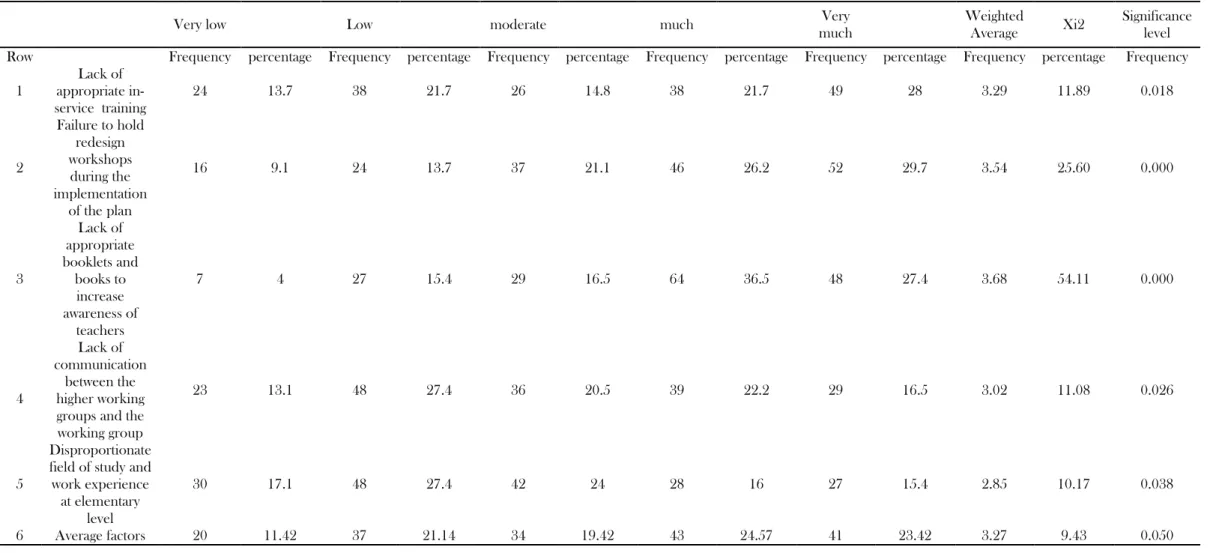
Lack of proper in-service training; Failure to hold redesign workshops during the implementation of the plan; Lack of appropriate booklets and books to increase awareness of teachers, Lack of communication between the higher working groups and the working group; Teacher's disproportionate degree; Disproportionate field of study and work experience at elementary level; Teachers' opinions are about the lack of awareness and appropriate knowledge of teachers about the plan shown in Table 2.
Table 3
Table 2 shows the design challenges and barriers as percentages by different individuals as follows. 49.7% teachers stated that high and very high level Lack of proper in-service training is plan challenge and barrier. 56% individuals stated that failure to hold workshops during the implementation of the plan is plan barrier. 64% individuals stated 64% lack of appropriate booklets and books to increase teachers' awareness is one of plan barrier. 38.7 % individuals stated Lack of communication between the higher working groups and the school working group is one of plan barrier. 31.4% individuals stated that disproportionate field of study and work experience at elementary level is one of plan barriers, overall, 47.99% of respondents stated that lack of teachers' knowledge and awareness at high and very high level is one of plan barrier. Among the abovementioned factors, the lack of booklets and books to increase the awareness of teachers with a weighted average of 3.68 (high) was the highest barrier. Disproportionate study field and work experience at elementary level with a weighted average of 2.85 (moderate) was the lowest barrier among the lack of knowledge and awareness of teachers factors which assessed by the respondents.
How much can executive factors (working group of Shahab design at the school, county and province level) be an obstacle to the implementation of the plan? Administrative barriers valuated with the following items: Lack of cooperation of the school team with teachers; delegating all affairs to teachers; Lacking the coordination of other sections of the elementary school, such as study groups, educational technology and ... with this plan; Paying attention only to the identification and neglect of how and the process of guiding superior talents by working groups; And disconnecting between school-county- province workgroups.
Teachers' opinions are about the items related to executive factors shown in Table 3.
Table3
Table 3 shows the design challenges and barriers as percentages by different individuals as follows. 69% teachers stated that high and very high level lack of cooperation of the school team with teachers is plan challenge and barrier. 83.9% respondents stated delegating all affairs to teachers is plan barrier. 38.7% individuals stated lack of coordination of other sections of the elementary school, such as study groups, educational technology and ... with this plan is one of plan barrier. 639.9 % individuals stated paying attention only to the identification and neglect of how and the process of guiding superior talents by working groups is one of plan barrier. 34.7% individuals stated that disconnecting between schools-county- province workgroups is one of plan barriers, overall, 58.04% of respondents stated executive factors at high and very high level is one of plan barrier. Among the abovementioned factors, delegating all affairs to teachers with a weighted average of 4.04 (very high) was the highest barrier and lack of coordination of other sections of the elementary school, such as study groups, educational technology with a weighted average of 3 (high) was the lowest barrier among the executive factors which assessed by the teachers. Of course, the results of Xi 2 about this item was equal 8.17 and was not significant therefore, there was no significant difference between the opinions of the teachers in this regard, but the opinions of the teachers about the other means were significantly different.
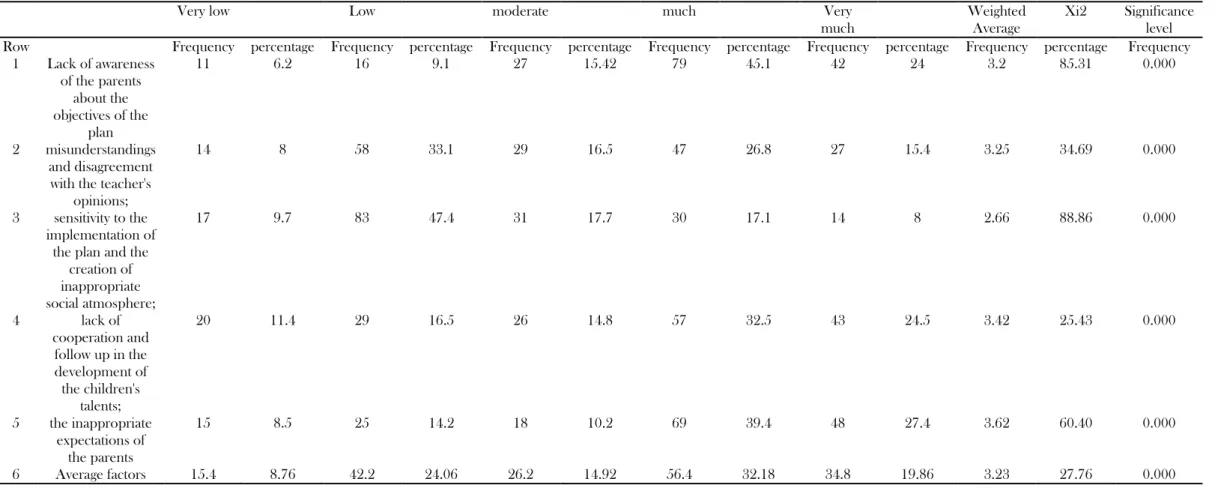
How much can factors related to parents be an obstacle to the implementation of the plan? The role of parents valuated with the following items: Lack of awareness of the parents about the objectives of the plan; misunderstandings and disagreement with the teacher's opinions; sensitivity to the implementation of the plan and the creation of inappropriate social atmosphere; lack of cooperation and follow up in the development of the children's talents; and the inappropriate expectations of the parents.
Table 4 shows teachers' opinions about items related to parents.
Table 4
Table 4 shows the design challenges and barriers as percentages by different individuals as follows. 69.1% teachers stated that high and very high level lack of awareness of the parents about the objectives of the plan is plan challenge and barrier. 42.2% respondents stated misunderstandings and disagreement with the teacher's opinions is plan barrier. 25.1% individuals stated sensitivity to the implementation of the plan and the creation of inappropriate social atmosphere is one of plan barrier. 57 % individuals stated lack of cooperation and follow up in the development of the children's talents is one of plan barrier. 68.8% individuals stated that the inappropriate expectations of the parents are one of plan barriers, overall, 52.04% of respondents stated factors related to parents at high and very high level is one of plan barrier. lack of awareness of the parents about the objectives of the plan with a weighted average of 3.62 (high) was the highest barrier; sensitivity to the implementation of the plan and the creation of inappropriate social atmosphere with a weighted average of 2.63 (moderate) was the lowest barrier among the factors related to parents which assessed by the teachers. Of course, the results of Xi 2 show teachers' opinions about each item are significantly different.
How much can educational factors be an obstacle to the implementation of the plan? The educational factors valuated with the following items:
Teacher teaching techniques and practices; interference of Shahab plan with other plans in the fourth grade; the lack of teacher opportunities due to the large volume of books and duties; educational inequality due to the particular attention to high school students and the neglect of poor and medium students; the ineffectiveness of identification - guidance activities in the assessment of students.
Table 5 shows teachers' opinions about items related to educational
factors.
Table 5
Table 5 shows the design challenges and barriers as percentages by different individuals as follows. 34.8% teachers stated that high and very high-level teacher teaching techniques and practices is plan challenge and barrier. 53.7% respondents stated interference of Shahab plan with other plans in the fourth grade is plan barrier. 81.1% individuals stated the lack of teacher opportunities due to the large volume of books and duties is one of plan barrier. 55.9 % individuals stated educational inequality due to the particular attention to high school students and the neglect of poor and medium students is one of plan barrier. 62.8% individuals stated that the ineffectiveness of identification - guidance activities in the assessment of students is one of plan barriers, overall, 57.66% of respondents stated educational factors at high and very high level is one of plan barrier. the lack of teacher opportunities due to the large volume of books and duties with a weighted average of 4.04 (very high) was the highest barrier; Teacher teaching techniques and practices with a weighted average of 2.66 (moderate) was the lowest barrier among the educational factors which assessed by the teachers. Of course, the results of Xi 2 show teachers' opinions about each item are significantly different.
How much can equipment and educational facilities be an obstacle to the implementation of the plan?
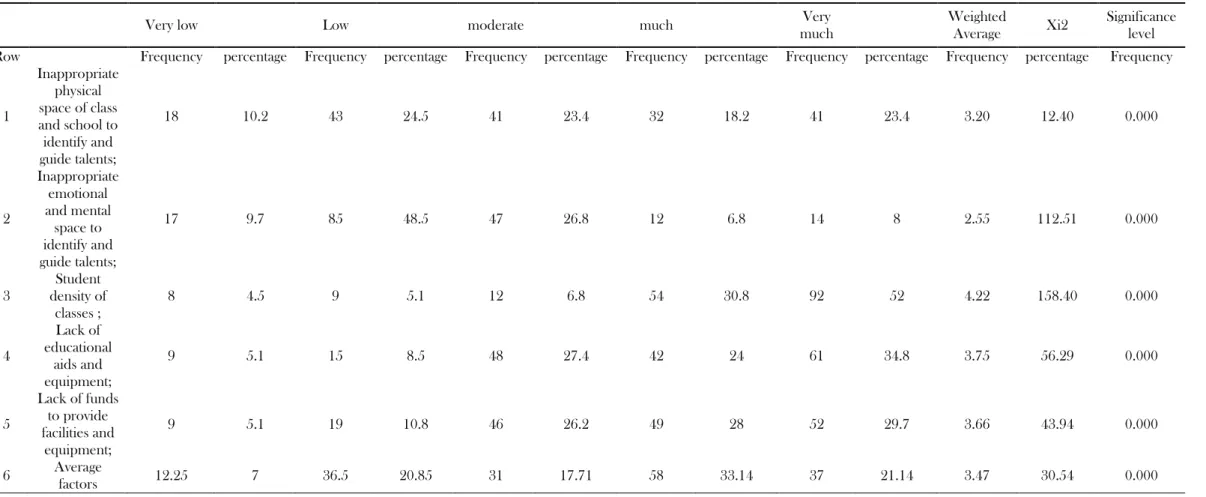
The Educational equipment and facilities valuated which include the following items: Inappropriate physical space of class and school to identify and guide talents; Inappropriate emotional and mental space to identify and guide talents; Student density of classes; Lack of educational aids and equipment; Lack of funds to provide facilities and equipment.
Table 6 shows teachers' opinions about items related to equipment and educational facilities.
Table 6
Table 6 shows the design challenges and barriers as percentages by different individuals as follows. 41.6% teachers stated that high and very high-level inappropriate physical space of class and school to identify and guide talents is plan challenge and barrier. 14.8% respondents stated inappropriate emotional and mental space to identify and guide talents is plan barrier. 82.8% individuals stated student density of classes is one of plan barrier. 58.8 % individuals stated of educational aids and equipment is one of plan barrier. 57.7% individuals stated that lack of funds to provide facilities and equipment is one of plan barriers, overall, 52.48% of respondents stated the Educational equipment and facilities at high and very high level is one of plan barrier. Student density of classes with a weighted average of 4.22 (very high) was the highest barrier; appropriate emotional and mental space to identify and guide talents with a weighted average of 2.55 (moderate) was the lowest among the factors related to equipment and training facilities which assessed by the teachers. Of course, the results of Xi 2 show teachers' opinions about each item are significantly different.
How much can tool and checklist for superior talent identification be an obstacle to the implementation of the plan?
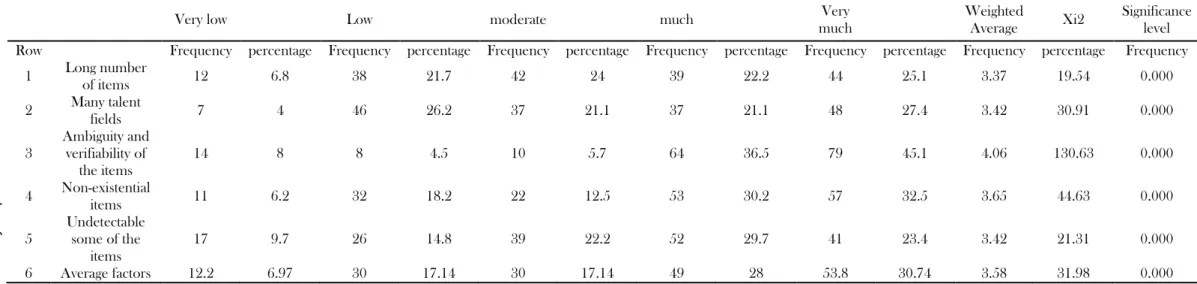
Tools and checklist for superior talent identification valuated with the following items: The length of the number of items; the high degree of talent domains; Ambiguity and interpretation of the items; some items cannot be measured.
Table 7 shows teachers' opinions about items related to tools and Checklist for superior talent identification.
Table 7
Table 7 shows the design challenges and barriers as percentages by different individuals as follows. 47.7% teachers stated that high and very high-level length of the number of items is plan challenge and barrier. 48.5% respondents stated the high degree of talent domains is plan barrier. 81.7% individuals stated ambiguity and interpretation of the items is one of plan barrier. 62.8 % individuals stated non-existential items is one of plan barrier. 53.1% individuals stated that some of the undetectable items is one of plan barriers, overall, 58.74% of respondents stated factors related to tools and checklist for superior talent identification at high and very high level is one of plan barrier. ambiguity and interpretation of the items with a weighted average of 4.06 (very high) was the highest barrier; the length of the number of items with a weighted average of 3.37 (moderate) was the lowest barrier among the factors related to equipment and training facilities which assessed by the teachers. Of course, the results of Xi 2 show teachers' opinions about each item are significantly different.
How much can factors related to students be an obstacle to the implementation of the plan?
Factors related to students valuated with the following items: Students 'lack of awareness of the goals of the plan; Students' sensitivity to some of the areas of talent; Motivational factors such as lack of self-confidence, stress and severe academic drop; The existence of various emotional and psychological disorders such as learning disorders, anxiety and depression, students' unexpected expectations.
Table 8 shows teachers' opinions about items related to student factors.
Table 8
Table 8 shows the design challenges and barriers as percentages by different individuals as follows. 55.9% teachers stated that high and very high-level students 'lack of awareness of the goals of the plan is plan challenge and barrier. 22.7% respondents stated students' sensitivity to some of the areas of talent is plan barrier. 72.5% individuals stated motivational factors such as lack of self-confidence, stress and severe academic drop is one of plan barrier. 65.1 % individuals stated The existence of various emotional and psychological disorders such as learning disorders, anxiety and depression is one of plan barrier. 32.8% individuals stated that student's inappropriate expectations are one of plan barriers, overall, 58.74% of respondents stated factors related to students at high and very high level is one of plan barrier. Motivational factors such as lack of self-confidence, stress and severe academic drop with a weighted average of 3.90 (high) was the highest barrier; Students' sensitivity to some of the areas of talent with a weighted average of 2.85 (moderate) was the lowest barrier among the factors related to equipment and training facilities which assessed by the teachers. Of course, the results of Xi 2 show teachers' opinions about each item are significantly different.
How have male and female teachers assessed the barriers and octave challenges of the Shahab project?
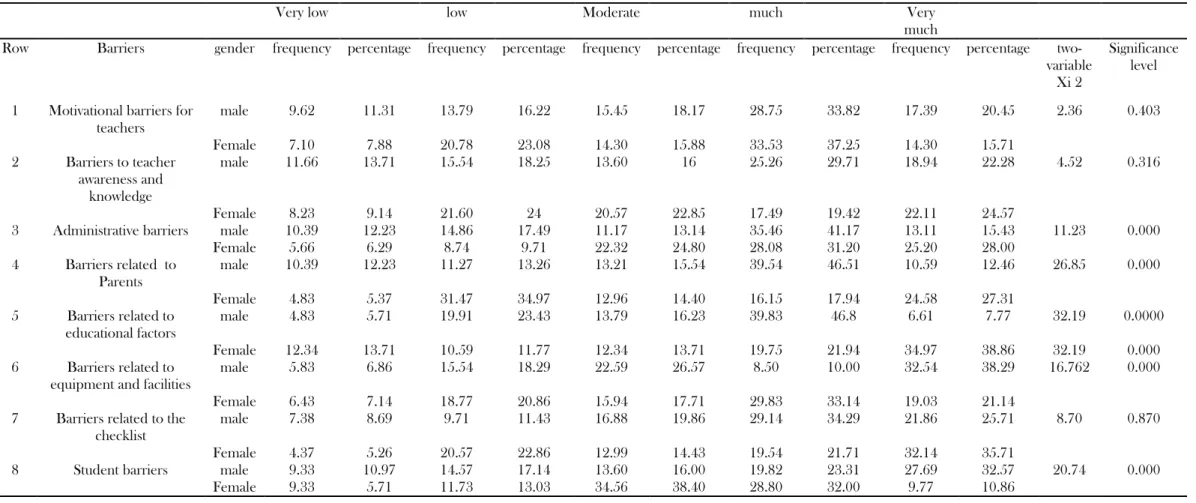
Table nine shows male and female teachers' average comments about each obstacle separated from gender.
Table 9
The outcomes of Table 9 indicate that percentage of high and very high responsiveness of male teachers on the eight factors, respectively, are:
1- 60% factors related to the checklist and identification tool. 2- 58.97 % factors related to parents.
3- 57.14%executive factors,
4- 55.88% Factors related to students. 5- 54.63% Educational factors.
6- 54.27% Motivational factors of teachers.
7- 51.99% Factors related to awareness and knowledge of teachers 8- 48.29 % Factors related to equipment and training facilities.
Therefore, according male teachers's view, the factors associated with the identification checklist and tool are the most important obstacle to the implementation of the plan. In addition, percentages of high and very high responsiveness of female teachers on the eight factors, respectively, are: 60.8% The factors related to education 2- 59.2% Executive factors 3- 57.42% Factors related to the identification checklist and tool 3- 54.28% Factors related to equipment and training facilities 5- 52.96% Motivational factors of teachers 6- 45.25% factors related to parents 7- 43.99% factors related to awareness and knowledge of teachers 8- 42.86% factors related to students . Therefore, according female teachers' view, the factors related to education are the most important obstacle to the implementation of the Shahab plan. In total, without considering gender, 58.71 percent of the respondents considered the factors related to the identification checklist and tool as high and very high as the most important obstacle to the implementation of the Shahab plan. In addition, as you can see, Xi 2 of motivational factors and factors related to the awareness and knowledge of teachers and the factors related to the identification checklist and tool are 2.36, 4.52 and 8.70, respectively, which are not significant and the other factors are completely meaningful. Therefore, there is no significant difference between the views of male and female teachers about the motivational factors; the factors related to the teachers' awareness and knowledge; and the factors related to the identification checklist and tool. There are significant differences between the views of female and female teachers about other factors. In other words, the opinions of female and female teachers about motivational factors; the factors related to teachers' awareness and knowledge; and the factors related to the identification checklist and tool are the same, but in other factors, the opinions of male and female teachers are different.
4. Conclusion
From the teachers' point of view, the lack of hope for continuity of the plan and the lack of interest and motivation of teachers is important obstacles to the motivation of the Shahab project. In recent years, the Ministry of Education has witnessed the emergence of various projects in various fields of education, and social issues, which have been rose from time to time but are soon abandoned. When a project runs for just one year, it is obvious that teachers do not feel responsible for it. One of the reasons why teachers do not have enough motivation is their work traffic and their mental work through the implementation of diverse designs in the elementary school, especially the fourth grade. In addition, the change of the fourth grade textbooks and the intense focus of the teacher to adapt to the new changes made to decrease the teachers' motivation. Part of this lack of motivation is also because teachers do not receive any remuneration or reward for this new task. Therefore, the need to pay attention to the motivation of teachers and their increasing interest in the plan is well felt. Findings of the present study are in line with the findings of Litewood (2005) and Folen (2007), it is necessary to appreciate the efforts of teachers, poll, creating an interest, motivation and support for them to implement change. Kennedy (1988) acknowledges that, given the role of teachers as major change managers, the increasing decision-making power of teachers will strengthen their sense
of ownership. He also says that if all participants feel that they have played a role in shaping change, then the change will succeed, but if people discarded during the change, they will not feel any responsibility for implementing the changes. If executives are forced to make changes in terms of their job responsibilities, their resistance to these changes will be high, because forcing executives to make changes makes them feel dissatisfied and reduce their sense of commitment to change. Palmer's (1993) study also showed that experienced teachers in the face of change love that gives them an opportunity to express themselves, and finally, Teachers will easily accept it when they feel that the change is appropriate to their circumstances.
The most important barrier to lack of awareness and knowledge of teachers is the lack of appropriate booklets and pamphlets to raise awareness of teachers, and then failure to hold reworked workshops during the implementation of the project which assessed by the teachers. The findings of the present study are in line with the findings of Hasani (2003) that according to that failure of teachers to understand and right comprehension to descriptive evaluation is Challenges for implementing that plan. In addition, according to a study by Saeing and Citicke (2015) titled assessing the effectiveness and efficacy of teachers in identifying superior students, outcomes of study showed that teachers who took part in classrooms had more effective and more effective than other teachers in identifying superior talent. In the executive section, the most important obstacle is delegating all affairs to teachers and after that lack of cooperation with the school team although the project implemented as the team at the school. However, it seems that teacher is responsible for the implementation of the plan. Moreover, it is therefore natural for teachers to point out this factor as the most important plan barrier. For this reason, it is worthy to be bone parts of tasks, such as calculating results, aggregating information and registering results in the system in the process of corrective design by other members of the work team and plan appropriately to increase collaboration among the members of the working group.
Findings of Folen (2007) and Cantter (2004), which provided a framework for Co-operation and sharing efforts among teachers to implement necessary changes, confirmed the findings of this study. Parents' lack of awareness of the goals of the plan and the inappropriate and inappropriate expectations of the parent is the most important obstacles and challenges of the project discussed in the section of parent role. Although the Shahab project initiated with the intention of preventing misunderstanding project and abuse of educational institutions without proper notification to parent, but then, if parents are not justified, the plan may be out of the mainstream. Many parents have no information about the Shahab plan, and this lack of information or low information causes the inadequate social atmosphere and background of misuse of some profitable institutions. Therefore, it is desirable to do proper notification through family education sessions, brochures and share efforts to identify students' talent.
As Siegel et al., 2016 states, developing student talent is a two-part process that in the first place, parents and educators should provide opportunities for the development of talents, and then provide appropriate educational opportunities to raise their talent and reach expected level. The findings of Epstein et al. (2002) confirm the findings of this study. They state that creation of the atmosphere of understanding and the sharing of efforts among parents and school officials is effective on implementing change. The teachers considered lack of teacher opportunities due to the massive volume of the book and then affectless identification and guidance activities in student evaluation as the most important obstacles and challenges of the project in the section on factors related to training by teachers. The in-service - questions asked frequently by teachers to familiarize with plan including:
Are there any opportunities for teachers to do other work despite the high student density in schools, the volume of textbooks and the changes in textbooks? In addition, many believed that if the process of recognition of talent is logical and scientific, why not these results are taking into account student evaluation. The results are consistent with the findings of Mortezaei Nejad
(2004). In addition, Hosseini (2010) has shown that teachers and parents have a positive attitude toward descriptive evaluation. However, but according to teachers, the high volume of work, the small time and the large number of students; and according to parents their children's lack of motivation due to lack of competition are the most important problem in the implementation of descriptive evaluation, which is in line with the results of this research. The high density of students in the classroom and then the shortage of equipment and educational facilities for the development of talents in the field of factors related to equipment and educational facilities are the most important obstacles and challenges evaluated by teachers.
In this regard, Mullah Dawajerdi (2010), Heydari (2008) and Hamedi (2009) also showed that at present, the main problem of conducting a descriptive evaluation project in elementary school schools is the high number of students in the class, which confirm well the results of this study. Class density has the greatest impact on teacher-student interactions and obviously, the more teacher interaction with students, will increase students learning. Delard, Anvilinck, McCarran and Webcore (2009) investigated impact of classroom student density on the type and number of interactions in elementary school; concluded that relationship between classroom interactions and density was negative, the types of interactions between teachers and students occur in smaller classes; the effects of low population classes are similar for all students, regardless of cognitive behavioral characteristics. The lack of facilities and equipment are one of the main barriers to the implementation of school-based projects.
As the findings of Mirza Mohammadi (2011), Hosseini (1389), Hebidich (2003), Lane (2001), Lachiour, and Tardif (2002) indicate that lack of executive facilities and inadequate motivation and awareness of teachers are executive barriers of the descriptive evaluation plan and are consistent with the results of this research. Obviously, implementing any plan without the proper equipment either failed or that the plan implemented incompletely and ineffectively. Although the school's intelligence movement has been expanding recently for the development of educational facilities, many primary schools still are lack the necessary equipment and facilities to develop different students' talents. Meanwhile, it seems that if the plan of guidance and identification of superior talents expand, the development of specific training programs for each talent, the recipe of textbooks, the design of materials, educational equipment will be necessity and priority of education. The ambiguity and interpretation of the items and then the uncertainty of the items in the section of checklist and identification tool are the most important obstacles and challenges evaluated by the teachers. Checklist or scheme identification tool as a tool for screening and identifying talent needed extensive research. Although the high number of items and the high number of talent spheres approved by nearly half of the respondents, but over eighty percent of respondent’s state that ambiguity and interpretation of the items are the most important obstacle and challenge. In addition, the lack of objective evidence for identifying talents is another problem that has well argued by teachers as a serious obstacle for Shahab plan.
Therefore, the standardization of checklists and studying reliability, validity and review of questions considered essentially. It is desirable to use the ideas and suggestions of teachers in this regard. In addition, the search in the information banks of papers and studies did not reveal any research on the Shahab project. Therefore, it is essential to conduct research on how and how to identify superior talent. Motivational and educational factors related to students such as lack of self-confidence, stress and severe academic drop, and consequently the existence of various emotional and psychological problems and disorders such as learning disorder, anxiety and depression in the student-related factors are the most important obstacles and challenges evaluated by teachers. One of the most important problems of plan is neglecting the proper mechanism for identifying and monitoring students with emotional problems, educational failure and various disorders (especially learning disorder, anxiety and depression).
Among the disorders and problems of the elementary school, the most common problem is children's learning disorders. In this regard, Moore and Lagouy (2005) argue that there is always a risk to students with learning disabilities that, if they did not identify promptly, teachers will label them lazy, irresponsible, and unmotivated. This is so important that students with learning disabilities who labeled with these labels often deprived of appropriate educational and academic opportunities and may experience common social and emotional problems, low motivation and incomplete learning of the lesson content (Clausen & Lynch, 2007). Identifying students with disabilities or students with better talent is important in determining the type of service provided to students (Rees et al., 2014). Since students with emotional problems, especially learning disabilities often recognized as learning disadvantages, it is appropriate to consider appropriate arrangements to identify and direct superior talent among these students. Male teachers valuated the most important obstacles among the eight octaves respectively following
Factors related to the identification checklist and tool; factors related to parents; Executive factors; factors related to students; Factors related to education; Motivational factors of teachers; factors related to teachers' awareness and knowledge; factors related to equipment and training facilities; Also, female teachers among the eight factors considered the most important obstacles as following:
Factors related to education; Executive factors; Factors related to checklist and identification tool; Factors related to equipment and educational facilities; Motivational factors of teachers; factors related to parents; factors related to teachers' awareness and knowledge; and factors related to students. Research findings, however, showed that regardless of gender, teachers consider factors related to checklist and identification tool as the most important barrier and challenge of Shahab plan. In addition, the views of male and female teachers about teacher motivation barriers and obstacles related to teachers' lack of knowledge and awareness; and the factors related to the checklist and identification tools are similar, but no other agreement find. Since the first step in the implementation of the Shahab project is identifying superior talent and the rest of the stages are subject to successful implementation of this step, considering the results of the research on the importance of identification tool is as the basis for future actions for planning, guidance and leadership of superior talent.
A comparative study with other countries on the approaches, indicators and criteria for identification of superior talent should made, so that based on outcomes existing tool can be strengthened and, if necessary, corrected. On the other hand, since the use of various sources can always provide more reliable results for the researcher, and, on the other hand, there are different tools and resources for identifying superior talent such as performance measurement, intelligence testing, progress testing, talent tests, tests Creativity, interview, observation, and teacher rating scale (Saxon and Citienkia, 2015). In addition, as Hemmati Alamdarli and colleagues (1394), state quoted from (Hussein Khanzadeh, 1392 and Kayhilgo, 2013); acuity includes quantitative and qualitative differences; using a tool is not enough to measure and identify acuity. Therefore, it is suggested that in identifying top talents, in addition to using the checklist, other tools such as academic achievement scores, intelligence tests and academic aptitude will also be used. The specificity of the research community to the teachers of Shahriar city is one of the research constraints. It is suggested that the obstacles to the implementation of the project should be investigated in other regions of Tehran and other provinces.
References
Buckingham, M., & Vosburgh, R.M (2001). The 21st Century Human Resources Function:It's the Talent, Stupid!. Human Resource Planning, 24(4), pp. 17 -23.
Doolaard, S., Annevelink, E., Mascareño,m., & Bosker, R. J. (2009). Class Size Effects on The Number and Types of Student-Teacher Interactions in Primary Classrooms. Journal of Classroom Interaction, ISSN 0749-4025. © 2009, Vol 44.2, pages 30-38.
Elite National Foundation (2012) Educational Textbook for Shahab plan (Identification and leading scheme of the top talent), Second map (October 2012)] Educational pamphlet.
Epstein, J., Sanders, M., Simon, B., Salinas, K., Janson, N., & Van Voorhis, F. (2002). School, family and community partnerships:Your handbook for action (2nd ed). Thousand Oaks, CA: CrownPress.
Fullan, M. (2007). The new meaning of educational change (4th ed.). New York: Teacher Collage Press.
Hamamoto, P. (2007). Program Guide for gifted and talented.office of curriculum instruction & student support.Instructional services Branch department of education, state of Hawaii.
Hasani M (1389). Descriptive evaluation guidance in the classroom. Abed Publishing.
Hasani M. (1382). Guidance on the implementation of descriptive evaluation. Tehran: Pre-school Education Office.
Hebdige, R. (2003). Teacher portfolio assessment. Eric:Ed 385608.
Hemmati Alamdarloo, Gh ; Hossein Khanzadeh, A .; Taher, M. and Arjmandi, M. S.(1394). Comparison of learning perceptions and study habits among students with brilliant and ordinary talents. Quarterly Exceptional Persons. 5 (18), 45-69
Heskett, L. J., Leonard, S. A., & Earl, S. W. (2002). The Value Profit Chain: How to ManageEmployees Like Customers & Customers Like Employees. Simon & Schuster.
Heydari, J. (1387). The study of the problems of implementing a descriptive evaluation project from the first to fourth grade in elementary schools in Ilam province. master thesis. Teacher Training University of Tehran. Hosseini, M. (1389). Investigating the relationship between teachers' awareness of descriptive evaluation approach
and their performance in the descriptive evaluation of the first elementary school of Shiraz 4th district schools. Master's Thesis. Marvdasht: Islamic Azad University.
Kahyaoglu, M. (2013). A comparision between gifted students and non-gifted students' learning styles and their motivation styles towards science learning. Educational Research and Reviews, 8(12), 890-896.
Kanter, R. M. (2004). Confidence: How winning and losing streaksbegin and end. New York: Crown Business. Kennedy, C. (1988). Evaluation of the management of change in ELT PROJECT, Applied Linguistics journal,
9(4), PP: 329-342.
Klassen, R. M., & Lynch, L. Sh. (2007) “Self Efficacy from the Perspective of Adolescents with LD and Their Specialist Teachers”. Journal of Learning Disabilities. 40(6). 494- 507.
Lachiver, R., & Tardif, G.L. (2002). Teacher Evaluation, student self- Evaluation. journal of learning disabilities, 13(5).
Leithwood, K. (2005). Teacher working condition that matter. Toronto: Elementary Teachers Federation of Ontario.
Linn, Robert L. (2001). Assessments and accountability (condensed version). Practical Assessment,Research & Evaluation,7(11).
Manteghi, M (1385), Investigating the Challenges of Educational Innovations. The first national conference on educational innovations. Tehran. 38-24.
Mirza Mohammadi, MA. (1390). Identifying qualitative descriptive evaluation problems, barriers of elementary school in Zanjan province and providing solutions for improving its quality. Zanjan Province: research council of the directorate general for education.
Moore,K.& lagoni, L (2005) "Learning disabilities.Colorado State university ".www. colosttateoedu/depts/coopext. Mortezaei Nejad, AS. (1383). Studying teachers 'and parents' attitudes on descriptive evaluation application in the
first and second elementary schools of Tehran in the academic years 83-84. Master's Thesis. Rey city: Islamic Azad University.
Mulla'i Dastjerdi, S. (1389). Studying qualitative descriptive evaluation problems from viewpoints of teachers, parents of elementary students in the years of 2008-2010. Master thesis of Isfahan university.
ossein Khanzadeh, AS (1392). Psychology and education of children and adolescents with special needs. Tehran: Avar Noor
Palmer, C. (1993). Innovation and experienced teacher, English Language Teaching Journal, 47(2) PP: 166-171. Pour Afkhani, N. (1382). Comprehensive culture of psychology, psychiatry. Tehran:Zarghalam Publications. Reis, S. M., Baum, S. M., & Burke, E. (2014). An operational definition of twice-exceptional learners:
Implications and applications. Gifted Child Quarterly, 58, 217–230
Rezaei, A. (2013). The Factor Structure and Reliability of Multiple Intelligence Questionnaire Scales in the Society of Humanities Students of Payame Noor University. Behavioral Sciences Research Journal. Course 11, No 1.
Rezvani, R and Amiri, T. (1392). Analysis of the content of English language teaching books Selected university from the point of view of multiple intelligences. Journal of Research, New Approach in Educational Management of Islamic Azad University, Marvdasht Branch, No. 4
Sadeghi Malah Amiri, M. (1393). Analysis Patterns of Variables Affecting Talent. Human Resources Management Research, Year 6, NO,4, 97-62
Şahin, F., & Çetinkaya, Ç. (2015). An Investigation of the Effectiveness and Efficiency of Classroom Teachers in the Identification of Gifted Students. Turkish Journal of Giftedness & Education, 5(2).
Sharifi, H.-P. (1997). Theory and application of intelligence and personality tests. Tehran: Sokhan Publications. Siegle, D., Gubbins, E. J., O’Rourke, P., Langley, S. D., Mun, R. U., Luria, S. R., ... & Plucker, J. A. (2016).
Barriers to Underserved Students’ Participation in Gifted Programs and Possible Solutions. Journal for the
Education of the Gifted, Vol. 39(2) 103 –131.
Subotnik, R. F., Olszewski-Kubilius, P., & Worrell, F. C.(2011). Rethinking giftedness and gifted education: A proposeddirection forward based on psychological science.Psychological Science in the Public Interest, 12, 3– 54.
Sumita, T. (2008), Intellectual assets based management for innovation: Lessons from experiences in Japan.
Journal of Intellectual Capital Vol. 9 No. 2, pp. 206-227
Wang. H. (2004). Talented Person Gathering: Foundation Promise of Development Industry Cluster Development. Economic Problem Exploration, 12(1) , pp. 104-106.
Very
low Low moderate much
Very much
Weighted
Average Xi2
Significance level
Row F P F P percentage Frequency percentage Frequency percentage Frequency percentage Frequency
1 The lack of interest of teachers in design 10 5.7 25 14.2 40 22.8 66 37.7 34 19.4 3.50 48.91 0.000
2 Lack of hope for continuation of the plan
in the coming years 12 6.8 19 10.8 27 15.4 78 44.5 39 22.2 3.64 77.54 0.000
3 Failure to receive adequate fees and
rewards 12 6.8 31 17.7 30 17.1 60 34.2 42 24 3.50 35.54 0.000
4
Disregarding the comments and suggestions of teachers in improving and
correcting
19 10.8 44 25.1 28 16 57 32.5 27 15.4 3.16 26.69 0.000
5 Concerned about improper identification
and harm to students 31 17.7 53 30.2 24 13.7 50 28.5 17 9.7 2.43 28.86 0.0001
6 Average factors 16.8 9.56 34.4 19.6 29.8 17 62.2 35.48 31.8 18.14 3.24 31.68 0.000
Table 2.Average and standard deviation of functional strategies based on groups
Very low Low moderate much Very
much
Weighted
Average Xi2
Significance level
Row Frequency percentage Frequency percentage Frequency percentage Frequency percentage Frequency percentage Frequency percentage Frequency
1
Lack of appropriate in-service training
24 13.7 38 21.7 26 14.8 38 21.7 49 28 3.29 11.89 0.018
2
Failure to hold redesign workshops
during the implementation
of the plan
16 9.1 24 13.7 37 21.1 46 26.2 52 29.7 3.54 25.60 0.000
3
Lack of appropriate booklets and
books to increase awareness of
teachers
7 4 27 15.4 29 16.5 64 36.5 48 27.4 3.68 54.11 0.000
4
Lack of communication
between the higher working groups and the working group
23 13.1 48 27.4 36 20.5 39 22.2 29 16.5 3.02 11.08 0.026
5
Disproportionate field of study and work experience
at elementary level
30 17.1 48 27.4 42 24 28 16 27 15.4 2.85 10.17 0.038
6 Average factors 20 11.42 37 21.14 34 19.42 43 24.57 41 23.42 3.27 9.43 0.050
Very low Low moderate much Very much Weighted
Average Xi2
Significance level
Row Frequency percentage Frequency percentage Frequency percentage Frequency percentage Frequency percentage Frequency percentage Frequency
1
Lack of cooperation of
the school team with teachers;
12 6.8 23 13.1 19 10.8 75 42.8 46 26.2 3.68 75.71 0.000
2
delegating all affairs to teachers
7 4 8 4.5 13 7.4 89 50.8 58 33.1 4.04 155.49 0.000
3
Lacking the coordination
of other sections of the
elementary school, such as
study groups, educational technology and
... with this plan;
27 15.4 38 21.7 42 24 43 24.5 25 14.2 3 8.17 0.085
4
Paying attention only
to the identification and neglect of
how and the process of
guiding superior talents
by working groups;
16 9.1 22 12.5 25 14.2 73 41.7 39 22.2 3.55 59.71 0.000
5
disconnecting between school-county-
province workgroups .
19 10.8 28 16 67 38.2 39 22.2 22 12.5 3.09 43.26 0.000
6 Average factors 16.2 9.2 23.8 13.86 32.2 18.97 63.8 36.4 38 21.64 3.47 37.73 0.000
Table 3.Frequency distribution, percentage and Xi 2 calculated items related to items of executive factors.
Very low Low moderate much Very
much
Weighted Average
Xi2 Significance level
Row Frequency percentage Frequency percentage Frequency percentage Frequency percentage Frequency percentage Frequency percentage Frequency
1 Lack of awareness of the parents
about the objectives of the
plan
11 6.2 16 9.1 27 15.42 79 45.1 42 24 3.2 85.31 0.000
2 misunderstandings and disagreement with the teacher's
opinions;
14 8 58 33.1 29 16.5 47 26.8 27 15.4 3.25 34.69 0.000
3 sensitivity to the implementation of
the plan and the creation of inappropriate social atmosphere;
17 9.7 83 47.4 31 17.7 30 17.1 14 8 2.66 88.86 0.000
4 lack of
cooperation and follow up in the development of the children's
talents;
20 11.4 29 16.5 26 14.8 57 32.5 43 24.5 3.42 25.43 0.000
5 the inappropriate expectations of
the parents
15 8.5 25 14.2 18 10.2 69 39.4 48 27.4 3.62 60.40 0.000
6 Average factors 15.4 8.76 42.2 24.06 26.2 14.92 56.4 32.18 34.8 19.86 3.23 27.76 0.000
Very low Low moderate much Very much
Weighted
Average Xi2
Significance level
Row Frequency percentage Frequency percentage Frequency percentage Frequency percentage Frequency percentage Frequency percentage Frequency
1
Teacher teaching techniques and practices;
23 18.8 50 28.57 31 17.7 41 23.4 20 11.4 2.80 14.46 0.000
2
interference of Shahab
plan with other plans in
the fourth grade;
21 12 42 24 18 10.2 63 36 31 17.7 3.23 38.11 0.000
3
the lack of teacher opportunities
due to the large volume of books and
duties;
8 4.5 9 5.1 16 9.1 77 44 65 37.1 4.04 126.57 0.000
4
educational inequality due
to the particular attention to high school students and the neglect of
poor and medium students;
11 6.2 39 22.2 27 15.4 57 32.5 41 23.4 3.45 33.60 0.000
5
the ineffectiveness
of identification -
guidance activities in
the assessment of
students.
12 6.8 14 8 39 22.2 63 36 47 26.8 3.68 54.69 0.000
6 Average
factors 17 9.66 30.8 17.57 26.2 14.92 60.2 34.38 40.8 23.28 3.44 31.08 0.000
Table 5. Frequency Distribution, Percentage and Xi 2 calculated of items related to the educational factors.
Very low Low moderate much Very
much
Weighted
Average Xi2
Significance level
Row Frequency percentage Frequency percentage Frequency percentage Frequency percentage Frequency percentage Frequency percentage Frequency
1
Inappropriate physical space of class and school to identify and guide talents;
18 10.2 43 24.5 41 23.4 32 18.2 41 23.4 3.20 12.40 0.000
2
Inappropriate emotional and mental
space to identify and guide talents;
17 9.7 85 48.5 47 26.8 12 6.8 14 8 2.55 112.51 0.000
3
Student density of
classes ;
8 4.5 9 5.1 12 6.8 54 30.8 92 52 4.22 158.40 0.000
4
Lack of educational
aids and equipment;
9 5.1 15 8.5 48 27.4 42 24 61 34.8 3.75 56.29 0.000
5
Lack of funds to provide facilities and
equipment;
9 5.1 19 10.8 46 26.2 49 28 52 29.7 3.66 43.94 0.000
6 Average
factors 12.25 7 36.5 20.85 31 17.71 58 33.14 37 21.14 3.47 30.54 0.000
Very low Low moderate much Very much
Weighted
Average Xi2
Significance level
Row Frequency percentage Frequency percentage Frequency percentage Frequency percentage Frequency percentage Frequency percentage Frequency
1
Inappropriate physical space of class and school to identify and guide talents;
18 10.2 43 24.5 41 23.4 32 18.2 41 23.4 3.20 12.40 0.000
2
Inappropriate emotional and mental
space to identify and guide talents;
17 9.7 85 48.5 47 26.8 12 6.8 14 8 2.55 112.51 0.000
3
Student density of
classes ;
8 4.5 9 5.1 12 6.8 54 30.8 92 52 4.22 158.40 0.000
4
Lack of educational
aids and equipment;
9 5.1 15 8.5 48 27.4 42 24 61 34.8 3.75 56.29 0.000
5
Lack of funds to provide facilities and
equipment
9 5.1 19 10.8 46 26.2 49 28 52 29.7 3.66 43.94 0.000
6 Average
factors 12.25 7 36.5 20.85 31 17.71 58 33.14 37 21.14 3.47 30.54 0.000
Table 7. Frequency Distribution, Percentage and Xi 2 calculated of items related to tools and checklist for identification.
Very low Low moderate much Very
much
Weighted
Average Xi2
Significance level Row Frequency percentage Frequency percentage Frequency percentage Frequency percentage Frequency percentage Frequency percentage Frequency
1 Long number
of items 12 6.8 38 21.7 42 24 39 22.2 44 25.1 3.37 19.54 0.000
2 Many talent
fields 7 4 46 26.2 37 21.1 37 21.1 48 27.4 3.42 30.91 0.000
3
Ambiguity and verifiability of
the items
14 8 8 4.5 10 5.7 64 36.5 79 45.1 4.06 130.63 0.000
4 Non-existential
items 11 6.2 32 18.2 22 12.5 53 30.2 57 32.5 3.65 44.63 0.000
5
Undetectable some of the
items
17 9.7 26 14.8 39 22.2 52 29.7 41 23.4 3.42 21.31 0.000
6 Average factors 12.2 6.97 30 17.14 30 17.14 49 28 53.8 30.74 3.58 31.98 0.000
Very low Low moderate much Very much
Weighted
Average Xi2
Significance level
Row Frequency percentage Frequency percentage Frequency percentage Frequency percentage Frequency percentage Frequency percentage Frequency
1
Students' lack of awareness
of the objectives of
the plan
10 5.7 13 7.4 54 30.8 72 41.1 26 14.8 3.52 83.43 0.000
2
sensitivity of students to some areas of
the talent
21 12 47 26.86 67 38.2 18 10.2 22 12.5 2.85 52.06 0.000
3
Motivational and psychological factors related
to students such as lack
of self-confidence
,stress and academic
failure
13 7.4 17 9.7 18 10.2 54 30.8 73 41.7 3.90 82.19 0.000
4
Existence of different emotional and
psychological problems and
disorders Such as learning disorders, anxiety and depression
11 6.2 9 5.1 41 23.4 66 37.7 48 27.4 3.75 69.90 0.000
5
Unpredictable expectations
of students
18 10.2 46 26.2 58 33.1 32 18.2 21 12 2.95 32.69 0.000
6 Average
factors 14.6 8.34 26.4 15.08 47.6 27.2 48.4 27.65 38 21.71 3.39 23.93 0.000
Table 9. Comparison of male and female teacher’s comments about barriers and octave challenges.
Very low low Moderate much Very
much
Row Barriers gender frequency percentage frequency percentage frequency percentage frequency percentage frequency percentage two-variable
Xi 2
Significance level
1 Motivational barriers for teachers
male 9.62 11.31 13.79 16.22 15.45 18.17 28.75 33.82 17.39 20.45 2.36 0.403
Female 7.10 7.88 20.78 23.08 14.30 15.88 33.53 37.25 14.30 15.71
2 Barriers to teacher awareness and
knowledge
male 11.66 13.71 15.54 18.25 13.60 16 25.26 29.71 18.94 22.28 4.52 0.316
Female 8.23 9.14 21.60 24 20.57 22.85 17.49 19.42 22.11 24.57
3 Administrative barriers male 10.39 12.23 14.86 17.49 11.17 13.14 35.46 41.17 13.11 15.43 11.23 0.000
Female 5.66 6.29 8.74 9.71 22.32 24.80 28.08 31.20 25.20 28.00
4 Barriers related to Parents
male 10.39 12.23 11.27 13.26 13.21 15.54 39.54 46.51 10.59 12.46 26.85 0.000
Female 4.83 5.37 31.47 34.97 12.96 14.40 16.15 17.94 24.58 27.31
5 Barriers related to educational factors
male 4.83 5.71 19.91 23.43 13.79 16.23 39.83 46.8 6.61 7.77 32.19 0.0000
Female 12.34 13.71 10.59 11.77 12.34 13.71 19.75 21.94 34.97 38.86 32.19 0.000
6 Barriers related to equipment and facilities
male 5.83 6.86 15.54 18.29 22.59 26.57 8.50 10.00 32.54 38.29 16.762 0.000
Female 6.43 7.14 18.77 20.86 15.94 17.71 29.83 33.14 19.03 21.14
7 Barriers related to the checklist
male 7.38 8.69 9.71 11.43 16.88 19.86 29.14 34.29 21.86 25.71 8.70 0.870
Female 4.37 5.26 20.57 22.86 12.99 14.43 19.54 21.71 32.14 35.71
8 Student barriers male 9.33 10.97 14.57 17.14 13.60 16.00 19.82 23.31 27.69 32.57 20.74 0.000
Female 9.33 5.71 11.73 13.03 34.56 38.40 28.80 32.00 9.77 10.86