Investigating Classroom Discourse: A Case Study of an Iranian Communicative EFL Classroom
Parviz Maftoon a
Associate Professor, Islamic Azad University, Science and Research Branch, Tehran, Iran
Ghafour Rezaie b
PhD, Islamic Azad University, Garmsar Branch, Garmsar, Iran
Received 10 June 2012; revised 22 January 2013; accepted 18 February 2013
Abstract
This article examines various features of classroom discourse in a communicative EFL classroom. The class was observed and audio-taped during five class sessions with the total recordings of 4 hours of classroom interactions. An analytic framework was developed to examine these features in four major areas of teaching exchanges, characteristics of input, error treatment, and question types. The analysis revealed that the database comprised 52 teaching exchanges, of which
a
Email address: [email protected] b
Email address: [email protected]
Corresponding address: Department of English, Faculty of Humanities, Islamic Azad University, Garmsar Branch, Daneshjoo St., Garmsar, Iran
73% contained the F-move with evaluative function, that the teacher modified his speech in accordance with the learners’ language proficiency level, and that there was a clear preference for recasting (51%) and explicit correction (22%), leaving little opportunity for other effective corrective feedback strategies to encourage learner uptake and self-repair. The database was also examined for question types. Although referential questions are believed to be valuable in promoting communicative interactions, it was found that the teacher asked proportionately more display questions (57%) than referential questions (21%).
Keywords: Classroom discourse; Teaching exchanges; Characteristics of input; Error treatment; Question type
Introduction
The investigation into the nature of classroom discourse is of great importance because it mediates pedagogical decision-making and the outcomes of language instruction. Classroom is a place where learners are provided with considerable input, interactions of various kind, and opportunities to practice and use language. Understanding the nature of language input provided to the learners in language classrooms is necessary to “explain how learners create second language grammars” (Gass, 1997, p. 1). Such an investigation is also inspired by Krashen’s (1987) input hypothesis and Long’s (1991, 1996) interaction hypothesis and focus-on-form. Analyzing the nature and different aspects of classroom interaction can provide teachers and researchers with valuable insight on how language use, type of input, and type of interaction affect the learning outcome (Cullen, 1998; Rymes, 2009; Tsui, 1985; Walsh, 2002, 2006). The present study examines different aspects of classroom discourse and teacher talk in an Iranian communicative language teaching context.
Background to the Study
The Social Nature of Classroom Discourse
Two different phases can be identified in the history of language classroom research. The earlier studies focused on examining communicativeness of the classroom in comparison to real world context (Nunan, 1987), and then there was a shift toward analyzing the classroom as a variety of institutional discourse (Seedhouse, 1996). Until recently, researchers have been concerned with the extent to which classroom discourse shared features with authentic communication
outside the classroom. The criteria for assessing the communicativeness of the classroom discourse came from real world communication (Nunan, 1987). Results of many studies in this area revealed that what went in classrooms was different from the communicative interactions in real world. It was thought that Teacher Talk Time (TTT) deprived learners of opportunities for genuine communication and language use (Cullen, 1998; Walsh, 2002).
The problem with this kind of analysis, as Cullen (1998) points out, is that this notion is over simplistic and ignores the social, independent nature of classroom discourse. Undoubtedly, it has its own legitimacy, authenticity, and reality, which is constructed by its own participants (i.e., the teacher and learners) (Taylor, 1994; Walsh, 2002). Perhaps, the main theoretical support to analyze language classroom as a separate institutional discourse comes from the authenticity debate in which authenticity is viewed as a quality conferred by the learners themselves rather than the outside world (Breen, 1985; Widdowson, 1990). Furthermore, sociocultural approaches view classroom talk as a kind of institutional talk in which learning objectives are not separate from conversational interactions (Markee & Kasper, 2004; Seedhouse, 1996; Walsh, 2002).
Features of Classroom Discourse
Features of classroom discourse have been identified and categorized by a number of researchers (Chaudron, 1988; Cullen, 1998; Ellis, 1994; Rymes, 2009; Spada, 1994; van Lier, 1996; Walsh, 2006). These categorizations generally include patterns of interaction, elicitation techniques, feedback strategies, and input modifications. The common underlying assumption to all of them is that analyzing classroom spoken discourse features is necessary to see how effectively they might facilitate learning and communicative interaction.
Given that teachers' language is the main source of input in language classrooms (Moser, Harris, & Carle, 2012) and that “teachers control what goes on in classrooms primarily through the ways in which they use language” (Johnson, 1995, p. 9), the present study attempted to include those aspects of classroom discourse that are more relevant to teachers' language and the strategies they use to assist learners in the process of language learning. These aspects were examined in four categories of teaching exchanges, characteristics of input, error treatment, and teachers’ questions. As a result, the term classroom discourse is used here with a rather restricted sense.
Teaching Exchanges
Since it is the teacher who controls most of the classroom discourse, the features of classroom discourse present a very clear structure (Walsh, 2006). According to Cullen, (2002) and Ellis (1994), the underlying structure of language lessons is defined in terms of teaching exchanges which consist of three moves, initiation, response, and follow-up (IRF). As Cullen (2002) argues, the F-move has two roles: evaluative and discoursal. It assumes an evaluative function when it provides feedback about whether the answer is acceptable or not; that is, it provides opportunity for correction. The F-move with a discoursal function, on the contrary, is the one whose purpose is to pick up the learner’s contribution and incorporate it into the flow of classroom discourse. The focus is on the content rather than on the form. The discoursal feature of the F-move can be seen as a kind of scaffolding in which learners’ contributions are reformulated, extended, and incorporated into the total discourse.
The IRF moves are very common in classroom interaction, but their prevalence has been criticized by Nunan (1987) and Wolf et al. (2005), arguing that they are non-communicative and fail to produce opportunity for learners to ask questions, negotiate meaning, collaborate, and engage in the process of learning. Their position, however, has been challenged by Seedhouse (1996) who claims that IRF cycle is very common in parent-child interaction and that “critics of the IRF cycle in L2 learning contexts have failed to notice the significant role it plays in LI learning in a home environment” (p. 20).
Characteristics of Input
Analysis of teacher talk has revealed that teachers modify their speech for language learners by reducing their rate of speaking and making adjustments to syntax accordingly, just as native speakers modify their speech toward foreigners (Ellis, 1990; Gass, 1997). These premodifications have long been inspired by the findings of studies carried out to investigate the nature and function of input in second language acquisition (Ellis, 1995; Ellis & He, 1999). As Ellis and He argue, modifications made to input by the teacher potentially affect the amount of learning and facilitate the processing of L2 data.
Modifications may include different aspects of input. For example, Chaudron (1988) found that teachers modify their speech in terms of phonological features and speech rate, vocabulary, syntax, and discourse. He also found that teachers use
standard language slowly and clearly, simple vocabulary, and short and simpler utterances. Teachers may also modify their speech through repetition, code switching, pauses, and redundancy (Ellis & He, 1999; Tsui, 1985; Yu, 2010).
Error Treatment
Treating learners’ errors is one of the important and indispensible features of language classroom. Basically, there are two conflicting views on the role of corrective feedback in L2 acquisition. On the one hand, there are those who assert that error correction should be avoided because it is inefficient, harmful, and counterproductive (Truscott, 1996). On the other hand, some have argued for the importance of providing learners with corrective feedback. For example, Seedhouse (1997) argues that in most cases learners expect and like to be corrected, and, therefore, correcting them overtly and directly is welcome. Furthermore, for successful L2 learning both positive evidence—examples showing what is correct—and negative evidence—examples indicating what is incorrect—are required (Ellis, 2005). Corrective feedback can also serve a valuable tool to focus learner attention on form (Long, 1991) and to promote noticing the gap (Schmidt, 1990, 1995). Walsh (2002), however, warns that for effective correction pedagogic goals and the teacher’s repair should coincide. Persistent repair may lead to learners’ inability to express their ideas. Repair should be moderate allowing learners to produce extended turns.
Analysis of classroom interaction has revealed that teachers have a number of corrective feedback strategies at their disposal. Based on previous studies on classroom interaction, Lyster and Mori (2006) have classified corrective feedback strategies into six categories:
(1) explicit correction, [in which] the teacher supplies the correct form and clearly indicates what the student said was incorrect;
(2) recasts, [in which] the teacher implicitly reformulates all or part of the student’s utterance;
(3) elicitation, in which the teacher directly elicits a reformulation from the student by asking questions such as ‘How do we say that in French?’ or by pausing to allow the student to complete the teacher’s utterance, or by asking the student to reformulate his or her utterance;
(4) metalinguistic clues, in which the teacher provides comments or questions related to the well-formedness of the student’s utterance such as ‘We don’t say it like that in Japanese’;
(5) clarification requests, in which the teacher uses phrases such as ‘Pardon?’, ‘I don’t understand’, after learner errors’ to indicate to students that their utterance is ill-formed in some way and that a reformulation is required; and
(6) repetition, in which the teacher repeats the student’s ill-formed utterance, adjusting intonation to highlight the error (p. 271).
Learner uptake that follows the corrective feedback is also believed to play an important role in SLA (Lyster, 2007). It is classified into two types by Lyster and Ranta (1997): uptake that results in correct reformulation of the error (repair); and uptake that results in an utterance that still needs repair (needs-repair).
Teachers’ Questions
Teachers’ questions are probably the most frequent learning activity in L2 classrooms. This popularity arises from the fact that questions and answers are related to the interactional aspect of classroom discourse and that questioning gives the teacher control over discourse (Ellis, 1990, 1994; Walsh, 2006).
Teachers vary considerably in the number and the type of questions they ask. According to Ellis (1994), one of the earliest taxonomies of teachers’ questions, developed by Barnes (1976), includes factual questions, reasoning questions, open questions, and social questions. Reasoning questions include open questions, permitting a number of acceptable answers, and closed questions, permitting only one single acceptable answer.
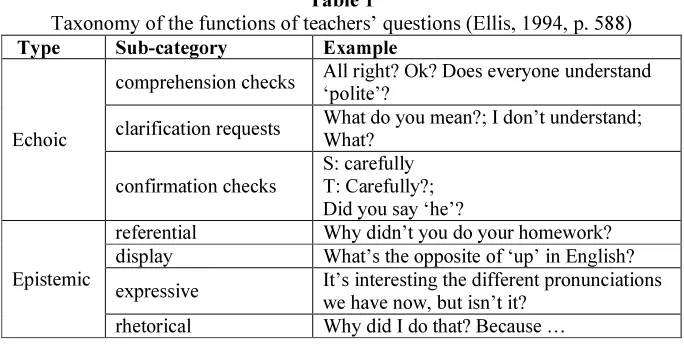
Later, Long and Sato (1983, cited in Ellis, 1994) classified teachers’ questions into two major categories of echoic questions and epistemic questions (Table 1). Echoic questions ask for the repetition of the utterances or the confirmation that they have been understood, while epistemic questions are aimed at acquiring information.
Table 1
Taxonomy of the functions of teachers’ questions (Ellis, 1994, p. 588)
Type Sub-category Example
Echoic
comprehension checks All right? Ok? Does everyone understand ‘polite’?
clarification requests What do you mean?; I don’t understand; What?
confirmation checks
S: carefully T: Carefully?; Did you say ‘he’?
Epistemic
referential Why didn’t you do your homework? display What’s the opposite of ‘up’ in English? expressive It’s interesting the different pronunciations
we have now, but isn’t it? rhetorical Why did I do that? Because …
Research on teachers’ questions reveals that display/closed questions are used more than referential/open questions (Chaudron, 1988; Cullen, 1998; Ho, 2005; Nunan, 1987; Seedhouse, 1996; Tsui, 1985; Walsh, 2006; Yu, 2010). Display questions elicit answers already known by the teacher and are likely to be closed. Referential questions, on the other hand, are genuinely information-seeking and are likely to be open. Chaudron’s review of relevant studies showed that L2 teachers asked proportionately more display questions than referential questions. Similarly, in Yu’s study, the participant teachers used far more display questions in comparison to referential questions.
The extensive use of display/close questions has been criticized by Nunan (1987) and Brock (1986). They argue that display questions do not reflect genuine communication and that they only encourage short, restricted responses while referential questions can encourage larger and syntactically more complex answers. Looking at the issue from sociocultural point of view, Lee (2006), Ho (2005), and Seedhouse (1996) adopt an opposite position and argue that display questions are interactional features of institutional discourse, and what seems to be display type can be used for a very different, genuine function and meaning by the teacher.
The Study
The study, described in the following section, was aimed at investigating the data gathered from a communicative class in relation to the four classroom features elaborated in the preceding section.
Method Participants
This study was conducted over a period of five sessions in an adult EFL classroom in Kish institute in Tehran. The observations took place in a class of 12 adult male elementary language learners with the age range of 20 to 40. They had more or less similar language learning experiences; they had been formally exposed to English during their school years and had completed about 90 hours of instruction at the same institute. In the course of observations, almost all of them expressed that they intended to improve their ability to use English in real-life situations. Both learners and the teacher were Iranian and spoke Persian as their language of communication outside the classroom.
The teacher, who claimed to be well-familiar with communicative language teaching methodology, was an MA graduate in TEFL with eight years of EFL teaching experience to adults. His proficiency profile indicated that he could be categorized as effective operational proficient or advanced user based on the Common European Framework of Reference for Languages. He was told that the study would examine different aspects of classroom interaction, and he expressed his willingness to participate in the study.
Materials
For the purpose of systematic and quantitative evaluation of the data in relation to the classroom features under investigation, an analytical framework (Appendix) was formed and used. The framework consisted of four sections, each dealing with one aspect: teaching exchanges, input characteristics, error treatment, and teachers’ questions. The categorizations included in the framework are not original to the present study. They were taken from Cullen (2002), Chaudron (1988), Ellis (1994), Lyster and Mori (2006), and Lyster and Ranta (1997), with no modifications to their content.
Based on Cullen (2002), teaching exchanges were identified as those exchanges that consisted of three moves of initiation (I), which usually was a question asked
by the teacher, response (R) from the learners, and follow-up (F) or the teacher’s reaction to learners’ responses. The F-move itself was classified into two categories, each representing a different function. These functions were identified as evaluative when the teacher’s response provided feedback about whether the answer was acceptable and as discoursal when the teacher picked up learners’ contributions and incorporated them into the flow of classroom discourse.
Input was investigated for its characteristics using the categories suggested by Chaudron (1988). The teacher’s modifications were, therefore, examined in terms of speech rate, vocabulary, syntax, and discourse, in accordance with the learners’ language proficiency level. These modifications were identified when the teacher used slow rate of speech, limited vocabulary, and simpler syntactic and discoursal structures.
The third section of the framework, which dealt with error treatment, was based on the six-move classification proposed by Lyster and Mori (2006) and Lyster and Ranta (1997). As described earlier, this classification includes explicit correction, recasts, elicitation, metalinguistic clues, clarification requests, and repetition. Additionally, this section also included learners’ uptake (i.e., their utterances and reaction following the feedback provided by the teacher). Both the rate and the type of uptake (repair, needs-repair) were included in the analysis. When uptake resulted in the repair of the initial utterance, it was coded as repair, and when it resulted in an utterance that contained the same or a new error, it was coded as needs-repair.
The fourth section of the framework focused on the types of questions asked by the teacher. This section included a taxonomy developed by Long and Sato (1983, cited in Ellis, 1994). Their taxonomy seems to include most of the question types referred to in the literature (Brock, 1986; Ho, 2005; Nunn, 1999; Seedhouse, 1996). According to Ellis (1994), this taxonomy comprises two general categories of echoic and epistemic questions. Echoic questions include comprehension checks, clarification requests, and confirmation checks. Epistemic questions comprise referential, display, expressive, and rhetorical questions. Echoic questions ask for repetition of an utterance or confirmation that it has been properly understood. They have the function of maintaining interaction by ensuring that interlocutors share the same assumption. Referential questions, on the other hand, serve the purpose of acquiring information. They genuinely seek knowledge. Display
questions check what learners know, whose answers are already known to the teacher (Lee, 2006; Walsh, 2006; Yu, 2010).
Teaching Context
Both the institute officials and the teacher claimed that the course was being taught using communicative language teaching method and that they were attempting to prepare the learners with necessary skills for real world communication. Their position was also reflected in their selection of materials and books for their classes, True to Life series. As Collie and Slater (1995) point out, these series have been designed for adult learners with topics chosen for their relevance to everyday life of adults around the world. The activities have been designed on real-world tasks and provide learners with opportunity to talk about their personal experiences, express their opinions, and exchange ideas.
During the observation stage, the lessons introduced such topics as national festivals, personal celebrations, attitudes to age, and future plans. The activities carried out in class involved both the whole class and small groups. More relevant activities to the focus of the study were free class discussions, small group discussions, pairwork activities, reading comprehension, and expression of personal experiences.
To start a class discussion, the teacher first introduced a topic (e.g., celebrations, future plans) and then asked the learners to express their knowledge and attitudes about it. This activity took the form of question-and-answer in which the teacher asked questions to elicit information about the topic. Class discussions were notably meaning-focused. The learners seemed to be very interested and motivated during the class discussions, although most of their errors went untreated or at most received recasting. In small group discussions, the learners were given some pictures accompanied by some related questions. They were required to exchange ideas about the pictures using the accompanying questions or questions of their own. The teacher was ready to help on request. He provided the learners with feedback whenever there was a notable disagreement among the group members.
Pairwork activities were mostly intended to draw learners’ attention to form. Pair members were asked to write down some sentences or questions (related to the grammar focus of the lesson) and then check their accuracy with each other. In the mean time, the teacher attended to individual pairs, providing help whenever
needed and offering sporadic feedback. In the next phase, the pair members read their sentences to the class. Erroneous utterances were corrected mainly through explicit feedback or sometimes directed to the whole class by the teacher for judgment.
To teach reading comprehension, after a short warm-up in the form of question-and-answer, the teacher asked the learners to read the passage individually, get help from a dictionary or a classmate whenever needed, and answer the questions. This phase was followed by a relatively large number of questions by the teacher, aimed at checking learners’ understanding of the passage. These questions asked about the meanings of vocabulary items as well as the meanings and grammatical structures of the sentences. Finally, learners were asked to read out the passage, and the teacher provided them with some corrections on their pronunciation.
Procedure
Data Collection
The observation took place in five class sessions. In each session, about 45 minutes of the teacher talk was audio taped. At the same time, the class was observed and notes were taken to capture the paralinguistic and contextual features. The recordings included about 4 hours of the teacher talk, making up the database for the present study. The database, along with notes, was used to analyze features of classroom discourse and patterns of interaction.
DataAnalysis
A triangulation method was used to analyze the data. The quantitative evaluation of the data was carried out using the analytical framework. For this purpose, the audio-recordings were transcribed and examined in relation to the four aspects that were included in the four sections of the framework. The main objective here was to provide a description of the data through descriptive statistics. To establish the reliability of the judgments, fifteen percent of the data was randomly selected and analyzed by another expert in the field. The agreement coefficient was found to be 0.87. For the IRF exchanges, different question types, and corrective feedback strategies, frequency counts and percentages were obtained. Modifications to the input were separately determined if the teacher modified his speech concerning the rate of speech, the range and complexity of lexical items, the complexity of the sentences, and the complexity of total discourse. In the qualitative analysis, the
transcriptions were examined to find any examples that could provide additional support for the results of the quantitative phase or to discover any new and non-predetermined patterns in the data. Judgments were not made on the utterances in isolation, but their relation to the total discourse was also taken into account. The note taken by one the researchers during the observations were used as a complimentary source.
Results and Discussion
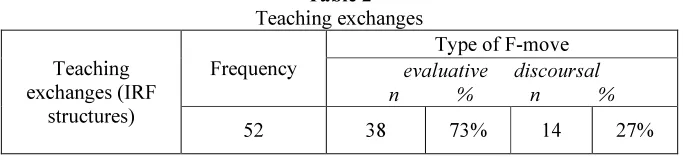
Using the analytic framework, the database was examined for the frequency of IRF exchanges. As illustrated in Table 2, the teacher talk in the database included 52 instances of teaching exchanges with IRF structure. Of these teaching exchanges, 73% contained the F-move with evaluative function. The F-move in Extract 1severs such a function.
Extract 1
T: A small party or big party? S: A big party.
T: A big party, yes.
Table 2 Teaching exchanges
Teaching exchanges (IRF
structures)
Frequency
Type of F-move evaluative discoursal n % n %
52 38 73% 14 27%
Fourteen instances (27%) of the teaching exchanges were identified as containing the F-move with discoursal function (Extract 2), extending learners’ responses to keep the conversation going.
Extract 2
T: What do you know about other celebrations all around the world? S: Halloween Day.
T: Aha, aha, Halloween Day. Yes, mostly in America. What do they do? S: They try to frighten the other people.
T: Aha, aha. Yes, they try to, let’s say, really frighten or scare other people in different ways, yes. They cover some black things on their… .
These findings reflect the teaching patterns adopted by the teacher. Most of these exchanges took place during the last phases of pairwork and reading comprehension activities, for which the teacher allowed relatively more time. The main objectives in these activities were to check the learners’ comprehension and the accuracy of their production. Naturally, these exchanges should take an evaluative rather than discoursal form. One major shortcoming in this regard, however, would be that the excessive use of F-move to evaluate learners’ responses can disrupt the flow of communication. To cater for both accuracy and fluency, it is important for the teacher to maintain a balance between the two functions.
Concerning the characteristics of input, it was found that the teacher simplified his speech in terms of rate, vocabulary, syntax, and discourse (Table 3), supporting the results of studies discussed in Chaudron (1988) and Walsh (2006). The teacher typically talked slowly with sometimes exaggerated intonation. His speech contained a lot of repetitions; that is, he repeated his utterances to make sure that the learners understood him. The range of vocabulary and the syntactic complexity of utterances seemed not to be beyond the learners’ language proficiency level. Given that the teacher was an advanced user, these modifications might reflect his attempts to facilitate learners’ comprehension of the input and his willingness to give them more time to process and better model the target language. In other words, the teacher adapted his speech to the proficiency level of the learners. His concern with the learner comprehension was also reflected in the proportionately large number of display and comprehension-check questions he asked.
Table 3 Input characteristics
Input modification
Speech rate yes no
Vocabulary yes no
Syntax yes no
Discourse yes no
* * * *
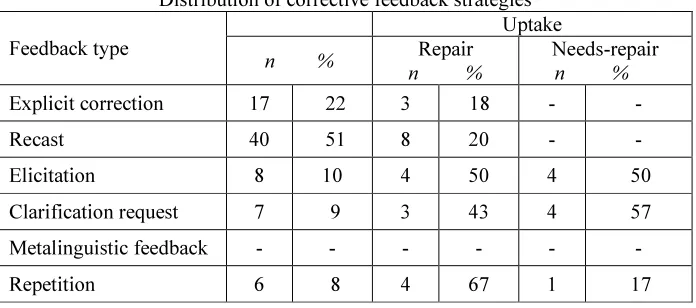
Using Lyster and Ranta (1997) and Lyster and Mori’s (2006) classification, the classroom interaction was analyzed for corrective feedback strategies employed by the teacher and the learner uptake that followed. Table 4 demonstrates the distribution of the corrective feedback strategies and learner uptake in the database. Generally, about 78 of the teacher turns included corrective feedback. In line with the findings of previous research (Lyster, 2004, 2007; Lyster and Mori, 2006),
recasting was found to be the most frequent strategy. It accounted for 51% of all corrective feedback strategies. However, it was found that only 20% of it resulted in learner uptake. In other words, recasting was not very effective in drawing learners’ attention to form, which is usually reflected in the amount of uptake that follows. This, however, does not invalidate the use of recasting. As Lyster (2004) argues, recasting is a valuable tool to move the lesson ahead when the focus is meaning.
Table 4
Distribution of corrective feedback strategies
Feedback type
Uptake
n % Repair n %
Needs-repair n %
Explicit correction 17 22 3 18 - -
Recast 40 51 8 20 - -
Elicitation 8 10 4 50 4 50
Clarification request 7 9 3 43 4 57
Metalinguistic feedback - - - -
Repetition 6 8 4 67 1 17
Explicit correction came next with 22% of all corrective feedback moves. Elicitation (10%), clarification requests (9%), and repetition (8%)) were next respectively. Unlike recasts, elicitation and clarification requests led to learner uptake of both kinds (repair, needs-repair) in all cases, suggesting their effectiveness in promoting learner uptake. Since it requires modification on the part of the learner, uptake can facilitate language acquisition. The assumption derives from Swain’s output hypothesis (Swain, 1985; Swain and Lapkin, 1995), which states that learners should be pushed to modify their output to be more precise, coherent, and appropriate through a variety of techniques such as elicitation and clarification requests.
For effective correction, the teacher should have been more selective and systematic in his use of corrective feedback strategies depending on the type and the purpose of the activity and the learners’ level of language proficiency. Recasts are more likely to be noticed by high ability learners than low ability and may not
draw learners’ attention to form (Lyster, 2007). Nevertheless, elicitation, metalinguistic feedback, clarification requests, and repetition can actively engage learners and enforce self-repair, allowing opportunity for uptake. Furthermore, it was evident from our database that learners’ utterances contained more (almost two times) errors, most of which did not receive any feedback because the teacher seemed to be quite unsystematic in his corrections. In our study, we didn’t address the learners’ reaction and amount of uptake in relation to the type of error (i.e., phonological, lexica, syntactic).
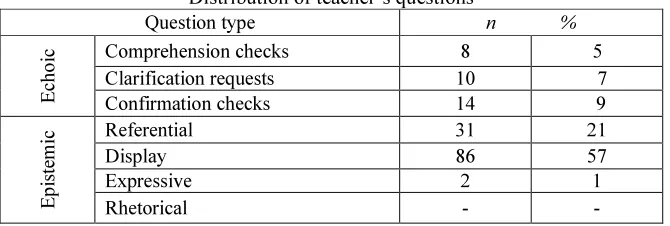
The database was also examined for the proportion of question types based on the classification proposed by Long and Sato (1083, cited in Ellis, 1994). The results were found to be compatible with those of previous studies (Chaudron, 1988; Ho, 2005; Nunan, 1987; Seedhouse, 1996; Walsh, 2006). The teacher talk in the database contained 151 questions. As Table 5 indicates, more than half (57%) of the questions were of the display type, the majority of which were asked during the last phases of reading comprehension and pairwork activities. The referential questions, on the other hand, made up 21% of the total number of questions. In general, the epistemic questions accounted for 79% of all questions. Twenty percent of the questions were identified as echoic through which the teacher asked for the repetition of the utterances or checked whether they were properly understood. The prevalence of display questions in the database apparently implies that the teacher was more anxious about whether the learners understood the materials presented to them or were ready for a specific activity, rather than providing them with opportunity to talk.
Table 5
Distribution of teacher’s questions
Question type n %
E
cho
ic Comprehension checks 8 5
Clarification requests 10 7
Confirmation checks 14 9
E
p
is
te
m
ic Referential 31 21
Display 86 57
Expressive 2 1
Rhetorical - -
Qualitative analysis of display and referential questions revealed that they affected classroom interaction differently. Display questions (Extract 3) were more like to be closed, allowing learners to give only one acceptable answer. Despite the fact that they do serve communicative function (Ho, 2005; Seedhouse, 1996), they could not encourage larger stretches of responses. Referential questions (Extract 4) on the other hand, served the purpose of acquiring information and were more like to open, providing learners with opportunities for longer turns. They potentially are a valuable tool in increasing the amount of speech of the learners.
Extract 3
T: Adjectives describe what? S: Nouns.
T: Nouns, yes. Good. Extract 4
T: What is your idea about picture C? S: Celebration Barmaske1.
T: So what do they do?
S: Women and men wear mask on their face and they dancing together.
One additional important point should be mentioned about referential questions. They certainly have the capacity to induce longer stretches of responses, but teacher’s behavior can affect this capacity. As indicated in Extract 5, the teacher sometimes interrupted learners’ responses when they were answering referential questions and denied them the opportunity to produce longer turns.
Extract 5
T: What do we do on Chaharshanbe Souri2?
S: We make a fire and jump. (Teacher’s intervention)
T: Aha, yes, you jump over the fire, ok, and then you play a lot of fire games, you have.
S: Dancing. (Teacher’s intervention)
T: Oh, yes, that’s important. Yes, you do a lot of dancing. I mean you.
The example above suggests that in some cases it is the teacher’s behavior not the type of question that affects the nature of teacher-students interaction.
Conclusion
The approach adopted in the present study was mainly analytic and descriptive in nature. We studied a communicative EFL class in Iranian context. The findings are
illuminating in that they provide us with an understanding of a typical communicative class and an opportunity to examine the extent to which classroom features and processes may promote L2 acquisition. In relation to IRF exchanges, the findings reveal that most of the F-moves employed by the teacher assumed evaluative function rather than discoursal function, suggesting that the teacher was more inclined to check whether learners understood the input or whether their utterances were accurate. Furthermore, the results indicate that corrective feedback strategies are different in their promotion of learner engagement and learner-generated uptake. Recasts and explicit correction were very common but failed to promote higher rates of uptake, which is seen as an indication of learner engagement in the leaning process. Unbalanced use of F-moves and feedback strategies suggests that the teacher was quite unsystematic in relation to these areas. In his attempts to promote both accuracy and fluency, the teacher was not found to be systematic and selective in the use of appropriate techniques. In relation to teachers’ questions, it was found that display questions comprised about two third of all question types, but they were not successful to promote longer stretches of production. However, this does not invalidate their use. As mentioned earlier, display questions can prove useful in focusing learners’ attention on form and establishing foundations for further activities.
Notes on Contributors:
Parviz Maftoon is associate professor of teaching English at Islamic Azad University, Science and Research Branch, Tehran, Iran. He received his Ph.D. degree from New York University in TESOL. His primary research interests concern second language acquisition, SL/FL language teaching methodology, and language syllabus design. He has published locally and internationally and edited a number of research articles and books. He is currently on the editorial board of
some language journals in Iran.
Ghafour Rezaie holds a Ph.D.in Teaching English as a Foreign Language (TEFL) and is a faculty member at Islamic Azad University, Garmsar Branch, Garmsar, Iran. His main research interests include cognitive aspects of second language acquisition, research in applied linguistics, and language assessment.
Notes 1
Barmaske was a word that the student apparently coined to describe a picture that depicted the ‘Day of the Dead’ festival celebrated in Mexico.
2
Chaharshanbe Souri is an Iranian festival celebrated on the last Tuesday night of the year.
References
Breen, M. P. (1985). Authenticity in the language classroom. Applied Linguistics, 6, 60-70.
Brock, C. A. (1986). The effects of referential questions on ESL classroom discourse. TESOL Quarterly, 20, 46-58.
Chaudron, C. (1988). Second language classrooms: Research on teaching and learning. Cambridge: Cambridge University Press.
Collie, J., & Slater, S. (1995). True to life: Elementary. Cambridge: Cambridge University Press.
Cullen, R. (1998). Teacher talk and the classroom context. ELT Journal, 52, 179-187.
Cullen, R. (2002). Supportive teacher talk: The importance of the F-move. ELT Journal, 56, 117-127.
Ellis, R. (1990). Instructed second language acquisition. Oxford: Blackwell. Ellis, R. (1994). The study of second language acquisition. Oxford: Oxford
University Press.
Ellis, R. (1995). Modified input and the acquisition of word meanings. Applied Linguistics, 16, 409-441.
Ellis, R. (2005). Instructed second language acquisition: A literature review.
Wellington: Ministry of Education. Retrieved from
http://www.educationcounts.edcentre.govt.nz/publications/downloads/instruct ed- second-language.pdf.
Ellis, R., He, X. (1999). The roles of modified input and output in the incidental acquisition of word meaning. Studies in Second Language Acquisition, 21, 285- 301.
Gass, S. M. (1997). Input, interaction, and the second language learner. Mahwah, New Jersey: Lawrence Elbraum Associates.
Ho, D. G. E. (2005). Why do teachers ask the questions they ask? RELC Journal, 36, 297- 310.
Johnson, K. E. (1995). Understanding communication in second language classrooms. Cambridge: Cambridge University Press.
Krashen, S. D. (1987). Principles and practice in second language acquisition. Englewood Cliffs, NJ: Prentice-Hall International.
Lee, Y. (2006). Respecifying display questions: Interactional resources for language teaching. TESOL Quarterly, 40, 691-713.
Long, M. H. (1991). Focus on form: A design feature in language teaching methodology. In K. de Bot, R. B. Ginsberg, & C. Kramsch, (Eds.), Foreign language research in cross-cultural perspective (pp. 39-52). Amsterdam: John Benjamins.
Long, M. (1996). The role of the linguistic environment in second language acquisition. In W. Ritchie & T. Bhatia (Eds.), Handbook of second language acquisition (pp. 413- 468). San Diego: Academic Press.
Lyster, R. (2004). Differential effects of prompts and recasts in form-focused instruction. Studies in Second Language Acquisition, 26, 399-432.
Lyster, R. (2007). Learning and teaching languages through content: A counterbalanced approach. Amsterdam: John Benjamins.
Lyster, R., & Mori, H. (2006). Interactional feedback and instructional counterbalance. Studies in Second Language Acquisition, 28, 269-300.
Lyster, R., & Ranta, L. (1997). Corrective feedback and learner uptake: Negotiation of form in communicative classrooms. Studies in Second Language Acquisition, 20, 37- 66.
Markee, N., & Kasper, G. (2004). Classroom talks: An introduction. Modern Language Journal, 88, 492-500.
Moser, J., Harris, J., & Carle, J. (2012). Improving teacher talk through a task-based approach. ELT Journal, 66, 81-88.
Nunan, D. (1987). Communicative language teaching: Making it work. ELT Journal, 41, 136-145.
Nunn, R. (1999). The purposes of language teachers’ questions. IRAL, 37, 23-42. Rymes, B. (2009). Classroom discourse analysis: A tool for critical reflection.
Cresskill, NJ: Hampton Press.
Schmidt, R. (1990). The role of consciousness in second language learning. Applied Linguistics, 11, 129-158.
Schmidt, R. (1995). Consciousness and foreign language learning: A tutorial on the role of attention and awareness in learning. In R. Schmidt (Ed.), Attention and awareness in foreign language learning (pp. 1-65). Honolulu: University of Hawaii Press.
Seedhouse, P. (1996). Classroom interaction: Possibilities and impossibilities. ELT Journal, 50, 16-24.
Seedhouse, P. (1997). The case of the missing “no”: The relationship between pedagogy and interaction. Language Learning, 47, 547-583.
Spada, P. M. (1994). Classroom interaction analysis. TESOL Quarterly, 2, 685-688.
Swain, M. (1985). Communicative competence: Some roles of comprehensible input and comprehensible output in its development. In S. Gass & C. Madden (Eds.), Input in second language acquisition (pp. 235-256). New York: Newbury House.
Swain, M., & Lapkin, S. (1995). Problems in output and the cognitive processes they generate: A step toward second language learning. Applied Linguistics, 16, 371-391.
Taylor, D. (1994). Inauthentic authenticity or authentic inauthenticity? TESL-EJ, 1. Retrieved from http://www-writing.berkeley.edu/TESL-EJ/ej02/a.1.html Truscott, J. (1996). The case against grammar correction in L2 writing classes.
Language Learning, 46, 327–369.
Tsui, A. B. M. (1985). Analyzing input and interaction in second language classrooms. RELC Journal, 16, 8-30.
van Lier, L. (1996). Interaction in the language curriculum: Awareness, autonomy, and authenticity. London: Longman.
Walsh, S. (2002). Construction or obstruction: Teacher talk and learner involvement in the EFL classroom. Language Teaching Research, 6, 3-23. Walsh, S. (2006). Investigating classroom discourse. London: Routledge.
Widdowson, H. (1990). Aspects of language teaching. Oxford: Oxford University Press.
Wolf, M. K., Crosson, A. C., & Resnick, L. B. (2005). Classroom talk for rigorous reading comprehension instruction. Reading Psychology, 26, 27-53.
Yu, W. (2010). An analysis of college English classroom questioning. Journal of Language Teaching and Research, 1, 136-144.
Appendix
The Framework for Analyzing Features of Classroom Discourse Teaching exchanges
Teaching exchanges (IRF structures)
Frequency
Type of F-move evaluative discoursal n % n %
Input characteristics
Input modification
Speech rate yes no
Vocabulary yes no
Syntax yes no
Discourse yes no
Distribution of corrective feedback strategies
Feedback type
Uptake
n % Repair n %
Needs-repair n % Explicit correction
Recast
Elicitation
Clarification request
Metalinguistic feedback
Repetition
Distribution of teacher’s questions
Question type n %
E
ch
o
ic Comprehension checks
Clarification requests Confirmation checks
E
p
is
te
m
ic Referential
Display Expressive Rhetorical