37
Reactive Power Control and Voltage Profile Improvement with Distributed
Generation and Statcom
Sushila Sahu
1, Chitra Thakur
2 M. Tech Scholar1, Assistant Prof.2Department of Electrical and Electronics 1, 2
Technocrats’ Institute of Technology and Science 1, 2 1[email protected], 2[email protected]
Abstract: - Power requirement is the most necessary
requirement of the modern high power advanced technology. To fulfil this increased demand of power requirement, a new technology has been developed which is known as the Distributed Generation (DG). It uses renewable energy sources for the generation of electric power with little impact on the environment of the surrounding area at its site of construction, economical production, less exclusion of toxic sea wastes etc. however it also has some disadvantages. In this study, IEEE-14 bus network, the impact of connecting DG to the Distribution Network (DN) was studied. The simulation results shown indicate disturbances in the power system with the integration of distributed generation.
Keywords: - Distributed Generation, Distribution network, non-renewable energy sources, renewable energy sources etc.
I. INTRODUCTION
A Distributed Generation is a new technology which is becoming an important area of research and study nowadays. A Distributed Generation can be defined as a technology which is based on the use of renewable energy sources viz. solar energy, biomass energy, geothermal energy, tidal energy etc. A Distributed Generation as compared to the traditional method of power generation has several advantages like – it occupies less area of installation, economical, flexible and environment friendly technology. Various authors defined distributed
generation (DG) as follows: The Electric Power Research Institute defines distributed generation as generation from ‘a few kilowatts up to 50 MW’ [7]. According to the Gas Research Institute, distributed generation is ‘typically between 2 and 25 MW’ [7]. Cardell defines distributed generation as generation ‘between 500 kW and 1MW’ [1]. The International Conference on Large High Voltage Electric Systems (CIGRE) defines DG as ‘smaller than 50
-100 MW’ [7]. Besides having several advantages, a DG can
38
II. METHODOLOGY
The proposed methodology was implemented using PSAT 2.1.7 simulation software. An IEEE-14 bus network with and without DG connection shown in Figure 1 and Figure 2 respectively.
2.1 Size and Location of Distributed Generation
The placement of distributed generation in a distribution system improved the voltage profile with reduced losses. However, placing DG only at optimal location is not sufficient wherein the size of the DG should also be determined for its efficient working. Wind based distributed generation of 50MVA and 11kV had been connected under the study. Authors of [3] suggested the method for finding the weakest node for the optimal location of DG in any grid connected network. The weakest node may be traced out by searching of the maximum voltage drop i.e. the bus with the smallest voltage magnitude is the weakest bus.
2.2
Benefits of Distributed GenerationIn spite of the several technical and economic impacts of the distributed generation systems, there are so many reasons to promote these distributed generation installations which may include the following main points: Reduction of greenhouse gas emissions, Grid support, Reduces the cost as there is no use of long transmission line , Environment friendly, Avoid the impact of massive grid failure. Better power quality and reliability. Independence from imported fuels Present Higher security of supply Promotion of development of certain technology, Establishment of new industries with additional employment The weakest bus was observed in the bus no. 14, 13, and 12 whereas bus no. 14 being the weakest bus and the most suited location for the installation of DG. The engineers may also advise to install the DGs’ at bus no. 12 and 13 as and when required.
2.3. Importance of FACTS Devises
The FACTS devices provides a fast and reliable control over transmission parameters, like voltage, line impedance and phase angle between the sending end and receiving end voltage. On the other hand the custom power device is used for low voltage distribution and improves the power quality due to which the system becomes reliable. A D-STATCOM is a VSI fed power electronic device which is connected in shunt to the network to mitigate the harmonics and other power quality problems. The performance of the D-STATCOM depends on different control algorithms which are used for extraction of reference currents and to provide pulses to the gate terminals of the VSI.
Fig-1: IEEE-14 bus network without DG connection
39
A literature review has been performed on different types of studies over D-STATCOM. The D-STATCOM is highly effective in providing load voltage regulation; however, maintaining load voltage at rated value has several unwanted effects from customer point of view. With voltage of 1p.u. at load point, D-STATCOM forces load to operate always at rated power. The STATCOM used in distribution systems is called D-STATCOM (Distribution-STATCOM). It can exchange both active and reactive power with the distribution system by varying the amplitude and phase angle of the converter voltage with respect to the line terminal voltage.
Fig-3: IEEE-14 bus network with DG and STATCOM connection
III. RESULT AND DISCUSSION
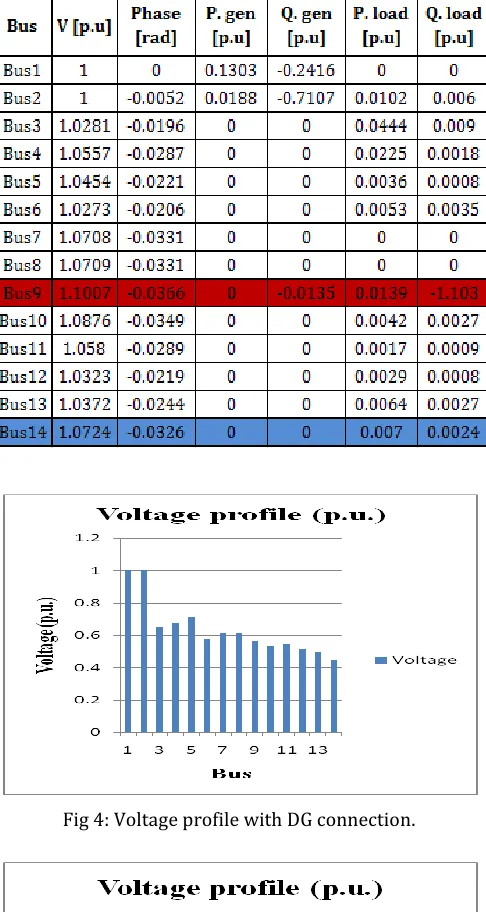
Comparison of the simulation results obtained with and without DG connection shows an improvement in the reactive power loss from 5.3766 p.u. to 5.3438 p.u. if the DG was connected at the optimal location (Table-1 and Table-2) respectively. The variation in the voltage profile of the network with and without DG connection was shown (Fig-3 and Fig-4) respectively.
Table-1: Reactive power at electricity generation and load without DG connection
Table-2: Reactive power at electricity generation and load with DG connection
40
Fig 4: Voltage profile with DG connection.
Fig-5: Voltage profile without DG connection
Fig-6: Voltage profile with DG and STATCOM connection
Table 4: Power Flow Comparison Result
IV. CONCLUSIONS
From the above study, it has been concluded that the distributed generation has several advantages like - it is eco-friendly, economical, uses renewable sources of energy, no toxic by-products etc. However, it also disturbs the voltage profile of the network if not connected at the optimal location. Under the study, the optimal location of the DG has been found by the study of the weakest bus and bus no. 14 was found to be the weakest. Integrating DG into the DN also decreases the stability of the connected grid network and thereby increasing the reactive power loss.
REFERENCES
[1]. Caples Donal, Boljevic Sreto, and F. Conlon Michael, “Impact of Distributed Generation on Voltage Profile in
38kV Distribution System”, Proc. 8th International
41
[2]. Acharya Naresh, Mahat Pukar, and Mithulananthan N., “An analytical approach for DG allocation in primary distribution network”, ELSEVIER Electrical Power and Energy Syst., vol. 28, pp. 669-678, 2006.
[3]. ajaram S. P., Rajasekaran V., and Sivakumar V., “Optimal Placement of Distributed Generation for Voltage Stability Improvement and Loss Reduction in Distribution Network”, International Journal of Innovative Research in Science Engineering and Technology, vol. 3, no. 3, pp.529-543, 2014.
[4]. Pecas Lopes J. A., Hatziargyriou N., Mutale J., Djapic P., and Jenkins N., “Integrating Distributed Generation into electric power systems: A review of drivers, challenges and opportunities”, ELSEVIER Electric Power System Research, vol. 77, pp. 1189-1203, 2006.
[5]. Banerjee Rangan, “Comparison of options for
distributed generation in India”, ELSEVIER Energy
Policy, vol. 34, pp. 101-111, 2004.
[6]. El-Khattam Walid, Hegazy Y. G., and Salama M. M. A.,
“Investigating Distributed Generation Systems
Performance Using Monte Carlo Simulation”, IEEE Transaction on Power System, vol. 21, no. 2, pp.524-532, 2006.
[7]. Ackermann Thomas, Andersson Goran, and Soder Lennart, “Distributed Generation: a definition”, ELSEVIER Electric Power Systems Research, vol. 57, pp.195-204, 2000.
[8]. Gandomkar M., and Shooshtary P., “A Genetic Based Tabu Search Algorithm to Distribution Network Expansion Planning with Distributed Generation”, IEEE 2011.
[9]. B. Hussain, S.M. Sharkh, and S. Hussain, “Impact Studies of Distributed Generation on Power Quality and Protection setup of an Existing Distribution Network”, School of Engineering Sciences, University of Southampton, SO17 1BX, UK, 2010.
[10]. S. K. Khadem, M. Basu and M.F. Conlon, “Power Quality in Grid Connected Renewable Energy Systems: Role
of Custom Power Devices, “International Conference on Renewable Energies and Power Quality - ICREPQ’2010, EA4EPQ, Granada (Spain), 23rd to 25th
March 2010.
[11]. Umar Naseem Khan, “Distributed Generation and
Power Quality,” 8th International Conference on
Environment and Electrical Engineering, 2009.
[12]. Calderaro, V., Milanovic, J. V., Kayikci, M. and Piccolo, A., 'The impact of distributed synchronous generators on quality of electricity supply and transient stability of real distribution network,” The Electric Power Systems Research, vol. 79, no. 1,, pp. 134–143, 2009.
[13]. S. M. Moghaddas-Tafreshi, and E. Mashhour,
“Distributed generation modelling for power flow
studies and a three-phase unbalanced power flow solution for radial distribution systems considering
distributed generation,” Electric Power Systems