346
Security against Attacks in Wireless Sensor Network: A Survey
Sonali Mahaver1, Prof. Kamlesh Chandravanshi2 Department of Computer Science and Engineering
TIT, R.G.P.V., Bhopal, M.P., India
1[email protected], 2[email protected]
Abstract— Wireless sensor Networks (WSN) secure routing is extremely necessary to the acceptance and use of for several applications. Security is another distinctive characteristic of WSN and it's an elementary concern so as to produce protected and attested communication between sensing element nodes in mission crucial applications, like military or attention. However, providing secure routing in WSNs may be a difficult task because of the inherently strained abilities of sensing element called nodes. Though a large type of routing protocols are proposed for WSNs, most don't take security under consideration as a main goal. Routing attacks will have distressing effects on WSN and gift a significant challenge once planning strong security mechanisms for WSN. During this paper, we tend to examine a number of the foremost common routing attacks and security schemes in WSN. It's advised that a number of the ways that to approach this made field of analysis issues in WSNs might be to fastidiously design new routing protocols within which attacks are often rendered meaningless and because of the inherent constraints found in WSN, there's a desire for light-weight and sturdy security mechanisms. The vampire attack is one of the dangerous attacks in network and we also considered many of the attacks in WSN and also the some latest work in field of security is mention. The examination of the routing attack and a few of the proposed countermeasures makes it evident that it's very tough to retrofit existing protocols with defenses against routing attacks.
Keywords— WSN, Security, Attack, Routing, Survey.
I.INTRODUCTION
Wireless sensor Networks (WSNs) incorporates spatially distributed autonomous little devices that hand and glove monitor environmental or physical conditions in remote and infrequently hostile environments. Because of recent technological advances, the producing of little and low price sensors became technically and economically possible. The sensing natural philosophy live close conditions associated with the setting close the sensing element and transform them into an electrical signal. Process such a signal reveals some properties regarding objects situated and/or events happening within the vicinity of the sensing element. An outsized range of those disposable sensors are often networked in several applications that need unattended operations. A Wireless sensing element Network (WSN) contains tons of or thousands of those sensing element nodes. These sensors have the flexibility to communicate among each other or to external base-station (BS). A larger range of sensors permits for sensing over larger geographical regions with more accuracy. Wireless sensing element Networks (WSN) [1] consists of various little sensors deployed at high density in regions requiring surveillance and observance. The sensing elements are deployed at a price abundant below the normal wired sensor system. An oversized range of sensors deployed can modify for correct measurements. A sensing element Node consists of one or more sensing components (motion, temperature, pressure, etc.), a
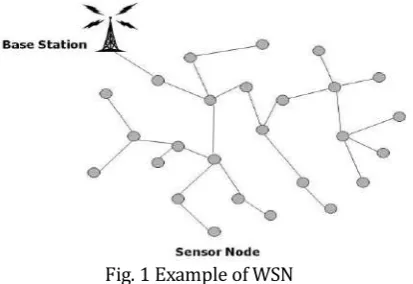
battery, and low power radio trans-receiver, silicon chip and restricted memory, mobilize (optional), a position finding system. A very important side of such networks is that the nodes are unattended, have restricted energy and therefore the constellation is unknown. Several style challenges that arise in sensing element networks area unit because of the restricted resources they need and their deployment in hostile environments. A Wireless sensing element Network (WSN) may be a specific sort of Ad hoc network. The taking part nodes are sensible sensors that are sensing the neighbors, equipped with advanced sensing functionalities (thermal, pressure, acoustic, etc), a little processor, and a short-range wireless transceiver [2]. The nodes switch over information so as to make a world read of the monitored region Figure 1. This information is usually created accessible to the user through one or more gateway nodes [3].
Fig. 1 Example of WSN
Sensor nodes communication architecture of a WSN and graphic representation of sensor node components represents in figure 1. Basically, the sensor nodes having comprise sensing, processing, communication, mobilizes, location finding system, and power units (some of these components are optional like the mobilizes). The identical figure shows the communication design of a WSN. sensing element nodes area unit sometimes scattered in a very sensing element field, that is an area unit, a neighborhood, a district, a region, a locality, a vicinity, a part and a section wherever the sensing element nodes are deployed. Sensing nodes coordinate among themselves to provide high class info regarding the physical setting. Every node bases its selections on its operation, the data it presently has, and its information of its neighbors.
II.CHARACTERISTICS OF WIRELESS SENSOR NETWORKS
The characteristics of sensor networks and application necessities have a decisive impact on the network style objectives in term of network capabilities and network performance [4].
2.1 Network Characteristics
347 comparable to wireless sensing element networks have the subsequent distinctive characteristics and constraints:-
Densely deployment: Sometimes Sensor nodes are densely deployed and might be many orders of magnitude on top of that in a SANET. The densely deployed network is reliable but required more resources and constraint.
Battery-powered sensing element nodes: The battery power is consumed for every activity done by sensor. Sensors are unit sometimes hopped up by battery and are deployed during a callous setting wherever it's very sturdy to alter or recharge the batteries.
Strict energy utilization, calculation, and storage
constraints: the battery utilization based
communication is the critical task in sensor network. Sensors have extremely restricted energy, computation, and storage capabilities.
Self-configurable: Sensors are independently
communicated with each other. Sensing nodes are sometimes arbitrarily deployed and separately section themselves into a communication network.
Unreliable sensor nodes: the sensors are unreliable in term of communication. If the node is participating in routing then they’re out of range is break the communication and second is energy depletion. Since sensing element nodes are at risk of physical damages or failures because of its readying in harsh or hostile setting.
Data redundancy: The sensor nodes in network collect huge amount of data and the nodes possible to deliver data same information that will to already evaluate. Thus, the data detected by multiple sensing element nodes usually have a particular level of correlation or redundancy.
Application specific: A sensors in network is typically designed and deployed for a particular application or a multiple tasks. The planning necessities of sensors in network modified with its application. The each sensor node energy time collect the information and complete their task.
Many-to-one communication manner: The collected by sensor nodes must be possible to deliver through the single sensor due to not identified the another sensor in range. In most sensor network applications, the data detected by sensing element nodes be due multiple supply sensor nodes to a selected single sink, exhibiting a many-to-one manner.
Frequent topology change: The sensor network is dynamic that means the topology changes frequently because of the node failures, damage, addition, energy depletion, or channel fading.
III.WSNDESIGN OBJECTIVES
Sensor networks area unit application specific and have completely different application necessities. Thus, all or a part of the subsequent main style objectives is considered within the style of sensor networks:
Small node size: Since sensor nodes area unit sometimes deployed in a very harsh or hostile setting in massive numbers, reducing node size can facilitate node readying. it'll additionally cut back the facility consumption and price of sensing element nodes.
Cheap node cost: The sensor nodes are deployed in a very insensitive or unfriendly environment in massive numbers and can't be reused; reducing price of sensing element nodes is vital and can result into the value reduction of whole network.
Power consumption: the sensor nodes in a network are completely battery dependent. Since sensor nodes are not possible to work without it and it's typically very sturdy or maybe not possible to charge or recharge their batteries, it's crucial to reduce the facility consumption of sensing element nodes so the period of time of the sensing element nodes, still because the whole network is prolonged.
Scalability: The quantity sensing nodes in sensor networks are within the order of tens, hundreds, or thousands, network protocols designed for sensing element networks ought to be scalable to completely different network sizes.
Reliability: Network protocols designed for sensing element networks should give error management and correction mechanisms to confirm reliable information delivery over yelling, erring, and time-varying wireless channels.
Self-configurability: In this kind of network networks, once deployed, sensing element nodes ought to be ready to autonomously organize themselves into a communication network and reconfigure their property within the event of topology changes and node failures.
Adaptability: In sensing element networks, a node might fail, join, or move, which might end in changes in node density and constellation. Thus, network protocols designed for sensing element networks ought to be adaptive to such density and topology changes.
Channel utilization: The channel utilization by
multiple nodes sensing element networks have restricted information measure resources, communication protocols designed for sensing element networks ought to expeditiously build use of the bandwidth to enhance channel utilization.
Fault tolerance: Sensor nodes are at risk of failures because of harsh readying environments and unattended operations. Thus, sensing element nodes ought to be fault tolerant and have the talents of self testing, calibrating, repairing, and self-recovering.
Security: A sensor network ought to introduce effective security mechanisms to forestall {the data|the info|the info} information within the network or a sensing element node from unauthorized access or malicious attacks.
Quos: In sensor networks, the different applications might be required different quality-of-service (QoS) necessities in terms of delivery latency and packet loss. Thus, network protocol style ought to think about the QoS necessities of specific applications.
IV.WSNCHALLENGES AND ROUTING ISSUES
348 Limited Energy Capacity: Since detector nodes area unit battery high-powered, they need restricted energy capability. Energy pretenses an enormous challenge for network designers in hostile environments, for example, a battlefield, wherever it is not possible to access the sensors and recharge their batteries. Moreover, once the energy of a detector reaches a definite threshold, the sensor can become faulty and cannot be able to operate properly, which can have a significant impact on the network performance. Thus, routing protocols designed for sensors ought to be as energy economical as doable to increase their period of time, and therefore prolong the network period of time whereas guaranteeing sensible performance overall.
Sensor locations: Another challenge that faces the design of routing protocols is to manage the locations of the sensors. Most of the likely protocols assume that the sensors either are equipped with international positioning system (GPS) receivers or use some localization technique [7] to learn about their locations.
Limited Hardware Resources: Additionally to restricted energy capability, sensor nodes have conjointly restricted process and storage capacities, and thus will only perform restricted procedure functionalities. These hardware constraints gift several challenges in computer code development and network protocol style for detector networks, that should contemplate not solely the energy constraint in sensor nodes, however conjointly the process and storage capacities of detector nodes.
Massive and Random Node Readying: sensor node deployment in WSNs is application dependent and may be either manual or random that finally affects the performance of the routing protocol. In most applications, sensor nodes is scattered arbitrarily in an intended space or a massively over inaccessible or hostile region. If the resultant distribution of nodes isn't uniform, best clustering becomes necessary to permit property and modify energy efficient network operation.
Network Characteristics and Unreliable
Ambiance: A sensor network sometimes operates in a very dynamic and unreliable environment. The topology of a network, that is outlined by the sensors and therefore the communication links between the sensors, changes topology owing to detector addition, deletion, node failures, damages, or energy depletion. Also, the detector nodes area unit connected by a wireless medium, that is hissing, error prone, and time variable. Therefore, routing ways ought to contemplate constellation dynamics owing to restricted energy and detector quality also as increasing the dimensions of the network to keep up specific application necessities in terms of coverage and property.
Data Aggregation: Since in network nodes might generate important redundant knowledge, a similar packet from multiple nodes is collective in order that the quantity of transmissions is reduced. Data aggregation technique has been accustomed come through energy potency and data transfer improvement in a very range of routing protocols.
Diverse sensing application requirements: Sensor networks have a wide range of various applications. No network protocol will meet the necessities of all applications. Therefore, the routing protocols ought to assurance data delivery and its accuracy in order that the sink will gather the desired data concerning the physical phenomenon on time.
Scalability: Routing protocols ought to be able to scale with the network size. Also, sensors might not essentially have equivalent capabilities in terms of energy, processing, sensing, and significantly communication. Hence, communication links between sensors might not be radial, that is, a try of sensors might not be able to have communication in each direction. This could be taken care of within the routing protocols.
V.ROUTING PROTOCOLS IN WSN
Routing in wireless sensor network (WSN) differs from conformist routing in fixed networks in various ways. The sensor node done routing without any fixed infrastructure, wireless links are unreliable, sensor nodes possibly will fail, and routing protocols have to congregate stringent resources requirements [8, 9, 10]. Routing paths can be established in one of three ways, namely proactive, reactive or hybrid..
A. Proactive (table-driven) Routing Protocol
The proactive routing protocol is the table driven protocol to managing the table of route information in network. The proactive routing protocol are showing the better performance in fixed or stationary network because the routing table updating is not possible their but in dynamic sensor network the routing information is changes by that the overhead in network is more. The most well-known types of the proactive routing protocol are: - Destination sequenced distance vector (DSDV) routing protocol
B.Reactive (on-demand) Routing Protocol
The reactive routing protocols re maintaining the connection in a On demand manner means if required then established connection. The routing protocol are flooded the route request and if the destination found data delivery is started but after the completion of routing procedure including data sending route information is completely destroyed in from nodes that has participating in routing. The Ad hoc on-demand distance vector (AODV) and Dynamic source routing (DSR) protocol is the example of that kind of routing C.Hybrid Routing Protocol
349
VI.SECURITYTHREATS IN WSN
It defines the intrusion as any set of actions that are attempting to compromise the main components of the security system. (1) The integrity, (2) Confidentiality or availability of a resource. In the same work, the intruder therefore was defined as an individual or group of individuals who take the action in the intrusion. The plainness of many routing protocols for wireless sensor networks makes them an easy target for the attacks. The [12, 13, 14] are classifies the routing attacks into the following categories;
Spoofed, Altered, or Replayed Routing Information While sending the data, the information in transition may be spoofed, altered, replayed, or destroyed. Due to the short range transmission of the sensor nodes, an attacker with high processing power and larger communication range could attack several sensors simultaneously and modify the transmitted information.
Selective Forwarding: - In this kind of attack a
malicious node may decline to forward every message it gets, acting as black hole or it can forward some messages to the wrong receiver and simply drop others. Sinkhole Attacks: - In the Sinkhole attack, the goal of the attacker is to attract all the traffic. Especially, in the case of a flooding based protocol the compromised node may listen to requests for routes, and then reply to the requesting node with messages containing a bogus route with the shortest path to the requested destination.
Sybil Attacks: - In Sybil attack the malicious node presents itself as multiple nodes. The attack of this type tries to degrade the usage and the efficiency of the distributed algorithms that are used. Sybil attack can be performed against distributed storage, routing, data aggregation, voting, fair resource allocation, and misbehavior detection [11].
Wormholes: - Wormhole attack [12] is an attack in which the malicious node tunnels messages from one part of the network over a link, that doesn’t exist normally, to another part of the network. The simplest form of the wormhole attack is to convince two nodes that they are neighbors. This attack would likely be used in combination with selective forwarding or eavesdropping.
HELLO Flood Attacks: - This attack is based on the use by many protocols of broadcasting Hello messages to announce themselves in the network. So an attacker with higher range of transmission may send many Hello messages to a large number of nodes in a big area of the network. These nodes are then convinced that the attacker is their neighbor. Consequently the network is left in a state of confusion.
Acknowledgement: - Some wireless sensor network
routing algorithms require link layer acknowledgements. A compromised node may exploit this by spoofing these acknowledgements, thus convincing the sender that a weak link is strong or a dead sensor is alive.
Vampire Attack: - A particularly destructive attack is the Vampire attack, where a malicious node forces legitimate nodes to waste their energy by resisting the sensor nodes from going into low power sleep mode.
The goal of this attack is to maximize the power consumption of the target node, thereby decreasing its battery life. So, it is also known as battery exhaustion attack. A Vampire attack [15, 16] in sensor networks and networks in general is defined as any event that eliminates the network’s capacity to perform its desired function. Attacker tries to exhaust the resources available to the victim node, by transmitting additional unwanted packets and thus prevent legitimate sensor network users from tapping work or resources to which these nodes are deployed. Vampire attack is means that not only for the adversary’s attempt to subvert, disrupt, or destroy a sensor network, but also for any event that diminishes a sensor network’s capability to provide a service. In network any node as normal node or week node in the radio range on attacker node agree with communication through attacker node by reply the request of attacker, so that probing packet receive by the attack node and infect through infection, after infection this infected node launch the Vampire attack
VII.SECURITY SCHEMES IN WSN
350 sensors being considered as compromised. In [18] Malicious node detection in WSN presents a solution to identify the possible malicious node based on the received signal strength measured in each node. They showed how to detect two kinds of attacks called HELLO flood attack and the wormhole attack in WSN by building a rule that compare the energy of the received signal and the energy of the same observed signal around the network. Although, this solution was one of the first solutions in the domain, it still restricted to those two types of attacks. In addition, sometimes there are other reasons rather than attacks that may cause a change in the signal strength which make this solution impractical. A novel intrusion detection scheme [19] that takes the benefits of neighboring node information to detect the node impersonation and resource depletion attacks has been proposed. In this scheme each node can make a statistical profile of its neighbor’s behavior based on two features which are the received power rate and the arrival packet rate. This scheme cannot to be generalized for a typical wireless sensor network application in which many types of attacks evolve continuously. In addition and similar to the scheme proposed in [20], the building of the rules based on the received power rate is impractical since there are other factors that may affect this feature. Towards intrusion detection in [20] introduce a lightweight scheme for detecting selective forwarding and black hole attacks in WSN. The key idea of their scheme is to make nodes monitor their neighborhood and then communicate between each other to decide if there is an intrusion taken place. The scheme is further evaluated experimentally on a real WSN deployment. This scheme benefits from the neighbors monitoring so that there is a kind of distribution that will minimize the computation load on a detection agent node. However, there will be an increase in the communication messages between nodes during the collaboration for voting that will increase the communication overhead and as a result will deplete the power of nodes quickly. It is clear that, this scheme lacks the generality that other schemes in the same category. Intrusion detection scheme of sinkhole attack in WSN is a more specific intrusion detection scheme to detect sinkhole attack was proposed by [21]. This scheme is composed of four modules: Local Packet Monitoring Module, Local Detection Engine Module, Cooperative Detection Engine and Local Response Model. The proposed scheme has been implemented in the TinyOS environment with MinRoute protocol. A suitable detection rules have been prepared to suite with the sinkhole attack. Generally, this scheme satisfies the distribution feature of IDS which is highly required on a large scale and autonomous environment like WSN. The problem here still with the communication overhead between the nodes to exchange useful information that helps in detecting the attack.
In [22] present an intrusion detection architecture based on collaboration between neighbors. They evaluated their scheme for detecting three types of attacks: Hello flood, selective forwarding and jamming attacks. Their scheme was implemented for Collaboration Tree Protocol (CTP) on the Tiny OS
environment. Although, the collaboration among nodes makes this scheme strong, the communication overhead is a problem. In addition, the extracted features that are used to construct the rules like packet sending rate and packet dropping rate caused a high false alarm for detecting attacks. Another drawback of this study is that it did not consider the power consumption rate related to the performance which is a very critical issue in WSNs.
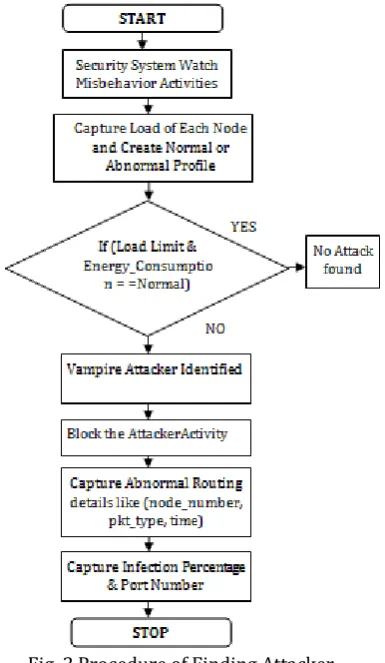
Fig. 2 Procedure of Finding Attacker
VIII.CONCLUSION
351 IX.EXPECTED PROPOSAL AGAINST VAMPIRE ATTACK
The work is actually in future focus on the DoS attack because of that attacker consumes the bandwidth, resources in network by that the network performance is affected. The security scheme against Vampire attack, watch the all information of mobile nodes if any abnormal behavior comes to our network, first check the symptoms of the attack and find out the attacker node , after finding attacker node, IDS block the attacker node and remove from the Vampire attack. Figure 2 shows the procedure to capture information of routing misbehavior of Vampire attack through security scheme. The attacker information is capture by security scheme and blocks the activities of attacker in network. The abnormal attacker behavior is identified by the node number, packet type and time. Infection percentage is evaluated by the heavy flooding of messages in network.
REFERENCES
[1]. Chris Karlof, David Wagner, “Secure Routing in
Wireless Sensor Networks", Attacks and Countermeasures”, Ad Hoc Networks (Elsevier), Page: 299-302, 2003.
[2]. Santi, P. “Topology control in wireless ad hoc and sensor networks” Chichester, England: John Wiley & Sons, 2005.
[3]. Jun Zheng and Abbas Jamalipour, “Wireless Sensor
Networks: A Networking Perspective”, a book published by A John & Sons, Inc, and IEEEE, 2009. [4]. 5. S. Misra et al. (eds.) Guide to Wireless Sensor
Networks, Computer Communications and Networks, DOI: 10.1007/978-1-84882-218-4 4, Springer-Verlag London Limited 2009.
[5]. Jamal Al-Karaki, and Ahmed E. Kamal, “Routing Techniques in Wireless Sensor Networks: A Survey“, IEEE Communications Magazine, vol 11, no. 6, pp. 6-28, Dec. 2004.
[6]. 13. Kemal Akkaya and Mohamed Younis, “A Survey
on Routing Protocols for Wireless Sensor Networks”, Ad hoc Networks, vol. 3, no. 3, pp. 325-349, May 2005.
[7]. 14. N. Bulusu, J. Heidemann, and D. Estrin, “GPS-less
Low Cost Outdoor Localization for Very Small
Devices”, IEEE Personal Communication Magazine,
vol. 7, no. 5, pp. 28-34, Oct. 2000.
[8]. Clement Ogugua Asogwa, Xiaoming Zhang, Degui Xiao, Ahmed Hamed, “Experimental Analysis of AODV, DSR and DSDV Protocols Based on Wireless Body Area Network” Communications in Computer and Information Science, Springer-Verlag Berlin Heidelberg, Volume 312, pp 183-191, 2012.
[9]. Faleh Rabeb, Nasri Nejah, Kachouri Abdennaceur, Samet Mounir, “An Extensive Comparison among DSDV, DSR and AODV Protocols in wireless sensor
network” IEEE, International Conference on
Education and e-Learning Innovations, 2012. [10]. Nasrin Hakim Mithila, “Performance analysis of
DSDV, AODV and DSR in Wireless Sensor Network” International Journal of Advanced Research in Computer Science and Electronics Engineering, Volume 2, Issue 4, pp.395-404, April 2013.
[11].Ipsita Panda “A Survey on Routing Protocols of
MANETs by Using QoS Metrics” International
Journal of Advanced Research in Computer Science and Software Engineering, Volume 2, Issue 10, pp. 121-129, 2012.
[12].5. C. Karlof and D. Wagner, Secure Routing in Sensor Networks: Attacks and Countermeasures, In Proc. of First IEEE International Workshop on Sensor Network Protocols and Applications, 2003.
[13].Shio Kumar Singh, M P Singh, and D K Singh“A Survey on Network Security and Attack Defense Mechanism for Wireless Sensor Networks” International Journal of Computer Trends and Technology (IJCTT) pp. 1-9, May to June 2011. [14].P. Mohanty, S. A. Panigrahi, N. Sarma, and S. S.
Satapathy, “Security Issues in Wireless Sensor Network Data Gathering Protocols: A Survey” Journal of Theoretical and Applied Information Technology, 2010, pp. 14-27.
[15].Prof. A. D. Potgantwar, Lina R. Deshmukh, "Ensuring an Early Recognition and Avoidance of the Vampire Attacks in WSN using Routing Loops", IEEE International Advance Computing Conference (IACC), 2015
[16].Eugene Y. Vasserman and Nicholas Hopper, "Vampire Attacks: Draining Life from Wireless Ad Hoc Sensor Networks", IEEE Transactions on Mobile Computing, Vol. 12, No. 2, February 2013.
[17].Vittorio P. Illiano and Emil C. Lupu, "Detecting Malicious Data Injections in Event Detection Wireless Sensor Networks", IEEE Transactions on Network and Service Management, Vol. 12, No. 3, September 2015.
[18].Pires, W.R., T.H. De Paula Figueiredo, H.C. Wong and A.A.F. Loureiro, "Malicious node detection in wireless sensor networks", Proceedings. 18th International, Parallel and Distributed Processing Symposium, (PDS’ 04), pp: 1-7, 2004.
[19].Onat, I. and A. Miri, "An Intrusion Detection System for Wireless Sensor Networks", Proceedings of the IEEE International Conference on, Wireless and Mobile Computing, Networking and Communications, IEEE Xplore Press, pp: 253-259, Aug. 22-24, 2005.
[20].Krontiris, I., T. Dimitriou and F.C. Freiling, "Towards Intrusion Detection in Wireless Sensor Networks", Proceeding of the 13th European Wireless Conference, Cite Seer, 2007.
[21].Krontiris, I., T. Dimitriou, T. Giannetsos and M. Mpasoukos, "Intrusion Detection of Sinkhole Attacks In Wireless Sensor Networks" Proceedings of the 3rd International Conference on Algorithmic Aspects of Wireless Sensor Networks, Springer-Verlag Berlin, Heidelberg, pp: 150- 161, 2008.