Analysis of Watermarked Video Data for Authentication,
Authorization and Data Protection
Krunal P.Rane, Deepti A.Barhate
I.
INTRODUCTION
In recent years, there has been a rapid progress in thedigital multimedia processing as well as in the internettechnologies. Analog form of multimedia was practicallyreplaced by the digital form of multimedia almost in the allthe areas of the human life.Digital multimedia has brought many advantages incomparison to the analog form of multimedia. The mainadvantages of digital multimedia form are easy processingand storage, compression and better noise resistance. Digitalmultimedia also has brought disadvantages. For example easycopying without quality degradation of copied multimedia.The copies is identical with the original multimedia andthey can be transmitted over the worldwide internet. Thisillegal sharing is wrong for authors and distributors of themultimedia because they lose income. [3] In order for a watermark to be useful, it must beperceptually invisible and robust against any possibleattack and image processing by those who seek tocorsair the material. [4]
Requirements of watermarking schemes:
Generally, a practical watermarking system embeds some copyright information into the host data as a proof of rightful ownership and must meet requirements. Obviously, different applications have different requirements for watermarking system. Therefore, it is quite difficult to have a unique set of requirements that all watermarking system must satisfy. The requirements with respect to copyright protection and rightful ownership are as follows (Cox et al 2007).
Abstract:
The watermarking is a technique to embed the image into a particular video for copyright protection of the data. The embedded video is nothing but watermarked video. The watermarking is a familiar tool for content protection, authentication and authorization of web data. The watermarked video is not affect by different attacks and video processing. The embedded watermark can be extracted from watermarked video using watermark extraction process. For inserting the watermark into particular data many algorithms are implemented such as Discrete Cosine Transform, Discrete Wavelet Transform, Singular Value Decomposition, Principal Component Analysis and using neural networks. Each algorithm has its individual qualities and drawbacks also. Basically the watermarked video must be having characteristics like robustness, perceptual transparency blindness, and capacity.In this paper the compressive approach for digital video watermarking is introduced, were watermark image is embedded in to the video frame each video frame is decomposed in to sub images using 2 level Discrete Wavelet Transform (DWT) and Principal Component Analysis (PCA) Transform is applied for each block in the two bands LL & HH.[1, 2]combining the two transform improved the performance of the watermark algorithm.
The watermarked video data is accessed by many users but due to embedding of watermark the data can be easily identified form hacking, pirating etc. The quality of watermarked video is to be check by measuring parameters like PSNR, Correlation factor. The PSNR checks robustness of watermarked video while perceptual transparency is checked by Correlation factor. The watermarked video is not affected by noise like salt & paper noise, white Gaussian noise, additive noise and different processing like rotation, cropping, sharpening etc. The video after extraction of watermark cannot degrade the quality of data is shows the robustness of web data.
(i) Robustness: Robustness refers to the ability of the watermark to be preserved even after distortions introduced by standard or malicious data processing, which may be either intentionally or un-intentionally. These distortions are also known as watermarking attacks.
(ii) Imperceptibility: The imperceptibility of the watermark refers to its perceptual transparency. In other words, the human eye should not be able to detect differences between the watermarked and original video.
(iii) Capacity: Capacity refers to the maximum amount of information that can be hidden in the media. This directly affects the robustness and perceptual transparency.
(iv) Security: Security refers to the fact that un-authorized persons should neither detect nor read the watermark; however, it must be retrieved correctly by the authorized user. [1]
In this paper I mainly focused on an imperceptibility and robust video watermarking algorithm based on Discrete Wavelet Transform(DWT) and Principal Component Analysis(PCA). DWT is more computationally efficient than other transform methods like DFT and DCT. DWT is very suitable to identify areas in the host video frames where watermark can be embedded imperceptibility. It is known that even after decomposition of video frame using the wavelet transformation there exist some amount of correlation between wavelet coefficients. PCA is basically used to hybridize the algorithm as it has inherent property of removing the correlation among the data, i.e. wavelet coefficient and it helps in distributing the watermark bits over the subbands used for embedding thus result in more robust watermarking scheme that is resistant to almost all attacks. Watermark is embedded in to the luminance component of extracted System known as Human Visual System (HVS).The HVSsplits an image into several frequency channels, which each channel processes the corresponding signals independently, the dyadic wavelet decomposition performs the similar image resolution by dividing the image into different bands with different frequency. 2-D DWT process the image by 2-D filters in each dimension. The filters divide the input image into four non-overlapping multi resolution sub-bands LL, LH, HL and HH. HH, HL and LH contain the diagonal, horizontal and vertical details of the image, respectively while the LL sub-band contains the coarse details of the image.[9]
Color image is used as cover data the RGB value of each pixel isconverted into RGB color spaces in which only R components constitute R color space, G components constitute G color space and B components constitute B color space. Watermark can be hidden in any one or in the three color channels. Since pixel values are highly correlated in RGB color spaces, informationcan be hidden in YUV color spaces. The RGB components of color image is converted into RGB color spaces which in turn is converted into YUV color spaces using below equation. The YUV color spaces consists of luminance (intensity) and chrominance (color) components YUV refers to the color resolution of digital component video signals, which is based on sampling rates. This means that some color information in the video signal is being discarded, but not brightness (luma) information. For these reasons the watermarking is added only to the Y component. [15]
Y = 0.2989 * R + 0.5866 * G + 0.1145 * B U = -0.1687*R-0.3312*G+0.5*B
V = 0.5 * R - 0.4183 * G - 0.0816 * B
II.
LITERATURE REVIEW
Author Balasubrmanian Raman presented research in his research “Wavelet packet transform-based robust videowatermarking technique” on watermarking mainly concentrates on the still images. In his work, a new robust video watermarking scheme is presented and employed in wavelet packet transform domain. The watermark is a meaningful binary logo instead of randomly generated Gaussian sequence. Watermark is embedded not only in higher, but also in lower frequency without anydegradation in the video. Experiments show better robustness against different attacks, especiallyagainst frame dropping and MPEG coding. The proposed algorithm is simple, efficient and with less complexity. In this work, he already considered small rotations and the problem withlarge rotations can be addressed in the future. [10]
Peter GOC-MATIS, Tomas KANOCZ, Radovan RIDZON, and Dusan LEVICKYdemonstrate video watermarking based on DWT in paper “Video watermarking based on DWT”. Experimental results shown, that the proposedwatermarking method based on DWT is robust against theunintended attacks like lossy compression. Method is alsorobust against specific attacks on the video like frameswrapping, frame dropping and frame averaging. Theincreasing of the robustness against attacks can be achievedby α factor increasing.Experimental results highly depend on the dynamicproperties of video. When the video content is less dynamicthe extraction of watermark is better.Primary disadvantages of the proposed methods arecomputing time and the need of the original video in thewatermark extraction process. [12]
Sadik Ali M. Al-Taweel, Putra Sumari, Saleh Ali K. Alomari and Anas J.A. Husainexplained the DCT video watermarking algorithm in paper “Digital Video Watermarking in the Discrete Cosine Transform Domain.” The need for digital watermarking on electronicdistribution of copyright material is becoming more prevalent. In this study, he had improved the existingmethod which is the robust watermarking algorithm.Various applications of watermarks were introducedand necessary requirements of such watermarks werealso introduced. An overview of the existingwatermarking techniques and the attacks were given. He had also demonstrated that the discrete cosinetransform (DCT) resembles the human visual system.Although there are many digital watermarkingtechniques developed in recent years; the capability ofthe traditional watermarking techniques is yet todevelop completely. Some video watermarkingtechniques are sensitive to geometric distortions, suchas rotation, scaling and cropping. In his research, he proposed a framework for a robust digital watermarkingfor MPEG-2 video against the global geometric attackssuch as cropping, scaling and rotation. [13]
Bibi Isac, V. Santhiexplained the video watermarking using neural network “A Study on Digital Image and Video Watermarking schemes uses Neural Networks”In this paper a detailed description of watermarking works carriedout using digital images and videos based on neural networks isgiven. Many of these techniques have been able to satisfy thebasic requirement of watermarking i.e. the extraction process doesnot require the original signal or in other words, the algorithm isblind. Similarly in few papers it is found that work is carried outin spatial domain, while others work are carried out in frequencydomain by using transformation techniques. The neural networksthat are used include Back propagation Network (BPN), CounterPropagation Network (CPN), Full Counter Propagation Networkand Cellular Neural Network (CNN). The robustness of thesealgorithms are tested with respect to various attacks like blurring,median filtering attack, low-pass filtering attack , cropping attackand salt and pepper noise attack. Each of these algorithms hastheir own advantages and disadvantages. Thus an ideal watermarkingalgorithm should be blind in nature and must be robust againstattacks. Also it should guarantee correct and fast watermark detection with low error rate. [14]
III.
PROPOSED WATERMARK SCHEME
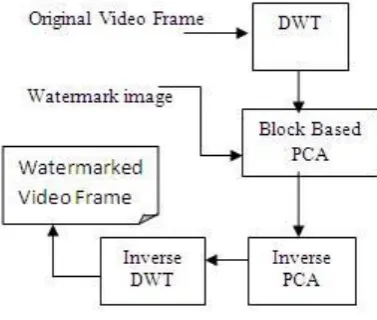
The proposed watermark scheme is based on combining two transform, the DWT and the PCA. Block diagram of embedding and extraction algorithm are as shown in fig.1 and fig.2. In this method video frames are taken as input and watermark is embedded in each frame by altering the wavelet coefficient of frame by altering the wavelet coefficient of selected DWT sub bands followed by performing the PCA transformation on selected sub bands.
Discrete Wavelet Transform:
Figure 1:.2- level DWT composition
Principal Component Analysis:
Principal Component Analysis(PCA) is a mathematical procedure that uses the orthogonal transformation to convert a set of observations of possible correlated variables in to set of values of uncorrelated variables called Principal Component. The number of principal component is less than or equal to the number of the original variables. PCA is a method of identifying patterns in data, and expressing the data in such a way that so as to highlight their similarities and differences .PCA is a powerful tool for analyzing data and other main advantages of PCA is that once these pattern in data have been identified, the data can be compressed by reducing the number of dimensions, without much loss of information [7,8].
Watermark Embedding
The proposed watermark embedding process as shown in fig.2 is briefly described in the following.
Steps1: Divide the video frame and convert 2 n x 2n RGB frames in to YUV components.
Steps2:For each frame, choose the luminance Y component and apply DWT to decompose the Y frames in to four multi resolution sub bands nxn: LL, HL, LH, and HH.
Figure 2: Watermark Embedding Algorithm
Step3: Divide the two sub bands LL and HH in to n x n non overlapping blocks.
Step4: Apply PCA to each block in the chosen sub bands LL and HH.
Step5: Convert the 50x50 watermark logo in a vector W= {w1, w2 . .W50x50} for 0 & 1.
Step6: Embed the logo in to LL and HH bands with the help of DWT and PCA for HH band, the watermark bits are embedded.
Step8: Apply inverse PCA on the modified PCA component of the two-bands to obtain modified wavelet coefficient.
Step9: Apply inverse DWT to produce the watermarked luminance component of the frame then the reconstruct the watermarked frame.
Watermark Extraction:
Watermark extraction process as shown in fig.3 is the inverse procedure of the watermark embedding process .The proposed algorithm is non blind algorithm so original video sequence and watermark is nothing but the user secrete key are required .The watermark extraction process as follows:
Figure 3: Watermark Extraction algorithm
Step1: Convert the watermark (and may be attack) video in to frames and convert the 2nx2n RGB frames in to YUV components.
Step2: For each frame, choose luminance Y component and apply the DWT to decompose the Y frames in to four multi resolution sub bands nxn.
Step3: Divide the sub bands LL and HH in to n x n non over lapping blocks.
Step4: Apply PCA to each block in chosen sub bands LL and HH.
Step5: Convert 50x50 watermark logo in to a vector W= {w1, w2 .W50x50} for 0 & 1.
Step6: watermark is extracted by following way as 𝑊𝑥 =V−V′
α where V = Original Video Frame after applying
DWT and PCA. V’ = Watermark Video Frame after applying DWT and PCA. α = Watermark strength.
Step7: After extracting the watermark frame LL and HH bands, similarly measurement of extracted watermark WE and reference watermark WR are used for the objective judgment of the extraction fidelity NC which is
given by
Where NC is normalized correlation whose peak value is 1. i.e NC value is 1 when original watermark and extracted watermark are identical and zero if the original watermark and extracted watermark are different from each other.
Performance Evaluation:
Where, f (i, j) is pixel values of original video frame.f’ (i, j) is pixel values of watermarked video frame.MaxI is
the maximum pixel value of video frame which is equal to 255 for gray scale image where pixels are represented with 8 bits.
Attack Scenarios:
DWT and PCA inherit many advantages in resisting the attacks on the watermarked frames. It achieves perceptual invisibility and can resist attacks by image processing techniques. To test the robustness of watermark, different attacks were mounted on watermarked video. The embedded watermark was retrieved using proposed algorithm and NC value of recovered watermark was recorded for different attacks scenarios. It was observed that the proposed scheme shows great robustness. The algorithm ability to make the watermark resistant to these attacks was analyzed and better results were inferred from the above discussion.
IV.
CONCLUSION
The algorithm implemented using DWT-PCA is robust and imperceptible in nature and embedding the watermark in LL sub band helps in increasing the robustness of embedding procedure without much degradation in the video quality.
REFERENCES
[1]. C.I.Podilchuk,E.J. Delp “Digital watermarking: algorithms and applications,” Signal Processing Magazine, Vol 18,pp. 33-46, IEEE, July 2001.
[2]. G. Langelaar, I. Setyawan, and R. Lagendijk, "WatermarkingDigital Image and Video Data: A State of - Art Overview," IEEE Signal Processing Magazine, vol. , pp. 20-46, Sep. 2000.
[3]. T. Tokar, T. Kanocz, D. Levicky, “Digital watermarking of uncompressed video in spatial domain,” 9th International Conference on Radioelectronica, IEEE, pp. 319-322, 2009.
[4]. C.H. Li and S.S. Wang, “Transform-Based Watermarking for Digital Images and Video,” IEEE International Conference, June1999.
[5]. T. Hu, J. Wei, “A digital video watermarking scheme based on 1D-DWT”, IEEE, International Conference on Biomedical Engineering and Computer Science , 2010, pp. 1-3.
[6]. C.X. Wang, X. Nie, X. Wan, W.B. Wan and F. Chao, “A Blind Video Watermarking Scheme Based on DWT”, Fifth International Conference on Intelligent Information Hiding and Multimedia Signal Processing, IEEE, vol. 1, pp. 434-437, 2009.
[7]. T.D. Hien, Y.W. Chen, Z. Nakao, “PCA Based Digital Watermarking”, KES 2003, LNAI 2773, pp. 1427-1434, 2003.
[8]. Andrews, H.C., Patterson, C.L, “Singular value decomposition (SVD) image Coding” IEEE Trans. Comm. 1976 COM-24, 425–432.
[9]. Azam sabaghi nedooshan, KhashayarYaghmaie, Reza Sabbaghi-Nadooshan, “Medical Image Watermarking based on SVD-DWT technique”, International Congress on Informatics, Environment, Energy and Applications-IEEA 2012.
[10]. Gaurav Bhatnagar, Balasubrmanian Raman, “Wavelet packet transform-based robust video watermarking technique” Sadhana Vol. 37, Part 3, June 2012.
[11]. Pik-Wah Chan and Michael R. Lyu, “A DWT-based Digital Video Watermarking Scheme with Error Correcting Code” January 2003.
[12]. Peter GOC-MATIS, Tomas KANOCZ, Radovan RIDZON, Dusan LEVICKY, “Video watermarking based on DWT”.
[13]. Sadik Ali M. Al-Taweel, Putra Sumari, Saleh Ali K. Alomari and Anas J.A. Husain , “Digital Video Watermarking in the Discrete Cosine Transform Domain. ,Journal of Computer Science 5 (8): 536-543, 2009 ISSN 1549-3636.
[14]. Bibi Isac, V. Santhi , “A Study on Digital Image and Video Watermarking Schemes using Neural Networks”, International Journal of Computer Applications (0975 – 8887) Volume 12– No.9, January 2011.