A Secure and Reliable Video Watermarking
based on Different Wavelet Transform
Dhanashree S. Shedge
PG Student, Dept. of Computer, Yadavrao Tasgaonkar College of Engineering & Management, Karjat, India
ABSTRACT: Video watermarking is generally another innovation that has been proposed to solve problem of illegal manipulation and distribution of digital videos. The paper is based on two different wavelet transforms such as DWT (Discrete Wavelet Transform) and LWT (Lifting Wavelet Transform).For decomposition of watermark SVD (Singular Value Decomposition) method is used. A gray scale watermark is preferred for this purpose. For dividing the video file into the number of frames, Histogram Difference Method is used.The watermark is installed into the first video outlines by first changing over it into YCbCr shading group and than decaying the luminance part i.e. Y segment into four sub-groups utilizing DWT/LWT lastly the particular estimations of LL sub-band decomposes it into U, S, and V components. The watermark is also decomposed to get Sw, Uw and Vw. For embedding the S part of the first video outline is changed by the Sw part of the watermark picture/logo. The inverse SVD and inverse DWT/LWT is connected to get the watermarked video outline.For extraction the inverse SVD is applied to get back the extracted watermark image/logo. The comparative result shows the imperceptibility and strength of the watermark against intentional attacks such as salt & pepper noise, rotation, vertical mirroring, horizontal mirroring on selected watermarked video frame. Additionally to illuminate the issue of time-management quality the implanting and separating timing of the watermark is computed by contrasting the DWT-SVD and LWT-SVD wavelet transforms.
KEYWORDS: Digital watermark, Video watermarking, Copyright Protection, Discrete Wavelet Transform, Lifting Wavelet Transform, Singular Value Decomposition.
I. INTRODUCTION
Digital video watermarking is a method for embedding some information into digital video sequences. E.g. text, audio, image, video. Video sequencing could be an assortment of consecutive and equally time spaced still pictures. Apparently any image watermarking technique may be extended to watermark videos, however in reality video watermarking techniques has to meet alternative challenges. Watermarked video series are fundamentally helpless to privateer assaults like frame averaging, frame swapping, statistical analysis, digital-analog (AD/DA) conversion, and lossy compressions. The digital watermarking system basically consists of a watermark embedder and a watermark detector. The watermark embedder inserts a watermark onto the cover signal and therefore the watermark detector detects the presence of watermark signal[1]. A number of researchers are using completely different watermarking techniques with the aim of creating the watermarked file more and more robust, undetectable and Secure.
Comparison of DWT-SVD and LWT-SVD is completed on the luminance component of the video frame. A greyscale watermark is chosen for this purpose. Each RGB video frame is converted into YCbCr format, and so luminance half (Y) is taken for inserting the watermark [2, 3, 10].
II. RELATED WORK
In this scheme, histogram difference method is employed with the Intersection and color models, for finding the various scenes of the colour input video. The colour input video is browse frame by frame and then each frame is converted into RGB to completely different colour models such as YCbCr, YIQ, YUV, CMY, HSI, HSV. In this proposed scheme, RGB color models of the frame is converted into the YCbCr format and then histogram difference method is applied in order to induce the histogram value of every frame [2]. In the event that the contrast between those present frame and next casing more greater then the threshold value, then that frame is expected as shot i.e. shot change happens in that frame. The histogram difference between two frames will be gotten utilizing crossing point equation. The Intersection equation is as follows are,
∑imin(f1[i],f2[i])
Intersection(f1,f2)=__________________ eq. (1)
N
Difference(D)INT = 1- Intersection(f1,f2) eq. (2)
Here N is the total number of frames, f1 is the current frame and f2 is the next frame.
The use of wavelet transform can principally address the capability and robustness of the Information- hiding system features. The Haar wavelet transform is that the simplest of all wavelet transform. The technique that is employed most generally these days for signal processing applications is DWT [2].The vitality of the wavelets is focused in time and furthermore these are appropriate for analysing of time varied signals and drifters. DWT breaks down a picture into sub pictures or sub groups, three subtle elements and one estimation. The groups are LL, LH, HL and HH. LL conveyed low frequencies both in level and vertical course. HH conveyed high frequencies both in flat and vertical heading. HL having high frequencies flat way and low frequencies vertical way. LH conveyed low frequencies in flat and high frequencies in vertical way. The LL band is carried the picture vitality to1represents the approximations of the picture. The high vitality watermarks is embedded inside the areas that the human vision is less fragile to, these districts are the high determination detail groups (LH, HL and HH) [3]. The robustness of the watermark is amassed by installing into these groups without having further effect on the nature of the image.
LWT is a substitute approach for DWT to redesign picture into frequency domain [4] for real time applications. Lifting wavelet is that the second era faster wavelet transform. In this, interpretation and enlargement are not appear to be fundamental to get lifting wavelets. In lifting wavelet change, up and down sampling is supplanted just by part and converge in everything about level. The multiphase parts of the signal are separated at the same time by the relating wavelet channel coefficients, creating the preferable outcomes over here and there examining that is required in DWT approach [5]. In examination with general wavelets, remaking of video by lifting wavelet is better because of, it will increases smoothness and decreases aliasing effects[6]. Lifting change likewise gives number of advantages like less memory needed, reduced contortion and associating impacts, sensible remodel, process complexities and less calculation [7]. Employing SVD together with LWT effort lessly of watermark recovery, enhances the intactness and spreads the watermark through out the spectrum, and implements square matrix to the watermarked. This successful remaking is essential to achieve sensible loyalty in computerized video watermarking.
Singular value Decomposition(SVD) is that the mathematical tool which is the a speculation of the eigen-esteem disintegration and it is utilized to break down rectangular matrices(the eigen-esteem deterioration is outlined just for square matrices) and is furthermore investigated for image process[5]. In the event that the picture grid, has low rank, or will be approximated adequately well by a matrices of low rank, at that point SVD is utilized to discover this guess to assist this low rank approximation is represented much more compactly than the first image[6]. The most arrangement of the SVD is to disintegrate a rectangular grid A or To say that a picture I(x, y) of size m ×n into the result of 3 lattices – U, S, and V. At that point the image is presented as takes after:
S11 0 0
SVD(Ixy) = Umm * 0 S22 0 * Vnn eq. (4) 0 0 Smn
In above equation, U is m*m matrices, Vis the n*n matrices and S is the diagonal matrices. In proposed conspire, the SVD is utilized in diagonal-wise way to embed the watermark data in the U, S, V [7].
III.PROPOSED ALGORITHM
The proposed method for secure video watermarking consists of embedding watermark and extracting watermark procedure are as follows:
A. Embedding Watermark by DWT/LWT-SVD
Fig. 1. Block diagram for Embedding Watermark [4]
Initially, the InputVideo(.avi)File is browse into the matlab and convert the video file into the number of frames. Then the Histogram Difference Method is applied on every frame of the video file and find different scenes of the video clip. After selecting the frame of each and every scene of the video file, convert that the RGB colour video frame into the YCbCr format. The Y component i.e luminance part of the frame for applying the DWT/LWT transform on it which will decompose it and generate four wavelets LL, LH, HL,HH. Here LL is the approximation coefficient which represent the low frequency and gives the detailed information of the image. LH & HL is the texture component. HH is the high frequency component, there is chances of occurance of noise in images. Therefore the SVD(Singular Value Decomposition) is applied on the LL approximation coefficient of the wavelet, to decompose it into three parts such as U, S and V.
[U,S,V]=SVD(LL) eq. (5)
Also decompose the watermark image/logo W using SVD method to get Sw, Uw, Vw components. Color model
conversion
Reconstructed video
Input video Frame separation Pre-
processing
DWT/LWT SVD
Embedding
Inverse DWT SVD on LL
subband Logo
i.e [Uw,Sw,Vw]=SVD(W) eq. (6)
Now modify the value of S by using the following equation,
S*=S+x*Sw eq. (7)
Here x is the threshold value which decides the percentage of watermarking. The inverse SVD is applied on U, S* and V to remodel wavelet LL’ are as follows:
LL’=U*S* *VT eq. (8)
Finally, Inverse DWT/LWT is applied on the modified approximation component and remaining the detailed component to get the watermarked component Y’.Then convert the new modified three channel Y’, Cb, Cr into RGB channel to get the watermarked video file
B. Extracting Watermark by DWT/LWT-SVD
In extracting watermark, the reverse procedure of embedding watermark is performed. The reconstructed video file is used to extract the watermark and the color model conversion has to be performed. The DWT/LWT wavelet transform is applied on the sub part of the luminance component which will further decompose into 4 sub-bands. The SVD is performed on the approximation part of the wavelet to decompose into the three sub-parts. The singular value of watermark is calculated and applying inverse SVD to extract the watermark. The following figure shows the block diagram for extracting watermark.
Fig.2. Block diagram for Extracting Watermark [4]
For extraction, the watermarked video file is browse and convert the RGB video frame into the YCbCr format.
Then select the Y’ i.e luminance component and apply DWT/LWT on it which will decompose it and will generate four wavelet such as LL’, LH, HL, HH.
After that SVD is applied on the LL’ approximation component of the wavelet to decompose it into three parts S*, U and V.
[U,S*,V]=SVD(LL’) eq. (9)
Now computing the singular value of watermark Sw* by using the equation:
Extracted image
Watermarked video Watermarked Frame
Pre-processing
DWT/LWT U and V
components
Extraction
Inverse SVD SVD on LL
Sw* = (S*-S)/x eq. (10)
To get the extracted watermark image/logo W’ by applying the Inverse SVD on Uw, Sw* and Vw.
W’ = [ (Uw) * (Sw* ) * (Vw)’] eq. (11)
IV.SIMULATION RESULTS
A software, MATLAB R2013a version is used to implement the above proposed method and tested the performance of the comparsion of DWT-SVD & LWT-SVD scheme using an uncompressed video clip (inp1.avi) having 50 video frames. A gray scale image of size(267 * 165) is taken as the watermark image.
To measure the imperceptibility and robustness of the watermarked video frame, the CC(Co- relation coefficient) and PSNR(Peak Signal to Noise Ratio) is calculated. To find the PSNR value, first need to calculate the value of MSE(Mean Square Error), which is given by:
eq. (12)
In eq. (12), F is the first video outline and F’ is the watermarked video outline. So the value of PSNR can be calculated as the following equation:
= 10 log eq. (13)
The correlation coefficient (CC) can be ascertained as:
=∑ ∑ W(i, j)W (i, j)
∑ ∑[W(i, j) ]
eq. (14) In eq. (14), W’ is the Extracted Watermark and W is the originalwatermark.
As the standardized coefficient (NC) is not giving the unmistakable thought regarding the relationship amongst's unique and extricated watermark, here another system is utilized for checking the correct connection amongst's unique and removed watermark. The outcome SSIM list is a decimal worth between -1 and 1, and esteem 1 is only reachable on account of two indistinguishable arrangements of information. Numerically it is characterized by eq. (15),
= ( )( )
( )( ) eq. (15)
Where,
σxy the variance of x and y;
c1=(k1L)2, c2=(k2L)2 two variables to balance out the division with frail denominator; L is the dynamic vary of the pixel-values;
k1=0.01 and k2=0.03 by default.
The original video frame (49th video frame) and watermarked video frame are shown in the fig. 3 (a), (b), (c).
(a) (b) (c)
Fig.3(a)Original video frame (b)DWT watermark frame (c) DWT watermark frame
The gray scale watermark image, used in the watermarking and the extracted watermark is shown in the fig. 4 (a), (b).
(a) (b) (c)
Fig.4(a) Original Watermark (b) Extracted Watermark by DWT(c) Extracted Watermark by LWT
The above figures clearly shows that the both DWT and LWT watermarked frames are highly imperceptible but the difference in extracted DWT watermark and the LWT watermark is clearly shows that extracted watermark by LWT is much clear then the extracted watermark by LWT and very much similar to the original one having the co-relation coefficient is in between 0.99-0.98.
The Comparative analysis of Video watermarking based on different wavelet transform such as DWT and LWT are also performed (on the same video clip) under various attacks like Salt & Pepper noise, Rotation, Vertical Mirroring, Horizontal Mirroring. The results were compared with one another scheme [7].
TABLE I: Comparative results of CC and PSNR values of both schemes using frame no.49
Attack Type
DWT-SVD Scheme (SSIM = 0.935862)
LWT-SVD Scheme (SSIM = 0.937039)
Watermarking Scheme
Extracted Watermark Watermarking Scheme
Extracted Watermark
Salt & Pepper noise (Density 0.01)
MSE = 25.7477 PSNR = 34.0234
CC = 0.979801 MSE = 22.284
PSNR = 34.6509 CC = 0.963525
Rotation (900)
MSE = 33.1764 PSNR = 32.9225
CC = 0.973257 MSE = 11.9675 PSNR = 37.3508
CC = 0.993056
Vertical Mirroring
MSE = 26.3654 PSNR = 33.9205
CC = 0.980105
MSE = 11.9675
PSNR = 37.3508 CC = 0.993056
Horizontal Mirroring
MSE = 26.3654 PSNR = 33..9205
CC = 0.980105
MSE = 11.9675 PSNR = 37.3508
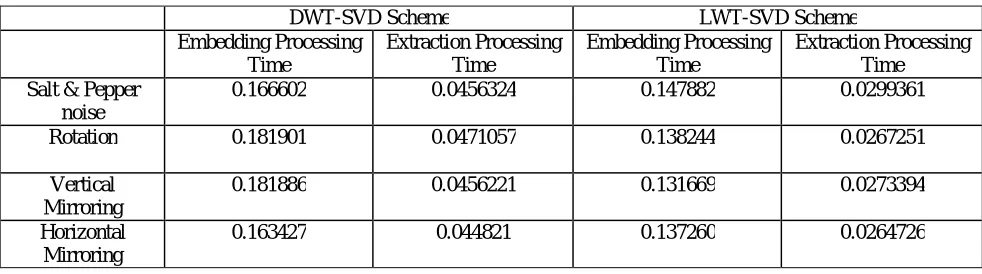
TABLE II: Time Taken in embedding and extracting watermark
DWT-SVD Scheme LWT-SVD Scheme
Embedding Processing Time Extraction Processing Time Embedding Processing Time Extraction Processing Time Salt & Pepper
noise
0.166602 0.0456324 0.147882 0.0299361
Rotation 0.181901 0.0471057 0.138244 0.0267251
Vertical Mirroring
0.181886 0.0456221 0.131669 0.0273394
Horizontal Mirroring
0.163427 0.044821 0.137260 0.0264726
So that, the time complexity of the LWT-SVD scheme is far better than the DWT-SVD scheme in [10]. Also there is a noticeable difference in CC values of both the schemes. The LWT-SVD scheme performs better under all the above mentioned attacks. Thus, the proposed scheme is robust, reliable, fast, imperceptible, secure, and optimized.
V. CONCLUSION AND FUTURE WORK
In this paper, Video watermarking is designed and implemented as a secure and reliable video watermarking scheme by comparing DWT-SVD and SVD . The mathematically calculated value of CC, SSIM and PSNR of LWT-SVD scheme are much satisfactory and are better in all respects than the DWT-LWT-SVD scheme [4], Also the time complexity of the LWT-SVD scheme is far better than the DWT-SVD scheme. Time complexity analysis also shows that the LWT-SVD scheme is suitable for real time application [9]. The proposed scheme was also performed (on the same video clip) much better under various attacks like Salt & Pepper Noise addition, Rotation, Vertical mirroring, Horizontal mirroring, hence the LWT-SVD scheme is proved to be very much secure and reliable then the DWT-SVD scheme[4, 5, 10].
In future there is a scope of finding a blind video watermarking scheme. Also there should be a way for embedding and extracting a RGB channel (coloured) watermark. A DSP processor based on implementation of video watermark. Video watermarking based on NSCT(Non-Sub Sampled Contourlet Transform).Secret data is in the some of color. (i.e. data hiding in input color give color output).
REFERENCES
1. Sanjana Sinha, PrajnatBardhan, SwarnaliPramanick, AnkurJagatramka, “ Digital Video Watermarking using Discrete Wavelet Transform and Principle Component Analysis”, International Journal of Wisdom based Computing, vol.1, August-2011.
2. Priyanks S, Dr. JharnaMajumdar, Santosh Kumar K L“Histogram Difference Methods Using Colour Models” IJIRCCE, vol. 3, issue August 2015.
3. Tabassum, S.M. Mohidul Islam, “A Digital Video Watermarking Technique based on identical frame extraction in 3-level DWT”, IEEE, 2012.
4. Dhanashree S. Shedge, Aarti G. Ambekar, “Digital Video Watermarking based on Different Wavelet Transform” Communications on Applied Electronics (CAE) – ISSN : 2394-4714, Foundation of Computer Science FCS, New York, USA , Volume 5-No.10, Issue September 2016. 5. Souvik Sarkar, K. Senthilkumar, “A Highly secured Digital Watermarking Algorithm for Binary Watermark using Lifting Wavelet Transform
and Singular Value Decomposition”, IET Third International conference on sustainable energy and intelligent system, p.p. 1-5, Dec 2012. 6. SwanirbharMajumder, TirthaSankar Das, Souvik Sarkar and SubirKumar Sarkar, “SVD and Lifting Wavelet based Fragile
ImageWatermarking, ACEEE International Journal on Signal &ImageProcessing, vol-2, no.1, Jan 2011.
7. Pragya Agarwal, Arvind Kumar, AnkurChoudhary, “A Secure and Reliable Video Watermarking Technique”,International Conference on Computer and Computational Sciences,IEEE, ISBN: 978-1-4799-1819-5/2015.
8. Prathik P, Rahul Krishna, Rahul Ajay Nafde, ShreeDarshan K, “ An Adaptive Blind Video Watermarking Technique based on SD-BPSO and DWT-SVD”, International Conference on Computer Communication and Informatics (ICCCI), January, 2013, Coimbatore, India.
9. BhavnaGoel, Charu Agarwal, “An Optimized Un-compressed Video Watermarking Scheme based on SVD and DWT”, IEEE International Conference, p.p. 307-312, August 2013.
![Fig. 1. Block diagram for Embedding Watermark [4]](https://thumb-us.123doks.com/thumbv2/123dok_us/1391013.1171822/3.595.75.508.389.607/fig-block-diagram-embedding-watermark.webp)