Abstract
Objective: Historically, changes in normal thyroid uptake values for iodine have been reported in different
geographical areas. These changes have been linked to geographical and chronological fluctuations in dietary
iodine intake in different populations. Namibia is a country with mixed ethnicity, with access to dietary iodine in table salt. Despite historical reports on deviating normal thyroid uptake values (emphasising the importance of establishing local normal reference values), the relevant Namibian authorities have never revised these reference values, nor have local reference values been established. The aim of this study was to establish the normal reference values for thyroid uptake of technetium-99m pertechnetate in the Namibian population.
Design: Participants who were considered to be euthyroid completed a questionnaire designed to exclude individuals with thyroid pathologies, as well as those with renal or heart disease.
Settings and subjects: The study cohort consisted of 76 participants (58 women and 18 men), ranging in age from 39-81 years. The participants were of mixed ethnicity, consisting of Hereros, Ovambos, Damaras, Namas, Coloureds, Caucasians and other (non-Namibian immigrants), and were from Windhoek, Namibia. Studies were performed at the Windhoek Central Hospital.
Outcome measures: Blood was drawn for thyroid hormone assessment. Participants were then given 100 MBq of technetium-99m pertechnetate intravenously, and their percentage thyroid uptake recorded after 20 minutes.
Results: In this study, thyroid-stimulating hormone, triiodothyronine, and thyroxine levels were found to be 1.7 µIU/ ml, 4.9 pmol/ml and 10.3 pmol/ml, respectively. Analysis of the empirical data showed that the normal reference uptake value for technetium-99m pertechnetate in the studied population ranged between 0.04% and 2.40%.The
fifth and 95th percentiles for pertechnetate uptake were 0.15% and 1.69%, respectively.
Conclusion: These results provide new evidence which supports the importance of periodical evaluation of normal thyroid uptake reference values for technetium-99m pertechnetate.
Peer reviewed. (Submitted: 2013-01-24. Accepted: 2013-05-22.) © SEMDSA JEMDSA 2013;18(3):142-147
Introduction
The normal reference values for thyroid uptake of technetium-99m pertechnetate and radioactive iodine in euthyroid persons change with the geographical location, and may change from one decade to the
next. Throughout history, fluctuations in the normal
reference values have been documented. These reports show the importance of periodic evaluation of normal reference values for thyroid uptake. Bernard et al1 discovered that the uptake range found in normal
subjects deviated significantly from the traditional
radioactive iodine ranges that were routinely used.
In California, Blum and Chandra2 likewise reported that several laboratories had recorded a lowered normal human thyroid gland uptake of radioactive iodine. Similarly, in Minneapolis, Wong and Schultz3 reported that normal ranges of radioiodine uptake had deviated twice in a span of 20 years. In a relatively stable population in Fort Smith, Arakansas, Culp and Huskison4 also reported that there was a deviation in the normal uptake values of iodine-131. However, in Boston, Anderson and Powsner5 observed stability in the normal reference values of radioactive iodine over 16 years. It has also been demonstrated that it is
Normal reference values for thyroid uptake
of technetium-99m pertechnetate for the
Namibian population
Hamunyela RH,1,3 MTech, Kotze T,2 MBBCh, FCNP(SA), Head of Department
Philotheou GM,1,2 MTech, Radiography Senior Lecturer
1Cape Peninsula University of Technology
2Nuclear Medicine Department, Groote Schuur Hospital
3Nuclear Medicine Department, Windhoek Central Hospital
Correspondence to: Roswita Hamunyela, e-mail: [email protected]
important to establish normal thyroid uptake values on a regional basis, since normal limits vary within different geographical areas,6 according to Nelson et al.
Geographical location-specific reference data for
thyroid uptake of technetium-99m pertechnetate are
rare and vary significantly.7-9 Therefore, there is a need
to establish reference values for each location.There are no reported reference values for technetium-99m pertechnetate uptake for Namibia. The reference range routinely used in Namibia for thyroid uptake of technetium-99m pertechnetate is 0.75-4% of the administered activity after 20 minutes. This range was adopted from guidelines of the International Society of Nuclear Medicine10 as it is not always convenient for each nuclear medicine facility to determine technetium-99m pertechnetate uptake in normal euthyroid individuals.
This study was limited to the Khomas region as it was the only region in Namibia that had a nuclear medicine department at the time of the research study which was from August to December 2011. The present study sought to test the hypothesis that thyroid uptake reference values for technetium-99m pertechnetate in the Namibian population deviate from available international normal reference values.
Euthyroid individuals were identified to determine
a normal reference range for thyroid uptake of technetium-99m pertechnetate for the Namibian population. A normative or norm-referenced research design was used which focused on establishing the
normal reference values for specific variables to serve
as a guide for diagnosis and treatment planning. A cross-sectional approach, which focused on a small subpopulation at one point in time in order to draw conclusions about the whole population, was adopted. Furthermore, a prospective data collection method was used to record the research variables. The study was non-therapeutic, and the participants received very low doses of ionising radiation.
Method
Seventy-six participants (58 women and 18 men), ranging in age from 39-81 years, living in the Khomas region of Windhoek, Namibia, were recruited. Three sampling methods, namely purposive, nonprobability and snowball sampling, were used. Each subject was selected by using a questionnaire which evaluated the clinical history, history of iodinated-contrast radiographic procedures and a physical examination, to exclude those with cardiac, renal or thyroid disease. Individuals with iodine contamination were also excluded. Participants taking medication known
to affect thyroid function were excluded from the study. The laboratory assessment of thyroid function was obtained via serum measurements of thyroid-stimulating hormone, free triiodothyronine, and free thyroxine. The study protocol was approved by the ethics committees of the Cape Peninsula University of Technology, the Ministry of Health and Social Services of Namibia, the Namibian Institute of Pathology and the National Radiation Protection Authority of Namibia.
Each participant received 100 MBq of technetium-99m pertechnetate intravenously. The percentage uptake of technetium-99m pertechnetate by the thyroid gland was determined at 20 minutes, using scintigraphic imaging techniques. A Nucline™ Spirit DH-V dual-head digital gamma camera equipped with a low-energy, high-resolution parallel hole collimator was
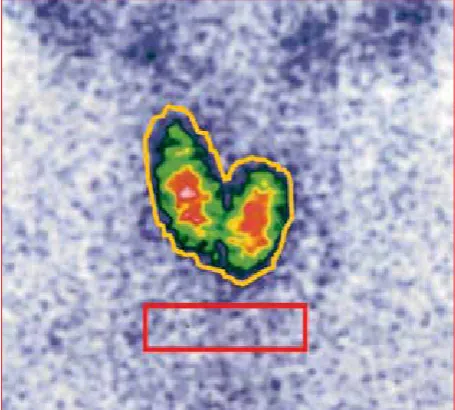
Figure 1 a: Irregular region of interest drawn around the thyroid gland (yellow) and rectangular background region of interest under the thyroid gland (red). The thyroid uptake was 1.09%
used. Images were obtained on a 128 × 128 pixel matrix, with a zoom of 1.8. Images of the syringe were obtained before and after injection of technetium-99m pertechnetate to determine the exact amount of administered activity for the calculation of thyroid uptake. Images of the syringe and anterior neck were acquired for 60 seconds. A control image of the injection site was obtained to determine if there was any extravasation that would invalidate the thyroid uptake percentage calculation.
The total number of counts was calculated by drawing an irregular region of interest (yellow) around the borders of the thyroid gland (Figure 1a). A rectangular region of interest (red), with a width that was approximately equal to that of the thyroid gland, was drawn under the gland to represent the background (Figure 1a). To demonstrate that the thyroid could be visualised at very low uptake, and that the respective images were of acceptable quality, an image that corresponded with an uptake of 0.25% was obtained (Figure 1b).
Pre-injection syringe counts (F) and the post-injection syringe counts (E) were obtained from the images. All counts were corrected for the decay of technetium-99m pertechnetate and acquisition time.
The thyroid uptake of technetium-99m pertechnetate for each participant was calculated using the following formula:
% uptake = [(TH – BK)/(F – E)] x 100%
where TH and BK are the thyroid and background counts, respectively.
Results
The study comprised 76 research participants (58 women and 18 men). Only participants aged 39 years and older were included in the study because of radiation safety concerns. Participants were selected from a population of mixed ethnicity consisting of Hereros, Ovambos, Damaras, Namas, Coloureds, Caucasians and other non-Namibian immigrants. The
ethnic distribution of the 76 participants, as illustrated in Figure 2,included 40.8% (n = 31) Ovambos, 23.7 % (n = 18) Hereros, 14.5% (n = 11) , 7.9% (n = 6) Namas, 6.6% (n = 5) Damaras, 5.2% (n = 4) Caucasians, and 1.3% (n = 1) others.11
The questionnaire comprised two sections on medical history and source of dietary iodine. Analysis of the medical history noted that participants had no past thyroid disorders, and were not suspected of having any thyroid disorders at the time of the study. Participants were not exposed to iodinated contrast media or radionuclides prior to or during the investigation. None of them had a history of taking heart medication two years before the study. None of the female participants had used any iodine-containing vaginal douche, or were pregnant or nursing at the time of investigation. None of the participants were smokers.
The different ethnic groups followed unique diets. All of the participants used iodised table salt on a daily basis. Twenty-three participants took multivitamins and minerals on a daily basis, and these included Q 10 Fatigue®, Dynamisan®, Pharmaton®, Glucosamin®, Sentrum®, Bico®, vitamin C, Beta Vita®, Vitathion®, Vitamin A to Z®, and Vital®. Twenty of the participants took energy supplements on a daily basis. These supplements did not contain high levels of iodine, and were found to contribute less than the daily recommended intake of 0.25 mg. All of the participants consumed fresh milk in their tea or coffee on a daily basis. Cheese, yoghurt, ice cream, frozen yoghurt and eggs were only eaten occasionally. All of the participants consumed at least two slices of bread daily. From an analysis of the dietary iodine section of the questionnaire, it emerged that the main sources of dietary iodine for this population were iodised table salt, dairy products and bread.
No enlarged thyroid glands or nodules were palpated on clinical evaluation of the 76 euthyroid participants.
These findings were further confirmed by scintigraphic
images which did not show thyromegally or nodules. The results of the serum thyroid hormone levels are summarised in Table I. All levels of thyroid hormones were within normal ranges.
The thyroid uptake of technetium-99 m pertechnetate ranged from 0.15-2.14%. The characteristics of the 76 euthyroid participants at the Windhoek Central Hospital’s Department of Nuclear Medicine are summarised in Table II. The mean [± standard deviation (SD)] technetium-99m pertechnetate uptake for males and females was 0.65 ± 0.38 and 0.81± 0.47%, respectively. When combined, the average pertechnetate uptake in the study cohort was 0.78 ± 0.45%.
Ovambo Herero Coloureds Namas Damara Caucasians Other
The gender-specific data were compared to the whole
euthyroid research population, as illustrated in Figure 3. The data show that gender did not seem to play
a significant role in euthyroid pertechnetate uptake,
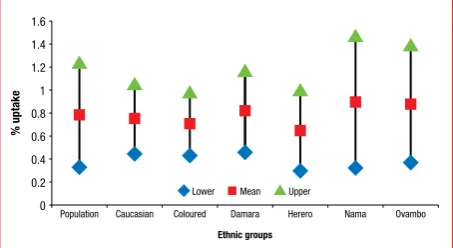
but normal values appeared to be marginally lower in men (0.65 ± 0.38%) than in women (0.81 ± 0.47%). To test whether or not ethnicity played a role in euthyroid uptake of technetium-99m pertechnetate, ethnic uptake data were compared with those pertaining
to the population (Figure 4). No significant differences
were apparent among the ethnic groups, relative to the representative population.
To determine if technetium-99m pertechnetate uptake was normally distributed in the Namibian population, uptake values were grouped over intervals of 0.25% (0-0.25, > 0.25-0.50, > 0.50-0.75 and > 2-2.25%), and a histogram mean uptake for the intervals generated (Figure 5). These data clearly show that euthyroid pertechnetate uptake in this population was skewed and not normally distributed. Twenty-six per cent of the participants (n = 20) had extremely low pertechnetate
uptake (≤ 0.5%). Half of the participants (n = 38) had Population
1.4
1.2
1
0.8
0.6
0.4
0.2
0
% uptake
Male Female
Mean
Lower Upper
Volunteers
Figure 3: Gender comparison of technetium-99m pertechnetate uptake in an euthyroid population
0.16 25
20
15
10
5
0
Frequency
5
0.39 15
0.6 18
0.89 21
1.16 7
1.38 2
1.63 4
1.89 1
2.22 3
% uptake
Figure 5: Frequency histogram of mean percentage uptake of technetium-99m pertechnetate in the Namibian population
0.0 80
60
40
20
0
Cumulative frequency
5th percentile
% uptake
0.0 0.0 0.0 0.0 2.5
25th percentile 50th percentile 75th percentile 95th percentile
Figure 6: Cumulative frequency polygon, showing the percentiles of mean euthyroid uptake of technetium-99m pertechnetate in the Namibian population
Population 1.6
1.4
1.2
1
0.8
0.6
0.4
0.2
0
% uptake
Mean
Lower Upper
Ethnic groups
Caucasian Coloured Damara Herero Nama Ovambo
Figure 4: Ethnic comparison of technetium-99m pertechnetate uptake in an euthyroid population
Table I: Thyroid hormone function data for the normal participants
Group Total TSH
Mean ± SD Mean ± SDTS Mean ± SDT4
Women 58 1.58 ± 0.76 4.82 ± 0.80 10.36 ± 1.84
Men 18 2.06 ± 1.40 4.96 ± 0.79 10.17 ± 1.77
Population 76 1.70 ± 0.96 4.86 ± 0.79 10.32 ± 1.82
Normal laboratory range 0.34-5.60 µIU/ml 3.80-6 pmol/l 7.2-21.1 pmol/l
TSH: thyroid-stimulating hormone, SD: standard deviation, T3: triiodothyronine, T4: thyroxine
Table II: Meansand ranges of technetium-99m pertechnetate uptake in euthyroid Namibian participants
Group Total % Mean age (years) Age range (years) % uptake range % uptake mean
± SD % uptake 95% CI
Men 18 23.7 49.83 39-67 0.31-1.07 0.65 ± 0.38 0.50-0.88
Women 58 76.3 49.28 41-81 0.34-1.28 0.81 ± 0.47 0.68-0.93
Population 76 100 49.41 39-81 0.31-1.28 0.78 ± 0.45 0.33-1.23
uptake values below the departmental lower limit of 0.75%. The remaining 50% of participants emerged with uptake values within the international and departmental reference range of 0.75-4%.
The red bars represent participants with uptake values less than the departmental lower limit of 0.75%
Owing to skewness in uptake distribution, the 95%
confidence interval and the mean (± SD) were
considered to be inappropriate indicators of the normal reference range. To determine the reference range for technetium-99m pertechnetate, the data in Figure 5 were plotted as a cumulative frequency
curve, as presented in Figure 6. The fifth and 95th
percentiles were then determined to represent the normal reference range for the Namibian population.
The fifth and 95th percentiles were found to be in the
range of 0.15-1.69%.
Discussion
In this study, the range of euthyroid uptake of derived
technetium-99m pertechnetate differed significantly
from the internationally accepted normal reference values (0.75-4%) that are currently used by the Department of Nuclear Medicine of the Windhoek Central Hospital, Namibia. In this study, the reference uptake values were found to range from 0.15-1.69%. The data in Figure 5 demonstrate that as many as 50% of participants had uptake values below 0.75%. Furthermore, approximately half of these presented
with a very low uptake of ≤ 0.50%. On the basis of the
departmental reference values, these participants would have been diagnosed as abnormal. Although these data overlap considerably with other ranges reported elsewhere,7-9 they differ significantly. For instance, normal thyroid reference values for technetium-99m pertechnetate uptake as reported by Ramos et al7 and Anjos et al9 were 0.4-1.7% and 0.56-0.80%, respectively.
Historically, thyroid uptake normal values for radioiodine have shown predominant decreases. A marked lowering of normal values has been reported by different groups.1,12,13 Others have reported upward trends in reference values, compared to those established in earlier years.3 More recently, Al-Muqbel and Tashtoush14 noted a lowering in normal values for the Jordan population. These values were comparable to those reported for American populations.2,15 Milakovic et al16 also reported lower values than those obtained half a century ago for a Swedish population. By contrast, the values obtained by Gonzalez et al17 for Chile did not differ from their departmental reference values. Some researchers have suggested
that medication that contains supplements may be responsible for the lowering of normal values of iodine. Anderson and Powsner5 demonstrated that an increase in iodine ingestion was a major cause of decreased reference values.
From the current findings, gender, age and ethnicity did not appear to significantly influence euthyroid
uptake of technetium-99m pertechnetate. The reasons for the extremely low pertechnetate uptake values encountered in this study are not clear, but may relate to diet and dietary supplementation. Vitamins and minerals taken by participants in this study did not contain high levels of iodine. However, the continuous intake of iodised table salt could have reduced thyroid uptake of technetium-99m pertechnetate. This notion is supported by the fact that thyroid uptake of iodine directly correlates with technetium-99m pertechnetate uptake,18 implying that the mode by which the two radiochemicals are taken up by the thyroid is similar. In an earlier study, Reinhardt et al19 demonstrated that thyroid uptake of pertechnetate inversely correlated with iodine intake, suggesting that preloading the thyroid with cold
iodine can significantly reduce the subsequent uptake
of technetium-99m pertechnetate. Therefore, it is not surprising that thyroid uptake pertechnetate tended to be low in a population that supplemented its diet with the daily intake of iodised salt.
Conclusion
There was a marked lowering of normal thyroid uptake values for technetium-99m pertechnetate in Namibia, compared to those that are traditionally used in the clinic. It is recommended that these new reference values are used for the Namibian population. The data obtained in this study provide new evidence that emphasises the importance of periodic,
location-specific monitoring of thyroid uptake of
technetium-99m pertechnetate to maintain quality assurance.
Declaration
Funding was provided by the Namibian Government Scholarship and Training Program (NGSTP) and the Ministry of Health and Social Services, Namibia.
Acknowledgements
The financial assistance of the NGSTP and the
expressed in this report and the conclusions arrived at are those of the authors, and should not necessarily be attributed to the NGSTP or the Namibian Ministry of Health.
We are also most grateful to the participants who made this work possible.
References
1. Bernard JD, McDonald RA, Nesmith JA. New normal ranges for the radioiodine
uptake study. J Nucl Med. 1970;11(7):449-451.
2. Blum M, Chandra R. Lower normal values for 131I thyroid uptake not related to
the ingestion of white bread. J Nucl Med. 1971;12(11):743-745.
3. Wong ET, Schultz AL. Changing values for the normal thyroid radioactive iodine
uptake test. JAMA. 1977;238(16):1741-1743.
4. Culp WC, Huskison WT. Changing normal values for thyroid uptake of radioactive
iodine. South Med J. 1978;71(6):674-676.
5. Anderson BG, Powsner RA. Stability of values for thyroid radioiodine uptake. J
Nucl Med. 1996;37(5):805-806.
6. Nelson JC, Renschler A, Dowswell JW. The normal thyroidal uptake of iodine.
West J Med. 1970;112(6):11-14.
7. Ramos CD, Zantut-Wittmann DE, Etchebehere EC, et al. Thyroid uptake and
scintigraphy using 99mTc pertechnetate: standardization in normal individuals. Sao Paulo Med J. 2002;120(2):45-48.
8. Taura S-I, Murata Y, Aung W, et al. Decreased thyroid uptake of Tc-99m
pertechnetate in patients with advanced-stage Sjögren syndrome: evaluation using salivary gland scintigraphy. Clin Nucl Med. 2002;27(4):265-269.
9. Anjos DA, Etchebehere ECSC, Santos AO, et al. Normal values of
[99mTc]-pertechnetate uptake and excretion fraction by major salivary glands. Nucl
Med Commun. 2006;27(4):395-403.
10. Practice guideline for the performance of thyroid schintigraphy and uptake measurements. American College of Radiology, Society of Nuclear Medicine, Society of Pediatric Radiology; 2009.
11. Namibia National Planning Commission. Population and housing census preliminary results. Windhoek: Government Printer; 2011.
12. Harvey WC, Kopp DT, Bovie WW. Further observations on the normal radioactive iodine uptake. J Nucl Med. 1972;13(7):548-550.
13. Pittman JA, Dailey GE, Beschi RJ. Changing normal values for thyroidal radioiodine uptake. N Engl J Med. 1969;280(26):1431-1434.
14. Schober B, Hunt JA. Evaluation of the normal range of values for uptake of radioactive iodine by the thyroid gland. Can Med Assoc J. 1976;115(1):29-35. 15. Al-Muqbel KM, Tashtoush RM. Patterns of thyroid radioiodine uptake: Jordanian
experience. J Nucl Med Tec. 2010;38(1):32-36.
16. Milakovic M, Berg G, Eggertsen R, Nystrom E. Effect of lifelong iodine supplementation on thyroid I-131 uptake: a decrease in uptake in euthyroid but not hyperthyroid individuals compared to observations 50 years ago. Eur J Clin Nutr. 2006;60(2):210-213.
17. Gonzalez EP, Carmona CAR, Araya QAV, et al. Normal iodine-131uptake values at 2 and 24 hours. Rev Med Chil. 2008;1369(10):1288-1293.
18. Reinhardt MJ, Joe A, von Mallek D, et al. Dose selection for radioiodine therapy of borderline hyperthyroid patients with multifocal and disseminated autonomy on the basis of 99mTc-pertechnetate thyroid uptake. Eur J Nucl Med. 2002;29(4):480-485.