Modern Journal of Language Teaching Methods ISSN: 2251-6204
Vol. 6, Issue 7, October 2016
Page 1
Modern Journal of Language Teaching Methods (MJLTM)
ISSN: 2251 - 6204
www.mjltm.com
Editor – in – Chief
Hamed Ghaemi, Assistant Professor in TEFL, Islamic Azad University (IAU)
Editorial Board:
1.
Abednia Arman, PhD in TEFL, Allameh Tabataba’i University, Tehran, Iran
2.
Afraz Shahram, PhD in TEFL, Islamic Azad University, Qeshm Branch, Iran
3.
Amiri Mehrdad, PhD in TEFL, Islamic Azad University, Science and research
Branch, Iran
4.
Azizi Masoud, PhD in Applied Linguistics, University of Tehran, Iran
5.
Basiroo Reza, PhD in TEFL, Islamic Azad University, Bushehr Branch, Iran
6.
Dlayedwa Ntombizodwa, Lecturer, University of the Western Cape, South Africa
7.
Doro Katalin, PhD in Applied Linguistics, Department of English Language
Teacher Education and Applied Linguistics, University of Szeged, Hungary
8.
Dutta Hemanga, Assistant Professor of Linguistics, The English and Foreign
Languages University (EFLU), India
9.
Elahi Shirvan Majid, PhD in TEFL, Ferdowsi University of Mashhad, Iran
10.
Fernández Miguel, PhD, Chicago State University, USA
11.
Ghaemi Hamide, PhD in Speech and Language Pathology, Mashhad University
of Medical Sciences, Iran
12.
Ghafournia Narjes, PhD in TEFL, Islamic Azad University, Neyshabur Branch,
Iran
13.
Grim Frédérique M. A., Associate Professor of French, Colorado State University,
USA
14.
Izadi Dariush, PhD in Applied Linguistics, Macquarie University, Sydney,
Australia
15.
Kargozari Hamid Reza, PhD in TEFL, Payame Noor University of Tehran, Iran
16.
Kaviani Amir, Assistant Professor at Zayed University, UAE
Modern Journal of Language Teaching Methods ISSN: 2251-6204
Vol. 6, Issue 7, October 2016
Page 2
17.
Kirkpatrick Robert, Assistant Professor of Applied Linguistics, Shinawatra
International University, Thailand
18.
Mehrani Mehdi, PhD in TEFL, University of Neyshabur, Neyshabur, Iran
19.
Morady Moghaddam Mostafa, PhD in TEFL, University of Tabriz, Iran
20.
Mouton Nelda, PhD in Education Management, North-West University
(NWU), South Africa
21.
Najafi Sarem Saeid, PhD Candidate in TEFL, Islamic Azad University, Science
and Research Branch, Tehran, Iran
22.
Naicker Suren, Department of Linguistics and Translation, University of South
Africa
23.
Ndhlovu Finex, PhD, Linguistics Programme, University of New England,
Australia
24.
Raddaoui Ali Hechemi, PhD, Associate Professor of Applied Linguistics,
University of Wyoming in Laramie, USA
25.
Rezaei Saeed, PhD in TEFL, Sharif University of Technology, Tehran, Iran
26.
Rolstad Kellie, PhD, Associate Professor of Education, University of Maryland,
USA
27.
Roohbakhshfar Hamid, PhD in TESOL, Islamic Azad University, Neyshabur
Branch, Iran
28.
Sanatifar Mohammad Saleh, PhD in Translation Studies, Tabaran Institute of
Higher Education, Mashhad, Iran.
29.
Shafiee Sajad, Department of English, Shahrekord Branch, Islamic Azad
University, Shahrekord, Iran
30.
Stobart Simon, PhD, Dean of Computing, Teesside University, UK
31.
Suszczynska Malgorzata, Senior Assistant Professor, University of Szeged,
Hungary
32.
Tabeifard Sayed Javad, PhD in ELT, University of Tehran, Kish International
Campus, Iran
33.
Weir George R. S., PhD in Philosophy of Psychology, University of Strathclyde,
Glasgow, UK
34.
Zabihi Reza, PhD in TEFL, University of Neyshabur, Neyshabur, Iran
35.
Zegarac Vladimir, PhD, University of Bedfordshire, UK
Modern Journal of Language Teaching Methods ISSN: 2251-6204
Vol. 6, Issue 7, October 2016
Page 3
Abstracting/Indexing
Index
Copernicus 2011
Modern Journal of Language Teaching Methods ISSN: 2251-6204
Vol. 6, Issue 7, October 2016
Page 4
Linguistics Abstract
EBSCO Publication
Lulu Publication
Modern Journal of Language Teaching Methods ISSN: 2251-6204
Vol. 6, Issue 7, October 2016
Page 5
Directory of Open Access Journals
ProQuest
Modern Language Association
Cabell's Directories
Modern Journal of Language Teaching Methods ISSN: 2251-6204
Vol. 6, Issue 7, October 2016
Page 6
COPE
Directory of Research Journal Indexing (DRJI)
Indian Citation Index
Modern Journal of Language Teaching Methods ISSN: 2251-6204
Vol. 6, Issue 7, October 2016
Page 7
International Society of Universal Research in Sciences
Ulrich's
Modern Journal of Language Teaching Methods ISSN: 2251-6204
Vol. 6, Issue 7, October 2016
Page 8
EFFECTS OF DIFFERENT TYPES OF DICTATION ON
GRAMMATICAL COMPETENCE OF IRANIAN
INTERMEDIATE MALE AND FEMALE EFL LEARNERS
Sahar Alipour
English Department, Najafabad Branch, Islamic Azad University, Isfahan, Najafabad, Iran Email: [email protected]
Omid Tabatabaei
English Department, Najafabad Branch, Islamic Azad University, Isfahan, Najafabad, Iran Email: [email protected]
ABSTRACT
THE AIM OF THE PRESENT STUDY WAS TO EXAMINE THE EFFECTIVENESS OF DICTO-COMP AND STANDARD DICTATION ON BOOSTING MALE AND FEMALE INTERMEDIATE IRANIAN EFL LEARNERS' GRAMMATICAL COMPETENCE. TO ACHIEVE THE OBJECTIVES OF THE STUDY, 120 INTERMEDIATE LEARNERS STUDYING ENGLISH AT A LANGUAGE INSTITUTE IN ISFAHAN, IRAN, WERE SELECTED AS THE PARTICIPANTS OF THE STUDY AFTER A PLACEMENT TEST (THE OXFORD QUICK PLACEMENT TEST) WAS CONDUCTED TO MEET THE HOMOGENEITY CRITERION. THE LEARNERS WERE THEN DIVIDED INTO FOUR GROUPS OF EQUAL SIZE: FEMALE DICTO-COMP GROUP (FDCG), MALE DICTO-COMP GROUP (MDCG), FEMALE STANDARD DICTATION GROUP (FSDG), AND MALE STANDARD DICTATION GROUP (MSDG). ALL THE PARTICIPANTS IN DIFFERENT GROUPS TOOK A GRAMMAR PRETEST. FDCG AND MDCG LEARNERS WERE EXPOSED TO DICTO-COMP IN THEIR CLASSES, WHILE FSDG AND MSDG WERE IN CLASSES IN WHICH STANDARD DICTATION WAS PRACTICED. SUBSEQUENTLY, ALL THE LEARNERS WERE GIVEN A GRAMMAR POSTTEST. COMPARISONS OF PRETEST AND
POSTTEST SCORES OF THE FOUR GROUPS THROUGH PAIRED-SAMPLES T TESTS REVEALED
THAT BOTH DICTO-COMP AND STANDARD DICTATION EXERTED STATISTICALLY SIGNIFICANT EFFECTS ON THE GRAMMATICAL COMPETENCE OF BOTH FEMALE AND MALE EFL LEARNERS, YET DICTO-COMP APPEARED TO HAVE GREATER EFFECTS ON THE GRAMMATICAL COMPETENCE OF THE LEARNERS, AND FEMALE LEARNERS WERE FOUND TO IMPROVE SLIGHTLY MORE THAN DID MALE LEARNERS. IMPLICATIONS OF THE STUDY INCLUDE, AMONG OTHER THINGS, A MORE SERIOUS INCORPORATION OF BOTH STANDARD DICTATION AND DICTO-COMP IN THE LANGUAGE TEACHING AND TESTING CURRICULA.
KEYWORDS: DICTO-COMP, STANDARD DICTATION, GRAMMATICAL COMPETENCE
Introduction
Grammar learning has been taken into account as both fundamental and marginal in language learning at different periods. Currently, grammar is considered as the indispensable part of language learning and it is believed that it has great importance for language learners. With the lack of sufficient grammatical
Modern Journal of Language Teaching Methods ISSN: 2251-6204
Vol. 6, Issue 7, October 2016
Page 9
knowledge, words that are used for naming objects , actions and conveying messages among people would not be useful and their meanings would be understood imprecisely (Larsen-Freeman, 1991cited in Rutherford, 2014). Grammar is the fundamental component of the language, which plays an essential role in any language-teaching program. According to Richards and Renandya (2002), grammar must not be neglected in language teaching, since a product without an appropriate knowledge of grammar would confine learners’ knowledge improvement, and there is a widespread agreement that grammar must be taught in order to acquire proper accuracy. What is the most helpful way for teaching grammar items to second language learners?
During the history of second language (L2) teaching, there has not been a unanimous agreement on the role of dictation and teacher-training courses have not paid enough attention to techniques that help students learn grammar. Not only is teaching through dictation, including standard dictation and dicto-comp, a technique that establishes a new way to perform this assessment technique, but also it is useful for improving spelling, making sentences, learning grammar, and new vocabulary, etc. It helps to settle an agreement between what learners think they need (which might not be grammar at all but maybe text organization or Lexis) and what teachers think is necessary for learners. It improves listening skills since learners need to concentrate on the meaning while listening to the text. It helps practice their proofreading and editing skills. Learners have to be aware of grammar and use it productively while doing this task. In addition, it supplies a chance for collaborative learning. It also upgrades and refines their use of language (Farzami Pooya, 2014).
According to Kidd (1992), based on different theoretical and pragmatic reasons, dictation is an inspiring typical technique to enhance both direct learning and the indirect acquisition of L2 grammatical structures. He claims that dictation could be a beneficial general method for teaching grammar to ESL and EFL learners. Special techniques of dictation such as dicto-comp and standard dictation are easy to operate in the classroom and attract students' attention to the target language structure.
Language teachers have always used dictation for testing, but some teachers have been doubtful about its advantage in language teaching/learning. Currently dictation seems to be experiencing a revival as a valuable teaching device. It is believed that dictation can assist developing all language skills, that is, grammar, oral communication, pronunciation, and listening comprehension. It is both a language teaching and testing device that dates back to the 16th century. Its approval fluctuates depending on the popular teaching methodologies. For example, the direct method, reading method, and grammar translation method of teaching support the use of dictation. On the other hand, the natural method and the audio-lingual method do not consider dictation as a useful language-teaching tool (Stansfield, 1985). Norris (1993) defines dictation as a technique in which a passage is read or played aloud to students with pauses (usually at the end of sentences or long phrases), and students are supposed to write down what they hear as precisely as possible. Dictation was largely regarded as a testing device in the past. However, according to Farhady, Jafarpur, and Birjandi (2001), the use of dictation as a language testing technique was criticized on many arguments. Relating to the teaching values of dictation, (Valette, 1964 as cited in Rahimi, 2008) claimed that students are able to learn the language of the dictation practice. She believed that teacher’s focus on different parts of the language, such as sound, phrases, sentences, etc., incites the learners to correct their writings. In fact, she stated that dictation could stimulate the students' consciousness of the written language. Conclusively, Stansfield (1985) mentioned that because learners employ morethan one skill in dictation, they could be more successful in internalizing the language.
Statement of the Problem
Lack of suitable grammatical knowledge has always created anxiety for teachers and learners. Moreover, nonexistence of an efficient method of teaching grammar and presenting structure to EFL learners is a
Modern Journal of Language Teaching Methods ISSN: 2251-6204
Vol. 6, Issue 7, October 2016
Page 10
huge problem in EFL classes. Finding a useful way of presenting new grammatical structures and training students for using those structures in their productions can be considered an unnoticed area of research.
The role of grammar is conceivably one of the most contentious issues in language teaching (Richards & Renandya, 2002). These days, many teachers believe that the word 'dictation' is synonymous with 'old-fashioned', 'boring', and 'teacher-centered’ activity. According to Kidd (1992), “The majority of ESL teachers in this modern communication era probably regard dictation as an old-fashioned and rather sterile method of language instruction” (p. 49).
There are a couple of reasons for why the researcher picked this subject for the study: Firstly, grammar learning has always been a challenging area for most EFL learners and applying an effective way of teaching grammar is important because without enough grammatical knowledge learners will not acquire proper accuracy (Debata, 2013). In addition, based on the researcher’s personal experience of teaching, the present perfect, present perfect continuous, and past perfect are the most problematic verb tenses for Iranian intermediate EFL learners to learn properly and use accurately. Secondly, in most of the studies, dictation is meant to provide practice in listening comprehension, pronunciation, and writing (Kiany & Shiramiry, 2002) but less attention was given to the effect of dictation on the acquisition of grammatical structure (Paek, Chickering, Badger, & Wu, 2010). Thirdly, the conscious learning of structures can be improved by dictation activities (Kidd, 1992). Fourthly, different types of dictations would help teachers teach grammar and leaners to internalize it in a more communicative way (Paek et al., 2010).
Therefore, the researcher suggested that different types of dictation practice could be practical for teaching grammatical points to EFL learners and their effects on the three aforementioned problematic grammatical structures must be examined in detail. Considering the results of the study, the researcher might get some steps closer to finding a solution to the poor grammatical knowledge of the intermediate EFL learners.
Objectives of the Study
In this study, there were four major objectives to be pursued. The first objective of the study was to determine if the use of dicto-comp had any significant effect on Iranian female intermediate EFL learners’ grammatical competence. The second objective of the study focused on using dicto-comp as a dictation technique and its effect on Iranian male intermediate EFL learners’ grammatical competence. The third objective of the study was to see if the use of standard dictation had any significant effect on Iranian female intermediate EFL learners’ grammatical competence. The fourth objective of the study focused on using standard dictation as a dictation technique and its effect on Iranian male intermediate EFL learners’ grammatical competence.
Research Questions
RQ1: Does using dicto-comp as a dictation technique have any significant effect on Iranian female intermediate EFL students’ grammatical competence?
RQ2: Does using dicto-comp as a dictation technique have any significant effect on Iranian male intermediate EFL students’ grammatical competence?
Modern Journal of Language Teaching Methods ISSN: 2251-6204
Vol. 6, Issue 7, October 2016
Page 11
RQ3: Does using standard dictation as a dictation technique have any significant effect on Iranian female intermediate EFL students’ grammatical competence?
RQ4: Does using standard dictation as a dictation technique have any significant effect on Iranian male intermediate EFL students’ grammatical competence?
Review of Literature
Grammar
The importance of grammar is emphasized at its best by so many teachers. They believe that in order to acquire fluency in speaking, comprehensibility at reading, and accuracy in writing sufficient knowledge of grammar is necessary. A rich grammar competency enables learners to produce correct sentences and have correct communication with other people. According to Canale and Swain's (1980) model of communicative competence, which considers grammatical competence as one component of communicative competence, also grammar instruction is part of language teaching. In this new role, grammar cooperates with meaning, social function, or discourse or a combination of these rather than being segregated as an independent system to be learned as the final goal.
The Importance of Grammar
The teaching of grammar should be based on the principles of comprehensibility and acceptability. Grammar is important, but usually English teachers in different countries of the world teach too much of it. They mention some significant reasons for the importance of grammar: a) because it is there, b) it is tidy, c) it is testable, d) comprehensibility, and e) acceptability
The Role of Grammar in Language Learning and Teaching
Ancient Greeks started studying grammar more than 2000 years ago and people have been studying it since then (Hudson & Stubbs, 1992). However, there is not still a unanimous agreement among scholars about where and how to comprise grammar in a foreign language curriculum. Traditionally, grammar and specifically separate structures, was considered as the pivotal and essential part of language program. Nevertheless, unfortunately nowadays it has been ignored and lost its common acceptance. Many teachers believe that language is for communication and linguistic elements that are important to reach to this goal are vocabulary and meaning rather than form (Krashen, 1985). Krashen (1985) also stated that it would be more natural and motivating to expose learners to meaningful situations rather than teaching grammar. On the other hand, other scholars claimed that teaching grammar could improve learners’ aptitude for learning a new language (Lund & Light, 2003).
According to them, grammar should be reestablished in teaching curriculum. As stated by Zhonggang-Gao (2001), an indispensable part of learning another language is comprehending its linguistic structures. According to them, these structures are instruments for acquiring communicative competence and they can ensure students’ accuracy and fluency in second or foreign language. Current studies on the role of grammar on foreign language teaching and learning have indicated that grammar should be considered as an indispensable part of foreign language teaching (Nunan, 2005; Patterson, 2001).
The Importance of Dictation
Madsen (1983) asserted that dictation is a guided-writing test that most teachers are familiar with it, but a minority of them handles it properly. In fact, he believed it is one of the easiest tests to use, and it gives very good information on the student’s language ability. However, to reach to this goal it must be prepared, presented, and scored correctly.
Benefits of Dictation
Modern Journal of Language Teaching Methods ISSN: 2251-6204
Vol. 6, Issue 7, October 2016
Page 12
Alkire (2002) in his article states the following benefits for dictation. A) Dictation shows students the kinds of spelling errors they are prone to make. B) Dictation can help develop all four language skills in an integrative way. C) Dictation helps to develop short-term memory. Students practice retaining meaningful phrases or whole sentences before writing them down. D) Dictation can serve as an excellent review exercise. E) Dictation is psychologically powerful and challenging. F) Dictation fosters unconscious thinking in the new language. G) If the students do well, dictation is motivating. H) Dictation involves the whole class, no matter how large it is. I) During and after the dictation, all students are active. J) Correction can be done by the students. K) Dictation can be prepared for any level.
Advantages of Using Dictation in the Classroom
Lightfood (2006) stated that there are numerous reasons why dictation activities function properly in the classroom. From the teacher’s point of view, dictation can be done with any level, based on the text, which is used and can be graded for a multi-level class.
For the students, dictations:
(1) Can focus on both accuracy (form) as well as meaning, e.g. in the dictogloss activity. (2) Can develop all four skills of listening, speaking, reading, and writing if the students do the dictating rather than the teacher. (3) Give students the chance to pay attention to features of pronouncing such as weak forms, linking, and elision.
In fact, dictation can be used to decrease preparation time for other activities, such as:
(1) Instead of spending hours making cut-up activities such as matching vocabulary and their definitions, why not give the students blank slips of paper and dictate the necessary information to them. This also gives the students more listening and writing/spelling practice. (2) To save time, the class can be divided into two groups and the words/phrases dictated quickly with each group required to write down only half the words given.
Montalvan (1990) has earlier remarked that there are at least twenty advantages of dictation but the most important are:
1. Dictation can help learners to improve all four language skills in an integrative way. 2. Students learn grammar while they are trying to develop their aural comprehension of meaning and of the relationship among segments of language. 3. Dictation is beneficial in developing short-term memory. Students practice remembering meaningful phrases or whole sentences before writing them down. 4. Practice in careful listening to dictation will be useful later on in note taking exercises. 5. Oral communication can be served through the correction of dictation. 6. Dictation can play a pivotal role in review exercise. 7. Dictation is psychologically powerful and challenging. 8. Dictation fosters unconscious thinking in the new language. 9. If the students do properly, dictation is inspiring. 10. Dictation involves the whole class and the size of the class is not problematic. 11. All students are active during and after dictation. 12. Peer correction is possible in a diction activity. 13. Dictation can be prepared for groups with different abilities. 14. Proficiency level is not a confining factor for preparing dictations. 15. Both students and teachers can get immediate feedback (if the exercise is corrected immediately). 16. The dictation passage can (and should) be completely prepared in advance. (It can also be taped.). 17. Dictation can be applied very effectively by a novice teacher. 18. While dictating, the teacher can move in the class and pay attention to the learners individually. 19. Dictation exercises can pull the class together, for example, during those valuable first minutes. 20. Dictation facilitates access to interesting texts, by introducing a topic or summarizing it, as in a dicto-comp. 21. Studies have indicated that learning to write down while hearing can have positive effect on the development of literacy.
According to Ezenwosu (2011), it is surprising that despite all the benefits of dictation as enumerated above, dictation is not commonly used in English classrooms, particularly at the secondary and tertiary
Modern Journal of Language Teaching Methods ISSN: 2251-6204
Vol. 6, Issue 7, October 2016
Page 13
education levels mostly because some linguists or teachers believe it is teacher-centered and old-fashioned. However, it seems that dictation is acquiring a revival as a beneficial teaching and learning device in recent years. It is believed that it can improve all language skills, which are, grammar, oral communication, pronunciation, and listening comprehension.
Usefulness of Dictation for Teaching Grammar
Some studies have stated that dictation has potential value for grammar teaching without regarding the size of the class and the learners’ proficiency level. For instance, Kidd (1992) argues that, in order to justify the usefulness of dictation practice for teaching grammar, one can resort to Oller’s notion of expectancy grammar. According to Oller Jr and Perkins (1978), a learner’s expectancy grammar is at the core of his or her predictive capacity. It is the ability to understand the speech by “continually formulating, modifying, and reformulating hypotheses about the underlying structure and meaning of input signals” (cited in Kidd, 1992, p. 50). Dictation can be an outstanding activity to practice and improve this general capacity, since it motivates the learner to pay attention to the forms as well as to the meanings of grammatical structures, both semantically and pragmatically. He continues that this approach is reliable with the modern view that the learning of grammatical forms must always occur in connection with semantic and/or pragmatic factors, the latter including both sociolinguistic and discourse related meanings (Celce-Murcia & McIntosh, 1991; Larsen-Freeman, 1991).
Dictation can also promote the subconscious acquisition of structures, since dictation passages may qualify as good comprehensible input. The well-chosen dictation texts that can challenge ESL students are bound to contain a few structures at the “i+1” level. Dictation also demands active involvement and attention to meaning. According to Krashen (1982), under such conditions, comprehensible input becomes “intake,” and acquisition occurs automatically.
On the other hand, Kidd (1992) emphasizes that dictation activities can promote conscious learning of structures. When students are performing dictation exercises, they try to transcribe the text as accurately as possible. Follow-up work also involves many kinds of correction activities, which focus directly on form. One advantage of such attention to formal features is encouraging “consciousness-raising” of grammatical structures. This process of “rule internalization” may be nothing more than the development of “automaticity” (McLaughlin, Rossman, & McLeod, 1983) or “control of grammatical knowledge” (Bialystok & Sharwood Smith, 1985). Zhiqian (1989) summarizes the characteristics of dictation as a technique serving both the teacher and the students efficiently as follows:
Dictation can be used with a class of any size. Dictation ensures attentive listening. When the students are doing a dictation, their attention will totally be focused on the exercises. Dictation gives the students a chance to get practice in the sort of note taking that many courses require. Dictation requires the students to make the transfer from the spoken to written language. Dictation, if properly varied, can provide practice in listening comprehension, vocabulary building, increasing reading speed and comprehension, as well as elementary aspects of handwriting, punctuation, spelling, and composition formation. Certain types of dictation also lend themselves to the grammar class.
Different Types of Dictation
According to Oller (1979), there are different types of dictation which include standard dictation, partial dictation, dictation with competing noise, dicto-comp (dictation composition), elicited imitation, dictogloss, combined cloze and dictation, pause and paraphrases, error identification, and jigsaw dictation. In Standard dictation, which is more properly called conventional dictation, dictation is usually read and the examinees are required to write down exactly what they hear. In Dicto-comp dictation, the material is presented to examine the learners in auditory format at a normal rate of speech, and they are required to write what they have heard. Rost (2002) stated that other variations of dictation include fast speed dictation, pause and paraphrases, listening closely, error identification, and jigsaw dictation.
Modern Journal of Language Teaching Methods ISSN: 2251-6204
Vol. 6, Issue 7, October 2016
Page 14
Consequently, because of the functional and theoretical significance of grammar, it is remarkably important to use dictation as an educational tool to teach grammar. The present study aimed to investigate the impact of using dictation on the enhancement of learning grammar by Iranian intermediate EFL learners.
Review of the Previous Studies
Kiany and Shiramiry (2002) investigated the effects of frequent dictation on the listening comprehension (LC) ability of elementary EFL learners. Two homogeneous groups of elementary EFL learners at the Kish Language Institute in Tehran, Iran were chosen. Each group consisted of 30 male elementary EFL students, 20 to 35 years of age. The participants were divided into control and experimental groups. The experimental group was given dictation 11 times during the term. At the end of the term the Le ability of both groups was post tested by a battery of 40-item NCTE Elementary Listening Tests (National Council of Teachers of English, 1972) which was also used as the listening pretest. The results showed that dictation had a significant effect on the listening comprehension ability of the participants in the experimental group. The mean gain scores of the experimental group were significantly higher than those of the control group.
Wangchao (2002) analyzed the effects of compound dictation on EFL teaching. The results revealed that the present task for our EFL teaching is still to rectify the teaching objectives, adhere to the teaching syllabus, and attach importance to textbooks and class teaching as well. Meanwhile CET should also pay attention to its item-setting regulations in order to make the test itself more valid and reliable.
Yang (2009) conducted a study on whether different dictation methods affect test-takers' performance. Three dictation passages were designed based on the three dictation methods, namely, partial dictation, passage dictation, and dicto-comp. Three homogeneous groups of 67 students took the test respectively. Results show that different dictation methods have significant effects on the test results. However, partial dictation and passage dictation tests do not produce significant difference in mean score, but dicto-comp test is significantly different from the other two. It suggests all three types of dictation methods, if well designed, can be applied to test dictation ability.
Cai (2013) examined the difference between partial dictation and test forms believed to measure more higher-order abilities. In a series of confirmatory factor analyses, the simplex, second-order, and bi-factor models were fitted to the scores of 367 college-level EFL learners in China in a listening test composed of partial dictation, gap-filling and constructed response tasks. The bi-factor model was identified as the best fitting and this supports the view that partial dictation measures the same construct as test forms believed to measure more higher-order abilities. Concomitant statistical analyses also showed that the partial dictation tasks were suited to the ability level of the test takers and had high internal consistency.
Marzban and Abdollahi (2013) investigated the effects of partial dictation on the listening comprehension (LC) ability of Iranian intermediate EFL learners. Sixty EFL learners were chosen as the participants of the study, divided into two equal groups of control, and experimental. Each group consisted of 30 female intermediate EFL students. They both took a listening test as a pre-test. For one term, consisting of 20 sessions, the students in the control group were given the listening exercises in their textbook. The experimental group, in addition to the listening exercises in the textbook, was given partial dictation 11 times during the term. At the end of the term, the LC ability of both groups was post-tested with the same listening test taken from a TOFEL test, which was also used as the listening pre-test. Results of a t-test showed that dictation had a significant effect on the listening comprehension ability of the participants in the experimental group. The mean gain scores of the experimental group were significantly higher than those of the control group.
Methodology
Modern Journal of Language Teaching Methods ISSN: 2251-6204
Vol. 6, Issue 7, October 2016
Page 15
Design
This study enjoys a quantitative design. It is a quasi-experimental study due to the lack of randomization in sampling. “This design is often used in classroom experiments when experimental and control groups are such naturally assembled groups as intact classes which may be similar” (Best & Kahn, 2006, p. 183).
The independent variable of the study was dictation, which appeared in two forms: standard dictation and dicto-comp while the dependent variable was grammar (i.e., three target English verb tenses: present perfect, past perfect, and present perfect continuous). There were four classes containing four experimental groups i.e., standard dictation, and dicto-comp (male and female). There were also two separate treatments each given to one of the experimental groups.
Participants
The participants of the study consisted of one hundred and twenty intermediate EFL students studying English at an English language Institute in Isfahan. There were 60 female and 60 male learners and their ages ranged from 18 to 24 years. The participants’ general English knowledge was assessed by Oxford Quick Placement Test (OQPT). The Oxford Quick Placement Test was run to guarantee the homogeneity of the participants. The participants were selected from 200 EFL learners after conducting the placement test and making sure that they were intermediate learners based on their scores of OQPT test. The participants whose scores of OQPT were between 29 and 43 were considered intermediate leaners and selected to partake in the study.
The students were divided into four groups containing two male and two female groups. After dividing the participants into different groups based on their genders, they were randomly assigned into the aforementioned groups. Two methods of treatment were used for the groups of the study, which were the standard dictation and the dicto-comp. The first female group (n=30) received Standard dictation, and the second female group (n=30) received dicto-comp dictation. In addition, the third male group (n=30) received Standard dictation, and the fourth male group (n = 30) received dicto-comp dictation.
Instruments
The instruments used in this study consisted of Oxford Quick Placement test (OQPT), pre-test, and post-test.
Oxford Quick Placement Test (OQPT)
The Oxford Quick Placement Test (OQPT) was used to measure the participants’ language proficiency. This test consists of sixty items with different question formats containing two parts (Part one and Part two). There are multiple choice, item matching, and cloze test type items in the test. In each item, there is a missing word for which, there are four options. Students should find the correct choice among these options. Based on the test scoring level chart, those whose scores on the test were between 29 and 43 were considered as the intermediate level and categorized to be at the same level according to the OQPT results.
Pre-test
To measure the grammatical ability of the participants before the application of the treatment a test of grammar based on the structures in focus of this study (present perfect, past perfect, and present perfect continuous) was developed by the researcher. The test included 45 multiple choice questions including 15 questions for each structure. To assure the reliability of the test prior to the main study a pilot study was
Modern Journal of Language Teaching Methods ISSN: 2251-6204
Vol. 6, Issue 7, October 2016
Page 16
conducted with 10 participants resembling the target sample of the main study. Moreover, the clarity of the instructions of the test and the face validity of the test were evaluated in the same pilot study. In order to determine the validity of the test three experts in the field of TEFL who were university professors were consulted.The researcher conducted KR-21 formula for evaluating the reliability of the test and test yielded good reliability (r = .85).
Post-test
To evaluate the participants’ grammatical competence and the efficiency of the treatment, a posttest was developed and conducted to them. The post-test was similar to the pretest with the same number of questions and level of difficulty. In order to solve the problem of test practice effects, the place of items and options were changed in the posttest. After collecting the numerical data, the scores of the pre-test and post-test were analyzed and compared to understand how much the treatments were effective and which group was more successful in achieving the goal of the study. Since the pre-test and the post-test were similar and the reliability and validity of the pre-test were already assessed, it could be considered that the post-test had the similar reliability and validity as the pre-test.
Procedure
The participants of the study sat for OQPT to fulfill the criterion of homogeneity. They were assigned to four groups containing two groups of male and two groups of female learners. Two groups of participants including one male and one female groups received dicto-comp, and two other groups (one male and one female) received standard dictation. The dictation was performed at the end of each session and 15 minutes of each class was devoted to this process. All participant groups attended the class three times a week, in sum the whole treatment lasted for 12 ninety-minute sessions.
At the beginning of the study, the pre-test was administered to the experimental groups. The research was conducted in 12 sessions. In each session, either in dicto-comp or standard dictation classes, the participants received three texts for dictation. During the treatment, the new grammatical items present perfect, past perfect, and present perfect continuous of the students’ book Top Notch, which had been taught to the experimental groups in the previous session, were practiced through dicto-comp and standard dictation techniques. The first experimental group received treatment through standard dictation and second experimental received treatment through dicto-comp.
At the end of the program, the post-test was administered to all the experimental groups. The aim of this test was to check the grammar development of the participants and to determine the effectiveness of using dicto-comp and standard dictation on grammar learning.
The basic procedure of research treatment was as follows:
Dicto-comp
1. The teacher read a text aloud to participants at normal speed. 2. Participants just listened but did not write anything. 3. The teacher then read the text again at normal speed and made short pauses between the sentences. The participants did not write anything but they tried to imagine what was being read. 4. Participants started writing what they heard and perceived. 5. In accordance with their perception, participants created a cohesive text with correct grammar and other features of the relevant type that approximates the meaning of the original, but was not a word-for-word copy of the text read by the
Modern Journal of Language Teaching Methods ISSN: 2251-6204
Vol. 6, Issue 7, October 2016
Page 17
teacher. 6. Finally, all papers were collected by the teacher and checked. 7. According to their weaknesses, the teacher worked on them more during teaching.
The texts were selected by researcher from their course book or other sources. The three verb tenses of the study were frequently used in the dictation. To assess the readability of the text the Fog index was used by the researcher. The index number was 5, which was a suitable readability level for intermediate learners.
Standard dictation
1. The teacher read a text aloud to participants at normal speed. 2. Participants just listened and did not write anything. 3. They listened again, but there were some pauses, during the pauses they were supposed to write 4. The other step was listen again check what they wrote in the second step. 5. Finally, all papers were collected by the teacher and checked. 6. According to their weaknesses, the teacher worked on them more during the course.
The texts were selected by the researcher from their course book or other sources. The texts were at or below participants’ current overall proficiency level, although there may be some new vocabularies. It may even be a text that participants have seen before. To assess the readability of the text the Fog index was used by the researcher. The index number was five, which was a suitable readability level for intermediate learners. The length of the text depends on participants’ proficiency level. The three verb tenses of the study were frequently used in the dictation.
Results
Results for the OQPT
In order to ascertain the learners in the four groups were homogeneous in terms of their overall language proficiency, their OQPT scores were compared using a one-way between groups ANOVA. What follows is the results of the related analyses.
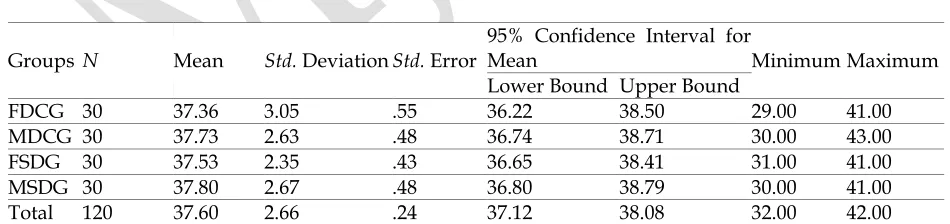
Table 1
Descriptive Statistics Results Comparing FDCG, MDCG, FSDG, and MSDG Mean Scores on the OQPT
Groups N Mean Std. Deviation Std. Error
95% Confidence Interval for
Mean Minimum Maximum
Lower Bound Upper Bound
FDCG 30 37.36 3.05 .55 36.22 38.50 29.00 41.00
MDCG 30 37.73 2.63 .48 36.74 38.71 30.00 43.00
FSDG 30 37.53 2.35 .43 36.65 38.41 31.00 41.00
MSDG 30 37.80 2.67 .48 36.80 38.79 30.00 41.00
Total 120 37.60 2.66 .24 37.12 38.08 32.00 42.00
The mean scores of the FDCG (M = 37.36), MDCG (M = 37.73), FSDG (M = 37.53), and MSDG (M = 37.80) were, though not drastically, different from one another on the OQPT. To figure out whether the differences among these mean scores were significant or not, one needs to check the p value under the
Sig. column in the ANOVA table below (Table 2.).
Modern Journal of Language Teaching Methods ISSN: 2251-6204
Vol. 6, Issue 7, October 2016
Page 18
Table 2
Results of One-Way ANOVA for Comparing FDCG, MDCG, FSDG, and MSDG Mean Scores on the OQPT
Sum of Squares Df Mean Square F Sig.
Between Groups 3.49 3 1.16 .16 .92
Within Groups 841.10 116 7.25
Total 844.59 119
As is displayed in Table 4.2, there was not a statistically significant difference in the OQPT scores for FDCG (M = 37.36, SD = 3.05), MDCG (M = 37.73, SD = 2.63), FSDG (M = 37.53, SD = 2.35), and MSDG (M = 37.80, SD = 2.67) because the p value under the Sig. column was greater than the specified level of significance (i.e. .92 > .05), indicating that the four groups did not significantly differ in terms of their overall language proficiency and thus were homogeneous. This result is also shown in the bar chart
Figure 1. The Mean Scores of FDCG, MDCG, FSDG, and MSDG on the OQPT
This bar chart depicts the fact that the differences among the four groups on the OQPT were not considerable.
Results for the Research Questions of the Study
The first research question of the study asked whether using dicto-comp led to the improvement of the grammatical competence of the FDCG learners or not. For this purpose, the pretest and posttest scores of the FDCG learners were compared using a paired-samples t test. The second research question of the study was essentially similar to the first one, except that it was about the MDCG learners. Consequently, the pretest and posttest scores of the MDCG learners were compared via another paired-samples t test. Since the third and fourth research questions were similar to the first two research questions except that they were about standard dictation, rather than dicto-comp, paired-samples t test was conducted two more times to compare the pretest and posttest scores of the FSDG learners and the MSDG learners. Table 1. presents the descriptive statistics for the pretest and posttest scores of the four groups of the study.
35 36 37 38 39 40
FDCG MDCG FSDG MSDG
Modern Journal of Language Teaching Methods ISSN: 2251-6204
Vol. 6, Issue 7, October 2016
Page 19
Table 3
Descriptive Statistics Results Comparing Pretest and Posttest Scores of the FDCG, MDCG, FSDG, and MSDG
Pairs Mean N Std. Deviation Std. Error Mean
FDCG Pretest
FDCG Posttest
23.86 30 2.41 .44
37.73 30 2.63 .48
MDCG Pretest
MDCG Posttest
23.70 30 2.83 .51
36.63 30 1.92 .35
FSDG Pretest
FSDG Posttest
23.36 30 2.88 .52
26.06 30 4.91 .89
MSDG Pretest
MSDG Posttest
23.83 30 2.87 .52
25.76 30 4.65 .85
Comparing the mean scores of the pretest and the posttest, it could be seen that for all the four groups, the posttest mean scores exceeded their corresponding pretest scores. That is, FDCG learners managed to achieve a mean score of 37.73 on the posttest, while their pretest mean score was 23.86. For MDCG learners, the same thing happened. Their posttest mean score (M = 36.63) was far greater than their pretest mean score (M = 23.70). Likewise, the pretest mean score of the FSDG learners (M = 23.36) improved to be 26.06. Finally, for the MSDG learners, the posttest mean score (M = 25.76) was greater than their pretest mean score (M = 23.83). The significance or insignificance of these differences between the pretest and posttest scores of the four groups could be determined in the t test table below (Table 4.). Table 4
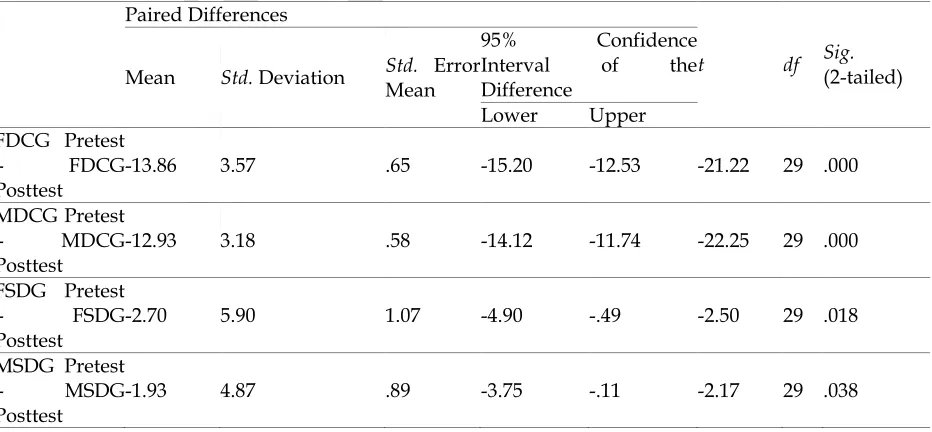
Paired Samples t Test Results Comparing Pretest and Posttest Scores of the FDCG, MDCG, FSDG, and MSDG
Paired Differences
t df Sig.
(2-tailed) Mean Std. Deviation Std. Error
Mean
95% Confidence
Interval of the
Difference
Lower Upper
FDCG Pretest
– FDCG
Posttest
-13.86 3.57 .65 -15.20 -12.53 -21.22 29 .000
MDCG Pretest
– MDCG
Posttest
-12.93 3.18 .58 -14.12 -11.74 -22.25 29 .000
FSDG Pretest
– FSDG
Posttest -2.70 5.90 1.07 -4.90 -.49 -2.50 29 .018
MSDG Pretest
– MSDG
Posttest
-1.93 4.87 .89 -3.75 -.11 -2.17 29 .038
Modern Journal of Language Teaching Methods ISSN: 2251-6204
Vol. 6, Issue 7, October 2016
Page 20
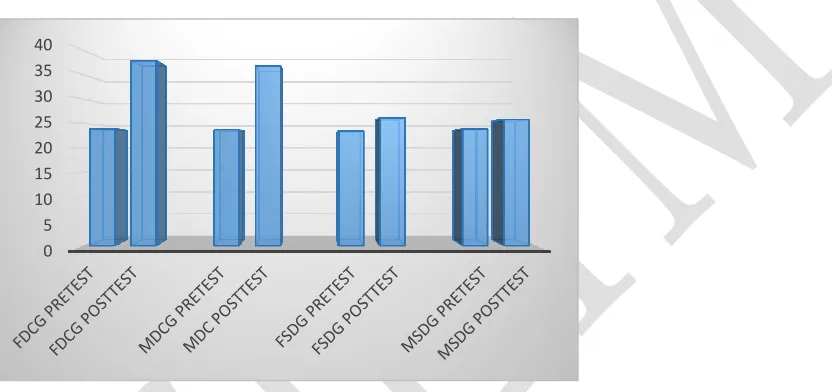
The Sig. (2-tailed) value represents a p value lower than the significance level (.000 < .05) for the FDCG, indicating that the difference between the pretest and posttest scores of the FDCG learners had been statistically significant. The same was also true for the pretest and posttest scores of the MDCG (p = .000), FSDC (p = .018), and MSDG (p = .038). This means that the grammatical competence of learners of both genders improved significantly as a result of exposure to both types of treatment (i.e. dicto-comp and standard dictation). However, the improvement was greatest for FDCG since the mean difference between the pretest and posttest scores (as shown under the Mean column in Table 4.4.), irrespective of the negative mark, was the highest value (-13.86). The second most value out there is the value in front of MDCG (-12.93) and thus the MDCG had the second most improvement. Thus was followed by the mean difference value in front of FSDG (-2.70). Finally, the least improvement was made by the MSDG learners as the mean difference was -1.93. It could thus be inferred that, by and large, dicto-comp groups improved more than standard dictation groups, and also, females improved a little more than did male learners. This is also graphically shown in the bar chart below (Figure 4.2).
Figure 2. The Mean Scores of FDCG, MDCG, FSDG, and MSDG on the Pretest and Posttest
It is well beyond doubt that the all the four groups showed better performances on their posttests, compared to their pretest performances. This indicates that both female and male learners’ knowledge of grammar improved via the two instructional approaches (i.e. dicto-comp and standard dictation).
Discussion
As set at the beginning of the study, the aim of the current study was to test the following research hypotheses:
HO1: Using dicto-comp does not have any significant effect on Iranian female intermediate EFL students’ grammatical competence.
HO2: Using dicto-comp does not have any significant effect on Iranian male intermediate EFL students’ grammatical competence.
HO3: Using standard dictation does not have any significant effect on Iranian female intermediate EFL students’ grammatical competence.
0 5 10 15 20 25 30 35 40
Modern Journal of Language Teaching Methods ISSN: 2251-6204
Vol. 6, Issue 7, October 2016
Page 21
HO4: Using standard dictation does not have any significant effect on Iranian male intermediate EFL students’ grammatical competence.
Addressing Research Hypotheses One and Two
Since the assumption made by these two hypotheses are the same both are discussed in one section. To test these research hypotheses, the pretest and posttest scores of the female and male dicto-comp group learners were compared using paired-samples t tests. The obtained results indicated that the treatment positively affected the grammatical competence of female and male learners. Thus, the first and second null hypotheses of the study can be safely rejected. Kidd (1992) stated that based on different theoretical and pragmatic reasons, dictation is an inspiring typical technique to enhance both direct learning and the indirect acquisition of L2 grammatical structures. He argued that dictation could be a beneficial general method for teaching grammar to ESL and EFL learners. Special techniques of dictation such as dicto-comp are easy to operate in the classroom and attract students' attention to the target language structure. Therefore, currently dictation seems to be undergoing a revival as a useful teaching device. It is proved that dictation can help students develop all language skills, such as grammar, oral communication, pronunciation, and listening comprehension.
Dictation can help both the learners and teachers remove the grammatical problems commonly combined with the troubles of the other aspects of the language. The dictation will then operate as a form of review, the possibility of error will be reduced, and the students will be encouraged by their progress (Cullen, 2007).
Alkire (2002) in his article states that dictation can show students the kinds of spelling errors they are prone to make. It also helps develop all four language skills in an integrative way. It develops short-term memory. Students practice retaining meaningful phrases or whole sentences before writing them down. It can serve as an excellent review exercise. It is psychologically powerful and challenging. It fosters unconscious thinking in the new language. In addition, if the students do well, dictation is motivating. Therefore, it is quite axiomatic that disregarding the gender of the participants involved, dictation and specially dicto-comp which better incorporate the above-mentioned features can lead to grammar improvement of EFL learners.
The findings of this study are in line with the ones reported by Khoii and Pourhassan (2012). They investigated the effects of three types of dictation practice (standard dictation, dicto-comp, and dictogloss) on elementary EFL learners' immediate and delayed performance on tests of present tense, to be verbs and indefinite articles in English. The results indicated that the groups which receive dicto-comp outperformed other groups in developing grammatical competence as regards the tenses under investigation. In dicto-comp activities, the students have to listen to the passage as a whole and are not allowed to write it during the listening phase. Then they try to reconstruct the text from their memory without any further help. Therefore, there might be more focus on meaning and the role of certain grammatical structures in creating the meaning which can result in better grammar learning and internalization.
Stansfield (1985) reports that “more than 50 studies of dictation were conducted in the 1970s, and these findings were invariably favorable” (p. 26). Takeuchi (1997) did an experiment of dictating on 207 English language learners in Japan. Learners were given the dialogues in movies for more than 13 weeks. Finally, he observed the big change in functional abilities of those students. Takeuchi concluded that his experiment “proves that dictation is effective in foreign language teaching” (p. 62).
Modern Journal of Language Teaching Methods ISSN: 2251-6204
Vol. 6, Issue 7, October 2016
Page 22
Addressing Research Hypotheses Three and Four
To test these research hypotheses, the pretest and posttest scores of the female and male standard dictation group learners were compared using paired-samples t tests. The obtained results indicated that the treatment positively affected the grammatical competence of female and male learners. Thus, the third and fourth null hypotheses of the study can be safely rejected.
According to Rivers (1981), standard dictation is not just spelling practice. The backwash effect of this kind of dictation can help both the students and teachers overcome significantly the grammatical problems mostly alongside the problems of the other areas of the language. The dictation will then serve as a form of review, the possibility of error will be reduced, and the students will be encouraged by their progress.
As this study showed, standard dictation can be a means of assessing students’ grammar learning ability and helping them to improve their grammar, and more importantly, the motivation implementing such a tool is created in learners to learn the language eagerly and effectively. Standard dictation helped learners to become aware of their own learning and monitor themselves. The students learned to be responsible for their own learning and become more independent learners.
The findings of this study lend support to those obtained by Domsky (2015). This study intended to investigate the effect of standard dictation on grammar learning ability of young Iranian beginner English as foreign language (EFL) learners. The findings confirmed the fact that standard dictation can significantly affect grammar learning ability of young Iranian beginner EFL learners. The findings were also in line with those of the study conducted by Khoii and Pourhassan (2012). They also reported the positive effect of standard dictation on grammar improvement of EFL learners. The findings also supported those reported by Adel and Hashemian (2015). They explored the effect of controlled writing (dictation) on the accuracy (in this case, grammar) of the writing of adult Iranian EFL learners. The results revealed that dictation has a positive impact on grammar accuracy of L2 learners.
In sum, there might be several reasons for the findings germane to third and fourth hypotheses of this study. In the standard dictation group, the students wrote the sentences or phrases chunk by chunk as they heard them; therefore, they kept the chunks only for a short time in their memory. Thus, this type of dictation involved immediate recall and had an immediate effect on the students' performance on the given test. As stated by Reinders (2009), having to remember only a small amount of text will allow learners to reproduce the text more accurately; in other words, greater uptake is likely to take place.
Conclusion
This study revealed the positive effect of standard dictation and dicto-comp on grammar improvement of Iranian EFL learners. In addition, there was no significant difference between the performance of male and female learners meaning that gender was not an influential factor as far as the effectiveness of dictation is concerned. Therefore, this study was a sort of confirmation for previous studies highlighting the importance and value of dictation both as a testing and teaching device.
A large number of previous studies stated that dictation has potential value for grammar teaching without regarding the size of the class, learners’ gender and the learners’ proficiency level. For instance, Kidd (1992) argues that, in order to justify the usefulness of dictation practice for teaching grammar, one can resort to Oller’s notion of expectancy grammar. According to Oller Jr and Perkins (1978), a learner’s expectancy grammar is at the core of his or her predictive capacity. It is the ability to understand the
Modern Journal of Language Teaching Methods ISSN: 2251-6204
Vol. 6, Issue 7, October 2016
Page 23
speech by “continually formulating, modifying, and reformulating hypotheses about the underlying structure and meaning of input signals” (cited in Kidd, 1992, p. 50). Dictation can be an outstanding activity to practice and improve this general capacity, since it motivates the learner to pay attention to the forms as well as to the meanings of grammatical structures, both semantically and pragmatically. He continues that this approach is reliable with the modern view that the learning of grammatical forms must always occur in connection with semantic and/or pragmatic factors, the latter including both sociolinguistic and discourse related meanings (Celce-Murcia, 1991; Larsen-Freeman, 1991).
Implications of the Study
The results of the current study can be beneficial for all instructional centers. They bear some implications for SLA researchers, material developers, syllabus designers, test makers, and L2 teachers. This study, according to the obtained results, may offer some tips for L2 teachers who might pay some attention to teaching grammar or any other four major skills; listening, speaking, reading, writing, because standard dictation and dicto-comp cannot be restricted to any skills or subjects in isolation.
The results are useful for teachers in schools, language centers and institutes in that they can change the way they assess and instruct the students and move toward a more learner-oriented method. By the use of dictation, they can design an assessment system in which the students have to study during the whole term for the course and not just study for the test. This way they will be more motivated to learn and will use meta-cognitive strategies and think about their learning. They will try to document their learning and this way enhances their ability in language skills. If we change the way we assess our learners, and move away from test-oriented procedures and seek help from alternative assessments like dictation, then it will indirectly affect teaching, learning, test development, syllabus design, and material development. Undoubtedly, implementing dictation is a continuous long-term assessment and it is more oriented to process than product. This way the students themselves are also involved in the process of evaluation and teachers can integrate assessment and instruction in order to obtain better results for their classes.
REFERENCES
Adel, R., & Hashemian, M. (2015). Effects of Dicto-Comp and Dictation on the Writing Skill of Female Adult Iranian EFL Learners. English Language Teaching, 8(11), 17–27.
Alkire, S. (2002). Dictation as a language learning device. The Internet TESL Journal, 8(3), 1. Best, J. W., & Kahn, J. V. (2006). Research in Education (10th Edition). Pearson Education Inc.
Bialystok, E., & Sharwood Smith, M. (1985). Interlanguage is not a state of mind: An evaluation of the construct for second-language acquisition. Applied Linguistics, 6(2), 101–117.
Cai, H. (2013). Partial dictation as a measure of EFL listening proficiency: Evidence from confirmatory factor analysis. Language Testing, 30(2), 177–199.
Canale, M., & Swain, M. (1980). Theoretical bases of com-municative approaches to second language teaching and testing. Applied Linguistics, 1(1), 1–47.
Celce-Murcia, M. (1991). Grammar pedagogy in second and foreign language teaching. TESOL Quarterly,
25(3), 459–480.
Celce-Murcia, M., & McIntosh, L. (1991). Teaching English as a second or foreign language. Heinle & Heinle Boston, MA.
Cullen, B. (2007). Song Dictation. Retrieved December 11, 2008, from http://iteslj.org/ techniques/Cullen-song dictation.html
Debata, P. K. (2013). The Importance of Grammar in English Language Teaching-A Reassessment.
Modern Journal of Language Teaching Methods ISSN: 2251-6204
Vol. 6, Issue 7, October 2016
Page 24
Language in India, 13(5), 286–482.
Domsky, J. G. H. (2015). The Effect of Standard Dictation on Grammar Learning Ability of Young Iranian Beginner EFL Learners. International Journal of Language Learning and Applied Linguistics World, 9(3), 156–166.
Ezenwosu, N. E. (2011). Dictation as a veritable tool for language proficiency on project educational reform in Nigeria. African Research Review, 5(6), 18–25.
Farhady, H., Jafarpur, A., & Birjandi, P. (2001). Testing language skills: From theory to practice. Tehran: SAMT Publications.
Farzami Pooya, A. (2014). The Effect of Visual Dictation on Grammar Learning by Iranian Children.
International Journal of Language Learning and Applied Linguistics Word (IJLALW), 6(1), 107–118.
Hudson, R. A., & Stubbs, M. (1992). Teaching grammar: a guide for the National Curriculum. Blackwell Oxford.
Khoii, R., & Pourhassan, E. (2012). Effects of Different Types of Dictation Practice on Immediate and Delayed Performance on Tests of Present Tense “To Be” Verbs and Indefinite. Islamic Azad University North – Tehran Branch Faculty Of Foreign Language.
Kiany, G. R., & Shiramiry, E. (2002). The effect of frequent dictation on the listening comprehension ability of elementary EFL learners. TESL Canada Journal, 20(1), 57–63.
Kidd, R. (1992). Teaching ESL grammar through dictation. Tesl Canada Journal, 10(1), 49–61.
Krashen, S. D. (1982). Principles and practice in second language acquisition. New York (Vol. 2). Oxford Pergamon. Retrieved from http://aces.ir/attachments/22d1286622494-communicative-approach-stephen-crashen.pdf
Krashen, S. D. (1985). The input hypothesis: Issues and implications. Addison-Wesley Longman Ltd.
Larsen-Freeman, D. (1991). Teaching grammar. Teaching English as a Second or Foreign Language, 2, 279– 296.
Lightfood, A. (2006). Using Dictation. Retrieved from
http://www.teachingenglish.org.uk/think/methodology/dictation.shtml
Lund, S. K., & Light, J. (2003). The Effectiveness of Grammar Instruction for Individuals Who Use Augmentative and Alternative Communication SystemsA Preliminary Study. Journal of Speech, Language, and Hearing Research, 46(5), 1110–1123.
Madsen, S. H. (1983). Techniques in Teaching. Oxford: Oxford University Press.
Marzban, A., & Abdollahi, M. (2013). The effect of partial dictation on the listening comprehension ability of Iranian intermediate EFL learners. International Research Journal of Applied and Basic Sciences, 5(2), 238–244.
McLaughlin, B., Rossman, T., & McLeod, B. (1983). Second Language Learning: An Information‐ Processing Perspective1. Language Learning, 33(2), 135–158.
Montalvan, R. G. (1990). Dictation updated: Guidelines for teacher-training workshops. English Language Programs Division, Bureau of Educational and Cultural Affairs, United States Information Agency. Norris, R. (1993). Using creative dictation to manage, motivate, and activate large groups of false
beginners. Fukuoka Women’s Junior College Studies, 45, 71–82.
Nunan, D. (2005). Important tasks of English education: Asia-wide and beyond. Asian EFL Journal, 7(3), 5– 8.
Oller Jr, J. W., & Perkins, K. (1978). Language in Education: Testing the Tests. ERIC.
Modern Journal of Language Teaching Methods ISSN: 2251-6204
Vol. 6, Issue 7, October 2016
Page 25
Oller, J. W. (1979). Language testing at school: A pragmatic approach. London: Longman.
Paek, T. S., Chickering, D. M., Badger, E. N., & Wu, Q. (2010, March 30). Personalizing a context-free grammar using a dictation language model. Google Patents.
Patterson, N. G. (2001). Just the facts: Research and theory about grammar instruction. Voices from the Middle, 8(3), 50–55.
Rahimi, M. (2008). Using dictation to improve language proficiency. Asian EFL Journal, 10(1), 33–47. Reinders, H. (2009). Learner uptake and acquisition in three grammar-oriented production activities.
Language Teaching Research, 13(2), 201–222.
Richards, J. C., & Renandya, W. A. (2002). Methodology in language teaching: An anthology of current practice. Cambridge university press.
Rivers, W. M. (1981). Teaching foreign-language skills. ERIC.
Rost, M. (2002). Teaching and Researching Listening Applied Linguistics in Action Series Longman. Longman: Edinburg.
Rutherford, W. E. (2014). Second language grammar: Learning and teaching. Routledge.
Stansfield, C. W. (1985). A history of dictation in foreign language teaching and testing. The Modern Language Journal, 69(2), 121–128.
Takeuchi, O. (1997). Dictation: Is it really effective for language teaching. Kansai University, Audio-Visual Education, 20, 55–63.
Valette, R. M. (1964). The use of the dictee in the French language classroom. The Modern Language Journal,
48(7), 431–434.
Wangchao, M. (2002). On EFL teaching from an analysis of compound dictation of CET-6, Jan. 2001 [J].
Foreign Language World, 2, 9.
Yang, M. (2009). A Study of the Effects of Dictation Methods on Dictation Test Results [J]. Foreign Language Learning Theory and Practice, 2, 10.
Zhiqian, W. (1989). Possible Aural Activities in the Listening Class. Guidelines: A Periodical for Classroom Language Teachers, 11(1), 33–41.
Zhonggang-Gao, C. (2001). Second language learning and the teaching of grammar. Education, 122(2), 326.
Modern Journal of Language Teaching Methods ISSN: 2251-6204
Vol. 6, Issue 7, October 2016
Page 26
IRANIAN EFL LEARNERS' VIEWS ON LEARNING GRAMMAR
THROUGH WEB- AND BOOK-BASED MATERIALS
Zahra Rouholamin*
Department of English, Isfahan (Khorasgan) Branch, Islamic Azad University, Isfahan, Iran Email: [email protected]
Sajad Shafiee
Department of English, Shahrekord Branch, Islamic Azad University, Shahrekord, Iran Email: [email protected]
ABSTRACT
SI FAN (2011) STATES THAT THE WEB AND WEB-BASED TECHNOLOGIES HAVE BECOME WIDELY ACCEPTABLE AND FEASIBLE IN THE MODERN SOCIETY. THEY HAVE CREATED A NEW PARADIGM IN VARIOUS AREAS, INVOLVING THE FIELD OF EDUCATION. THE WEB SUPPLIES TEACHING STAFF AND LEARNERS WITH A INFLUENTIAL SOURCE FOR INTERACTIVE COMMUNICATION, EVALUATION, AND ASSESSMENT. THIS PAPER SHOWS THE ATTITUDES OF EFL LEARNERS TOWARD LEARNING GRAMMAR IN AUTONOMOUS WEB-BASED AS WELL AS TRADITIONAL BOOK-BASED CONTEXTS AND ALSO TOWARD SOME MATERIALS THAT ARE USED FOR THESE SITUATIONS. THE PARTICIPANTS CONSISTED OF 30 HOMOGENOUS MALE AND FEMALE LEARNERS. THEY WERE ASKED TO FILL OUT QUESTIONNAIRE, WHICH WAS ADAPTED AND USED FOR THE PURPOSE OF THE STUDY. THE ANALYSIS OF OBTAINED DATA SHOWS THAT ALTHOUGH COMPUTERS HAVE A LOT OF WELL-DOCUMENTED ADVANTAGES, THE PARTICIPANTS IN THIS STUDY GENERALLY PREFERRED PAPER-BASED MATERIALS. THE IMPLICATIONS OF THIS STUDY SUGGEST SOME SOLUTIONS FOR IMPROVING BOTH WEB- AND BOOK- BASED MATERIALS.
KEY WORDS: CALL, WEB-BASED MATERIALS, BOOK-BASED MATERIALS, EFL LEARNERS ATTITUDE.
1. Introduction
For many years, learner autonomy has been noticed essential and Language Resource Centers (LRCs) and the materials that attached within them are frequently imagined as ideal physical locations to facilitate such autonomy. Centers will often provide materials to cover the range of language skills as well as vocabulary, essentially above all else, grammar-based materials. In the past, such materials would be specifically paper-based frequently comprising in house task sheets and published self-study resource books. Recently, computers have come to play an important role and in many situations it would be difficult to imagine an LRC without computer.
Numerous authors have highlighted the important role of computer in the process of language learning. The term Computer Assisted Language Learning (CALL) became established in language education in the early1980s (Chapelle, 2001). The Levy (1997) named it as tutorial CALL, because it is rolled as a teacher for students. Richardson and Swan (2003) noted that online learning has been defined as any class that offers at least part of its curriculum in the online course delivery
Modern Journal of Language Teaching Methods ISSN: 2251-6204
Vol. 6, Issue 7, October 2016
Page 27
mode, or as transmission of information and/or communication via the internet without instructors and students being connected at the same. Some people named tutorial as a dated application and one which is associated with a bygone era of Skinner (1954) and behaviorism, and as such, it is sometimes featured as ‘drill and kill’ because students would mechanically enter answers into a computer software program over and over again until they got it right. However a lot of changes have done in CALL. Levy and Stockwell (2006: 185) note that ‘Although a highly valid and useful appl