Vol.7 No.3
Received: April 2018 , Accepted: September 2018 , Available online: September 2018
Hossein Babaeipour1, Mansour Sahebozamani2*, Fariborz Mohammadipour3, Alireza Vakilian4
1 Instractor of Sport Sciences, Faculty of Literature and Human Sciences, Vali-e-Asr University of Rafsanjan, Rafsanjan, Iran and PhD student of Sport Injuries and Corrective Exercises, Faculty of Sport Sciences, Shahid Bahonar University of Kerman, Kerman, Iran
2 Professor Department of Sport Injuries and Corrective Trainings, Faculty of Sport Sciences, Shahid Bahonar University of Kerman, Kerman, Iran
3 Associate Professor Department of Sport Biomechanics, Faculty of Sport Sciences, Shahid Bahonar Universityof Kerman, Kerman, Iran
4 Associate Professor of Neurology, Faculty of Medicine, Neurology Department Rafsanjan University of Medical Sciences, Rafsanjan, Iran and Non Communicable Diseases Research Center, Rafsanjan University of Medical Sciences, Rafsanjan, Iran
Corresponding Author: Department of Sport Injuries and Corrective Trainings, Faculty of Sport Sciences, Shahid Bahonar University of Kerman, Kerman, Iran Email:[email protected]
Abstract
Introduction: Stroke is the most common and debilitating nervous disease in adults, which is a major problem in rehabilitation medicine. There is evidence that hydrotherapy is associated with increased immunity, reduced risk of falling, more pressure on the muscles, and challenging the balance system. Hydrotherapy is a method to improve outcome. The purpose of this study was to evaluate the effect of 6 weeks of aquatic training in shallow and deep water on balance patients with stroke in Rafsanjan in 2017. Methods: This study is a randomized clinical trial (RCT) with pre-test and post-test design. 36 available male patients with chronic ischemic stroke were randomly divided into 3 same groups of 12 subjects including two groups (shallow, deep) and one control group. Experimental groups had the aquatic training program that included 6 weeks (3 sessions of exercises per week) and the control group did not experience any aquatic training. All participants were assessed their balance, used timed up and go test and the berg balance scale. Results: Findings showed that the mean age, height, weight and body mass index were not significantly different in the three groups (P >0.05). The results showed that the intervention groups (shallow and deep water) had a significant increase in mean scores of balance (P <0.001) were significantly increased, while this increase was not significant in the control group. Also, in both training groups (shallow and deep water), no significant superiority was observed in relation to each other, and the effect of both depth on balance tests were the same (P<0.005). Conclusion: The results showed that although the two different depths of water defined in this study had not any different effect on the mean scores of these variables, but the protocol of aquatic training in this study could be considered as a safe and effective method. Positive therapeutic and pharmaceutical treatments as well as a complementary treatment alongside new approach and effective way to improve balance in patients with chronic ischemic stroke regarded and used.
Keywords: Aquatic Training Shallow and Deep, Balance, Chronic Ischemic Stroke
TRAINING ON THE BALANCE OF CHRONIC ISCHEMIC STROKE PATIENTS VOL. 7 (3)
International Journal of Applied Exercise Physiology www.ijaep.com
Introduction
The effects of stroke are devastating and consist of neurologic, musculoskeletal, and cognitive manifestations. Among Balance disorders are common in stroke patients. Postural instability and sway are examples of balance impairments that are prevalent in those who have suffered a stroke [1]. One of the most important goals of rehabilitation for patients with stroke is improvement in balance, ideally to the point of achieving independent ambulation without requiring physical assistance or
supervision by another person [2]. Many different rehabilitation approaches
have been used to improve disability after stroke. Rehabilitation can help stroke survivors to walk independently with sufficient velocity and endurance [3]. One promising intervention used to facilitate this goal is hydrotherapy. The physical attributes of hydrodynamics, such as density, buoyancy, hydrostatic pressure, and viscosity, provide environmental conditions that improve physiological processes and motor activity [4].
Variations in the aquatic environment, such as the production of turbulence, create an interesting medium for working on static and dynamic balance Movement in aqueous may be modified in numerous
ways, creating diverse therapeutic
situations [5].
Previous studies have found that aquatic therapy can achieve optimal mobility in patients with neurological disorders [6]. Six weeks of aquatic exercise was more effective than land-based exercise in improving balance in older adults [7], and a 12-week aquatic exercise was beneficial in improving gait and balance in the elderly [8]. In post-stroke patients, an eight-week aquatic exercise programme was found to significantly increase
cardiovascular endurance, maximal
workload, gait speed and paretic lower-extremity muscle strength [9]. In 2014, a systematic review of the effectiveness of
aquatic therapy indicated that there is ‘fair’ evidence that aquatic therapy improves dynamic balance and gait speed in individuals with neurological disorders, especially those with multiple sclerosis, Parkinson’s disease and stroke [10].
patients post-stroke may present with barriers to conventional dry land therapy, such as impaired balance, decreased safety awareness, and a fear of falling. These barriers may prevent patients from acquiring their full rehab potential [1]. The addition of an aquatic therapy program may be a solution to these barriers and allow for better functional
outcomes. Aquatic therapy as an
intervention for patients post-stroke will be discussed.
Overall though Literature shows
evidence that the practice of aquatic physical exercises in stroke patients is considered an improvement factor on
physical Capabilities, increasing
coordination, agility, body Perception,
body schema, action and Reaction
velocity, strength, gait, range of motion, better balance and directionality, and psychological well-being [1,4,5, 9,10]. In a study conducted by the researcher, it was not found to study in the form of a Aquatic therapy program especially at two depths of water in patients with ischemic and chronic stroke. to study balance (static
and dynamic) evaluation with two
authoritative testing the Timed Up and Go (TUG) Test and the Berg Balance Scale (BBS).
70
International Journal of Applied Exercise Physiology www.ijaep.com
Methods
This study is a randomized clinical trial (RCT) with pre-test and post-test design. the research population consisted of all male patients with chronic ischemic stroke in Rafsanjan city who had been referred to Ali ibn Abi Talib Hospital during two years and filed a case. 36 available male patients with chronic ischemic stroke were randomly divided into 3 same groups of 12 subjects including two groups (shallow, deep) and one control group. Experimental groups had the aquatic training program that included 6 weeks (3 sessions of exercises per week) and the control group did not experience any aquatic training.
All participants were assessed their
balance, used timed up and go test and the berg balance scale.
The inclusion criteria were: 1- Aged
40–70 years; 2-first stroke Chronic ischemia (history obtained), 3-Patients with hemiparesis (slight motor weakness) that the loss of muscle strength five fifth to three-fifths 4- At least 6 months and a maximum of 2 years after the onset of illness and the desire and motivation to participate in the study, 5- Individuals with a score of 21-44 from Berg's balance, 6-were able to walk 10 m without assistance, 7-The ability to stand without help (at least 5 minutes) and 8- Not practicing any other periodic physical activity.
The exclusion criteria were: 1- Having certain diseases (uncontrolled arterial pressure, Uncontrolled diabetes, brain tumors, uncontrolled heart failure, recent myocardial infarction, severe respiratory illnesses). and 2- Absence in training for 3 sessions.
This information was collected through observation, examination, questionnaire,
test, medical records and interviews. Demographic data including age, height,
weight, BMI, In a questionnaire
demographic was taken from the person. It should be mentioned, Exercise groups (shallow, deep) and control group were segregated through a randomization table
(Minimization Randomization). By this
method, the researcher intended to homogenize the patients in the examined groups so that the patients in terms of age and balance were placed in the same three groups so that there was no difference between the three groups and the abusing to the same group and It also does not interfere with the statistical results. Therefore, in Table 1, according to the two criteria for entering the study, which is the age of patients aged 40 to 70 years and their score (Berg), they range from 21 to 44 (average), were classified into two categories.
In the study, which was approved by the
Institution's ethical committee and
developed under the process number (IR.RUMS.REC.1396.207), fulfilling the
ethical principles included in the
Declaration of Helsinki, in addition to complying with the present legislation. As well as at the Iranian Center for Clinical
Trials (www.IRCT.ir) to number
(IRCT20180513039626N1) registration
and all assessments by researcher and research with the written consent of the patients and patients were allowed to opt-out if they did not wish to cooperate at all
times. Also, the patient was reassured that
all information obtained from them is confidential and will be used solely for research purposes.
List of abbreviations: (BBS):Berg balance scale
(TUG): Timed up and go
TRAINING ON THE BALANCE OF CHRONIC ISCHEMIC STROKE PATIENTS VOL. 7 (3)
71
International Journal of Applied Exercise Physiology www.ijaep.com
Table 1: Randomization for homogenization of male patients with chronic ischemic stroke in terms of age and balance status
Aquatic Therapy Sessions
the control group did not participate in any exercise during this period. but Both experimental groups conducted aquatic training in water with a temperature of 34–36 °C and an air temperature of 24°C [11]. for 30 minutes a day, 3 days a week, for 6 weeks. Matching the training in two depths in terms of the type and pattern of movement and increasing the number of sets and repetitions in each training session is the same, According to the principle of practice science. Each exercise in the first session begins with a three-repetition set, and finally ends in the final sessions with three sets of ten repetitions so that the principle of exercise overload is observed, For The first group (shallow) took place in deep water up to hip height (anterior superior iliac spine) and second (deep) in
deep water up to chest height subjects (xiphoid process sternum).
Most patients during all the practice sessions for security and peace of mind achieved in the exercise protocol aquatic two lifeguards at the pool were present. Also during training Discomfort and pain in the chest or dizziness felt ill practice was ceased or reduced [5].
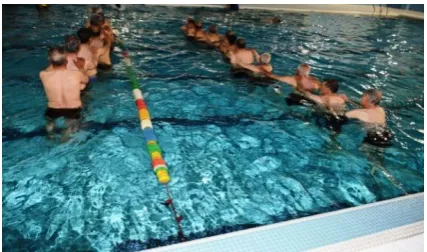
Aquatic training consisted: hip flextion, hip extension, lung walking, backward walking, hip abductor strech, hip tensor stretch, stork stand, side stepping, bent knee hip rotation [1] Figure 1. It has been shown earlier that the water exercises used in this study are well able to improve the central stability and balance of patients with stroke [1].
Figure 1:An example of the exercises of the two experimental groups (lung walking)
Variable status Shallow practice group (SPG) Deep practice group (DPG) Control group (CG)
Age (year)
40-55 2 2 2
56-70 10 10 10
Berg (Score)
21-32 0 0 0
72
International Journal of Applied Exercise Physiology www.ijaep.com
To conduct balance this study, we used: the Timed Up and Go (TUG) Test and the Berg Balance Scale (BBS)
Timed “Up & Go” test (TUG) the Timed Up and Go (TUG) test, which has provided good results, for instance the balance test that involves some functional maneuvers, such as getting up from a chair, walking, turning around, and sitting down again [12].
The TUG test was utilized at the beginning and end of hydrotherapy for a total of 18 therapy sessions. This test evaluates the functional mobility of the individual, including items such as balance, gait speed, and getting up from a sitting to a standing position (when timing is begun), walking 3 m, returning the 3 m and sitting on the chair again until their backs lean against the back of the chair (when timing is stopped), [13, 14].
The intrarater reliability of the TUG was high in individuals with chronic stroke. One study showed an ICC of .95 (95% CI, .84–.99), [15] and another demonstrated an ICC of .96 (95% CI, .93–.98), [16].
The Berg Balance Scale (BBS) was first
introduced in 1989 [17]. The scale is a
functional balance measurement and
consists of 14 items, each rating a participant’s ability to maintain stability in a specified functional task on a 5-point (0-4) scale, with 0 indicating an inability to complete the task entirely and 4 indicating an ability to complete the task criterion. Scores can range from 0 to 56. The higher the score, the better the postural control [17, 18].
The BBS has demonstrated excellent test-retest reliability (intraclass correlation
coefficient [ICC]=95-98), [19]. and
interrater reliability (ICC=95) [20]. for participants with stroke and has been extensively used for measuring the functional balance performance of elderly participants, [21] stroke survivors, [20, 22] and participants with Parkinson disease [23]. It has also been used to evaluate the risk of falling with participants who have had a stroke [24].
The time required to perform this scale is 15 to 20 minutes. After completing questions with a score of 14 questions, including: Sitting to standing, Standing
unsupported, Sitting unsupported,
Standing to sitting, Transfers, Standing with eyes closed, Standing with feet
together, Reaching forward with
outstretched arm, Retrieving object from floor, Turning to look behind, Turning 360 degrees, Placing alternate foot on stool, Standing with one foot in front, Standing on one foot [1]. The student's equilibrium score is calculated and interpreted as follows, Scores (41-56 = low fall risk, 21-40 = medium fall risk, 0 –20 = high fall
risk),[25].
Data Analysis
TRAINING ON THE BALANCE OF CHRONIC ISCHEMIC STROKE PATIENTS VOL. 7 (3)
73
International Journal of Applied Exercise Physiology www.ijaep.com Results
In the present study, Which shows that the three groups did not have a significant difference in mean age (P = 0.889).
According to the findings, mean age, height, weight and BMI in the three groups did not show a significant difference (P> 0.05), (table 2).
Table 2: The demographic characteristics of male patients with chronic ischemic stroke in the studied groups
Sig Control group (CG)
(n=12) Deep practice group (DPG)
(n=12) Shallow practice group (SPG)
(n=12) Group
Variable Mean ± SD Mean ± SD Mean ± SD
0.889 60.83 ± 5.48
60.17 ± 7.383 59.50 ± 7.103
Age (year)
0.263 68.625 ± 8.090
75.833 ± 14.622 70.500 ± 9.115
Weight (KG)
0.638 164.33 ± 7.73
166.67 ± 4.60 164.92 ± 5.961
Height (CM)
0.473 25.433 ± 2.72
27.216 ± 4.502 25.974 ± 3.42
Body Mass Index (BMI)
in Table 3,the mean and standard deviation of the balance test variables in patients with stroke can be seen in the pretest and posttest stages by the intervention and control groups.The results
show that there is a significant difference between the two intervention groups (shallow and deep water) in the pretest and posttest scores, While this increase is not significant in the control group.
Table 3: the Berg Balance Scale (BBS) and the Timed Up and Go (TUG) Test Subjects (Mean ± SD)
Control group(CG) (n=12) Deep practice group (DPG)
(n=12) Shallow practice group (SPG)
(n=12) Group
Variable Post
Mean ± SD Pre
Mean ± SD Post
Mean ± SD Pre
Mean ± SD Post
Mean ± SD Pre
Mean ± SD
42.17 ± 2.76 42.17 ± 2.13
51.92 ± 3.40 42.17 ± 2.73
51.00 ± 4.37 41.25 ± 3.17
(score) , Berg Balance Scale (BBS)
10.665 ± 1.5977 10.648 ± 1.5282
8.215 ± 1.6491 10.428 ± 2.0685
8.551 ± 1.6032 11.171 ± 1.5571
(sec) , Timed Up and Go (TUG)
According to the results of Table 4, the results of the Pillais Trace, Wilks Lambda,
Hoteling Trace and roys largest root on the
difference between the intervention and control groups on the balance in patients with stroke, is significant at the level of (P
= 0.001), which shows that to test the
Pillais Trace between three the study
group has a significant difference in terms
of one of the balance criteria. Eta squared
values indicate that 46% of the variance of the scores of the three groups in the studied variables is due to group membership.
Table 4: Multivariate Tests
The results of multivariate analysis of covariance for the main effect of group variables on balance variables among male patients with chronic ischemic stroke
Power Eta Squared Sig F Value Test 1.000 0.464 0.001 13.424 0.928 Pillais Trace 1.000 0.699 0.001 34.911 0.090 Wilks Lambda 1.000 0.831 0.001 71.532 9.87 Hotelings Trace 1.000 0.908 0.001 152.61 9.85
74
International Journal of Applied Exercise Physiology www.ijaep.com
Regarding the significance of group effects, the results of multivariate analysis of covariance in Table 5 show that all
There were significant differences in the balance tests between the groups (P = 0.001).
Table 5: Tests of Between – Subject Effects
The results of multivariate analysis of covariance, assessment of the balance between male patients with chronic ischemic stroke
Power Eta Squared Sig F Mean Squared Df
Sum of Squares Effect Dependent Variable 1.000 0.899 0.001 137.842 384.013 2 768.03 (BBS) After Group Berg Balance Scale (BBS) 1.000 0.748 0.001 91.784 255.70 1 255.70 (BBS) After (BBS) Befor 0.679 0.168 0.018 6.270 3.741 1 3.741 (TUG) After 2.79 31 86.363 (BBS) After Error 36 85313.000 (BBS) After Total 1.000 0.723 0.001 40.441 24.13 2 48.252 (TUG) After Group
Timed Up and Go (TUG) 0.079 0.009 0.608 0.269 0.748 1 0.748 (BBS) After (TUG) Befor 1.000 0.683 0.001 66.92 39.922 1 39.922 (TUG) After 0.597 31 18.494 (TUG) After Error 36 3138.41 (TUG) After Total
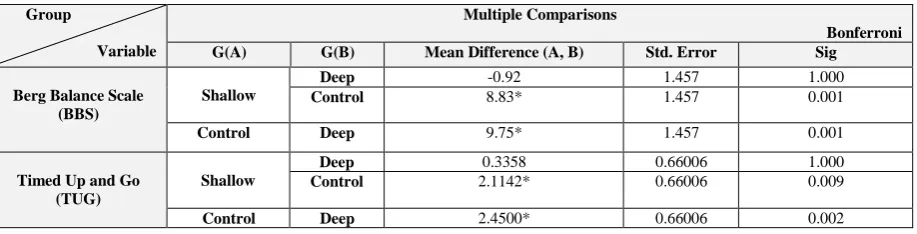
In order to better understand that the difference between a pair of averages is significant between the groups (tests), the Bonferroni test was used, the results of
which are presented in Table 6. There was
no significant difference between the two intervention groups (shallow and deep water) in the post-test in the balance of assessments, But there was a statistically significant difference between the two intervention groups (shallow and deep
water) with the control group in balancing test (p <0.05).So, the score of the balances of the two intervention groups (shallow and deep water) was higher than that of the
control group. Also, in both training
groups (shallow and deep water), no significant superiority was observed in relation to each other, and the effect of both depth On balance tests were the same (P<0.005).
Table 6:Results Bonferroni post hoc testIn the balance assessments between the two intervention (shallow and deep) and control groups in male patients with chronic ischemic stroke
Multiple Comparisons
Bonferroni Group
Variable
G(A) G(B) Mean Difference (A, B) Std. Error Sig
1.000 1.457
-0.92
Deep Shallow
Berg Balance Scale (BBS) 0.001 1.457 8.83* Control 0.001 1.457 9.75* Deep Control 1.000 0.66006 0.3358 Deep Shallow
TRAINING ON THE BALANCE OF CHRONIC ISCHEMIC STROKE PATIENTS VOL. 7 (3)
75
International Journal of Applied Exercise Physiology www.ijaep.com
Discussion
The main finding of this study is that six weeks of hydrotherapy is an effective tool for improving postural balance in chronic ischemic stroke patients. The results of this study showed that the balance in the control group in pre- and post-training performances are similar and equal. But this study demonstrates that both aquatic
interventions significantly improved
results for Timed Up and Go Test and the Berg Balance Scale. Also, in both training groups (shallow and deep water), no significant superiority was observed in relation to each other, and the effect of both depth On balance tests were the same. In other words, the results showed that 6 weeks of exercise program Has a significant effect on improving the balance of stroke patients that the findings of this study are similar to the research It is consistent. The final day of the 12th session. These data evidence that a program of exercises in a therapeutic pool
may be beneficial for improving
performance of functional mobility in patients with stroke [5].
In a study conducted by Noh DK et al, findings showed that Aquatic training improves motor function, and static and dynamic balance in people who suffered stroke. After eight weeks aquatic therapy based on the Halliwick and Ai Chi methods, postural balance and knee flexor strength were improved [11].
Findings of Daniel Santos et al, showed that all patients with stroke sequelae
experienced improvements in their
functional mobility performance during the 12 hydrotherapy sessions, comparing the first day of evaluation with the final day of the 12th session. These data evidence that a program of exercises in a therapeutic pool may be beneficial for improving performance of functional mobility in patients with stroke [5].
In a research conducted in 2006 by Belgen et al, The study results may be due to the water environment permitting strength training of the lower extremity in a gravity-attenuated environment, thus reducing a fear of falling in these patients. The literature indicates both that lower
extremity strength is an important
determinant of balance and fall-related self-efficacy in stroke survivors (Beninato, Sullivan, & Narielwalla, 2006) and that the
aquatic environment can produce
significant improvements in balance scores (Noh, Lim, Shin, & Palk, 2008), [26]. Zhu et al (2016), In a research titled Hydrotherapy vs. conventional land-based exercise for improving walking and balance after stroke, suggest that a relatively short programme (four weeks) of hydrotherapy exercise resulted in a large improvement in a small group (n=14) of individuals with relativelyhigh balance and walking function following a stroke [11]. but the differences in the mean values of the improvements in the Berg Balance Scale and the Timed Up and Go Test were not statistically significant [11].
The reason for the contradiction between the results of the two tests of this research was our findings that a training group in the environment land practice and low number of samples and low number of training sessions of this study.
76
International Journal of Applied Exercise Physiology www.ijaep.com
The popularity of aquatic physical therapy has increased recently among
Neurological rehabilitation physical
therapists and researchers because of the many benefits such therapy provides. Furthermore, the buoyancy of water might allow stroke patients to move with less effort and across movement planes that would be impossible on land without assistance [28].
Conclusion
In this study, the small size of the sample groups, limiting the study to men and limiting it to ischemic, chronic and hemiparesic patients are among the limitations of this study. Therefore, it is
suggested that in future studies,
researchers will study this treatment on
patients with hemorrhagic stroke,
hemiplegia, in both sexually transmitted models with a higher sample size and in chronic and debilitating neurological diseases.
The results showed that although the two different depths of water defined in this study had not any different effect on the mean scores of these variables, but the
protocol of aquatic training in this study could be considered as a safe and effective
method. Positive therapeutic and
pharmaceutical treatments as well as a complementary treatment alongside new approach and effective way to improve balance in patients with chronic ischemic
stroke regarded and used. These findings
enable us to extend the research on larger groups of subjects.The results of this study can be an idea for Medicine, Department of Rehabilitation, physiotherapist, clients and even practice sports are placed.
ACKNOWLEDGEMENT
TRAINING ON THE BALANCE OF CHRONIC ISCHEMIC STROKE PATIENTS VOL. 7 (3)
77
International Journal of Applied Exercise Physiology www.ijaep.com
References
1. Duffy, K., Aquatic therapy for a patient post-stroke: A case report. 2014, Florida Gulf Coast University. 2. Bohannon, R.W., M.G. Morton, and J.B. Wikholm, Importance of four variables of walking to patients with
stroke. International Journal of Rehabilitation Research, 1991. 14(3): p. 246-250.
3. Yen, C.-L., et al., Gait training—induced change in corticomotor excitability in patients with chronic stroke. Neurorehabilitation and neural repair, 2008. 22(1): p. 22-30.
4. Becker, B.E., Aquatic therapy: scientific foundations and clinical rehabilitation applications. Pm&r, 2009. 1(9): p. 859-872.
5. Santos, D.G.d., et al., Evaluation of functional mobility of patients with stroke sequela after treatment in hydrotherapy pool using the Timed Up and Go Test .Einstein (São Paulo), 2011. 9(3): p. 302-306. 6. Cole, A., et al., i sur. Spine pain: aquatic rehabilitation strategies. U: Becker BE and Cole AJ. ur.
Comprehensive aquatic therapy, 3. izd. 2011, Washington State University Press.
7. Douris, P., et al ,.The effect of land and aquatic exercise on balance scores in older adults. Journal of Geriatric Physical Therapy, 2003. 26(1): p. 3-6.
8. Waters, D. and L. Hale, Do aqua-aerobics improve gait and balance in older people? A pilot study. International journal of therapy and rehabilitation, 2007. 14(12): p. 538-543.
9. Chu, K.S., et al., Water-based exercise for cardiovascular fitness in people with chronic stroke: a randomized controlled trial1. Archives of physical medicine and rehabilitation, 2004. 85(6) :p. 870-874.
10. Marinho-Buzelli, A.R., A.M. Bonnyman, and M.C. Verrier, The effects of aquatic therapy on mobility of individuals with neurological diseases: a systematic review. Clinical rehabilitation, 2015. 29(8): p. 741-751.
11. Zhu, Z., et al., Hydrotherapy vs. conventional land-based exercise for improving walking and balance after stroke: a randomized controlled trial. Clinical rehabilitation, 2016. 30(6): p. 587-593.
12. de Lima Paula, F., E.d.D.A. Junior, and H. Prata, Teste TIMED “UP AND GO”: uma comparação entre valores obtidos em ambiente fechado e aberto. Fisioterapia em Movimento, 2017. 20(4).
13. Podsiadlo, D. and S. Richardson, The timed “Up & Go”: a test of basic functional mobility for frail elderly persons. Journal of the American geriatrics Society, 1991. 39(2): p. 142-148.
14. Bohannon, R.W., Reference values for the timed up and go test: a descriptive meta-analysis. Journal of geriatric physical therapy, 2006. 29(2): p. 64-68.
15. Ng, S.S. and C.W. Hui-Chan, The timed up & go test: its reliability and association with lower-limb impairments and locomotor capacities in people with chronic stroke. Archives of physical medicine and rehabilitation, 2005. 86(8): p. 1641-1647.
16. Flansbjer, U.-B., et al., Reliability of gait performance tests in men and women with hemiparesis after stroke. Journal of rehabilitation medicine, 2005. 37(2): p. 75-82.
17. Berg, K., et al., Measuring balance in the elderly: preliminary development of an instrument. Physiotherapy Canada, 1989. 41(6): p. 304-31.
18. Berg, K.O., et al., Measuring balance in the elderly: validation of an instrument. Canadian journal of public health= Revue canadienne de sante publique, 1992. 83: p. 7-11.
19. Hiengkaew, V., K. Jitaree, and P. Chaiyawat, Minimal detectable changes of the Berg Balance Scale, Fugl-Meyer Assessment Scale, Timed “Up & Go” Test, gait speeds, and 2-minute walk test in individuals with chronic stroke with different degrees of ankle plantarflexor tone. Archives of physical medicine and rehabilitation, 2012. 93(7): p. 1201-1208.
20. Mao, H.-F., et al., Analysis and comparison of the psychometric properties of three balance measures for stroke patients. Stroke, 2002. 33(4): p. 1022-1027.
21. Muir, S.W., et al., Use of the Berg Balance Scale for predicting multiple falls in community-dwelling elderly people: a prospective study. Physical therapy, 2008. 88(4): p. 449-459.
22. Flansbjer, U.-B., J. Blom, and C. Brogårdh, The reproducibility of Berg Balance Scale and the Single-leg Stance in chronic stroke and the relationship between the two tests. PM&R, 2012. 4(3): p. 165-170. 23. Dibble, L.E. and M. Lange, Predicting falls in individuals with Parkinson disease: a reconsideration of
clinical balance measures. Journal of Neurologic Physical Therapy, 2006. 30(2): p. 60-67.
24. Mackintosh, S.F., et al., Balance score and a history of falls in hospital predict recurrent falls in the 6 months following stroke rehabilitation. Archives of physical medicine and rehabilitation, 2006. 87(12): p. 1583-1589.
78
International Journal of Applied Exercise Physiology www.ijaep.com
26. Roberts, R., et al., Movement imagery ability: development and assessment of a revised version of the vividness of movement imagery questionnaire. Journal of Sport and Exercise Psychology, 2008. 30(2): p. 200-221.
27. Dziubek, W., et al., The effects of aquatic exercises on physical fitness and muscle function in dialysis patients. BioMed research international, 2015.