DOI: 10.2478/10004-1254-64-2013-2274 Scientifi c paper
BIOLOGICAL SIGNIFICANCE OF THE
OVER-EXPRESSION OF HSP70 AND ALPHA B-CRYSTALLIN
IN RAT
SUBSTANTIA NIGRA
EXPOSED TO
DIFFERENT DOSES OF PERMETHRIN
Dilek GUVENC1,Yonca Betil KABAK2, Enes ATMACA1, Abdurrahman AKSOY1, and Tolga
GUVENC2
Department of Pharmacology and Toxicology1, Department of Pathology2, Faculty of Veterinary Medicine, University
of Ondokuz Mayis, Samsun, Turkey
Received in May 2012 CrossChecked in January 2013
Accepted in November 2012
The aim of this study was to investigate the possible role of the Heat Shock Protein 70 (HSP70) and Alpha B-crystallin (αBC) in the substantia nigra of rats exposed to permethrin at different doses on the apoptotic cell status. The orogastric gavage method was used to administer the different doses of permethrin (75 mg kg-1 in Group I, 150 mg kg-1 in group II, 300 mg kg-1 in group III) to the rats. Using the Western blot test, all the permethrin-treated groups showed a dose-dependent increase in the expression of HSP70 and αBC when compared to the control group. TUNEL positive apoptotic cells were not detected in the dopaminergic neurons of the substantia nigra after treatment with permethrin; however, upon immunofl uorescent staining, intense positive reactions for HSP70 and αBC were observed in all of the treated groups. No immunopositive cells were detected in the tissue sections of the control group. These results suggest that the different administered doses of permethrin did not cause apoptotic cell death in the substantia nigra dopaminergic neurons; however, they did induce an increase in HSP70 and αBC expression. Thus, it appears that HSP70 and αBC could play a neuroprotective role in permethrin-induced neurotoxicity.
KEY WORDS:Heat Shock Protein, immunohistochemistry, pyrethroid, TUNEL
Pyrethroids are chemicals used to control indoor and agricultural pests (1). They can be divided into two classes, based on their chemical structure and biological effect after high-dose acute exposure. Type I Pyrethroids, which lack one α-cyano group, produce toxic effects, including aggressive sparring, increased sensitivity to external stimuli, whole body tremor and prostration (T syndrome). Type II pyrethroids, however, which contain the α-cyano group, produce a syndrome characterized by pawing and burrowing behaviour, salivation, and coarse tremor progressing to choreoathetosis and clonic seizures (2, 3). The toxic
membrane-bound ATPases mediate the neurotoxic effects of the pyrethroids. While low-dose permethrin (3 mg kg-1) significantly decreases the dopamine
transporter immunoreactive protein, high-dose permethrin (200 mg kg-1) signifi cantly increases the
glial fibrillary acidic protein in the striatum of C57BL/6 mice (9). The expression of tyrosine hydroxylase (TH) and the dopamine transporter protein (DAT) in the striatal dopaminergic terminals of mice did not change when subjected to long-term (3 months) and low doses (between 0.8 mg kg-1 and
1.5 mg kg-1) of permethrin (10).
Prokaryotic and eukaryotic cells both contain Heat Shock Proteins (HSPs). A wide variety of stress factors such as heavy metals, pesticides, solvents, sodium arsenite, nitric oxide, glucose and amino acid analogues, ischemia, microbial infections and antibiotics can induce HSPs (11, 12). HSPs have a molecular-chaperone activity involving several aspects of protein synthesis including the prevention of premature protein folding, restoration of denaturing proteins, transportation and translocalization processes (13, 14). Recently, HSPs have also been found to regulate apoptosis by acting on different stages of programmed cell death machinery (15). Upregulation and overexpression of HSPs in the nervous system is associated with their neuroprotective role (16-18). The neuroprotective effects of HSPs take place by anti-apoptotic and chaperoning activities (18). They can be classifi ed into fi ve major categories based on their molecular weight, amino acid sequence homologies and functions. They include the HSP100 family, HSP90 family, HSP70 family, HSP60 family and the small HSP family (12).
The HSP70 family comprises two major members, viz., HSP70, an inducible form, and Hsc70, the heat shock cognate protein, a constitutively expressed form. HSP70 is never expressed in the brain under non-stressed conditions (19). Therefore, due to the fact that inducible HSP70 cannot be detected under normal conditions, it serves as a useful sensitive marker for neuronal injury (20). Several studies have indicated the expression of HSP70 to be a response to various neurotoxic stimuli, including hyperthermia, cerebral and focal ischemia, seizures, excitotoxicity, subarachnoid haemorrhage and spinal cord injury (20, 21).
Primarily defi ned as a major component of the eye lens, αBC belongs to the family of small HSPs. It is also found in non-lenticular tissues such as the heart,
skeletal muscle, skin, oesophagus, kidney, placenta, peripheral nerves and nervous system (22). Interestingly, αBC expression has also been detected in heat shock, anticancer drugs, radiation and oxidative stress (23). In a normal central nervous system, αBC is present in glial cells, particularly in astrocytes and oligodendrocytes, although not in the neurons (24). The neuronal expression of αBC has been investigated in Alexander’s disease, Alzheimer’s disease, Pick’s disease, Creutzfeldt-Jakob disease, multiple sclerosis (25), astrocytoma, glioblastoma multiforme and oligodendroglioma (26). Thus, αBC is considered to be a good molecular marker for neurodegenerative disorders and brain tumours (25, 27).
Relatively little information is available on the possible dose-related toxicity of permethrin, despite its wide application in practice. Also, not much is known on permethrin-induced apoptotic cell death in the
substantia nigra. Therefore, the aim of this study is to investigate the apoptosis in the substantia nigra of rats exposed to differentdoses of permethrin, as well as the interaction of permethrin with HSP70 and αBC.
MATERIAL AND METHODS
Animals and Treatments
Approval for the experimental protocol involved in this study was granted by the Experimental Animal Studies Ethics Committee of the Ondokuz Mayis University (HADYEK-2008/51). Thirty-two adult male Spraque-Dawley rats, about 8 weeks old, and approximately 270 g in weight, (supplied by Kobay Inc., Ankara, Turkey) were used. The animal room was maintained at 22 °C ± 2 °C, 60 % ± 5 % relative humidity, and a 12 h/12 h light/dark cycle. Food and water were given ad libitum. Thirty-two rats were randomized into three experimental groups and one control group (n=8 for each group). Permethrin was given orally, three times in the experimental groups, on days 1, 7 and 14, respectively; group I rats (n=8), 75 mg kg-1 permethrin (1/20 of the LD
50 value); group II
rats (n=8) 150 mg kg-1 permethrin (1/10 of the LD 50
value, group II) and group III rats (n=8) 300 mg kg-1
Immunofl uorescence microscopy
Five animals from each experimental group were anesthetized with pentobarbital (100 mg kg-1, ip) and
perfused through the heart with phosphate-buffered saline followed by 2 % paraformaldehyde and 1.5 % glutaraldehyde in phosphate-buffered saline. The brains were removed, postfi xed, and embedded in paraffi n according to standard histological techniques. Next, the specimens were sectioned (5 μm) and placed on 3-aminopropyltriethoxysilane (Sigma, St. Louis, MT, USA) coated slides. The sections were stained using the immunofl uorescence technique. For double immunostaining, tissue sections were incubated with anti-alpha B-crystallin antibody diluted 1:200 (ab13497, Abcam, USA) or anti-HSP70 antibody diluted 1:100 (SPA-810, Stressgen, USA), followed by FITC-labelled anti-rabbit antibody (1:160, F7512, Sigma, USA) or FITC-labelled anti-mouse antibody (1:50, AP300F, Chemicon, USA). Tissue sections were incubated with anti-tyrosine hydroxylase antibody (1:200, AB152, Millipore, USA), followed by rhodamine-linked anti-mouse antibody (1:100, AP124R, Chemicon, USA). Two negative controls were prepared, fi rst by omitting the primary antibody, and then by replacing them with PBS. The sections were then mounted with an aqueous mounting medium. Slides were evaluated with a fl uorescence microscope (Nikon, E-600) equipped with appropriate fi lter systems (Nikon, B-2A for FITC and G-2A for rhodamine). A total of 10 high-power fi elds were randomly chosen and analysed at high magnifi cation (200x) by two independent pathologists (TG and YBK). Image analysis and merged images were carried out with the Bs200P Image Analysis System software (BAB software, Ankara, Turkey).
TUNEL Staining
To identify DNA fragmentation, brain sections were stained using the terminal deoxynucleotidyl transferase-mediated deoxyuridine triphosphate nick-end labelling (TUNEL) method (in situ cell death detection kit, Roche Diagnostics, GmbH, Germany). This was performed according to the manufacturer’s instructions. The paraffi n-embedded sections were dewaxed and rehydrated. Next, the irradiation of the sections was done at 350 W in 0.1 μmol L-1 citrate
buffer, pH 6.0 for 5 min, in a microwave oven. After washing in PBS twice, the sections were covered with 50 μL of the TUNEL reaction mixture containing terminal deoxynucleotidyl transferase and fl
uorescein-dUTP (2´-deoxyuridine 5´-triphosphate). Tissue sections were incubated with anti-tyrosine hydroxylase antibody (1:200, AB152, Millipore, USA), followed by rhodamine-linked anti-mouse antibody (1:100, AP124R, Chemicon, USA). Tissue sections were mounted with an aqueous mounting medium, and evaluated with a fl uorescence microscope as described previously.
Analysis of stress protein expression on Western blot
Non-fi xed brain tissues of three animals were homogenized for 2 min by using a tissue homogenizator (20.000 rpm, SilentCrusher M, Heidolph Instruments, Germany) in a lysis buffer (50 mmol L-1 Tris, pH 7.4,
containing 0.15 mol L-1 NaCl, 10 % glycerol, 1 %
NP-40, protease inhibitor cocktail tablets, Roche Diagnostics, GmbH, Germany) in a tissue: buffer ratio of 1:5. After homogenization, the samples were centrifuged at 10,000 g for 15 min, and the supernatants were collected and stored at −70 °C. The protein concentration was determined by the method used by Lowry et al. (31), and equal quantities of protein were loaded per lane and subjected to sodium dodecyl sulphate polyacrylamide gel electrophoresis (4 % stacking gel and 12 % separating gel) as described by Laemmli (32). Electrophoresis was performed at 75 V and the proteins resolved were electrophoretically transferred onto a polyvinylidene difl uoride (PVDF) membrane (Roche Diagnostics, GmbH, Germany) in a transfer buffer (0.2 mol L-1 glycine, 25 mmol L-1 Tris
Statistical Analysis
Statistical differences in the Western blot bands at certain experiment times were determined by a One-Way Analysis of Variance (ANOVA) followed by a Tukey’s post-hoc Test. Differences were considered signifi cant only when the P-values were less than 0.05.
RESULTS
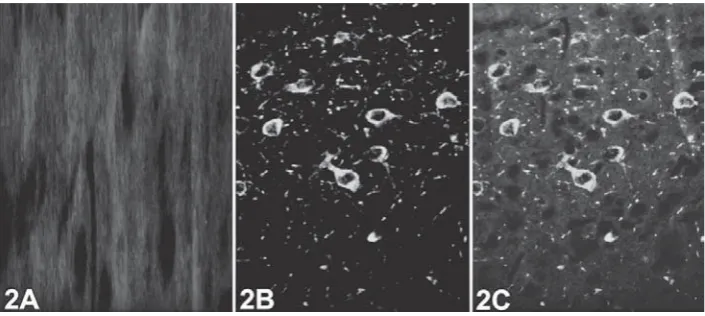
Immunofl uorescent staining demonstrated intense positive reactions for HSP70 (Figure1A) and αBC (Figure1C) in the substantia nigra of rats from the treatment groups; however, no immunopositive cells were detected in the control tissue sections (Figures 1B and 1D). In the same tissue sections, neurons were identifi ed by TH for dopaminergic neurons in the substantia nigra. No changes were observed in the staining intensity of TH immunoreactivity in the control or treatment groups (Figures 1E to 1H). The merged images strongly suggested that HSP70 and αBC immunopositive cells were also TH positive neurons (Figures 1J to 1M). As expected, TUNEL staining was negative in the nuclei of control substantia nigra cells. The same sections were also stained for TH antibody using the immunofl uorescent technique to determine the dopaminergic neurons in the substantia nigra, and clear positive reactions were detected. A similar fi nding was observed in the case of the treated groups (Figures 2A to 2C).
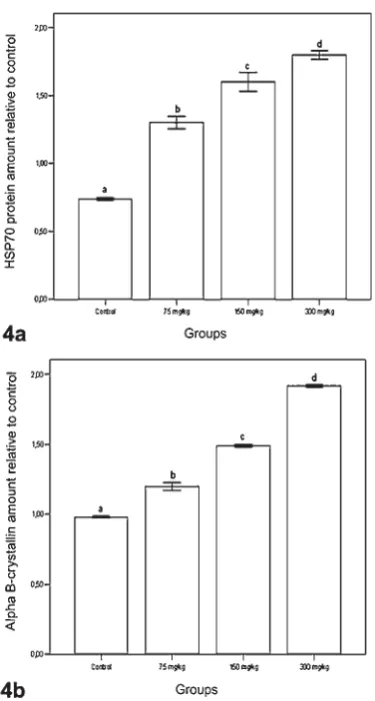
We also explored the possible induction of HSP70 and αBC after treatment of permethrin at the protein level determined by the Western blotting technique. Anti-alpha B crystallin antibody and HSP 70 antibody were detected as major bands of 21 kD and 70 kD, respectively (Figure 3). A signifi cant increase in the HSP70 and αBC expression was observed on a dose-dependent manner (P<0.05) (Figures 4A and 4B).
DISCUSSION
Apoptosis develops through a complex signalling cascade which can occur under pathological or specifi c physiological conditions. One of the main apoptotic pathways (the so-called endogenous-dependent programmed cell death) is related to the mitochondrial release of cytochrome-c into the cytosol. Cytochrome-c aCytochrome-ctivates the apoptotiCytochrome-c protease-aCytochrome-ctivating faCytochrome-ctor 1
(Apaf-1). Subsequently, Apaf-1 and cytochrome-c bind to procaspase-9 and activate it. Afterwards, caspase-9 activates the effector caspase, caspase-3. Thus, the mitochondria-dependent apoptotic pathway is initiated (33, 34). Earlier studies have reported that a single dermal application of permethrin did not signifi cantly increase the release of cytochrome c. However, a combined single dermal application of DEET (N,N-Diethyl-m-toluamide) and permethrin significantly increased the release of brain mitochondrial cytochrome c, which has been correlated with inducing apoptosis (35, 36). Elwan et al. (37) showed that a lower concentration of permethrin (5 μmol L-1) can induce increased DNA fragmentation
in the cultured neuroblastoma cells. These data, therefore, indicate that apoptosis can be induced by permethrin. Other reports have shown that the topical application of permethrin (25 μL, equivalent to 1100 mg kg-1 bw) in mice signifi cantly increased apoptosis
in the CD4(-) 8(-) and CD4(-)8(+) thymocytes (38). Contrary to these reports, in the present study, TUNEL-TH co-labelling of cells was not detected in the nigral dopaminergic neurons in spite of the rats being treated with higher doses of permethrin (300 mg kg-1, orally). This fi nding suggests that the loss of
nigral dopaminergic neurons might not be caused by apoptosis due to permethrin treatment.
The major stress-inducible protein HSP70 is produced by any kind of stressful stimulus, such as hyperthermia or cerebral ischemia (21, 39). It has been recognized as a molecular chaperone, whose main functions include folding up proteins and protecting the tertiary protein structure (20, 21, 39). Furthermore, the cytoprotective effects of HSP70 are not reduced to these functions; they also block the apoptotic mechanism at various points of cell death. HSP70 has been reported to be capable of inhibiting caspase activation by interfering with Apaf-1, and preventing the participation of procaspase-9 apoptosome. Nevertheless, the role of HSP70 against apoptosis is not limited to caspases. HSP70 can also prevent apoptosis in a caspase-independent but mitochondrial-dependent manner by direct interaction with the AIF (Apoptosis inducing factor) (40).
Figure 1 Brain sections were double immunofl uorecence staining with HSP70, αBC and TH in permethrin treatment (group III, 300 mg kg-1) and control group. [1A] HSP70 (green) in group III (300 mg kg-1); [1B] HSP70 in control group, no
Immunofl uorescence staining; [1C] αBC (green) in group III (300 mg kg-1); [1D] αBC in control group, no
Immunofl uorescence staining; [1E-H] Immunofl uorescence staining of TH (red) in permethrin treatment group III (300 mg kg-1) [1E,G] and control group [1F,H]; [1J-M] Merged images shows TH-positive neurons co-express HSP70
and αBC in treatment group [1J,L] and negative results in control group (1K,M). Magnifi cation 200x.
Figure 2 TUNEL andimmunofl uorecence staining with TH antibody in permethrin treatment (group III, 300 mg kg-1). [2A]
Negative staining for TUNEL methods; [2B] Immunofl uorescence staining of TH (red); [3C] Merged images 2A and 2B. Magnifi cation 200x.
caspase-3 (43, 44). Moreover, it has been shown that αBC inhibits TRAIL-induced (tumour necrosis factor involved in apoptosis-inducing ligand) apoptosis through the suppression of caspase-3 activation (45).
members such as Bax (46). All of these data strongly suggest that the overexpression of αBC could be neuroprotective by blocking apoptosis. Additionally,
Kirbach and Golenhofen (47) reported a signifi cant increase in αBC (HspB5) in cultured rat hippocampal neurons after heat shock. This fi nding indicates that αBC might protect neurons from heat stress. We showed that HSP70 and αBC-TH co-labelled cells were seen in the substantia nigra of the permethrin treated rats. Also, a signifi cant increase in both HSP70 and αBC expressions were observed in a dose-dependent manner. No TUNEL positive signals were detected in the substantia nigra dopaminergic neurons of the control and treated groups. Taken together, these findings suggest that an over-expression of both HSP70 and αBC will inhibit pro-apoptotic events, exerting a neuroprotective effect.
It has previously been reported that TH and DAT protein expression in mice striatal dopaminergic terminals did not change when they were subjected to long-term and low doses of permethrin (10). Similarly, no changes in the staining intensity of TH immunoreactivity were observed in our study, either.
In conclusion, our findings demonstrated that relatively high doses of permethrin did not cause apoptotic cell death in the substantia nigra dopaminergic neurons. Nevertheless, the present study also observed an over-expression of HSP70 and αBC. The increase in HSP70 and αBC expression suggests that these stress proteins may have played a role as anti-apoptotic factors in our experimental model of permethrin-induced neurotoxicity.
Acknowledgements
This work was supported by Ondokuz Mayis University Research Foundation (project no. Vet.1901.09.004).
REFERENCES
1. Kaneko H. Pyrethroid chemistry and metabolism. In: Kreiger R, editor. Handbook of pesticide toxicology. San Diego: Academic Press; 2010. p. 1635-63.
2. Aldridge WN. An assessment of the toxicological properties of pyrethroids and their neurotoxicity. Crit Rev Toxicol 1990;21:89-104.
3. Verschoyle RD, Aldridge WN. Structure-activity relationships of some pyrethroids in rats. Arch Toxicol 1980;45:325-9. 4. Ray DE. Pyrethroid insecticides: mechanisms of toxicity,
systemic poisoning syndromes, paraesthesia, and therapy. In: Kreiger R, editor. Handbook of pesticide toxicology. San Diego: Academic Press; 2001. p. 1289-303.
5. Soderlund DM, Clark JM, Sheets LP, Mullin LS, Piccirillo VJ, Sargent D, Stevens JT, Weiner ML. Mechanisms of
Figure 3 Western blot analysis of the effects of permethrin on the expression of HSP70 and αBC. Equal amounts of protein (20 μg) were resolved by SDS-PAGE on 12 % polyacrylamide gels. Brain tissue from permethrin treatment groups shows increased protein levels of HSP70 and αBC relative to control.
pyrethroid neurotoxicity: implications for cumulative risk assessment. Toxicology 2003;171:3-59.
6. Soderlund DM. Toxicology and mode of action of pyrethroid insecticides. In: Kreiger R, editor. Handbook of pesticide toxicology. San Diego: Academic Press; 2010. p. 1665-86. 7. Karen DJ, Li W, Harp PR, Gillette JS, Bloomquist JR. Striatal
dopaminergic pathways as a target for the insecticides permethrin and chlorpyrifos. Neurotoxicology 2001;22:811-7.
8. Kakko I, Toimela T, Tähti H. The synaptosomal membrane bound ATPase as a target for the neurotoxic effects of pyrethroids, permethrin and cypermethrin. Chemosphere 2003;51:475-80.
9. Pittman JT, Dodd CA, Klein BG. Immunohistochemical changes in the mouse striatum induced by the pyrethroid insecticide permethrin. Int J Toxicol 2003;22:359-70. 10. Kou J, Bloomquist JR. Neurotoxicity in murine striatal
dopaminergic pathways following long-term application of low doses of permethrin and MPTP. Toxicol Lett 2007;171:154-61.
11. Kiang GJ, Tsokos GC. Heat Shock Protein 70 kDa: Molecular Biology, Biochemistry, and Physiology.Pharmacol Ther 1998;80:183-201.
12. Gupta SC, Sharma A, Mishra M, Mishra RK, Chowdhuri DK. Heat shock proteins in toxicology: How close and how far? Life Sci 2010;86:377-84.
13. Samali A, Orrenius S. Heat shock proteins: regulators of stress response and apoptosis. Cell Stress Chaperones 1998;3:228-36.
14. Goldbaum O, Landsberg RC. Stress proteins in oligodendrocytes: differential effects of heat shock and oxidative stress. J Neurochem 2001;78:1233-42.
15. Garrido C, Gurbuxani S, Ravagnan L, Kroemer G. Heat shock proteins: endogenous modulators of apoptotic cell death. Biochem Biophys Res Commun 2001;286:433-42. 16. Landsberg CR, Goldbaum O. Stress proteins in neural cells:
functional roles in health and disease. Cell Mol Life Sci 2003;60:337-49.
17. Brown IR. Heat shock proteins and protection of the nervous system. Ann N Y Acad Sci 2007;1113:147-58.
18. Franklin TB, Krueger-Naug AM, Clarke DB, Arrigo AP, Currie RW. The role of heat shock proteins Hsp70 and Hsp27 in cellular protection of the central nervous system. Hyperthermia 2005;21:379-92.
19. Suzuki T, Usuda N, Murata S, Nakazawa A, Ohtsuka K, Takagi H. Presence of molecular chaperones, heat shock cognate (Hsc) 70 and heat shock proteins (Hsp) 40, in the postsynaptic structures of rat brain. Brain Res 1999;816:99-110.
20. Yenari MA, Giffard RG, Sapolsky RM, Steinberg GK. The neuroprotective potential of heat shock protein 70 (HSP70). Mol Med Today 1999;5:525-31.
21. Rajdev S, Sharp FR. Stres proteins as molecular markers of neurotoxicity. Toxicol Pathol 2000;28:105-12.
22. Iwaki T, Kume-Iwaki A, Goldman JE. Cellular distribution of αB-crystallin in non- lenticular tissues. J Histochem Cytochem 1990;38:31-9.
23. Parcellier A, Schmitt E, Brunet M, Hammann A, Solary E, Garrido C. Small heat shock proteins HSP27 and aB-crystallin: cytoprotective and oncogenic functions. Antioxid Redox Signal 2005;7:404-12.
24. Iwaki T, Wisniewski T, Iwaki A, Corbin E, Tomokane N, Tateishi J, Goldman JE. Accumulation of αB-crystallin in central nervous system glia and neurons in pathologic condition. Am J Pathol 1992;140:345-56.
25. van Rijk AF, Bloemendal H. Alpha-B-crystallin in neuropathology. Ophthalmologica 2000;214:7-12.
26. Aoyama A, Steiger RH, Fröhli E, Schäfer R, von Deimling A, Wiestler OD, Klemenz R. Expression of alpha B-crystallin in human brain tumors. Int J Cancer 1993;55:760-4. 27. Head MW, Goldman JE. Small heat shock proteins, the
cytoskeleton, and inclusion body formation. Neuropathol Appl Neurobiol 2000;26:304-12.
28. Bloomquist JR, Barlow RL, Gillette JS, Li W, Kirby ML. Selective effects of insecticides on nigrostriatal dopaminergic nerve pathways. Neurotoxicology 2002;23:537-44. 29. Cantalamessa F. Acute toxicity of two pyrethroids,
permethrin, and cypermethrin in neonatal and adult rats. Arch Toxicol1993;67:510-3.
30. Kirby ML, Castagnoli K, Bloomquist JR. In Vivo effects of deltamethrin on dopamine neurochemistry and the role of augmented neurotransmitter release. Pestic Biochem Physiol 1999;65:160-8.
31. Lowry OH, Rosebrough NJ, Farr AL, Randall RJ. Protein measurement with the Folin phenol reagent. J Biol Chem 1951;193:265-75.
32. Laemmli UK. Cleavage of structural proteins during the assembly of the head of bacteriophage T4. Nature 1970;227:680-5.
33. Elmore S. Apoptosis: a review of programmed cell death. Toxicol Pathol 2007;35:495-516.
34. Vermeulen K, Van Bockstaele DR, Berneman ZN. Apoptosis: mechanisms and relevance in cancer. Ann Hematol 2005;84:627-39.
35. Abu-Qare AW, Abou-Donia MB. Combined exposure to DEET (N,N-diethyl-m-toluamide) and permethrin-induced release of rat brain mitochondrial cytochrome c. J Toxicol Environ Health A 2001;63:243-52.
36. Martinou JC, Desagher S, Antonsson B. Cytochrome c release from mitochondria: all or nothing. Nat Cell Biol 2000;2: E41-3.
37. Elwan MA, Richardson JR, Guillot TS, Caudle WM, Miller GW. Pyrethroid pesticide-induced alterations in dopamine transporter function. Toxicol Appl Pharmacol 2006;211:188-97.
38. Prater MR, Gogal RM Jr, Blaylock BL, Longstreth J, Holladay SD. Single-dose topical exposure to the pyrethroid insecticide, permethrin in C57BL/6N mice: effects on thymus and spleen. Food Chem Toxicol 2002;40:1863-73. 39. Yenari MA, Liu J, Zheng Z, Vexler ZS, Lee JE, Giffard RG.
Antiapoptotic and anti-infl ammatory mechanisms of heat-shock protein protection. Ann N Y Acad Sci 2005;1053:74-83.
40. Ravagnan L, Gurbuxani S, Susin SA, Maisse C, Daugas E, Zamzami N, Mak T, Jäättelä M, Penninger JM, Garrido C, Kroemer G. Heat-shock protein 70 antagonizes apoptosis-inducing factor. Nat Cell Biol 2001;3:839-43.
42. Mehlen P, Schulze-Osthoff K, Arrigo AP. Small stress proteins as novel regulators of apoptosis. Heat shock protein 27 blocks Fas/APO-1- and staurosporine-induced cell death. J Biol Chem 1996;271:16510-4.
43. Kamradt MC, Chen F, Cryns VL. The small heat shock protein alpha B-crystallin negatively regulates cytochrome c- and caspase-8-dependent activation of caspase-3 by inhibiting its autoproteolytic maturation. J Biol Chem 2001;276:16059-63.
44. Kamradt MC, Chen F, Sam S, Cryns VL. The small heat shock protein alpha B-crystallin negatively regulates apoptosis during myogenic differentiation by inhibiting caspase-3 activation. J Biol Chem 2002;277:38731-6.
45. Kamradt MC, Lu M, Werner ME, Kwan T, Chen F, Strohecker A, Oshita S, Wilkinson JC, Yu C, Oliver PG, Duckett CS, Buchsbaum DJ, LoBuglio AF, Jordan VC, Cryns VL. The small heat shock protein alpha B-crystallin is a novel inhibitor of TRAIL-induced apoptosis that suppresses the activation of caspase-3. J Biol Chem 2005;280:11059-66.
46. Mao YW, Liu JP, Xiang H, Li DW. Human alphaA- and alphaB-crystallins bind to Bax and Bcl-X(S) to sequester their translocation during staurosporine-induced apoptosis. Cell Death Differ 2004;11:512-26.
Sažetak
BIOLOŠKA VAŽNOST PRETJERANE EKSPRESIJE HSP70 I ALFA-B KRISTALINA U SUPSTANCIJI NIGRI ŠTAKORA IZLOŽENIH RAZLIČITIM DOZAMA PERMETRINA
Svrha ove studije bila je istražiti moguću ulogu proteina toplinskog stresa 70 (HSP70) i alfa-B kristalina (αBC) u supstanciji nigri (lat. substantia nigra) štakora izloženih različitim dozama permetrina na apoptotske stanice. Metoda orogastričnog hranjenja upotrijebljena je kako bi se štakorima dale različite doze permetrina (75 mg kg-1 u skupini I, 150mg kg-1 u skupini II, 300mg kg-1 u skupini III). Nakon provođenja analize Western blot sve skupine kojima je dan permetrin pokazale su, ovisno o dozi, povećanje ekspresije HSP70 iαBC u usporedbi s kontrolnom skupinom. Apoptotske stanice pozitivne na TUNEL-test nisu otkrivene u dopaminergičkim neuronima supstancije nigre nakon tretmana permetrinom. Međutim nakon imunofl uorescentnog bojenja za HSP70 i αBC primijećene su snažne pozitivne reakcije u svim tretiranim skupinama. U tkivu kontrolne skupine nije bilo imunopozitivnih stanica. Naši rezultati upućuju na to da različite doze permetrina nisu uzrokovale apoptozu dopaminergičkih neurona supstancije nigre, ali su izazvale povećanje ekspresije HSP70 i αBC. Stoga bi HSP70 i αBC mogli imati pozitivan neuroprotektivni učinak pri neurotoksičnosti izazvanoj permetrinom.
KLJUČNE RIJEČI:protein toplinskog stresa, imunohistokemija, piretroid, TUNEL-test
CORRESPONDING AUTHOR:
Dilek Guvenc
Department of Pharmacology and Toxicology, Faculty of Veterinary Medicine