
Please cite this article as: H. Al-Bugharbee, A. Jubear, An Experimental Investigation of Enclosure’s Effect on Noise Reduction in Portable Generators , International Journal of Engineering (IJE), IJE TRANSACTIONS B: Applications Vol. 33, No. 2, (February 2020) 350-356
International Journal of Engineering
J o u r n a l H o m e p a g e : w w w . i j e . i rAn Experimental Investigation of Enclosure’s Effect on Noise Reduction in Portable
Generators
H. Al-Bugharbee*, A. Jubear
Mechanical Department, College of Engineering, Wasit University, Iraq
P A P E R I N F O
Paper history: Received 27 August 2019
Received in revised form 02 October 2019 Accepted 08 November 2019
Keywords:
Portable Generators Noise Suppression Eenclosur
A B S T R A C T
The portable generators are the main means of compensating the shortage of national electricity power as in Iraq. However, their noise causes a huge disturbance, uncomforting and loss of concentration of the nearby resident. This problem requires a solution because most shops and residential houses use generators. Covering method is a simple and relatively low cost one for reduction of generators noise. In the present study, an experimental investigation is conducted for evaluating the effect of using an enclosure on noise reduction of portable generators. The enclosure is made from some available and traditional materials such as foam and plywood. The sound transmission loss due to the use of enclosure is estimated for a wide range of frequency spectrum and the results showed that used enclosure helps in reduction of noise effectively. Furthermore, it was found that the generator temperature was not affected much by the use of the present enclosure. The present study is intended to be a step stone for a development of a low cost and effective commercial enclosure of portable generator.
doi: 10.5829/ije.2020.33.02b.21
NOMENCLATURE
Xi A signal vector Pwithout
the sound power of generator in no enclosure condition
Xin A data point in a vector Xi Pwith the sound power of generator inside the enclosure
R is the percentage reduction of sound power due to the use of enclosure
1. INTRODUCTION1
Since 1990s, Iraq has suffered the shortage of electricity due to the destruction of the electrical power plant in Persian Gulf war and due to the sanction imposed for several years. The rehabilitation of electrical power plants and transmission power network was not sufficient to cover the growing demand for electricity .
Therefore, people have used portable generators at home or even at shops for the purpose of running the cooling and lighting electrical machines. In addition, many large generators have been settled in the
*Corresponding Author Email: [email protected]
(H. R. Al-Bugharbee)
neighborhoods to provide electricity for a number of hours and people pay for this service.
It becomes very common when somebody walking through streets to hear the generator noisy sounds particularly in the summer. These noisy sounds are no doubt cause disturbance, headache and lack of sleep to family and neighbors. Thus, an easy and simple to apply solution should be found for reducing noise to acceptable levels. The estimation of sound transmission loss is still attracted the interest of many research. Recently, an analytical model was developed in literature [1] to estimate the noise transmission loss through a ventilation window .
Generator noise comes from cooling fan, engine, exhaust and frame vibration. Researchers have investigated the use of several types of enclosures and its effect in suppression of noise.
Onawum et al. [2] proposed a 440×440×440 mm enclosure made from a galvanized metal sheet (0.9 mm), Polyurethane acoustic foam (7.5 mm), particle board (35 mm) and plywood (10 mm). Sound signals are recorded at 1 m distance. It was found that the reduction of noise reached to 20%.
The effect of using composite walls on generator noise suppression is also investigated by Kuku et al. [3]. The walls of the enclosure are fabricated by combining panels of foam, composite sawdust and grinded glass and an outer plywood with air trapped in-between the composite and plywood. The outside dimensions of the box are (500×500×650) mm. The wall thickness was 10 cm. The generator used in the experimental work was of 950 Watts/220 volts. It is found that the noise isolation reached to 76.40% .
The study conducted by Pandey [4] a project done by the government and made a single wall enclosure, which was made of plywood with dimensions (2.1 ×1.5 ×1.78) m for 7.5 kVA diesel generator. Another solution conducted by the researcher a double wall (4x2.1x2.3) m enclosure was also made for a 200 KVA. If the air-gap is filled with mineral wool, it can give a further 10 dB reduction than the government solution .
Patil et al. [5] investigated the use of hemisphere enclosure which is made from a mild metallic sheet of 1 mm thickness with a glass wool of 25 mm thickness. A small engine of 375mm, 175mm and 100mm was used. The sound pressure levels obtained at a distance of 1m from the generator and measured the noise from eight points around the motor. It was found that the average noise reduction is by 4.75 dBA.
An experimental investigation of a noise reduction of a 4.5 kVA generator was conducted in space of 50×50 ft as explained in literature [6]. A reduction of 15 dB was achieved with the use of the designed canopy .
The research conducted by Hassan-Beygi, and Ghobadian [7] used a small generator fueled by natural gas in the experimental work. The sound signals of generator with and without enclosure. Four different models of enclosures were used in the experiment. The sound measurements were conducted in front of the generator exhaust at five electric loading conditions of (0%, 25%, 50%, 75% and 100% maximum generator load). Simple enclosure (SE) and modified enclosures were found effective to attenuate the generator noise.
The sound insulation of an enclosure made of three pairs of panel with each pair having sizes (686×444×686) mm and (480×480×444) mm, padded with polyurethane foam of thickness 25mm were fabricated from MDF was investigated by Akhaze and
John [8]. A generator of 950 W was used in the study. The measurement was done for ¾ of the total load and for 20 minute. The sound pressure level of the generator was reduced by 7.64, 6.24, 6.82, 8.72 and 8.68dB at distances of 0.70, 1.40, 2.10, 2.80 and 3.50m from the generator, respectively .
In this research an experimental investigation of using a low cost enclosure on the generator noise suppression and generator’s temperature increase was investigated. Generator sounds were measured at two different distances. One of the main goals of the present study is offering a step stone investigation for development a commercial effective but relatively inexpensive enclosure. The inexpensive cost of present generator’s enclosure is also considered due to relative income of the majority of families who uses portable generators. The size of the present enclosure is also designed to fit the size of the common used generators dimensions in order to be available for most of people. To this end, the current work offers a simple but effective methodology to screen the reduction of noise over wide spectrum of acoustic frequency .
The rest of the paper includes the description the present enclosure in section two. The section three presents the methodology conducted in the current study. The experimental work is presented in section four. The results and their discussion are illustrated in section five. Finally, the main conclusions made in this research are presented in section six.
2. DESCRIPTION OF THE ENCLOSURE
There are several points should be considered in the design of the enclosure such as weight, cost, types of materials and temperature. The weight should not be so heavy in order to be easy for moving when used for domestic purposes. The materials were preferred to be cheap materials and not high costs to the generator. The temperature, which may develop significantly inside the enclosure, should be controlled using sufficient ventilation.
In this project the enclosure is of (100×83×62) cm. The multi layers walls are made of plywood, sponge, foam, galvanized iron sheet from outside to inside as shown in Figure 1.
Figure 1. Components of enclosure wall used in the experiment
Figure 2. Intake and outtake fans
3. METHODOLOGY
The generator sound signals are recorded using microphones at different distances while the generator temperatures were acquired from different positions on the generator body.
A signal (Xi) each of length (n) is acquired using a suitable microphone and used as input to Matlab. The acquired signal can be considered as a time domain series and represented as in the following equation:
(1)
Then power spectrum of every signal (Xi) is then obtained using fast Fourier transform to obtain the frequency spectrum of the measured raw signal. The frequency spectrum of N signals ((Xi) is then averaged to minimize the uncertainty of the measurement process and to strengthen the main frequency components. Eventually, the power spectrum of two conditions of the generator (with and without enclosure
were compared for every suitable length frequency bands) and the percentage reduction of generator sound is obtained using the following equation:
(2)
where,
% R is the percentage reduction of sound power due to the use of enclosure.
is the sound power of generator in no enclosure condition.
is the sound power of generator inside the enclosure.
On the other hand, the temperature degree of the generators at different locations on the generator body as well as the ambient temperature were measured M times and then averaged to reduce the uncertainty of measurements.
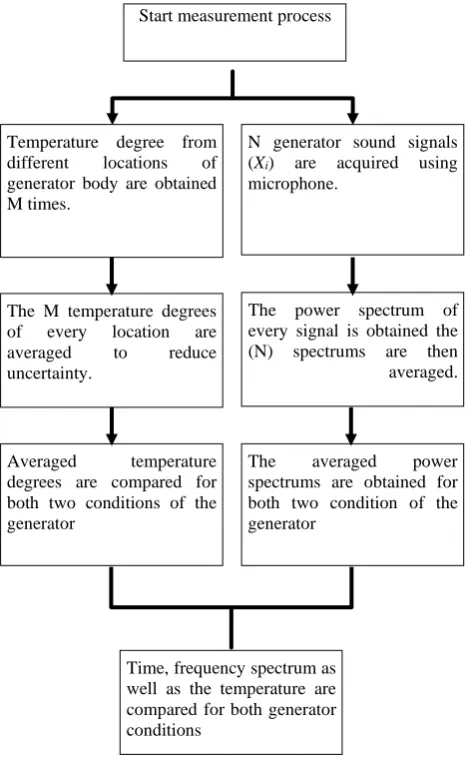
Figure 3 illustrates the flowchart of the present methodology
Figure 3. Flow chart of the present methodology
2
1 3 4
Time, frequency spectrum as well as the temperature are compared for both generator conditions
N generator sound signals
(Xi) are acquired using
microphone.
The power spectrum of every signal is obtained the (N) spectrums are then averaged.
The averaged power
spectrums are obtained for both two condition of the generator
Temperature degree from
different locations of
generator body are obtained M times.
The M temperature degrees
of every location are
averaged to reduce
uncertainty.
Averaged temperature
degrees are compared for both two conditions of the generator
Start measurement process
1. Plywood (1 cm) 2. Sponge (1.8 cm) 3. Foam (1 cm)
4. EXPERIMENTAL WORK
In this study, sound and temperature signals were recorded using microphone and thermocouples. Two microphones were located at different distances (1.5 and 4.5) m. The thermocouples were fixed at engine cylinder head, exhaust and the enclosure to monitor the change in temperature due to the use of enclosure (see Figure 4).
All the measurements are acquired for two conditions 1) generator without enclosure and 2) generator inside enclosure.
Ten sound samples were recorded for each of the above two cases. Each sample is of 10 seconds and the data length of each sample has 441000 data points (10 seconds ×44100). The 44100 is the sampling rate of the sound card of the PC. Every sample is then subjected to Fast Fourier Transform (FFT) using Matlab in order to obtain the frequency spectrum.
For the thermal analysis, the temperature is measured from all the thermocouples at every 15 minutes and 8 readings are taken for every location of thermocouple. Temperature degrees and sound signals of both conditions above are then compared. All the instrumentations used in the experiments are shown in Figure 5.
Figure 4. Fixing thermocouples at engine cylinder head and at
exhaust
Figure 5. Instruments used in the experimental work
5. RESULTS AND DISCUSSION
In order to evaluate the reliability of the experimental results, the sound signals are acquired ten times for each generator conditions (i.e with and without enclosure). These signals are repeated for reducing uncertainty of measurement process. The signals were recorded at different distances from the generator. Generator sound signals were represented in time domain in order to visualizing the reduction in general amplitude of the signal which was an indication to the reduction of the noisy sound level. In addition, the power spectrum of these sound signals were obtained and visualized in order to visualize in more details the reduction of sound power at different frequency bands. In addition, the temperature degrees were recorded by thermocouples which were fixed at different locations. Temperature degrees acquired in every 15 minutes and eight readings were recorded.
5. 1. Measuring Generator Noise at 1.5 m
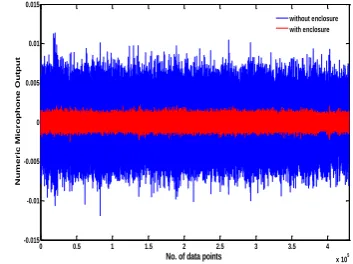
Figure 6 represents the generator sound signals recorded at a distance 1.5m (i.e microphone distance from the generator). The x- axis represents the number of measured data points. This number is obtained from multiplying the sampling rate (in this study 44.1 kHz by the sample length in seconds). Such kind of representation is useful when signals are considered as a time series. The y-axis represents the microphone output, which is scaled to voltage by some factor. This type of axis unit representation is usually used when analog signal (i.e here is microphone voltage) is digitized by the PC analog to digital sound card converter. The plot in blue represents the signals for the case of enclosure is not in use while the plot in red represents the case of using enclosure. The comparison shows the considerable reduction of sound level because the acoustic properties of the materials of enclosure wall components in absorbing or reflecting noisy generator sounds. The general noise reduction can be visually estimated by 50% or slightly higher.
0 0.5 1 1.5 2 2.5 3 3.5 4 x 10⁵
-0.015 -0.01 -0.005 0 0.005 0.01 0.015
No. of data points
N
u
m
e
r
ic
M
ic
r
o
p
h
o
n
e
O
u
tp
u
t
without enclosure with enclosure
Figure 6. Representation of generator noise in time domain
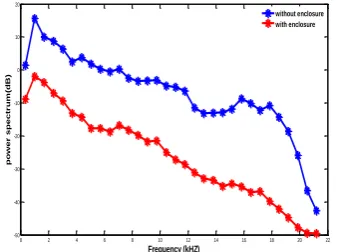
Figures 7 and 8 show the signals representation in the frequency domain. The x-axis represents the frequency in hertz (HZ) while the y-axis represents the power spectral, which can be obtained using the conversion 20 log10 (amplitude). It is clear that unit of this axis is also scaled to the output voltage of the microphone for the same reason mentioned in the description of Figure 6 above. At this stage of analysis, the estimation of percentage reduction of sound level eliminates the need to determine the exact value of microphone output voltage. From Figure 7, it can be seen that enclosure wall materials have the ability to curb sound transmission all over the entire sound frequency spectrum which represents the human being hearing frequency spectrum range (i.e from 20-20kHz). It can be easily to determine the noise reduction at any frequency band. In Figure 8, the average power spectrum is represented at every 1 kHz frequency band. This is to improve the visualization of the reduction in the power spectral due to the use of enclosure. In the present analysis it is found that the noise reduction percentage within the human hearing range is around 50% (i.e 49.8%).
0 0.5 1 1.5 2
x 104
-60 -50 -40 -30 -20 -10 0 10 20 30 Frequency (Hz) P o w e r s p e c tr u m ( d B ) without enclosure with enclosure
Figure 7. Power spectrum of generator noise for a distance 1.5
m.
0 2 4 6 8 10 12 14 16 18 20 22
-50 -40 -30 -20 -10 0 10 20 Frequency (kHZ) p o w e r s p e c tr u m (d B ) without enclosure with enclosure
Figure 8. Power spectrum of generator noise for every 1 kHz
band and for a distance 1.5 m.
5. 2. Measuring Generator Noise at 4.5 m
Figures 9, 10 and 11 represent the reduction in noise level both in time and frequency domains. In Figure 9, it is also seen that it can be seen that sound power spectral decreased at all the frequency bands used in the analysis. It can be seen that the noise reduction occurs over the entire frequency spectrum. The reduction within the human hearing range is around 50% (i.e. 48%).
0 0.5 1 1.5 2 2.5 3 3.5 4 x 10⁵ -8 -6 -4 -2 0 2 4 6 8x 10
-3
No. of data points
N u m e r ic M ic r o p h o n e O o u tp u t without enclosure with enclosure
Figure 9. Representation of generator noise in time domain for
a distance 4.5 m
0 0.2 0.4 0.6 0.8 1 1.2 1.4 1.6 1.8 2 2.2 x 10⁴ -60 -50 -40 -30 -20 -10 0 10 20 30
No. of data points
P o w e r s p e c tr u m ( d B ) without enclosure with enclosure
Figure 10: Power spectrum of generator noise for a distance 4.5 m.
0 2 4 6 8 10 12 14 16 18 20 22
-50 -40 -30 -20 -10 0 10 20 Frequency (kHZ) p o w e r s p e c tr u m (d B ) without enclosure with enclosure
5. 3. Thermal Performance The thermal performance of the generator with and without enclosure is shown in Figure 12. The x-axis represents the time intervals of the experimental test (i.e every fifteen minutes). The y-axis represents the temperature difference between the base of the generator and surrounding (i.e Tb-Ts). From this figure, it can be noticed that the temperature difference increases with time as an indication to the accumulation of combustion-generated heat of the generator engine. By a quick comparison, it is also seen that the temperature difference of no enclosure case is higher that case where generator is inside the enclosure. This can be explained as when the generator is outside, the surrounding temperature is lower than the surrounding temperature when the generator is inside the enclosure. This makes the temperature difference (Tb-Ts) is higher. However and over time, the temperature difference converges for the two conditions of the generator to 99% in approximate. This convergence can be attributed to the balancing of heat transfer rate between the generator and surrounding. The same behavior can also be described for the for heat transfer coefficient. The main reason behind this convergence (or balancing) is the type of heat transfer process in both cases. In the first case (i.e generator without an enclosure) the heat transfer is conducted by natural convection while for the second case, where enclosure is used, the heat transfer is conducted by forced convection. Consequently, the thermal performance of the generator is not affected much when putting inside the enclosure.
Figure12. Thermal performance of generator with and without enclosure
6. CONCLUSION
An experimental study was conducted to investigate the possibility of development of low cost but effective enclosure. This development aims to reduce the
generator noise and to make the enclosure cost be affordable by the majority of the people. The enclosure is made from available materials in the local market. The generator acoustic signals are compared in time domain in order to illustrate the reduction made in sound power level. The reduction in the signal amplitude due to the use of the enclosure indicates the reduction of sound level in general. The power spectrums under the two condition of the generator are compared in order to screen the reduction percentage of
sound over wide frequency spectrum. These
representations and comparisons were useful in estimating the percentage reduction of sound level at the human being hearing frequency range (i.e 20-20kHz). It was noticed from the reduction was achieved effectively along the entire frequency spectrum where the noisy sounds were approximately decreased by 50%. In addition to the very good results in the reduction of generator noisy sounds, the analysis of the recorded temperature readings shows a slight change of temperature which can be considered not dangerous due to the effective small cooling intake and discharge fanes. Another important point is to be mentioned that the size of the present enclosure is also designed to fit the size of the common used generators dimensions in order to be available for most of people.
It was taken in consideration, during the experimental work, that the distances between the generator and microphones are close enough to those distances where families install their generators from their sitting room. This makes the results more reliable to use the enclosure by major families who live in houses of standard dimensions.
It is believed by the authors that this study offers a step stone investigation for development a commercial effective and relatively inexpensive enclosure to reduce the generator noise. And this proposed enclosure can be affordable by the majority of people and be helpful providing the use of portable generators with more comfort.
7. REFERENCES
1. Khalvati, F. and Omidvar, A., "Prediction of noise transmission loss and acoustic comfort assessment of a ventilated window using statistical energy analysis", International Journal of
Engineering, Transactions C: Aspects, Vol. 32, No. 3, (2019),
451-459.
2. Onawumi, A.S., Okoli, S., Mfon, U. and Raheem, W., "Noise level investigation and control of household electric power generator", Covenant Journal of Engineering Technology, Vol. 2, No. 1, (2018). https://journals.covenantuniversity. edu.ng/index.php/cjet/article/view/898
3. Kuku, R., Raji, N. and Bello, T., "Development and performance evaluation of sound proof enclosure for portable generators",
Research Journal of Applied Sciences, Engineering and
4. Pandey, K., Deb, K. and Kumar, U., "Experimental studies on effect of noise level control for 7.5 kva diesel generator set with an enclosure", Journal of Environmental Research and
Development, Vol. 4, No. 2, (2009), 506-516.
5. Patil, S. R., S. S. Shinde, S. V. Chaitanya, Varish Chaturvedi, G. Raghavendra, and I. Manimozhi. "Noise reduction of an IC engine by enclosure method with 25 mm thick glass wool as noise absorbing medium.", International Journal of
Engineering Technology, Management and Applied Sciences,
Vol. 1, No. 2 (2014), 1-8.
6. Hammad, U., Aizaz, A., Khan, A.A. and Qurehi, T., "Design and development of noise suppression system for domestic
generators", European Scientific Journal, Vol. 9, No. 10, (2014), 526-533.
7. Hassan-Beygi, S.R. and Ghobadian, B., "Noise reduction of a portable gas generator set using an acoustic enclosure",
Agricultural Engineering International: CIGR Journal, Vol.
18, No. 3, (2016), 159-170.
8. Akhaze, M.N. and John, E., "Development of a soundproof device for 950 watt rated portable generators", Journal of
Applied Sciences and Environmental Management, Vol. 20,
No. 1, (2016), 83-86.
An Experimental Investigation of Enclosure’s Effect on Noise
Reduction in Portable Generators
TECHNICAL NOTE
H. Al-Bugharbee, A. Jubear
Mechanical Department, College of Engineering, Wasit University, Iraq
P A P E R I N F O
Paper history: Received 27 August 2019
Received in revised form 02 October 2019 Accepted 08 November 2019
Keywords:
Portable Generators Noise Suppression Eenclosur
هدیکچ
اهروتارنژ ی لصا لمح لباق ی
رت نی سو هلی ارب ی لم قرب دوبمک ناربج ی
ا اب .تسا قارع دننام نی
ادص و رس ، لاح ی
اهنآ
گتفشآ ثعاب ی تحاران ، ی ب زا و نی قم دارفا زکرمت نتفر می
رد آ ن دزن یکی م ی ا .دوش نی ن لکشم زای ز دراد لح هار هب اری
ب رتشی
هزاغم اه و اه هناخ ی نوکسم ی وتارنژ زا اهر م هدافتسا ی ششوپ شور .دننک کی
زه مک ًاتبسن و هداس شور هنی
ارب ی شهاک
یادص و رس ، رضاح هعلاطم رد .تسا اهروتارنژ
کی قحت قی برجت ی ارب ی زرا یبای ثأت ری زا هدافتسا کی شهاک رد هظفحم رس
یادص و اهروتارنژ ی ا هطوحم .تسا هدش ماجنا لمح لباق ز
رب خ ی تنس و دوجوم داوم ی
ف دننام مو هتخاس لا هس هتخت و
لد هب ادص لاقتنا نتفر تسد زا .تسا هدش لی
ارب هظفحم زا هدافتسا ی
ط فی ا هدرتسگ ی ط زا فی مخت سناکرف نی
م هدز ی
اتن و دوش جی شهاک رد هدافتسا دروم هطوحم هک داد ناشن ادص و رس
م کمک رثوم روط هب ی
ا رب هولاع .دنک نی
، شم صخ
امد هک دش ی نازرا یراجت هطوحم هعسوت یارب مدق کی ناونع هب هک تسا هدش هتفرگ رظن رد رضاح هعلاطم .درادن روتارنژ
لمح لباق روتارنژ زا رثؤم و تمیق یم
دشاب .
![Crystal structure of bis{μ 4 methyl N′ [3 (oxidoimino)butan 2 ylidene]benzenesulfonohydrazidato}bis[(dimethyl sulfoxide κO)copper(II)]](data:image/gif;base64,R0lGODlhAQABAIAAAP///wAAACH5BAEAAAAALAAAAAABAAEAAAICRAEAOw==)