Volume 3, Issue 1, 2016
1 Available online at www.ijiere.com
International Journal of Innovative and Emerging
Research in Engineering
e-ISSN: 2394 - 3343 p-ISSN: 2394 - 5494
Remediation of textile effluent using siliceous materials: A
review with a proposed alternative
Priya Mundada
a, Dr. Urmila Brighu
baResearch Scholar, Malaviya National Institute of Technology, Jaipur, India bAssociate Professor, Malaviya National Institute of Technology, Jaipur, India
ABSTRACT:
Treatment of the colored effluent from the textile industries is a major challenge. Many treatment techniques have been reported in the recent past. However, adsorption on low cost adsorbents has received a worthy attention. A number of low cost adsorbents have been researched. This paper discusses the potential of the siliceous materials in dye removal. A new low cost adsorbent, soil from Rajasthan, India, has also been reported. Keywords: Dyes, low cost adsorbents, siliceous adsorbents, direct red 81, soil
I. INTRODUCTION
The discharge of wastewater from textile and dyeing industries to the environment is a major concern due to its toxicity. These dyes can consume the dissolved oxygen required by aquatic life and some of them have direct toxicity to microbial populations and even can be toxic and/or carcinogenic to mammals [1]. Therefore, it is necessary to remove the dye stuff from the effluents. However, due to the synthetic origin and complex aromatic molecular structures of dyes (Table I & II), they become more stable and more difficult to degrade. Hence, it is imperative that a suitable treatment method should be devised to treat dyes [2].
Dye class Description
Acid Water-soluble anionic compounds
Basic Water-soluble, applied in weakly acidic dyebaths; very bright dyes
Direct Water-soluble, anionic compounds; can be applied directly to cellulosics without mordants (or metals like chromium and copper)
Disperse Not water-soluble
Reactive Water-soluble, anionic compounds; largest dye class Sulfur Organic compounds containing sulfur or sodium sulfide Vat Water-insoluble; oldest dyes; more chemically complex
TABLE I: TYPICAL DYES USED IN TEXTILE DYEING OPERATIONS [3]
Dye Structure
Crystal violet
Rhodamine b
Methylene blue
Acid red 57
Malachite green
Volume 3, Issue 1, 2016
2 Adsorption techniques have proved to be an effective and attractive process for removal of dyes from wastewater. Activated carbon is commonly used as adsorbent to remove dyes in wastewater as it has excellent adsorption ability, but its high cost limits its widespread use [4]. If the adsorbent material is of inexpensive material and does not require any expensive additional pretreatment step, the adsorption process becomes economically viable and such adsorbent material is known as low cost adsorbents. These low-cost adsorbents may be classified in two ways either (i) on basis of their availability, i.e., (a) natural materials such as wood, peat, coal, lignite etc. (b) industrial/agricultural/domestic wastes or by-products such as slag, sludge, fly ash, bagasse flyash, red mud etc. and (c) synthesized products; or (ii) depending on their nature, i.e., (a) inorganic and (b) organic [5].
TABLE III:VARIOUS TREATMENT METHODS HAVE BEEN EMPLOYED FOR REMOVAL OF DYES FROM WASTEWATERS [6]
The main goal of this paper is to summarize the recent information available on the use of siliceous materials as adsorbents for dyes in wastewaters. This paper also discusses an alternate low cost adsorbent for the removal of an anionic dye, Direct Red 81.
II. SILICEOUS MATERIALS AS A LOW COST ADSORBENT
A. Clay
Natural clay minerals are well known and familiar to mankind from the earliest days of civilization [7]. Clay is relatively cheap due to its accessibility and abundance. Clay minerals have great potential to fix dye wastewater due to their interesting physicochemical properties (lamellar structure, high surface area, and high cation exchange capacity). An important property of the clays is that the layers are negatively charged and this negative charge is normally balanced by hydrated cations placed in the interlayer spaces [8]. Several clay minerals have been reported till date such as montmorillonite [9], kaolinite [10], bentonite [11], fuller’s earth [12], etc.
B. Diatomite
Diatomite is a mineral of organic origin in which fossilised diatom skeleton contains opal or hydrous silica (SiO2.H2O).
The silica surface contains silanol groups that spread over the matrix of silica. The silanol group is an active one which tends to react with many polar organic compounds and various functional groups. Diatomite has shown its effectiveness for the removal of dyes [13].
C. Fly ash
Fly ash is a waste material generated from the combustion of coal at the power plants. It is mostly used in the cement industry because of its cementation property or otherwise, for the disposal at landfills. According to ASTM standards, fly ash can be classified as Type F when the sum of SiO2, Al2O3 and Fe2O3 is 70% but if the sum is upto 50% then it is
classified as Type C. The good sorption property of fly ash helps in removal of organics and dye colour from the textile
Physical/chemical methods Advantages Disadvantages
Fentons reagent Effective decolourisation of both soluble and insoluble dye
Sludge generation
Ozonation Applied in gaseous state: no alteration of volume
Short half-life (20 min), high cost
Photochemical No sludge production Formation of by-products Naocl Initiates and accelerates azo-bond
cleavage
Release of aromatic amines
Cucurbituril Good sorption capacity for various dyes High cost Electrochemical destruction Breakdown compounds are
non-hazardous
High cost of electricity
Activated carbon Good removal of wide variety of dyes Very expensive
Peat Good adsorbent due to cellular structure Specific surface areas for adsorption are lower than activated carbon
Wood chips Good sorption capacity for acid dyes Requires long retention times
Silica gel Effective for basic dye removal Side reactions prevent commercial application
Membrane filtration Removes all dye types Concentrated sludge production, membrane fouling
Ion exchange Regeneration: no adsorbent loss Not effective for all dyes Irradiation Effective oxidation at lab scale Requires a lot of dissolved O2
Volume 3, Issue 1, 2016
3 waste water. Due to its availability at negligible or no cost as compared to activated carbon by [14], it can be effectively used for dye removal from wastewater and industrial effluents [15].
D. Zeolite
Zeolite is hydrated aluminosilicate mineral with a micro porous structure [16]. It has a three dimensional crystal structure in which the unit cell lattice bears the formula either Na6[(AlO2)6(SiO2)30].24H2O or (Na2, K2, Ca, Mg)3[(AlO2)6
(SiO2)30].24H2O. Due to the presence of ion exchangeable cations such as Na, K, Ca and Mg in its structure, zeolite
possesses a high cation exchange capability. The ion exchange capacity of zeolites varies in the range of 1.9 and 2.2 meq/g [17].
E. Sepiolite
Sepiolite is a fibrous hydrated magnesium silicate with chemical structure of (Si12)(Mg9)O30(OH)6(OH2).4H2O. The fibrous
structure of sepiolite induces sorptive, colloidal/rheological, and catalytic properties which find various diverse applications. This is ascribed to its unique structure with interior channels (3.6×10.6×10-10 m) which allows penetration
of organic and inorganic ions together with solutes into the structure of sepiolite [18].
F. Alunite
Alunite ore, Al2(SO4)3·K2SO4·4Al(OH)3, is one of the minerals of the jarosite group and it is insoluble in water. It forms
when volcanic rocks are changed hydrothermally and it occurs with SiO2 minerals and contains about 10- 50% SiO2.
Alunite gives thermal decomposition reaction products such as Al2O3, Al2(SO4)3 and K2SO4 when it is calcined at 973–
1023 K [19].
I. Perlite
Perlite is mainly composed of silica, aluminum, potassium and sodium and has been extensively used for the adsorption of heavy metals, arsenate and dyes. Raw perlite is mostly amorphous; molecular water and hydroxyl groups bound to silicon
atoms are present. Non-layered glassy perlites are ideal to compare their adsorption behavior with that of clays [20]. Another type of siliceous material used to identify its adsorption potential is sand. Sand has been used for the adsorption
of methylene blue [21], neutral red [22], and coomassie blue, malachite green and safranin orange [22]. [23] used clayey soil of Indian origin.
Adsorbent Dye Removal References
Natural Zeolite Methylene Blue 5×10⁻⁵molg-1 [24]
Synthetic Zeolite Methylene Blue 1.7×10⁻⁴molg-1 [24]
Organo-attapulgite Congo Red 189.39 mgg-1 [2]
Unmodified Zeolite Methylene Blue 8.67 [1]
SDBS modified Zeolite Methylene Blue 15.68 mgg-1 [1]
Unmodified Zeolite Orange II 0.63 mgg-1 [1]
HDTMAmodified Zeolite Orange II 3.38 mgg-1 [1]
Zeolite MCM-22 Methylene Blue 1.8 × 10⁻⁴ mol/g [25] Zeolite MCM-22 Crystal Violet 1.2 × 10⁻⁴ mol/g [25] Zeolite MCM-22 Rhodamine Blue 1.1 ×10⁻⁴ mol/g [25] Natural Zeolite Malachite Green 5 × 10⁻⁵ mol/g [26]
Pure kaolin Methylene Blue 15.55mgg-1 [10]
NaOH-treated pure kaolin Methylene Blue 20.49mgg-1 [10]
Calcined pure kaolin Methylene Blue 8.88mgg-1 [10]
Clay Methylene Blue 58.2mgg-1 [8]
Clay Methylene Blue 6.93mgg-1 [27]
Diatomite Methylene Blue 198 mgg-1 [28]
Untreated Alunite Reactive blue 114 2.92 mgg-1 [29]
Calcined Alunite Reactive blue 114 170.7 mgg-1 [29]
Bentonite Basic Red 2 274 mgg-1 [30]
TABLE IV:DATA ON ADSORPTION OF VARIOUS DYES BY VARIOUS SILICEOUS MATERIALS
III.ADSORPTION ON LOCALLY AVAILABLE SOIL: AN ALTERNATIVE TO PRESENT LOW COST ADSORBENTS
Volume 3, Issue 1, 2016
4 λmax is 548nm. A stock solution of 500mg/L was prepared by dissolving accurately weighed quantity of the dye in distilled water. Experimental dye solutions were prepared by diluting the stock solution in of distilled water [31].
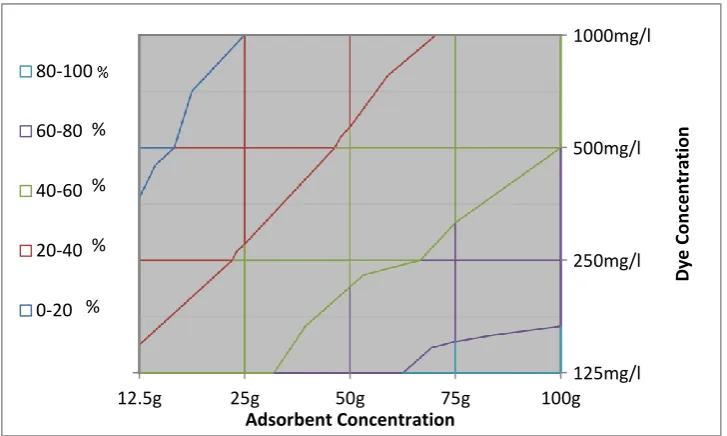
FIGURE I:EFFECT OF INITIAL DYE CONCENTRATION AND ADSORBENT CONCENTRATION (CONDITION: PH3, TIME 10 MINUTES)
The fig.I shows the effect of initial dye concentration and adsorbent concentration on percentage dye removal. From the fig. I, it can be observed that percentage dye removal decreases with increase in initial dye concentration. This could be due to the exhaustion of the limited active sites available for adsorption on a particular adsorbent concentration[9]. Another thing worth noticing from the fig.I is that with increase in the adsorbent dose, percentage dye removal also increases. Increased adsorbent dose results in the greater suface area and also more active sites for binding of the dye molecules [9]. The maximum dye removal soil gave was 90%. Thus, this can be stated that soil can be effectively used as a low cost adsorbent.
FIGURE II: MOLECULAR STRUCTURE OF DIRECT RED 81 (DR81).
IV.CONCLUSIONS
This paper enlists the available siliceous materials for dye removal. A new low cost adsorbent, locally available soil, from Rajasthan, India has also been introduced in this paper. Authors are presently working on this adsorbent. This adsorbent has shown good dye removal efficiency and could be used as a low cost adsorbent
REFERENCES
[1] C.A.P. Almeida, N.A. Debacher, A.J. Downs, L. Cottet, C.A.D. Mello, "Removal of methylene blue from colored effluents by adsorption on montmorillonite clay", Journal of Colloid and Interface Science, Vol. 332, pp. 46– 53,2009.
[2] Xiaoying Jin, Ming-qin Jiang, Xaio-quan Shan, Zhi-guo Pei, Zuliang Chen, "Adsorption of methylene blue and orange II onto unmodified and surfactant-modified zeolite", Journal of Colloid and Interface Science , Vol. 328 , pp. 243–247, 2008.
[3] H. Chen, J. Zhao, "Adsorption study for removal of Congo red anionic dye using organo-attapulgite", Adsorption , Vol. 15, pp. 381–389, 2009.
[4] Ayhan Demirbas, "Agricultural based activated carbons for the removal of dyes from aqueous solutions: A review", Journal of Hazardous Materials , Vol. 167, pp. 1-9. 2009.
125mg/l 250mg/l 500mg/l 1000mg/l
12.5g 25g 50g 75g 100g
D
ye
Co
n
ce
n
tr
ation
Adsorbent Concentration
80-100
60-80
40-60
20-40
0-20 % %
Volume 3, Issue 1, 2016
5 [5] Runping Han, Yi Wang, Weihua Zou, Yuanfeng Wang, Jie Shi,"Comparison of linear and nonlinear analysis in
estimating the Thomas model parameters for methylene blue adsorption onto natural zeolite in fixed-bed column", Journal of Hazardous Materials, Vol. 145, pp. 331–335, 2007.
[6] V.K. Gupta, Suhas, "Application of low-cost adsorbents for dye removal – A review", Journal of Environmental Management , Vol. 90, pp. 2313–2342, 2009.
[7] Grègorio Crini, "Non-conventional low-cost adsorbents for dye removal: A review", Bioresource Technology, Vol. 97, pp. 1061-1085, 2006.
[8] A. Gürses, Ç. Dŏgar, M. Yalçın, M. Açıkyıldız, R. Bayrak, S. Karaca, "The adsorption kinetics of the cationic dye, methylene blue, onto clay",Journal of Hazardous Materials, Vol. B131, pp. 217-228, 2006.
[9] Dipa Ghosh, Krishna G. Bhattacharyya, "Adsorption of methylene blue on kaolinite", Applied Clay Science , Vol. 20, pp. 295– 300, 2002.
[10]Emrah Bulut, Mahmut Özacar, İ. Ayhan Şengil,"Equilibrium and kinetic data and process design for adsorption of Congo Red onto bentonite", Journal of Hazardous Materials , Vol. 154 , pp. 613–622, 2008.
[11]G. Atun, G. Hisarli, W.S. Sheldrick, M. Muhler, "Adsorptive removal of methylene blue from colored effluents on fuller's earth", J. Colloid Int. Sci., Vol. 261, pp. 32-39, 2003.
[12]M.A.M. Khraisheh, M.A. Al-Ghouti, S.J. Allen, M.N. Ahmad, "Effect of OH and silanol groups in the removal of dyes from aqueous solution using diatomite", Water Research , Vol. 39, pp. 922–932, 2005.
[13]Olugbenga Solomon Bell, Oluwole Abraham Olusegun and Victor Obinna Njoku, "Fly ash: an alternative to powdered activated carbon for the removal of eosin dye from aqueous solutions", Bull. Chem. Soc. Ethiop. , in Proc. of Chemical Society of Ethiopia, Vol. 27, pp. 191-204, 2013.
[14]Chayada Pansuk, Soydoa Vinitnantharat, "A Comparative Study of the Adsorption of Acid Brown 75 and Direct Yellow 162 onto Unmodified and Surfactant Modified Granule Developed from Coal Fly Ash", IACSIT Press, 2nd International Conference on Environmental Science and Technology IPCBEE, Singapore, Vol. 6, pp. 49-54, 2011.
[15]Normala Halimoon, Rachel Goh Soo Yin, "Removal of Heavy Metals from Textile Wastewater using Zeolite", Environment Asia (special issue), Vol. 3, pp. 124-130, 2010.
[16]Bülent Armağan, Mustafa Turan,Orhan Özdemir, and Mehmet S. Çelik, "Color Removal of Reactive Dyes from Water by Clinoptilolite", Journal of Environmental Science and Health Part A—Toxic/Hazardous Substances & Environmental Engineering, Vol. A39, 5, pp. 1251-121, 2004.
[17]Orhan Ozdemir, Bulent Armagan, Mustafa Turan, Mehmet S. Çelik, "Comparison of the adsorption characteristics of azo-reactive dyes on mezoporous minerals", Dyes and Pigments , Vol. 62, pp. 49-60, 2004.
[18]Mahmut Özacar, İ. Ayhan Şengil, "Adsorption of Acid Dyes from Aqueous Solutions by Calcined Alunite and Granular Activated Carbon", Adsorption , Vol. 8, pp. 301-308, 2002.
[19]Asude Ateş, Rabia Köklü and Çiğdem Özer, "The Adsorption of Dye Removal from Textile Industry Wastewater with Natural Adsorbents", in Proc. of Digital Proceeding Of The ICOEST, Side, Turkey, pp. 14 – 17, 2014. [20]Saeed B. Bukallah, M.A. Rauf, S.S. AlAli, "Removal of Methylene Blue from aqueous solution by adsorption on
sand", Dyes and Pigments, Vol. 74, pp. 85-87, 2007.
[21]M.A. Rauf, Ihsan A. Shehadi, Walaa W. Hassan, "Studies on the removal of Neutral Red on sand from aqueous solution and its kinetic behavior", Dyes and Pigments, Vol. 75, pp. 723-726, 2007.
[22]Papita Saha, Shamik Chowdhury, Suyash Gupta, Indresh Kumar, "Insight into adsorption equilibrium, kinetics and thermodynamics of Malachite Green onto clayey soil of Indian origin", Chemical Engineering Journal, Vol. 165, pp. 874–882, 2010.
[23]Shaobin Wang, Huiting Li, Sujuan Xie, Shenglin Liu, Longya Xu, "Physical and chemical regeneration of zeolitic adsorbents for dye removal in wastewater treatment", Chemosphere, Vol. 65, pp. 82–87, 2006.
[24]Shaobin Wang, Huiting Li, Longya Xu, "Application of zeolite MCM-22 for basic dye removal from wastewater" , Journal of Colloid and Interface Science, Vol. 295, pp. 71–78, 2006.
[25]Shaobin Wang, Eko Ariyanto, "Competitive adsorption of malachite green and Pb ions on natural zeolite", Journal of Colloid and Interface Science, Vol. 314, pp. 25–31, 2007.
[26]Y. Zaker, M. A. Hossain and T. S. A. Islam, "Adsorption Kinetics of Methylene Blue onto Clay Fractionated from Bijoypur Soil, Bangladesh", Research Journal of Chemical Sciences , Vol. 3,2, pp. 65-72, 2013.
[27]Al-Ghouti, M.A.Khraisheh, M.A.M. Allen, S.J.Ahmad,"The removal of dyes from textile wastwater: a study of the physical characteristics and adsorption mechanisms of diatomaceous earth", Journal of Environmental Management, Vol. 69, pp. 229-238, 2003.
[28]M. Ozacar, I.A. Sengil, "Adsorption of reactive dyes on calcined alunite from aqueius solutions", Journal of Hazardous Materials, Vol. 98, pp. 11-224, 2003.
[29]Q.H.Hu, S.Z.Qiao, F.Haghseresht, M.A.Wilson, G.Q.Lu "Adsorption study for removal of basic red dye using bentonite", Ind. Eng. Chem. Res., Vol. 45, pp. 733-738, 2006a.
[30]Tim Robinson, Geoff McMullan, Roger Marchant, Poonam Nigam, "Remediation of dyes in textile e‚uent: a critical review on current treatment technologies with a proposed alternative", Bioresource Technology , Vol. 77, pp. 247-255, 2001.