Volume 65, 2019, Pages 127–138
GCAI 2019. Proceedings of the 5th Global Conference on Artificial Intelligence
DLS-Forgetter: An Implementation of the DLS Forgetting
Calculus for First-Order Logic
Ruba Alassaf and Renate Schmidt
The University of Manchester, UK
Abstract
DLS-Forgetteris a reasoning tool that aims to compute restricted views of a knowl-edge base of first-order logic formulae via semantic forgetting. Semantic forgetting achieves this by eliminating predicate symbols in an equivalence preserving way up to the remain-ing symbols. Forgettremain-ing has many applications such as information hidremain-ing, explanation generation and computing logical difference. DLS-Forgettercombines ideas from two Ackermann-based approaches: the DLS algorithm and a modal logic inference system inspired by the algorithm. The tool enhances the DLS algorithm by incorporating an ordering over the symbols in the forgetting signature. This allows more control over the forgetting process and the application of the elimination rules. The theory behind the tool is provided by a first-order Ackermann calculus, a first-order generalisation of the rules outlined by the modal logic inference system. The purpose of the tool is to provide the research community with an experimental tool to allow further research to be conducted in the area. This paper describes the DLS-Forgetter tool along with its underlying calculus, it outlines the forgetting process used in the implementation, and presents results of an empirical evaluation.
1
Introduction
This paper presents a nonstandard reasoning tool calledDLS-Forgetter. The aim of
DLS-Forgetteris to compute forgetting solutions for problems in first-order logic based on a result
of Ackermann [1]. Forgetting is a reasoning technique that seeks to reduce the symbols used to express a given set of formulae provided that equivalence is preserved up to the remaining symbols.
The recent developments in the applications of forgetting have increased interest in the topic, particularly in the artificial intelligence community. Forgetting could be applied to diverse areas such as abductive reasoning [4], logical difference [10, 11] and correspondence theory [6, 14]. The following gives a formal definition of forgetting.
Definition 1(Semantic/Strong Forgetting). Let F be a first-order logic formula and Σ a set of predicate symbols. F0 is a solution of semantic forgetting Σ fromF iff for any interpretation
Semantic forgetting amounts to the elimination of the second-order existential quantifier[6]. Other related notions are weak forgetting which is the dual to uniform interpolation [10].
Ackermann showed that the problem of second-order quantifier elimination is incomplete and undecidable for first-order logic [1,6]. Nonetheless, there are practical approaches to compute forgetting. These fall within two categories: saturation approaches and rewrite-replacement1 approaches. Saturation approaches rely on the idea of exhaustively generating consequences (e.g., using a resolution algorithm) and subsequently eliminating the consequences containing symbols from the forgetting signature. Exploiting Ackermann’s Lemma, which is a monotonic-ity property, rewrite-replacement approaches attempt to rewrite the knowledge base using a specified set of rules until a definition of a forgetting symbol is found. The elimination of the symbol is achieved via a replacement with the definition.
The current version of DLS-Forgetter combines ideas from two rewrite replacement approaches: the DLS algorithm of [5] and the Ackermann-based inference system for modal logic described in [14]. Along with one other recent implementation [16], the system is currently the only Ackermann-based system for computing forgetting for first-order logic.
2
The DLS Inference System
This section describes the calculus that forms the basis of the reasoning approach used in the implementation. The language used in the calculus is that of first-order logic. We useX to denote a predicate symbol in the forgetting signature andα, βto denote two possibly complex formulas. To begin with, we give some preliminary definitions.
Definition 2(Orderings). An ordering over a setSis a binary relation overSthat is irreflexive and transitive. An ordering>over a setS is said to be total if and only if for any two different elementsxandy in S eitherx > yor y > x.
Definition 3. Letαcontain at least one occurrence of the predicate symbolX. We say thatX
occurs negatively in a formulaα, if it is preceded by a negation symbol in the negation normal form ofα. Otherwise, the predicate symbolX is said to occur positively in α. Note that it is possible thatX occurs both positively and negatively inα.
Example 1. Consider the following formula¬(F ∨ ¬X)∧ ¬G. Transforming the formula into negation normal form will give us¬F∧X∧ ¬G. Since the predicate symbol X is not proceeded by a negation symbol in the latter, it is said that it occurs positively in the former.
Definition 4. Let α and β be first-order formulas, X be a predicate symbol, and ¯x be a sequence of distinct variables where the length of ¯xis equal to the arity of X. The expression
βαX(¯(¯x,x)z¯) denotes a first-order formula that is obtained by replacing each occurrence ofX of the formX(¯x) inβ byα(¯x,z¯).
Example 2. Consider the expression (X(a, b)∨ ¬X(b, c))(XR((x,yx,y,z) )∧¬Q(y,z)). It denotes the formula obtained by replacing each occurrence ofX(x, y) by (R(x, y, z)∧¬Q(y, z)). Evaluation of the expression results in (R(a, b, z)∧ ¬Q(b, z))∨ ¬((R(b, c, z)∧ ¬Q(c, z))).
Definition 5. A formula α is said to be positive (respectively negative) w.r.t the predicate symbolX if and only ifX only occurs positively (respectively negatively) inα. The formulaα
is said to be neutral w.r.t. X if and only ifX does not occur inα.
Before we introduce the inference system, we introduce Ackermann’s lemma, the lemma that the forgetting approach is based upon.
Lemma 1 (Ackermann’s Lemma). Let X be a predicate symbol and let α(¯x,z¯) and β(X) be classical first-order formulas, where the number of distinct variables in x¯ is equal to the arity ofX, andαcontains no occurrences ofX.
If β(X) is positive w.r.t. X then
∃X{∀x¯[X(¯x)→α(¯x,z¯)]∧β(X)} ≡βαX(¯(¯x,x)¯z).
If β(X) is negative w.r.t. X then
∃X{∀x¯[α(¯x,¯z)→X(¯x)]∧β(X)} ≡βαX(¯(¯x,x)¯z).
Proofs of the lemma can be found in several sources, for example, in [6]. Intuitively, to forget a predicate symbolX, the idea is to first compute a definition forX, then replace every occurrence ofX by the definition, applying unification appropriately. In that way, we eliminate
X but still maintain the semantics. To illustrate the idea, we give an example.
Example 3. Consider:
∃X{∀x[X(x)→ ∀yQ(x, y)]∧[X(a)∨X(b)]}
Applying the first form of Ackermann’s lemma to eliminate the predicate symbolX gives the following equivalent formula moduloX
∀yQ(a, y) ∨ ∀yQ(b, y).
The inference system that we discuss is based on the DLS algorithm by [5] together with an Ackermann-based inference system for modal logic described in [14]. The idea here is to generalise the novel ideas presented in [14] to the full first-order case. Given a set of first-order formulas, a forgetting signature and a total ordering over that signature, the aim is to eliminate these symbols in order to return a set of formulas or clauses that is equivalent to the original set up to the remaining symbols. To simplify the description, we assume that the formulas have been preprocessed using the steps outlined in the DLS algorithm in [6]. The only modification we advise to apply is miniscoping; that is to minimise the scope of the quantifiers as much as possible. In the end, the set of formulas are transformed into first-order clausal form.
The main difference between the inference system presented here and the DLS algorithm is that the inference system incorporates an ordering over the forgetting signature which is vital for Ackermann-based forgetting approaches. The reason behind this is that in many cases, applying Ackermann’s lemma over a set of clauses may succeed for one ordering but not for another.
Example 4. Given a forgetting signature Σ ={X1, X2}, an ordering>andX1> X2. F,G,H
are possibly complex first-order formulas that share variables with the arguments of forgetting symbols. Consider:
1. ¬X1(x1)∨F
2. X1(x4)∨G
The underlining here is to put emphasis on the maximal symbol in each clause. Attempting to eliminateX1 fails sinceX1 occurs positively and negatively in3, and the forgetting algorithm will terminate with failure. However, if the ordering is changed toX2> X1, then eliminating
X2 gives
1. ¬X1(x1)∨F
2. X1(x4)∨G
X1 is then no longer problematic. The forgetting solution is
F{x1/x4} ∨G,
where{x1/x4} denotes the substitution mappingx1to x4.
The inference rules in the calculus are given in Figure 1. The first three rules are based on Ackermann’s lemma [1]. The purification rules are only applied when all occurrences of a forgetting symbol have the same polarity. They are applied independent of the ordering on the forgetting signature. This is beneficial since in Example 4, the application of this rule allows for the solution to be computed using the first ordering, because X2 only occurs positively in the set and is then pure.
The Ackermann rule performs the elimination by replacing the positive occurrences of the maximal symbol in the forgetting signature with a definition that is based on the grouping of the negative occurrences of that symbol. What is important for the application of the Ackermann rule is that the arguments of all negative occurrences of the forgetting symbol are variables.
The term abstraction rule is used if a negative occurrence of the maximal forgetting symbol has non-variable arguments. The existential term abstraction rule is used to group the negative occurrences of the maximal forgetting symbol together by introducing an existential quantifier over them, in order to allow the application of the Ackermann rule. Appropriate Skolemization and clausification rules are used to eliminate the existential quantifier and the conjunction introduced by this rule.
The rules of the first-order Ackermann calculus are sound but incomplete. If the positive and negative occurrences of a forgetting predicate symbol cannot be separated and no rule in the calculus can be applied, the elimination problem cannot be solved. The following gives a counter example for a strictly maximal forgetting symbolX, which is not solvable.
N ={¬X(x)∨X(y)∨F(x, y),¬X(x)∨X(y)∨G(x, y)}
The output of the inference system is apartial forgetting solution if it contains at least one symbol from the forgetting signature.
3
Implementation
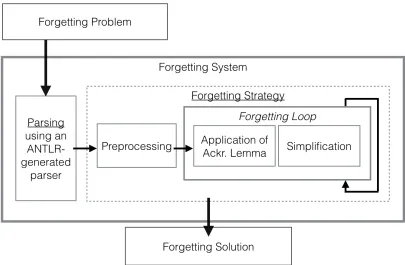
The implementation ofDLS-Forgetterundergoes two main phases: the preprocessing phase and the forgetting phase. This section starts by describing the input and output of the system, which is followed with a high level description of what occurs in each stage.
3.1
Input and Output
Ackermann: N, α1(¯x)∨ ¬X(¯x), . . . αn(¯x)∨ ¬X(¯x)
N(Xα(¯x) 1∧···∧αn)(¯x) provided:
(i) X is in the forgetting signature Σ,
(ii) X is strictly maximal with respect to eachαi(¯x)∨ ¬X(¯x),
(iii) X only occurs positively in the formulas ofN, and
(iv) For any distinctαiandαj, no free first-order variables are shared except for possibly
some or all of ¯x.
Positive purification: N
N>X(¯x)
provided:
(i) X is in the forgetting signature Σ, and
(ii) X only occurs positively in the formulas ofN.
Negative purification: N
N>¬X(¯x)
provided:
(i) X is in the forgetting signature Σ, and
(ii) X only occurs negatively in the formulas ofN.
Term abstraction: N, α∨ ¬X(¯t)
N, α∨ ¬X(¯x)∨x¯6≈¯t provided:
(i) X is in the forgetting signature Σ,
(ii) X is maximal with respect to the ordering,
(iii) ¯tare function symbols, and
(iv) ¯xare fresh variables.
Existential term abstraction: N, α∨ ¬X(¯t1)∨ · · · ∨ ¬X(¯tn)
N, α∨ ∃x¯(¬X(¯x)∧(¯x≈¯t1∨ · · · ∨x¯≈¯tn)) provided:
(i) X is in the forgetting signature Σ,
(ii) X is maximal with respect to the ordering,
(iii) X occurs negatively multiple times (i.e. n >1), and
(iv) ¯xare fresh variables.
Figure 1: The elimination rules of the first-order DLS calculus. ¯x6≈¯tis shorthand notation for
x16≈t1∨xn6≈tn if ¯x= (x1, . . . , xn) and ¯t= (t1, . . . , tn), while ¯x≈¯tis shorthand notation for
using the DFG syntax [9], which is also used by the SPASS prover [15]. The output of the system is a set of clauses that may contain Skolem terms. The correct way to interpret the output is to assume that all variables expressed usingxi,yi,zi fori∈Nare universally quantified. Skolem
terms in the result are expressed in the formfi(¯x) for i∈N, where ¯xare the variables in its
arity. The output of the system is a forgetting solution if none of the forgetting symbols appear in the result. If the system fails to eliminate a forgetting symbol, the symbol appears in the result; and in this case, the output is a partial forgetting solution.
3.2
The Preprocessing Phase
DLS-Forgetteruses a parser that was generated using ANTLR (ANother Tool for Language
Recognition) [13] to translate a forgetting problem into data structure of the system. The data structure extensively uses the HashSet class from the Collection framework for the Java programming language [3] to automate simplifications that are due to redundancies in the input.2 Suitable hashing and caching techniques are used to make this process more efficient. This has improved the performance of the current system in comparison to a previous version by up to four times for large inputs. The idea is to compute a hashcode via a well-designed hashing function for each new object. The hashcode is subsequently cached within the object for the duration of its lifetime. In this way, the system gains increased speed for relatively little memory. DLS-Forgetterexecutes the following preprocessing steps to transform the input into a set of clauses. First, implications, equivalences and redundant first-order quantifiers are eliminated. The formulas are then transformed into negation normal form. The scope of all first-order quantifiers are minimised until they are as minimal as possible. Skolemization is applied to eliminate the existential quantifiers. The universal quantifiers are subsequently dropped. Finally, all top-level conjunctions over the disjunctions occurring in the conjuncts are removed.
3.3
The Forgetting Phase
After the preprocessing phase,DLS-Forgetterstarts the forgetting procedure. The rules of the DLS calculus that were presented in the previous section are applied in this phase.
The procedure starts by purifying the clauses if possible. This means if any of the symbols in the forgetting signature occur only positively or only negatively in the input,DLS-Forgetter applies the purification rules to eliminate them.
After the clauses are purified, the procedure picks a total ordering over the symbols remain-ing in the forgettremain-ing signature. In the default settremain-ing, the forgettremain-ing signature is ordered as specified by the user. After this, the procedure is ready to start the forgetting loop.
The forgetting loop attempts to eliminate each of the forgetting symbols remaining after the purification step in the order as given by the ordering. For each maximal symbol in the forgetting signature, the set of clauses are split based on the polarity of the forgetting symbol. If no clause contains an occurrence of the maximal symbol negatively and positively at the same time, then the elimination is possible, and the Ackermann rule is applied. Otherwise, the procedure attempts to purify the clauses and reattempts to eliminate the maximal forgetting symbol. If the elimination is still not possible, the procedure alters the ordering to make the problematic (currently maximal) forgetting symbol in hand minimal. After eliminating each
2We highlight this implementation detail to encourage other authors to use this class in building similar
¬> ≡ ⊥ α∧ ⊥ ≡ ⊥ α∨ > ≡ > ¬α∧α∧β ≡ ⊥ ¬¬α≡α
¬⊥ ≡ > α∧ > ≡α α∨ ⊥ ≡α ¬α∨α∨β ≡ >
Figure 2: The simplification rules used inDLS-Forgetterfor a possibly complex first-order formulaα. β also denotes a first-order formula.
Figure 3: A top-level view of the main software components of DLS-Forgetter.
symbol, the system also checks if possible simplifications can be performed. The simplifications that the system performs can be found in Figure2.
The procedure terminates if all the symbols in the signature are eliminated or if the system could not eliminate any of the symbols remaining in the forgetting signature.
Finally, as mentioned earlier, the output is a forgetting solution if it does not contain any of the predicate symbols specified in the forgetting signature. We say that forgetting has succeeded. Otherwise, the output is a partial forgetting solution. If the system does not succeed and outputs a partial forgetting solution, that does not imply that no solution exists. This may be because the heuristics used by the system did not compute a forgetting solution. The Ackermann approach may still be able to compute a forgetting solution if the forgetting procedure attempted to eliminate the forgetting symbols by exhaustively trying all possible orderings. Even if all eliminated order are tried there is no guarantee that a solution is found because a solution may not exist.
4
Related tools
The first implementation of DLS algorithm was developed and described in [8] but unfortu-nately, it is no longer maintained. The most closely related tool to DLS-Forgetter is a recent implementation of the DLS algorithm that is briefly described in [16] as part of the PIE environment. Another Ackermann-based forgetting tool isFame 1.0 [18] for description logic. Recent work onFame1.0 has shown excellent performance and great potential for other Ackermann-based approaches [17].
TheScanalgorithm [7], due to Gabbay and Ohlbach, is a resolution-based forgetting algo-rithm and was the first fully automated forgetting algoalgo-rithm (for first-order logic). TheScan forgetting tool may be accessed via the web [12]. Even though it does not accept large inputs, it was used during the development of our tool to confirm the correctness of parts of our system. Related to theScan algorithm is the resolution-based approach used in theLetheforgetting tool [10] for description logics.
5
Evaluation
We conducted an evaluation over a corpus of large real-world description logic ontologies taken from the Oxford repository,3a commonly used resource that is available to evaluate reasoners. The ontologies in the Oxford repository are a collection of ontologies that were selected from other publicly available repositories such as the NCBO BioPortal repository.4 We compare our results with results computed using theLethe5forgetting tool to show the practicality of the approach and the implementation. For the purpose of the conversion from the OWL syntax, we have developed a translator to facilitate the translation of the ontologies into first-order logic (DFG syntax).
The experiments were run on a standard machine with an Intel Core i5-4200 processor, four cores running at up to 2.50 GHz. To conduct the experiments, we randomly selected 124 ontologies from the Oxford repository. The total number of experiments that were run over the ontologies is 9181 for each system. A timeout of 5 minutes was imposed on each run. To ensure that both tools receive the same ontologies, we first ran the ontologies throughLethe
without forgetting any symbols.
Overall, the average amount of time it tookDLS-Forgetterto compute a result was 14 seconds. The result was a partial forgetting solution in 23.6% of the tests that terminated within the allowed time period. The system terminated due to exceeding the time limit in 204 tests from 7 ontologies; 93 of which were from the ontology with the id 677. Moreover, it was observed thatLethesuccessfully solved 200 of these tests within the 5 minute time-out.
On the other hand,Lethecomputed a forgetting solution in an average time of 32 seconds. The time limit was exceeded in 537 tests which spanned 25 ontologies. DLS-Forgetter successfully terminated in 28 of them.
Statistical information on a sample of the ontologies that we have used can be found in Table 1. The first row is the unique id given to the ontology by the developers of the Oxford repository. The row headed ‘Expr.’ indicates the expressivity of the test ontology. The row headed ‘#(O)’ indicates the number of logical axioms in the ontology. The row headed ‘#sigc(O)’ indicates
3http://www.cs.ox.ac.uk/isg/ontologies/ 4https://bioportal.bioontology.org
5Ideally, the comparison would have been against the
the number of concept symbols in the ontology. The column headed ‘#sigr(O)’ indicates the
number of role symbols in the ontology.
UID 2 17 22 392 590 605 609 677
Expr. ALCH ALCH ALCH ALE ALCH ALE ALCH ALE
#(O) 3368 1034 367 1214 599 734 164 1882
#sigc(O) 761 97 39 1153 401 552 38 1582
#sigr(O) 46 259 90 12 34 2 87 11
Table 1: Statistical information on the 8 samples of the test ontologies.
The results of the evaluation over the ontologies described in Table 1 are summarised in Table 2 and Table 3. The first column identifies the ontologies being used to conduct the experiments. The column headed ‘#F(avg)’ is the average forgetting signature size for the test cases of each ontology. The column headed ‘Time’ gives the average time it took each system to compute an output. The results show thatDLS-Forgetteris noticeably faster thanLethe on all ontologies.
UID #F(avg) Time Timeout Success Remaining #F(avg)
2 237 3.2s 0% 41% 2.2
17 48 1s 0% 0% 9.4
22 20 0.14s 0% 88% 2.2
392 555 56s 0% 0% 230
590 200 1.1s 0% 93% 11.6
605 300 0.74s 0% 100% 0
609 20 0.06s 0% 11% 2.6
677 1004 52.5s 74% 0% 80.8
Table 2: Results of forgetting concept symbols usingDLS-Forgetter.
UID #F(avg) Time Timeout
2 237 30.9s 11.2%
17 48 15.7s 61.2%
22 20 5.2s 0%
392 555 69.5s 0%
590 200 9.2s 0%
605 300 9.5s 0%
609 20 0.8s 0%
677 1004 93.8s 5.6%
Table 3: Results of forgetting concept symbols usingLethe.
The column headed ‘Timeout’ shows the percentage of cases exceeding the 5 minute time limit for each tool. This evaluation shows that expect for the case of ontology 677,
DLS-Forgetter did not exceed the time limit in any of the tests. In fact, if ontology 677 and
The column headed ‘Success’ gives the rate in which DLS-Forgetter succeeds in com-puting a forgetting solution, and the column headed ‘Remaining #F (avg)’ gives the average number of symbols that remain in the forgetting signature for partial solutions. In the cases where the success rate was high, it was observed that the reason was due to a small number of problematic symbols that appeared in the tests multiple times. For example, the maximum number of remaining symbols in the first ontology 2 and ontology 609 were 9 and 4 symbols respectively.
It was interesting to observe that in some casesDLS-Forgettersucceeded in computing a forgetting solution within seconds whileLethewas terminated due to exceeding the allowed time. On the other hand, ontology 677 shows that the contrary also occurred, as the time limit was exceeded byDLS-Forgetterin 74% of the test cases as opposed to 5.6% in the case of
Lethe.
This example encouraged us to lift the time limit constraint imposed onDLS-Forgetter. We found that, for the experiments that were conducted, the maximum amount of time it took forDLS-Forgetter to terminate was 21 minutes. The output was a partial forgetting solution that contained 835 symbols from a forgetting signature of a 1500 symbol size.
These observations might indicate that for application purposes, it might be useful to in-vestigate a hybrid approach that benefits from the speed of Ackermann-based approaches and the high success rate of resolution-based methods as was suggested in [2].
6
Conclusion
To summarise, this paper has introducedDLS-Forgetter; a practical nonstandard reasoning system that provides functionality for forgetting. The system is inspired by the DLS algorithm [5] with some optimisations that were adopted from [14]. Specifically, the description of this system assumes that symbols in the forgetting signature are given in a specific order. The core idea we integrated into our system was purification: if a forgetting symbol occurs only posi-tively (or negaposi-tively), eliminating that symbol will only reduce the complexity of the problem. Therefore, symbols that occur with a single polarity should be eliminated as early as possible. However, it is important to note that in practice, this is highly dependent on the application. In certain circumstances, it may be unlikely that a symbol can be purified, and hence constantly preforming polarity checks could be expensive.
We showed through an extensive evaluation that an Ackermann-based system computes forgetting solutions in a shorter amount of time when compared against a resolution-based system. We have also seen many examples in the evaluation that show that resolution-based systems are capable of solving more forgetting problems.
In the process of comparing the results of DLS-Forgetterand theScanforgetting tool to confirm the correctness of our system, it was observed that even for small syntactically uncomplex problems,DLS-Forgettercomputed forgetting solutions for problems thatScan did not.
Example 5. Consider the problem of forgetting the predicate symbol X from the following clauses:
1. X(x)∨X(y)∨R(x, y)
2. ¬X(x)∨ ¬X(y)∨T(x, y)
Since the positive and negative occurrences of the forgetting symbol X are separated,
applied to this problem. The solution requires the use of the existential term abstraction rule which is not implemented inScan.
Even though a hard problem, as a future step, it would be interesting to define the class of problems each forgetting approach can solve.
The latest version of DLS-Forgettercan be downloaded from http://personalpages. manchester.ac.uk/postgrad/ruba.alassaf/software.
References
[1] W. Ackermann. Untersuchungen ¨uber das Eliminationsproblem der mathematischen Logik. Math-ematische Annalen, 110:390–413, 1935.
[2] R. Alassaf and R. A. Schmidt. A preliminary comparison of the forgetting solutions computed using SCAN, LETHE and FAME. InProceedings of the Workshop on Second-Order Quantifier Elimination and Related Topics (SOQE 2017)., volume 2013 of CEUR Workshop Proceedings, pages 21–26. CEUR-WS.org, 2017.
[3] K. Arnold, J. Gosling, and D. Holmes. The Java Programming Language. Addison-Wesley Long-man, 2000.
[4] W. Del-Pinto and R. A. Schmidt. ABox abduction via forgetting in ALC. In P. Van Hentenryck and Z.-H. Zhou, editors,Proceedings of the Thirty-Third AAAI Conference on Artificial Intelligence (AAAI-2019). AAAI Press, 2019. In press.
[5] P. Doherty, W. Lukaszewicz, and A. Sza las. Computing circumscription revisited: A reduction algorithm. Journal of Automated Reasoning, 18(3):297–336, 1997.
[6] D. Gabbay, R. A. Schmidt, and A. Sza las. Second-Order Quantifier Elimination: Foundations, Computational Aspects and Applications, volume 12 ofStudies in Logic: Mathematical Logic and Foundations. College Publications, 2008.
[7] D. M. Gabbay and H. J. Ohlbach. Quantifier elimination in second-order predicate logic. In
Proceedings of the Third International Conference on Principles of Knowledge Representation and Reasoning, KR’92, pages 425–435. Morgan Kaufmann, 1992.
[8] J. Gustafsson. An Implementation and Optimization of an Algorithm for Reducing Formulea in Second-Order Logic. Master’s thesis, Linkoping University, Sweden, 1996.
[9] R. H¨ahnle, M. Kerber, C. Weidenbach, and R. A. Schmidt. Common syntax of the DFG-Schwerpunktprogramm deduktion version 1.5. , Technical Report TR 10/96, Fakult¨at f¨ur In-formatik, Universit¨at Karlsruhe, Karlsruhe, Germany, 1996.
[10] P. Koopmann and R. A. Schmidt. LETHE: A saturation-based tool for non-classical reasoning. In M. Dumontier, B. Glimm, R. Goncalves, M. Horridge, E. Jim´enez-Ruiz, N. Matentzoglu, B. Par-sia, G. Stamou, and G. Stoilos, editors,Proceedings of the 4th International Workshop on OWL Reasoner Evaluation (ORE-2015), volume 1387 ofCEUR Workshop Proceedings. CEUR-WS.org, 2015.
[11] M. Ludwig and B. Konev. Practical uniform interpolation and forgetting for ALC TBoxes with applications to logical difference. InPrinciples of Knowledge Representation and Reasoning: Pro-ceedings of the Fourteenth International Conference, KR 2014, 2014.
[12] H. Ohlbach, T. Engel, R. Schmidt, and D. Gabbay. Scan: Home page. http://www. mettel-prover.org/scan/index.html. [Online; accessed 2-March-2019].
[13] T. Parr. The Definitive ANTLR 4 Reference. Pragmatic Bookshelf, 2013.
[14] R. A. Schmidt. The Ackermann approach for modal logic, correspondence theory and second-order reduction. Journal of Applied Logic, 10(1):52–74, 2012.
[15] C. Weidenbach, R. A. Schmidt, T. Hillenbrand, R. Rusev, and D. Topic. System description: SPASS version 3.0. In F. Pfenning, editor, Automated Deduction—CADE-21, volume 4603 of
[16] C. Wernhard. The PIE system for proving, interpolating and eliminating. In P. Fontaine, S. Schulz, and J. Urban, editors,5th Workshop on Practical Aspects of Automated Reasoning, PAAR 2016, volume 1635 ofCEUR Workshop Proceedings, pages 125–138. CEUR-WS.org, 2016.
[17] Y. Zhao and R. Schmidt. On concept forgetting in description logics with qualified number restrictions. InProceedings of the Twenty-Seventh International Joint Conference on Artificial Intelligence, IJCAI-18, pages 1984–1990. IJCAI/AAAI Proc., 2018.