78 Available online at www.ijiere.com
International Journal of Innovative and Emerging
Research in Engineering
e-ISSN: 2394 - 3343 p-ISSN: 2394 - 5494
Comparative Analysis of SEA and XTEA for Resource
Constrained Embedded Systems
Ruchita Jain
a, Dr. K. G. Maradia
baME Scholar, Vishwakarma Government Engineering College, Chandkheda, Ahmedabad,Gujarat,India bAssociate Professor, Government Engineering College, Modasa, Gujarat, India
ABSTRACT:
Embedded systems become integral part of our lives. They are used for various industrial automation purposes, service oriented applications like power, water distribution, healthcare and low cost systems like smart cards and PDA’s. Embedded systems exchange data and information both locally and globally using networking and wireless communication, thus making them vulnerable to various kinds of active and passive attacks. In small embedded application like RFID, sensor network, smart card, etc. have very limited resources. It yields design criteria such as: low memory requirements, small code size, limited instruction set, etc. So, it’s a challenge to implement cryptographic algorithm for the resource constrained environment.
This paper deals with performance research of cryptographic techniques, i.e. Sacalable Encryption Algorithm (SEA) and Extended Tiny Encryption Algorithm (XTEA). The main goal of this paper is to find out an efficient and powerful cryptographic technique for embedded systems. These algorithms are implemented on low cost Spartan-3 FPGA family and investigated in the course of this paper. The main criteria of this investigation are speed, throughput, power, efficiency as well as area requirement.
Keywords: Cryptography, SEA (Scalable Encryption Algorithm), XTEA (Extended Tiny Encryption Algorithm), Feistel
structure, FPGA(Field Programmable Gate Array)
I. INTRODUCTION
With the advancements in technology, embedded systems have become an essential part of our everyday lives. These devices range from high-end ones such as servers, computers and laptops to more constrained ones like RFID tags, smart cards and wireless sensor nodes. These devices communicate with each other to exchange information. They are more susceptible to active and passive attacks. Various cryptographic algorithms are used to provide security to such systems. The usual cryptographic algorithm can’t use for resource constrained system. Therefore, the objective is to find out the best optimum cryptographic algorithm for resource constrained system.
The cryptographic algorithms are mainly divided into symmetric and asymmetric cryptography. Since asymmetric keys are bigger than symmetric keys, data that is encrypted asymmetrically is tougher to crack than data that is symmetrically encrypted. However, this does not mean that asymmetric keys are better. Rather than being compared by their size, these keys should compared by the following properties: computational burden and ease of distribution. Symmetric keys are smaller than asymmetric, so they require less computational burden. Hence, symmetric key algorithms are more preferred than asymmetric key algorithm for small embedded applications. We implement SEA and XTEA on FPGA as it is more efficient for implementation of cryptographic algorithms [1]. The reconfigurability of FPGA provides required flexibility.
II. RELATED WORK
F. X. Standaert et all. [2] introduce new algorithm SEA for resource constrained system(RFID, sensor network , etc.). It gives theoretical explanations and pseudo code for software implementation. F. Mace et all. [3] implement SEA on FPGA for the first time. For efficient implementation, loop architecture is proposed in this paper. It compares area and throughput for various input parameter. It also gives comparative survey of various cryptographic algorithms.
79
III.ALGORITHMOVERVIEW
A. SEA
Scalable Encryption Algorithm (SEA) is feistel based symmetric key algorithm. 𝑆𝐸𝐴𝑛,𝑏 operates on various text, key, and
has variable number of rounds. It is defined with following parameters: n plain text and key size;
b processor(or word) size;
𝑛𝑏= 𝑛 2𝑏 ⁄ number of words per feistel branch;
𝑛𝑟 number of block cipher rounds.
As an only constraint, it is required that n is a multiple of 6b (Because both the plain text are separated into 2 parts, and all the operation are done in 3 words).
The minimum required number of rounds to provide security against known attacks would be nr = [3(n/4) + 2((n/2b )+ b/2)].
The value of nr must be always odd, if not 1 must be added to make it odd.
BASIC OPERATIONS
Due to its simplicity constraints, 𝑆𝐸𝐴𝑛,𝑏 is based on a limited number of elementary operations (selected for their
availability in any processing device) denoted as follows: 1) Bit wise XOR
2) Mod 2b addition
3) A 3-bit substitution box S: = [0, 5, 6, 7, 4, 3, 1, 2] that can be applied bit wise to any set of 3-bit words for efficiency purposes.
In addition, we use the following rotation operations: 4) Word rotation R, defined on nb-word vectors The word rotation is defined on nb-word vectors:
R:𝑍2
𝑛
2: x → y = R(x) ⇔y
i+1 = xi, 0 ≤ i ≤ nb− 2, y0 = xnb−1
5) Bit rotation, b defined on nb-word vectors: The bit rotation is defined on nb-word vectors:
r : 𝑍2
𝑛
2: x → y = r(x) ⇔y
3i= x3i≫1, y3i+1 = x3i+1,
y3i+2 = x3i+2≪1, 0 ≤ i ≤ nb/3− 1,
where, ≫and ≪represent the cyclic right and left shifts inside a word.
LOOP IMPLEMENTATIONS OF SEA
The structure of our loop architecture for SEA is depicted in Fig. 7.3, with the round function on the left part and the key schedule on the right part.
80
B. XTEA
TEA uses only simple addition, XOR and shifts, and has a very small code size. This makes TEA an ideal candidate to provide data security services for wireless sensor network (WSN) nodes which have limited memory and computational power.
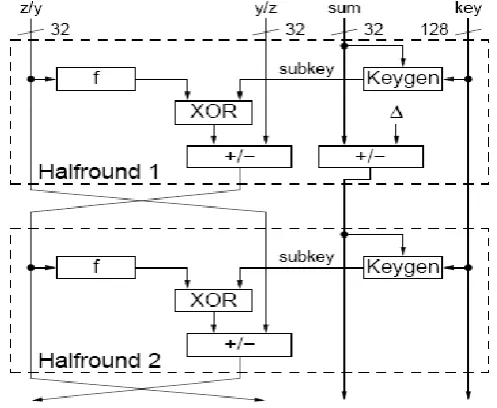
The Extended Tiny Encryption Algorithm (XTEA) is a block cipher that uses a cryptographic key of 128 bits to encrypt or decrypt data in blocks of 64 bits. Each input block is split into two halves y and z which are then applied to a routine similar to a Feistel network for N rounds where N is typically 32. Most Feistel networks apply the result of a mixing function to one half of the data using XOR as a reversible function. For the same purpose, XTEA uses integer addition during encryption and subtraction during decryption.
For encryption, z is applied to the left side, y to the right side, and all adder/subtracters are in addition mode. For decryption, the opposite is applied. The permutation function is shown as f and the subkey generation as Keygen.
Figure 2. Top level block diagram of XTEA [6]
One round of xTEA computes a new value for y and z. Therefore, we can view the computation of one value as a halfround. A new value for sum is computed between the first and the second halfround. It is incremented by a constant ∆ during encryption and decremented during decryption.
IV.PROPOSED WORK
As the main application is for small embedded application, area is the most important criteria.
In SEA, the resource consuming operation is modulo 2b addition and S-box. Other operation can simply obtained by swapping wires. So, to reduce area, ripple carry adder is implemented in loop architecture to perform modulo operation. Instead of doing addition of n bits, only addition of b bit is performed as it is modulo 2b. This reduces area significantly.
As adder and subtractor is most important part of XTEA algorithm, ripple carry adder and Kogge-stone adder is implemented on Spartan 3E with speed grade of -5.
Table 1. Comparison between various adders
no. of slices no. of LUTs Latency(ns)
Ripple carry adder 36 63 38.26
Kogge-stone adder 62 115 16.46
From the comparison, we can conclude that kogge-stone adder is more efficient in terms of speed. But for small embedded application, area is first priority. So, ripple carry adder is used as basic building block for adder/subtractor as it has minimum area.
V. IMPLEMENTATIONRESULTS
The above algorithms are implemented on Xilinx Spartan-3 (Family), XCS500 (Device), FG320 (Package), -5(speed Grade) FPGA Device in hardware description language VHDL.
A. SEA
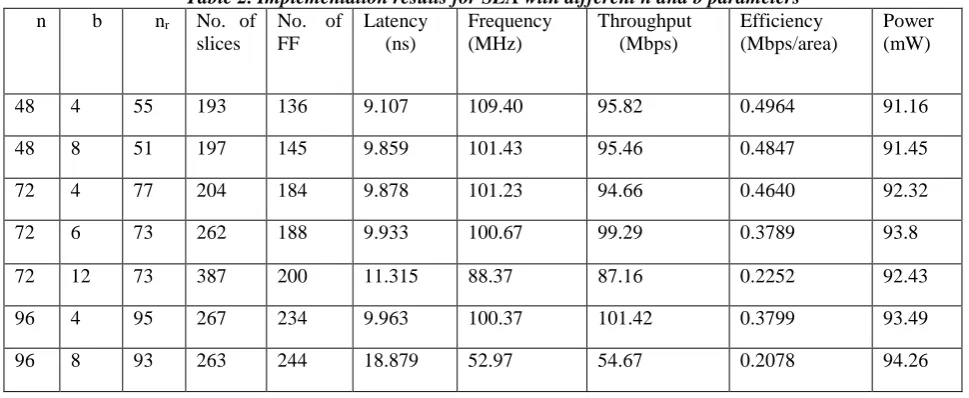
81 empirical conclusion that as long as the b parameter is not a limiting factor for the work frequency, increasing the word size leads to the most efficient implementations for both area and throughput reasons.
Table 2. Implementation results for SEA with different n and b parameters n b nr No. of
slices
No. of FF
Latency (ns)
Frequency (MHz)
Throughput (Mbps)
Efficiency (Mbps/area)
Power (mW)
48 4 55 193 136 9.107 109.40 95.82 0.4964 91.16
48 8 51 197 145 9.859 101.43 95.46 0.4847 91.45
72 4 77 204 184 9.878 101.23 94.66 0.4640 92.32
72 6 73 262 188 9.933 100.67 99.29 0.3789 93.8
72 12 73 387 200 11.315 88.37 87.16 0.2252 92.43
96 4 95 267 234 9.963 100.37 101.42 0.3799 93.49
96 8 93 263 244 18.879 52.97 54.67 0.2078 94.26
The implementation results are compared with implementation results of [3]. The result is shown in table 3.From the comparison, it can be said that for small processor size, the proposed implementation is more area efficient. In [3], the algorithm is implemented on xc4vlx25 VIRTEX-4 platform with speed grade -12.
Table 3. Comparison with other implementation no. of slices no. of FF
SEA48,4[3] 197 127
SEA48,4 193 136
SEA72,4[3] 296 194
SEA72,4 204 184
SEA72,8[3] 258 194
SEA72,8 262 188
SEA96,4[3] 368 241
SEA96,4 267 234
SEA96,8[3] 333 246
SEA96,8 263 244
B. XTEA
The implementation result of XTEA is shown in table 4.
Table 4. Performance parameter of XTEA
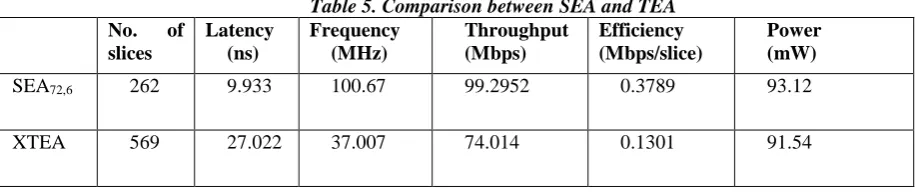
The comparison between SEA and XTEA is shown in table. The area requirement is less for SEA. The throughput and hardware efficiency is also high for SEA compared to XTEA. The power consumption is slightly higher than XTEA due to higher operating frequency of SEA.
Parameters Results
No. of slices 332
No. of FF 450
Latency (ns) 25.090
Frequency (MHz) 39.85
Throughput (Mbps) 79.7
Efficiency (Mbps/slices) 0.2401
82 Table 5. Comparison between SEA and TEA
No. of
slices
Latency (ns)
Frequency (MHz)
Throughput (Mbps)
Efficiency (Mbps/slice)
Power (mW)
SEA72,6 262 9.933 100.67 99.2952 0.3789 93.12
XTEA 569 27.022 37.007 74.014 0.1301 91.54
VI.CONCLUSIONS
This paper presents the FPGA implementation of SEA and XTEA. It executes one round per one clock cycle. The SEA is implemented for various plain text and processor size n and b, respectively. The proposed structure of SEA is well suited for small processor size b. Form the comparison between SEA and XTEA, it can be concluded that SEA is more efficient algorithm in terms of area requirement, speed, throughput and hardware efficiency compared to XTEA. So, SEA can be considered as efficient alternative for resource constrained system.
REFERENCES
[1] K. Jarvinen, M. Tommiska, and J. Skytta, “Comparative survey of high-performance cryptographic algorithm implementations on FPGAs,” IEE Proc. Inf. Security, vol. 152, pp. 3–12, Oct. 2005.
[2] F.-X. Standaert, G. Piret, N. Gershenfeld, and J.-J.Quisquater, “Sea: A scalable encryption algorithm for small embedded applications,” in Proc. CARDIS, 2006, pp. 222–236.
[3] F. Mace, F . -X. Standaert, and J.-J Quisquater “FPGA implementation(s) of a Scalable Encryption Algorithm,” in IEEE Transaction on very large scale integration (VLSI) systems ,VOL.16, NO. 2, FEBRUARY 2008.
[4] Wheeler, D., Needham, R.: TEA, a tiny encryption algorithm, Technical report, Cambridge University, England (Nov 1994).
[5] Wheeler, D., Needham, R.: TEA extensions. Technical report,Cambridge University, England (Oct 1997).
[6] J.-P. Kaps, "Chai-Tea, Cryptographic Hardware Implemenations of xTEA", The 9th International Conference on Cryptology in India - INDOCRYPT 2008, LNCS 5356, pp. 363-375, 2008.
[7] Krishna Kumari V, Sri Chakrapani Y and Kamaraju M, “Design and Characterization of Koggestone, Sparse Koggestone, Spanning Tree and Brentkung Adders”, International Journalof Scientific & Engineering Research, Vol. 4, No. 10, pp. 1502- 1506, ISSN 2229-5518, 2013.
[8] B. Schneier, “Applied Cryptography” John Wiley & Sons Inc., New York, New York, USA, 2nd edition, 1996. [9] Xilinx Inc., “Spartan-3 FPGA Family Data Sheet”, DS099, December 4, 2009, available at
![Figure 1. Loop structure of SEA [2]](https://thumb-us.123doks.com/thumbv2/123dok_us/8874868.1816252/2.595.110.510.506.770/figure-loop-structure-of-sea.webp)