I
nternational Journal ofP
harmaceuticalB
iological andC
hemicalS
ciencese-ISSN: 2278-5191
International Journal of Pharmaceutical, Biological and Chemical Sciences (IJPBCS) | JUL-SEPT 2014 | VOLUME 3 | ISSUE 3 | 27-35 www.ijpbcs.net or www.ijpbcs.com
R
esearch
A
rticle
Pa
ge
27
A NOVEL FORMULATION BASED ON PEARL MILLET FOR BROILERS FEEDING Emtenan M.Hanafi1*, Manal M. Ramadan2, Seham S.Kassem3, Madeha M. Abdel kader3,A .M. Kholif 4,
Ghada E.A. Awad5 and Enas N. Danial5,
1
Department of Animal reproduction and A.I,
2
Chemistry of Flavour and Aroma Department,
3
Department of food science and nutrition,
4
Departement of Dairy products,
5
Department of Chemistry of Natural and Microbial Products, National Research Center, Giza, Egypt
*Corresponding Author Email: [email protected]
INTRODUCTION
Pearl millet has the requisite characteristics for dry land production in comparison to the traditional grain crops. Pearl millet can be grown with limited N-input. As N-fertilization is the major cost of producing any crop, Pearl millet offers special opportunity for large number of limited resource farmers [1]. Millets rank as the sixth most important cereal in the world especially in developed countries
where they serve as staple foods for millions of people. In Sudan, it is the second important crop after wheat for human consumption. It may be cooked as rice or minced and packed like wheat. Seeds are fed to birds and leaves are also fed to farm animals. Among cereals, millet is a major supplier of micronutrients where it has 2-7 folds higher level of trace metals than other cereals. Mice fed on pearl millet showed higher body weight gain and higher
ABSTRACT:
Among cereals, millet is a major supplier of micronutrients, where it has 2-7 folds higher level of trace metals than other cereals.In the same time it can be grown in dry land. It represents the third important cereal after wheat and rice for human consumption in some countries. Also it is good feed for animals. The current study was designed to find out the performance of pearl millet seeds if replaced maize in broilers feed. After extraction of the volatile components of seeds it was examined for antioxidant power using DPPH and β-Carotene-linoleate scavenging assays. Millet extract showed high antioxidant power in both assays. Gas chromatography (GC/ MS) showed the presence of butaylated hydroxytoluene (BHT), the volatile natural antioxidant compound, as main volatile constituent. Chemical analysis of seeds showed that pearl millet was rich in protein, phosphorus, iron and zinc if compared to maize seeds. Also, by estimation of the phytin phosphorus and phytate, millet showed much lower level if compared to maize. The formulated feeds were justified to have 21% protein for the growing chicks after total maize and partial soya bean replacement by pearl millet. Twenty cup chicks (1 day old) were divided into 2 equal groups, control group fed on diet based on maize (G1) and birds fed on diet based on pearl millet (G2). All chicks had free access to feed and water. The daily consumed feed were calculated and the feed efficiency ratio (FER) was estimated (Body weight gain/ consumed feed). After 6 weeks, birds were slaughtered and blood samples were collected for investigation. Also transfers sections of femur were dried in oven to be sent for of estimation of bone porosity then ground and burned for estimation of mineral concentration by atomic absorption. Ovaries and testes of hens and cocks were examined for any pathology. Results revealed that birds fed on P.millet diet showed better FER towards the end of the experiment. Analysis of minerals and traces showed higher levels phosphorus, zinc and iron in serum and bone with less bone porosity of birds fed p.millet formulation if compared to those fed on maize based formulation. The superiority of P millet to maize may be explained to be due to a lower ratio of phytate that increased the bioavailability of micronutrients. Also its high zinc concentration controlled bone porosity. Screening the organ function and oxidative stress markers showed that feed based on p. millet markedly lowered the liver enzyme. Millet grains contain wide range of phenolic compounds which has health promoting properties. Examination of gonads showed normal function. It is concluded that p.millet offers special opportunity for large number of limited resources farmers. It is rich in protein and traces that promotes health and higher meat output in poultry industry.
KEYWORDS:
Emtenan M.Hanafi* et al;A NOVEL FORMULATION BASED ON PEARL MILLET FOR BROILERS FEEDING….
International Journal of Pharmaceutical, Biological and Chemical Sciences (IJPBCS) | JULY-SEPT 2014 | VOLUME 3 | ISSUE 3 | 27-35| www.ijpbcs.net
Pa
ge
28
level of plasma zinc, copper and iron when compared to those groups of mice fed on sorghum, rice and wheat [2].
In particular, the negative influence of phytate, naturally present in seeds, on the bioavailability of Ca, phosphorus and trace minerals, particularly zinc, has been extensively investigated. Pearl millet showed superiority for the absorption and utilization of metals over the other cereals due to lower ratio of phytate:zinc and phytate:iron and higher levels of other micronutrients present in pearl millet [2]. Animals having copper and zinc deficiency usually have general weakness, stunted growth and infertility [3]. When millet was substituted for maize in both broiler starter and finisher feeds, the chicks fed on millet diets had higher overall body weight gain [4].The big goal of this work is to shed light on the performance of pearl millet seeds when substitutes maize and part of soya bean in broilers feed. Evaluation of nutritive value and antioxidant effect of millet seeds extract and its effect on feed efficiency ratio, bone mineralization and reproductive state of birds is our target.
MATERIALS AND METHODS
Seeds of Pearl Millet (Arabic name is Dokhn Shandaweel and latin name is Panicum miliane) was provided by Agricultural Research Center, Ministry of Agriculture, Egypt.
Isolation of volatile components of pearl millet seed:
Simultaneous distillation extraction method was used followed by solvent extraction according to Lee and Shibamoto [5].
Determination of antioxidant activity of volatile extract in vitro:
Radical scavenging activity was determined by DPPH assay [6]and β-Carotene-linoleate scavenging assay [7].
Identification of volatile compounds:
This was done by Gas chromatographic-mass spectrometric analysis (GC/ MS): The analysis was carried out by using a coupled gas chromatography Hewlett-Packard model (5890) / mass spectrometery Hewlett-Packard-MS (5970). The ionization voltage was 70 eV, mass range m/z 39-400 a.m.u. The isolated peaks were identified by matching with data from the library of mass spectra (National Institute of Standard and Technology) and compared with those of authentic compounds and published data. The quantitative determination was carried out based on peak area integration. The spectrum of the unknown component was compared with the spectrum of the known components stored in the NIST library. The Name, Molecular weight and structure of the components of the test materials were ascertained.
Preparation of the feed
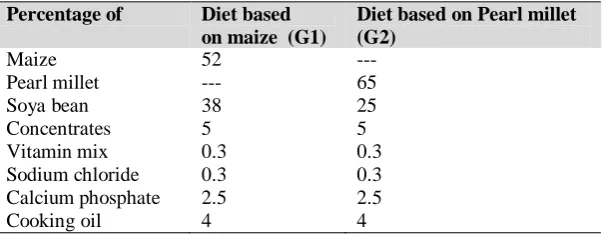
The formulated feed were analyzed (Table 1) for minerals, carbohydrate, protein, fat, ash according to AOAC [8]. The formulated feed was justified as having 21% protein (Table 2) for the growing chicks [9].
Table 1: Analysis of the nutritional components (%) of poultry feed
DM= Dry matter, NFE= nitrogen free extract (CHO), EE= Ether extract, CF= Crude fiber, CP= crude protein, OM= organic matter.
Table 2: Formulation of poultry feed based on Maize or Pearl Millet (%)
Ash NFE EE CF CP OM DM Moisture 16.21 67.64 5.42 4.10 6.63 83.79 91.42 8.58 Maize 5.05 36.40 3.66 11.79 43.10 94.95 91.56 8.44 Soya bean 2.32 67.46 7.69 9.40 13.13 97.68 90.38 9.62 Pearl millet 26.51 14.22 13.30 5.63 40.34 73.49 91.01 8.99 Concentrate
Percentage of Diet based
on maize (G1)
Emtenan M.Hanafi* et al;A NOVEL FORMULATION BASED ON PEARL MILLET FOR BROILERS FEEDING….
International Journal of Pharmaceutical, Biological and Chemical Sciences (IJPBCS) | JULY-SEPT 2014 | VOLUME 3 | ISSUE 3 | 27-35| www.ijpbcs.net
Pa
ge
29
Determination of phytate in feed
Complete diets of birds have been analyzed (Table 3) to estimate the phytin-phosphorus and phytate levels [10]. Powdered sample (4 g) was soaked in 100 cm of 2% HCl (v/v) for 3 h and filtered. To 25 cm of the
filtrate in a conical flask, 5 cm of 0.3% NH4SCN(aq)
and 53.5 cm of distilled water were mixed together and titrated against standard FeCl3(aq) solution
containing 0.00195 g Fe/cm3 until a brownish yellow colour persisted for five minutes.
Table 3.Analysis of phytate and phytin phosphorus in the feed ingredients
EXPERIMENTAL DESIGN
Twenty cup chicks (1 day old) were purchased and divided into 2 groups (10 each). Control group fed on diet based on maize (G1), birds fed on diet based on pearl millet (G2). Chicks were weighed before the start of the experiment and twice weekly. All chicks had free access to feed and water. The daily consumed feed were calculated and the feed efficiency ratio (FER) were estimated (Body weight gain/ consumed feed). At the end of the experiment (after 6 weeks) birds were slaughtered and the collected blood samples were centrifuged and the harvested plasma was analyzed for the levels of calcium, iron, phosphorus, zinc, total antioxidant , malondialdehyde, gama glutamyl tansferase, creatinine and total bilirubin.Data were analyzed using computer program . Also transfers sections of femur were dried in oven and sent for estimation of bone porosity using Automated Helium Pycnometer (Ultra Pyc 1200e by Quantachrome) at 19 psi and the ambient temperature.The bulk volume (vb) was
measured after isolating the bone sample in a Para-film to avoid Helium invading into the bone section while the skeleton volume (vsk)was measured after
removing the para-film to let the gas diffuse inside the bone section. Porosity ‘’ of the dry core-shaped samples was then calculated by the following equation.
The dried section of bone is ground and burned in oven to be sent for the estimation of minerals concentration by atomic absorption. Ovaries and testes of hens and cocks were collected and kept in saline formalin 10% and sent for histological investigation.
RESULTS
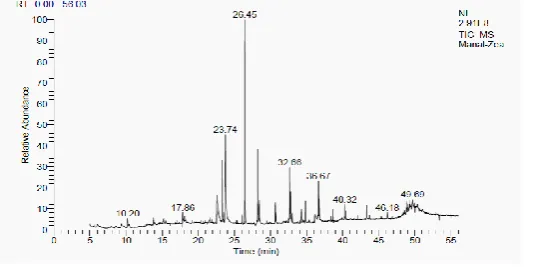
GC/MS analysis of pearl millet (Table 4 and Fig.1) revealed the presence of thirty seven volatile compounds in classified according to their retention time (Rt) and mass spectral data. The major constituents was butylated hydroxytoluene (BHT) (19.03%), the volatiles contained moderate amounts of various constituents such as esters, hydrocarbons, alcohols, and few acids.
Fig.1 GC-MS analysis of Egyptian pearl millet volatiles Phytin phosphorus
(mg/100g DW)
Phytate (mg/g Dw)
Maize seeds 19.04 67.59
Pearl Millet seeds 1.19 4.22
Maize stuff 16.66 59.14
Pearl millet stuff 10.11 35.9 concentrate 173.74 616.77
Emtenan M.Hanafi* et al;A NOVEL FORMULATION BASED ON PEARL MILLET FOR BROILERS FEEDING….
International Journal of Pharmaceutical, Biological and Chemical Sciences (IJPBCS) | JULY-SEPT 2014 | VOLUME 3 | ISSUE 3 | 27-35| www.ijpbcs.net
Pa
ge
30
Table 4.Chemical composition of volatiles of Egyptian Pearl millet by GC-MS
Rt Peak
No.
Area % Identified compound formula M.W
5.98 1 0.84 3,4-Dihydroartemisinic acid C15H24O2 236
9.30 2 0.65 Cis-3-Decene C10H20 140
10.20 3 1.62 1,4-Diethylhexyl butyrate C14H28O2 228
13.81 4 1.07 Dodecane C12H26 170
17.86 5 1.45 1-Tetradecanol C14H30O 214
18.10 6 0.6 Docosane C22H46 310
21.60 7 0.83 Nonacosane C29H60 408
22.60 8 4.67 Isoeugenol C10H12O2 164
23.34 9 6.21 1-Hexadecanol C16H34O 242
23.55 10 0.8 pentadecane C15H32 212
23.74 11 12.09 Tricyclo[5.2.1.0(1,5)]decan-8-onep-toluene-sulfonyl-hydrazone
C17H22N2O2S 318
26.04 12 0.9 3-Ethyl-5-(2'ethylbutyl)octadecane C26H54 366
26.45 13 19.03 Butylated Hydroxytoluene C15H24O 220
28.25 14 7.59 1-Octadecene C18H36 252
28.41 15 2.01 1,1-di deuteriohexadecanyl methane sulfonate C17H34D2O3S 320
30.66 16 2.14 Heptadecane C17H36 240
30.78 17 1.03 Hexadecane C16H34 226
32.66 18 6.36 (3E)3-Icosene C20H40 280
32.80 19 3.15 Octadecane C18H38 254
32.99 20 1.2 5-hydroxy-6-methyl -12-13-dioxacarboxylic acid, methyl ester
C14H22O5 270
34.28 21 1.72 2,4,6-Trimethyl mandelic acid C11H14O3 194
34.84 22 2.37 Pentacosane C25H52 352
36.22 23 1.08 3-ethyl-5-(2-ethyl-butyl) Octadecane C26H54 366
36.67 24 3.87 Octadecane C22H44 308
36.78 25 2.28 Eicosane C20H42 282
38.39 26 0.65 17-Penta triacontene C35H70 490
38.64 27 1.25 2,2,4,15,17,17-Hexamethyl-7,12-di(3',5',5'trimethylhexyl) octadecane
C42H86 590
40.32 28 1.56 1-Eicosanol C20H42O 298
40.42 29 0.81 1-Docosanol C22H46O 326
43.30 30 1.54 1,2-Diphenyl-5-butyl acephenanthrylene C32H26 410
46.18 31 0.66 1,2-Benzenedicarboxylic acid, di-octyl ester C24H38O4 390
48.87 32 1.27 Phthalic acid, nonylpenta decyl ester C32H54O4 502
49.34 33 1.15 Phthalic acid, bis(7-methyloctyl)ester C26H42O4 418
49.58 34 0.68 Phthalic acid, diisononyl ester C26H42O4 418
49.69 35 1.3 1,2-Benzene dicarboxylic acid, dinonyl ester C26H42O4 418
50.16 36 0.57 Lucenin C27H30O16 610
53.40 37 0.58 1,2-Bis(Trimethyl silyoxy2(3 tri methyl silyoxy phenyl) ethanone
C17H32O4Si3 384
Emtenan M.Hanafi* et al;A NOVEL FORMULATION BASED ON PEARL MILLET FOR BROILERS FEEDING….
International Journal of Pharmaceutical, Biological and Chemical Sciences (IJPBCS) | JULY-SEPT 2014 | VOLUME 3 | ISSUE 3 | 27-35| www.ijpbcs.net
Pa
ge
31
The radical scavenging activity of the volatile extract of β-carotene/linoleic acid and DPPH free radicals, as shown in Table 5, increased with increasing concentration of extract. Volatile extract showed very good antioxidant activity with DPPH radicals
(73.66% ± 4.1) and β-carotene/linoleic acid radicals (80.11% ± 3.7) when comparing with the standard antioxidant Tert-butyl hydroquinone (TBHQ) at concentration (400 ug/ml).
Table 5: Antioxidant Activity (A.A) of pearl millet volatiles (Mean ± SE) % inhibition at different concentrations of pearl millet volatiles
A.A by DPPH free radical assay A.A by β- carotene/ Linoleic acid assay
50 ug/ml 100ug/ml 200 ug/ml 400ug/ml 50 ug/ml 100ug/ml 200ug/ml 400 ug/ml
P
.m
il
le
t 26.14
± 2.7
38.88 ± 3.1
54.22 ± 3.9
73.66 ± 4.1
30.33 ± 2.8
47.34 ± 2.9
65.11 ± 1.7
80.11 ± 3.7
♦ TBH
Q 75.53
± 2.2
82.15 ± 2.1
93.96 ± 2.6
99.0 ± 2.1
76.23 ± 2.1
84.0 ± 2.5
90.22 ±3.3
99.41 ± 2.9
♦
TBHQ: Tert –butyl hydroquinone, standard synthetic antioxidant. Each value represents the mean ± S.E (Standard Error) and mean of three replicates.
♦
TBHQ: Tert –butyl hydroquinone, standard
synthetic antioxidant. Each value represents the mean ± S.E (Standard Error) and mean of three replicates.
Results revealed that pearl millet seeds are rich in protein (Table 1), phosphorus, iron and zinc (Table 6) if compared to maize seeds.
Table 6: Level of minerals and traces in Maize and Pearl millet seeds
Also estimation of the phytin phosphorus and phytate (Table 3) are much lower in p. millet seeds if compared to maize.
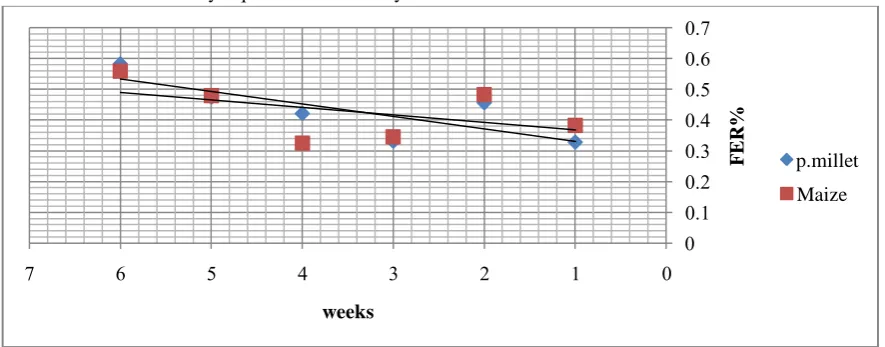
Feeding of pearl millet and maize based diets to broiler chicks showed nearly equal feed efficiency
rate (Fig 2). However towards the end of the experiment the group of birds fed on P.millet diet showed better FER.
Fig 2: Feed Efficiency Ratio (FER) of birds fed on Maize and pearl millet
0 0.1 0.2 0.3 0.4 0.5 0.6 0.7
0 1
2 3
4 5
6 7
F
ER
%
weeks
p.millet
Maize
pi(mg/g) Ca(mg/g) Fe (ug/g) Zn(ug/g)
Maize seeds 43.4 34.1 850 37.4
Pearl millet seeds 54.8 29.1 1178 197.6
Maize stuff 16.2 13.5 540.1 21.5
Emtenan M.Hanafi* et al;A NOVEL FORMULATION BASED ON PEARL MILLET FOR BROILERS FEEDING….
International Journal of Pharmaceutical, Biological and Chemical Sciences (IJPBCS) | JULY-SEPT 2014 | VOLUME 3 | ISSUE 3 | 27-35| www.ijpbcs.net
Pa
ge
32
Analysis of minerals and traces (Table 7) showed higher levels of phosphorus, zinc and iron. Slightly lower levels of calcium in serum and bone of birds
fed millet formulation if compared to those fed on maize based formulation.
Table 7.Minerals and Traces (mean ± SE) in plasma and bone of birds fed on Pearl Millet and Maize diets for 6 weeks
Screening the organ function and oxidative stress markers (Table 8) showed that both feed formulations have no harmful effect on health.
However feed based on P. Millet markedly lowered the liver enzyme GGT suggesting its hepato protective effect.
Table 8: Plasma chemistry (mean ± SE) of birds fed on Pearl Millet and Maize diets for 6 weeks
Histological investigation of ovaries (Figs 3, 4) and testicles (Figs 5, 6) of birds fed on p. millet and maize respectively showed normal gonads function without any pathological findings the thing confirms
that the new formulation based on pearl millet is safe for health and give the same reproductive efficiency of maize based formulation.
M
in
er
a
ls
i
n
s
er
u
m Females Males
p. millet Maize p.millet Maize
Calcium (mg/g) 7.9 ± 0.1 8.16±0.2 7.74± 0.2 8.50 ±0.13 Phosphorus (mg/g) 20.1± 0.7 17.25± 0.6 22.4± 0.8 19.0±0.18 Zinc (µg/g) 49.9 ±1.6 29.44 ± 4.1 44.1 ± 2.09 27.07±0.58
Iron (µg/g) 84.3± 0.4 63.40 ± 3.9 98.12 ± 5.6 74.00 ±1.5
Calcium(mg/g) 29.44±.0.1 32.35±0.2 87.7±0.1 92.7± 0.2
M
in
er
a
ls
i
n
fe
mu
r
Phosphorus(mg/g) 96.60± 0.9 83.90± 0.3 92 .00±0.2 74.7± 0.3 zinc(µg/g) 669 ± 9.5 500.0± 10.1 668.4±4.3 360.0 ±5.1
Iron (µg/g) 500±6.2 489.0± 10.5 551.0±3.2 496± 10.2
Bone porosity (%) 10.3±0.2 20.5±0.1 13.8±0.1 18.7±0.1
Pearl millet Maize
Total antioxidant (mu/L) 0.58±0.05 0.65±0.03
MDA (nm/ml) 6.27±0.42 6.64±0.36
GGT (u/L) 64.0± 4.00 110.96±8.01
Total bilirubin (mg/dl) 0.84±0.03 0.94±0.04
Creatinine (mg/dl) 1.71±0.15 1.82±0.11
3
4
3
Emtenan M.Hanafi* et al;A NOVEL FORMULATION BASED ON PEARL MILLET FOR BROILERS FEEDING….
International Journal of Pharmaceutical, Biological and Chemical Sciences (IJPBCS) | JULY-SEPT 2014 | VOLUME 3 | ISSUE 3 | 27-35| www.ijpbcs.net
Pa
ge
33
DISCUSSION
Millet is one of the most drought-tolerant cereal grain crops and requires little input during growth, but like other crops, yields better with good husbandry [11].
With increasing world population and decreasing water supply, it represents important crop for future human use. While millets are vital food crops for millions of people in parts of Africa and Asia, they are an underutilised resource and little cultivated in most developed countries [11].
Pearl Millet grain is generally superior to sorghum as human food and at least equals maize in value as a feed grain [12]. Millet grains contain wide range of phenolic compounds which has health promoting properties. Its antioxidant activity and use as functional food is previously reviewed [13-15]. The major volatile compound in pearl millet cultivated in Egypt is butylated hydroxytoluene (BHT), which is a volatile natural antioxidant compound. Benzene derivatives were the largest group identified in pear millet volatiles as well as phenolic compounds, they have been identified as odour-active compounds in cereal; they are related to aromatic aspects [16]. Compared to other cereal, such as rice and buckwheat, more benzene derivatives were identified in the millet. These compounds, especially the odour-active benzene derivatives, may contribute to the flavour of millet and distinguish it from other cereal. A certain number of hydrocarbons, acids and esters were also identified; the hydrocarbons identified in the sample included a homologous series of n-hydrocarbons. These hydrocarbons could result from the decarboxylation and splitting of carbon-carbon chains of higher fatty acids [17]. Hydrocarbons, acids and esters, have relatively high flavour thresholds and have little contribution to the odour of the millet. Some heterocycles and sulphur-containing compounds were also detected in the samples. The characteristic aromatic notes of few sulphur-containing compounds have been described as nutty, roasted and corn-like [18]. These compounds are less abundant in cereal and may play an important role in millet.
In Chinese pearl millet, volatile extract contains high concentration of aldehydes and benzene derivatives [19]. Millet cultivated in Ghana showed 2-hydroxy-3-butanone, 1-octen-3-ol, 3,7-dimethyl-3-hydroxy-1,6-octadiene, borneol, isovaleric acid, as major components [20]. These differences in main components may result in the different overall aromas of each type of millet according to place of its cultivation.
Our GC-MS results (Table 4) confirm that BHT represents 19.3% of volatile extract. A positive correlation was found between antioxidant activity and the content of the BHT in volatile extracts [21]. Beside BHT there was another volatile antioxidant compounds such as isoeugenol, a volatile antioxidant phenolic compound, as well as the other oxygenated and hydrocarbon compounds often work synergistically with each other to produce a broad spectrum of antioxidative activities that creates an effective defense system against free radical attack and prevent most of oxidative damage, especially of liver tissue [22-24]. The current study showed very good antioxidant activity of the radical scavenging activity of millet (Table 5) with DPPH radicals and
β-carotene/linoleic acid radicals if compared to the standard antioxidant Tert-butyl hydroquinone (TBHQ) at concentration (400 ug/ml). Some studies have reported the antioxidant activity of the extracts of different types of millet [13-15]. The free radicals scavenging activity of some volatile extracts were superior when compared with the other types of extracts of the same plant [25]. Chandr and Shahidi [26] showed that millet phenolics were effective in inhibiting the formation of conjugated dienes and hydroperoxides in phosphatidylcholine liposome membranes which were oxidized under UV light. Recently, Chandr and Shahidi [27] reported that simulated gastrointestinal digestion and colonic fermentation in vitro released millet phenolics which showed antioxidant activity through different mechanisms such as free radical scavenging, ferrous ion chelating, and reducing activity. Furthermore, antioxidant activity depended on the type of millet. The higher protein content in millet (Table 2) directed us to screen the value of using millet not only for maize replacement but also for partial substitution of protein supplements (Soya bean) in broiler diets. It was interesting to find this new formulation showing superior FER to that based on maize after three weeks of feeding. This result coincide with previous study showed that chicks fed on the bulrush millet diets has got higher overall body weight than those fed on Sorghum after 55 days feeding experiment [3].
Emtenan M.Hanafi* et al;A NOVEL FORMULATION BASED ON PEARL MILLET FOR BROILERS FEEDING….
International Journal of Pharmaceutical, Biological and Chemical Sciences (IJPBCS) | JULY-SEPT 2014 | VOLUME 3 | ISSUE 3 | 27-35| www.ijpbcs.net
Pa
ge
34
may be related to the higher calcium bioavailability due to lower phytate concentration in p.millet if compared to maize (Table 3).
It is generally recognized that sufficient dietary calcium, phosphate and magnesium supply has a positive effect on the maintenance of mineral balance and bone mineral mass. In animal and poultry nutrition, Ca and P requirements are largely met by dietary inclusions of limestone, inorganic P supplements such as dicalcium phosphate and meat and-bone meal. However, quite considerable amounts of P are present in plant-sourced feed ingredients but the phytate molecule present in plants carries negative charges and could potentially chelate six Ca atoms and other divalent cations, including zinc and copper. Consequently, these phytate-bound minerals are only partially available to monogastrics[28]. Ca requirements for broilers are calculated on the basis of dietary phytate-P concentrations Ca %= 0.6 + phyate-p % × 1.1 [29].
Superiority of pearl millet for the absorption and utilisation of the 3 metals over other cereals has been previously explained to be due to a lower ratio of phytate:zinc and phytate; iron and higher levels of other micronutrients [1] .
The higher concentration of zinc in P.millet plays important role in bone formation where zinc supplementation reduced osteoporosis in overictomized rats [30]. Zinc serves as an essential cofactor for more than 300 enzymes. It has a critical role in the structure and function of biomembranes. It prevents oxidative damage of cell membranes through its effect on some enzymes such as alkaline phosphatase, carbonic anhydrase and superoxide dismutase stabilizing and maintaining phospholipid and thiol groups in a reduced state [31]. Analysis of serum showed no adverse effects on organ functions (Table 8) and normal gonadal functions (Figs 3-6) of both P.millet and maize fed hens and cocks. Previous study indicated that feeding P.millet to laying hens had no adverse effect on egg production, increased egg shell thickness and reduced liver fat content if compared to birds fed on yellow maize based diets [32].
CONCLUSION
Pearl millet is good alternative to maize in poultry feed formulation. It proved better FER and general health condition. It has antioxidant and hepatoprotective effect, controls bone osteoporosis and safe for gonadal function. Besides it can be cultivated in dry land with minimal costs in
comparison to other crops. It offers good opportunity for limited resources farmers.
REFERENCES
[1] Obeng E., Cebert, E.,.Singh, B, Ward, R. , Nyochembeng L. and Mays, D. 2012. Growth and Grain Yield of Pearl Millet (Pennisetum glaucum) Genotypes at Different Levels of Nitrogen Fertilization in the Southeastern United States Journal of Agricultural Science; Vol. 4, (12) 155-164.
[2] Agtei, V. V.,Khot, S.Girigosavi,T,PaknlkarM and Chiplonkar, S.A.1999. Comparative Performance of Pearl millet-and Sorghum- based Diets vs. Wheat-and Rice-based Diets for Trace Metal Bioavailability .
Trace Elements Med. BioI. 13: 215-219.
[3] Ahmed, W.M., Sabra H and HamamA.M, 2001.Effect of administration of vitamins AD3E and selenium
during prepartum period on the reproductive
performance of native cows in Egypt. Beni-Suef Vet. Med. J., XI: 81-91
[4] Taylor, J.R.N., 2004. Grain production and consumption: Africa. In: Wrigley, C., Corke, H., Walker, C.E. (Eds.), Encyclopedia of Grain Science. Elsevier, London, pp. 70–78.
[5] Lee, K. G. and Shibamoto, T. 2001. Antioxidant property of aroma extract isolated from clove bud [(Syzygium aromaticum L.) Merr. et Perry]. Food Chem., 74: 443-448
[6] Gülçin ,I., Elmastas.M and Aboul-Enein, H.Y. 2007. Determination of antioxidant and radical scavenging activity of basil (Ocimum basilicum) assayed by different methodologies. Phytother. Res. 21(4): 354-361.
[7] Gülçin ,I.2006. Antioxidant activity of caffeic acid (3,4-dihydroxycinnamic acid). Toxicology 217: 213–220 [8] A.O.A.C., 2000. (Association of Official Analytical
Chemists) Official Methods of Analysis International 17 Ed. Gaithersburg, MD, USA.
[9] Selle,P.H., Ravindran,V, Ravindran G and
Bryden,W.L.2005. Amino acid digestibility and growth performance interactions to phytase and lysine supplementation of lysine-deficient broiler diets. Proc. Aust. Poult. Sci. Symp., 17: 234-237.
[10] Ola, F.L. and Oboh, G. 2000. Food value of two Nigerian edible Mushrooms (Termitomycetes stratus and Termitomycetesrobustus). The J. Technosci.,4: 1-3. [11] International Crops Research Institute for the Semi-Arid Tropics (ICRISAT)/Food and Agriculture Organization (FAO), 1996. The World Sorghum and Millet Economies. ICRISAT, Patancheru, India/ FAO, Rome.
[12] Taylor,J. R., Schober T.J. and Bean S.R., 2006. Novel food and non-food uses for sorghum and millets
Journal of Cereal Science 44 : 252–271
Emtenan M.Hanafi* et al;A NOVEL FORMULATION BASED ON PEARL MILLET FOR BROILERS FEEDING….
International Journal of Pharmaceutical, Biological and Chemical Sciences (IJPBCS) | JULY-SEPT 2014 | VOLUME 3 | ISSUE 3 | 27-35| www.ijpbcs.net
Pa
ge
35
[14] Pradeep, S. R. and Guha,M., 2011 . Effect of processing on the nutr aceutical and antioxidant
properties of little millet (Pannicum
sumatrense)extracts. Food Chemistry , 126: 1643– 1647.
[15] Pushp araj, F.S. and Urooj, A.,2011 .Influenceof processing on dietary fiber,tannin and in vitro protein digestibility of pearl millet. Food and Nutrition Sciences,2: 895–900.
[16] Yang, D.S.; Lee, K.S.; Jeong, O.Y.; Kim, K.J.; Kays, S.J. Characterization of volatile aroma compounds in cooked black rice. J. Agric. Food Chem. 2008, 56, 235–240.
[17] Grosch, W. , 1982 Lipid Degradation Products and Flavors. In Food flavors. Part A. Introduction, 1st ed.; Morton, I.D., Macleod, A.J., Eds.; Elsevier: Amsterdam, The Netherlands.P. 325–398.
[18] Liu, Y.; Xu, X.L.; Ouyang, G.F. and Zhou, G.H.2006. Changes in volatile compounds of traditional Chinese Nanjing water-boiled salted duck during processing. J. Food Sci. 71: 371–377.
[19] Jingke L., Xia Tang, Yuzong Zhang and Wei Zhao (2012): Determination of the Volatile Composition in Brown Millet,Milled Millet and Millet Bran by Gas Chromatography/Mass Spectrometry. Molecules, 17, 2271-2282;
[20] D. R. HALL, D. I. FARMAN, S. V. GREEN, E. OWUSU, Y. MALIKI & O. YOUM, 2000. analysis of volatiles from millet as potential factors affecting oviposition by the millet head miner moth,
Heliocheilus albipunctella DE JOANNIS
((LEPIDOPTERA: NOCTUIDAE) APPENDIX. 8: 1-12
[21] Ait-Kaci Aourahoun ,K., F Fazouane, T. Benayad, Z. Bettache and N.Denni ,2014. The synthetic antioxidant Butylated Hydroxytoluene, a natural occurring constituent of the broom cytisus triflorus. J.
Natural products 7: 58-64.
[22] Ramadana, M. M..Abd-Algaderd, N.N. El-kamalid, H.H, Ghanemb, K.Z. and Farrag, A.H. 2013. Volatile compounds and antioxidant activity of the aromatic herb Anethum graveolens . Journal of the Arab Society for Medical Research.8:311-320 .
[23] Abd-Algader, N.N. El-Kamali, H.H., Ramadan, M.M., Ghanem K.Z. and Farrag , A.H., 2013. Xylopia aethiopica Volatile Compounds Protect Against Panadol-Induced Hepatic and Renal Toxicity in Male Rats. World Applied Sciences Journal 27 (1): 10-22. [24] Ramadan, M.M. Abd Algader, N.N., El-kamali,
H.H.,Ghanem, K.Z. and. Farrag, A.H.,
2013.Chemopreventive Effect of Coriandrum sativum Fruits on Hepatic Toxicity in Male Rats. World Journal of Medical Sciences 8( 4): 322-333.
[25] Ramadan M. M., Yehia, H.A. Shaheen M. S. and Abed EL-Fattah, M. S.,2014. American-Eurasian J. Agric. and Environ. Sci., 14 (6): 486-494.
[26] Chandr , A.and Shahidi, F., 2011.Antiprolifer ative potent ial and DNA scissio n inhibitory activity of phe nolics from whole millet grains. Journal of Functional Foods,3: 159–170.
[27] Chandr , A.and Shahidi, F., 2012. Bioac cessibility and antiox idant potential of millet grain phe nolics as affec ted by simulated in vitro diges tion and mi crobial fermentat ion. Journal of Function al Foods,4, 226– 237.
[28] Angel, R., Saylor, W,Dhandu, A.S., Powers S and Applegate, T.J., 2005. Effects of dietary phosphorus,
phytase and 25-hydroxychole calciferol on
performance on broiler chickens grown in floor pens.
Poult. Sci., 84: 1031-1044.
[29] Nelson, T.S., 1984. Available calcium for poultry. Proc. Florida Nutr. Conf. FeedManuf. Pp. 1–7. Orlando, Florida.
[30] Yamaguchi, M. and Kishi, S.,1993. `Prolonged Administration of Beta-alanyl-L-histidinato Zinc Prevents Bone Loss in Ovariectomized Rats' in Jpn. J. Pharmacol. 63: 203-207.
[31] Lewis, S.M., Ullrey, D.E., Barnard, D.E. and Knapa. J.J., 2006. The laboratory rat 2nd Edition Copyright elseiver Inc p.237
[32] Abd-Elrazig S.M. and Elzubeir,E.A.,1998. Effects of feeding pearl millet on laying hen performance and egg quality. Animal Feed Science and Technology 76: 89-94
*Corresponding author address: Email address: