ISSN: 2334-2986 (Print), 2334-2994 (Online) Copyright © The Author(s). 2014. All Rights Reserved. Published by American Research Institute for Policy Development DOI: 10.15640/jea.v2n2a3 URL: http://dx.doi.org/10.15640/ jea.v2n2a3
Environmental Analysis of Master Plans in Social Interest Housing Developments in the City of Presidente Prudente – State of São Paulo – Brazil
Sibila CAL Honda1, Marcela C Vieira2, Mayara P Albano3 & Yeda R Maria4
Abstract
This article is the result of research on urban housing and environmental policies in a Brazilian city. The study was based on the city of Presidente Prudente, a municipality located in the West region of the State of São Paulo in Brazil, and analyzes four social interest housing developments implemented between 1997 and 1999. The Constitution of Brazil was sanctioned in 1988, strengthening the municipality before the other federal entities and attributing to it the duty of planning urban development through municipal master plans fairly and environmentally feasible. Thus, sustainable development would be part of the decision-making process for urban planning and management aimed at ensuring better quality of life. However, the municipality analyzed presents a different reality, once social housing projects are inserted into the urban grid disregarding standards, laws and guidelines, and urban policy processes occur non-coherently with the quality of life and environmental issues. The methodology used was based on qualitative research, including field surveys in the selected housing developments, according to architectural, urban and environmental aspects.
Keywords: Public policy, urban housing policy, environmental policy, social interest housing, Brazilian city
planning
1. Introduction
The production of urban space is directly related to the laws, policies and culture of each society. Therefore, the definition of the urban structure of each city is unique. Based on these assumptions, this article focuses on the analysis of the city of Presidente Prudente, in the countryside of the state São Paulo in Brazil, and seeks to expand the discussion about the production of urban space in medium-sized cities, correlating it with issues of policies related to environmental conservation between 1997 and 1999. The case study of this article for discussions includes social housing developments financed by the Companhia de
Desenvolvimento Habitacional e Urbano5 (CDHU) of the São Paulo State Government.
1
Universidade do Oeste Paulista, BR, Rua Ribeiro de Barros 1878 – Presidente Prudente - SP – Brazil- 19015-030. Email: [email protected] - +55(18)3229-2016
2Universidade do Oeste Paulista, BR, Rod Raposo Tavares, km 572 - Presidente Prudente - SP – Brazil - 19067-175.
Email: [email protected], Phone +55(18)3229-2016
3
Universidade do Oeste Paulista, BR, Rua José Bongiovani, 700 - Presidente Prudente - SP – Brazil - 19050-920. Email: [email protected], Phone +55(18)3229-2016
4
Universidade do Oeste Paulista, BR, Rua José Bongiovani, 700 - Presidente Prudente - SP – Brazil - 19050-920. Email: [email protected], Phone +55(18)3229-2016
The urbanization process in Brazil, taking place mainly from 1960´s, presented a series of challenges to issues relating to public policies, management and organization of the municipal territory and increased the demand for housing, jobs and public services in the cities. This Brazilian process of urban land sprawl and the lack of public policies that guide their panorama over time have resulted in the emergence and growth of unplanned cities (Pinheiro, 2010).
The situation of social misery is vastly seen in the major urban centers, where large percentage of the population living in illegal, clandestine, slum and risky areas. This reality has also expanded in medium and small cities. In view of the urban crisis process, facing the serious problems that affect the population requires coordinated solutions of urban planning and management.
The creation of public policies suitable for the citizens who inhabit urban areas today is essential, especially to those relating to the use and occupation of urban land, housing and infrastructure, and such policies should contribute to the construction of balanced and fairer urban environments, which are less degrading to the natural environment.
In this context, this article aims to analyze an urban reality relating to the urban planning guidelines approved in the Constitution of Brazil (1988) and the City Statute (Brazilian Federal Law nr. 10,257/2001), whose instruments should be included in the municipal master plan and applied in the management of the territory.
In 1996, the municipality of Presidente Prudente approved its master plan including environmental policies and guidelines.
The methodology used is based on qualitative research, deepening the theoretical basis and legal aspects related to social housing and environmental analysis, physical, social and environmental characterization of the developments studied and field surveys. The qualitative approach allows to relate theory and data through the understanding of the phenomena based on the description and interpretation, as well as the personal experiences of the researchers by using the deductive method (Teixeira, 2000).
2. Legal Bases for Stimulating the Brazilian Urban Land Planning
Together with the process of redemocratization that took place in Brazil in the 1980´s at the end of the military dictatorship government, the discussions on urban reform were resumed by councils and class entities, such as the Architecture and Law councils. The urban reform longed since the late 1950´s in Brazil aimed at equal access to urban land, possibility of access to urban equipment and services mainly by the less favored population, among other guidelines for the democratization of cities.
As it was possible to send amendment projects for discussion during the Brazilian Constituent Assembly in 1987, a project based on urban reform was submitted. That project was partially approved and included in the Constitution of Brazil of 1988, articles 182 and 183. Thus, with the constitutional inclusion, the urban policy and city management themes started to occupy a prominent place in many institutional, political and social levels in Brazil.
The promulgation of this Constitution was based on the strengthening of the municipality, which became one of the federative entities together with the States and the Federal Government, and should also be governed by a special Organic Law, and whose autonomy was politically, administratively and financially expanded. In the constitutional article 182, the requirement to approve a master plan for cities with population over 20 thousand inhabitants was also set forth.
Its article 22 establishes that the space intended for driveways and squares, open spaces, and areas for public buildings and other urban facilities will integrate the public domain assets of the municipality after the project for the new land development is legally approved. Then, these areas become inalienable and imprescriptible by nature, limiting new guidelines on planning and urban policy. This legislation has not been revoked.
The Constitution of Brazil of 1988, article 182, states that the urban development policy, a responsibility of the municipal public power, should focus on the city planning ensuring the well-being of its inhabitants. Housing policy has become strategic for the municipality since one of the main problems in Brazilian cities is the provision of suitable housing for a large portion of the population, which should occur in line with the environmental and urban development policies, respecting the Urban Land Division Law.
The City Statute (Federal Law nr. 10,257/2001) was discussed in the Brazilian National Congress for 21 years until its approval in 2001, having as the main objective the regulation of the constitutional articles on urban policy (182 and 183) and establishing several guidelines related to municipal policies.
This debate is based on the concern with the quality of life in the urban space, the preservation of natural environments and the conservation of fragile built environments, aspects discussed in the first United Nations Human Settlements Conference (Habitat I), held in Vancouver in 1976. In the Habitat II Conference, held in Istanbul in 1996, a document called the Habitat II Agenda was approved, presenting principles, commitments and strategies to be adopted by the public power and the society, aiming at the sustainable development in the urban area (Antonucci et al, 2010).
During the United Nations Conference on Environment and Development (Rio-92), held in the city of Rio de Janeiro in Brazil in 1992, the Rio Declaration on Environment and Development (Agenda 21) was drafted concerning the discussion about the urban environment sustainability. Goals were presented for promoting the quality of life and social equity in the cities.
The Brazilian Agenda 21 was drafted in Brazil. Among several actions, this agenda is “a planning instrument for the construction of sustainable societies in different geographic bases, which reconciles methods of environmental protection, social justice and economic efficiency” (Ministry of the Environment, 1992).
This should mean that public policies should promote sustainability to the urban reality, with the implementation of urban policies that do not bypass the environmental issue, once there is a great amount of problems related to the environment in the cities, such as air and water pollution, noise, garbage, among others (Medauar, 2004). Thus, the need for integrating public policies sectors through the urban environmental management for the construction and maintenance of the quality of life in cities is demonstrated.
2.1. Brazilian Urban Public Policy
Analyzing politics is of great importance for understanding the human environment. According to Maquiavel (Weffort, 1993), politics is directly connected to human action in social control, guiding the private life. It may be understood as a conscious purpose-oriented action or inaction (Monteiro, 1982; Villaça, 1999).
In other words, when one tries to understand the actions in the urban environment, the recognition process of public policies and their results in the space is the key.
Public policies are developed in response to urban problems. They seek the provision of collective resources and public services until the control of urban sprawl, and land use and occupation. Thus, public policies can be identified as the legal planning sector of the territory of cities through a set of described actions, with the observation of the demands and the harmonization attempt.
It is also important to highlight the urban policies as a specific set of public policies that aim to guide the organization and planning of the territory of cities, through the production of space, infrastructure, services and public facilities, and the regulation of functions and constructive density. In Brazil, an important sector of urban policy is the housing policy (Alvim et al, 2010).
Beyond, the housing policy may include responsibility programs from any of the three government levels: federal, state and municipal instances. However, during the implementation of the programs in the urban space, an alignment among the municipal, environmental, urban land use and occupation and urban development definitions is necessary, among others. The political and technical-scientific sectors also need to be aligned, through review and evaluation of planning and management instruments (Lacaze, 1999).
It is also important to note that there is often a legal imposition in the urban space, generated by other policies and legislations approved, creating, reproducing or reinforcing characteristics of urban sprawl and/or segregation.
Thus, in many cases, there are written and disseminated policies to benefit the population most in need of services and financial conditions, but whose actions do not reflect their legal form. Therefore, the public policy of speeches, plans, programs and projects are not necessarily considered as policy, due to its non-completion and/or actual distortion.
Combined with the urban policy, the Brazilian municipal public power is responsible for control and adjustment actions on urban planning and management, focusing on the appropriate urban development (Constitution of Brazil, 1988, article 182), based on theoretical knowledge and defined as practical policies and guidelines (Ferrari, 1991).
Management is a feature clearly seen in the municipal government action in Brazilian cities and refers to the present by administering within the resources presently available and considering the immediate needs. The relationship between management and planning is based on the temporal reference because planning is the preparation for the future management (Souza, 2002).
Thereby, the urban planning process should have the objective of stipulating guidelines and goals oriented to ordering and equipping the urban space rationally and democratically, directing the sprawl of the urban grid, defining the areas properly to their population, conserving the natural environment within the limitations of the built space, among other aspects (Philippi Jr. et al, 2004).
In the Constitution of Brazil, 1988, article 225, it is stated that everyone is entitled to a good quality of life. The World Health Organization (WHO) reports that the quality of life is closely connected to the conditions of food, education, income, labor, employment, freedom, sanitation, housing, environment, transport, leisure, access to land and to health. That way, that is closely related to urban policies (Di Sarno, 2004).
The City Statute reinforces this vision, as in its article 1, sole paragraph, which establishes as objective the citizen welfare and the environmental balance. The municipal master plan should feature the attainment of the quality of life for the affected population.
2.2. Environmental Sustainability, Planning and Development
Environmental sustainability is directly related to the quality of life, not just for human societies, but also for the entire biosphere. Environmental sustainability is based on the conservation of fragile environments as natural and built environments, and for this, urban planning is necessary with the real inclusion of the environmental issue. Thus, planning connected to the environment is essential (Canepa, 2007).
The environmental planning is a basic element for the economic and social development, and should occur broadly, focused on the best use, operation and management of a land unit, in order to obtain the maximum benefit to the collectivity (Almeida et al, 1999; Albano, 2013).
Therefore, sustainable development may be understood as the possible way for the quality of life of the population, primarily to the peripheral and underdeveloped countries. In other words, the notion of sustainability applied to urban development expresses two aspects: urban policies and introduction of environmental issues in urban planning (Moreno, 2002).
The concept of sustainable development involves various dimensions, including the environmental, social, economic and temporal aspects of urban processes, which may appear singly or dynamically. Its concept proposes the harmonization between socioeconomic development and environmental conservation for the rational use of natural resources (Canepa, 2007; Franco, 2001).
The quality of life is connected to the welfare in urban spaces through the appropriate adoption of guidelines and measures for the achievement of sustainable development in urban spaces, which is closely related to the idea of commitment to new economic parameters and new values and lifestyles and to the protection of the natural environment (Dias, 2005).
Therefore, urban environmental planning is structured as a challenge that should be able to reconcile the environment with urban processes through the relationship between planning and environmental analysis (Maria, 2013; Albano, 2013). To this end, the master plan is an instrument that should define the guidelines and the proper control of space through urban environmental planning, according to the current Constitution of Brazil.
The master plan is the basis of urban policies, approved in each municipality, with the task of democratizing the urban space through the social function of the city and the urban property. Some urban legal instruments may and should be approved to ensure the full development and planning of cities through the legal regularization and urbanization of illegal and precarious settlements, the combat to real estate speculation, the democratization of access to public services, and the popular participation in the creation of public policies (Holz and Monteiro, 2008).
This instrument should be in line with the objectives of the urban planning and management, aiming at improving the quality of life of the population, especially the most vulnerable groups. It includes the reduction of real estate speculation and the pursuit of good environmental quality (Souza, 2002).
However, the federal legislation, such as the Urban Land Division Law (Law nr. 6,766/1979) cannot be overlapped.
3. City of Presidente Prudente – State of São Paulo - Land Occupation and Sprawl
Presidente Prudente is a medium-sized Brazilian city, currently with approximately 200 thousand
inhabitants (IBGE6, 2010), located in the West region of the State of São Paulo (Figure 1).
Since its beginning, this town features populism7 as a model of municipal government, fact that contributes to the absence of an effective and coherent urban planning and management process (Leite, 1972).
Figure 1 - Location of the Municipality of Presidente Prudente in the State of São Paulo – Brazil
Source: Portal Prudente
Associated with that, the absence of an effective municipal housing policy, the declared public disinterest for the clear definition of areas aimed at social housing in the urban structure, and the lack of concern with the natural and built environments reproduce and reinforce the peripheral and segregated urban sprawl model that has taken place in recent decades (Honda, 2011).
From the 1960´s, with the institution of the new Federal Government (Military Dictatorship), the city of Presidente Prudente was the target of significant social, economic, political and legal changes, reflected in the urban structuring process. In addition, the industrial segment expanded with extended productive range, increased population, and development of tertiary activities.
In 1968, the first master plan for the city was drafted. Also in that year, the municipality was benefited by the construction of the first social interest housing development, financed by the Banco
Nacional de Habitação8 (BNH), located in the urban fringe of the city (Silva, 2005).
Urban sprawl during the following two decades (1970 and 1980) occurred without precedent, and was more noticed towards the Southwest direction, creating large voids at the outline of city for long periods of time. The urban grid practically doubled during that period. From the 1970´s, a highly segregationist urbanization process starts in the city (Marisco, 2003).
From 1983, the history of sites and land development offering changed, with little private and public investment, as the construction of social housing. In 1989, the Companhia de Desenvolvimento Habitacional e Urbano (CDHU), of the State of São Paulo, was created, and the construction of social housing developments was resumed with both state and federal funding (Honda, 2011).
In 1996, the new master plan was approved for the city, the Municipal Law nr. 29/1996, based on the new Constitution of Brazil (1988) and on discussions about the City Statute. The Política Nacional de
Habitação9 (PNH) in force during the presidency of Fernando Henrique Cardoso (1995-2002) aimed at the
decentralization of the conduction of housing programs, encouraging the actions of municipal governments as agents for the promotion of social housing.
7 Populism is a set of political practices consisting in the establishment of a direct relationship between the mass and the
charismatic leader to obtain popular support.
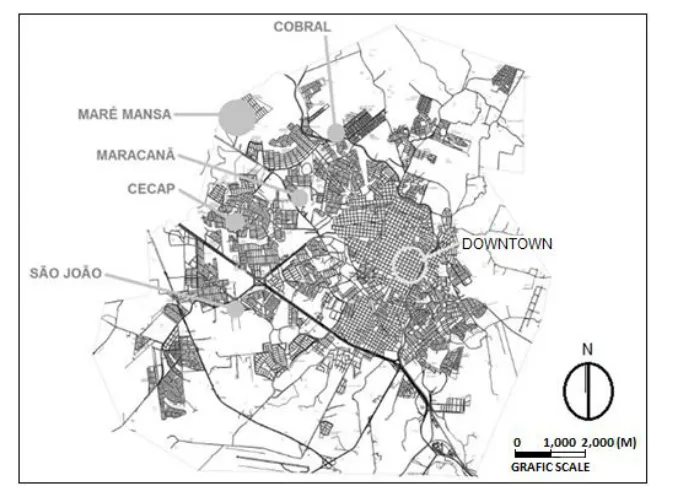
During the 1997-2000 municipal management, five social housing developments were conducted in the city, being one private project and four projects with CDHU funding – Maracanã, Cecap II, Cobral and São João, which are focus of the case study for the discussion of this paper.
In January 2008, the revision of the master plan was approved (Municipal Law nr. 151/2008). The urban sprawl of the city of Presidente Prudente has shown the greatest interest in the Southwest areas for land developments and condominiums to elites, and in the West and North areas for the lower-income classes. The growth process with maintenance of large urban voids has remained.
3.1. Environmental and Political Aspects
The urban area is constantly produced and reproduced, and it should be analyzed in several aspects, among which the political, economic, social and environmental levels. Its physical structure should use as references the relief where it is implemented, and the way it has been appropriated (Casseti, 1991; Nunes, 2002).
In this aspect, the urban environmental planning has the role of interpreting urban areas as reflections of these events, whose characterization should present topics such as geology, geomorphology, hydrology and climatology. In other words, the definition of these geoenvironmental aspects aims to provide recognition of the interaction processes of physical and biological conditions and their potentialities and limitations, revealing the possibilities for the rational use of natural resources in each region (Maria, 2013).
The relief forms prevalent in the city of Presidente Prudente, state of São Paulo in Brazil, are the large and low hills, between 300 and 600 meter height, with declivities varying between 10 and 20%, and soil easily susceptible to erosion (Oxisol and Argisol Soils) and with high permeability power. It is also documented that in the occupation of the region, until the present days, there has been no proper care with the soil concerning deforestation and urban occupation (Pedro, 2011).
The municipality of Presidente Prudente has not focused properly on mitigating and reducing the impacts relating to this degrading occupation, and the land sprawl of the urban grid. There are legal regulations in this respect defined in the municipal master plan and complementary laws, including the conservation and recovery of the environment, the development of actions integrated to the protection of the environment, the selective collection of urban garbage and solid waste, the compatibilization of the environmental policy with sector policies for the land use and occupation, the development of environmental zoning, among other aspects.
However, the implementation of policies and laws is not noticed in the municipality. The environmental zoning has never been drafted and it is not included in municipal guidelines. There is also no relationship between the use and occupation of rural or urban land and environmental issues (Albano, 2013).
The land occupation follows economic criteria, the definition of uses does not respect the municipal guidelines and both have disrespected the federal legislation concerning the Urban Land Division Law (Law nr. 6,766/1979). It is noted that public spaces, and green and institutional areas of the city of Presidente Prudente have been granted and donated to third parties after 1980 (Boin et al, 2014).
3.2. Social Interest Housing and Social-Environmental Concern
The four developments are constituted of multi-family buildings with four floors of housing units, being them ground floor – first floor – second floor - third floor. However, they differ in relation to the location in the urban grid and the number of buildings and units in the developments: Cecap II features 16 blocks and 256 units, while the other three (São João, Maracanã and Cobral) feature 19 blocks and 304 units each.
Figure 2 - Location of the Housing Developments Surveyed in the Urban Grid
Source: Author
The social housing development Cecap II was built in the Western region of the urban grid, in an area limited on one side (East) by urban land development for low-income population, and on the other side (West) by the opening of Avenida Presidente Juscelino Kubitschek de Oliveira. It was a consolidated area at the time of the construction of the social development, which benefited its population due to the already existing public transport services, schools, preschools and health centers, as well as the available urban infrastructure.
The region presents high land elevation and is far from environmentally fragile areas. Due to the occupation of adjacent neighborhoods, with maximum height gauge of 1 and 2 floors, the housing development is quite privileged as regards ventilation and insolation aspects. In the surveys carried out, it could be verified that, although not presenting negative aspects with regard to local environmental analysis, there was no feasibility or impact study for its approval and implementation. The approval of the area by the City Council of Presidente Prudente for the CDHU was a direct result of the existence of an urban void.
The residential development São João was built in the Southwestern region of the urban grid, in a great void resulting from the urban land sprawl process, due to the implementation of three other social interest housing developments in the early 1990´s. The highly elevated area does not present environmental fragility aspects, is far from streams and environmental conservation areas, and its soil features geomorphologic characteristics favorable to the implementation of buildings not damaging the environment. There are strong winds in the whole development, aiding the dispersal of pollutants and the thermal comfort issue.
A fairly negative aspect is the high voltage transmission network along the development, with no distance analysis of the transmission cables and the apartment blocks. No environmental impact analysis has been performed.
The Maracanã development was built in the Western region of the urban grid, in an already existing neighborhood, in an area defined as green and for leisure use in the land development project approved by the Municipal Planning Department. The elimination of the leisure area in the land development has not been compensated by any other urban structure, resulting in lack of open spaces for the use of the population and significant increase of the population density. The legal neglect is quite significant, and federal and state laws are ignored, as well as standards, plans and municipal guidelines. The development is close to social interest neighborhoods of and major urban plots. Its location is not related to the lack of available areas. It is in a low elevation land, near a valley bottom and a channeled stream in the urban fringe. It is clearly noticed that the urban planning does not configure a concern of the local public power, and even less the urban environmental planning.
The residential development Cobral is located in the Northern region of the urban grid, which concentrates a large amount of social interest housing units. However, its implementation is isolated, there are no other developments or housing or commercial units next to its limits. It is in the urban fringe, in an area of much reduced urban mobility due to the barrier caused by the railway line, the lack of transpositions and the deficiency of the public transport system. This area is fairly segregated and lacks public services.
The development is in a low elevated land, in the downward face of the connected hill. Its position impairs the area in relation to the prevailing winds, besides to be positioned at the end of the wind path after passing through the whole city, resulting in air pollution due to the particulate load and greater heat intensity. No social, economic or environmental concern could be noticed in defining the location of the mentioned housing development.
The land sprawl and the occupation of the urban land in the city of Presidente Prudente presents a dynamics marked by the economic, political and social history of the region, with no focus on urban planning, and even less environmental concern or social inclusion.
It is noted that in the four developments analyzed, the non-negative aspects identified were a result of “luck”, and there was no discussion and reflection about them. The negative aspects, on their turn, were completely ignored, also with legal indifference.
4. Final Considerations
The social interest housing developments presented in this research, with case study in Presidente Prudente, a municipality in the countryside of the state of São Paulo in Brazil, were used to identify the urban planning process in this city, observing the concern or not with the general urban and environmental guidelines by the local public authorities.
The lack of criteria in choosing the locations for the construction of these social housing developments results in negative social and environmental implications. It is possible to conclude that the urban sprawl process in this city locally reproduces national aspects on the production process of Brazilian cities. In addition, it collaborates with the strengthening of urban segregation, the creation of voids in the urban grid, the legal indifference and the ignorance concerning the importance of reducing urban environmental impacts.
Despite the discussions for the preparation and revision of master plans between 1968 and 2008 in this municipality, it is clear that the process of urban land sprawl has taken place quite diversely to the purposes of the urban legal instruments established and approved in the Constitution of Brazil (1988) and the City Statute (2001). Despite the local plans have housing and environmental policies approved, in practice, such policies are not followed, which shows no positive results.
Housing programs have been implemented with no connection to the municipal housing policy or an inclusive urban policy, showing no link with balanced urban development policies, or concerns with the natural and built environment.
New action paths from the municipal public power are necessary. For example, restructuring and reimplementing guidelines such as environmental zoning, prohibiting the occupancy of non-urbanizable areas due to environmental fragility, and not approving land development projects beyond the urban grid and in environmentally inappropriate areas. Beyond, it is crucial to respect rules and laws previously approved at all government levels.
The sprawl and urban density processes and the social housing in the city of Presidente Prudente do not show preparation for the future management. In addition, the socio-spatial segregation reproduced by the existing sprawl process of the urban grid and the provision of social interest housing, and environmental problems have also been reinforced, due to the lack of definition and guidelines for environmentally fragile areas.
The urban and municipal development cannot be the result of chance. The compliance with the laws is essential for the creation of a society and the consolidation of the basic rights of the population. The future planning and proper management of the current aspects are paramount to building a fair and environmentally feasible environment.
5. Bibliographical References
Albano, M.P. (2013) A importância do planejamento urbano ambiental – a habitação social e a expansão urbana em Presidente Prudente-SP. Master’s Dissertation, Universidade do Oeste Paulista, BR.
Almeida et al (1999) Planejamento Ambiental: caminho para a participação popular e gestão ambiental para o nosso futuro comum – uma necessidade, um desafio. (2nd.ed.) Rio de Janeiro-BR: Thex Ed.
Alvim et al (2010) Avaliação de políticas urbanas. In: Alvim et al (eds). Avaliação de políticas urbanas – contexto e perspectivas. (pp.13-41) São Paulo-BR: UPM/Romano Guerra Editora.
Antonucci et al (2010) UN-Habitat: das declarações aos compromissos. São Paulo-BR: Romano Guerra.
Boin et al (2014) Espaços Livres Públicos e Áreas Institucionais com Usos Alterados - Microrregião 08 de Presidente Prudente – SP. Revista Colloquium Humanarum 10(esp), 11-18.
Canepa C (2007) Cidades Sustentáveis: o município como lócus da sustentabilidade. São Paulo-BR: RCS Editora. Casseti, V. (1991) Ambiente e apropriação do relevo. São Paulo-BR: Contexto.
Castells, M. (1972) The Urban Question. Cambridge: MIT Press.
Di Sarno, D.C.L. (2004) Elementos de Direito Urbanístico. Barueri-BR: Manole.
Dias, D.S. (2005) Desenvolvimento Urbano: princípios constitucionais. Curitiba-BR: Juruá.
Leite, J.F. (1972) A Alta Sorocabana e o espaço polarizado de Presidente Prudente. Presidente Prudente-BR: UNESP. Ferrari, C. (1991) Curso de planejamento municipal integrado: urbanismo. São Paulo-BR: Pioneira.
Franco, M.A.R. (2001) Planejamento Ambiental para a cidade sustentável. São Paulo-BR: Annablume/FAPESP. Holz, S. & Monteiro, T.V.A. (2008) Política de Habitação Social e o Direito a Moradia no Brasil. X Colóquio
Internacional de Geocrítica. Barcelona. Available at: www.ub.es/geocrit/-xcol/158.htm (Sept 2, 2010). Honda, S.C.A.L. (2011) Habitação de Baixa Renda como Produto do Capital - o Programa de Arrendamento
Residencial (PAR) em Presidente Prudente-SP. PhD Thesis, Universidade Presbiteriana Mackenzie, BR. IBGE – Instituto Brasileiro de Geografia e Estatística (2010) Censo 2010. Available at:
Maria, Y.R. (2013) Resíduos sólidos urbanos e políticas públicas de educação ambiental: o caso do Pontal do Paranapanema-SP. Master’s Dissertation, Universidade do Oeste Paulista, BR.
Marisco, L.M.O. (2003) A norma e o fato: abordagem analítica da segregação sócio-espacial e exclusão social a partir dos instrumentos urbanísticos. PhD Thesis, Universidade Estadual Paulista, BR.
Medauar, O. (2004) Diretrizes Gerais. In: Medauar, O. & Almeida, F.D.M. (eds.). Estatuto da Cidade – Lei 10.257, de 10.07.2001 – Comentários. São Paulo-BR: Editora Revista dos Tribunais Ltda. 15-40.
Monteiro, J.V. (1982) Fundamentos da política pública. Rio de Janeiro-BR: IPEA/INPES. Moreno, J. (2002) O futuro das cidades. São Paulo-BR: Editora SENAC.
Ministério do Meio Ambiente (1992) Agenda 21. Available at:
http://www.mma.gov.br/sitio/ index.php?ido=conteudo.monta&idEstrutura=18 (July 4, 2011).
Nunes, J.O.R. (2002) Uma contribuição metodológica ao estudo da dinâmica da paisagem aplicada à escolha de áreas para construção de aterro sanitário em Presidente Prudente/SP. PhD Thesis, Universidade Estadual Paulista, BR.
Pedro, L.C. (2011) Geomorfologia urbana: impactos no ambiente urbano decorrente da forma de apropriação, ocupação do relevo. Geografia em Questão 04(01), 153-172.
Pinheiro, O.M. (2010) Plano Diretor e Gestão Urbana. Florianópolis-BR: UFSC.
Philippi Jr. et al (2004) Uma Introdução à Questão Ambiental. In: Philippi Jr. et al (eds.). Curso de Gestão Ambiental. (pp.3-16) Barueri-BR: Manole.
Silva, R.B. (2005) Segregação e/ou integração: o ‘Programa de Desfavelamento e Loteamentos Urbanizados’ em Presidente Prudente. Master’s Dissertation, Universidade Estadual Paulista, BR.
Souza, M.L. (2002) Mudar a cidade: uma introdução crítica ao planejamento e à gestão urbanos. Rio de Janeiro-BR: Bertrand Brasil.
Teixeira, E. (2000) As três metodologias. São Paulo-BR: Vozes.
Villaça, F. (1999) Uma contribuição para a história do planejamento urbano no Brasil. In: Déak, C. & Schiffer, S.R. (eds). O Processo de Urbanização no Brasil. (pp.169-243) São Paulo-BR: EDUSP.