Evaluation of removal efficiency of 2-chlorophenol in aquatic
environments by modified fly ash
Mohammad Malakootian1*, Alireza Mesdaghinia2, Shima Rezaei3
1Professor, Environmental Health Engineering Research Center, Department of Environmental Health, School of Public Health, Kerman University of Medical Sciences, Kerman, Iran
2Professor, Department of Environmental Health Engineering, School of Public Health, Water Quality Research Centre, Institute for Environmental Research, Tehran University of Medical Sciences, Tehran, Iran.
3MSc, Department of Environmental Health, School of Public Health, Kurdistan University of Medical Sciences, Sanandaj, Iran
Abstract
Background: Chlorophenols are classified as priority toxic pollutants. These acidic organic compounds present a serious potential hazard for human health and aquatic life. Chlorophenols accumulate in water, soil and air due to high stability, and impart an unpleasant taste and odor to drinking water and can exert negative effects on different biological processes. Among the different methods of removal, adsorption process by low price adsorbents, such as fly ash (FA) is common. Therefore, in this study, the effects of oxidation of FA as modified adsorbent were investigated when the adsorption of 2-chlorophenol (2-CP) was increased.
Methods: This experimental study was conducted from March to September of 2013. FA obtained from Zarand power plant (located in Kerman province) was oxidized with potassium permanganate. Effective factors on the oxidation of FA, such as temperature, oxidation time and concentrations of oxidizers were optimized. Raw sewage of Zarand coal washing plant was tested under optimal conditions. All tests were carried out according to the standard methods book for the examination of water and wastewater. Results: Optimal condition for the preparation of oxidized FA was obtained at 70°C, 1 hour, and 1 mM of potassium permanganate concentration. The absorber obtained was able to remove 96.22% of 2-CP under optimized conditions (pH=3, 2 hours, adsorbent dose 0.8 g and room temperature). The removal efficiency of the real wastewater under optimal conditions was 82.1%.
Conclusion: Oxidized FA can be used for the removal of this pollutant from industry wastewater due to its high efficiency of removal in real wastewater, it is easy and inexpensive to prepare and could modify the sorbent.
Keywords: Chlorophenol, Adsorption process, Modified adsorbent.
Citation: Malakootian M, Mesdaghinia A, Rezaei S. Evaluation of removal efficiency of 2-chlorophenol in aquatic environments by modified fly ash. Environmental Health Engineering and Management Journal2015; 2(4): 179–185.
*Correspondence to: Mohammad Malakootian Email: [email protected]
Article History: Received: 4 October 2015 Accepted: 23 November 2015 ePublished: 8 December 2015
Introduction
The presence of chlorophenol in the environment is one major environmental concern due to its potential toxicity, carcinogenicity, mutagenicity, poor biodegradation, high stability and widespread pollution (1,2). Chlorophenol has 19 derivatives. The Environmental Protection Agency (EPA) classified 9 compositions of chlorophenol in prior-ity categories. One of the most important is the 2-chlo-rophenol (2-CP) (3,4). Short-term exposure with high amount of 2-CP in laboratory animals leads to increasing respiratory rate, weakness, tremors, seizures, coma and finally death (5). The maximum allowable concentration of 2-CP in drinking water is 10 μg/L (6). This contami-nant has high solubility in aquatic environment (7). This combination has been reported usually in petrochemical
wastewater refineries, leather and textile industries, steel plants, manufacturing of pharmaceuticals, plastic, paint, paper industry, pesticides, herbicides and wood preserva-tive (8-10). Commonly used techniques for the removal of phenol and its derivatives are catalytic and photocatalytic decompositions, electrochemical conversion, coagulation, flocculation, resins, microbial decomposition and adsorp-tion (11-14). Recycling of waste materials as an economi-cal solution to the purification of aquatic environment, in addition to environmental pollution control, is consistent with the policy of recycling waste materials management at its source . The application of low cost and the easy avail-ability of materials in wastewater treatment have recently attracted great interest (15). Several studies have been per-formed using industrial waste materials, such as fly ash Environmental Health
Engineering and Management Journal
HE M J
© 2015 The Author(s). Published by Kerman University of Medical Sciences. This is an open-access article distributed under
Original Article
Open Access(FA), to absorb NOX, SOX, organic compounds and mer-cury in air, heavy metals, color and organic compounds in water (14,16). FA, obtained from fossil fuels, can be considered as an alternative to activated carbon, due to the presence of high amount of unburned carbon particles (3,14,17). FA is a by-product of coal burning power plants, its characteristics are dependent on several factors, such as the method of burning coal, type of burn, fuel com-position, combustion zone temperature, time of residence particle in the combustion zone, etc (18-22). Several stud-ies have been carried out to enhance adsorption capacity, in which FA was modified and activated. Luo et al (23) in China, used absorbent oxidation with potassium per-manganate to increase the efficiency of adsorption. In this study, the oxidation effect of FA on 2-CP adsorption ef-ficiency in aquatic environments was investigated in order to increase the adsorption capacity of the absorbent.
Methods
This experimental study was conducted in the laboratory from March to September of 2013 at the Environmental Health Engineering Research Center of Kerman Univer-sity of Medical Sciences. Raw FA of Zarand thermal power plant was obtained from cyclone dust collector. In total, 100 to 200 mesh particles were selected. Sieved FA was washed for 48 hours, using a distilled water to FA ratio equal to 10, in order to remove impurities and dissolu-tion of metal oxides in water. Electro-conductivity (EC), pH and total dissolved solids (TDS) of the solution were measured before and after washing (24). The washed FA (WFA) was dried in an oven at 105°C to attain a con-stant weight (by trial and error method). Thereafter, FA was oxidized with potassium permanganate (PC) oxidiz-ers to improve the efficiency of adsorption (23) and thus, oxidized FA (OFA) was obtained. So at first, the oxidizer solution was prepared with the desired concentration us-ing potassium permanganate powder. The solution pH was adjusted in acidic range using sulfuric acid (Purity of acid: 98% and molarity =1) to increase the power of the oxidation.
Preparation of OFA
Optimal amounts of the effective factors (oxidizers con-centration, time and temperature of oxidation) on absor-bent oxidation were then determined:
1. Determination of PC concentration: To determine the optimal concentration of oxidizers, FA was oxidized at different concentrations (0, 0.5, 1, 5, 10, 30 mM) with potassium permanganate. This process was performed at room temperature for 30 minutes. Then, the adsorption efficiency of 2-CP (at concentration 50 mg/L) was deter-mined at room temperature, contact time: 1.5 hours with 0.5 g of OFA obtained at different PC concentrations. The optimum PC concentration was selected by comparing the results.
2. Determination of temperatures of oxidation: In order
to determine the optimal temperature of modification, FA was oxidized at different temperatures (room temperature (28 ± 2), 50, 60, 70 and 80°C). This process was performed for 30 minutes at the optimal concentration of oxidizers. The temperature was set at the desired range using paraf-fin bath. Thereafter, the optimum temperature was select-ed by comparing the 2-CP removal efficiency with OFA obtained at different temperatures.
3. Determination of time of oxidation: FA was oxidized at different times (0.5, 1, 2 and 3 hours). This experiment was set at the optimum temperature and concentration of oxidizers. The removal efficiency of 2-CP was then deter-mined with OFA obtained at different times.
At all stages of this experiment, to separate the OFA from the oxidizers solution, the samples were centrifuged for 10 minutes at 3500 rpm. The OFA was then washed with distilled water on high speed stirrer for 4 hours and fil-tered using 0.45 micron filter. The samples were dried in an oven at 105°C to attain a constant weight. The scan-ning electron microscope (SEM) of the adsorbents was prepared before and after modification.
Sorption studies
The effective factors on adsorption process were opti-mized after optimization of all effective parameters on FA oxidation.
In order to investigate the effect of pH on absorption, 100 mL of 2-CP solution with different pH (2-1) at room tem-perature (2 ± 29˚C) was added to 0.5 g of OFA. The pH was adjusted using 0.1 molar NaOH and HCl.
Different doses of OFA (from 0.3 to 1 g) with 100 mL of 2-CP solution (50 mg/L) were added at different times (for 30 to 180 minutes) in order to evaluate the effect of two factors (adsorbent dose and contact time) on the removal efficiency of 2-CP.
2-CP with different concentrations ranging from 20 to 250 mg/L were placed in contact with OFA at optimal condi-tions and pseudo-first order and pseudo-second order kinetic equations were tested, Freundlich and Langmuir isotherms were investigated also to adsorption of 2-CP on OFA (25, 26).
Wastewater from Zarand coal washing plant located ad-jacent to the power plant was sampled and transported to the laboratory under standard conditions. After deter-mining the physico-chemical quality of real raw sewage, the 2-CP removal efficiency was determined by OFA un-der optimal conditions.
To determine the reusability of the adsorbent, the used FA in 2-CP removal was separated from the reaction solution and dried after washing with distilled water. Finally, the 2-CP removal efficiency was determined again.
The adsorption solution was exposed to the environment for 24 hours and then the concentration of 2-CP was mea-sured to determine the desorption of contaminants from the surface of the absorber.
repeated three times. The determination of 2-CP was done spectrophotometrically on a spectrophotometer UV-1800 SHIMADZU model at wavelength of 274 nm. All tests were conducted at the same time with distilled water and with a synthetic sample containing 2-CP in order to avoid interference of adsorption of residual per-manganate on the adsorbent surface. Afterwards, the test solution with distilled water was placed in a spectropho-tometer as a blank sample. Stirrer speed of 3001 Heido-lph MR Model in adsorption process tests was set at 400 rpm. The required chemical substances were produced by Merck Company. Statistical analysis was done using SPSS version 19.
Results
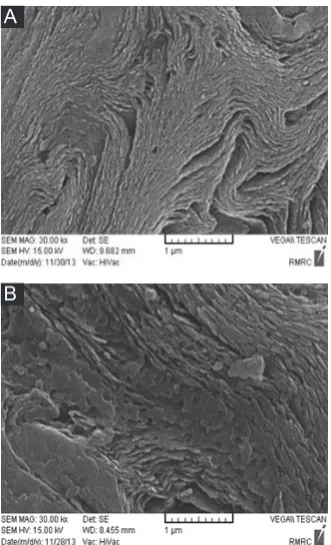
The EC and TDS of FA solution increased after and be-fore being washed for 48 hours. As EC and TDS increased from 2.3 to 4.07 (ms/cm) and 0.08 to 1.71 g/L, respectively. But, pH was fixed and equal to 6.2 after washing for 48 hours. The SEM images of the absorber before and after oxidation are shown in Figure 1.
Figure 1 confirms an increase in porosity of the adsorbent
surface after oxidation process. As shown in the figure, streaks surface was more open and the surface uniformi-ty of the FA was reduced after oxidation. This effect was intensified by increasing the time. The weight percent of elements and compounds in WFA and OFA samples is shown in Table 1.
Oxidizers concentration
Figure 2 shows changes in 2-CP removal efficiency by changing the PC concentration in the absorber oxidation process.
When PC concentration is zero (WFA), 2-CP adsorption efficiency is less (67.3%) than the situation that absorber is oxide (OFA). But the removal efficiency decreased by increasing the concentration of the oxidizers. The highest adsorption efficiency obtained at lower PC concentration (1 mM) was 81.9%.
Effect of oxidation temperature
The effect of changes in oxidation temperature of FA on removal efficiency is shown in in Figure 3.
Increasing the temperature of FA oxidation (from 28 to 80°C) resulted in increased 2-CP removal efficiency (from 81.9 to 89.5%). Hence, 80°C was selected as optimum oxi-dation temperature of FA.
Oxidation time of FA
The effect of oxidation time on removal efficiency is shown in Figure 4.
As the time of absorber oxidation increases, the removal efficiency increased as well. But there was no significant difference in adsorption efficiency of OFA obtained at dif-ferent times. Therefore, 1 hour was selected as the optimal time by considering the appropriate efficiency.
A
B
Figure 1. SEM image of a sample fly ash (FA). (A) Raw FA, (B)
oxidized FA.
Table 1. Weight percent of elements and compounds in WFA samples and OFA
Present elements in samples (wt.-%) Present compounds in samples (wt.-%)
CO2 SO3 V2O5 Fe2O3 TiO2 Carbon Sulfur Oxygen Iron Vanadium Titanium
91.97 6.22 1.2 0.61 0 77.94 7.73 10.91 1.32 2.09 0 WFA
94.92 5.08 0 0 0 86.52 6.8 6.68 0 0 0 AFA
Abbreviations: WFA, washed fly ash; OFA, oxidize fly ash.
50 55 60 65 70 75 80 85 90 95 100
0 10 20 30 40
Re
m
ova
l e
ffi
ci
en
cy
%
Potassium permanganate concentration (mM)
Figure 2. Effect of potassium permanganate concentration in the
Effect of pH
In this study, the effect of pH is shown in Figure 5. pH reduction resulted in an increase in the removal efficiency, therefore, pH = 3 was obtained as the highest efficiency. The removal efficiency decreased greatly at neutral pH and increased again under alkaline conditions.
Effect of adsorbent dose and contact time
Changes in removal efficiency by the differing adsorbent dose and contact time are shown in Figure 6.
As the adsorbent dose and contact time increases, the re-moval efficiency and adsorption capacity increases as well. 0.8 g in 120 min was selected as optimum adsorbent dose.
Kinetics and isotherm of adsorption
An increase in the initial concentration of 2-CP resulted in an increase in the rate of adsorption and reduced the removal efficiency. Batch adsorption studies were con-ducted in varying concentration of 2-CP. The amount of sorption at time t, qt (mg/g), was calculated using the fol-lowing equation:
qt =(C0-Ct) V/M (1)
where C0 is the initial concentration of 2-CP, Ct is the con-centration at a given time t, V is the volume of the 2-CP solution in L and M is the weight of the activated carbon
in g. For the prediction of isotherm parameter, the Freun-dlich and Langmuir isotherms were used. The FreunFreun-dlich isotherm was used based on the assumption that the sorp-tion process is involved in a heterogeneous layer. The non-linear form of the Freundlich equation is as follows: qe=KFCe1/nF (2)
The linearized form of the Freundlich equation: logqe = log(KF) + 1/ nF log(Ce) (3)
where qe is the amount of adsorbate adsorbed at equilib-rium (mg/ g), Ce represents an equilibrium concentration of the adsorbate (mg/L), KF is the Freundlich adsorption constant related to the adsorption capacity of the adsor-bent ((mg/g) (L/mg)1/n) and 1/n is the adsorption in-tensity. The Langmuir isotherm assumes that adsorption proceeds in the homogeneous sites, which are involved in the intramolecular binding on the adsorbent surface and attains a specific site occupation. Thus, no extension of adsorption was found on the occupied site of the adsor-bent material. This states that the adsorption process is a monolayer process (26). Table 2 shows the parameters of isotherm and kinetic equations in 2-CP adsorption by oxidized FA.
The Freundlich isotherm was found to be the best exposi-tor for equilibrium conditions of 2-CP absorption. Based on the determination coefficient (R2) and the comparison
81 82 83 84 85 86 87 88 89 90
0 20 40 60 80 100
Re m ov al e ff ici en cy % Temperature (°C)
Figure 3. Effect of oxidation temperature on the removal
efficiency of 2-chlorophenol (2-CP). Figure 5.(2-CP). Effect of pH on the removal efficiency of 2-chlorophenol
Figure 4. Effect of oxidation time on the removal efficiency of
2-chlorophenol (2-CP). Figure 6.
Effect of adsorbent dose and contact time on the removal efficiency of 2-chlorophenol (2-CP).
80 82 84 86 88 90 92 94 96
0 1 2 3 4
Re m ov al ef fic ie nc y%
Oxidation time (h)
0 10 20 30 40 50 60 70 80 90 100
0 50 100 150 200
Rem ov al ef fic en cy % Time (minutes) pH= 7 pH= 2 pH=3 pH= 5 pH= 9 pH= 11 50 55 60 65 70 75 80 85 90 95 100
0 50 100 150 200
between calculated equilibrium adsorption (qe(cal)) and the obtained equilibrium adsorption amount through testing (qe(exp)), the 2-CP adsorption of oxidized FA was followed by second degree kinetics.
Recyclability of adsorption and desorption rate
Studies have shown that reusability of the adsorbent (OFA) is possible. The removal efficiency of 2-CP under optimal conditions during the two times of adsorbent re-cycling were 78.4% and 63%, respectively. By evaluating the desorption rate, it was shown that after 24 hours, there was no desorption through the absorbent by contaminant. The removal efficiency of 2-CP in the actual wastewater of Zarand coal washing (82.1%) was less than the synthetic samples (96.2%) due to the presence of available interfer-ence in the actual samples.
Discussion
The effect of absorbent oxidation
The increased EC and TDS after washing the raw FAs for 48 hours, indicates that the soluble metal oxides, in the presence of water absorbent, are soluble. The risk of leakage of dangerous metals from the absorbent to the aqueous solution reduced when these compounds were removed from the absorbent during the pickling process (27,28). The increasing removal efficiency of oxidized FA is induced by the oxidation of carbon present in the FA with MnO4-. During the oxidation process, this
car-bon is converted to other forms of carcar-bon (C=O, C-OH, OH-C=O, C-O-C). Thus, the ability of oxidized carbon is higher than raw carbon. Also, the observed increase in oxidized adsorption could be attributed to the presence of C=O double bonds in the oxidized FA, and absorbing in-teractions between the absorbent and pollutants is always the π-π type (29). Jeon et al in North Korea reported that the oxidation process of alginate acid to alginate carboxyl acid by potassium permanganate leads to an increase in carboxyl groups in the oxidized sample rather than the non-oxidized samples, indicating that the carbon type was changed (30). These results are in line with the results obtained in the present study. The observed reduction in adsorption efficiency with increasing concentration could be attributed to the deposition of potassium permanga-nate oxidizer on the surface of the absorbent. The empty spaces were filled with the oxidizing agent and the adsorp-tion capability was reduced by reducing porosity on the adsorbent surface. The increasing removal efficiency of the oxidized absorbent at high temperatures was due to the effect of heat on absorbent oxidation.
Effect of pH
At acidic pH, chlorophenols are neutralized, whereas the absorbent surface is surrounded by hydronium ion. This results in an increase in surface tension between chloro-phenols and binding sites on the adsorbent surface (31). At alkaline pH (greater than pHZPC), along with increase in the percentage of ionized species, the number of negative charged sites on the adsorbent surface increased. Thus, adsorption will decrease due to electrostatic desorption between the negative surface of the absorbent and Chloro-phenol anions (2,8,12,32). The result of this study is in line with the result obtained by Baker and Ghanem in Japan on the removal of 2-CP using natural Zeolites (33). The reduction of adsorption efficiency could be attributed to the weakening of the interaction forces between Chloro-phenol and the adsorbent surface (34).
Effect of adsorbent dose
Increasing removal efficiency and adsorption capacity by increasing the amount of adsorbent, could be attributed to the availability of empty binding sites. Nadavala et al (13) in America using calcium alginate and chitosan beads and Bayramoglu et al (35) in Turkey, using yeast bio-absor-bent, reported that as time and adsorbent dose increased, the adsorption capacity of 2-CP increased as well. Their obtained results are consistent with the findings of the present study.
Effect of 2-CP original concentration
The number of adsorbed component molecules increased, when the concentration of 2-CP in a fixed number of adsorption sites increased. The generated competition resulted in reduced efficiency and increased qt. The ini-tial concentration provides a large driving force to over-come the mass transfer resistance of monochlorophenol between solid and aqueous phases. Kamble et al (10) in India, using FA-modified zeolite by detergent; and Man-grulkar et al (12) in India, using MCM-41 observed that initial concentration increases resulted to a decrease in efficiency and increasing qt. The results of this study are consistent with the mentioned studies.
Conclusion
The oxidation process removes impurities, increases po-rosity and results in an increase in adsorption efficiency. During oxidation process, the carbon present in the ab-sorber is oxidized and converted to carbon species con-taining greater affinity interaction with the contaminants. Finally, the adsorption rate improves. In this study, an
Table 2. Isotherm and kinetics parameters for the adsorption of 2-CP (adsorption values are in mg/L)
Adsorption isotherms Adsorption kinetics
Freundlich Langmuir-type 1 Second degree- type 1 First degree
1/n Kf (m/g) R2 q
m(m/g Ka R2 qe(exp) qe(cal) *k h R2 R2 k1 qe
adsorbent with high adsorption capacity to wastewater treatment of coal washing plant adjacent to the power plant was obtained using a sample and inexpensive modi-fied method, which requires no transportation cost and sophisticated technology. In addition to environmental pollution control, reuse of waste FA is consistent with the policy of recycling at source and waste management dis-cussion.
Acknowledgments
This study is one of the approved projects for students the-ses in the Environmental Health Research Center and was sponsored by the Vice-Chancellor for Research and Tech-nology of Kerman University of Medical Sciences.
Ethical issue
The authors certify that all data collected during the study period are presented in this manuscript, and no datum from this study has been or will be published separately.
Competing interests
The authors declare that they have no competing interests.
Authors’ contributions
All authors participated in the design of the study, per-formed the literature search and wrote the manuscript, data acquisition, analysis, and interpretation. All authors critically reviewed, refined, and approved the manuscript.
References
1. Altunlu M, Yapar S. Effect of OH−/Al3+ and Al3+/clay
ratios on the adsorption properties of Al-pillared bentonites. Colloids Surf A Physicochem Eng Asp 2007; 306(1–3): 88-94.
2. Namasivayam C, Kavitha D. Adsorptive removal of 2-chlorophenol by low-cost coir pith carbon. J Hazard Mater 2003; 98(1–3): 257-74.
3. Andini S, Cioffi R, Colangelo F, Montagnaro F, Santoro L. Adsorption of chlorophenol, chloroaniline and methylene blue on fuel oil fly ash. J Hazard Mate 2008; 157(2–3): 599-604.
4. Sun D, Zhang H. Electrochemical determination of 2-chlorophenol using an acetylene black film modified glassy carbon electrode. Water Res 2006; 40(16): 3069-74.
5. Xia S, Zhanga Z, Zhong F, Zhang J. High efficiency removal of 2-chlorophenol from drinking water by a hydrogen-based polyvinyl chloride membrane biofilm reactor. J Hazard Mate 2011; 186(2-3): 1367-73.
6. Tu Y, Xiong Y, Tian S, Kong L, Descorme C. Catalytic wet air oxidation of 2-chlorophenol over sewage sludge-derived carbon-based catalysts. J Hazard Mate 2014; 276: 88-96.
7. Yang B, Zhang J, Zhang Y, Deng S, Yu G, Wu J, et al. Promoting effect of EDTA on catalytic activity of
highly stable Al–Ni bimetal alloy for dechlorination of 2-chlorophenol. Chem Eng J 2014; 250: 222-9. 8. Anbia M, Amirmahmoodi S. Adsorption of
phenolic compounds from aqueous solutions using functionalized SBA-15 as a nano-sorbent. Scientia Iranica 2011; 18(3): 446-52.
9. Fattahi N, Assadi Y, Hosseini MR, Jahromi EZ. Determination of chlorophenols in water samples using simultaneous dispersive liquid–liquid microextraction and derivatization followed by gas chromatography-electron-capture detection. J Chromatogr A 2007; 1157(1–2): 23-9.
10. Kamble SP, Mangrulkar PA, Bansiwal AK, Rayalu SS. Adsorption of phenol and o-chlorophenol on surface altered fly ash based molecular sieves. Chem Eng J 2008; 138(1–3): 73-83.
11. Lin SH, Pan CL, Leu HG. Equilibrium and mass transfer characteristics of 2-chlorophenol removal from aqueous solution by liquid membrane. Chem Eng J 2002; 87(2): 163-9.
12. Mangrulkar PA, Kamble SP, Meshram J, Rayalu SS. Adsorption of phenol and o-chlorophenol by mesoporous MCM-41. J Hazard Mate 2008; 160(2-3): 414-21.
13. Nadavala SK, Swayampakula K, Boddu VM, Abburi K. Biosorption of phenol and o-chlorophenol from aqueous solutions on to chitosan–calcium alginate blended beads. J Hazard Mate 2009; 162(1): 482-9. 14. Sarkar M, Acharya PK. Use of fly ash for the removal
of phenol and its analogues from contaminated water. Waste Manag 2006; 26(6): 559-70.
15. Visa M, Andronic L, Lucaci D, Duta A. Concurrent dyes adsorption and photo-degradation on fly ash based substrates. Adsorption 2011; 17(1): 101-8. 16. Wang S, Wu H. Environmental-benign utilisation of
fly ash as low-cost adsorbents. J Hazard Mate 2006; 136(3): 482-501.
17. Malakootian M, Almasi A, Hossaini H. Pb and Co removal from paint industries effluent using wood ash. International Journal of Environmental Science & Technology 2008; 5(2): 217-22.
18. Lin JX, Zhan SL, Fang MH, Qian XQ, Yang H. Adsorption of basic dye from aqueous solution onto fly ash. J Environ Manage 2008; 87(1): 193-200. 19. Malakootian M, Mesdaghinia AR, Rezaei S.
Efficiency of ortho-chlorophenol removal from aqueo us solutions using activated Fly Ash of Zarand Fossil Fuel Power Plant. Journal of School of Public Health and Institute of Public Health Research 2014; 12(2): 81-92.
20. Tiwari M, Sahu S, Bhangare R, Ajmal P, Pandit G. Elemental characterization of coal, fly ash, and bottom ash using an energy dispersive X-ray fluorescence technique. Appl Radiat Isot 2014; 90: 53-7.
p-nitrophenol in water using acid-activated fly ash. J Hazard Mate 2012; 201–202: 68-73.
22. Zhou L, Chen YL, Zhang XH, Tian FM, Zu ZN. Zeolites developed from mixed alkali modified coal fly ash for adsorption of volatile organic compounds. Mater Lett 2014; 119: 140-2.
23. Luo F, Liu Y, Li X, Xuan Z, Ma J. Biosorption of lead ion by chemically-modified biomass of marine brown algae Laminaria japonica. Chemosphere 2006; 64(7): 1122-7.
24. Lu SG, Bai SQ, Zhu L, Shan HD. Removal mechanism of phosphate from aqueous solution by fly ash. J Hazard Mate 2009; 161(1): 95-101.
25. Doğan M, Alkan M, Türkyilmaz A, Özdemir Y. Kinetics and mechanism of removal of methylene blue by adsorption onto perlite. J Hazard Mate 2004; 109(1–3): 141-8.
26. Kumar M, Tamilarasan R. Modeling studies for the removal of methylene blue from aqueous solution using Acacia fumosa seed shell activated carbon. Journal of Environmental Chemical Engineering 2013; 1(4): 1108-16.
27. Kashiwakura S, Ohno H, Kumagai Y, Kubo H, Matsubae K, Nagasaka T. Dissolution behavior of selenium from coal fly ash particles for the development of an acid-washing process. Chemosphere 2011; 85(4): 598-602. 28. Kashiwakura S, Ohno H, Matsubae-Yokoyama K,
Kumagai Y, Kubo H, Nagasaka T. Removal of arsenic
in coal fly ash by acid washing process using dilute H2SO4 solvent. J Hazard Mate 2010; 181(1–3): 419-25.
29. Rodríguez-Reinoso F. The role of carbon materials in heterogeneous catalysis. Carbon 1998; 36(3): 159-75. 30. Jeon C, Park JY, Yoo YJ. Characteristics of metal
removal using carboxylated alginic acid. Water Res 2002; 36(7): 1814-24.
31. Ali I, Asim M, Khan TA. Low cost adsorbents for the removal of organic pollutants from wastewater. J Environ Manage 2012; 113: 170-83.
32. Anbia M, Lashgari M. Synthesis of amino-modified ordered mesoporous silica as a new nano sorbent for the removal of chlorophenols from aqueous media. Chem Eng J 2009; 150(2–3): 555-60.
33. Baker HM, Ghanem R. Evaluation of treated natural zeolite for the removal of o-chlorophenol from aqueous solution. Desalination 2009; 249(3): 1265-72.
34. Şenel S, Kara A, Alsancak G, Denizli A. Removal of phenol and chlorophenols from water with reusable dye-affinity hollow fibers. J Hazard Mate 2006; 138(2): 317-24.