Vol. 10, No. 2, 2018 Article ID IJIM-00724, 12 pages Research Article
Anti-Synchronization of Complex Chaotic T-System Via Optimal
Adaptive Sliding-Mode and Its Applications In Secure
Communication
B. Naderi ∗†, H. Kheiri ‡, A. Heydari §
Received Date: 2015-07-09 Revised Date: 2016-10-14 Accepted Date: 2017-10-21
————————————————————————————————–
Abstract
In this paper, an optimal adaptive sliding mode controller is proposed for anti-synchronization of two identical hyperchaotic systems. We use hyperchaotic complex T-system for master and slave systems with unknown parameters in the slave system. To construct the optimal adaptive sliding mode controller, first a simple sliding surface is designed. Then, the optimal adaptive sliding mode controller is derived to guarantee the occurrence of the sliding motion. Also, suitable update laws are designed to estimate the unknown parameters. The optimality and stability of the proposed method are proved using Hamilton-Jacobi-Bellman(HJB) technique and Barbalates lemma, respectively. Finally, anti-synchronization result is applied to secure communication via masking method. Numerical simulations illustrate the ability and effectiveness of proposed method.
Keywords: Anti-synchronization; Optimal control; Sliding mode; Barbalate’s lemma; Secure
commu-nication.
—————————————————————————————————–
1
Introduction
C
hwhich has been intensively studied duringaos is a very interesting nonlinear effect the last four decades. Chaotic systems, as non-linear deterministic systems, display complex andunpredictable behaviors. The most important
characteristic of these systems is their
sensi-∗Corresponding author. b
−[email protected] Tel:+98(914)3079289
†Department of Mathematics, Payame Noor University,
Iran.
‡Faculty of Mathematical Sciences, University of
Tabriz, Tabriz, Iran.
§Department of Mathematics, Payame Noor University,
Iran.
tivity to initial conditions. Chaotic
phenom-ena can be found in many scientific and engi-neering fields such as biological systems, elec-tronic circuits, power converters, chemical
sys-tems. The chaotic systems have many
impor-tant applications in nonlinear sciences, such as laser physics, secure communications, nonlinear circuits, neural networks, and active wave propa-gation [22,25,40,29,39,3,26,27,19,24,4].
Synchronization of dynamical systems is an im-portant field of nonlinear dynamics. The idea of synchronizing two identical chaotic systems has
been introduced by Pecora and Carroll [29] in
1990. Recently, the synchronization of chaotic
systems widely investigated in many fields, such as physics, chemistry, ecological sciences, and
cure communications [15,6,39]. Till now, differ-ent methods for synchronization have been pro-posed to achieve chaos synchronization and anti-synchronization, such as adaptive control, active control, sliding mode, nonlinear and linear
con-trol [2,18,36,12,19]. Fortunately, some existing
synchronization methods can be generalized to anti-synchronization of chaotic systems. To ad-dress the anti-synchronization problem, we con-sider a chaotic system, the master (or transmit-ter), together with the slave (or receiver), such that the anti-synchronization is to make the out-put of the slave system follows the symmetry of output of the master system.
Most methods mentioned in pervious para-graph synchronize or anti-synchronize two chaotic systems using robust methods. Obviously, The roust methods differ from the optimal methods and in general, the sliding mode or adaptive syn-chronization does not need to satisfy the optimal-ity conditions. The problem of minimal control synthesis algorithm for the control and
synchro-nization of chaotic systems was studied in [14]
and the optimal control for the chaos
synchro-nization of R¨ossler systems with complete
uncer-tain parameters was discussed in [13]. Recently
the optimal adaptive synchronization of chaotic
complex systems was studied in [27].
In this paper, we discuss the
anti-synchronization of a new chaotic system
[20] via optimal adaptive sliding-mode method.
The optimal adaptive sliding-mode control
is used as a robust and optimal method for anti-synchronization.
Secure communication was developed in 1992 based on the synchronization of chaotic dynami-cal systems. The general idea for transmitting in-formation via chaotic systems is that an informa-tion signal is embedded in a transmitter system which produces a chaotic signal. The sending in-formation signal is then recovered by the chaotic receiver.
Chaotic communication techniques include chaos masking, chaos modulation, and chaos shift keying. In chaos masking, the information signal is added directly to the transmitter. Chaos mod-ulation is based on the master-slave synchroniza-tion, where the information signal is injected into the transmitter as a nonlinear filter. In chaos shift
keying, the information signal is a binary signal mapped into the transmitter and the receiver. In these three cases, the information signal can be recovered by a receiver, if the transmitter and the
receiver are synchronized [21,7,28].
In 1993, Cuomo et al. [10] developed the
addi-tive chaos masking approach. Dedieu et al. [11]
presented the chaotic shift keying or the chaotic switching approach in 1993. Then in 1996, Yang
and Chua [39] introduced the chaotic parameter
modulation method, where the information sig-nal is used to modulate the chaotic system pa-rameters in the transmitter. In this scheme, the information signal is encrypted by an encryption rule with a key generated from the chaotic system in the transmitter. In the last decade, several new chaotic systems have been introduced and the synchronization of these systems via schemes such as adaptive, sliding-mode, and nonlinear
feedback control have been discussed. Some
manuscripts used these systems for secure
com-munication [34,38, 37, 5,23,41,42, 16, 33,26].
Recently, we used the synchronization of hyper-chaotic complex T-system for secure communica-tion [27].
The sensitivity of chaotic and hyperchaotic sys-tem with respect to initial condition caused it most attended in secure communication. Secure communication of information in the world is of utmost importance. Chaotic (especially hyper-chaotic) systems is a very powerful tool for this
purpose [30,31]. Recently, chaotic lorenz system
is used for monitoring of nuclear reactors[1].
Some properties of hyperchaotic systems have directed attentions respect to chaotic systems. Hyperchaotic systems exhibit more than one pos-itive Lyapunov exponent which means that their dynamics can expand in more than one
direc-tion. Compared with chaotic systems,
hyper-chaotic systems with more complexity dynam-ics characteristdynam-ics can provide tighter security for
secure communication. Also, the
synchroniza-tion and anti-synchronizasynchroniza-tion of such systems are
leading to control problems [30,31].
Motivated by the above discussion, in this pa-per, the new complex hyperchaotic system
intro-duced by Kheiri and Naderi [20] is used for secure
scheme for anti-synchronization of two identi-cal hyperchaotic complex T-systems, with three
unknown parameters. We use the result of
anti-synchronization for secure communications
via the chaotic masking method. By
apply-ing this process, we can achieve chaos anti-synchronization of master and slave systems, identify the unknown parameters, and mask and unmask the message signals simultaneously. In secure communication, a parameter and a state of master system are used for masking the informa-tion, such that a chaotic signal is added to the in-formation. The anti-synchronized states and es-timation of unknown parameters of the slave sys-tem are used to unmask the information. Based on the Barbalate’s lemma and Hamilton-Jacobi-Bellman(HJB) technique, an optimal adaptive sliding-mod controller with parameters estima-tion rules is designed to anti-synchronize complex chaotic T-systems asymptotically.
The rest of this paper is organized as follows:
Section2briefly introduces hyperchaotic complex
T-systems. In Section 3, the optimal adaptive
sliding-mode anti-synchronization of two identi-cal complex T-systems and numeriidenti-cal simulations
are addressed. In section 4, secure
communica-tion based on anti-synchronizacommunica-tion and masking method is proposed, and the effectiveness of the proposed scheme is evaluated with simulations for
digital images and continuous signals. Finally,
concluding remarks are presented in Section5.
2
Complex chaotic T-system
In 2005, G. Tigen [35] introduced a new real
chaotic nonlinear system called T-system, pre-sented as follows:
˙
x=a(y−x)
˙
y= (c−a)x−axz
˙
z=xy−bz,
(2.1)
where x, y and z are the state variables and a, b
and care real positive parameters.
In [20], a new complex hyperchaotic system is
introduced and its dynamical properties and
syn-chronization are discussed. This system is
ex-pressed as:
˙
x=a(y−x)
˙
y= (c−a)x−axz
˙
z= 12(¯xy+xy¯)−bz,
(2.2)
wherex=u1+iu2,y=u3+iu4 are complex
vari-ables,i=√−1 andz=u5 is a real variable; dots
represent derivatives with respect to time and the
overbars in ¯xand ¯ydenote the complex conjugate
of xandy, respectively. The real version of (2.2)
is expressed as follows:
˙
u1=a(u3−u1)
˙
u2=a(u4−u2)
˙
u3= (c−a)u1−au1u5
˙
u4= (c−a)u2−au2u5
˙
u5=u1u3+u2u4−bu5.
(2.3)
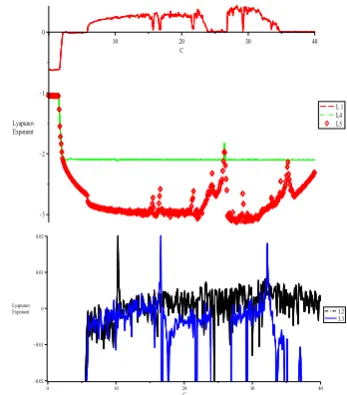
By choosing a= 2.1, b= 0.6, and some value of
0 < c < 40, the Lyapunov exponents in Figure
1 show that the system (2.3) is a hyperchaotic
system because at least two Lyapunov exponents
of system are positive [20]. Also this system is a
dissipative system, since sum of its Lyapunov ex-ponents is negative. The attractors of a chaotic system are bounded but they are not a fixed point or limit cycle. It is a property of chaotic
sys-tems [8]. Figure 2 displays the attractors of the
complex T-system. Anti-synchronization of this system can be used for the cryptography and de-cryption of data in secure communication.
0 −4 −5 5 −3 −4 10 −2 u5 −3 15 −1
−2 0
20
−1
u2 u1
1 25
0 1 2 3 4 5 4 3 2
0 −4 −10 5 −3 10 −2 −5 u5 15 −1 20 0 0 u3 u1 25 1 2 5 10 5 4 3
−4 −10
−5 −3
−5
−4 −2
0 u3
−3
−1 5
−2 0
10
−1
u1 1 u20 1 2 3 4 5 4 3 2
Figure 2: Attractors of (2.3) for a = 2.1, b = 0.6 and c = 30 with initial conditions: u1(0) = 1, u2(0) =−1, u3(0) = 2, u4(0) =−2, u5(0) = 0.
3 Anti-synchronization with
op-timal adaptive sliding-mode
control method
For anti-synchronization of two identical chaotic systems, assume that the master and slave sys-tems are defined as follows:
˙
x=f(x) (3.4)
˙
y=f(y) +ω, (3.5)
where x, y ∈ Rn are the state vectors of the
systems (3.4) and (3.5), f : Rn −→ Rn and
ω= (ω1, ω2,· · ·, ωn)T is control signal. The
anti-synchronization error ise=y+x. Then, the
dy-namical system error between master and slave systems is calculated as follows:
˙
e = ˙y+ ˙x=f(y) +f(x) +ω
=f(e−x) +f(x) +ω.
(3.6)
The goal is to design an appropriate controller
ω such that for any initial condition y0 and x0,
we have:
lim
t−→∞∥e∥= limt−→∞∥y(t) +x(t)∥= 0,
where ∥.∥ is the Euclidean norm.
We assume the master system and the slave system with unknown parameters are defined re-spectively, as follows:
˙
u1m=a(u3m−u1m)
˙
u2m=a(u4m−u2m)
˙
u3m= (c−a)u1m−au1mu5m
˙
u4m= (c−a)u2m−au2mu5m
˙
u5m=u1mu3m+u2mu4m−bu5m
(3.7) and ˙
u1s= ˆa(u3s−u1s) +ω1
˙
u2s= ˆa(u4s−u2s) +ω2
˙
u3s= (ˆc−ˆa)u1s−ˆau1su5s+ω3
˙
u4s= (ˆc−ˆa)u2s−ˆau2su5s+ω4
˙
u5s=u1su3s+u2su4s−ˆbu5s+ω5,
(3.8)
where ˆa, ˆband ˆc are unknown parameters, which
need to be estimated in the slave system. In order
to obtain the complex error system, we sum (3.7)
and (3.8), then we have:
˙
e1 = −a˜(u3m−u1m)
+ˆa(e3−e1) +ω1
˙
e2 = −a˜(u4m−u2m)
+ˆa(e4−e2) +ω2
˙
e3 = −cu˜ 1m+ ˜au1m+ (ˆc−ˆa)e1
−aˆ(e1e5−e1u5m−e5u1m)
−(ˆa+a)u1mu5m+ω3
˙
e4 = −cu˜ 2m+ ˜au2m+ (ˆc−ˆa)e2
−aˆ(e2e5+e2u5m+e5u2m)
−(ˆa+a)u2mu5m+ω4
˙
e5 = ˜bu5m+e1e3+e2e4
−e1u3m−u1me3
+2u1mu3m+ 2u2mu4m
−e2u4m−e4u2m
−ˆbe5+ω5,
(3.9)
where ei = uis+uim, ˜a = ˆa−a, ˜b = ˆb−b and
˜
c= ˆc−c.
The sliding mode control is an excellent
strat-egy in the area of robust control [17, 32]. The
be replaced with a high-gain linear feedback if the system state is close to the switching
mani-fold. To this end, we rewrite (3.9) as the equation
below: ˙
e1=−a˜(u3m−u1m) +W1−ξ1sign(e1)
˙
e2=−a˜(u4m−u2m) +W2−ξ2sign(e2)
˙
e3=−cu˜ 1m+ ˜au1m+W3−ξ3sign(e3)
˙
e4=−cu˜ 2m+ ˜au2m+W4−ξ4sign(e4)
˙
e5= ˜bu5m+W5−ξ5sign(e5),
(3.10) such that
W1−ξ1sign(e1) =ω1+ ˆa(e3−e1)
W2−ξ2sign(e2) =ω2+ ˆa(e4−e2)
W3−ξ3sign(e3) =ω3+ (ˆcˆa)e1
−ˆa(e1e5−e1u5m−e5u1m)
−(ˆa+a)u1mu5m
W4−ξ4sign(e4) =ω4+ (ˆc−ˆa)e2
−ˆa(e2e5+e2u5m+e5u2m)
−(ˆa+a)u2mu5m
W5−ξ5sign(e5) =ω5+e1e3
+e2e4−e1u3m−u1me3
+2u1mu3m+ 2u2mu4m
−e2u4m−e4u2m−ˆbe5.
(3.11)
The first step taken to design sliding mode con-trol is to select an appropriate sliding surface
[17, 32]. The sliding surface can be designed as
follow:
S(t) = [Se(t), Sp(t)], (3.12)
where Se(t) = [λ1e1, λ2e2, λ3e3, λ4e4, λ5e5] and
Sp(t) = [λ6˜a, λ7˜b, λ8c˜] such that surface
param-etersλi are positive constants.
The next step is to determine an optimal input
signal W(t) to guarantee that the error system
trajectories reach the sliding surface S(t) = 0.
The following theorem discusses the optimal controllers, dynamic of unknown parameters, and stability of error system in sliding surface.
Theorem 3.1 Let the parameter estimation
dy-namic is as follow ˙ˆ
a= e1(u3m−u1m) +e2(u4m−u2m)
−e3u1m−e4u2m−k1(ˆa−a)
˙ˆ
b= −e5u5m−k2(ˆb−b)
˙ˆ
c= e3u1m+e4u2m−k3cˆ−c)
(3.13)
and Wi = −2eηii, where ki ≥ 0 (i = 1,2,3) and
ηi > 0 (i = 1, ...,5). Then ω = (ω1, ..., ω5)
in relation (3.11) with ξi = |ei| is the optimal sliding-mode control in the sliding surface (3.12) and minimizes the cost function:
I =∫0∞Ω(e1, e2, e3, e4, e5,ˆa,ˆb,c, ⃗ˆ W)dt
=∫0∞{k1(ˆa−a)2+k2(ˆb−b)2
+k3(ˆc−c)2+
∑5
1(cie2i +ηiWi2)}dt,
(3.14)
where ci, is real positive constant. Also error dynamical system (3.10) and parameter estima-tion low (3.13) converge to equilibriums, ei = 0
(i= 1, ...,5), ˆa=a,ˆb=b andcˆ=c respectively.
Hence, the master system (3.7) and slave sys-tem (3.8) are asymptotically anti-synchronize.
Proof. Assume that the minimum of (3.14) is
obtained with W =W∗ = (W1∗, ..., W5∗), then we
have:
V(e1, e2, e3, e4, e5,ˆa,ˆb,c, Wˆ ∗, t) =
min
W
∫∞
0 Ω(e1, . . . , e5,ˆa,ˆb,c, Wˆ )dt.
(3.15)
We shall show that V may be treated as the
Lyapunov function in our system.
Now, we find the optimal controller W∗ such
that the systems (3.10)and (3.13) stabilize in
equilibrium points and the integral (3.14) is
min-imum. This requirement can be met by applying HJB technique of dynamic programming problem [17,13]; that is
∂V ∂e1e˙1+
∂V ∂e2e˙2+
∂V ∂e3e˙3+
∂V ∂e4e˙4+
∂V ∂e5e˙5
+∂V∂ˆaa˙ˆ+∂V
∂ˆb
˙ˆ
b+∂V∂cˆc˙ˆ+k1(ˆa−a)2
+k2(ˆb−b)2+k3(ˆc−c)2
+∑51(ciei2+ηiWi∗2) = 0.
By using (3.10) in (3.16), we get:
∂V
∂e1[−(ˆa−a)(u3m−u1m)
+W1−ξ1sign(e1)]+
∂V
∂e2[−(ˆa−a)(u4m−u2m)
+W2−ξ2sign(e2)]+
∂V
∂e3[−(ˆc−c)u1m+ (ˆa−a)u1m
+W3−ξ3sign(e3)]+
∂V
∂e4[−(ˆc−c)u2m+ (ˆa−a)u2m
+W4−ξ4sign(e4)]+
∂V
∂e5[(ˆb−b)u5m+W5−ξ5sign(e5)]
+∂V∂ˆaa˙ˆ+∂V
∂ˆb
˙ˆ
b+∂V∂ˆcc˙ˆ+
k1(ˆa−a)2+k2(ˆb−b)2+k3(ˆc−c)2
+∑51(ciei2+ηiWi∗2) = 0.
(3.17)
Minimizing (3.17) with respect toW∗, gives the
optimal controllers as follows:
∂V
∂ei + 2ηiW ∗
i = 0
⇒Wi∗ = 2−η1
i
∂V
∂ei(i= 1, ...,5).
(3.18)
By substituting the equations (3.18) in (3.17), we
have:
∂V
∂e1[−(ˆa−a)(u3m−u1m)−ξ1sign(e1)]+
∂V
∂e2[−(ˆa−a)(u4m−u2m)−ξ2sign(e2)]+
∂V
∂e3[−(ˆc−c)u1m+ (ˆa−a)u1m
−ξ3sign(e3)]+
∂V
∂e4[−(ˆc−c)u2m+ (ˆa−a)u2m
−ξ4sign(e4)]+
∂V
∂e5[(ˆb−b)u5m−ξ5sign(e5)]
+∂V∂ˆaa˙ˆ+∂V
∂ˆb
˙ˆ
b+∂V∂ˆcc˙ˆ+
k1(ˆa−a)2+k2(ˆb−b)2+k3(ˆc−c)2
+∑51(cie2i −41ηi(
∂V ∂ei)
2) = 0.
(3.19) Now, we choose the Lyaponuv function in the
sliding surface (3.12) as follows:
ϕ(e1, . . . , e5,ˆa,ˆb,ˆc) =SAST
= 12[∑51e2i + (ˆa−a)2+ (ˆb−b)2+ (ˆc−c)2], (3.20)
where A = diag[2λ12
i
] ∈ R8×8. The HJB
equa-tion (3.19) is satisfied for V = ϕ, ξi = |ei| and
ηi = 4(ci1−1)(ci ̸= 1). Then,ϕis a solution of
par-tial differenpar-tial equation (3.19). Hence, by
substi-tuting the (3.20) in (3.18), the optimal controllers
can be derived as follows:
Wi∗=− ei
2ηi
(i= 1, ..,5).
Also, from (3.20) we have:
˙
ϕ=−
[
k1˜a2+k2˜b2+k3c˜2+ 5
∑
1
2cie2i ]
<0.
(3.21)
Equation (3.21) can be rewritten as follow:
˙
ϕ=−(k1λ26
λ2 6
˜
a2+k2λ27
λ2 7
˜b2+ k3λ28
λ2 8
˜ c2
+∑512ciλ2i
λ2 i
e2i)<0. (3.22)
Let
L= min{2c1
λ21 , 2c2
λ22 , 2c3
λ23, 2c4
λ24 , 2c5
λ25 , k1
λ26, k2
λ27, k3
λ28}
and |S|2 is Euclidean norm of (3.12). Then
˙
ϕ <−L|S|2=−h(t)<0, (3.23)
where L|S|2= h(t). Integrating equation (3.23)
from zero tot yields:
{
ϕ(0)−ϕ(t)≥0
ϕ(0)−ϕ(t)≥∫0th(τ)dτ. (3.24)
Hence lim
t→∞ ∫t
0h(τ)dτ ≥0. Thus, according to the
Barbalate’s lemma [17], we have:
lim
t→∞h(t) = limt→∞L|S|
2= 0.
(3.25)
Since L is greater than zero, (3.25) implies
lim
t→∞S(t) = 0. This shows the solutions (3.10)
and (3.13) are asymptotically stable via optimal
adaptive sliding-mode control [17].Then the
3.1 Numerical simulation of anti-synchronization
To demonstrate the validity of the proposed method, we present and discuss the numeri-cal simulation for anti-synchronization of the
hyperchaotic complex T-system. For
anti-synchronizing, systems (3.7), (3.8) and (3.13)
with obtained controllers are solved numerically. In the numerical simulation, the fourth-order Runge-Kutta method is used.
By assuming a= 2.1,b= 0.6, andc = 30, the
system (3.7) is turned into a hyperchaotic system
[20]. To anti-synchronize the master and slave
systems, we choose initial conditions as follows:
um(0) = (0.5,0.5,1,1,−0.5)
us(0) = (2,0.25,0.5,−0.4,−0.2,−2)
ˆ
a(0) = 0.2,ˆb(0) = 1,ˆc(0) = 29.
(3.26)
Also, suppose the constant parameters in opti-mal adaptive sliding-mode controller and param-eters estimation rules are:
η1 = 1, η2= 5, η3 = 1,
η4 = 0.3, η5= 0.3 k1 = 5,
k2= 10, k3 = 10.
(3.27)
The results of chaotic anti-synchronization of
two identical hyperchaotic T-systems (3.7) and
(3.8), via optimal adaptive sliding-mode
con-troller are shown in Figure 3.
Clearly, the slave and master systems are synchronized after a short time. The
anti-synchronization errors are plotted in Figure 4.
Figure 5 shows the estimates ˆa(t), ˆb(t), and ˆc(t)
of the unknown parameters converge to a= 2.1,
b = 0.6, and c = 30, respectively. As expected
from in the above analytical considerations, the
anti-synchronization errorseiand error of
param-eter estimations are converged to zero ast−→ ∞.
4
Secure communication
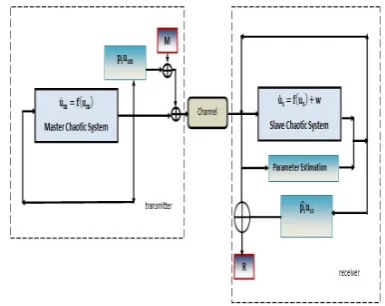
This section addresses a new secure communica-tion scheme based on anti-synchronizacommunica-tion of two complex chaotic T-systems. According to
Theo-rem 3.1, the architecture of the proposed secure
0 2 4 6 8 10
−10 0 10
u
1s
u
1m
0 2 4 6 8 10
−10 0 10
u
2s
u
2m
0 2 4 6 8 10
−20 0 20
u
3s
u
3m
0 2 4 6 8 10
−20 0 20
u
4s
u
4m
0 2 4 6 8 10
−50 0 50
t
u
5s
u
5m
Figure 3: State trajectories for anti-synchronization via optimal sliding-mode controllers.
0 2 4 6 8 10
−1 0 1
e1
0 2 4 6 8 10
−1 0 1
e2
0 2 4 6 8 10
−1 0 1
e3
0 2 4 6 8 10
−1 0 1
e4
0 2 4 6 8 10
−1 0 1
e5
t
Figure 4: The error due to anti-synchronization.
communication scheme is established by two iden-tical complex chaotic systems with uncertain
pa-rameters as shown in Figure6. At the transmitter
side, system (3.7) with state variables um(t) and
parameter P = (a, b, c) are used as the master
system, while at the receiver side, system (3.8)
has the same structure as system (3.7).
How-ever, with different state variablesus(t),
parame-ter ˆP(t) = (ˆa(t),ˆb(t),ˆc(t)), and an optimal adap-tive sliding mode controller is employed to anti-synchronize the two systems. At the transmitter
side, the original messageM(t) is masked by the
chaotic signal Piuιm(t). Let T(t) is the masked
message as shown as follows:
T(t) =M(t) +piuιm(t), (4.28)
where i= 1,2 or 3 and ι= 1,2,3,4 or 5. In the
0 0.5 1 1.5 2 2.5 3 3.5 4 0
2 4
ˆ
a
0 0.5 1 1.5 2 2.5 3 3.5 4
0 0.5 1 1.5
ˆb
0 0.5 1 1.5 2 2.5 3 3.5 4
29 29.5 30 30.5
ˆ
c
t
Figure 5: Estimation of unknown parameters.
Figure 6: Diagram of secure communication
system is employed as a encryption key for mask-ing, so the estimation of this parameter in the slave system must be used as a decryption key for unmasking. Therefore, this scheme has more
security compared than similar work [33,42]
Also, M(t) must be well chosen in a way that
it can be successfully masked by Piuιm(t).
Oth-erwise, the original message M(t) is multiplied
by a scaling factor [9] is used for resizing the
original message. The resulting signal T(t) from
the transmitter is sent to the receiver via a
pub-lic channel. By theorem 3.1, the chaotic
anti-synchronization will be achieved by the optimal adaptive sliding mode controller after some time
Ts (Ts is the anti-synchronization time). If Tc is
a time greater thanTs, it will be suitable time for
transfer and recovery. The received signal by the
receiver is recoverable with following equation:
R(t) =T(t) + ˆpi(t)uιs(t)∼=M(t). (4.29)
Because, according to the concept of
anti-synchronization and parameter estimation rule, we have:
R(t) =M(t) +piuιm(t) + ˆpi(t)uιs(t)
∼
=M(t). (4.30)
During the communication process, the
trans-mitter can useke as the encryption key, whilekd
is used as the decryption key by the receiver, such that
ke={u1m(0), . . . , u5m(0), a, b, c, Tc}
and
kd={u1s(0), . . . , u5s(0),ˆa,ˆb,c, Tˆ c}.
The encrypted signal is transmitted through the public channel which is open to any intruder. Nevertheless, intruders are unable to decrypt the message even if they have knowledge of the struc-ture of the chaotic system at the transmitter. Since the initial conditions, the system
param-eters and the anti-synchronized timeTcare
com-pletely unknown, it would be extremely difficult for an intruder to recover the masked messages from the system without the correct encryption or decryption keys. It is also noted that even an extremely small deviation of the correct keys will lead to a completely different result due to the systems chaotic nature, thus increasing the diffi-culty for intruders to recover the original message.
In addition, the proposed communication
scheme consists of four phases:
• Design an optimal adaptive sliding mode
controller for anti-synchronization of two coupled complex chaotic T-systems
• Design estimation rule of unknown
parame-ters.
• Masking and transmitting the information
signal
• Recovering the signal by using the concept
In subsection 3.1, the numerical simulation of anti-synchronization of complex chaotic system via optimal sliding mode method was discussed. To evaluate the feasibility of the proposed se-cure communication scheme, numerical simula-tions are given in following subsection.
4.1 Numerical simulation of secure communication
To test the validity of the proposed scheme, we present and discuss the simulations results for the encryption and decryption of continuous signal and digital images. All the simulations are car-ried out by the MATLAB software and for solving the dynamical systems the fourth-order
Runge-Kutaa numerical method is used. We assume
the initial conditions and requirement parameters
similar to those in the subsection3.1. Encryption
and decryption occur after anti-synchronization
time Ts. In simulations that are different from
a one-dimensional continuous signal, the digital image must be rearranged in an image data set
S = {s1, s2, ..., sd}, in which each element has
a value with a double format (d is the number
pixel of the digital image). For example, the
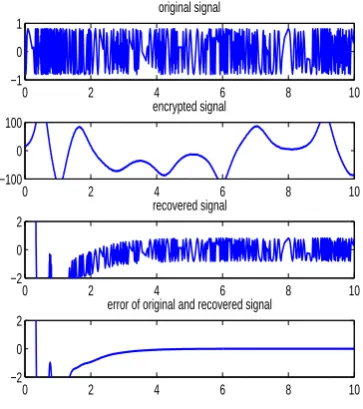
presented method is tested on the continues
sig-nal M(t) = 0.8 sin(200πt), black-white and color
digital images. Simulation results are shown in
Figures7-9 with encryption and decryption rules
(4.28) and (4.29) forι= 2 and i= 3.
5
Conclusions
In this study, a new optimal adaptive
sliding-mode controller was designed for the anti-synchronization of two identical complex chaotic T-systems with unknown parameters. Our obtained optimal control laws and parame-ter estimation rules were satisfied in Barbalet’s lemma and the HJB technique. So, the obtained
controller are robust and optimal.
Anti-synchronization results showed that the errors and the parameter estimation are asymptotically convergent. The results of anti-synchronization were used to secure communication via masking
method. In the presented method, the state
variables, the known parameters and the esti-mation of unknown parameters were used as
original picture encrypted picture recovered picture
Figure 7: Secure communication based on anti-synchronization for color digital image (Iranian cheetah image withd= 104×156×3)
original picture encrypted picture recovered picture
Figure 8: Secure communication based on anti-synchronization for black-white digital image (Lena image withd= 120×86×3)
encoding and decoding keys. Secure communi-cation based on optimal adaptive sliding-mode
anti-synchronization decrypt the continuous
signals or digital images easily. The simulation results showed the effectiveness of the proposed
method for anti-synchronization and secure
communication purposes.
References
[1] G. Ablay, C. E. Koksal, T. Aldemir, Chaotic data encryption for long-distance
monitor-ing of nuclear reactors, Nuclear Science and
0 2 4 6 8 10 −1
0 1
original signal
0 2 4 6 8 10
−100 0 100
encrypted signal
0 2 4 6 8 10
−2 0 2
recovered signal
0 2 4 6 8 10
−2 0 2
error of original and recovered signal
Figure 9: Secure communication based on anti-synchronization for continues signal
[2] M. M. Al-sawalha, M. S. M. Noorani, On anti-synchronization of chaotic systems via
nonlinear control,Chaos Solitons Fractals42
(2009) 170-179.
[3] B. R. Andrievskii, A. L. Fradkov, Control of Chaos: Methods and Applications. I.
Meth-ods, Automation and Remote Control 64
(2003) 673-713.
[4] P. Arena, S. Baglio, L. Fortuna, G. Manga-naro, Hyperchaos from cellular neural
net-works,Electron. Lett.31 (1995) 250-251.
[5] F. Austin, W. Sun, X. Lu, Estimation of unknown parameters and adaptive
synchro-nization of hyperchaotic systems, Commun
Nonlinear Sci Numer Simul 14 (2009) 4264-4272.
[6] B. Blasius, A. Huppert, L. Stone, Complex dynamics and phase synchronization in
spa-tially extended ecological system, Nature
399 (1999) 354-359.
[7] M. Boutayeb, M. Darouach, H.
Rafar-alahy, Generalized state observers for chaotic synchronization and secure communication,
IEEE Trans Circuits Syst I. 49 (2002) 345-349.
[8] H. Broer, F. Takens, Dynamical systems and chaos, Springer, (2009).
[9] C. J. Cheng, Robust synchronization of un-certain unified chaotic systems subject to noise and its application to secure
commu-nication, Applied Mathematics and
Compu-tation 219 (2012) 2698-2712.
[10] K. M. Cuomo, A. V. Oppenheim, S. H. Strogatz, Synchronization of Lorenz-based chaotic circuits with applications to
com-munications, IEEE Trans Circuits Syst 40
(1993) 626-633.
[11] H. Dedieu, M. P. Kennedy, M. Hasler, Chaos shift keying: modulation and demodulation of a chaotic carrier using self-synchronizing
Chuas circuits,IEEE, Trans Circuits Syst 40
(1993) 634-642.
[12] E. M. Elabbasy, M. M. El-Dessoky, Adap-tive anti-synchronization of different chaotic
dynamical systems, Chaos Solitons Fractals
42 (2009) 2174-2180.
[13] A. E. Gohari, Optimal synchronization of
R¨ossler system with complete uncertain
pa-rameters, Chaos Solitons Fractals 27 (2006)
354-359.
[14] A. E. Gohary, F. Bukhari, Optimal control of Lorenz system during different time
inter-vals, Appl. Math. Comput.144 (2003)
337-351.
[15] S. K. Han, C. Kerrer, Y. Kuramoto, Dephas-ing and burstDephas-ing in coupled neural
oscilla-tors,Phys. Rev. Lett. 75 (1995) 3190-3193.
[16] M. F. Haroun, A. T. Gulliver, A new 3D chaotic cipher for encrypting two data
streams simultaneously, Nonlinear Dyn. 81
(2015) 1053-1066.
[17] K. H. Khalil, Nonlinear systems, secound
edition, Prentice Hall, Michigan State
Uni-versity (1950).
[18] H. Kheiri, M. R. Moghaddam, V. Vafaei, Anti-synchronization of the T System with Uncertain Parameters Via Adaptive Control,
[19] H. Kheiri, B. Naderi, Dynamical Behavior And Synchronization Of Chaotic Chemical
Reactors Model Iranian J. Math. Chem. 6
(2015) 81-92.
[20] H. Kheiri, B. Naderi, Dynamical behavior and synchronization of hyperchaotic
com-plex T-system, Journal of Mathematical
Modelling 3 (2015) 14-31.
[21] L. Kocarev, K. S. Halle, K. Eckert, L. O. Chua, U. Parlitz, Experimental demonstra-tion of secure communicademonstra-tion via chaotic
synchronization, Int J Bifur Chaos 2 (1992)
709-713.
[22] E. N. Lorenz, Deterministic non-periodic
flows,J. Atoms Sci.20 (1963) 130-141.
[23] J. L. Mata-Machuca, R. Martinez-Guerra, R. Aguilar-Lopez, C. Aguilar-Ibanez, A chaotic system in synchronization and
se-cure communications, Commun. Nonlinear
Sci. Numer. Simulat.17 (2012) 1706-1713.
[24] T. Matsumoto, L. O. Chua, K. Kobayashi,
Hyperchaos: laboratory experimental and
numerical confirmation, IEEE. Trans. CAS
33 (1986) 1143-1147.
[25] E. Ott, C. Grebogi, J. A. Yorke, Controlling
chaos,Phys. Rev. Lett.64 (1990) 1196-1199.
[26] B. Naderi, H. Kheiri, Exponential synchro-nization of chaotic system and application in
secure communication,Optik - International
Journal for Light and Electron Optics 127 (2016) 2407-2412.
[27] B. Naderi, H. Kheiri, A. Heydari, R.
Mahini, Optimal Synchronization of Com-plex Chaotic T-Systems and Its Application in Secure Communication, Journal of
Con-trol, Automation and Electrical Systems 27
(2016) 379-390.
[28] U. Parlitz, L. O. Chua, L. Kocarev, K. S. Halle, A. Shang, Transmission of digital
sig-nals by chaotic synchronization, Int. J.
Bi-fur. Chaos 2 (1992) 973-977.
[29] L. M. Pecora, T. L. Carroll,
Synchroniza-tion in chaotic systems, Phys. Rev. Lett. 64
(1990) 821-824.
[30] W. Perruquetti, J. P. Barbot, Chaos in Au-tomatic Control, CRC Press (Taylor and
Francis Group), USA(2006).
[31] O. E. R¨ossler, An equation for hyperchaos,
Phys. Lett. A71 (1979) 155-157.
[32] J. J. E. Slotine, W. P. Lin, Applied Nonlinear
Control, Prentice-Hall,New York (1991).
[33] N. Smaoui, A. Karouma, M. Zribi, Secure communications based on the synchroniza-tion of the hyperchaotic Chen and the
uni-fied chaotic systems, Commun. Nonlinear
Sci. Numer. Simulat.16 (2011) 3279-3293.
[34] C. Tao, X. Liu, Feedback and adaptive con-trol and synchronization of a set of chaotic
and hyperchaotic systems, Chaos Solitons
Fract 32 (2007) 1572-1581.
[35] G. Tigen, Analysis of a dynamical system
de-rived from the Lorenz system,Sci. Bull.
Po-litehnica Univ. Timisoara Tomul 50 (2005) 61-72.
[36] Z. Wang, Anti-synchronization in two non-identical hyperchaotic systems with known
or unknown parameters, Commun
Nonlin-ear Sci Numer Simulat 14 (2009) 2366-2372.
[37] X. Wu, Z. H. Guan, Z. Wu, Adaptive syn-chronization between two different
hyper-chaotic systems, Nonlinear Anal.68 (2008)
1346-1351.
[38] X. Wang, M. Wang, Adaptive synchroniza-tion for a class of high-dimensional
au-tonomous uncertain chaotic systems, Int. J.
Mod. Phys. C 18 (2007) 399-406.
[39] T. Yang, L. O. Chua, Secure communication
via chaotic parameter modulation, IEEE
Trans. Circuits Syst. I 43 (1996) 817-819.
[40] S. M. Yu, J.. H. L¨u, H. Leung, G. R.
Chen, N-scroll chaotic attractors from a
gen-eral jerk circuit, Circuits Systems ISCAS 2
(2005) 1473-1476.
[41] F. Yua, C. Wang, Secure communication based on a four-wing chaotic system
sub-jectto disturbance inputs, Optik -
Interna-tional Journal for Light and Electron Optics
[42] L. F. Zhang, Secure Communication and Im-plementation for a Chaotic Autonomous
Sys-tem,TELKOMNIKA Indonesian Journal of
Electrical Engineering 12 (2014) 361-370.
Bashir Naderi has got PHD degree
in Applied Mathematics from
Pyame Noor University(PNU),
Iran, in 2016. Now he is an Assis-tant Professor of Mathematics at Payame Noor University (PNU), Iran. His main research interests
include Dynamical system, Optimal control,
Chaotic systems, Secure communication and Chaos control.
Hossein Kheiri has got PhD degree in Applied Mathematics from Uni-versity of Tabriz in 2005 and now he is a professor in this
Univer-sity. His main research interests
include Chaos dynamical systems, Control problems, Biomathematics and Numerical methods for ordinary differential equations.