a Tool for Case Study Analysis with Health
Professions Students: A Randomized Study
Kathleen Packard, PharmD, MS, BCPS; Hardeep Chehal, BDS, MS; Anna Maio, MD; Joy Doll, OTD, OTR/L; Jennifer Furze, PT, DPT; Kathryn
Huggett, PhD; Gail Jensen, PhD, PT, FAPTA; Diane Jorgensen, BCC, MA, MSW, LMHP; Marlene Wilken, RN, PhD; Yongyue Qi, MS
Abstract
Background:This pilot study evaluated the efficacy of the Interprofessional Team Reasoning Framework (IPTRF) to facilitate teaching and learning case studies with health professions students.
Methods and Findings: Eighteen interprofessional students were randomized to teams of six and were videotaped while completing a case. Team 1 (control) received only the case; team 2 received the case plus framework; and team 3 received the case, framework, and was shown videotaped examples of interprofessional interactions. The primary endpoint was students’ perceptions of interprofessional skills as meas-ured pre and post intervention using a modified Team Skills Scale. The secondary endpoint was student performance as assessed by blinded individuals using a stan-dardized rubric. The results revealed that students’ perceptions of team skills were significantly improved in team 2 and team 3 but not team 1. Students’ performance of their case as assessed by blinded faculty was significantly better in team 3 com-pared with teams 1 and 2.
Conclusions: In this study of six disciplines, the IPTRF, in combination with mod-eled examples of interprofessional communication, was an effective tool to teach skills necessary to workup a patient case, which included collaboration, communi-cation, and values/ethics. As the landscape of interprofessional education evolves, tools like the IPTRF will facilitate incorporation of these skills into health profes-sions education.
Keywords: Randomized study; Interprofessional education; Teamwork; Interprofessional; Case studies; Interdisciplinary; Team
Introduction
The changing face of healthcare and the focus on efficiency and quality will require increasing accountability for both health professions education and practice to ensure professionals are able to work as a team [1]. Interprofessional education, as defined by the Centre for Advancement of Interprofessional Education (CAIPE) “occurs when two or more professions learn with, from and about each other to improve collabora-tion and the quality of care” and includes “all such learning in academic and work based settings before and after qualification, adopting an inclusive view of ‘profes-sional’” [2, n.p.]. Each profession must be able to understand the other professions in order to learn how to maximize the talents of individual team members in an efficient and cost-effective manner while still improving quality of care. Interprofessional teams have been shown to enhance quality of care and patient satisfaction, lower
Journal of Research in
Interprofessional Practice and Education
Vol. 2.3 August, 2012
Journal of Research in Interprofessional Practice and Education (JRIPE)
Vol. 2.3 © 2012
costs, decrease length of stay, and reduce medical errors [3,4]. Therefore, opportuni-ties in health professions education are needed so that students may interact in mean-ingful ways as they communicate, negotiate, share leadership and decision making, and engage in conflict resolution when necessary. In order to provide such opportu-nities, health professions faculty need teaching and learning tools and structures to facilitate the design and implementation of such opportunities. The recent publica-tion of the Core Competencies for Interprofessional Collaborative Practice now pro-vides a road map for faculty to implement interprofessional education [5].
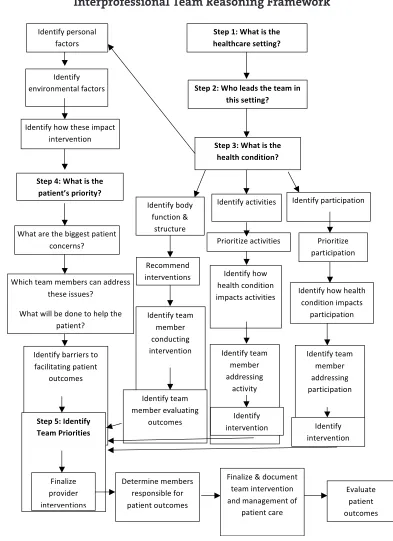
The purpose of this pilot study was to create teaching and learning tools that complement an important key pedagogical tool in health professions education— clinical cases. Clinical cases are essential teaching tools in helping students move from didactic knowledge, theory, and laboratory skills to application of their emerg-ing abilities to patient cases that represent authentic clinical contexts of practice. Real or simulated experiences such as this have been previously used to promote deeper learning [6,7] and have been identified as a key component of interdiscipli-nary education [8] to improve critical thinking [9,10]. However, we found no estab-lished frameworks in the literature for teaching students to analyze, deconstruct, and discuss patient cases as part of the distributed knowledge and shared work of an interdisciplinary team. Therefore, the Interprofessional Team Reasoning Framework (Figure 1) was developed to provide structure and guide interdiscipli-nary teams to pursue patient cases. The tool is intended to foster effective collabo-ration between the various disciplines and to improve patient care.
The framework is based on the International Classification of Functioning, Disability and Health (ICF) developed by the World Health Organization [11]. The ICF model was chosen because it has been standardized and can be applied across the continuum of care in different settings. The tool was developed by an expert panel of faculty at Creighton University with an interest in interprofessional educa-tion. This included clinical experts in the fields of chaplaincy, dentistry, medicine, medical education, nursing, occupational therapy, pharmacy, and physical therapy. The framework was tested by faculty on existing sample cases prior to the initiation of this study.
The purpose of this pilot study was to evaluate the Interprofessional Team Reasoning Framework as a tool to facilitate teaching and learning of case studies with health professions students. It was hypothesized that the use of the framework would be associated with better student perceptions about working as part of a team and would also correlate to better student performance in working up the patient case.
Methods
Recruitment and Randomization
This study was reviewed and approved by the Creighton University Social/Behavioral Institutional Review Board (10-15836). Health professions stu-dents from the disciplines of dentistry, medicine, nursing, occupational therapy,
Journal of Research in
Interprofessional Practice and Education
Vol. 2.3 August, 2012
251
Interprofessional Team Reasoning Framework
Journal of Research in Interprofessional Practice and Education Vol. 2.3 August, 2012 252 Interprofessional Team Reasoning Framework Packard, Chehal, Maio, Doll, Furze, Huggett, Jensen, Jorgensen, Wilken, & Qi ! ! ! ! ! ! ! ! ! ! ! ! ! ! ! ! ! ! ! ! ! ! ! "#$%!&'!()*#!+,!#)$!! )$*-#).*/$!,$##+012!! "#$%!3'!()4!-$*5,!#)$!#$*6!+0! #)+,!,$##+012!! "#$%!7'!()*#!+,!#)$!! )$*-#)!.405+#+402!! "#$%!8'!()*#!+,!#)$!! %*#+$0#9,!%/+4/+#:2!! !"#$%#&'%$"'%()**'+$%,#$)'-$% ./-.'&-+0% !")."%$'#1%1'1('&+%.#-%#22&'++% $"'+'%)++3'+0% !"#$%4)55%('%2/-'%$/%"'5,%$"'% ,#$)'-$0%% 62'-$)78%(/28% 73-.$)/-%9% +$&3.$3&'% :'./11'-2% )-$'&;'-$)/-+% 62'-$)78%#.$);)$)'+%% <&)/&)$)='%#.$);)$)'+%% 62'-$)78%"/4% "'#5$"%./-2)$)/-% )1,#.$+%#.$);)$)'+% 62'-$)78%,'&+/-#5% 7#.$/&+% 62'-$)78% '-;)&/-1'-$#5%7#.$/&+% 62'-$)78%"/4%$"'+'%)1,#.$% )-$'&;'-$)/-% 62'-$)78%,#&$).),#$)/-% <&)/&)$)='% ,#&$).),#$)/-% 62'-$)78%"/4%"'#5$"% ./-2)$)/-%)1,#.$+% ,#&$).),#$)/-% 62'-$)78%(#&&)'&+%$/% 7#.)5)$#$)-*%,#$)'-$% /3$./1'+% 62'-$)78%$'#1% 1'1('&% ./-23.$)-*% )-$'&;'-$)/-% 62'-$)78%$'#1% 1'1('&% #22&'++)-*% #.$);)$8% 62'-$)78%$'#1% 1'1('&% #22&'++)-*% ,#&$).),#$)/-% "#$%!;'!<5$0#+=:! >$*6!?/+4/+#+$,! 62'-$)78%$'#1% 1'1('&%';#53#$)-*% /3$./1'+% 62'-$)78% )-$'&;'-$)/-% 62'-$)78% )-$'&;'-$)/-% >'$'&1)-'%1'1('&+% &'+,/-+)(5'%7/&% ,#$)'-$%/3$./1'+% ?)-#5)='% ,&/;)2'&% )-$'&;'-$)/-+% ?)-#5)='%9%2/.31'-$% $'#1%)-$'&;'-$)/-% #-2%1#-#*'1'-$%/7% ,#$)'-$%.#&'% @;#53#$'% ,#$)'-$% /3$./1'+% Figure 1
Interprofessional Team Reasoning Framework
Definitions of Terminology:
• Body function/structure – anatomy and physiology of the body parts
(i.e., signs and symptoms, lab values, test results/diagnostics, medications, etc.) • Activities – activities of daily living (i.e., dressing, bathing, etc.)
• Participation – roles like work, parenting, etc.
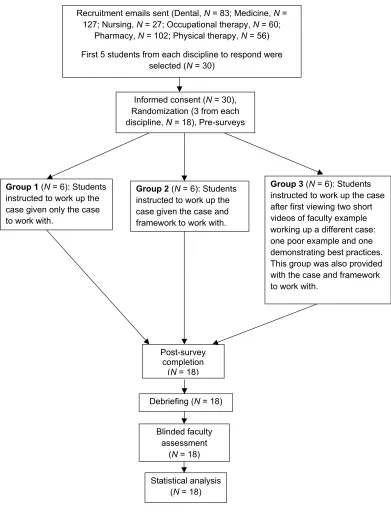
pharmacy, and physical therapy were recruited by faculty investigators one month prior to the study learning experience. Specifically, an email was sent to all students who were in their final year of didactic training, just prior to clinical rotations/clerk-ships (Figure 2). Five students were recruited from each discipline, three that were randomized into the study and two as a back-up. During the recruitment process, students were notified that they would be working as an interprofessional team for an educational research study. They were informed in advance that these
interac-Journal of Research in
Interprofessional Practice and Education
Vol. 2.3 August, 2012
253
Interprofessional Team Reasoning Framework
Packard, Chehal, Maio, Doll, Furze, Huggett, Jensen, Jorgensen, Wilken, & Qi
!
Group 1 (N = 6): Students instructed to work up the case given only the case to work with.
Group 2 (N = 6): Students instructed to work up the case given the case and framework to work with.
Group 3 (N = 6): Students instructed to work up the case after first viewing two short videos of faculty example working up a different case: one poor example and one demonstrating best practices. This group was also provided with the case and framework to work with.
Post-survey completion
(N = 18)
Informed consent (N = 30), Randomization (3 from each discipline, N = 18), Pre-surveys
Debriefing (N = 18)
Blinded faculty assessment
(N = 18)
Recruitment emails sent (Dental, N = 83; Medicine, N = 127; Nursing, N = 27; Occupational therapy, N = 60;
Pharmacy, N = 102; Physical therapy, N = 56)
First 5 students from each discipline to respond were selected (N = 30)
Statistical analysis (N = 18)
Figure 2
tions would be videotaped as part of the data collection process. The first five stu-dents to respond to the recruitment email were notified to report to a room on the evening of the study.
That evening, all recruited students reported to a room on campus where they received a name tag, copy of the informed consent form, and a catered meal. During the meal, investigators reviewed the informed consent form with students and then individually rounded to obtain signatures and answer questions. After informed con-sent was obtained, students were randomized to one of three teams or “team 0” by drawing numbers. Randomization occurred by drawing numbers from an envelope that an investigator had possession of (team 1, team 2, team 3, and two alternates). Of the five students recruited from each discipline, two were not selected (“team 0”) but were invited to stay for dessert and debriefing after the team interactions.
Following the dinner and team assignment, students were asked to complete a pre-experience survey to assess their perceptions about working as part of an inter-professional team, the primary study endpoint. The null hypothesis was that there would be no significant differences between scores from the three teams. Questions were from a modified Team Skills Scale and were also included in the tion survey to compare student perceptions of capabilities pre- and post-interven-tion [12]. Quespost-interven-tions for the modified Team Skills Scale were drawn from the John A. Hartford Foundation, Inc. Geriatric Interdisciplinary Team Training Program (GITT) kit. The scale measures perception of capabilities for effective team interac-tions and consists of 17 quesinterac-tions at 5 points each, for a maximum score of 85 points. The scale was originally designed to measure three key areas: interpersonal skills, profession-specific skills, and geriatric care skills. Because not all students had experienced interprofessional interactions prior to this study, the scale was modi-fied to include a 6thanswer, not applicable, in addition to 1 = poor, 2 = fair, 3 = good, 4 = very good, and 5 = excellent. If a student answered not applicable, that question was dropped. Therefore, the final score of the modified scale is presented as a per-centage based on the number of questions answered.
Case Workup
Students were told that they had 45 minutes to prepare and articulate a case plan and that their interactions would be video recorded by the faculty assessor. Students were blinded in that they were not informed that teams were provided with differ-ent sets of tools to perform this task. Studdiffer-ents randomized to teams 1–3 were instructed to divide by team and move to three different classrooms, each with a fac-ulty team facilitator (Figure 2). The facfac-ulty team facilitator was only permitted to read a script with instructions (Appendix A). Students randomized to team 1 received the case only. Team 2 students received the case and Interprofessional Team Reasoning Framework. In addition to receiving the case and framework, team 3 students watched two video examples of interprofessional faculty working up a different case. The first example, 6.5 minutes in length, was a poor example of a team interaction and the second example, 8.5 minutes in length, was considered an exemplary example.
Journal of Research in
Interprofessional Practice and Education
Vol. 2.3 August, 2012
254
Interprofessional Team Reasoning Framework
Faculty facilitators, who were all study investigators, were not allowed to inter-vene during the case workup process other than to tell the students when 15, 30, and 40 minutes had passed. Videotaping began only after the tools were provided and taped examples viewed (if applicable) to prevent bias during the faculty assessment process. After the case was completed or 45 minutes passed, whichever came first, the case workup process was complete. Students were then asked to fill out a post-experience survey. In addition to assessing for change in perceptions about working as part of an interprofessional team, using questions from the modified Team Skills Scale [12], the post-experience survey also allowed students to provide any subjec-tive feedback from the experience. When all surveys were completed, the students re-convened for dessert and were unblinded and debriefed on the process. Students were also invited to share verbal feedback at this time.
Faculty Assessment Tool
Fifteen independent, blinded assessors, including dental, medical, nursing, occupa-tional therapy, pharmacy, and physical therapy faculty, were provided a DVD copy of one of the videotaped team interactions. Through randomization, five faculty members were assigned to assess each team interaction as a secondary study end-point. They were instructed to evaluate the students using a rubric based on the University of Toronto Framework for the Development of Interprofessional Education Values and Core Competencies Collaboration [13]. The rubric was a 12-point scale assessing three areas: collaboration, communication, and values/ethics (Appendix B). The null hypothesis was that there would be no significant differ-ences between the scores of the three teams.
Data Analysis
Data from the pre- and post- student surveys and the faculty assessments were com-bined and analyzed using PASW Statistics 18 (IBM Corporation, Somers, New York) and SAS 9.2 (SAS Institute Inc., Cary, North Carolina). The categorical back-ground data were compared between teams using Fisher’s exact test. Analysis of covariance (ANCOVA) was employed to evaluate the differences in perception of team skills among the three teams after controlling for the pre-scores. Grades assigned by faculty for the blinded assessment of the taped interactions were aver-aged and compared between the teams using the Kruskal-Wallis test. A p-value for all tests less than .05 was considered statistically significant (p-value was adjusted to .017 using Bonferroni correction for post-hoc Mann-Whitney tests following a Kruskal-Wallis test). Effect size was reported as partial ŋ2(ANCOVA) and r (Mann-Whitney test).
Results
There were five, six, and three female students on teams 1, 2, and 3, respectively. All three Fisher’s exact tests showed p > .05, indicating no gender difference across the teams. For teams 1 and 2, three out of six (50%) students had prior interprofessional experience, whereas for team 3, four out of six (67%) students had prior experience;
Journal of Research in
Interprofessional Practice and Education
Vol. 2.3 August, 2012
255
Interprofessional Team Reasoning Framework
all Fisher’s exact tests were p> .05 (Table 1). Students that did have prior interpro-fessional experience stated that it was obtained either through job experience, internship experience, or an interprofessional course.
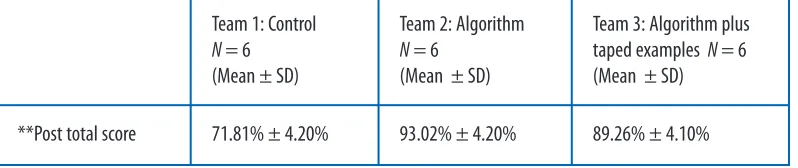
To evaluate whether there was an improvement in students’ perceptions of team skills (the primary endpoint), ANCOVA with adjusted pre-scores of the Team Skills Scale as a covariate was carried out. Since the adjusted scores were proportions, arc-sine transformations were applied. After the transformation, the dependent variable was normally distributed and the assumptions of homogeneity of variance and homo-geneity of regression slopes were met. ANCOVA revealed the significant main effect of team after controlling for the effect of pre scores, F(2, 14) = 23.18, (p < .05, partial ŋ2 =.77) (Table 2). Post hoc pairwise comparisons with Bonferroni adjustment indi-cated that the students’ perceptions of team skills significantly improved both for team 2 (p< .05, partial ŋ2 = .75) and team 3 (p< .05, partial ŋ2 = .65) when compared with team 1; there was no difference in team skills between team 2 and team 3 (p= .42).
** Adjusted score out of 100% ; **Covariate (Pre-total score) was evaluated at 72.80%
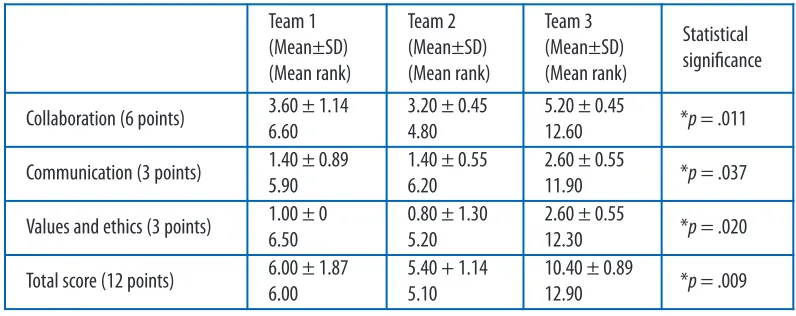
To examine the students’ performance of their case work (the secondary end-point), a Kruskal-Wallis test was conducted on the blinded faculty assessment scores for the three teams (Table 3). Three areas were assessed (communication, col-laboration, and values/ethics) and each team could earn up to 12 points. The mean ranks of total scores for teams 1 through team 3 were 6.00, 5.10, and 12.90, respec-tively. The team differences were significant, X2 = 9.34, df = 2, p= .009. Post hoc pair-wise comparisons by Mann-Whitney tests indicated that students on team 3 performed significantly better than both team 1 (Z = -2.55, p< .017, r = -.74) and team 2 (Z= -2.65, p< .017, r= -.77). No difference was detected between team 1 and team 2 (p= .69).
Journal of Research in
Interprofessional Practice and Education
Vol. 2.3 August, 2012
256
Interprofessional Team Reasoning Framework
Packard, Chehal, Maio, Doll, Furze, Huggett, Jensen, Jorgensen, Wilken, & Qi
Table 1
Background Characteristics for Teams 1, 2, and 3
Table 2
Team Skills Scale Comparison for Teams 1, 2, and 3
Team 1: Control
N= 6
Team 2: Algorithm
N= 6
Team 3:
Algorithm plus taped examples N= 6
Females 5 (83.33%) 6 (100.00%) 3 (50.00%)
Prior interprofessional experience 3 (50.00%) 3 (50.00%) 4 (66.67%)
Team 1: Control N = 6
(Mean ± SD)
Team 2: Algorithm
N= 6
(Mean ± SD)
Team 3: Algorithm plus taped examples N = 6 (Mean ± SD)
Discussion
For the primary endpoint of this study, we found that the use of the Interprofessional Team Reasoning Framework, regardless of teaching condition (i.e., taped examples [team 3] versus no taped examples [team 2]), was independ-ently associated with improvements in students’ perceptions of team skills. Therefore, the Interprofessional Team Reasoning Framework by itself likely pro-vided the students with enough structure and framework to improve their percep-tions about working in a team. Overall, the findings of this pilot study support the conclusions of a systematic review that indicated health professions students bene-fit from interprofessional education interventions as measured by changes in knowledge, skills, and attitudes [14].
However, for the secondary endpoint, only the students provided with both the teaching conditions of the framework and video-taped examples (team 3) per-formed significantly better than teams 1 and 2, as measured by blinded faculty assessment. It is possible that to significantly improve team interaction skills stu-dents must be exposed to some additional form of representing application of the framework in order to adequately utilize it. In this study, none of the teams were taught how to use the framework; they were provided only with a copy of the frame-work and the standardized instructions read aloud by the faculty facilitator. Nonetheless, the framework was independently associated with improvements in students’ perceptions of team skills, which indicates that the tool by itself is effective enough to guide students to complete a case. We propose that because the frame-work is comprehensive and represents issues of context in case management, it pro-vides enough distributed intelligence to support interprofessional teamwork. However, to optimize the framework’s use if it were to be incorporated into an inter-professional course, instructors would be expected to teach the use of the frame-work in addition to modeling it in a case study scenario. This would include introducing the ICD model and the Team Reasoning framework and providing
Journal of Research in
Interprofessional Practice and Education
Vol. 2.3 August, 2012
257
Interprofessional Team Reasoning Framework
Packard, Chehal, Maio, Doll, Furze, Huggett, Jensen, Jorgensen, Wilken, & Qi
Table 3
Faculty Assessment of Student Performance for Teams 1, 2, and 3
*p < .05
Team 1 (Mean±SD) (Mean rank)
Team 2 (Mean±SD) (Mean rank)
Team 3 (Mean±SD) (Mean rank)
Statistical significance
Collaboration (6 points) 3.60 ± 1.14 6.60
3.20 ± 0.45 4.80
5.20 ± 0.45
12.60 *p = .011
Communication (3 points) 1.40 ± 0.89 5.90
1.40 ± 0.55 6.20
2.60 ± 0.55
11.90 *p= .037
Values and ethics (3 points) 1.00 ± 0 6.50
0.80 ± 1.30 5.20
2.60 ± 0.55
12.30 *p= .020
Total score (12 points) 6.00 ± 1.87 6.00
5.40 + 1.14 5.10
10.40 ± 0.89
sample cases, learning objectives, and study questions. It would also be prudent to introduce team-building skills, team best practices, and team commitments. To facilitate this process, the investigators have created a website with sample cases and tools to teach the framework [15].
A systematic literature review found that educational approaches to interprofes-sional education are generally focused on problem-based learning, small-group teaching, case studies, and experiential work [14]. In addition to clinical cases, some other key components of successful interdisciplinary education include team devel-opment and sensitizing students to their role and the role of other team members, sequencing interdisciplinary experiences after the establishment of the student’s own professional identity, and embedding short interdisciplinary experiences throughout the curriculum as opposed to one-time intensive experiences [8]. Although this experience was sequenced toward the end of the students’ didactic learning, there were no formal team development activities. If incorporated into a course, it would be expected that team development training would occur prior to introducing the framework. We also propose that optimal use of the framework would entail introducing it to students in the early stages of their didactic curricu-lum followed by embedding its application into multiple courses throughout their studies for reinforcement. Optimal timing for introduction and use of the frame-work is a potential area of future research.
Developing a tool kit centred on this framework for teaching and learning inter-professional education could have important implications and value for educators, especially in light of the recent publication of the Core Competencies for Interprofessional Collaborative Practice [5]. Qualitative analysis of reflection data from this same situated, case-based learning experience indicated a strong congru-ency with the core competencies [16]. These data were captured during this same study exercise through written open-ended reflection questions at the end of the evening. Students were asked what the most difficult part of working together as a team was, what would have made their experience better, what they learned from the experience about themselves and their profession, what they learned about other professions, and why they think interprofessional practice is important in today’s healthcare environment. The themes that emerged from these responses cor-responded strongly to all four core competency domains, including roles/responsi-bilities, interprofessional communication, teams/teamwork, and values/ethics for interprofessional practice. The results suggest that the use of the tool can effectively foster the core competencies in health professions students.
Clinical cases remain powerful pedagogical tools in health professions education but may be challenging to implement in an interprofessional setting. One barrier to effective use of cases in interprofessional education is the challenge of developing them. We found that our cases, while simple, required input and revision from all professional faculty involved. Although our emphasis for this learning activity was to foster the skills required to effectively collaborate as a team, subjective feedback from student reflections indicated that many would have preferred more complex clinical information relative to their specific discipline in order to optimize their
Journal of Research in
Interprofessional Practice and Education
Vol. 2.3 August, 2012
258
Interprofessional Team Reasoning Framework
clinical skills. Thus, finding a balance in case content to provide the students with enough clinical information but not so much as to shift the focus away from inter-professional collaboration remains a challenge.
The development of this novel framework, however, is an important first step in overcoming the challenge of teaching students to workup cases in a formal manner. Further development and implementation of such tools will be critical in our efforts to assess student learning in interprofessional education. At our institution, our next steps will be to determine the efficacy of the framework in interprofessional Team Observed Structured Clinical Encounters (TOSCEs) in the near future.
Limitations
There are several limitations of this study that should be addressed. Because this is a pilot study with a small sample size, the results should be interpreted with caution. When developing the Interprofessional Team Reasoning Framework, it was noted that only some of the disciplines at our institution were familiar with and actively incorporating the ICF model into their pedagogy. Therefore, it is probable that only some of the disciplines in this study were familiar with the model. However, because all students were recruited from the same university, the effects should have been evenly distributed between the three teams.
Whether these results can be extrapolated to the general population of students would need to be assessed in a larger group as well. Because of the nature of the recruitment process, it is likely that the students who volunteered for the study may have been more motivated than the general population. Also, although this study was completed at a fully integrated academic health centre, certain disciplines were not included in the study due to lack of availability of programs or conflicts with stu-dent schedules. This includes physician assistant, optometry, podiatry, social work, exercise science, nutrition, and seminary programs/chaplaincy. Furthermore, five of the fifteen blinded faculty assessors played an integral role in the development of the Interprofessional Team Reasoning Framework, which could have introduced some bias in their assessment. However, the assessors were randomly assigned the team they assessed; therefore, this effect would have been evenly dispersed. Finally, the rubric used for the blinded faculty assessment was not a validated tool. Since com-pleting this study, the researchers have become aware of a validated rubric created by McMaster University, which will be used for future studies [17].
Conclusion
In this pilot study of six disciplines, the Interprofessional Team Reasoning Framework, in combination with modeled examples of interprofessional communi-cation, was an effective tool to teach health professions students the skills necessary to workup a patient case, which included collaboration, communication, and val-ues/ethics. The framework will continue to be utilized as part of our didactic curricu-lum to determine optimal pedagogical use. As the landscape of interprofessional education continues to evolve, tools like the Team Reasoning Framework will be crit-ical in the integration of these skills into health professions education.
Journal of Research in
Interprofessional Practice and Education
Vol. 2.3 August, 2012
259
Interprofessional Team Reasoning Framework
Acknowledgements
The authors would like to acknowledge the funding received from the District V National Association of Boards of Pharmacy and American Association of Colleges of Pharmacy Individual Study Grant.
References
1. Barr, H., Koppel, I., Reeves, S., Hammick, M., & Freeth, D. (2005). Effective interprofessional educa-tion: Argument, assumption, and evidence. Oxford: Blackwell.
2. Centre for Advancement of Interprofessional Education (CAIPE). Defining IPE. URL: http://www.caipe.org.uk/resources [April 3, 2012].
3. Greiner, A.C., & Knebel, E. (2003). Institute of Medicine Committee on the Health Professions Education Summit. Health professions education: A bridge to quality. Washington, DC: National Academy Press.
4. Reeves, S., Goldman, J., Burton, A., & Sawatzky-Girling, B. (2010). Synthesis of systematic review evidence of interprofessional education. Journal of Allied Health, 39(3 pt 2), 198-203.
5. Interprofessional Education Collaborative Expert Panel. (2011). Core competencies for interprofes-sional collaborative practice: Report of an expert panel. Washington, DC: Interprofessional Education Collaborative.
6. Boyce, G., Williams, S., Kelly, A., & Yee, H. (2001). Fostering deep and elaborative learning and generic (soft) skill development: The strategic use of case studies in accounting education.
Accounting Education 10(1), 37-60.
7. Cliff, W.H., & Wright, A.W. (1996). Directed case study method for teaching human anatomy and physiology. Advances in Physiology Education, 270(1), S19-S28.
8. Shepard, K., Yeo, G., & McGann, I. (1985). Successful components of interdisciplinary education.
Journal of Allied Health, 14(3), 297-303.
9. Zimmerman, S.D., Lester Short, G.F., Hendrix, E.M., & Timson, B.F. (2011). Impact of interdisci-plinary learning on critical thinking using case study method in allied health care graduate stu-dents. Journal of Allied Health, 40(1), 15-18.
10. Smith, A.R., & Christie, C. (2004). Facilitating transdicsiplinary teamwork in dietetics education: A case study approach. Journal of the American Dietetics Association, 104,959-962.
11. World Health Organization. (2011). International classification of functioning, disability, and health. URL: http://www.who.int/classifications/icf/en [April 2, 2012].
12. Hepburn, K., Tsukuda, R.A., & Fasser, C. (1996). Team skills scale, 1996. In Hyer, K., Flaherty, E., Fairchild, S., Bottrell, M., Mezey, M., & Fulmer, T. (Eds.), Geriatric interdisciplinary team train-ing: The GITT Kit, 2nd edition. New York: John A. Hartford Foundation, Inc.
13. University of Toronto Office of Interprofessional Education; Health Professional Programs. (2010).
A framework for the development of interprofessional education values and core competencies.
14. Cooper, H., Carlisle, C., Gibbs, T., & Watkins, C. (2001). Developing an evidence base for interdis-ciplinary learning: A systematic review. Journal of Advanced Nursing, 35(2), 228-237.
15. Creighton University. (2011). Creighton University interprofessional case studies resources. URL: http://oisse.creighton.edu/Interprofessional%20Case%20Studies%20Resources.aspx [April 2, 2012]. 16. Doll, J., Packard, K., Furze, J., et al. (2012). [Submitted] Reflections from an interprofessional edu-cation experience: Evidence for the core competencies for interprofessional collaborative prac-tice. Journal of Interprofessional Care.
17. McMaster/Ottawa TOSCE (Team Observed Structured Clinical Encounter) Toolkit. URL: http:// fhs.mcmaster.ca/tosce/en/administration.html [April 2, 2012].
Journal of Research in
Interprofessional Practice and Education
Vol. 2.3 August, 2012
260
Interprofessional Team Reasoning Framework
Appendix A Faculty Script
• Teams 1, 2, and 3 - DISTRIBUTE CASE FIRST
• I am _______________ and I am a faculty member in the department of _________________. Because this is a research study, I can only provide to you the instructions that are on this script. I can repeat them at your request. Again, this process will be videotaped for study purposes only. It will not be publicized or used outside of Creighton University other than for study purposes, so try not to let the camera distract you. You will be working as a team this evening to come up with a care plan for patient Jane Doe in the case you have been provided. You will have 45 minutes to workup the patient, prepare a care plan, and communicate this plan with members of the team. All of these tasks should be accomplished within 45 minutes. After 45 minutes, the process is complete and we will meet together again as a large group for debriefing and dessert. I will tell you when 15 minutes, 30 minutes, and 40 minutes have passed.
The scenario is that you are working in a hospital as part of a care conference team. Some of your professions may not routinely participate in hospital care con-ferences but instead may be consulted. For this project, however, you are all able to participate. You do not need to turn in any written plan, it just needs to be verbally articulated amongst yourselves as you work through the case. If you have brought any references with you (guidelines, drug information texts, calculators, etc.) you are free to use those, but this is not required.
• Team 1 – STOP READING, TURN ON CAMERA, FOCUS AND START TIMER. Remind them when 15, 30, and 40 min have passed. • Teams 2 and 3 – CONTINUE HERE:
You also have the availability of the team reasoning algorithm to use as a tool to workup this case. The algorithm provides a flow diagram model that you may choose to follow to guide your decisions and interactions. If you are unfamiliar with terms in this model, they have been defined on the second page.
• Teams 2 and 3 – DISTRIBUTE ALGORITHM NOW
• Team 2 – STOP READING, TURN ON CAMERA, FOCUS AND START TIMER. Remind them when 15, 30, and 40 min have passed. • Team 3 – CONTINUE HERE:
Before we begin, you will watch two brief taped interprofessional interactions of healthcare professionals working up a different patient case. The first is a poor or bad example of team interaction and the second is a good example.
• TURN ON VIDEO EXAMPLES TO WATCH.
• Team 3 – STOP READING, TURN ON CAMERA, FOCUS AND START TIMER. Remind them when 15, 30, and 40 min have passed.
Journal of Research in
Interprofessional Practice and Education
Vol. 2.3 August, 2012
261
Interprofessional Team Reasoning Framework
Appendix B
Faculty Grading Rubric for Students
Adapted from University of Toronto Office of Interprofessional Education; Health Professional Programs. A Framework for the Development of Interprofessional Education Values and Core Competencies.
Collaboration
Journal of Research in
Interprofessional Practice and Education
Vol. 2.3 August, 2012
262
Interprofessional Team Reasoning Framework
Packard, Chehal, Maio, Doll, Furze, Huggett, Jensen, Jorgensen, Wilken, & Qi
0 Points 1 Point 2 Points 3 Points Number
of Points
Team members are unable to describe their own role, responsibilities, values, and scope of practice
effectively to clients, patients/families, and other professionals.
Members of the team can describe their role, responsibili-ties, values, and scope of practice effectively to clients, patients/ families, and other professionals.
In addition to their own role, team members can accurately describe the roles, responsibil-ities, and scopes of practice of other professionals.
In addition to knowledge of their own role and of others’ roles, team members can work collaboratively with others, as appropriate, to assess, plan, provide care, intervention, and make decisions to optimize client /patient/family health outcomes and improve quality of care.
0 Points 1 Point 2 Points 3 Points Number
of Points
Team members are not involved with other professions in client/patient/family care appropriate to their role. Members do not perform effective decision making.
Team members: • are involved
with other professions in client/patient/f amily care appropriate to their role. • perform
effective decision making in interprofession al teamwork utilizing judgment and critical thinking.
Team members demonstrate leadership in advancing effective interprofessional team function through a variety of strategies which may include:
• reflection
• promotion of effective decision making
• identification of factors that contribute to or hinder team collaboration including power and hierarchy • flexibility and adaptability • able to assume diverse roles
Communication
Values and Ethics
Journal of Research in
Interprofessional Practice and Education Vol. 2.3 August, 2012 263 Interprofessional Team Reasoning Framework Packard, Chehal, Maio, Doll, Furze, Huggett, Jensen, Jorgensen, Wilken, & Qi
0 Points 1 Point 2 Points 3 Points Number
of Points
Team members do not recognize and understand how their uniqueness and the uniqueness of other team members, may contribute to effective communication and/or tension. Team members recognize and understand how their uniqueness and the uniqueness of other team members, including power and hierarchy within the interprofessional team, may contribute to effective communication and/or tension.
In addition to recognizing the uniqueness of themselves and other team members, they contribute to effective interprofessional communication including giving and receiving feedback, addressing conflict or difference of opinion, and self-reflecting.
Team members communicate effectively including giving and receiving feedback. Team members advance the interprofessional group functioning through effectively addressing interprofessional conflict. Team members perform effectively by:
• sharing information • listening attentively • using understandable
communications
• providing feedback to others • responding to feedback from
others
0 Points 1 Point 2 Points 3 Points Number
of Points
Team members cannot describe interprofessional team dynamics as they relate to individuals’ values. Team members cannot describe the nature of interprofessional ethical reasoning and justification. Team members cannot identify interprofessioanl ethical issues nor utilize basic skills of reasoning and justification.
Team members can describe
interprofessional team dynamics as they relate to individuals’ values and impact on team functioning in ethical dilemmas. Team members can describe the nature of interprofessional ethical reasoning and justification. Team members can identify interprofessional ethical issues and utilize basic skills of reasoning and justification.
In addition to describing team dynamics and the nature of interprofessional ethical reasoning and justification, team members can describe frameworks for ethical decision making within the interprofessional team. Team members contribute to interprofessional ethical reasoning and decision making using such
framework.
Team members perform effectively to develop shared team values. Team members practice ethically and are able to use a framework for ethical decision making to guide ethical reasoning within the team.