R E S E A R C H
Open Access
A versatile toolkit for high throughput functional
genomics with
Trichoderma reesei
André Schuster
1,2, Kenneth S Bruno
1, James R Collett
1, Scott E Baker
1, Bernhard Seiboth
2, Christian P Kubicek
2*and Monika Schmoll
2Abstract
Background:The ascomycete fungus,Trichoderma reesei (anamorph ofHypocrea jecorina), represents a biotechnological workhorse and is currently one of the most proficient cellulase producers. While strain improvement was traditionally accomplished by random mutagenesis, a detailed understanding of cellulase regulation can only be gained using recombinant technologies.
Results:Aiming at high efficiency and high throughput methods, we present here a construction kit for gene knock out inT. reesei. We provide a primer database for gene deletion using thepyr4, amdSandhphselection markers. For high throughput generation of gene knock outs, we constructed vectors using yeast mediated recombination and then transformed aT. reeseistrain deficient in non-homologous end joining (NHEJ) by spore electroporation. This NHEJ-defect was subsequently removed by crossing of mutants with a sexually competent strain derived from the parental strain, QM9414.
Conclusions:Using this strategy and the materials provided, high throughput gene deletion inT. reeseibecomes feasible. Moreover, with the application of sexual development, the NHEJ-defect can be removed efficiently and without the need for additional selection markers. The same advantages apply for the construction of multiple mutants by crossing of strains with different gene deletions, which is now possible with considerably less hands-on time and minimal screening effort compared to a transformation approach. Consequently this toolkit can
considerably boost research towards efficient exploitation of the resources ofT. reeseifor cellulase expression and hence second generation biofuel production.
Keywords:Trichoderma reesei;Hypocrea jecorina, transformation, vector construction, gene knock-out library, sexual crossing
Background
The increasing awareness of the limited availability of fossil fuels along with the environmental problems caused by their application initiated considerable research efforts towards clean and sustainable biofuels [1-3]. Thereby, the cellulases required to degrade cellu-losic plant materials into small building blocks, which can be metabolized by yeast or other microbes to etha-nol or hydrocarbon biofuel precursors, respectively, are one major focus of investigation [4].Trichoderma reesei (Hypocrea jecorina) is currently the most efficient
producer of enzyme mixtures for degradation of plant materials [5]. The cellulases produced by this fungus are utilized for diverse industrial processes, from biobleach-ing of textiles, paper recyclbiobleach-ing to juice extraction and even as additives in animal feeds [6-8].
The long-standing use of cellulase production by T.
reesei is paralleled by a thorough investigation of the cellulolytic enzyme system of this fungus and its regula-tion [9,10]. With publicaregula-tion of the genomic sequence of T. reesei [11], the progress in understanding the mechanisms of cellulase regulation was accelerated. Analysis of the genome indicated, that despite its pro-duction efficiency, T. reesei has the lowest amount of cellulolytic enzymes among Sordariomycetes at its disposal.
* Correspondence: [email protected]
2Research Area of Gene Technology and Applied Biochemistry, Institute for Chemical Engineering, Vienna University of Technology, Gumpendorfer Strasse 1a/1665, A-1060 Wien, Austria
Full list of author information is available at the end of the article
In order to gain an understanding of gene regulation, manipulation of the genome ofT. reeseiis indispensible. A transformation system for this fungus has been avail-able for decades withamdS[12],pyr4[13] andhph [14] being the most frequently used selection marker sys-tems. Also pyrithiamine resistence [15], benomyl resis-tence [16] and hexokinase [17] have proven useful for transformation ofT. reesei. Additionally, vector systems enabling excision of the marker gene cassette has facili-tated multiple sequential genome modifications despite the limited availability of marker systems [18,19]. Never-theless, the typical efficiency of homologous integration is less than 10% using these methods.
One of the most important advancements in recent years, for improving the performance of research with T. reesei was the development of strains deficient in non-homologous endjoining (NHEJ) [19,20]. These strains strongly enhance the probability of homologous integration of DNA constructs for deletion or modifica-tion of genes. Up to 95% of transformants were the result of homologous integration events [20]. While in most fungi little discernible phenotype is reported for this mutation, the respective strains are more sensitive to DNA damage [21], the HOG-MAPkinase pathway is up-regulated [22] and effects on genes involved in car-bohydrate transport [23] have been observed in some organisms. The major drawbacks of using strains defi-cient in non-homologous end joining, however, is that this mutation causes telomere shortening and defects in DNA repair [21], both of which negatively influence genome stability and fitness of the respective strains.
Recently, a further tool for work withT. reesei became available: After decades of research leading to the con-clusion that T. reeseiis a clonal, asexual derivative of a previously sexual species [24], the capability of this fun-gus for sexual development was discovered [25]. Besides the physiological relevance, this finding also opens up a wide array of new possibilities for research with T. ree-sei. Crossing can now be used for strain improvement and classical genetics. However, the fact that the paren-tal strain of all T. reesei strains used in research and industry, QM6a, is female sterile [25], necessitates the use of a sexually competent wildtype isolate for crossing. Consequently, the genetic background introduced by this closely related but also phenotypically different iso-late represents a serious drawback for use of sexual crossing in research.
Genome sequencing and high throughput analysis methods for transcriptomics, proteomics and metabolo-mics have had considerable impact on how research with fungi progresses [26]. Despite considerable improvements in transformation techniques, the recent increase in available genomic sequences of fungi also caused the need to efficiently use these resources.
However, despite the wealth of data created, in depth functional analysis of genes often lags behind and conse-quently many fungal genome databases still remain with their most precious treasures undiscovered. Mostly, this is due to the enormous effort necessary for creation of a gene knock out library, which necessitates thousands of experiments and subsequent screenings. Therefore the respective methods need to be streamlined and auto-mated as much as possible. For the model organism, Neurospora crassa, a community-wide effort recently led to the completion of a whole genome knock-out library [27]. This resource is especially important for evaluation of transcriptome data, because screening of a large num-ber of mutant strains considerably increases the knowl-edge and understanding to be gained from these studies [28,29]. Additionally, the possibility to study a group of functionally related genes, such as transcription factors can provide intriguing insights into previously unex-plored physiological processes [30,31].
While elaborate molecular biological tools are avail-able for other fungi, especiallyN. crassa, tools for effi-cient systematic analysis of gene function are relatively under-developed inT. reesei. Despite its widespread use in industry, no comprehensive gene knock out library is available for this fungus, nor are there currently efforts to start such an initiative. We therefore aimed to pro-vide a dependable and easy to handle toolkit as a first step towards creation of larger sets of gene knock out strains inT. reesei.
In this study we explored strategies to enable high throughput gene-knockout along with efficient construc-tion of multiple mutants. We applied yeast based recombination mediated vector construction, transfor-mation by electroporation and subsequently removal of the NHEJ-deficient background by crossing with a
sexu-ally competent T. reeseistrain derived from QM9414.
Genome wide primer libraries for knock out vector con-struction using different marker systems complete this toolkit. These methods can serve as a basis for construc-tion of large scale libraries of knock out strains for sys-tematic functional genomic studies withT. reesei.
Results and discussion
Vector construction by yeast mediated recombination
ranged between around 1000 to 4000 bp with the excep-tion of the peptaibol synthetases which are larger than 50 kb. For amplification of the flanking sequences of these genes, primers were designed with the following properties: Tm: 50 - 60°C, GC-content 40 - 60% and a
length of 20 base pairs. We generated 5’ flanking
sequences and 3’ flanking sequences with a size of
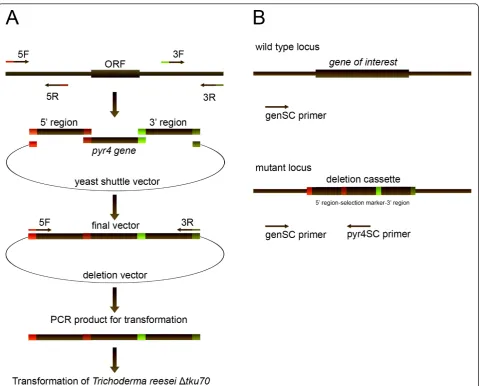
around 1000 - 1500 bp’s for each gene (Figure 1A,
Additional file 1). In case of TR_23171 and TR_123786 (peptaibol synthetases genes with a size > 50.000 bp’s)
we chose as the 3’ downstream flanking sequence a
1000 - 1500 bp’s fragment from within the open reading frame. This selection should result in a deletion of the first 2200 base pairs of the gene and consequently in a non-functional peptaibol synthetase. As the selectable
marker for Trichoderma transformation, we used the
orotidine-5’-phosphate decarboxylase (pyr4, TR_74020)
for transformation of Δtku70 which is also a uridine
auxotroph [20]. The pyr4gene was amplified from T.
reesei wild-type DNA and used for yeast mediated
recombination with the 3’ and 5’ flanking sequences
containing 29 bp homologous overhangs into the shuttle vector pRS426 [30]. Total DNA was isolated from the
yeast cells and was used as the template for amplifica-tion of the deleamplifica-tion cassettes by PCR.
Construction of deletion mutants in an NHEJ-deficient background
For high throughput gene deletion a high efficiency of homologous recombination is indispensable. Previous deletion of thetku70 gene inT. reesei TU-6, a uridine auxotrophic derivative of QM9414 [13], resulted in a strain deficient in non homologous endjoining resulting in a homologous integration efficiency which is higher than 95% [20]. For transformation we used both conven-tional protoplasting [13] and spore electroporation, as indicated with the respective genes (Table 1). Electro-poration was found to be less time consuming and easier to handle,
From the resulting transformants we chose five colo-nies per gene, which considering the high recombination frequency should result in identification of a positive mutant. For screening we used a PCR based mutant screening. For each gene we designed a specific primer which binds outside from the deletion cassette in the flanking regions of the gene (Additional file 1 Figure
Table 1 Overview about selectedT. reeseigenes.
protein ID
gene name
function classification/ group
ORF length [bp]
protein size [aa]
successful transformation method
2526 pkc1 protein kinase C signal transduction 3888 1140 P
2845 gna2 g-protein alpha subunit two signal transduction 1510 355 E 3873 pde1 hypothetical cyclic AMP phosphodiesterase, class II signal transduction 2177 526 P 21505 gna3 g-protein alpha subunit three signal transduction 1423 356 E 23171 nonribosomal peptide synthetase (NRPS) secondary
metabolism
69518 20874 N
28731 gpr2 hypothetical GPCR, family 2 G-protein coupled receptor
1258 374 E
37515 rid1 DNA methylase, required for RIP (GenBank Accession number: JN227866)
sexual development
1815 553 E
56684 - sugar transporter transport 1758 504 P
58456 - Zn2Cys6 transcription factor transcription factor 1589 445 P 65315 - basic leucine zipper transcription factor transcription factor 1046 299 P 70351 - Zn2Cys6 transcription factor transcription factor 1670 480 P 72004 - hypothetical GPCR, family 2, G-protein coupled
receptor
1464 442 N
77795 lim1 putative E3 ubiquitin ligase signal transduction 2004 637 E 79202 - hypothetical transmembrane protein, transport
protein
transport 1575 401 E
79756 fwd1 hypothetical F-Box/WD40 repeat protein circadian rhythm 2832 920 P 102497 - Zn2Cys6 transcription factor transcription factor 2328 665 P 102655 pde2 hypothetical phosphodiesterase signal transduction 2933 857 P 109088 hpo1 heterochromatin regulator chromatin binding 1308 272 P
109146 - PTH11-GPCR G-protein coupled
receptor
1604 452 P
123786 - non-ribosomal peptide synthetase secondary metabolism
50787 16535 P
1B). In combination with a specific primer which binds inside of the selectable marker (pyr4) and the primer which binds outside from the cassette we were able to very efficiently screen the mutant strains by PCR. An integration of the deletion cassette at the homologous locus results in a specific amplicon with a size between 1400 to 2000 bp (data not shown) depending on the exact location of the outside primer.
The PCR screening method showed that we were able to generate 18 out of 20 deletion mutant strains. We failed with generation of mutant strains of the following genes:tr_123806, andtr_72004. The frequency of homo-logous integration was between 33 and 100%.
Phenotype ofTrichoderma reeseimutant strains
The deletion mutant strains and the control strain (Δtku70, supplemented with 1 M uridine) were culti-vated on malt extract agar (3% (w/v) plates at 28°C for 6
days. We did not observe severe growth phenotypes for the strains studied, which corresponded well with the
available N. crassa strains deleted for the predicted
orthologous gene as available from the respective gen-ome database http://www.broadinstitute.org/annotation/ genome/neurospora/MultiHome.html (Figure 2).
The mutant lacking NCU00478.5, the homologue of theT. reeseiphosphodiesterase gene pde2(tr_102655), is white due to lack of pigment and no conidia are formed in slants on minimal medium at 25°C. Similarly,
the respective T. reesei deletion strain Δpde2 shows
reduced growth and white pigmentation. Also the
Δfwd1(tr_79756) strain shows reduced and white
pig-mentation which was also described for its N. crassa
ortholog (NCU04540.5). Deletion ofgpr2(tr_28731) and hpo1(tr_109088) inT. reeseileads to a reduced growth on rich medium but no phenotype was described for the orthologous genes (NCU04626.5 and NCU04017.5)
strain inN. crassa. Deletion ofgna3(tr_21505) leads to a higher sporulation on malt extract plates, a phenom-enon which was also shown for mutants of this gene in the closely relatedTrichoderma atroviride[32].
This pilot study showed that using vector construction by yeast mediated recombination, amplification of trans-formation cassettes and electroporation can significantly reduce hands-on time and considerably enhance effi-ciency of deletion mutant construction. We therefore went on to design an automated approach for construc-tion of deleconstruc-tion primers for all T. reeseigenes. This automated approach yielded a full set of primers for 8661 of the 9143 genes in T. reeseiv2.0, as well as a partial set of primers for 488 of the genes for use with the pyr4selection marker system in the NHEJ-deficient background ofT. reeseiΔtku70(Additional file 2).
Rescue of non homologous end joining by crossing
Since the deficiency in NHEJ not only brings the advan-tage of a higher probability of positive transformants, but also the problem of increased sensitivity to DNA damage, decreased genome stability and some changes in gene expression in some fungi [21-23], rescue of wild-type NHEJ is advisable.
The recently described sexual development ofT. reesei [25] represents a new method for strain development in this fungus. It is possible with this technique to remove undesired mutations by crossing with compatible strains. For this purpose we created a sexually competent strain compatible with our mutants (dubbed QF1; MAT1-1) derived from QM9414 (MAT1-2). Therefore, progeny of
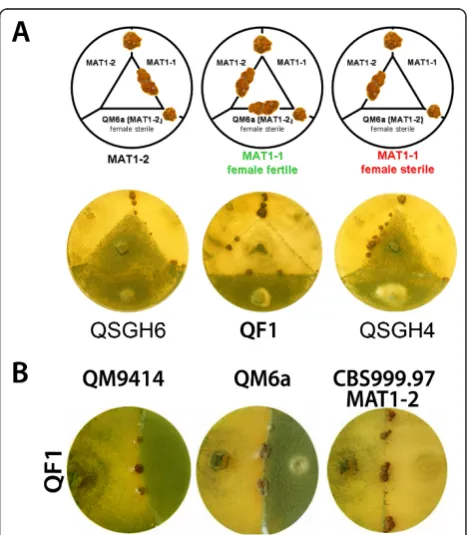
a cross between the wild-type isolateHypocrea jecorina CBS999.97 (MAT1-1) and the female sterile QM9414 were checked for mating type and sexual competence. Strains with MAT1-1 mating type which had gained female fertility were used for further crosses with QM9414. After several rounds of crosses, progeny were checked for desired properties by crossing with CBS999.97 MAT1-1 and CBS999.97 MAT1-2 in order to check for mating type and with QM6a to confirm female fertility (Figure 3A). A female fertile strain of mating type MAT1-1 was selected and checked for its
Figure 2Phenotypes of deletion mutant strains constructed in this study. Strains were grown on malt extract agar plates for six days at 28°C.
ability to undergo sexual development with QM9414, QM6a and CBS999.97 MAT1-2 (Figure 3B). QF1 shows a similar phenotype as QM9414 as well as comparable cellulase production after five days of growth, albeit also CBS999.97 MAT1-1 produces cellulase levels similar to these strains (data not shown). Consequently we gener-ated a strain with the retained capability of sexual devel-opment despite recovery of the QM9414 phenotype.
All mutant strains created in the course of this study are still able to mate with CBS999.97 and also with QF1 despite their deletions. As a proof of principle we selected three deletion strains for the crossing approach aimed at removal of thetku70deletion: Δgna2, Δgna3 and Δrid1. While Δgna2 does not show a discernible phenotype, sporulation is increased inΔgna3andΔrid1 is of particular interest, because in this mutant the mechanism of repeat induced point mutation (RIP) is likely to be perturbed. Deletion of the homologue of rid1(RIP-deficient-1) inN. crassaabolishes RIP [33]. In
T. reesei this phenomenon has not yet been
demon-strated, nevertheless the low frequency of gene duplica-tions in the genome of this fungus could be due to the operation of RIP [11].
Mating assays were performed on malt extract med-ium [25]. Crosses of these three strains were successful, albeit for Δgna3 lower fertility in sexual crosses was expected [34]. After three weeks the resulting ascospores were isolated randomly and the colonies were grown on selective medium and analyzed. Growth on hygromycin
containing medium indicated that the tku70 deletion
was retained, and strains not able to grow in the pre-sence of hygromycin were selected for further analysis. Growth on malt extract medium indicated presence of the initial gene deletion i. e. presence of the functional pyr4marker gene. Strains growing on malt extract med-ium without uridine as supplement were checked for presence of the genes of interest. PCR screening
con-firmed restoration of the wild type tku70and showed
that the desired gene deletion was retained.
While this method provides a significant improvement compared to retransformation, because no additional marker genes are needed and the hands on time to achieve rescue of the deletion is decreased there are cer-tain issues to be considered. Due to the number of backcrosses, QF1 is estimated to contain approximately 96 - 97% of the QM9414 genome including the same percentage of QM9414 specific mutations [35]. Thus, QF1 can also be assumed to contain 3 - 4% of the dif-ferences that distinguish QM9414 from CBS999.97.
Interestingly, a recent survey on classical mutations
and genome polymorphisms inN. crassa [36] revealed
significant genomic variation in classical mutant strains in this fungus. Nevertheless, these strains represent the
basis for decades of research with N. crassa and the
estimated level of difference between QF1 and QM9414 is well within the range used historically forNeurospora genetic studies.
The major difference between QF1 and QM9414 is likely to be found in the gene(s) involved in female ferti-lity (and the genes located nearby in the genome), which is functional in QF1 and enables this strain to undergo sexual development with female sterile QM6a and its derivatives including QM9414. The nature of the responsible gene(s) is currently unknown as is its func-tion. Additionally, QF1 has mating type MAT1-1 and hence certain differences in gene expression related to the mating type cannot be excluded [37]. We therefore recommend use of MAT1-2 progeny for further analysis and comparison with QM9414 data.
Although mating is a very efficient means of strain improvement and construction of multiple mutants, the fact that sexual development may introduce alterations in the genome has to be considered. In case of QF1, this includes the unlikely but possible interference of the small portion of the CBS999.97 genome retained in this strain. Therefore, segregation of the observed phenotype of a mutant with the selection marker has to be evalu-ated for several progeny. Additionally, as required with conventional transformations, different mutant strains have to be checked to confirm the effect of the mutation.
Increasing utility of the system by additional selection markers
Since the mutation causing uridine-auxotrophy of
Δtku70is not a complete deletion of thepyr4gene [13], the preconditions for the operation of RIP (homologous sequences longer than 400 bps) would be fulfilled [38]. Use of alternative selection markers will likely prove to be beneficial. We consequently modified the full genome
primer set described above for use with theamdS
mar-ker system [12], which can also be used with the NHEJ deficient strainΔtku70[20] (Additional file 3). Addition-ally, we provide this primer set for use with the hph-marker cassette (Additional file 4) used in theN. crassa high throughput gene knock out program [30] appropri-ate for transformation of the NJEH deficient strain
QM6aΔtmus53 [19]. These marker systems do not
involve the use of homologous sequences of T. reesei
and thus circumvent possible problems with RIP. Alter-natively, Δrid1 could be used for these constructions, which however would require subsequent removal of this background in order to avoid side effects by this mutation.
Conclusions
reesei. Recent studies on genomes of early industrial mutants of T. reeseirevealed several interesting muta-tions in these strains [35,39,40], but nevertheless, in many cases the specific genes responsible for the effect on cellulase gene expression as well as possible synergis-tic effects in these mutant strains, remain to be eluci-dated. Regulation of cellulase gene expression has been a focus of research withT. reeseifor decades and hence a considerable number of transcriptome studies are available [41,42]. Since the availability of the genome sequence of T. reesei[11] several approaches using gen-ome-wide microarrays have been reported [43,44]. These studies provide intriguing insights into various aspects of cellulase gene expression, from transcription factors to secretion pathways. Investigation of the target genes identified to be involved in cellulase regulation by analysis of gene knock out strains largely covering the involved pathways would be a logical further step towards elucidation of the mechanisms triggering induc-tion, transcripinduc-tion, processing and secretion of celluloly-tic enzymes.
The high relevance ofT. reeseifor the production of economically feasible second generation biofuels from cellulosic agricultural waste instead of food crops still requires considerable improvement of the efficiency of the cellulase mixture secreted [45]. Moreover, the use of T. reeseias a host for heterologous protein production necessitates a more detailed understanding of the phy-siology of this fungus. Our streamlined system for knockout-construction along with the convenient and easy to use method to create multiple mutants by cross-ing can serve as a startcross-ing point for large scale func-tional analysis studies aimed to uncover the hidden treasures of the biotechnological workhorseT. reesei.
Methods
Strains and plasmids
T. reeseiΔtku70, which is defective in the non-homolo-gous end-joining pathway [20] was used in the present study and was maintained on potato dextrose agar (PDA, Difico, Detroit, USA) which was supplemented with 5 mM uridine (Sigma Aldrich, St. Louis, USA) in order to complement the auxotrophy of strain TU-6, a derivative of QM9414 [13]. Parental strain QM9414 (ATCC 26921; [35,46]) and strains derived from it were maintained on 3% (w/v) malt extract with 2% (w/v) agar 28°C. Mating experiments were performed as described previously [25]. Briefly, strains were grown on 3% (w/v) malt extract medium with 2% (w/v) agar. Plates were incubated at 20-25°C in daylight for 10 - 14 days until formation of fruiting bodies and ascospore discharge. For yeast transformation the shuttle vector pRS426 [47] and the yeast strain WW-YH10 (ATCC number: 208405) were used.
Vector construction for gene deletion
For construction of deletion vectors for the selected genes (Table 1) the orotidine-5’-phosphate
decarboxy-lase gene of T. reesei (pyr4, TR_74020) was used as
selectable marker. The marker gene was amplified using primers pyr4F and pyr4R (supplementary file 1). The 50
μl reaction mixture contained 1.25 U Takara Ex Taq™
(Takara Bio, Madison, Wisconsin), 1 × Ex Taq™Buffer, 0.2 mM dNTP, 0.1μM forward and reverse primer, 1μl T. reesei QM9414 genomic DNA (90 ng/μl) as template and nuclease free water. The selectable marker PCR fragment was purified using the E.Z.N.A. Gel Extraction Kit (Omega Bio-Tek, Inc., Norcross, USA).
For generation of the respective 5’ and 3’ flanking sequences, primers (Table 1) were designed with the OligoExplorer software (version 1.1.2; http://www.gene-link.com/tools/gl-oe.asp). In order to enable yeast-mediated recombination of the deletion cassette, linker sequences were added to the primers for amplification of the 5’and 3’flanking region (supplementary file 1; Figure 1). Sequences were obtained from: T. reesei gen-ome database (JGI webpage: http://gengen-ome.jgi-psf.org/).
The PCR mixture contained 1.25 U Takara Ex Taq™
(Takara Bio, Madison, Wisconsin), 1 × Ex Taq™Buffer, 0.2 mM dNTP, 0.1μM forward and reverse primer, 1μl T. reeseiwild-type genomic DNA (90 ng/μl) as template and nuclease free water.
Database generation
A genome-wide database of primers for the 5’ and 3’
fragments for construction of the deletion cassette by yeast mediated recombination was generated using a Python script (provided by Peter Andrews of the Neuro-sporaGenome Project) that serialized the function of the Primer3 core primer design program [48]. A masked genome sequence file and a gene annotation file for T. reesei v2.0 were downloaded from the Joint Genome Institute (JGI; http://genome.jgi-psf.org/Trire2/Trire2. download.html) and converted into a format suitable for input into the Python script. The default parameters which were used for Primer3 were the predefined 29 nucleotide sequences attached to the primers (supple-mentary file 1) and the following settings: optimal pri-mer length = 20 bp, minimum pripri-mer length = 19 bp, flanking region length = 1500 bp, primer product size = min: 1000 bp and max.: 1300 bp, maximal size of GC clamp in primer = 2, primer optimal temperature = 56° C, primer GC content = min: 50% and max: 65%, mono-valent catio salt concentration = 50 mM and concentra-tion of annealing DNA oligo = 200 nM.
Vector construction and yeast mediated recombination
The yeast shuttle vector pRS426 was digested with
from New England Biolabs, Ontario, Canada) and puri-fied with the E.Z.N.A. Gel Extraction Kit (Omega Bio-Tek, Inc., Norcross, USA). Yeast transformation and preparation was performed essentially as described pre-viously [30,49,50].
An overnight culture (200 rpm, 30°C) of the yeast strain WW-YH10 was prepared. 1 ml of the overnight culture was added to 50 ml of fresh YPD (1% yeast extract, 2% peptone, 1% glucose (all chemicals from Sigma Aldrich, St. Louis, USA unless noted otherwise)) medium and incubated at 30°C until O.D.600 = 1. The cells were centrifuged at 14.000 rpm for 3 min. The supernatant was discarded and the pellet was washed with 25 ml of sterile water and centrifuged again for 3 min. The supernatant was discarded and the pellet was
resuspended in 400 μl of 100 mM lithium acetate
(Sigma Aldrich). 50μl of yeast cell suspension was cen-trifuged for 20 sec and 240μl 50% PEG 3550, 36μl 1 M
lithium acetate, 50 μl sheared salmon sperm DNA (2
mg/ml) (Sigma Aldrich) and 34 μl sterile water was
added to the pelleted cells. Thereafter, 200 ng of 5’
DNA fragment, 200 ng of 3’DNA fragment, 100 ng of
digested pRS426 and 100 ng of selectable marker frag-ment was added and mixed. After the heat shock for 30 min at 42°C the mixture was centrifuged for 15 sec at 14.000 g and the supernatant was discarded. 1 ml of sterile water was added, and after thorough mixing cen-trifuged for 15 sec again. 800μl of supernatant was dis-carded and the rest was spread onto SC-URA (1.54 g/l BSM-Iso-Ura Powder, 1.71 g/l yeast nitrogen base (Sun-rise Science Products, San Diego, USA), 5 g/l ammo-nium sulfate, 20 g/l glucose and 20 g/l agar (Sigma Aldrich, St. Louis, USA)) plates and incubated for 3-4 days at 30°C. The resulting colonies were resuspended in 2 ml of sterile water and transferred into a new reac-tion tube. The sample was centrifuged for 15 sec at 14.000 g and the supernatant was discarded. 400 μl of smash-and-grab lysis buffer (2% Triton X-100, 1% SDS, 100 mM NaCl, 10 mM Tris pH 8.0, 1 mM EDTA), 500
μl phenol (pH = 7.8), 500 μl chloroform/isoamylalcohol (48:2) and 0.3 g of glass beads were added and mixed well. After centrifugation for 10 min at 14.000 g the supernatant was transferred to a new reaction tube and
500 μl of chloroform was added and mixed. The
super-natant, after centrifugation for 10 min at 14.000 g, was transferred to a new reaction tube and 0.3 M sodium acetate (pH 5.2) and 2.5 volumes of ethanol (96%) were added. After precipitation and centrifugation for 10 min at 14.000 g, the pellet was washed with 400μl 70% etha-nol and resuspended in 50μl of sterile water. The final linear deletion cassette was amplified from this solution by PCR. The mixture contained 1.25 U Takara Ex
Taq™ (Takara-Bio, Madison, USA) appropriate buffer
as described in the application manual, 0.2 mM dNTP,
0.1 μM forward (5F) and reverse primer (3R), 2μl of isolated yeast DNA (approx. 100 ng) and nuclease free water. The protocol was: 94°C 3:00 min followed by 3 cycles of 94°C, 30 sec; 65°C, 30 s; 72°C, 2:00 min; fol-lowed by 2 cycles of 94°C, 30 sec; 63°C, 30 s; 72°C, 2:00 min; followed by 30 cycles of 94°C, 30 sec; 60°C, 30 s; 72°C, 2:00 min; and a final extension of 72°C, 10:00 min. The final linear deletion cassette was purified using the E.Z.N.A. Gel Extraction Kit (Omega Bio-Tek, Inc., Nor-cross, USA).
Transformation ofT. reesei
TheT. reeseiΔtku70strain [20] was used for transforma-tion in order to achieve a high efficiency in homologous integration of the deletion cassettes. The protoplast transformation was carried out as previously described [13]. For transformation 2.5μg of purified deletion cas-sette fragment was used. Transformants were grown on selective minimal medium (1 g/liter MgSO4*7H2O, 10 g/ liter 1% KH2PO4, 6 g/liter (NH4)2SO4, 3 g/liter trisodium citrate*2H2O, 10 g/liter glucose, 20 ml/liter 50x trace ele-ments solution (0.25 g/liter FeSO4*7H2O, 0.07 g/liter
ZnSO4*2H2O, 0.1 g/liter CoCl2*6H2O, 0.085 g/liter
MnSO4*H2O), 2% (wt/vol) agar; all chemicals were from Sigma Aldrich, St. Louis, USA).
The protocol for electroporation of T. reesei was
adapted from patent application US2010/0304468. Spores ofT. reeseiΔtku70were harvested from a freshly sporulated 90 mm malt extract agar plate and sus-pended in 1.1 M sorbitol. Spores were washed twice, resuspended in 100μl 1.1 M sorbitol and cooled on ice. 75μl of cold spore suspension was mixed with 10μg of vector of interest. For electroporation we used an
Elec-troporation System ECM® 630 (BTX Instrument
Divi-sion Harvard Apparatus, Holliston, USA). 1.8 kV, 800Ω
and 25 μF were used as setting for the ECM® 630
device. Thereafter one volume of the reaction mixture (consisting of spore suspension plus deletion cassette) of YEPD (1% (w/v) yeast extract, 2% (w/v) peptone, 1% (w/ v) glucose) and four reaction volumes 1.1 M sorbitol were added and mixed. For regeneration the whole mix-ture was incubated over night at room temperamix-ture. Thereafter, spores were streaked out on plates contain-ing selection medium.
Compared to the classical protoplast transformation technique [13] transformation by electroporation is less time consuming, easier to perform and the efficiency of this method was comparable to that of protoplast transformation.
Putative deletion strains were tested for integration of the construct by PCR using primer pyr4Sc (inside in the selectable marker genepyr4) and the gene-specific pri-mer, geneSc (outside from the transformation cassette)
integration results in a specific amplicon (1400 - 2000 bp’s, depending on the gene) (supplementary file 1) and
no amplification was possible with T. reesei Δtku70
genomic DNA (data not shown).
Construction of a sexually competent derivative of QM9414
The female sterile wild type strain QM9414 (MAT 1-2) and the sexually competent wild-type strain CBS999.97 (MAT1-1) [25] were inoculated on 3% (w/v) malt extract medium with 2% (w/v) agar for two to three weeks at 28°C until ascospore discharge. The ascospores were isolated from the lid with sterile water. This solu-tion was spread out on a 3% (w/v) malt extract medium with 2% (w/v) agar plate and incubated at 28°C for two days until single colonies could be observed. The result-ing colonies were screened for the matresult-ing type and again crossed to QM9414. The number of sexually com-petent strains decreased after each round of crossing, indicating a small region of the genomic to be relevant for this process. After five rounds of backcrossing, sexu-ally competent strains with mating type MAT1-1 were tested for their phenotype upon growth on plates and a strain with characteristics largely indistinguishable from QM9414 was selected for further analysis.
For comparison of cellulase production, the parental strain QM9414 and QF1 were grown in 200 ml of liquid Mandels-Andreotti minimal medium with 1% (w/v) microcrystalline cellulose (No. 14204; Serva, Heidelberg, Germany) as carbon source at 200 rpm and 28°C in a rotary shaker. After 5 days of cultivation, samples were harvested and biomass formation and cellulase activity were measured as described previously [51].
Crossing of the deletion mutant strains against QF1
The deletion strains were crossed with QF1 as described previously [25]. Ascopores were isolated and colonies were grown on selective medium in order to obtain pro-geny carrying the desired gene deletion, but not the
Δtku70 background. The resulting strains were tested
for restoration of the tku70 locus using primers
tku70ORFF and tku70ORFR. DNA was isolated with standard protocols. Successful restoration results in a specific band (480 bp’s) for tku70whereas no amplifica-tion was possible in theΔtku70 background. Screening of mutants for propagation of the desired deletion was performed by PCR as described above.
Additional material
Additional file 1: Oligonucleotides used for vector construction and screening. This file contains primer sequences, the respective fragment sizes of the amplicons prepared for vector construction along with the size of the amplicon for transformant screenings.
Additional file 2: Oligonucleotides for high throughput yeast mediated vector construction using the pyr4 marker system.
Additional file 3: Oligonucleotides for high throughput yeast mediated vector construction using the amdS marker system.
Additional file 4: Oligonucleotides for high throughput yeast mediated vector construction using the hph marker system.
Acknowledgements
We want to thank Kulwant Kandra for technical assistance with selected analyses. Work of AS and MS was supported by grants from the Austrian Science Fund (FWF; P20004 and V152-B20) to MS. TheT. reeseigenome sequencing project was done at the Joint Genome Institute (JGI) funded by the US Department of Energy.
Author details
1Chemical and Biological Process Development, Energy and Environment Directorate, Pacific Northwest National Laboratory, 902 Battelle Blvd, Richland, WA, USA.2Research Area of Gene Technology and Applied Biochemistry, Institute for Chemical Engineering, Vienna University of Technology, Gumpendorfer Strasse 1a/1665, A-1060 Wien, Austria.
Authors’contributions
AS performed primer design, vector construction, transformation and screening of knock out strains and wrote the draft version of the manuscript, KSB and BS participated in conception of the study, KSB and and SEB supervised construction of knock out strains, JRC prepared the whole genome primer database, CPK and SEB conceived of the study, MS participated in conception of the study, suggested and constructed the backcrossed strain QF1, supervised work of AS and wrote the final version of the manuscript.
All authors have read and approved the final manuscript.
Competing interests
The authors declare that they have no competing interests.
Received: 20 September 2011 Accepted: 2 January 2012 Published: 2 January 2012
References
1. Rubin EM:Genomics of cellulosic biofuels.Nature2008,454:841-845. 2. Kubicek CP, Herrera-Estrella A, Seidl-Seiboth V, Martinez DA, Druzhinina IS,
Thon M, Zeilinger S, Casas-Flores S, Horwitz BA, Mukherjee PK,et al: Comparative genome sequence analysis underscores mycoparasitism as the ancestral life style ofTrichoderma.Genome Biol2011,12:R40. 3. Somerville C:Biofuels.Curr Biol2007, 17.
4. Kumar R, Singh S, Singh OV:Bioconversion of lignocellulosic biomass: biochemical and molecular perspectives.J Ind Microbiol Biotechnol2008, 35:377-391.
5. Schuster A, Schmoll M:Biology and biotechnology ofTrichoderma.Appl Microbiol Biotechnol2010,87:787-799.
6. Buchert J, Oksanen T, Pere J, Siika-Aho M, Suurnäkki A, Viikari L: Applications ofTrichoderma reeseienzymes in the pulp and paper industry.InTrichoderma and Gliocladium.Edited by: Harman GE, Kubicek CP. London: Taylor and Francis; 1998:343-363.
7. Galante Y, De Conti A, Monteverdi R:Application ofTrichodermaenzymes in the textile industry.InTrichoderma and Gliocladium. Volume 2.Edited by: Harman GE, Kubicek CP. London: Taylor and Francis; 1998:311-326. 8. Galante Y, De Conti A, Monteverdi R:Application ofTrichodermaenzymes
in the food and feed industries.InTrichoderma and Gliocladium. Volume 2.
Edited by: Harman GE, Kubicek CP. London: Taylor and Francis; 1998:327-342.
9. Kubicek CP, Mikus M, Schuster A, Schmoll M, Seiboth B:Metabolic engineering strategies for the improvement of cellulase production by
Hypocrea jecorina.Biotechnol Biofuels2009,2:19.
11. Martinez D, Berka RM, Henrissat B, Saloheimo M, Arvas M, Baker SE, Chapman J, Chertkov O, Coutinho PM, Cullen D,et al:Genome sequencing and analysis of the biomass-degrading fungusTrichoderma reesei(syn.
Hypocrea jecorina).Nat Biotechnol2008,26:553-560.
12. Penttila M, Nevalainen H, Ratto M, Salminen E, Knowles J:A versatile transformation system for the cellulolytic filamentous fungus
Trichoderma reesei.Gene1987,61:155-164.
13. Gruber F, Visser J, Kubicek CP, de Graaff LH:The development of a heterologous transformation system for the cellulolytic fungus
Trichoderma reeseibased on apyrG-negative mutant strain.Curr Genet
1990,18:71-76.
14. Mach RL, Schindler M, Kubicek CP:Transformation ofTrichoderma reesei
based on hygromycin B resistance using homologous expression signals.Curr Genet1994,25:567-570.
15. Kubodera T, Yamashita N, Nishimura A:Transformation ofAspergillus sp. andTrichoderma reeseiusing the pyrithiamine resistance gene (ptrA) of
Aspergillus oryzae.Biosci Biotechnol Biochem2002,66:404-406. 16. Schuster A, Kubicek CP, Friedl MA, Druzhinina IS, Schmoll M:Impact of
light onHypocrea jecorinaand the multiple cellular roles of ENVOY in this process.BMC Genomics2007,8:449.
17. Guangtao Z, Seiboth B, Wen C, Yaohua Z, Xian L, Wang T:A novel carbon source dependent genetic transformation system for the versatile cell factoryHypocrea jecorina(anamorphTrichoderma reesei).FEMS Microbiol Lett2010,303:26-32.
18. Hartl L, Seiboth B:Sequential gene deletions inHypocrea jecorinausing a single blaster cassette.Curr Genet2005,48:204-211.
19. Steiger MG, Vitikainen M, Uskonen P, Brunner K, Adam G, Pakula T, Penttila M, Saloheimo M, Mach RL, Mach-Aigner AR:Transformation System forHypocrea jecorina(Trichoderma reesei) That Favors Homologous Integration and Employs Reusable Bidirectionally Selectable Markers.Applied and environmental microbiology2011,77:114. 20. Guangtao Z, Hartl L, Schuster A, Polak S, Schmoll M, Wang T, Seidl V,
Seiboth B:Gene targeting in a nonhomologous end joining deficient
Hypocrea jecorina.J Biotechnol2009,139:146-151.
21. Critchlow SE, Bowater RP, Jackson SP:Mammalian DNA double-strand break repair protein XRCC4 interacts with DNA ligase IV.Curr Biol1997, 7:588-598.
22. Hoff B, Kamerewerd J, Sigl C, Zadra I, Kück U:Homologous recombination in the antibiotic producerPenicillium chrysogenum: strain Pcku70 shows up-regulation of genes from the HOG pathway.Appl Microbiol Biotechnol
2010,85:1081-1094.
23. Snoek I, van der Krogt Z, Touw H, Kerkman R, Pronk J, Bovenberg R, van den Berg M, Daran J:Construction of anhdfA Penicillium chrysogenum
strain impaired in non-homologous end-joining and analysis of its potential for functional analysis studies.Fungal Genet Biol2009, 46:418-426.
24. Kuhls K, Lieckfeldt E, Samuels GJ, Kovacs W, Meyer W, Petrini O, Gams W, Borner T, Kubicek CP:Molecular evidence that the asexual industrial fungusTrichoderma reeseiis a clonal derivative of the ascomycete
Hypocrea jecorina.Proc Natl Acad Sci USA1996,93:7755-7760. 25. Seidl V, Seibel C, Kubicek CP, Schmoll M:Sexual development in the
industrial workhorseTrichoderma reesei.Proc Natl Acad Sci USA2009, 106:13909-13914.
26. Wilson RA, Talbot NJ:Fungal physiology-a future perspective.Microbiology
2009,155:3810.
27. Park G, Colot HV, Collopy PD, Krystofova S, Crew C, Ringelberg C, Litvinkova L, Altamirano L, Li L, Curilla S:High-Throughput Production of Gene Replacement Mutants inNeurospora crassa.Methods Mol Biol2011, 722:179.
28. Tian C, Beeson W, Iavarone A, Sun J, Marletta M, Cate J, Glass N:Systems analysis of plant cell wall degradation by the model filamentous fungus
Neurospora crassa.Proc Natl Acad Sci USA2009,106:22157-22162. 29. Videira A, Kasuga T, Tian C, Lemos C, Castro A, Glass NL:Transcriptional
analysis of the response ofNeurospora crassato phytosphingosine reveals links to mitochondrial function.Microbiology2009,155:3134. 30. Colot HV, Park G, Turner GE, Ringelberg C, Crew CM, Litvinkova L, Weiss RL,
Borkovich KA, Dunlap JC:A high-throughput gene knockout procedure forNeurospora revealsfunctions for multiple transcription factors.Proc Natl Acad Sci USA2006,103:10352-10357.
31. Tian C, Li J, Glass NL:Exploring thebZIPtranscription factor regulatory network inNeurospora crassa.Microbiology2011,157:747.
32. Zeilinger S, Reithner B, Scala V, Peissl I, Lorito M, Mach RL:Signal transduction by Tga3, a novel G protein alpha subunit ofTrichoderma atroviride.Applied and environmental microbiology2005,71:1591-1597. 33. Freitag M, Williams RL, Kothe GO, Selker EU:A cytosine methyltransferase
homologue is essential for repeat-induced point mutation in Neurospora crassa.Proc Natl Acad Sci USA2002,99:8802.
34. Kays AM, Rowley PS, Baasiri RA, Borkovich KA:Regulation of conidiation and adenylyl cyclase levels by the Galpha protein GNA-3 inNeurospora crassa.Mol Cell Biol2000,20:7693-7705.
35. Vitikainen M, Arvas M, Pakula T, Oja M, Penttilä M, Saloheimo M:Array comparative genomic hybridization analysis ofTrichoderma reeseistrains with enhanced cellulase production properties.BMC Genomics2010, 11:441.
36. McCluskey K, Wiest AE, Grigoriev IV, Lipzen A, Martin J, Schackwitz W, Baker SE:Rediscovery by whole genome sequencing: classical mutations and genome polymorphisms inNeurospora crassa.G3: Genes, Genomes, Genetics2011,1:303-316.
37. Bidard F, Benkhali JA, Coppin E, Imbeaud S, Grognet P, Delacroix H, Debuchy R:Genome-wide gene expression profiling of fertilization competent mycelium in opposite mating types in the heterothallic fungusPodospora anserina.PloS one2011,6:e21476.
38. Galagan JE, Selker EU:RIP: the evolutionary cost of genome defense.
Trends Genet2004,20:417-423.
39. Le Crom S, Schackwitz W, Pennacchio L, Magnuson JK, Culley DE, Collett JR, Martin J, Druzhinina IS, Mathis H, Monot F:Tracking the roots of cellulase hyperproduction by the fungusTrichoderma reeseiusing massively parallel DNA sequencing.Proc Natl Acad Sci USA2009,106:16151. 40. Seidl V, Gamauf C, Druzhinina IS, Seiboth B, Hartl L, Kubicek CP:The
Hypocrea jecorina(Trichoderma reesei) hypercellulolytic mutant RUT C 30 lacks a 85 kb(29 gene-encoding) region of the wild-type genome.BMC Genomics2008,9:327.
41. Diener SE, Chellappan MK, Mitchell TK, Dunn-Coleman N, Ward M, Dean RA: Insight intoTrichoderma reesei’sgenome content, organization and evolution revealed through BAC library characterization.Fungal Genet Biol2004,41:1077-1087.
42. Foreman PK, Brown D, Dankmeyer L, Dean R, Diener S, Dunn-Coleman NS, Goedegebuur F, Houfek TD, England GJ, Kelley AS:Transcriptional regulation of biomass-degrading enzymes in the filamentous fungus
Trichoderma reesei.J Biol Chem2003,278:31988.
43. Arvas M, Haiminen N, Smit B, Rautio J, Vitikainen M, Wiebe M, Martinez D, Chee C, Kunkel J:Detecting novel genes with sparse arrays.Gene2010, 467(1-2):41-51.
44. Portnoy T, Margeot A, Linke R, Atanasova L, Fekete E, Sandor E, Hartl L, Karaffa L, Druzhinina I, Seiboth B:The CRE1 carbon catabolite repressor of the fungusTrichoderma reesei: a master regulator of carbon assimilation.
BMC Genomics2011,12:269.
45. Wilson DB:Cellulases and biofuels.Curr Opin Biotechnol2009,20:295-299. 46. Montenecourt B, Eveleigh D:Preparation of mutants ofTrichoderma reesei
with enhanced cellulase production.Applied and environmental microbiology1977,34:777-782.
47. Christianson TW, Sikorski RS, Dante M, Shero JH, Hieter P:Multifunctional yeast high-copy-number shuttle vectors.Gene1992,110:119-122. 48. Rozen S, Skaletsky H:Primer3 on the WWW for general users and for
biologist programmers.Methods Mol Biol2000,132:365-386. 49. Collopy PD, Colot HV, Park G, Ringelberg C, Crew CM, Borkovich KA,
Dunlap JC:High-throughput construction of gene deletion cassettes for generation ofNeurospora crassaknockout strains.Methods Mol Biol2010, 638:33.
50. Gietz RD, Schiestl RH:High-efficiency yeast transformation using the LiAc/ SS carrier DNA/PEG method.Nat Protoc2007,2:31-34.
51. Schuster A, Kubicek CP, Schmoll M:The dehydrogenase GRD1 represents a novel component of the cellulase regulon inTrichoderma reesei
(Hypocrea jecorina).Applied and environmental microbiology2011, AEM.00513-00511.
doi:10.1186/1754-6834-5-1
Cite this article as:Schusteret al.:A versatile toolkit for high throughput functional genomics withTrichoderma reesei.Biotechnology