Koshe et al. World Journal of Pharmaceutical and Life Sciences
STRESS DEGRADATION STUDY FOR ASSAY METHOD
DEVELOPMENT AND VALIDATION OF ANTI-TUBERCULAR DRUG
IN COMBINED FINISHED PHARMACEUTICAL FORMULATION
Kishor Kumar Koshe*1,Umesh Maniyar1, Dr. M. V. Katariya2, Sushil Jaiswal1,
Dr. V. R. Katariya4 and Dr. G. S. Karva3
1
Macleods Pharmaceuticals Ltd. Premier Industrial Estate, Kachigam Daman 396 210 (U.T.).
2
Department of Chemistry, Deogiri college, Aurangabad-431005 (M.S.) India.
3
Research Center, Macleods Pharmacetical Ltd. Andheri (E), Mumbai.
4
4-Lecturer, Kamla Nehru Pharmacy College, Aurangabad.
Article Received on 13/12/2016 Article Revised on 02/01/2017 Article Accepted on 23/01/2017
ABSTRACT
As HPLC method is time consuming, very accurate and precise
method was developed for simultaneous estimation of Rifampicin,
Isoniazid and Pyrazinamide from Rifampicin, Isoniazid, Pyrazinamide
and Ethambutol dosage form by UPLC. Forced degradation study was
performed on this method to establish the method is stability
indicating. The liquid forced degradation and solid degradation study was carried out on
Acquity UPLC @BEH C18, (100 mm x 2.1 mm), 1.7 µm column using the gradient
composition of mixture of phosphate buffer pH 6.8 and acetonitrile in ratio of 96:4 v/v as
mobile phase A and mixture of phosphate buffer pH 6.8 and acetonitrile in ratio of 45:55 v/v
used as mobile phase B at flow rate 0.25 mL/min and detection wavelength 238 nm.
KEYWORDS: Development and validation of UPLC method for Rifampicin, Isoniazid and
Pyrazinamide.
INTRODUCTION
The new developed assay method on UPLC is simple, accurate, precise, linear and rugged.
Method was validated as per ICH guidelines.[1,2,3] for simultaneous estimation of Rifampicin,
World Journal of Pharmaceutical and Life Sciences
WJPLS
www.wjpls.org
SJIF Impact Factor: 4.223*Corresponding Author
Isoniazid, and Pyrazinamide in tablet dosage form. To demonstrate that the developed
method is stability indicating the forced degradation study preformed.[4]
Rifampicin (7S,9E,11S,12R,13S,14R,15R,16R,17S,18S,19E,21Z)-2,15,17,27,29-pentahydroxy
-11-methoxy-3, 7, 12, 14, 16, 18, 22-heptamethyl-26-{(E)-[(4-methylpiperazin-1-yl)imino]
methyl}-6,23-dioxo-8,30-dioxa-24-azatetracyclo triaconta-1(28), 2, 4, 9, 19, 21, 25(29),
26-octaen-13-yl acetate is a semisynthetic derivative of rifamycin, an antibiotic produced by
Streptomyces mediterranei. It is active in vitro against gram positive and gram negative
cocci, some enteric bacteria, mycobacteria and chlamydia.
Isoniazide is pyridine-4-carbohydrazide is a chemo not antibiotic. Isoniazid is the most active
drug for the treatment of tuberculosis caused by susceptible strains.
Pyrazinamide is pyrazine-2-carboxamide is a relative of nicotinamide, stable and slightly
soluble in water.
Purpose of this study is demonstrate the assay method is stability indicating method for
combination drug dosage form of Rifampicin, Isoniazid, Pyrazinamide and Ethambutol
tablet.
MATERIALS AND METHODS
1.1 Chemical and Reagents
Rifampicin, Isoniazide and Pyrazinamide API, used having purity 99.8%, 99.2% and 99.7%,
respectively. The combination tablet dosage form of Rifampicin, Isoniazid, Pyrazinamide and
Ethambutol contain 150, 75, 400 and 275mg strength tablets of Macleods Pharmaceutical
Ltd. Mumbai, India were used. Water (Milli-Q), Anhydrous dibasic sodium phosphate,
Methanol, Acetonitrile, Orthophosphoric acid, were purchased from Ranchem. All the
chemical used were of HPLC grade.
1.2Instruments / Equipments
Waters Acquity UPLC with UV detector having Acquity UPLC @BEH C18, (100 mm x 2.1
mm) 1.7 µm , Analytical Balance (Sartorius), pH meter(Lab India), used for the study.
1.3Method
The separation of drug was achieved with gradient method on a reverse phase Acquity UPLC
1.7µl and column oven temperature was 35°C and sample temperature was 10°C. The
gradient program is of 6 minutes and is as follow.
Tabel 1: Gradient program.
Time (mins)
Mobile phase
Ratio A:B (%) Comment
0 95:05 Linear gradient
1.5 0:100 Linear gradient
3.5 0:100 Linear gradient
3.51 95:05 Linear gradient
6.00 95:05 Re-equilibration
Buffer solution
Buffer was prepared by dissolving about 1.4 g of anhydrous dibasic sodium phosphate in
1000 mL of water, mixed. Adjusted the pH of the solution to 6.8 ± 0.05 with orthophosphoric
acid, mixed. Filtered.
Diluent: Prepared a mixture of methanol and buffer solution (4 : 96 v/v), degas.
Mobile phase A: Prepared a mixture of buffer solution and acetonitrile (96 : 4 v/v), degassed
Mobile phase B: Prepare a mixture of buffer solution and acetonitrile (45 : 55 v/v),
degassed.
Standard Preparation
16 mg Rifampicin reference/ working standard, 8 mg of Isoniazid reference/ working
standard and 43 mg of Pyrazinamide reference/ working standard was taken in to a 100 mL
volumetric flask. Added 4 mL methanol; sonicated for 2-3 min. Added about 50 mL of buffer
solution and sonicated to dissolve. Allowed to equilibrate to room temperature and make up
the volume with buffer and mix.
Sample solution preparation
Weighed 20 tablets selected at random and crushed them to a fine powder. Transferred an
accurately weighed quantity of crushed tablet powder, equivalent to 8 mg of Isoniazid to a
100 mL volumetric flask. Added 4 mL of methanol and sonicated for 2-3 min. Added 50 mL
of buffer. Sonicated for 5 min. Allowed to equilibration to room temperature, diluted with
buffer to volume. Filtered through PVDF syringe filter (Axiva or equivalent) by discarding
the first few mL of the filtrate. The final concentration of solution was 160, 80 and 430
EXPERIMENTALS
1.4Forced degradation study
Stress testing[5] (forced degradation study) help to identify the degradation products, stability
of the molecules and also validate the stability[6] and specificity of the analytical procedure.
Study was performed for following factor.
Thermal degradation with Heated the powder at 80°C for 14 hours.
Photolytic degradation[7], Powder covered with aluminum foil exposed. Also powder was
directly exposed (without aluminum foil) in the photo stability chamber, as per ICH
guidelines.
Thermal and Humidity degradation with at 40oC/75%RH for 24 hours exposed.
Acid degradation with acid media, powder was kept in 0.01M HCl for 1 hrs at 40°C on
water bath.
Base degradation with base media, powder was kept in 0.01M NaOH for 2 hrs. at room
temperature.
Oxidative degradation with Oxidative degradation media, powder was kept in 5 ml of 0.03% H2O2 for 2 hrs. at 40oC on water bath.
1.4.1 Summary of forced degradation results
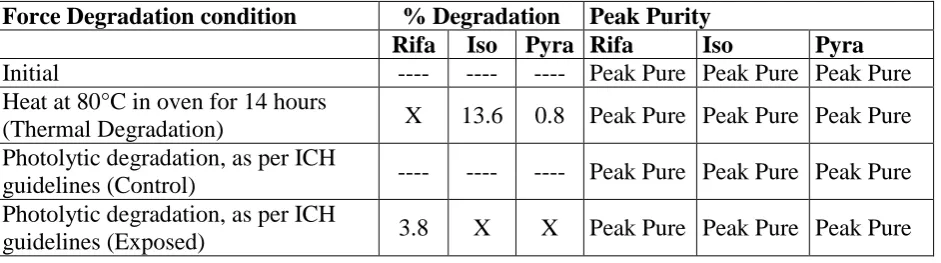
The summary of degradation given with Tabel 2. The maximum degradation was observed in
thermal degradation (Solid degradation) and acid degradation (Liquid degradation)
chromatograms of same were shown in Figure 1 & 6.
RESULTS
1.5Forced degradation study
Table 2: Forced degradation summary result for Assay method of Rifampicin,
Isoniazide and Pyrazinamide
Force Degradation condition % Degradation Peak Purity
Rifa Iso Pyra Rifa Iso Pyra
Initial ---- ---- ---- Peak Pure Peak Pure Peak Pure
Heat at 80°C in oven for 14 hours
(Thermal Degradation) X 13.6 0.8 Peak Pure Peak Pure Peak Pure
Photolytic degradation, as per ICH
guidelines (Control) ---- ---- ---- Peak Pure Peak Pure Peak Pure
Photolytic degradation, as per ICH
Thermal and Humidity at 40°C/75%
RH for 24 hours 3.4 4.9 X Peak Pure Peak Pure Peak Pure
5 mL of 0.01 M HCl heated at 40°C
for 1 hr on water bath. 0.8 8.7 4.5 Peak Pure Peak Pure Peak Pure
5 mL of 0.01 M NaOH kept at room
temperature. 5.7 X 2.6 Peak Pure Peak Pure Peak Pure
5 mL of 0.03 % H2O2 heated at 40°C
for 2 hours on water bath X 3.5 0.5 Peak Pure Peak Pure Peak Pure
Note: X indicates No degradation, Rifa indicates Rifampicin; Iso indicates Isoniazide and
Pyra indicates Pyrazinamide.
The peaks due to Rifampicin, Isoniazide and Pyrazinamide were found to the spectrally pure
in all the degradation conditions, indicating that there was no co-elution with main peaks.
Based on the above results it was concluded that the method for assay of Rifampicin,
Isoniazide and Pyrazinamide estimation in Rifampicin, Isoniazide, Pyrazinamide and
Ethambutol Hydrochloride tablets (150 mg / 75 mg / 400 mg/ 275mg) tablets was specific
and stability indicating.
5 CONCLUSION
The forced degradation study was performed on validated method for the determination of
assay of Rifampicin, Isoniazide and Pyrazinamide in Rifampicin, Isoniazide, Pyrazinamide
and Ethambutol Hydrochloride tablets (150 mg / 75 mg / 400 mg/ 275mg) and found that
method is stabilitry indicating hence concluded that the method has been suitable for its
intended use, i.e. to determine the assay of Rifampicin, Isoniazide and Pyrazinamide in
Rifampicin, Isoniazide, Pyrazinamide and Ethambutol Hydrochloride tablets (150 mg / 75 mg
/ 400 mg/ 275mg).
Figure 2: Chrmatograph of Base Degradation
Figure 3: Chrmatograph of Peroxide Degradation
Figure 5: Chrmatograph of Photo Degradation.
Figure 6: Chrmatograph of Thermal Degradation
REFERENCES
1. International Conference on the Harmonization of Technical Requirements for
Registration of Pharmaceuticals for Human Use (ICH). Validation of Analytical
Procedures:Text and Methodology Q2 (R1). (2005). Available from http://www.ich.org
2. International Conference on Harmonization (ICH) Q8(R2): Pharmaceutical Development
(August 2009).
3. International Conference on Harmonization (ICH) Q11: Development and Manufacture
of Drug Substances (Chemical Entities and Biotechnological/Biological Entities) (May
2011)
4. United States Pharmacopeia/National Formulary
General Chapter <621> Chromatography
General Chapter <1010> Analytical Data-Interpretation and Treatment
General Chapter <1224> Transfer of Analytical Procedures
General Chapter <1225> Validation of Compendial Procedures
General Chapter <1226> Verification of Compendial Procedures
5. Sudha T. et al: Stability indicating RP-HPLC method for the simultaneous estimation of
the anti-retroviral drugs and in tablet dosage forms IJBPAS, October, 2012; 1(9):
1322-1335.
6. Chirlange S., et al.: Stability Indicating HPTLC method for the Simultaneous estimation
of Rilpivirin, Isoniazide and Pyrazinamide in Bulk and Combined Pharmaceutical Dosage
Form. Journal of Advanced Drug Delivery, 2014; 1(4): 157-172.
7. ICH Harmonised Guidleine Stability Testing: Photostability Testing of New Drugs